







Abstract
This paper presents the notion of approximate orthogonality of complex fuzzy sets, which is a generalization of the existing concept. Based on the new concept, we present some basic properties of the approximate orthogonality of complex fuzzy sets. Furthermore, we discuss approximately orthogonality preserving with respect to complement, union and intersection operations of complex fuzzy sets.
Introduction
Complex fuzzy set theory introduced by Ramot et al. [17] is an increasingly popular generalization of fuzzy sets where traditional [0,1]-valued membership grades are extended to the unit disc of the complex plane. In recent years, complex fuzzy sets have been successfully used in various applications [1, 18–21].
The membership grade of a complex fuzzy set can be expressed in the form of exponent, which contains an amplitude and a phase terms. In many theoretical and application studies, both terms are considered together. For example, distance measures of complex fuzzy set in [1, 21] are defined by combining the difference between the amplitude terms and the difference between the phase terms.
As mentioned in Ramot et al. [17], the phase term of membership grade is the key feature which essentially distinguish complex fuzzy sets from traditional fuzzy sets. So some concepts and relationships in complex fuzzy theories are mostly depends on the phase term of membership grade. Dick [7] introduced the rotational invariance of operations of complex fuzzy sets. Bi et al. [2, 10] introduced the parallelity and approximate parallelity between complex fuzzy sets. Hu et al. [8] introduced the orthogonality relation of complex fuzzy sets, which is a dependency relation, i.e., is symmetric and reflexive, but is not transitive. Then they discussed orthogonality preserving with respect to various complex fuzzy operators.
However, the exact orthogonality of two complex fuzzy sets and operators which exactly preserve orthogonality restrict the potential applications of concepts of orthogonality in complex fuzzy sets. In this paper, we propose the concept of approximate orthogonality between complex fuzzy sets, which is a generalization of Hu et al.’s [8] concept. Based on the new concept, we discuss the approximately orthogonality preserving property of Ramot et al.’s [13] complex fuzzy operations.
The remainder of this paper is organized as follows. In Section 2, we review the orthogonality and orthogonality preserving operators introduced by Hu et al. [8]. The concepts of approximate parallelity of complex fuzzy sets are introduced in Section 3. Then, we discuss whether parallelity can be preserved for Ramot et al.’s [17] complex fuzzy operations in Section 4. Finally, conclusions are presented in Section 5.
Related work
Orthogonality and orthogonality preserving operators
Let X be a universe and
In this paper, we only consider the phase term of membership vector. Unless otherwise stated, we always assume that r A (x) ≠0 for all x ∈ X.
Hu et al. [8] introduced a dependency relation of complex fuzzy sets as follows,
Moreover, Hu et al. [8] introduced the concept of orthogonality preserving mappings as follows,
Then they discussed the complex fuzzy operators which exactly preserve orthogonality.
This section introduces the concept of approximate orthogonality between complex fuzzy sets. For the orthogonality relation introduced above we may define its approximate extension.
(ii) ɛ represents the degree of orthogonal between A and B, for ɛ = 0, approximate orthogonality coincides with the notion of orthogonality.
See Fig. 1 for an example, two membership vectors A and C are orthogonality, and two membership vectors A and B are ɛ-orthogonality.
Obviously, A ⊥ B is a special case of A ⊥ ɛ B in which ɛ = 0.
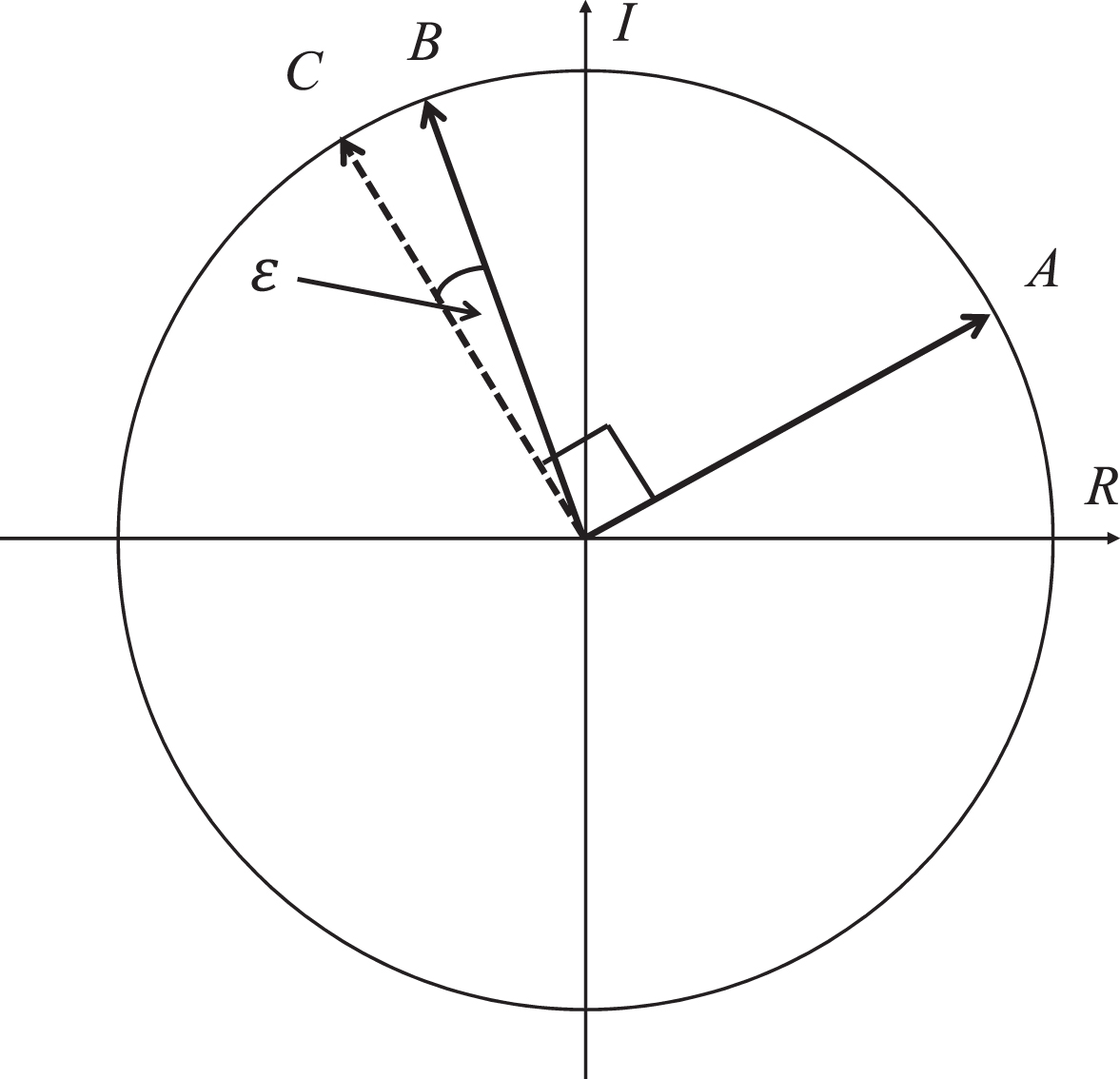
A ⊥ C and A ⊥ ɛ B.
The following basic properties hold.
A ⊥
ɛ
B if and only if B ⊥
ɛ
A
A ⊥
ɛ
1
B ⇒ A ⊥
ɛ
2
B if ɛ1 ≤ ɛ2.
In this section, we first extend the definition of orthogonality preserving operators to (ɛ, δ)-orthogonality preserving operators in the following manner.
Then we study the approximate orthogonality preserving property of Ramot et al.’s [17] complex fuzzy operations.
Set rotation and reflection operations are two complex fuzzy set operations introduced by Ramot et al. [17].
Let A ∈ CF (X), and μ A (x) = r A (x) · ejθ A (x) be its membership function.
The Rotation of A by θ radians, denoted Rot
θ
(A), is defined as
The reflection of A, denoted Ref (A), is defined as
Let A ∈ CF (X), and μ
A
(x) = r
A
(x) · ejθ
A
(x) be its membership function. The following three complex fuzzy complement are defined as follows (see [17]).
From this result, we have ¬ i A ⊥ ɛ ¬ i B (i ∈ {1, 2, 3}) from A ⊥ ɛ B.
Let A, B ∈ CF (X), μ
A
(x) = r
A
(x) · ejθ
A
(x) and μ
B
(x) = r
B
(x) · ejθ
B
(x) be their membership functions respectively. Ramot et al. [17] introduced the complex fuzzy union of A and B as follows:
The following functions are possibilities of θA⊗B.
Similarly, we can prove the case of ⊗ =-. ■
Then we have A ⊥ 0.01πB.
If ⊕ is max union function and ⊗ =+, then we have
If ⊗ =∨. Let C ≡ 0.5ej1.5π. We can verify that A ∪ C = B ∪ C.
If ⊗ =∧. Let C ≡ 0.5ej0.2π. We can verify that A ∪ C = B ∪ C.
If ⊗ =•. Let C ≡ 0.5ej0π. We can verify that A ∪ C = B ∪ C. ■
Similarly, we can prove the case of ⊗ =∧. ■
If ⊕ is max union function and ⊗ =∨, then
We can verify that A ⊥ 0.02π (B ∪ C).
If ⊗ =-. Let A ≡ 0.5e jπ , B ≡ 0.5ej1.5π+ɛ and C ≡ 0.5ej0.5π+ɛ. We can verify that A ⊥ ɛ B, A ⊥ ɛ C and A = B ∪ C. ■
Let A, B ∈ CF (X), μ
A
(x) = r
A
(x) · ejθ
A
(x) and μ
B
(x) = r
B
(x) · ejθ
B
(x) be their membership functions respectively. Ramot et al. [17] introduced the complex fuzzy intersection of A and B as follows:
In this paper, we considered a weaker orthogonality relationship, denoted by “approximate” orthogonality, and discussed approximately orthogonality preserving operators. Obviously, the new concepts proposed in the present paper are extensions of the old concepts obtained by Hu et al. [8]. The new concepts are more comprehensive than the old ones because the latter are special cases of the former respectively.
We presented some results on approximately orthogonality preserving with respect to various operators of complex fuzzy sets, which can be summarized as follows (also see Table 1)
Approximately preserve orthogonality of complex fuzzy operators
√ and × represent the corresponding property holds and does not hold respectively.
(i) A ⊥ ɛ B ⇒ A ∘ C ⊥ ɛ B ∘ C, where ⊗ ∈ {+ , -} (see Theorems 6 and 10);
(ii) A ⊥ ɛ 1 B, A ⊥ ɛ 2 C ⇒ A ⊥ max(ɛ1,ɛ2)B ∘ C, where ⊗ ∈ {∨ , ∧} (see Theorems 7 and 11).
In this paper, we only considered approximately orthogonality preserving with respect to several Ramot et al.’s complex fuzzy operations. Naturally, a more detailed discussion of other complex fuzzy operations, such as the operations proposed by Zhang et al. [21], will be necessary and interesting. Another problem we need to investigate in the future is the approximately orthogonality preserving with respect to complex fuzzy reasoning methods.
Footnotes
Acknowledgments
This project was supported by the Opening Foundation of Guangxi Colleges and Universities Key Laboratory of Complex System Optimization and Big Data Processing (Grant No. 2017CSOBDP0103).