Weakly contractive mappings in partially ordered metric space and solutions of delay interval-valued differential equations under generalized Hukuhara differentiability
Available accessResearch articleFirst published online February 16, 2019
Weakly contractive mappings in partially ordered metric space and solutions of delay interval-valued differential equations under generalized Hukuhara differentiability
In this paper, by weakly contractive mappings in partially ordered metric space, we have proved problem of existence and uniqueness solution for delay interval-valued differential equations under generalized Hukuhara differentiability (DIDEs). We give also some examples being simple illustrations of this DIDEs.
The interval-valued differential equations (IDEs) are important parts of the interval-valued analysis (see [7, 24–31]). As we have known that there are many approaches to the IDEs. In case, when modeling real-world phenomena, information about the behavior of a dynamical system is uncertain and one has to consider these uncertainties to gain better meaning of full models. The interval-valued differential equations can be used for modeling dynamical systems subject to uncertainties. The papers [21, 28] are focused on the interval-valued differential equations. These equations can be studied with a framework of the Hukuhara derivative [21]. The first method was based on Hukuhara difference notation and was further investigated by Markov [27], Moore [28] and other authors. The approach based on Hukuhara derivative [21] has the disadvantage that it leads to solutions which have an increased length of their support. Recently, Stefanini and Bede (see [31]) and Chalco-Cano (see [15]) studied IDEs under generalized Hukuhara differentiability of interval-valued functions. In this case, the derivative exists and the solution of the IDEs may have a decreasing length of the support, but the uniqueness is lost. Therefore, our point is that the generalization of the concept of Hukuhara differentiability can be of great help in the dynamic study of interval-valued differential equations. The paper of Stefanini and Bede was the starting point for the topic of interval-valued differential equations under generalized Hukuhara differentiability (can see [7, 24–26]) and this studies of the interval-valued differential equations are very beneficial to survey the fuzzy differential equations under generalized Hukuhara differentiability - FDEs (can see for example, Allahviranloo [4, 5], or Bede [13, 14]). In the papers [7, 29], we can find the studies on interval-valued differential equations under generalized Hukuhara differentiability (IDEs), i.e. the IVP for IDEs in the form:
where is understood as the classical Hukuhara derivative, then as the second type Hukuhara derivative - the generalized Hukuhara derivative. The existence and uniqueness of solution to the IVP for IDEs is obtained under an assumption that the coefficients satisfy a condition with the Lipschitz constant (see [24]). In [26], under the generalized Lipschitz condition, Malinowski obtained the existence and uniqueness of solutions to both kinds of IVP for IDEs (1.1) by the Banach fixed point theorem.
Approach and Objective
In this paper, we consider the initial valued problem for delay interval-valued differential equations under generalized Hukuhara differenytiability (IVP for DIDEs):
where is delay interval-valued process, is continuous interval-valued function and the symbol denotes the generalized Hukuhara derivative. The existence and uniqueness of solution to IVP for DIDEs (ref eq1.2) are obtained by weakly contractive mappings and by the extremal solutions in partially ordered metric space.
Outline
The paper is organized as follows. In section 2, it is devoted to the preliminaries of interval-valued analysis and interval-valued differential equations. In Section 3, we consider the weakly contractive mappings in partially ordered metric space and formulate existence and uniqueness of solution of IVP for DIDEs. In the last section, we give some examples being simple illustrations of existence and uniqueness of solution to this IVP for DIDEs.
Preliminaries and notation
Let be the family all nonempty, compact and bounded subsets of The addition and scalar multiplication in , we define as usual, i.e. for , where , and λ ≥ 0, then we have
Furthermore, let and λ3λ4 ≥ 0, then we have λ1 (λ2A) = (λ1λ2) A and (λ3 + λ4) A = λ3A + λ4A . Let as above. Then the Hausdorff metric H in is defined as follows:
It is known that is a complete, separable and locally compact metric space. We define the magnitude and the length of by
, respectively, where {0} is the zero element of , which is regarded as one point. The Hausdorff metric (2.1) satisfies the following properties:
for all and λ ∈ R.
Definition 2.1. (see [27]) Let If there exists an interval such that A = B + C, then we call C the Hukuhara difference of A and B. We denote the interval C by A ⊖ B.
Note that A ⊖ B ≠ A + (-) B . It is known that A ⊖ B exists in the case len (A) ≥ len (B) . Besides that we can see the following properties for (see [27]):
A ⊖ A = {0};
If A ⊖ B, A ⊖ C exist, then H [A⊖ B, A ⊖ C] = H [B, C] ;
If A ⊖ B, C ⊖ D exist, then H [A⊖ B, C ⊖ D] = H [A + D, B + C] ;
If A ⊖ B, A ⊖ (B + C) exist, then there exist (A ⊖ B) ⊖ C and (A⊖ B) ⊖ C = A ⊖ (B + C) ;
If A ⊖ B, A ⊖ C, C ⊖ B exist, then there exist (A ⊖ B) ⊖ (A ⊖ C) and (A ⊖ B) ⊖ (A ⊖ C) = C ⊖ B .
Definition 2.2.(see [31]) Let If there exists an interval such that
we call C the generalized Hukuhara difference of A and B. We denote the interval C by . Besides, we can see the following properties for (see [31]):
the generalized Hukuhara is unique and
where
,
if exists then exists.
,
,
if and only if C = {0} and A = B.
Definition 2.3.We say that the interval-valued mapping is continuous at the point t ∈ [t0, t0 + p] if for every ɛ > 0 there exists δ = δ (t, ɛ) >0 such that H [X (t) , X (s)] ≤ ɛ, for all s ∈ [t0, t0 + p] and |t - s| < δ .
The generalized differentiability was introduced in [31] and studied by Bede in [13, 31], by Chalco-Cano, Román-Flores, Rodrguez-Lpez, and Jimnez-Gamero in [15, 16], by Lupulescu in [24] and by Malinowski in [25, 26].
Definition 2.4. Let and t ∈ (t0, t0 + p). We say that X is generalized differentiable at t if there exists such that
for all h > 0 sufficiently small, ∃X (t + h) ⊖ X (t) , ∃ X (t) ⊖ X (t - h) and
or
for all h > 0 sufficiently small, ∃X (t) ⊖ X (t + h) , ∃ X (t - h) ⊖ X (t) and
or
for all h > 0 sufficiently small, ∃X (t + h) ⊖ X (t) , ∃ X (t - h) ⊖ X (t) and
or
for all h > 0 sufficiently small, ∃X (t) ⊖ X (t + h) , ∃ X (t) ⊖ X (t - h) and the limits
In this definition, case (Hg1)-differentiable corresponds to the classical H-derivative, so this differentiability concept is a generalization of the Hukuhara derivative. In this paper, we consider only the first two case of Definition 2.4. In the other cases, the derivative is trivial because it is reduced to a crisp element (more precisely, ). Further, we say that X is (Hg1)-differentiable or (Hg2)-differentiable on (t0, t0 + p) if it is differentiable in the sense (Hg1) or (Hg2) of Definition 2.4, respectively.
Corollary 2.1. Let p > 0 . Assume that is continuous. The interval-valued function X (t) is equivalent to one of the following integral equations:
if X is (Hg1)-differentiable, and
if X is (Hg2)-differentiable, provided that the H-difference exists.
Corollary 2.2. Let we denote with t ∈ [t0, t0 + p], where
If the mapping X is (Hg1)-differentiable (i.e. classical Hukuhara differentiable) at t ∈ [t0, t0 + p], then the real-valued functions and are differentiable at t and
If the mapping X is (Hg2)-differentiable at t ∈ [t0, t0 + p], then the real-valued functions and are differentiable at t and
Definition 2.6. [19] We say that the real function ψ : [0, + ∞) → [0, + ∞) is distance translation function if it is a continuous increasing function and ψ (0) =0 only when t = 0 .
Definition 2.7. [19] The real function f : (ℵ , d) → (ℵ , d) in complete metric space is called a weakly contractive mapping if existence the distance translation functions ψ, γ : [0, + ∞) → [0, + ∞) such that satisfies:
Theorem 2.1. Assume that the real continuous function f : (ℵ , d) → (ℵ , d) in complete metric space satisfies:
with ψ, γ are distance translation functions and
if exists x0∈ ℵ such that x0 ≤ f (x0) then x0 = f (x0), that means x0 is fixed point
Theorem 2.2. In addition to the assumptions in Theorem 2.1, suppose that f :ℵ → ℵ is a not decreasing monotonic function in metric space ℵ. If the sequence (xk) k∈N does not increase and convergence
or f :ℵ → ℵ is continuous, then if exists x0∈ ℵ such that x0 ≤ f (x0) then x0 = f (x0), that means x0 is fixed point.
Corollary 2.4. Assume that the real continuous function f : (ℵ , d) → (ℵ , d) in partially ordered complete metric space ℵ satisfies conditions in Theorem 2.1, Theorem 2.2 and
then x0 is uniqueness fixed point.
The initial valued problems for delay interval-valued differential equations (IVP for DIDEs) under generalized Hukuhara differentiability
Definition 3.1. In we consider the initial valued problems for delay interval-valued differential equations (IVP for DIDEs) under generalized Hukuhara differentiability:
where for σ > 0, p > 0, let denote the space of continuous mappings from [t0 - σ, t0] to the function In addition, we denote J = [t0 - σ, t0] ∪ [t0, t0 + p] = [t0 - σ, t + p]
Lemma 3.1. Assume that is a local solution of (3.1) on [t0, t0 + p] then it is expressed as interval-valued integral equations as follows:
if is (Hg1)-differentiable and
if is (Hg2)-differentiable.
Proof. It is obtained by the generalized Hukuhara diffrfrentiability (Hg1) and (Hg2) of interval-valued function For example, for the case, when interval-valued function is (Hg2)-differentiable, then is integrable and
from 3.1, we get
with Xt0 (τ) = φ (t0 - τ) = φ0, t0 - τ ≤ t0 ≤ t .
Definition 3.2. Let X (t) is a solution of the initial valued problems for delay interval-valued differential equations (IVP for DIDEs) under generalized Hukuhara differentiability. From Lemma 3.1, a/ if X (t) is (Hg1)-differentiable then X (t) is a solution of interval-valued integral equation:
b/ if X (t) is (Hg2)-differentiable then X (t) is a solution of interval-valued integral equation:
Definition 3.3. With p > 0, σ > 0 assume that , we denote a metric:
Definition 3.4. The local solution of IVP for DIDEs (3.1) is unique on [t0 - σ, t0 + p] if for any the other solution satisfies H [X (t) , Y (t)] = 0 on [t0 - σ, t0 + p] .
Definition 3.5. Let we denote a metric:
Definition 3.6. Assume that , we denote metric:
Definition 3.7. Assume that , we denote new metric:
Corollary 3.1. For all we have
and
Proof. We have these results from Definition 3.7
The weakly contractive mappings in partially ordered metric space and existence of a unique delay solution
Definition 3.8. The interval-valued functions are called partially ordered X ⪯ Y or (X≥Y) , if and only if satisfies one of the followings:
X ⪯ Y if
X ⪰Y if
with metric between two interval-valued functions denoted by
where
Definition 3.9. We denote distance translation function for the functions ψ, γ : [0, + ∞) → [0, + ∞) by
Remark. The real functions ψ (HC [X, Y]) and γ (Hσ [X, Y]) are the distance translation functions because ψ, γ : [0, + ∞) → [0, + ∞) in Definition 3.9 are two continuous increasing function and ψ (0) =0, γ (0) =0 only when HC [X, Y] =0, Hσ [X, Y] =0 .
Theorem 3.1. Assume that and F (t, A, B) is monotone increasing interval-valued function with t ∈ [t0, t0 + p] such that if A≥C and B≥D then F (t, A, B)≥F (t, C, D) . Furthermore, F (t, A, B) is a weakly contractive mapping in partially ordered metric space such that satisfies:
where ψ and γ are distance translation functions in Definition 2.6 and Definition 3.3 for interval-valued function F (t, A, B) then:
H [F (t, X (t) , Xt) , F (t, Y (t) , Yt)] ≤ L (HC [X (t) , Y (t)] + Hσ [Xt, Yt]) ,
the delay interval-valued differential equations under generalized Hukuhara differentiability - DIDEs (3.1) has a unique solution on [t0 - σ, t0 + p] .
Proof. a/ if the interval-valued functions X and Y belong to . We have:
then for every X ⪰ Y on [t0 - σ, t0 + p] . We have
Assume that the formula a/ is wrong then for X ⪰ Y on [t0 - σ, t0 + p] that means:
such that implies
From (*) we have ψ (HC [X (t) , Y (t)]) + ψ (Hσ [Xt, Yt]) = ψ (H [F (t, X (t) , Xt) , F (t, Y (t) , Yt)]) for every X ⪰ Y . From (*) and 0 ≤ - γ (HC [X (t) , Y (t)]) - γ (Hσ [Xt, Yt]) , implies that
If γ is a distance translation function by Definition 3.9, then we have H [X (t) , Y (t)] = H [Xt, Yt] =0 for all X ⪰ Y, that implies H [F (t, X (t) , Xt) , F (t, Y (t) , Yt)] =0 and
what contradicts the notion of distance change function ψ, γ . Finally, we have H [F (t, X (t) , Xt) , F (t, Y (t) , Yt)] ≤ L (HC [X (t) , Y (t)] + Hσ [Xt, Yt]) .
b/ if the interval-valued functions X and Y belong to . We prove that (3.1) exists the unique solution.
Putting we denote a operator which is
Choosing Y ⪰ X on [t0 - σ, t0 + p] (Ys ⪰ Xs, ∀ s ∈ [t0, t0 + p]) such that for all t ∈ [t0 - σ, t0] , we have then with Y ⪰ X on [t0 - σ, t0 + p] , implies that operator is not decreased. On the other hand, we have
for all X ⪰ Y on [t0 - σ, t0] . We consider all X ⪰ Y on [t0, t0 + p] :
With L > 0, we have the operator is contractive that means exists a fixed point in thus the delay interval-valued differential equations under generalized Hukuhara differentiability - DIDEs (3.1) has a unique solution on [t0 - σ, t0 + p] .
Existence and uniqueness of solution by the extremal solutions and the weakly contractive mappings in partially ordered metric space
Definition 3.10. The monotone increasing interval-valued functions with is called a lower solution on [t0, t0 + p] to IVP for DIDEs (3.1) if and only if it is
where ξ (t0 - τ) ∈ Cσ, t0 ≥ τ ≥ t0 - σ .
Definition 3.11.The monotone increasing interval-valued functions with is called a upper solution on [t0, t0 + p] to IVP for DIDEs (3.1), if and only if it is
where ξ (t0 - τ) ∈ Cσ, t0 ≥ τ ≥ t0 - σ .
Remark 3.1. We can repeat this proof for the case, when existence a upper solution XU (t) on [t0, t0 + p] with monotone then we prove that
Definition 3.12. The interval-value function with monotone is the lower solution of IVP for DIDEs (3.1) if
where ξ (t0 - τ) ∈ Cσ, t0 ≥ τ ≥ t0 - σ .
Definition 3.13. The interval-value function with monotone is the upper solution of IVP for DIDEs (3.1), if:
where ξ (t0 - τ) ∈ Cσ, t0 ≥ τ ≥ t0 - σ .
Theorem 3.2 Assume that and F (t, A, B) is monotone increasing interval-valued functions on t ∈ [t0, t0 + p] such that if A ⪰ C and B ⪰ D then F (t, A, B) ⪰ F (t, C, D) . Furthermore, F (t, A, B) is weakly contractive mapping in partially ordered metric space and hold the followings:
if existence a (Hg1) lower and a (Hg1) upper solutions: on [t0, t0 + p] with monotone ;
or if existence a (Hg2) lower and a (Hg2) upper solutions: on [t0, t0 + p] with monotone ,
then the delay interval-valued differential equations under generalized Hukuhara differentiability - DIDEs (3.1) has a unique solution on [t0 - σ, t0 + p] that it is one of the type in (3.2)-(3.3).
Proof. It is obtained by generalized Hukuhara diffrfrentiability (Hg1) and (Hg2) of interval-valued function For example, we consider condition (A2) for the case, when interval-valued function is (Hg2)-differentiable then is integrable and
and by Lemma 3.1 it becomes
with Xt0 (τ) = φ (t0 - τ) = φ0, t0 ≥ τ ≥ t0 - σ .
Similarly to prove Theorem 3.1, putting
which is
such that exists a generalized Hukuhara difference on [t0, t0 + p] . If we have Y ⪯ Z, we obtain:
implies that operator is not decreased. By condition (*), we have
Because Y ⪯ X, then Hk [Y, Z] and implies
where
Finally, we have existence of extremal (Hg2)-solution:
It implies that and is weakly contractive mapping in partially ordered metric space that means exists a fixed point Y and it is an unique solution (Hg2) of DIDEs (3.1).
Illustrations
Example 4.1. we consider the initial valued problem for delay interval-valued differential equation under generalized Hukuhara differentialbility (IVP for DIDEs):
In this example, we solve the Problem (4.1) on [0, 1].
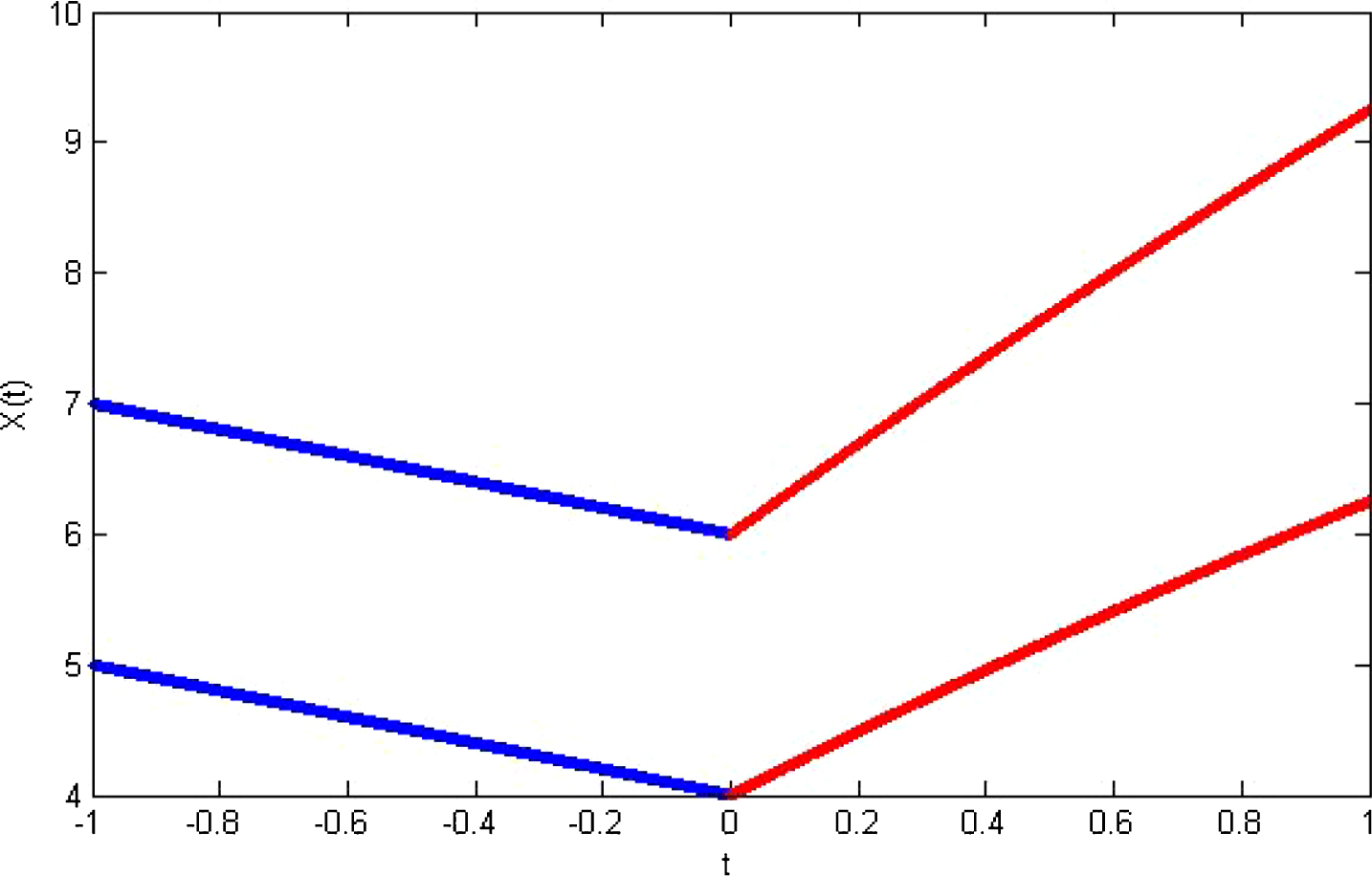
a/ Case 1, by detailed calculation, we get a solution, which is (Hg1)-differentiable, of problem (4.1) on [0, 1],
with Xt0 (τ) = [4 - τ, 6 - τ] , τ ∈ [0, 1] and its the picture illustrations presented in Fig. 1.
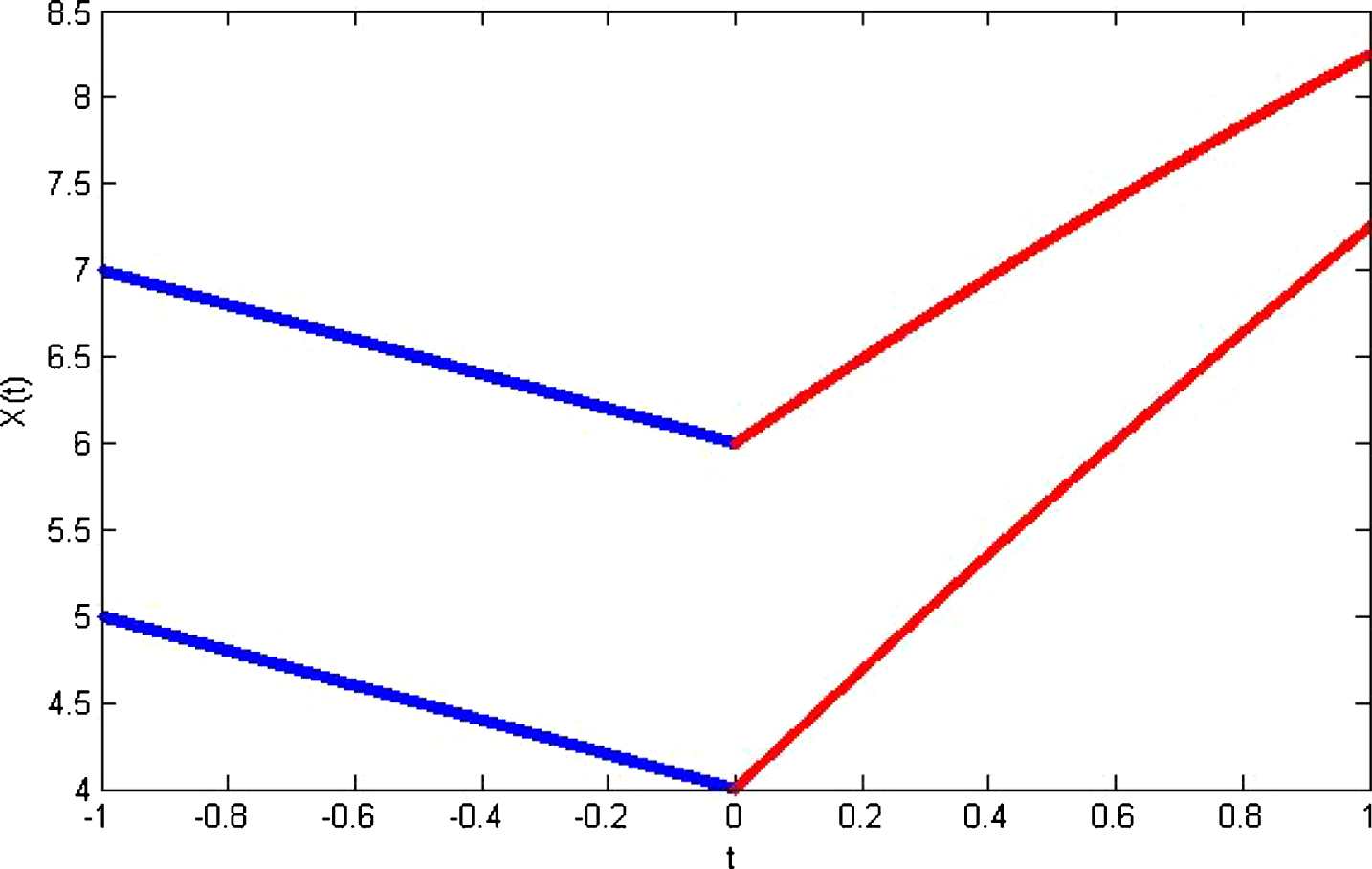
b/ Case 2, we get a solution, which is (Hg2)-differentiable, of problem (4.1) on [0, 1],
with Xt0 (τ) = [4 - τ, 6 - τ] , τ ∈ [0, 1] and its the picture illustrations presented in Fig. 2.
(Hg1)-solution to IVP for DIDEs (4.1) (when τ = 1, λ = 0, 5, t ∈ [-1, 1]).
(Hg2)-solution to IVP for DIDEs (4.1) (when τ = 1, λ = 0.5, t ∈ [-1, 1]).
Example 4.2. we consider the initial valued problem for delay interval-valued differential equation under generalized Hukuhara differentialbility (IVP for DIDEs):
For ease of calculation for this example, we give τ = 1 and t0 = 0 in the problem (4.2). Then the problem is rewritten as follows
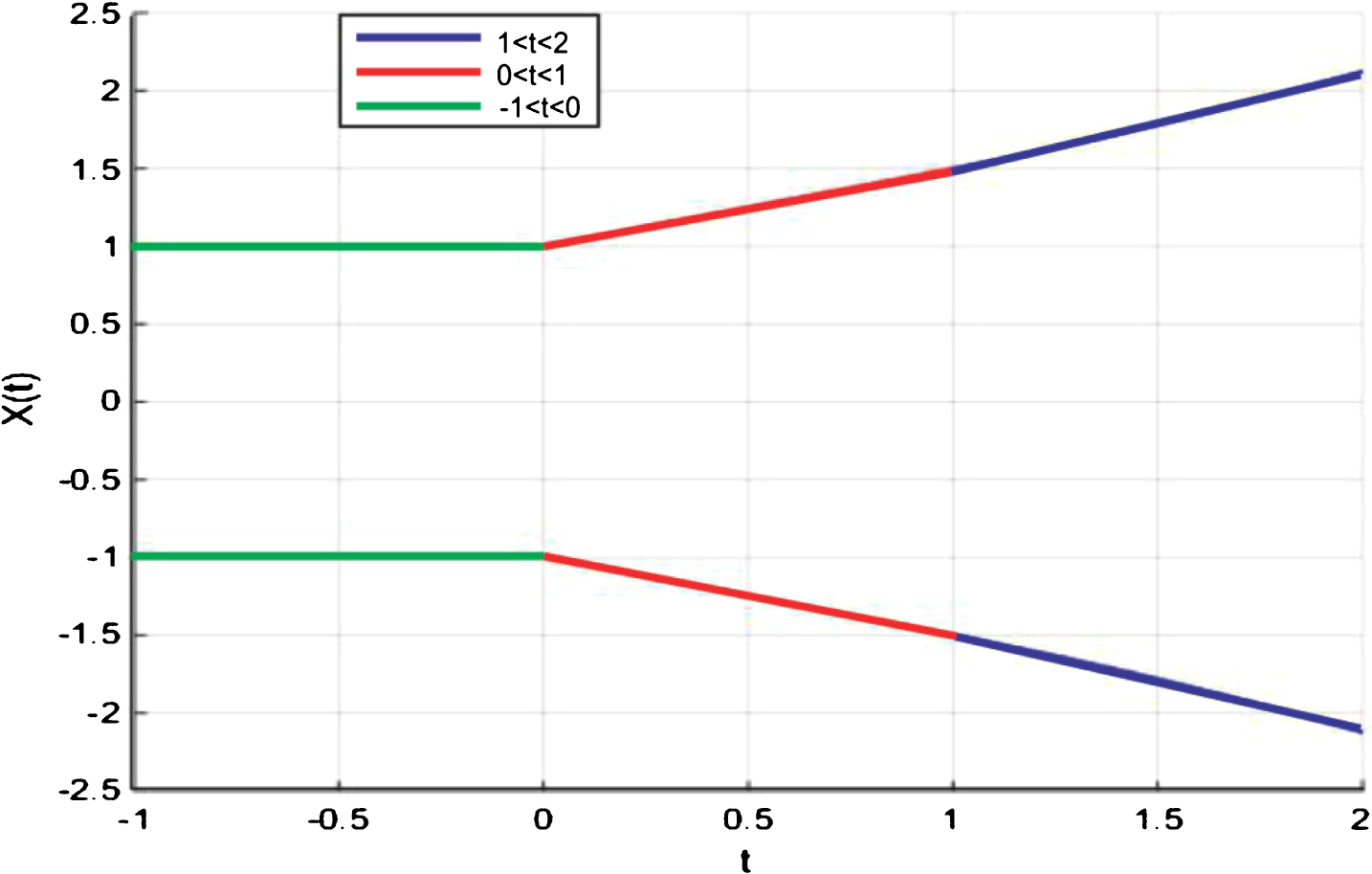
a/Case 1, when coefficient λ < 0 : A solution of problem (4.3) is interval-valued function, which is (Hg1)-differentiable. We find the (Hg1)-solution with delay condition X (0) = [-1, 1] , λ < 0 is
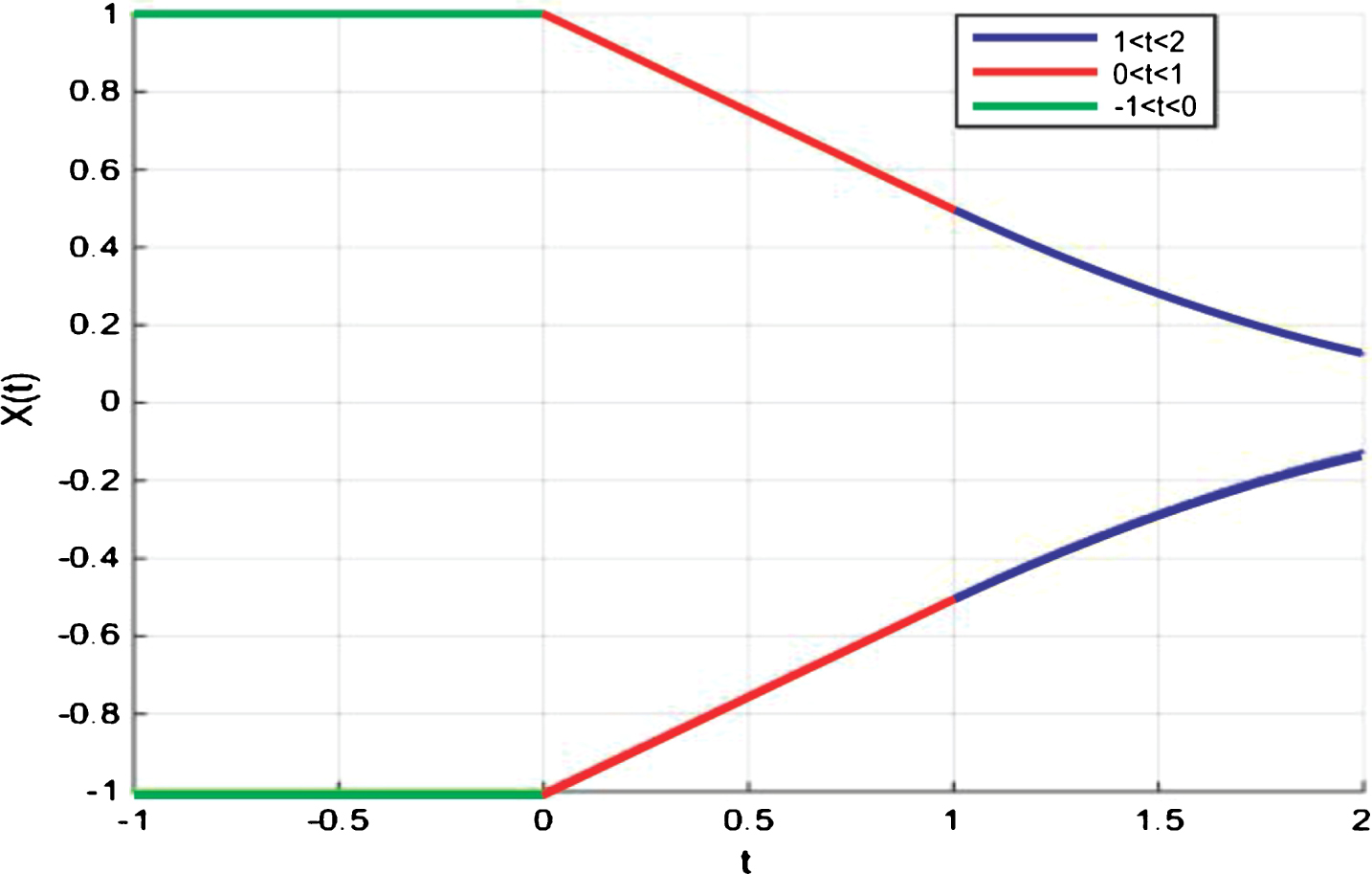
its the picture illustrations presented in Fig. 3 (with τ = 1, λ = -1). b/Case 2, when coefficient λ > 0 : A solution of problem (4.3) is interval-valued function, which is Hg2-differentiable. We find the Hg2-solution with delay condition X (0) = [-1, 1] , λ < 0 is
its the picture illustrations presented in Fig. 4 (with τ = λ = 1).
(Hg1)-solution to IVP for DIDEs (4.3) (with τ = 1, λ = -1, t0 = 0, t ∈ [-1, 2]).
(Hg2)-solution to IVP for DIDEs (4.3) (when τ = λ = 1, t0 = 0, t ∈ [-1, 2]).
Conclusion
There is always a close relationship between the class of the fuzzy differential equations (FDEs) - the fuzzy systems (FSs) and interval-valued differential equations (IDEs), so the mathematicians draw the attention to study the class of IDEs. The initial valued problem for delay interval-valued differential equations under generalized Hukuhara differentiability (IVP for DIDEs) (3.1) is very most different from IVP for interval-valued differential equations under generalized Hukuhara differentiability (IVP for IDEs) (1.1). This paper presented developed the concept of partially ordered metric space of interval-valued functions and the weakly contractive mappings in partially ordered metric space. The existence and uniqueness of the solution to IVP for DIDEs (1.2) are obtained by weakly contractive mappings and by the extremal solutions in partially ordered metric space.
Footnotes
Acknowledgements
The authors would like to express their gratitude to the anonymous referees for their helpful comments and suggestions.
References
1.
B.AhmadSivasundaramS., The monotone iterative technique for impulsive hybrid set valued integro-differential equations, Nonlinear Anal65 (2006), 2260–2276.
2.
R.P.Agarwal, S.Arshad, O’ReganD. and LupulescuV., A Schauder fixed point theorem in semilinear spaces and applications, Fixed Point Theory and Applications2013 (2013), 306.
3.
R.P.Agarwal, O’ReganD. and LakshmikanthamV., A stacking theorem approach for fuzzy differential equations, Nonlinear Analysis (TMA)55 (2003), 299–312.
4.
T.Allahviranloo, N.A.Kiani and MotamediN., Solving fuzzy differential equations by differential transformation method, Information Sciences179 (2009), 956–966.
5.
T.Allahviranloo, A.Amirteimoori, M.Khezerloo and KhezerlooS., A new method for solving fuzzy volterra integro-differential equations, Australian Journal of Basic and Applied Sciences5(4) (2011), 154–164.
6.
T.Allahviranloo, Z.Gouyandeh, A.Armand and HasanogluA., Onfuzzy solutions for heat equation based on generalized Hukuhara differentiability, Fuzzy Sets and Systems265 (2015), 1–23.
7.
T.V.An, N.V.Hoa and PhuN.D., Global existence of solutions for interval-valued integro-differential equations under generalized H-differentiability, Advances in Difference Equations (2013), 21710.1186/1687-1847-2013-217.
8.
T.V.An, N.D.Phu and HoaN.V., A note on solutions of interval-valued Volterra integral equations, Journal of Integral Equations and Applications26 (2014), 1–14.
9.
M.Chehlabi and AllahviranlooT., Positive or negative solutions to first-order fully fuzzy linear differential equations under generalized differentiability, Applied Soft Computing (2018). 10.1016/j.asoc.2018.05.040.
10.
M.Chehlabi and AllahviranlooT., Concreted solutions to fuzzy linear fractional differential equations, Applied Soft Computing44 (2016), 108–11610.1016/j.asoc.2016.03.011.
11.
T.G.Bhaskar and LakshmikanthamV., Set differential equations and Flow invariance, J Appl Analy82 (2003), 357–368.
12.
T.G.Bhaskar and DeviJ.V., Stability criteria in set differential equations, Math Comput Modelling41 (2005), 1371–1378.
13.
B.Bede and GalS.G., Generalizations of the differentiability of fuzzy-number-valued functions with applications to fuzzy differential equations, Fuzzy Sets and Systems151 (2005), 581–599.
14.
B.Bede, I.J.Rudas and BencsikA.L., First order linear fuzzy differential equations under generalized differentiability, Information Sciences177 (2007), 1648–1662.
15.
Y.Chalco-Cano, A.RufiáN-Lizana, H.RomáNFlores, M.D.JiméNez-Gamero, Calculus for interval-valued functions using generalized hukuhara derivative and applications, Fuzzy Sets and Systems219 (2013), 49–67.
16.
Y.Chalco-Cano, R.Rodrguez-Lpez, M.D.Jimnez-Gamero, Characterizations of generalized differentiable fuzzy functions, Fuzzy Sets and Systems295 (2016), 37–56.
17.
J.V.Devi, Generalized monotone iterative technique for set differential equations involving causal operators with memory, Int J Adv Eng Sci Appl Math (2011) 10.1007/s12572-011-0031-1.
18.
HaleJ.K., Theory of Functional Differential Equations, Springer, NewYork, 1977.
19.
J.Harjani and SadaranganiK., Generalized contractions in partially ordered metric spaces and applications to ordinary differential equations, Nonlinear Analysis72 (2010), 1188–1197.
20.
N.V.Hoa and PhuN.D., Fuzzy functional integro-differential equations under generalized H-differentiability, Journal of Intelligent and Fuzzy Systems26 (2014), 2073–2085.
21.
HukuharaM., Inteǵration des applications mesurables dont la valeur est un compact convex, Funkcial Ekvac10 (1967), 205–229.
22.
V.Lakshmikantham, T.G.Bhaskar and DeviJ.V., Theory of set differential equations in metric spaces, Cambridge Scientific Publisher, UK, 2006.
23.
V.Lakshmikantham and TolstonogovA.A., Existence and interrelation between set and fuzzy differential equations, J Nonlinear Analysis (TMA)55 (2003), 255–268.
24.
V.Lupulescu, Hukuhara differentiability of interval-valued functions and interval differential equations on time scales, Information Sciences248 (2013), 50–67.
25.
M.T.Malinowski, Interval differential equations with a second type Hukuhara derivative, J Applied Mathematics Letters24 (2011), 2118–2123.
26.
M.T.Malinowski, Interval Cauchy problem with a second type Hukuhara derivative, Information Sciences213 (2012), 94–105.
27.
S.Markov, Calculus for interval functions of a real variable, Computing22 (1979), 325–337.
N.D.Phu, T.V.An, N.V.Hoa and HienN.T., Interval-valued functional di_erential equations under dissipative conditions, J Advances in Difference Equations2014 (2014), 198.
30.
L.T.Quang, N.V.Hoa, N.D.Phu and TungT.T., Existence of extremal solutions for interval-valued functional integro - differential equations, Journal of Intelligent and Fuzzy Systems30 (2016), 3495–3512.
31.
L.Stefanini and BedeB., Generalized Hukuhara differentiability of interval-valued functions and interval differential equations, Nonlinear Analysis71 (2009), 1311–1328.