






Abstract
Information about customers, products, and suppliers has become an essential resource for firms. Information and communication technologies (ICTs) contribute in different ways to the operation of firms, in terms of access to information, improvements to the business model, adequate knowledge management, and reduction of risks and costs, all of which can affect economic performance. The present study focuses on new technology-based firms (NTBFs), using a Mamdani fuzzy inference system with five inputs and five outputs, to assess the impact that ICTs have on economic performance, applying the reasoning of fuzzy logic. For the construction of the fuzzy inference system, a database of NTBFs founder-promoters was used. Information about ICTs (use of internet technologies, collaboration technologies, management technologies, support for decision-making and, search and data management) and measures of economic performance (sales, net profit, profitability, productivity and improvement of production costs) were extracted from the database for use in developing the model, which begins with definitions of the relationships between the input and output variables. The analyses performed indicated a slight change in economic performance through the interaction between ICTs measures. These findings will help firms make better decisions regarding the implementation of ICT infrastructure, allowing them to improve their economic performance.
Keywords
Introduction
The constant and rapid advancement of technology in today’s world is a challenge for firms, which are expected to have incorporated the latest technological advances into their processes, products, and services. Firms must have the ability to acquire, combine, reconfigure, mobilize and continuously expand technological resources due to the dynamic environment in which they operate, as a means of improving their performances [37].
Information and communications technologies (ICTs) are key to optimizing the scope, speed of transfer, and transformation of knowledge in systems oriented toward a firm’s interests [31, 36]. ICTs are resources (computers, software, databases, applications, etc.) that enable improvements in the treatment of information by a firm, making a positive impact on planning and execution processes and producing automated controls for the optimization of goods and services [3].
ICTs contribute in various ways to the operation of firms, including access to information, improvements to the business model, adequate knowledge management, and reduction of risks and costs. Similarly, the adoption of the internet requires new organizational practices, such as the proper use and management of technologies, as well as the development of capacities to understand this environment [30].
ICTs are elements that permit the acquisition, storage, and distribution of knowledge and the ability to sustain the wealth, content, and context of updated information in order to feed continuous processes that favor innovation capability. These technologies also allow workers and managers to make decisions more effectively [23] as they seek to expand the scope and improve the speed of knowledge transfer, enabling the extraction and structuring of knowledge pertaining to a person or group for subsequent use at all levels of the firm [41].
On the other hand, ICTs are particularly relevant to NTBFs since information systems are part of their structure [14], and become unifying mechanisms for new and existing internal and external knowledge [13]. NTBFs base their activities on new scientific or technological discoveries for the development of innovations. These firms represent the current practice of transferring and commercializing research results, making a significant contribution to researchers and society in general [12]. However, the market segments at which NTBFs are targeted have not yet achieved sufficient maturity in most cases, so the environment in which they operate is highly dynamic, with a high proportion of new entrants as well as disappearances, mergers, and acquisitions of other firms [14]. Understanding how ICTs impact firms’ economic performance is a question that interests to researchers, managers, and policymakers [29, 32]. The relationship between the use and exploitation of ICTs and a firm’s economic performance has been studied since the 1990 s, through financial indicators that include sales growth, net profit, profitability, productivity, and improved cost of production, all of which will be considered in this study [24, 35].
The availability of ICT infrastructure and the use of mobile technology resources such as computers, internet (broadband, fiber optic), and, inversely, the price of the internet, are recognized as factors that have a significant and positive impact on a firm’s economic performance. These results translate into sales, growth, productivity, and net profit [3, 33].
Moreover, it has been shown that different forms of ICT development and usage involving collaborative technologies, the internet, management and search and data management show a positive relationship with economic performance, compliance, and strategic projection, as well as with improving firms’ competitive position [12, 39].
With regard to the methodology employed in this study, fuzzy inference is used. The fuzzy set theory provides a mathematical framework that allows us to deal with the inaccuracy and uncertainty of the information provided by humans—and thus constitutes a suitable tool to translate a set of linguistic rules into mathematical terms. This theory is increasingly used in systems that use the information provided by humans and has produced excellent results across a variety of applications [7, 18]. Fuzzy set theory, when used in conjunction with logical concepts, results in so-called fuzzy inference systems [8, 42].
Based on the above, the objective of the study is to analyze the effects of ICTs on the economic performance of NTBFs. This objective helps to establish the following research questions: Which measures of economic performance is favored by the direct influence of the ICTs? Which ICT measures used had the most significant impact on economic performance?
The findings indicate that the interactions between the various ICTs have effects on each of the five measures of economic performance. In decreasing order of importance, these are: (1) management technologies; (2) support for decision-making; (3) search and data management; (4) use of internet technologies; and (5) collaboration technologies. These results will help managers and directors of NTBFs to adequately implement ICTs and improve their economic performance in the short term, maximizing internal processes so that the development of innovations is faster and more dynamic. Among the most important limitations of the study are the small sample size and the nature of the firms. However, the sample size proved to be of sufficient statistical power for the statistical analysis carried out, and the technological orientation of the firms will help in extrapolating the results to other non-technological sectors or those in which technology is little-used.
The article is organized as follows: Section 2 performs a theoretical review of each of the study variables and the relationship between them. Section 3 presents the methodology used to achieve the study objective. Section 4 sets out the results of the exploratory factor analysis and Mamdani’s fuzzy inference method. Section 5 discusses the main results obtained, comparing them with previous studies and pointing out the most important limitations and practical implications. The last section contains the conclusions and challenges for future studies.
Literature review
ICTs provide the possibility for firms to acquire, develop, combine, and configure various technologies to support and improve business strategies and workflows, which is critical for enhancing business value and competitive advantage [31, 44].
The successful use of tools and technologies in the development of a firm’s organizational capacities depends on its information-processing and decision-making capacities, which become more relevant when the management of these technologies requires a greater degree of theoretical and practical knowledge. Therefore, tools and technologies are not characteristic of organizational capacities but only acquire meaning through people, who are responsible for operating the instruments [13].
The first studies on the effect that ICTs have on the performance of firms found a non-significant relationship between them. However, research from the beginning of this contradicts these results, probably because the initial studies contained biases related to measurement errors and the still basic capacity of firms to manage technological resources [12].
Some studies carried out in developed countries, where ICTs tend to be connected across all processes, found no significant relationship between ICTs and a firm’s performance, whereas in emerging countries ICTs could continue to present a strong competitive advantage. Of 141 studies published between 1990 and 2017, 37% were published in Europe and 32% in the Americas, primarily the United States, with few studies existing at the Latin American level [32].
At the macro level, ICTs have a positive influence on national economic growth [29]. In Mexico, it was found that the use of mobile phones has a positive influence on economic growth. The use of mobile phones is directly related to the use of computers, the internet and fiber optics, and inversely to the price of the internet [29]. Another study evaluated the impact of ICTs on economic growth in African developing countries between 2007 and 2016, finding that mobile phones, internet use, and broadband adoption boosted economic growth [33]. In a study of eleven geographic regions worldwide, it was found that the use of websites improves the performance of industry, although not significantly, with financial factors having the greatest influence on performance [3]. Other researchers measured the impact of ICTs on economic growth in European Union countries. The results indicated a positive and strong effect, cellphone subscriptions being the ICT infrastructure that had the greatest impact [6].
On the other hand, a critical review of more than 50 articles focusing on the relationship between ICTs and productivity shows that ICTs do indeed have an impact on productivity growth, both at the macro level, (the United States and industries) and the micro-level (individual firms) [23]. Another study, of Peruvian micro and small manufacturing firms between 2011 and 2013, found that the adoption of the internet increases the labor productivity of firms, in addition to offering other benefits at the macro and micro (job creation and economic growth) levels [30].
In a study of Ecuadorian firms [12], it was observed that ICT components (internet, website, e-mail, fax, and telephone) improved sales by 73% and profits by 48% for around 11,000 industrial firms in that country. The authors found that the internet is the factor that contributes the most to the improvement in the competitiveness of firms. Another group of researchers conducted a study of more than 300 US-based firms, concluding that ICTs oriented toward strategy and investments affect a firm’s profitability and market value. In turn, ICTs oriented toward strategy moderate the relationship between ICT investments and firm performance (revenue growth or cost reduction) [39]. Finally, in a study drawing on a sample of 102 Colombian manufacturing and service firms, the authors observed that ICTs positively influenced economic performance by 33%, and that this relationship is enhanced by the mediation of absorptive capacity [37].
Methodology
Participants
Sampling in this study is non-probabilistic and intentional. To obtain an optimal sample size, an a priori statistical power analysis was performed. Statistical power refers to the probability of detecting an effect when it exists [25], and is a widely used procedure in applied research at the organizational level to calculate the minimum sample size necessary for a study [2, 40].
The analysis was performed with G*Power 3.1.9.6 [4]. The input parameters set to obtain a minimum sample size were as follows: significance level equal to 0.05 (two-tailed), expected statistical power of 0.80 (minimum required), expected effect size (coefficient of determination) equal to 0.09, and the correlation in null hypothesis equal to 0. The minimum recommended sample size was 84 (Fig. 1). Figure 1 indicates the statistical power that the study achieves with a specific sample size. The final sample was 102 NTBFs, located in incubators and science and technology parks in Colombia.
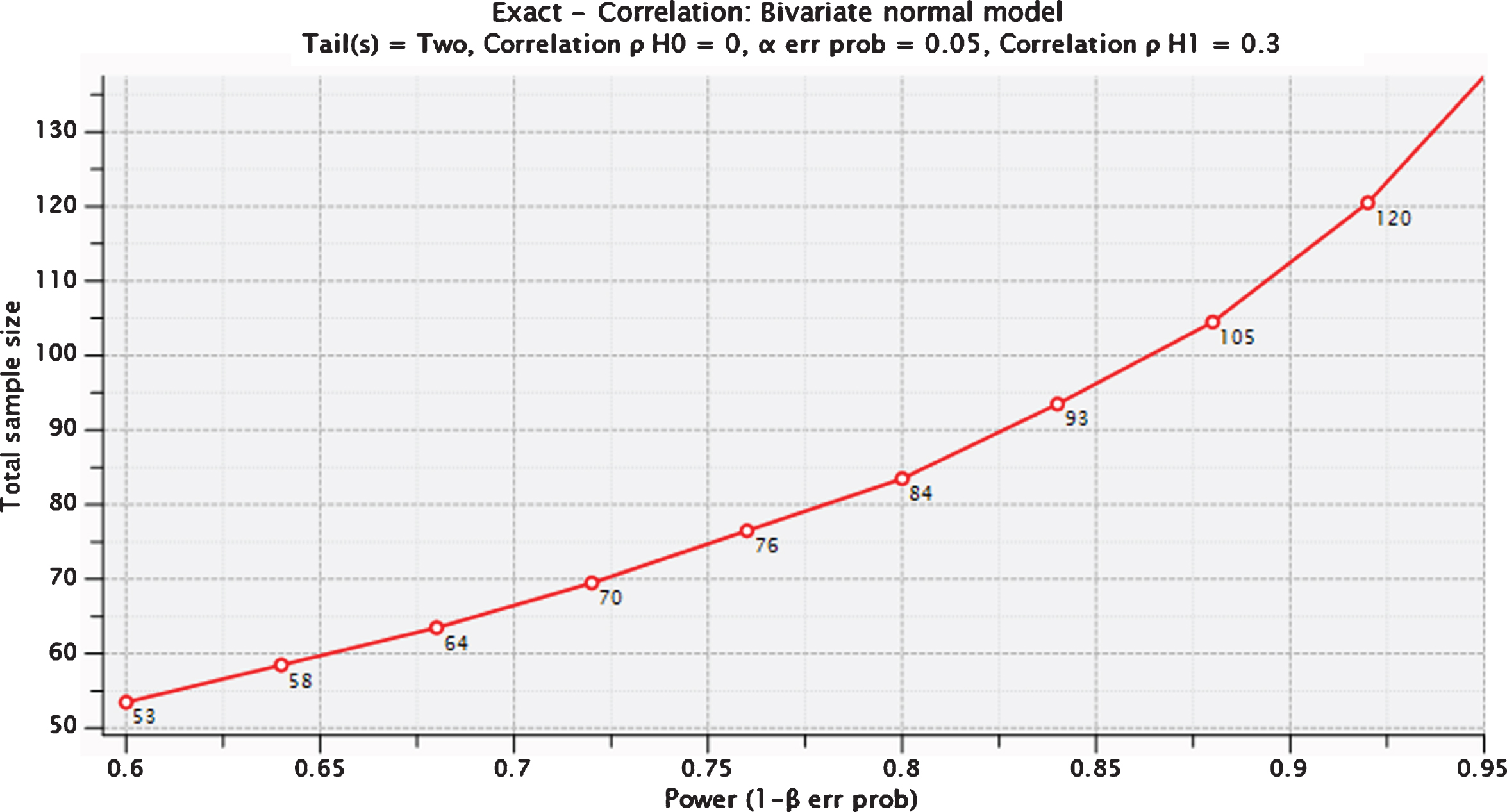
Minimum recommended simple size based on a priori statistical power.
The following sectors were selected: ICT and electronics; environment and renewable energies; biological and health sciences, biotechnology and chemistry; nanotechnology, new materials and engineering; and the creative industry. These sectors were selected because the firms of which they are comprised meet all the characteristics of NTBFs; that is to say, they are at the forefront of knowledge, were created no more than 25 years ago, and base their work on the exploitation of an invention or exploration of technological innovation [11, 15].
These NTBFs are micro-enterprises (with fewer than ten staff members) or small firms (with fewer than 50 staff members) oriented toward the exploitation of an invention or a technological innovation, and a high proportion of whose workforce is skilled [1]. As to the characteristics of the 102 NTBFs, 64% belonged to the ICT and electronics sector, 38% were based in the city of Cali and 74% were consolidated firms.
For the measurement of the two variables, ICTs and economic performance, the scale developed by [22] was used, which measures different organizational variables within the NTBFs. Only the items corresponding to ICTs and economic performance were selected. The measurement scale is self-reporting and was answered online through the Google Forms tool.
The measurement scale is composed of three parts. The first part refers to general information about the firm (activity sector, localization, phase of the firm, among others). The second part evaluates five items related to ICTs through a five-point Likert scale (almost nothing, little, sometimes, many times, and usually). In these items, participants were asked to indicate how often the firm has and uses internet technologies, collaboration technologies, management technologies, support for decision-making, and search and data management. Finally, in the third part, economic performance was evaluated through five items, again using a five-point Likert scale (very negative, from – 10% to – 20%; negative, from – 1% to – 9%; stable; positive, from 1% to 9%; and very positive, from 10% to 20%). In this section, participants were asked state the results of the 2018 economic evolution of based on the previous year’s results across five measures of economic performance (sales, net profit, profitability, productivity, and improvement of production costs).
This instrument has been utilized in previous studies and has presented adequate psychometric properties (reliability and validity) that assure its proper functioning in NTBFs [19, 21,22]. Therefore, its use was considered appropriate for the present study.
Procedure
The list of 316 NTBFs (target population) was obtained from directories of business incubators and technology parks involved in the Colombian Network of Technology Parks, Incubators and Innovation Territories in 2018. This network seeks to promote innovation based on scientific and technological knowledge in order to contribute to business productivity and regional competitiveness. It is overseen by the Administrative Department of Science, Technology, and Innovation (Colciencias), from which contact information for the NTBFs was obtained.
The measurement scale was provided via e-mail to the founder-promoter of each of the 316 NTBFs. Responses were collected between September and December 2018. A response rate of 32% was obtained; that is to say, 102 firms responded to the scale formulated. Because a computerized measurement scale was used, the responses were tabulated automatically as the participants responded to the scale.
Data analysis
The workflow focused on two stages. First, to validate the “ICTs and economic performance” constructs, Exploratory Factor Analysis (EFA) was utilized. The adequacy of Pearson’s correlation matrix to the EFA was analyzed using the Kaiser-Meyer-Olkin or KMO index and Bartlett’s Sphericity test. In the EFA, Unweighted Least Squares (ULS) was employed in two cases as a factorial extraction method. As criteria for the retention of factors, three methods were utilized: the Kaiser-Gutman rule or eigenvalues greater than 1, the Scree test, and parallel analysis. Factor loadings considered higher than 0.40 to be adequate.
In the second stage, a Mamdani fuzzy inference system model was used. The input was five ICT measures (use of internet technologies, collaboration technologies, management technologies, support for decision-making, and search and data management) and the output was five measures of economic performances (sales, net profit, profitability, productivity, and improvement of production costs). The form was min-max, and the centroid method was selected for defuzzification. Finally, the rules were built according to the responses of the measurement scale.
The Fuzzy inference system (FIS) is the most widespread application of fuzzy logic, representing the ambiguity of knowledge or data by imitating part of human reasoning. The fuzzy rules were obtained from a group of three experts through interviews; thus, rules were generated that defined an adequate correspondence between the input and output variables.
The fuzzy mathematical model proposed in this study sought to explain the behavioral characteristics of the aforementioned ICT input indicators (use of internet technologies, collaboration technologies, management technologies, support for decision-making, and search and data management) and economic output returns (sales, net profit, profitability, productivity and improvement of production costs). For the creation of the base rule for the fuzzy model. The model was calculated for the two variables.
The ICT variables were constructed based on the frequency of use (hours per day) of ICTs in NTBFs (Table 1), and were defined by the linguistic scale as follows: “almost nothing”, “little”, “sometimes”, “several times” and “usually”. Meanwhile, the five variables of economic performance were defined using the linguistic scale as “very negative”, “negative”, “stable”, “positive” and “very positive”. In this case, the economic performance for the previous year (2017) was taken as a reference, as shown in Table 2.
Definition of membership functions of the input variables (ICTs)
Definition of membership functions of the input variables (ICTs)
Definition of membership functions of the output variables (economic performance)
A linguistic variable is one whose values are the names of fuzzy sets. A linguistic variable can be sentences in a specified language, constructed from primary terms (for example: high, low, small, medium, large, zero), logical connectives (negation: no, connective: and-or), modifiers (much, little, slightly, remarkably), and delimiters. The primary function of linguistic variables is to offer a systematic way for a fair characterization of complex or poorly defined phenomena.
The membership function is designed to map a given value x domain of a fuzzy set M to a value between 0 and 1, called the degree of membership of the value x of the domain fuzzy set M [26]. From the model indicated above, the membership functions of the input and output variables were established as
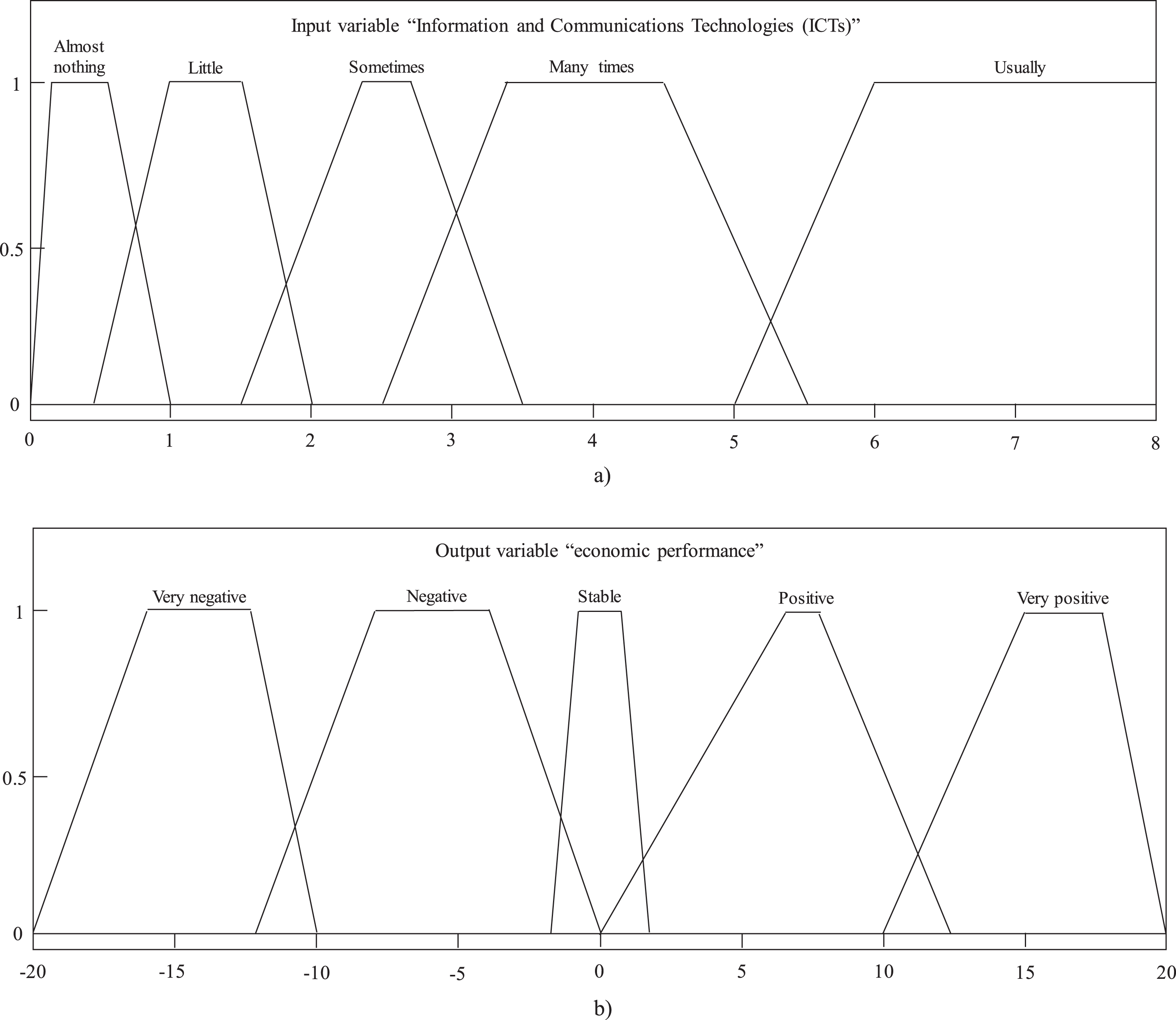
Membership function (a – from Information and Communications Technologies, b – from economic performance).
A fuzzy inference system can be represented modularly, according to Fig. 3. Non-fuzzy or deterministic information is translated into a fuzzy set language. The fuzzy inference engine combines, through logical precepts, data from the base of knowledge rules with the fuzzifier to provide a decision. Since this is fuzzy, it is usually necessary to perform an interpretation to translate it into a deterministic value. This procedure is performed by the defuzzifier.
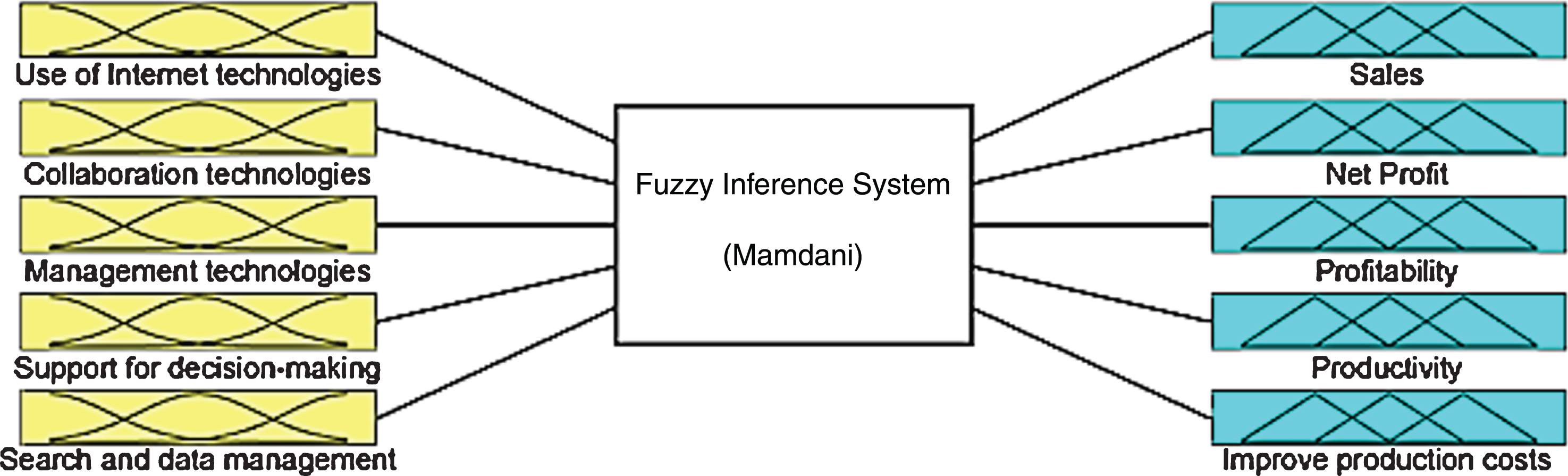
Fuzzy inference system.
The knowledge base of a fuzzy inference system is expressed by a set of “Yes—then” rules and logical prepositions, built on the linguistic information represented by fuzzy sets. In addition to the logical operations on fuzzy sets, it is also possible to perform actions with sets. The inference system represents and processes the imprecise knowledge of human operators (specialists), in terms of linguistic rules [27].
The fuzzy inference method used in this study is of the Mamdani type [5, 9]. This method uses a set of linguistic rules which, depending on the input values x (deterministic), are converted to fuzzy (using fuzzy sets) to activate some of the rules. According to the membership function, a degree of belonging is assigned to each fuzzy set to which x may belong. In cases where x can belong to more than one fuzzy set, operations will be performed in the Min-Max form, and if several rules are activated simultaneously, aggregation operations will be performed—that is, the inference rules are composed using the intersection operator T-norm min [16]. and the union operator S-conorm max. Aggregation is the method by which the values obtained in each of the activated inference rules of the system are joined, to obtain a fuzzy set resulting from the application of said rules. Thus, the centroid calculation of the resulting fuzzy set is performed to obtain a number or deterministic value as the output of the system.
EFA was performed using the base, tidyverse [17], and psych [43] packages of R software, version 3.6.1 [34]. In addition, the Matlab Fuzzy Logic ToolBox was used for the fuzzy inference system.
As regards EFA for ICT, the index of sampling adequacy was meritorious (KMO = 0.83). Bartlett’s sphericity test found that the correlation matrix was adequate for the factor analysis, χ2(10) = 238.12, p < 0.001. On the other hand, the three methods for selecting the number of factors suggested the extraction of a factor. The extracted factor explained 56% of the variance. In addition, factor loadings were found between 0.43 and 0.86. In the EFA for economic performance, the sampling adequacy analysis was meritorious (KMO = 0.85). Bartlett’s sphericity test was statistically significant, χ2(10) = 477.11, p < 0.001. For the determination of the number of factors to be retained, the three methods coincided in extracting a unique factor. The total variance explained was 76%. Factor loadings varied between 0.78 and 0.91.
On the other hand, the fuzzy inference system results indicated six relevant interactions. Explaining the results more broadly, with respect to Fig. 4 (a), the highest percentages of membership rules activated for the use of internet technologies (e-mail and internal service networks) were obtained for “Usually” while the lowest were obtained for “Many times”. the same rules are activated for search and data management (internet and search engines). This causes the rules of membership activated for the five measures of economic performance to be obtained in a more significant percentage for “Positive” and in a smaller percentage for “Stable”.
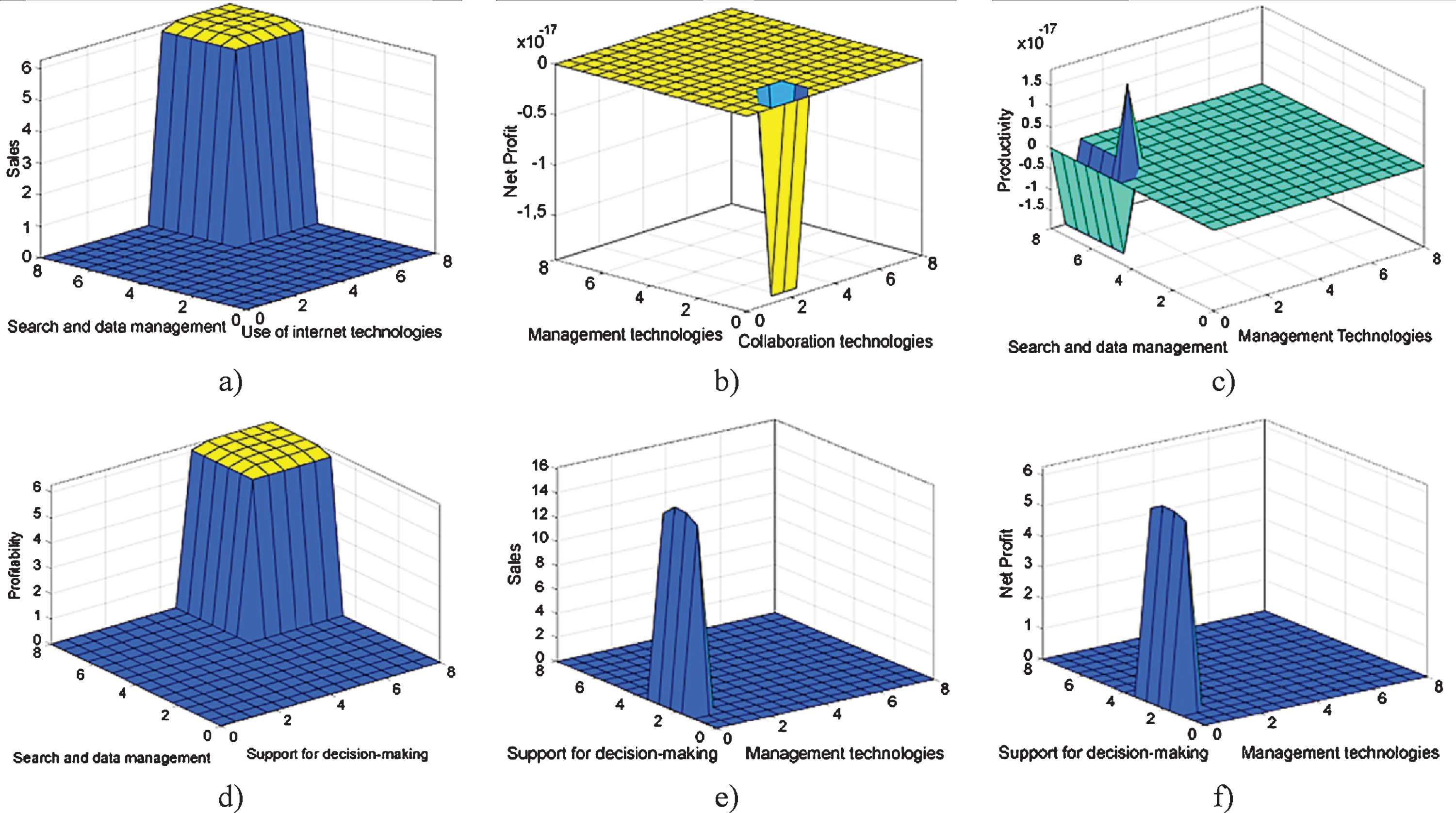
Fuzzy surfaces plot (a – use of internet technologies, and search and data management on five measures of economic performance; b – management technologies and collaboration technologies on five measures of economic performance; c – search and data management and management technologies on five measures of economic performance; d – search and data management and support for decision-making on five measures of economic performance; e – support for decision-making and management technologies on sales, profitability, and productivity; f – support for decision-making and management technologies on net profit, improvement of production costs).
Fig. 4 (b) shows that the membership rules for management technologies (Oracle, CRM, MP5, SAP, and ERP) activated are obtained at similar percentages for “Almost nothing” and “Little”. Likewise, the membership rules that are activated for collaboration technologies (groupware, videoconferences, virtual forums, and workflow) are obtained at a higher percentage for “Little” and a smaller percentage for “Sometimes”. This causes the rules of membership activated for the five measures of economic performance to be obtained at similar percentages for “Negative” and “Stable”.
For Fig. 4 (c), the membership rules for search and data management (internet and search engines) activated are at a higher percentage for “Usually” and a smaller percentage for “Many times”. Likewise, the membership rule that is activated for management technologies (Oracle, CRM, MP5, SAP, and ERP) is at a smaller percentage for “Almost nothing”. This causes the rules of membership activated for the five measures of economic performance to be at a similar percentage for “Negative” and “Stable”. In addition, in this same figure, when the membership rule activated changes for management technologies (higher percentage “Little” and lower percentage “Almost nothing” and “Sometimes”), the membership rules activated for the five measures of economic performance prove to be at higher percentage for “Stable” and lower percentage “Positive”.
As regards Fig. 4 (d), the membership rules for search and data management (internet and search engines) activated are at a higher percentage for “Usually” and a smaller percentage for “Many times”; the same rules are activated for support for decision-making (data mining, data modeling and other support software). This causes the rules of membership that are activated for the five measures of economic performance to be at a greater percentage for “Positive” and a smaller percentage for “Stable”.
When it comes to Fig. 4 (e) and Fig. 4 (f), the membership rules for management technologies (Oracle, CRM, MP5, SAP, and ERP) activated are at a greater percentage for “Almost nothing” and a lower percentage for “Little”. Moreover, the membership rules activated for support for decision-making (data mining, data modeling, and other support software) are at a greater percentage for “Little” and a smaller percentage for “Almost nothing” and “Sometimes”. This causes the membership rules activated for sales, profitability, and productivity to be at higher percentages for “Positive” and lower percentages for “Stable” and “Very positive”. Moreover, it causes the rules of membership activated for net profit and improvement of production costs to be at greater percentages for “Positive” and lower percentages for “Stable”.
The objective of the study was to analyze the effects of ICTs on the economic performance of NTBFs, over two stages. Firstly, the variables ICTs and economic performance were validated through EFA. Secondly, Mamdani the fuzzy inference system was used to complement and achieve the study objective.
The results are directly related to previous studies, such as [30], in that the adoption of the internet was found to increase a firm’s productivity. Along similar lines, [39] concluded that ICTs with an emphasis on strategy and investments affect a firm’s profitability. Finally, in the study of [12], it was observed that specific ICTs (internet, websites, e-mail, and telephone) improved sales by 73% within industrial firms. These studies coincide with the findings of the present study.
The application of a fuzzy inference system is an appropriate mechanism through which to address the issue of the impact of ICT infrastructures on the economic performance of NTBFs, helping managers and promoters to make better decisions when implementing technological systems while improving their economic performance.
The results have various implications. First, ICTs and economic performance were conceptualized as two one-dimensional constructs each made up of five indicators of relevance in the reviewed literature. This conceptualization allowed observation of the relationship that the indicators have with each other and which contributes to explaining the results obtained. Likewise, the influence that ICTs have on economic performance provides NTBFs with a greater capacity for attention, response and adaptation in changing and dynamic environments, anticipating market demands to provide a quick response and increasing their level of production and operation [38].
The findings indicate that the interactions between the five technologies have direct effects on the five measures of economic returns considered in the present study. In order of decreasing importance by amount of interaction, these are: (1) management technologies; (2) support for decision-making; (3) search and data management; (4) use of internet technologies; and (5) collaboration technologies. This information has potential practical implications for managers and directors of NTBFs. It could assist them in the adequate implementation of technological infrastructure and in obtaining economic results in the short term, maximizing internal processes so that innovation development (processes and products) is faster and more dynamic while also enhancing management capacity to facilitate competitiveness with other firms and even provide a competitive advantage.
The fuzzy inference system applied in the ICT analysis is an option for the evaluation of economic performance. However, one difficulty in the design of the system concerns the interrelationship with economic performance measures. This limitation of the study should be taken into for future research that might include other measures of economic performance, as well as non-economic performance such as customer satisfaction or external recognition of the firm. Finally, another recommendation for future research would be to replicate this study for other types of firms (for example, industrial, textile, or manufacturing) since NTBFs already have technology incorporated in their business processes, and so it cannot be expected to have a significant impact on their economic performance.
The study has had some limitations that should be taken into account for a better understanding of the results and for future research. First, the sample size of 102 NTBFs is relatively small; even though it spanned various cities in Colombia and represents 32% of the entire country, the ability to generalize the results to the entire population is limited. Likewise, the cross-sectional research design limits the potential for a causal relationship in terms of the impact of ICTs on economic performance. A longitudinal design would allow for delimitation and dynamic exploration of the causality of economic performance, considering simultaneously the effect of ICTs and the time they have been used within firms, or their impact over a certain period on the evolution of a firm’s economic performance.
On the other hand, it is important to point out that technology is only one component among many others from a socio-technological perspective. Thus, future research should extend the scope of this study and examine other aspects, such as culture, production processes, technological capacity, or interaction between workers. For example, in a study [20] it was found that organizational ambidexterity and intangible assets influence the economic results of firms, generating greater use of available resources, as well as the incorporation of new knowledge with which to integrate, develop and reconfigure the internal and external capabilities of firms. Future research should study how a firm can include ICTs in these processes, integrating technology, people, processes, and results. Furthermore, developing technological capacity has a significant impact on the economic performance of NTBFs [10].
The results obtained in the present study have allowed us to expand our knowledge of the relationship between ICTs and economic performance, specifying which technologies have the greatest impact on various economic returns. From this, firms could prioritize the implementation of those technologies that obtain better economic returns and increase their productive capacity in a short time.
Conclusions
The increase in technology and firms that promote their creation and regulation has helped different countries to develop their policy guidelines in relation to science, technology, and innovation, promoting the economic growth of the firms and the countries in which they operate. In Latin America, NTBFs have been in existence for less than 25 years, so research focusing on this type of firm is still scarce or has not been fully explored using different mathematical or statistical approaches, although their role is of significant relevance for any economy that seeks to be competitive and dynamic. Therefore, this article has presented a Mamdani fuzzy inference approach to determine how the use of technology within NTBFs affects different measures of economic performance.
Future research could use and integrate other artificial intelligence methods, as well as various interpretive methods, such as structural equation models, fuzzy artificial neural networks, among others, to corroborate the efficiency of the results obtained. Likewise, the methodology proposed in this study could be used to evaluate the degree of impact that ICTs have on the economic performance of other, non-technological types of firms.