






Abstract
In the field of data analysis clustering is considered to be a major tool. Application of clustering in various field of science, has led to advancement in clustering algorithm. Traditional clustering algorithm have lot of defects, while these defects have been addressed but no clustering algorithm can be considered as superior. A new approach based on Kernel Fuzzy C-means clustering using teaching learning-based optimization algorithm (TLBO-KFCM) is proposed in this paper. Kernel function used in this algorithm improves separation and makes clustering more apprehensive. Teaching learning-based optimization algorithm discussed in the paper helps to improve clustering compactness. Simulation using five data sets are performed and the results are compared with two other optimization algorithms (genetic algorithm GA and particle swam optimization PSO). Results show that the proposed clustering algorithm has better performance. Another simulation on same set of data is also performed, and clustering results of TLBO-KFCM are compared with teaching learning-based optimization algorithm with Fuzzy C- Means Clustering (TLBO-FCM).
Introduction
Data grouping in unsupervised manner, to form clusters and find the hidden pattern in data is clustering. This unsupervised learning method has helped to make data into more meaningful form that can be used in all prospects of new innovation and technology likewise data mining, image segmentation pattern recognition and taxonomy etc. A good clustering is one in which has following (A) the distance of data point with centre (centroid) within the cluster is minimum (B) the distance between two cluster centre (centroid) is maximum (C) number of clusters ‘n’ is not known beforehand.
The most common type of clustering is partitional clustering, because of its simplicity and better computational results than hierarchical and density-based clustering. Well-known partitional clustering algorithm are K-medoids, K-means, Fuzzy C-means (FCM) etc. are based on similarity and dissimilarity matrix, calculated from distance between (Euclidian distance) data point to cluster centre. MacQueen proposed K-means algorithm back in 1967 and K-medoids proposed by Kaufman and Rousseeuw are hard clustering techniques, where pattern can be part of one cluster and cannot affect other clusters which makes hard clustering more rigid and less practical in real world scenario. So, the problems associated with hard clustering were overcome by introducing a fuzzy factor in 1981 by J.C. Bezdek known as Fuzzy C-Means (FCM). In case of FCM, pattern can be a part of two or more clusters depending on the assigned membership value and this will lead to no drift of smaller cluster centre to adjacent larger cluster.
Although FCM is practical in approach, issues arise when data is not linearly separable, have high dimensionality or overlap is formed in clusters input space. FCM is also sensitive to outliers and noise adding to its demerits. Thus, scope for improvement in FCM has introduced kernel methods in 1960 s and were found to be very useful. Kernel method is typically mapping of data using kernel functions into higher dimensional feature space, then clustering is done in higher dimensional feature space and results are reformulated in original space. Gaussian kernel function is most commonly applied for mapping data values into higher dimensional feature space [14]. Other kernel functions like Hyper-tangent, Cauchy kernel and Log kernel functions are also implemented in some research work [12]. Based on traditional FCM a kernel based fuzzy c means algorithm (KFCM) was proposed by Zhong-Dong Wu [8] in 2003. KFCM has advantage that it can tolerate unequal cluster size and is less sensitive to noise and outliers, making it robust. Constraints in the membership value in case of FCM was overcome by possibilistic fuzzy c- means (PFCM) proposed by Pal et al. [15], but this algorithm is sensitive to initial cluster centres [20]. All the above algorithms aim to minimize the least square distance (Euclidian distance) within the cluster, but number of clusters ‘n’ have to be known beforehand. This drawback in classical clustering algorithm have made metaheuristic algorithms more trustable in clustering.
Over the last two decades, metaheuristic algorithms have shown great results and are simple to implement as optimization algorithms [19]. Unlike heuristic algorithms, metaheuristic algorithms do not rely on surface gradient, which gives them edge of not getting trapped in local minima/maxima [19]. Several metaheuristic algorithms like Genetic algorithm (GA) [10], Ant colony optimization (ACO) and Particle swam optimization (PSO) are inspired by activities that are involuntarily happening in nature and will tend to optimize a given problem. However, some algorithm like Differential Evolution (DE) does not fall into category of nature inspired algorithm. An important algorithm in these series of metaheuristic algorithm for dealing with complex optimization problems is human based teaching learning-based optimization algorithm (TLBO) proposed by RAO et al. [17]. TLBO is an approach based on classroom environment of learning through interaction between teacher and learner [1, 2], has no controlling factor and designing part is also simple, making it more efficient in real life practice. Other variations such as Modified TLBO is proposed by S.C. Satapathy et al. [18] and multi-objective TLBO is proposed by Dong Yu and Jim Hong [11].
These metaheuristic algorithms gained popularity in various fields of engineering, mathematics commerce, humanity and management etc. These algorithms when used in an optimization problem have helped to find optimal number of clusters, minimize the inter cluster distance and maximise the intra cluster distance. Some work already done in this field are [4] Genetic algorithm based fuzzy C-means clustering (GAFCM), Genetic algorithm-based kernel Fuzzy C-means (GA-KFCM) [5], Particle swam optimization based fuzzy C means clustering. (PSOFCM) [6], Kernel based PSO-KFCM, multi objective Immune algorithm-based kernel intuitionistic fuzzy c- means KIFCM-IMOIA clustering and others are there in literature [3].
TLBO is already applied to automatic data clustering by M.R. Krishna Murty. et.al. K-means clustering by Naik et al. [9, 13] have proposed paper on TLBO based FCM and compared the result with hard clustering. A paper on hybrid elicit teaching learning-based optimization with fuzzy c-means have been presented by Janmenjoy Nayak etal., wherein comparison is made with TLBO on K-means [1].
The motivation for the research in this direction is to minimise the intra cluster distance of data sets with cluster centre, and make the clusters more compact. Research in this paper is dedicated to applying TLBO based kernel Fuzzy C-means on standard data sets. Out of total 5 data sets, three data sets have been taken from UCI Repository [16] and two are synthetic data sets, and comparison is drawn with TLBO-FCM for some standard benchmark data sets. Comparison of fitness function with other metaheuristic algorithms GA-KPFCM and PSO-KFCM are done. Contributions of the research are stated in Section 1.1 of the paper. Section 2 of the paper deals with concept of basic algorithms. Proposed work is illustrated in Section 3. Simulations and results are drawn in Section 4. Conclusion and scope of future work are discussed in Section 5.
Contributions of the paper
In this paper, a new algorithm on clustering is implemented. The major areas in which this paper has contributed are discussed as below as- Study of metaheuristic optimization algorithms GA, PSO and TLBO on Kernel Fuzzy C- means clustering is done. TLBO-KFCM algorithm is implemented (which is not implemented till now as per author’s knowledge) to optimize the within cluster distance. A comparative study between TLBO-KFCM, PSO-KFCM and GA-KFCM is done and results of simulation are discussed.
TLBO-FCM is also implemented and performance is compared with TLBO-KFCM.
Related concepts
In this section we will see the basic concepts of FCM, KFCM and TLBO.
Fuzzy C means
Like K means algorithm we know that Fuzzy C-means [FCM] is basically partitioning the data samples, with fuzzy element in membership value. The objective function Ƒ is minimized in each iteration ‘i’ and values of new partition matrix Ü and cluster center Ʋ are updated. Now suppose X = {x1,x2,x3, …… …… . . x
l
} is unlabeled data samples of length l such that x εR
f
where R
f
is dimension of data samples [8]. The value of objective function is -
Where ‘n’ is no. of clusters in the data set.
Such that,
1⩽ m < ∞
The membership value can be updated as:
And cluster center is given by
Where Ʋ= [ν1,ν2, …… …… …… … . ν n ] is matrix of center and k = [1,2 ... ... ... ... n] is the kth cluster and ||x j - ν k || is the Euclidian distance. Number of iterations is given by ‘i’.
The algorithm will converge when ith iteration has reached its maximum value or when –
Where ε is very small positive number.
KFCM is popularly used in data sets that are not linearly separable, i.e. when clusters cannot be separated by drawing a well-defined line in the space. If such data samples are transformed into some higher dimensional space then the data samples can be separated linearly in that space. This higher dimensional feature space is called kernel space [7]. Several kernel functions used for defining these kernel spaces are Radial Basis function, Hyper Tangent function, Gaussian Kernel function, and others [9, 12]. Of these, Gaussian kernel function, which is special case of radial basis function, is most widely used in studies because of its bell-shaped curve, which makes it incredibly useful for analysis in higher dimensional feature space. Suppose nonlinear map is defined as Φ : x → Φ (x) ε F is transformed feature space with higher dimension and x ε X and X is data space, which was previously defined in FCM. The Euclidian distance ||x - y||2 which is similarity measure between x & y, is replaced by ||Φ (x) - Φ (y) ||2.
K (x, x) =1, as both are same points so dot product is 1.
The objective function Equation (1) earlier used in FCM can be modified using Equation (5) as Ƒ
KFCM
, given below [14]
Now the above objective function is to be minimized, and the partition matrix
The new cluster center
k
is updated from following equation:
The stopping criterion for equation is when i
th
iteration has reached it maximum value or when –
TLBO (Teaching Learning Based Optimization) algorithm is powerful like other metaheuristic algorithms i.e. genetic algorithm (GA) and, particle swarm optimization (PSO) but unlike them it has less computational complexity to obtain a global solution. The algorithm is suggested based on teaching and learning phenomenon that happens in classroom environment [2]. The teaching and learning process in the classroom is the ideology behind the algorithm. The algorithm has teacher and learner as its major component [16]. The algorithm works in two phases, a learner (student) can either learn from teacher or else gain knowledge from interaction from other students or his friends. In this algorithm population is defined as group of learner’s ‘q’, different subjects taught are design variable ‘p’ of the algorithm, fitness value is result of learner and best solution is teacher with best knowledge. The output of TLBO is the result of learner which depends on knowledge of teacher.
Phase 1-teaching
We know that teacher is one of the most learned people in the society, and has more knowledge than students but teaching capability of every teacher varies. The mean result of the class can show the teaching capability of teacher, which he/she tries to improve while teaching. In the teaching phase of the algorithm, the teacher will try to improve the knowledge of the students, from their personal existing knowledge. All students initially possess different knowledge levels, so teacher cannot increase the knowledge level of students equally. Therefore, mean knowledge value is evaluated for the entire population, and then it is the job of teacher in the teaching phase to increase the knowledge level of the students by increasing the mean value. Thus, new mean result of class depends on teacher’s teaching capability [1]. This can be mathematically computed and represented as-
The above equation is the increase in mean value of each subject by the teacher. Xp,q.r is the solution i.e teacher’s teaching capability. Xp,Qbest.r is the best solution of learner (i.e. teacher) obtained at any iteration for minimum value of objective function in subject ‘p’. Number of iterations is given by ‘r’ for a population (learner) of size ‘q’. ‘s’ is a random value between 0 and 1. The existing mean result of learner in a particular subject ‘p’ is given as Mp,r. T
f
is the teaching factor and is given as
T f is not some parameter of the TLBO algorithm and its value is generally taken as 1 or 2.
Based on Mean _ differencep,q,r the existing solution is updated in teacher phase as-
All the values of
This phase is about how learner (student) increases knowledge about the subject. He or she will primarily learn through teaching in the class, but he/she might increase his/her wisdom through interaction of learner with other class fellows (students) in the class. The other class fellow might have more knowledge on the concerned subject, for this the learners (in this case U and V) are compared. The learning part can be mathematically formulated as:
if
if
Here U and V are the two learners selected randomly with different solution
TLBO-FCM proposed by Naik [9] and other variations of TLBO algorithm like TLBO K-means algorithm and TLBO in Automatic clustering have already been studied TLBO-FCM and modified TLBO was proposed by Janmenjoy Nayak et al. [1] is also applied in data clustering. But for nonlinear inseparable clusters, the methods suggested above give no clear cluster, for this, kernel based TLBO-KFCM as shown in Fig. 1 have been proposed in this paper and optimization of within cluster distance is done. This optimization is compared with other metaheuristic techniques and results are shown.
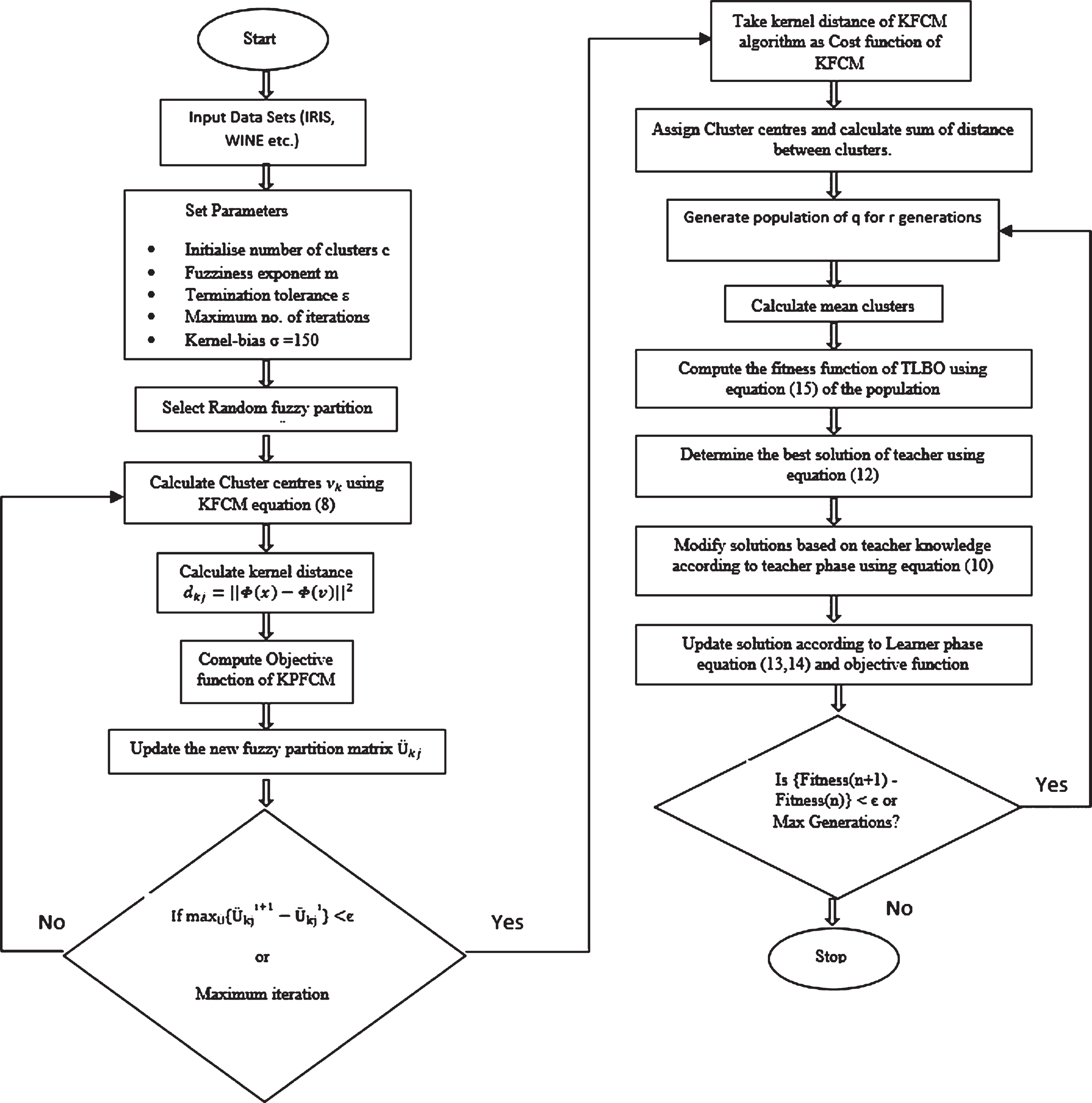
Flowchart of TLBO-KFCM Algorithm.
TLBO based KFCM optimization algorithm is proposed for dataset that is not linearly separable in lower dimensional space, so transformation of distance in higher dimensional feature space has made separation of data sets simple and easier for analysis. Use of TLBO for optimizing within cluster distance has led to compact cluster sets, which is better for separating noise and outliers. Suppose ‘k’ is population of cluster centres that is received from KFCM algorithm, F(C
i
) is the fitness mean of cluster distance and sum of within cluster distance (variation) is to be minimized, then fitness function is given as
for ‘r’ generations.
Where x j , v k and l have same notation as above and C i is the ith candidate solution in the population of ‘k’. After evaluation from the population the worst solution is replaced by the best solution (new cluster mean), in each generation. Generation ‘r’ is number of iterations of TLBO. The main aim is to minimize intra cluster distance i.e. clusters are compact and the value of fitness function is also low. Flowchart of TLBO-KFCM is shown below.
Simulation is done in MATLAB2018a software 64 bit, on a system with core i5 processor, windows10, with 4GB RAM. 5 data sets are considered for carrying out experiment, out of which three are from UCI repository [16] (IRIS, WINE and ZOO) and two synthetic (artificial) datasets are used for testing all clustering approaches. Data set table with number of cluster and attributes is shown in Table 1.
Different data sets considered for clustering
Different data sets considered for clustering
The comparison is drawn between KFCM and other clustering techniques PSO-KFCM, GA-KFCM and TLBO-KFCM and results of fitness function and computational complexity (no of iterations) are discussed. The population size of 50 is taken for 150 generations. Best mean of cluster centre is computed based on mean of cluster centre and fitness value is computed from best cost. Computational complexity (no of iterations) is an important aspect in data clustering as datasets can be very large. Equation (15) has been implemented in all the methods and the result of clustering is discussed in this section.
Figure 2 shows cluster of three types of Iris flowers (Red, Blue and Green) based on petal length and sepal length. The centres of these clusters are marked by black diamond after updating the cluster centre by TLBO-KFCM.
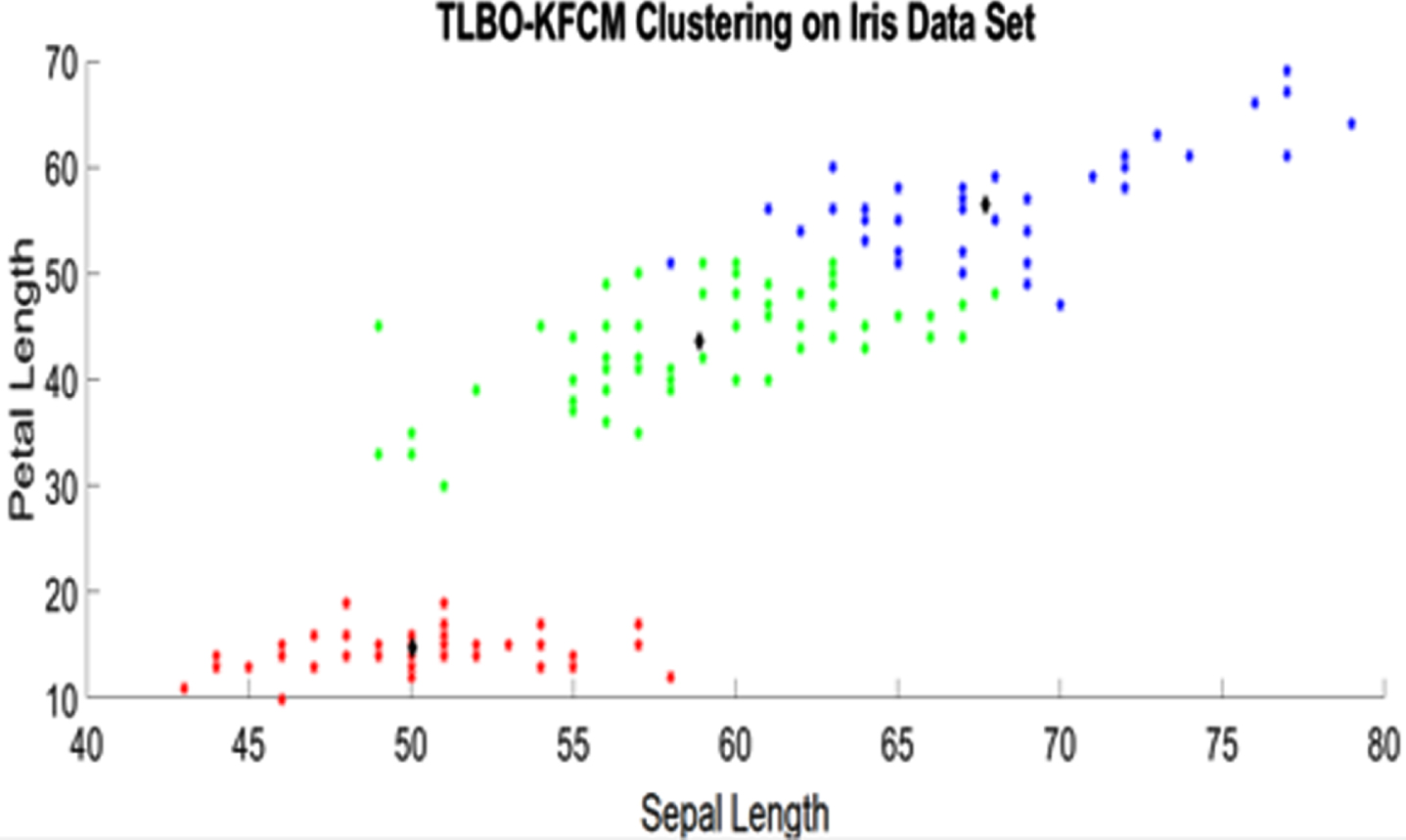
TLBO-KFCM Clustering in IRIS data set.
Figure 3 above shows fitness function of various metaheuristic algorithms (TLBO-KFCM, GA-KFCM and PSO-KFCM) on Iris data set. We can see clearly in the figure that TLBO-KFCM (red colour) shows better fitness function than PSO-KFCM and GA-KFCM. Also, the number of iterations required for convergence of TLBO-KFCM are 23, which are far less than the other two algorithms.
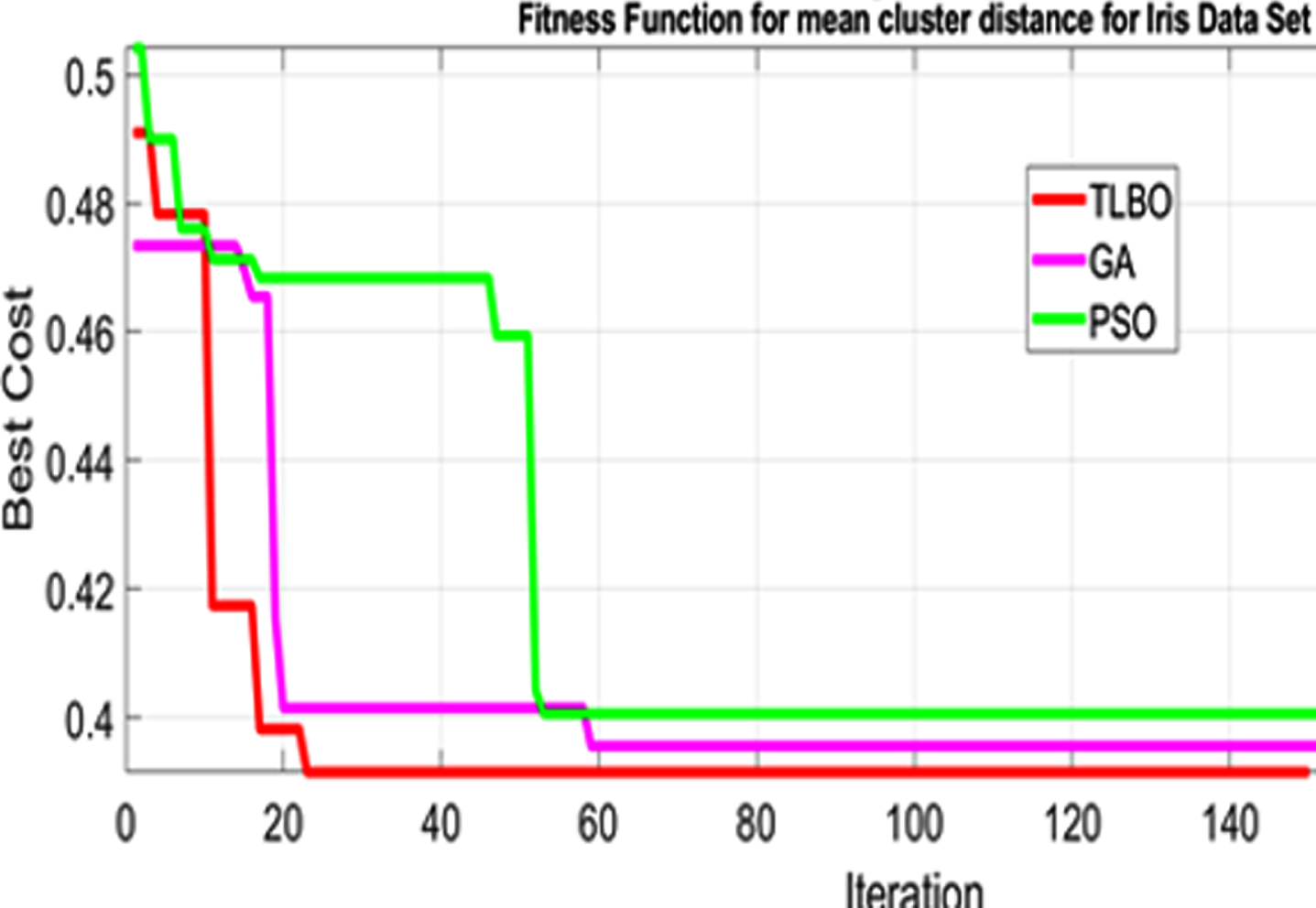
Comparison of fitness function on Iris data set.
Figure 4 shows clustering result of Artificial Data set Crescent full moon. The inner circle is full moon and the outer one is crescent. The data set is divided into two clusters. Red dots in the figure are cluster centres on applying TLBO-KFCM.
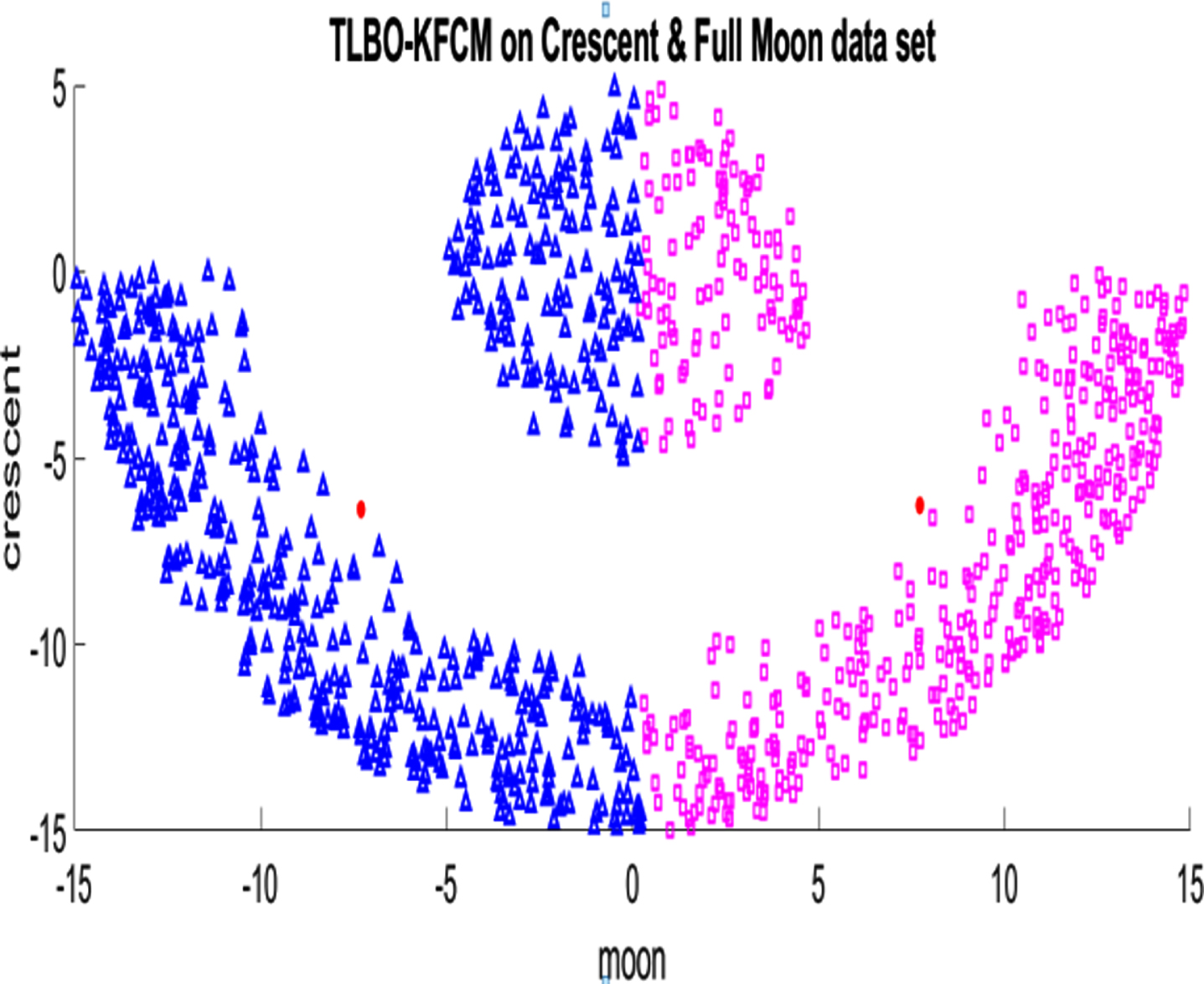
TLBO-KFCM Clustering in Crescent Full Moon data set.
Figure 5 shows that fitness function of TLBO-KFCM is achieved at much lesser number of iterations than GA-KFCM and PSO-KFCM. This shows that the computational complexity in case of TLBO is much less than PSO and GA, which is an advantage as data clustering algorithms inherently deal with time complexity.
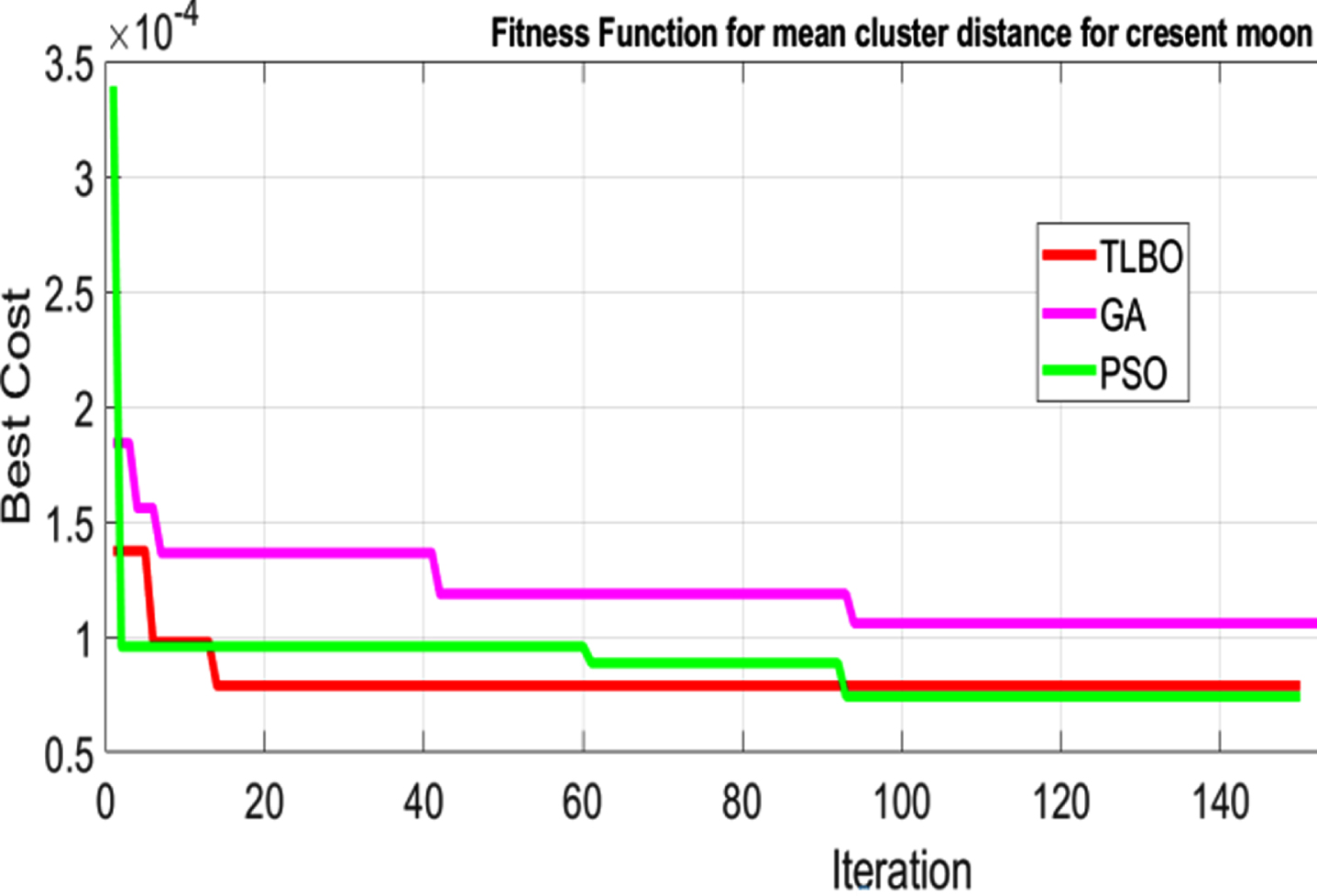
Comparison of fitness function Crescent Full Moon on data set.
The Experiment was carried out on five data sets but figure of only two data set (Iris and Crescent Full moon) are shown due to space constraint of the paper. But the performance comparison for all tested data sets is shown in the Table 2.
Comparison based on performance of KFCM with other metaheuristic clustering algorithm
Performance comparison of TLBO-KFCM and TLBO-FCM
FCM is basic clustering algorithm. TLBO based optimization on FCM is already proposed in literature [9] showing it improvement over TLBO based K-means algorithm. However, in this paper comparison of performance between TLBO-KFCM and TLBO-FCM clustering is proposed to show superiority of one over the other for given data set. functions are not comparable because both are altogether different clustering approach however number of iterations required can be compared, and results are shown in Table-3. It is evident that number of iterations in generally required in TLBO-KFCM is far more less. Thus, proposed TLBO-KFCM is better than TLBO FCM for higher dimensional data clustering.
Conclusion and future scope
New metaheuristic algorithm TLBO, is based on human interaction in the teaching environment and is applicable in diversified field of engineering. In TLBO algorithm the mean of the class is improved with the teacher learner interaction, and the process is evaluated until learner gets the best solution i.e. teacher. In this paper teaching learning-based optimization algorithm, when implemented with kernel based fuzzy c- means clustering gives better fitness value than GA-KFCM and PSO-KFCM.
After implementation of the proposed approach it is clearly seen that the number of generations (iterations) required to achieve this fitness level is far more less in TLBO-KFCM than the other two algorithms. This reduces the computational time of the algorithm making it a better choice than GA-KFCM and PSO-KFCM. Optimizing only one fitness function makes clustering not practically applicable in real life. Now-a day’s several objective functions are computed simultaneously to obtain optimized set of solutions. Future work can be done in area of multi-objective functions based TLBO in clustering. Since no work is done till date in this field, it makes it quite lucrative for researcher to explore this area. Further the above research work can be extended to possibilistic fuzzy c means which may work better to reduce noise and outliers and hence improve clustering performance.