






Abstract
To describe the values of criteria and to generate a sort of alternatives are two important issues in multi-criteria decision-making (MCDM). A superior tool for the former issue is Pythagorean hesitant fuzzy number (PHFN) and an effective tool for the latter issue is aggregation operator. So far, a number of aggregation operators of PHFNs have been presented within the academia. Each aggregation operator has its own characteristics and can work well for its specific purpose. But there is not yet an aggregation operator of PHFNs that can provide satisfying generality and flexibility in aggregating the values of criteria and capturing the interactions of criteria. The Archimedean t-conorm and t-norm (ATT) are well-known for having the capability to generate versatile and flexible operational rules for fuzzy numbers, while the Muirhead mean (MM) operator is an all-in-one aggregation operator for capturing the interrelationships of the aggregated arguments. To this end, the MM operator and the ATT for PHFNs are combined to present a Pythagorean hesitant fuzzy Archimedean MM (PHFAMM) operator and a weighted PHFAMM operator and a new MCDM method based on the presented operators is proposed in this paper. Firstly, the generalised expressions of the presented operators are provided. The properties of the operators are explored and proved and their specific expressions based on Algebraic, Einstein, Hamacher, and Frank ATTs are then constructed. Based on these specific expressions, a new method for solving the MCDM problems based on PHFNs is developed. Finally, the developed MCDM method is demonstrated via an example, a set of experiments and qualitative and quantitative comparisons.
Keywords
Introduction
Multi-criteria decision-making (MCDM) is a process of finding desirable alternatives via evaluating the values of multiple criteria of all alternatives synthetically [1]. In this process, a primary issue is to describe the values of criteria. For this issue, many experts proposed to adopt fuzzy sets [2]. For example, Atanassov [3–5] introduced the intuitionistic fuzzy set (IFS), which is a generalization of fuzzy set. Garg and Rani [6, 7] extended the aggregation operators for IFS to deal with two-dimensional information in a set. Yager [8, 9] introduced the Pythagorean fuzzy set (PFS), which improves the expressiveness of IFS. Zhang and Xu [10] developed a set of new operational laws for PFSs and explored their desirable properties. Garg [11–14] improved the existing aggregation operators for PFSs by adding the pairs of the hesitation between the membership functions and proposed some new operational laws for Pythagorean fuzzy numbers using Einstein operations. Gou et al. [15] studied the continuity, derivability, and differentiability of continuous Pythagorean fuzzy information. Peng [16] extended the scope of PFS to combine soft set with rough set, employ PFS in the information environment of language and propose a method to manage the membership and non-membership degrees expressed by interval-values. Garg [17] presented the linguistic Pythagorean fuzzy set by combining PFSs and linguistic fuzzy sets. Wei and Lu [18] proposed a set of Pythagorean fuzzy power aggregation operators and studied the prominent characteristics of these operators. By aggregated interval-valued Pythagorean fuzzy set (IVPFS) and the Maclaurin symmetric mean (MSM) operator, Garg [19] explored the IVPFSMSM operators and their weighted forms for solving MCDM problem, which can consider the interaction between the pairs of the membership degrees. In addition, Garg [20, 21] also developed two new exponential operational laws and the aggregation operators to cope with crisp values on IVPFS in MCDM. Peng [22, 23] proposed a novel score function, a new distance measure with multiple parameters and novel algorithms for IVPFS in the context of MCDM. Torra and Narukawa [24, 25] presented the concept of hesitant fuzzy set (HFS), which allows the membership degree of an element to be a set of some feasible values between 0 and 1. Qin et al. [26] investigated the Frank triangular norms with hesitant fuzzy information. Xu and Liang [27] proposed a distance measure for Pythagorean hesitant fuzzy sets (PHFSs), which can consider the differences of the membership, non-membership, and indeterminacy degrees.
Another important issue in MCDM is to generate a sort of alternatives. For this issue, there are normally two categories of approaches. One category is comprised by conventional approaches (e.g. TOPSIS, VIKOR, PROMETHEE, ELECTRE). The other category consists of the approaches based on aggregation operators. Aggregation operators can deal with the MCDM problems more effectively because they can provide comprehensive values and ranking of alternatives, whereas conventional approaches can only generate ranking [28]. Recently, a number of different aggregation operators for PHFSs have been presented, which mainly include the weighted average and geometric operators [29], Hamacher aggregation operators [30], MSM operator [31], Bonferroni mean (BM) operator [32], Hybrid aggregation operator [33], Dual hesitant Pythagorean fuzzy Hamacher operator [34], and Archimedean aggregation operators [35]. Among these operators, the Archimedean Pythagorean hesitant fuzzy weighted averaging operator and weighted geometric operator [35] are the most generalized aggregation operators of Pythagorean hesitant fuzzy numbers (PHFNs). In them, the operations are performed on the basis of any types of Archimedean t-conorm and t-norm (ATT) (e.g. Algebraic, Einstein, Hamacher, and Frank t-conorms and t-norms) [36–38]. Due to such characteristic, the operators are more generalized, versatile and flexible than those operators based on one specific t-conorm and t-norm.
In addition to the generality of the operations, the capability to capture the interactions among criteria is also an important feature of aggregation operators [39]. Among the existing aggregation operators of PHFNs, the MSM and BM operators have this capability. The Muirhead mean (MM) operator [40], a generalization of the arithmetic average, BM [41], MSM [42, 43] and geometric average operators, also has such capability [44]. A number of researchers have explored the MM operator in various fuzzy environments for MCDM. For example, Liu and Li [45] developed an MM operator to aggregate hesitant fuzzy linguistic information. Wang J et al. [46] developed a hesitant fuzzy linguistic MM operator. Hong and Rong [44] presented a hesitant fuzzy dual Muirhead mean operator. Zhu and Li [47] proposed a Pythagorean fuzzy MM operator and a Pythagorean fuzzy dual MM operator.
Based on the considerations above, it is non-trivial to combine the MM operators with the ATTs under Pythagorean hesitant fuzzy environment. In this paper, such combination is studied in depth. The major contributions of the paper are to present and explore the properties of a Pythagorean hesitant fuzzy Archimedean MM (PHFAMM) operator and its weighted form and to propose a new method based on the presented operators to resolve the MCDM problems based on PHFNs. To the best of the knowledge, this is the first PHFNs based MCDM method that combines the MM operators and the ATTs in the context of PHFSs.
The remainder of the paper is organized as follows. Section 2 gives a brief introduction to some related concepts. Section 3 explains the details of the presented operators. Section 4 elaborates the proposed MCDM method. Section 5 demonstrates the proposed method via a practical example, a set of experiments, and comparisons with existing methods. Section 6 ends the paper with a conclusion.
Preliminaries
MM operator
An advantage of the MM operator is that it can capture the interrelationships among the multiple aggregated arguments. In addition, the MM operator is a generalization of a number of existing aggregation operators.
The special cases of MM operator are as follows:
if S (h1p) > S (h2p), then h1p is superior to h2p, denoted by h1p > h2p;
if S (h1p) = S (h2p), then if A (h1p) > A (h2p), then h1p > h2p; if A (h1p) = A (h2p), then h1p is equivalent to h2p, denoted by h1p ≈ h2p.
U (a, 0) = a for all a. U (a, b) = U (b, a) for all a and b. If b < b* and d < d* then U (b, d) ≤ U (b*, d*). U (a, U (b, d)) = U (U (a, b) , d for all a,b and d.
I (a, 1) = a for all a. I (a, b) = I (b, a) for all a and b. If b < b* and d < d* then I (b, d) ≤ I (b*, d*). I (a, I (b, d)) = I (I (a, b) , d for all a, b and d.
For ATN and ATC: If f (t) (t ∈ R) is monotonically decreasing and satisfies the conditions that f (t) : (0, 1] → R+;f-1 (t) : R+ → (0, 1]; If g (t) (t ∈ R) is monotonically increasing and satisfies the conditions that g (t) : (0, 1] → R+;g-1 (t) : R+ → (0, 1];
Please note that g (t) = f (1 - t) for all a, b ∈ [0, 1].
Four specific types of ATTs and their additive generators are shown in the Tables 1 and 2 [35]. From the two tables, it is not difficult to derive the inverses of the additive generators (i. e . f-1 and g-1) of each type of ATT. They are omitted here due to space limitations.
Four types of ATNs and their additive generators
Four types of ATCs and their additive generators
In this section, a Pythagorean hesitant fuzzy Archimedean Muirhead mean (PHFAMM) operator and a weighted PHFAMM (WPHFAMM) operator are presented via using the MM operator and the operational laws of PHFNs based on ATTs. The properties of the two operators are explored and proved and their specific expressions are derived.
PHFAMM operator
Then PHFAMM Q is called the PHFAMM operator. In this equation, ϑ(j) (j = 1, 2, … n) is any a permutation of (1, 2, … n), S n is the collection of all permutations of (1, 2, … n), ⊕ and ⊗ convey the same meaning as they are in Definition 9 and Definition 10, respectively.
Proof.
Firstly, it is needed to prove that Equation (13) holds.
According to law (2) in Definition 8, it can be obtained that
Obviously,
Thus, it is obtained that
Obviously,
Thus, it is obtained that
According to law (1) in Definition 8, it can be obtained that
According to law (2) in Definition 8, the following equation is obtained:
The following will prove that Equation (13) is a PHFNs.
Let
According to the definition of a PHFNs (Definition 2), it can be obtained that 0 ≤ γ
j
≤ 1, 0 ≤ η
j
≤ 1 and
Thus, it is obtained that
Since
Since
Therefore, the following inequality is attained:
That is,
According to the Definition 2, it can be concluded that the aggregated result of Equation (12) is a PHFN.□
The following theorems state the idempotency, monotonicity and boundedness of the PHFAMM operator, respectively:
Proof.
According to the Theorem 1 yields
Since
Then it can be achieved that
Then it is obtained that
Then it can be achieved that
Then it is obtained that
Then it can be achieved that
Then it is obtained that
Then it can be achieved that
Then it can be achieved that
Finally, it is obtained that:
Proof.
According to Theorem 1, it can be obtained that
Since f (x) and f-1 (x) are monotonically decreasing, g (x) and g-1 (x) are monotonically increasing,
Then it is obtained that
Then it can be achieved that
Then it is obtained that
Then it can be achieved that
Then it is obtained that
Then it can be achieved that
Since
Therefore, it is obtained that
Let hp- = (γmin, ηmax) and hp+ = (γmax, ηmin), then
Proof.
According to Theorem 2 and Theorem 3, it can be achieved that
Consequently, it is obtained that
Equation (13) is a generalized expression of the PHFAMM operator. To construct specific expressions of the operator, different pairs of f (x)
s
and g (x)
s
are used:
The PHFAHMM operator reduces to the PHFAAMM operator when θ = 1 and reduces to the PHFAEMM operator when θ = 2.
The PHFAMM operator has advantages in describing fuzzy information flexibly and capturing the interrelationships among criteria. But it does not measure the relative importance of criteria. To this end, weights are introduced and a weighted PHFAMM operator is constructed as follow:
Then WPHFAMMQ is called the WPHFAMM operator.
The proof of Theorem 5 is similar as that of Theorem 1 and is omitted here. Furthermore, the WPHFAMM operator has the properties of monotonicity and boundedness. Such proofs are respectively similar as that of Theorem 3 and Theorem 4 and are also omitted here.
The following are some special cases of the WPHFAMM operator with respect to the value of parameter Q: When Q = (1, 0, …, 0), the WPHFAMM reduces to: When When Q = (1, 1, 0, 0, …, 0), the WPHFAMM reduces to: When
Equation (19) is a generalized expression of the WPHFAMM operator. To construct specific expressions of the operator, different pairs of f (x)
s
and g (x)
s
are used:
Let Z = {z1, z2, …, z
m
} be a set of alternatives, C = {c1, c2, …, c
n
} be a collection of criteria whose weight vector is given by W = (w1, w2, …, w
n
)
T
, with w
j
∈ [0, 1] and
Example, experiments and comparisons
In this section, an example is given to illustrate the working process of the proposed method firstly. Then a set of experiments are performed to explore the decision results under different parameters. Finally, the effectiveness of the method is demonstrated via comparisons with existing methods.
Example
With the fast-growing industrialization, the society is facing various threats, such as global warming, food safety, trash-dumping issue, natural resources depletion, etc. The green supply chain management (GSCM) (cited from Reference [35]) is one of burgeoning fields of research that present solutions for these threats. It not only considers environmental impacts but also productivity and profit. Consequently, GSCM is a good example of MCDM problems. It is formally described as follow.
There are five alternative green suppliers in GSCM Z = {z j |i = 1, 2, 3, 4, 5}. The experts mainly consider four criteria, namely, the product quality factor (C1), the environmental factor (C2), the delivery factor (C3), and the price factor (C4). The weight vector of these criteria is w = (0.4, 0.1, 0.2, 0.3) T . The assessed values of the four criteria of the five alternative green suppliers are shown in Table 3.
Pythagorean hesitant fuzzy decision matrix
Pythagorean hesitant fuzzy decision matrix
With the conditions above, the GSCM problem can be resolved using the proposed MCDM method. The specific process is as follows:
Then WPHFAHMM
Q
(h1p, h2p, h3p, h4p)
Similarly, the comprehensive values of the remaining alternatives are calculated.
The calculated accuracy and score values
To explore the effect of using different groups of aggregation operators and assigning different parameter values on the aggregation result, the following three experiments were carried out: Experiment 1 was conducted to show the effect of using different groups of operators on the aggregation result. In this experiment, (h
ij
) m×n, Q = (1, 1, 1, 1), θ = 3 and w = (0.4, 0.1, 0.2, 0.3)
T
were used as the input of the WPHFAMM operator.
The results of the experiment are the scores and rankings of the five alternatives, which are shown in Table 5. As can be seen from Table 5, the ranking results of the four operators are the same. This indicate that leveraging different groups of operators has no obvious impact on the aggregation result.
The results of experiment 1
The results of experiment 1
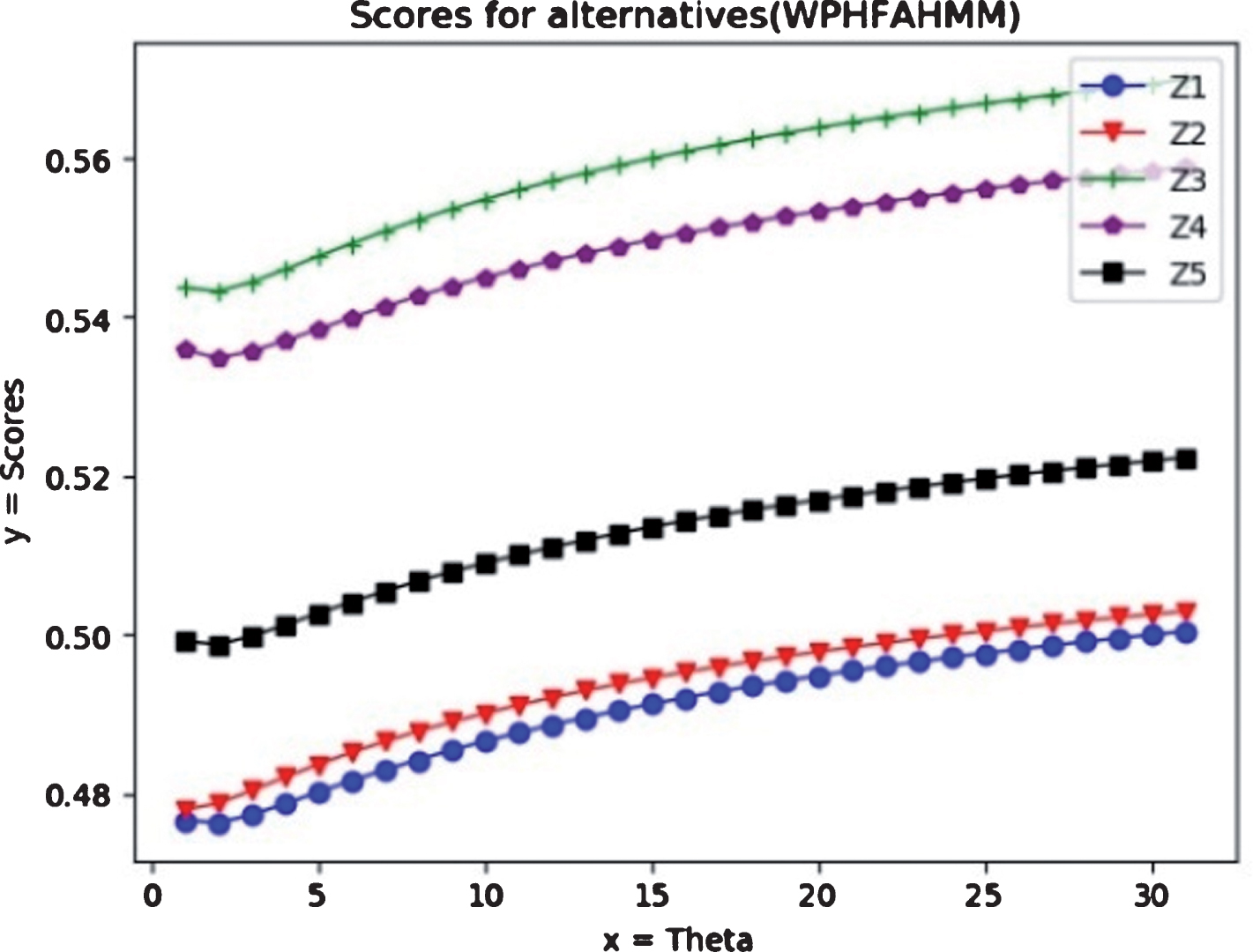
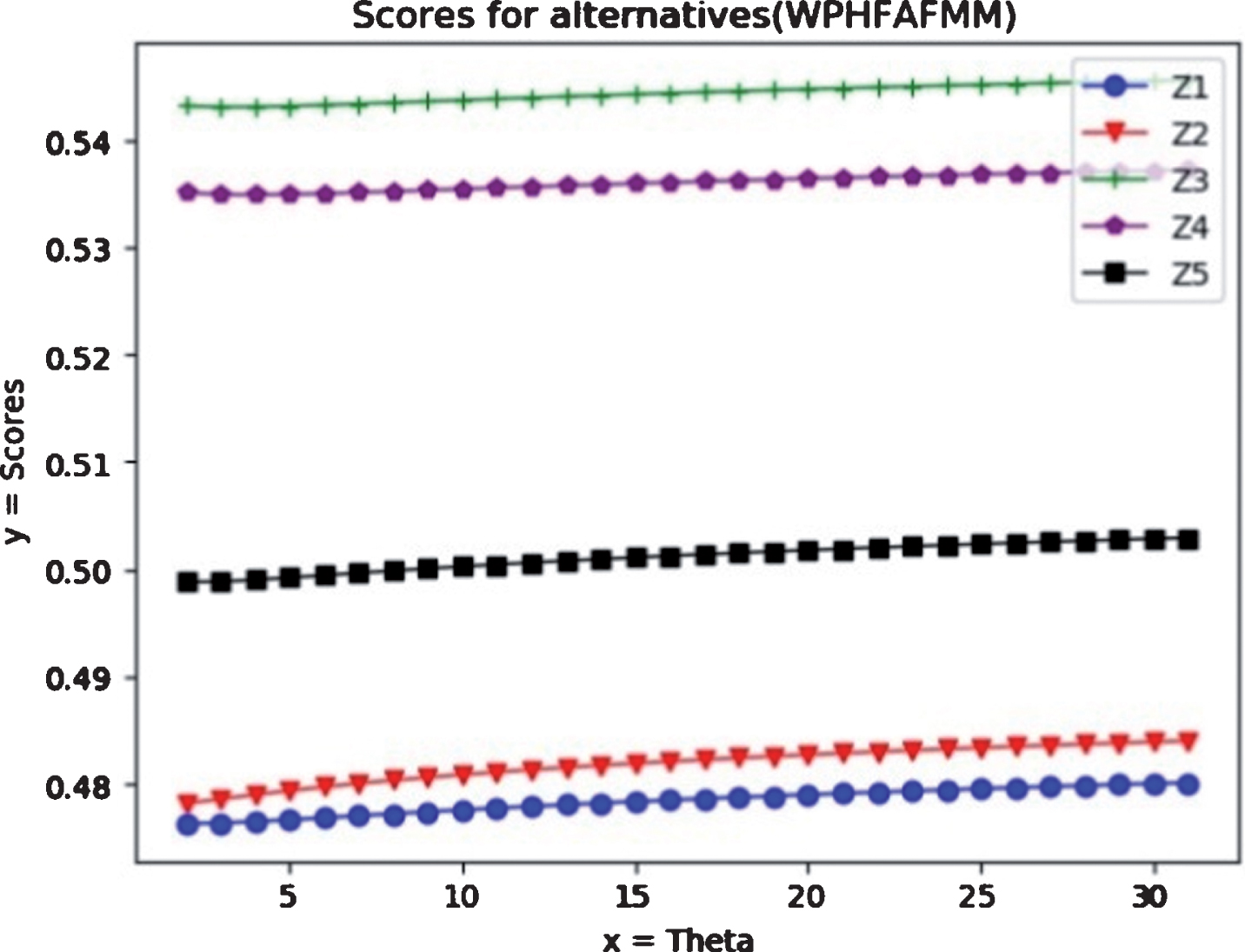
Experiment 2 was carried out to show the effect of assigning different values to on the aggregation result. (h ij ) m×n, Q = (1, 1, 1, 1), θ and w = (0.4, 0.1, 0.2, 0.3) T were used as the input of WPHFAHMM and WPHFAFMM operators. The value of the parameter θ was adapted from 1 to 32. The scores obtained by the WPHFAHMM and WPHFAFMM operators are shown in Figs. 1 and 2, respectively.
The scores of alternatives obtained by WPHFAHMM.
The scores of alternatives obtained by WPHFAFMM.
From Figs. 1 and 2, it can be observed that the score values increase as θ increases. The ranking orders of the two operators remain the same. This reveals that both the WPHFAHMM and WPHFAFMM operators are effective for solving the MCDM problems based on PHFNs.
It’s worth noting that, as described in subsection 3.2 (Equation (26)), if the value of the parameter θ is assigned as 1 and 2, the WPHFAHMM operator will reduce to the WPHFAAMM and WPHFAEMM operators, respectively. The score values and the sort of alternatives derived from the WPHFAAMM and WPHFAEMM operators are presented in Table 6 with the condition that Q = (1, 1, 1, 1) and w = (0.4, 0.1, 0.2, 0.3) T . From Table 6, it can be observed that the ranking orders of the two operators are the same, which is consistent with the result of Experiment 1.
The results of WPHFAAMMand WPHFAEMM
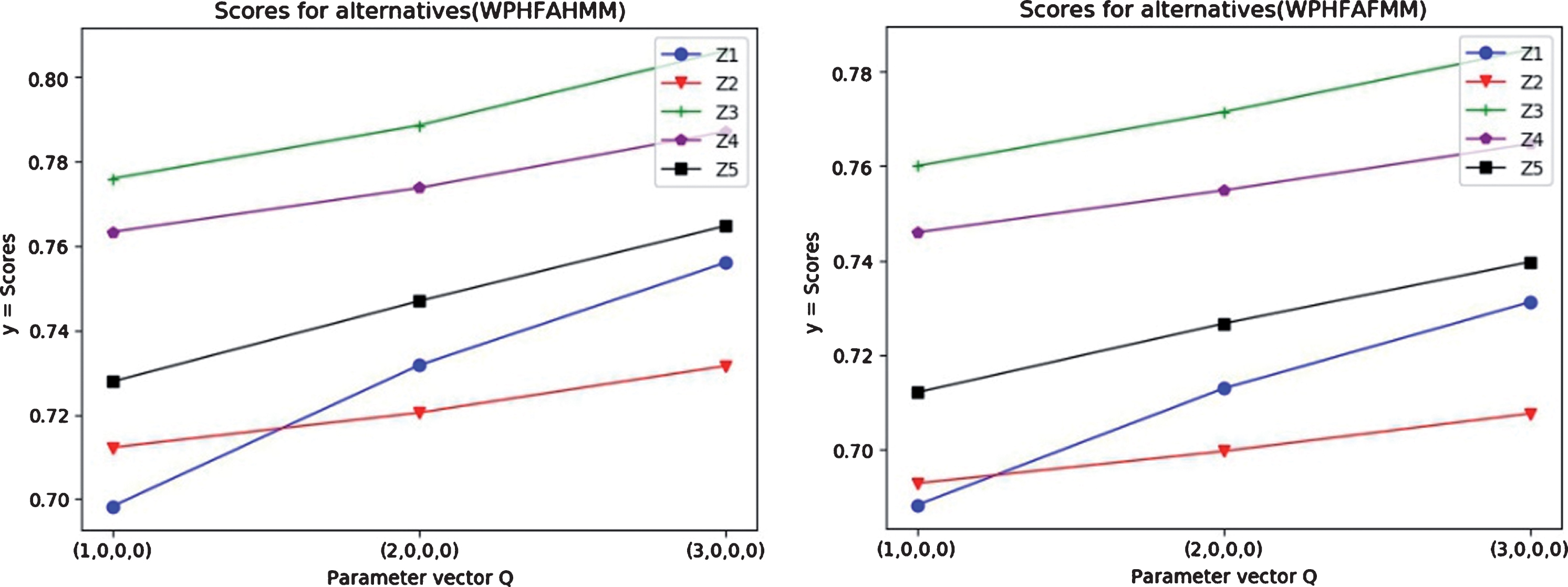
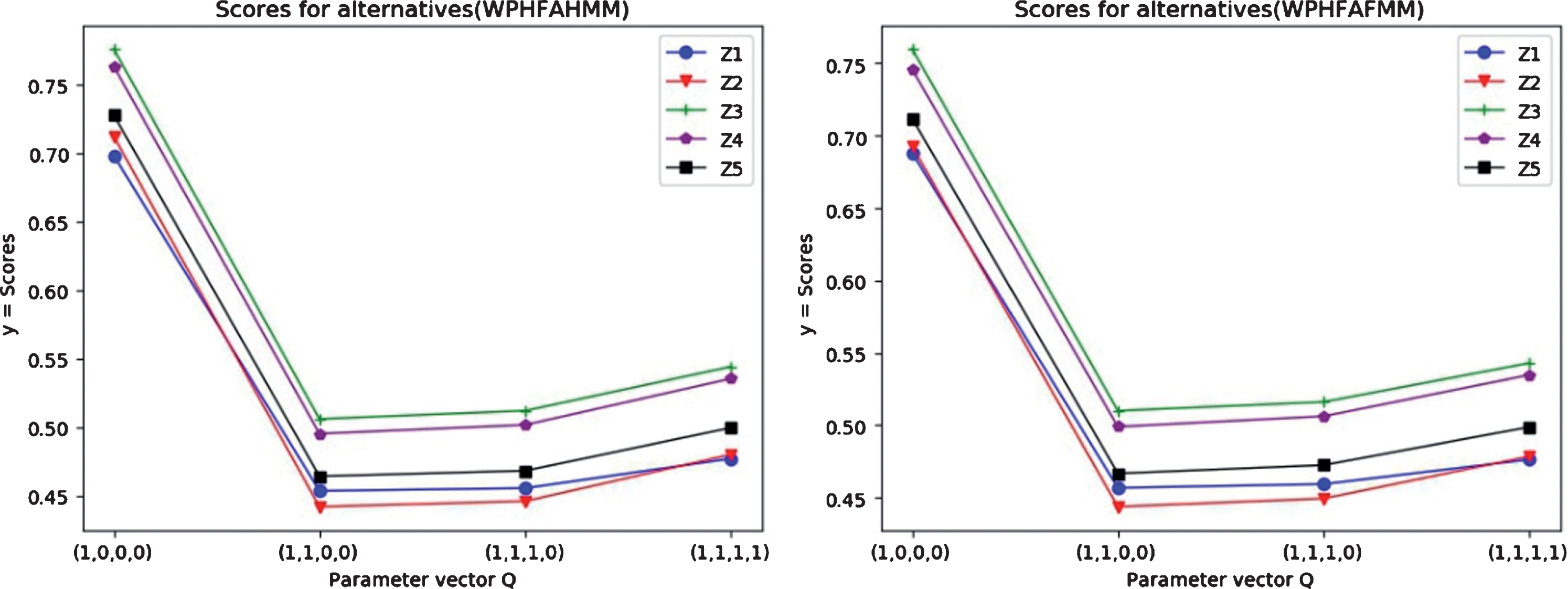
Experiment 3 was carried out to show the effect of assigning different values to Q on aggregation result. (h ij ) m×n, Q, θ = 3 and w = (0.4, 0.1, 0.2, 0.3) T were used as the input of the WPHFAHMM and WPHFAFMM operators. There are seven groups of values of Q. The results of the two operators are shown in Table 7.
The results of experiment 3. Note: θ = 3
In Table 7, when Q = (3, 0, 0, 0), Q = (2, 0, 0, 0), Q = (1, 1, 0, 0) and Q = (1, 1, 1, 0), the rankings are z3 > z4 > z5 > z1 > z2. When Q = (1, 0, 0, 0), Q = (1, 1, 1, 1) and Q = (0.25, 0.25, 0.25, 0.25), the rankings are z3 > z4 > z5 > z2 > z1. Though the rankings change slightly, the best alternatives remain the same (i.e., z3). When Q=(1,0,0,0), it’s worth noting that WPHFAMM operator reduces to the APHFWA operator [35].
In addition, Figs. 3 and 4 draw our attention to the diversification of the parameters Q in more details: 1) For the WPHFAHMM and WPHFAFMM operators with the condition that θ = 3, the larger the real number of Q, the greater the value of the score function when Q has merely one real number and the rest are 0; 2) For the WPHFAHMM and WPHFAFMM operators with the condition that θ = 3, the more complex relationships among criteria, the greater the value of the score function when Q has more than one real number. Based on this, decision makers can choose different values of Q according to the actual relationships of criteria.
Scores of alternatives for different parameters Q.
Scores of alternatives for different parameters Q.
So far, a number of MCDM methods based on the operators that can aggregate PHFNs have been proposed. In this subsection, these MCDM methods are compared with the developed method in this paper. Specifically, the comparison methods include the methods based on the Pythagorean hesitant fuzzy Hamacher ordered weighted averaging (PHFHOWA) and Pythagorean hesitant fuzzy Hamacher ordered weighted (PHFHOWG) operators [30], the Pythagorean hesitant fuzzy Hamacher weighted averaging (PHFHWA) and Pythagorean hesitant fuzzy Hamacher weighted geometric (PHFHWG) operators [35], the weighted Pythagorean hesitant fuzzy Maclaurin symmetric mean (WHPFMSM) operator [31], the Pythagorean hesitant fuzzy Hybrid weighted averaging (PHFHWA) and Pythagorean hesitant fuzzy Hybrid weighted geometric (PHFHWG) operators [33], and the presented WPHFAMM operator. A qualitative comparison and a quantitative comparison among these methods are carried out to verify the effectiveness and show the advantages of the proposed method.
Qualitative comparison
This comparison is carried out by comparing the characteristics of the selected methods. The comparable characteristics are the generality of aggregation operators, whether takes into account the interrelationships of different criteria and the flexibility of aggregation operators. The comparison results are shown in Table 8. The details of the comparison are explained as follows:
The results of the qualitative comparisons of different methods
The results of the qualitative comparisons of different methods
Generality. The PHFHOWA and PHFHOWG method [30], the PHFHWA and PHFHWG method [35], and the PHFHWA and PHFHWG method [33] are based on a specific type of ATT. The WHPFMSM method [31] and the proposed method are based on any types of ATTs. Therefore, the WHPFMSM and proposed methods are more general than the remaining methods. Further, the proposed method provides more satisfying generality than the WHPFMSM method since the MSM operator is a special case of the MM operator.
Interrelationships. Among the comparison methods, the WHPFMSM and proposed methods have the capability to deal with the interrelationships of different criteria in MCDM problems because they respectively use the MSM and MM operators.
Flexibility. Since any types of ATTs can provide flexible parameters, the WHPFMSM and proposed methods are more flexible than the remaining methods.
As can be summarized from the qualitative comparison, the proposed method not only has desirable generality and flexibility, but also can consider the interrelationships of criteria more comprehensively.
The quantitative comparison is carried out based on the numerical example in subsection 5.1. In this comparison, the PHFHOWA [30], PHFHOWG [30], PHFHWA [35], PHFHWG [35], WHPFMSM [31], PHFHWA [33], PHFHWA [33] and proposed methods are applied to resolve the MCDM problem in the example. The results of the experiment are the rankings of the five alternatives, which are shown in Table 9.
The results of the quantitative comparison of different methods
The results of the quantitative comparison of different methods
As can be seen from Table 9, the first two optimal alternatives derived from all comparison methods are z3 and z4, which demonstrate the feasibility and effectiveness of the proposed method. Careful readers may find that the ranking of the proposed method is slightly different at the third, fourth and fifth places with the rankings of the PHFHWA, PHFHWG, WHPFMSM and PHFHWA methods. The reason is that different methods use different aggregation operators and have different mathematical properties.
The ATT can generate versatile and flexible operational laws for fuzzy numbers, while the MM operator is capable of capturing the interrelationships of aggregated arguments. In this paper, the MM operator and the ATT have been combined to present a PHFAMM operator and a WPHFAMM operator, and a MCDM method based on these operators has been proposed. To be more specific, the generalised and specific expressions of the two operators have been constructed and their properties have been explored and proved. The paper has also reported a practical example, a set of experiments, and qualitative and quantitative comparisons to demonstrate the proposed method. The demonstrate results suggest that the method is feasible and effective that can provide desirable generality and flexibility in aggregation of criterion values and capturing of criterion relationships.
In future work, the application of the proposed method in real decision-making problems will be studied. The application of the similarity measures of the presented operators in knowledge graphs is a representative example that will be studied. Further, other types of aggregation operators can easily be derived by combining the MM operator with dual hesitant Pythagorean fuzzy information and ATT or the triangle intuitionistic fuzzy information and picture fuzzy information. The development of 2-tuple linguistic neutrosophic fuzzy Archimedean MM operators may also be explored. For all of these studies, the research findings in references [32, 48– 52] could be helpful.