







Abstract
With resource exhaustion and environmental problems becoming more and more serious, green supply chain management attracts the attention of enterprises and scholars. For a new type of environmental-friendly product in this supply chain, we have no enough historical data to refer the demand. Hence, uncertainty theory is introduced as a tool to characterize the uncertainty of demand. Then this paper investigates the pricing, green degree and sales effort decisions in a green supply chain with a manufacturer and a retailer, where the demand of the product is described by uncertain variable. Considering the different power structures of supply chain, we build three expected value models and obtain equilibrium solutions, respectively. Then we analyze the influences of uncertain parameters and different power structures on decisions and profits. The results show that the green degree coefficient and sales effort coefficient have positive influences on the pricing, green degree and sales effort. Moreover, the results also show that decision leaders do not necessarily make more profits, which is up to the weights of green degree and sales effort. In addition, numerical analyses are given to show the correctness of results.
Introduction
In recent years, the environmental problem have become increasingly prominent with the rapid development of economy. In order to cope with the environmental crisis, numerous countries and organizations have taken actions to realize the target of sustainable development, which aims to achieve the coordinated development of economy, society and environment. The United National Environment Programme has pointed out that the earth ecosystem and the sustainable development would be faced with great threats unless we take measures immediately [10]. Thus, the sustainable green supply chain management has attracted lots of attention of many scholars. The stages of green supply chain include raw materials procurement, green production, green marketing, green package, green consumption and reverse logistics, and the green production plays an important role in the decision-making process of supply chain [16]. The manufacture of green products can help enterprises to get competitive advantages in the market and establish a good image [29]. Generally, the green degree of products refers to the friendly degree of green products towards environment and is evaluated by the Analytic Hierarchy Process with respect to the economic, social and ecological indicators [2].
From the perspective of human beings, their environmental awareness is increasing under the environmental pressure. Consequently, consumers tend to buy environmental-friendly products, and they are willing to pay a premium for green products. In 2015, a market research firm GfK found that 80% of Chinese consumers claim that a brand or an enterprise should take responsibility for environment [9]. Another investigation indicated that more and more consumers show their environmental concern and desire to purchase green products [13]. Therefore, the influence of consumer’s environmental awareness on green production should not be ignored. While consumer’s environmental awareness does not always lead to the green purchasing behavior [28]. In this case, sales effort is an effective way to convert the environmental awareness into the purchase behavior [4], such as green advertising [8], that is, sales effort is an important factor in pricing decision.
In the past decades, the pricing decision problem of supply chain was studied widely. For instance, Liu et al. [20] investigated the impacts of consumer environmental awareness and competition level on the profits of channel members, and found that retailers’ profits increase with the intensification of production competition. Ghosh and Shah [6] analyzed the impact of cost-sharing contract on key decisions of supply chain players, and the result showed that cost-sharing contract is beneficial to manufacturers and supply chain’s performance. Pan et al. [24] studied different contract strategies under different power structures, and found that the revenue-sharing contract is beneficial to manufacturer under the manufacturer-dominant scenario. Basiri and Heydari [1] investigated the green channel coordination issue with substitutable products and proposed a collaboration model.
All the literatures mentioned above were studied in a certain situation. As we all know, there are many indeterministic phenomena in real life, and their influences on the decision-making process in supply chain can not be neglected. Some researches considered demand to be random and investigated multiple decision scenarios. For example, Mills [23] studied and compared the prices between certain and stochastic demand. Giri et al. [7] discussed the three-stage supply chain with random demand, which found that the repurchase contract is invalid in coordinating the supply chain. Hua and Li [11] introduced the sensitivity of the retailer’s order amount to manufacturer’s wholesale price, and developed a non-cooperative game model dominated by the retailer. They investigated two cooperative scenarios both with exogenous and endogenous retail-prices. Shi et al. [27] explored the influences of the different power structures on the performance of supply chain and the consumer welfare in stochastic environment. Xu et al. [30] studied a new income distribution mechanism for resource-based supply chain cooperation using the improved Shapley value method under random demand.
However, the premise of using probability theory is that the estimated cumulative probability distribution is close enough to the real frequency, which implies that we have to acquire a large number of effective data. Instead, the probability theory is invalid when historical data are lacking. For a new type of component, we may not precisely know its product quality and product life cycle. In this situation, we have to invite experts to give belief degrees to estimate the chance of event occurring. While Kahneman and Tversky [14] insisted that human beings usually overrate the impossible events. Liu [19] also pointed out that the gap between human estimation and real value is large. As a result, the belief degree should not be treated as a probability measure. In this situation, fuzzy set theory is an effective tool to handle this complicated nondeterministic environment. Many scholars have used triangular fuzzy random variable to describe the uncertainty factors. For instance, Zhao et al. [33] proposed a buyback contract model accounting for the fuzzy random demands with different risk attitudes. The results made clear that the model can allocate total benefits more fairly and keep the supply chain system stable by updating the buyback contract. Zhao and Wei [32] investigated the coordination of a two-echelon supply chain with fuzzy demand and developed two coordinating models based on symmetric information and asymmetric information about retailer’s scale parameter. Yang and Xiao [31] studied how channel leadership and governmental interventions influence prices, green levels and expected profits. Their investigation indicated that governmental interventions are not always beneficial to the green supply chain and the manufacturer.
When indeterminate phenomena behave neither randomness nor fuzziness, we need to find a new tool to deal with belief degree. Thus, Liu [17] introduced uncertainty theory in 2007, and characterized the belief degree by uncertain measure. Huang and Ke [12] firstly introduced uncertainty theory into the pricing decision problem of supply chain, in which the manufacturing cost, sales cost and demand are uncertain and described by uncertain variables. They studied the pricing strategies competitive manufacturers under different power structures. Further more, Chen et al. [3] regarded the retailer’s sales effort to be uncertain which depicted by an uncertain variable, and given a new form of sales effort cost. Afterwards, they discussed the influences of uncertain parameters on the pricing and sales effort decisions. Ke et al. [15] investigated the pricing decision problem in the case of manufacturer distributing products through traditional offline channel and e-commence online channel. Sang [25] studied the pricing and green degree decisions with a risk averse retailer in uncertain environment. The result showed that the manufacturer makes more profits when the retailer is more risk sensitive. Following that, Shen and Zhu [26] investigated the decision-making problem basing on the information about retailer’s scale parameter, and developed two coordination models with symmetric and asymmetric information.
Commonly, in many literatures, there are three power structures in two-stage supply chain: manufacturer-dominant game, retailer-dominant game and Nash game. Due to retailers power rising, such as Carrefour and JD, they own more power and even become a leader in the decision of supply chain [5]. The change of channel power structures has a significant impact on the decision level of supply chain [21]. Thus, we are interested in studying how supply chain make decisions under different structures. Combing through the previous literature, we found that no literature studied the pricing, green degree and sales effort decisions of a two-stage supply chain including a manufacturer and a retailer with uncertain demand under assumption that the coefficients of price, green degree and sales effort are simultaneously described by uncertain variables. Hence, we introduce uncertainty theory into the supply chain management in this case and explore the pricing, green degree and sales effort decisions of the two-stage supply chain. The wholesale price and green degree are determined by manufacturer, while the retail price and sales effort are determined by retailer. We build three models under different power structures: (1) integrated scenario, (2) manufacturer-dominant scenario, and (3) retailer-dominant scenario. Then we compare the decision level of each model, and discuss how power structures and uncertain parameters influences the performance of supply chain.
After analysis, the price parameter β has a negative impact on the optimal green degree, pricing and sales effort decisions, while the green degree parameter θ and sales effort parameter γ have positive impacts on the optimal green degree, pricing and sales effort decisions, respectively. Following that, we found that green degree and sales effort level are affected by the decision-making order and their ranking is related to the value of parameters. Finally, when manufacturer has high bargaining power in the supply chain, he does not necessarily benefit more from his high bargaining power. Therefore, in some cases, it is better for manufacturer to abandon the dominance. The rest of the paper is organized as follows. In section 2, some important definitions and theorems of uncertainty theory are introduced. Section 3 proposes the notations and assumptions for the models. In section 4, we build three models and obtain the equilibrium solutions. In addition, the solutions are compared for the analysis of chain’s performances in three models. Section 5 offers numerical experiment to verify the correctness of the result and analyze the sensitivity of parameters. In section 6, the conclusion is given.
Preliminaries
Uncertainty theory was found by Liu [17] in 2007 which is a branch of axiomatic mathematics for modeling human uncertainty. Some important definitions and theorems of uncertainty theory are introduced in the following to solve pricing issue in our study.
Let Γ be a nonempty set, and let ℒ be a σ-algebra over Γ. Each element Λ in ℒ is called an event.
The triplet (Γ, ℒ, ℳ) is called an uncertainty space. Furthermore, a product uncertain measure was defined by Liu [17]: Axiom 4. (Product Axiom) Let (Γ
k
, ℒ
k
, ℳk) be uncertainty spaces, k = 1, 2, ⋯. If a product uncertain measure ℳ satisfies
We consider a supply chain with a manufacturer and a retailer, where the manufacturer pays investment in the green degree of products and distributes green products to the retailer, then the retailer sells green products to final consumers by making sales effort. The green degree and the wholesale price are determined by manufacturer. The sales effort and the retail price are determined by retailer.
The customer demand function D can be expressed as follows:
This linear form of demand function could be found in [22]. Here, a is the total market potential, p is the retail price, e is the green degree of products, and s is the retailer’s sales effort. Let β, θ and γ represent retail price coefficient, green degree coefficient and sales effort coefficient, respectively. Considering a new product lack of historical data, we suppose that β, θ and γ are independent nonnegative uncertain variables with regular uncertainty distributions Φ1, Φ2, Φ3, respectively. Moreover, the expectation of β, θ and γ exist. Similar to the Reference [25], the greening investment cost is written by
According to the above assumptions, the manufacturer’s profit function is formulated as
The channel profit function can be written as
To keep the supply chain profitable, the customer demand of green product should be nonnegative, and the retail price should be larger than marginal manufacturing cost. That is, a - βp + θe + γs > 0 and p > w > c.
In this section, we establish three models under integrated scenario, manufacturer-dominant scenario and retailer-dominant scenario, and derive the equilibrium solutions. Then we compare the performances of supply chain in these three models.
Integrated scenario
Under the integrated scenario, the manufacturer and the retailer form an ideal organization and make decisions together to maximizing the total expected channel profit. The decision model under the integrated scenario is a single-level programming model, which can be built as following format:
Then the optimal expected channel profit
Proposition 1 is verified in Appendix.
Manufacturer-dominant scenario
Under the manufacturer-dominant scenario, the manufacturer and the retailer make their decisions alone in order to achieve their own maximal expected profits. It is a bi-level programming problem, in which the manufacturer decides the wholesale price and green degree first, and then the retailer decides the retail price and sales effort. The expected value model can be formulated as follows:
The optimal expected profit of manufacturer is
Proposition 2 is proved in Appendix.
The optimal expected profit of retailer is
Then the optimal expected channel profit is
Proposition 3 is shown in Appendix.
Retailer-dominant scenario
Under the retailer-dominant scenario, the manufacturer and the retailer make their decisions alone in order to achieve their own maximal expected profits. It is a bi-level programming problem, in which the retailer decides the retail price and sales effort first, then the manufacturer decides the wholesale price and green degree. The expected value model can be formulated as follows:
Hence, the optimal profit of manufacturer is
The proof of Proposition 4 is in Appendix.
The optimal expected profit of retailer is
Thus, the optimal expected channel profit is
Proposition 5 is proved in Appendix.
Discussion
In this subsection, we investigate the impacts of parameters, and compare the performances of green supply chain in the above three models. After that, some corollaries are obtained.
(1) The optimal green degree, retail price, sales effort and expected channel profit rise when E [θ] increases.
(2) The optimal green degree, retail price, sales effort and expected channel profit rise when E [γ] increases.
The result of Corollary 1 indicates that the optimal green degree, retail price and expected channel profit increase with the rise of E [θ]. The manufacturer would be encouraged to invest more in the improvement of green degree for products when E [θ] rises because the demand is positively related to E [θ]. Following that, the retailer will make more sales efforts for green products. Consequently, the demand and the expected channel profit will grow. However, more greening investments mean higher manufacturing costs, which brings higher retail prices. In this situation, consumers have to pay more for green products. Similarly, the optimal green degree, retail price and expected channel profit increase with the rise of E [γ]. Due to the demand being positively related to E [γ], the demand will improve with E [γ] increasing, which inspires the retailer to make more sales efforts for green product. Affected by the retailer behavior, the manufacturer will invest more in the improvement of green degree, then the demand and expected channel profit will augment. More investments to sales effort mean higher costs, so the retail price will grow.
(1) If hE2 [γ] > kE2 [θ], then eI∗ > eℳ∗ > eR∗, sI∗ > sℳ∗ > sR∗ and
(2) If hE2 [γ] = kE2 [θ], then eI∗ > eℳ∗ = eR∗, sI∗ > sℳ∗ = sR∗ and
(3) If hE2 [γ] < kE2 [θ], then eI∗ > eR∗ > eℳ∗, sI∗ > sR∗ > sℳ∗ and
Corollary 2 shows that the optimal green degree, the sales effort and the expected channel profit are greatest in integrated scenario. It means that the integrated decision is more environmental-friendly and profitable than that in other scenarios. So the collaboration of chain members can help chain to improve environmental performance significantly and boost more profits.
(1) If hE2 [γ] = kE2 [θ] and
(2) If hE2 [γ] = kE2 [θ] and
(3) If hE2 [γ] > kE2 [θ] and
(4) If hE2 [γ] > kE2 [θ] and
(5) If hE2 [γ] < kE2 [θ] and
(6) If hE2 [γ] < kE2 [θ] and
Corollary 3 indicates that when
(1) If hE2 [γ] > kE2 [θ], then
(2) If hE2 [γ] = kE2 [θ], then
(3) If hE2 [γ] < kE2 [θ] and
(4) If hE2 [γ] < kE2 [θ] and
Corollary 4 implies that when hE2 [γ] > kE2 [θ], the expected profit of manufacturer is larger in manufacturer-dominant scenario than that in retailer-dominant scenario. When hE2 [γ] = kE2 [θ], the expected profit of manufacturer in manufacturer-dominant scenario is equal to that in retailer-dominant scenario. When hE2 [γ] < kE2 [θ], if E [β] satisfies
(1) If hE2 [γ] > kE2 [θ] and
(2) If hE2 [γ] > kE2 [θ] and
(3) If hE2 [γ] = kE2 [θ], then
(4) If hE2 [γ] < kE2 [θ], then
Corollary 5 shows that when hE2 [γ] > kE2 [θ], if E [β] satisfies the condition
The proof of all corollaries above are shown in Appendix.
Numerical analyses
Numerical experiment
In this section, we employ a numerical example to illustrate the effectiveness of the proposed method. According to the Reference [3] and the assumptions mentioned above, Table 2 shows the basic parameters. By Theorem 1, we have
Notations
Notations
The value of parameters
Substituting the above values in Table 2 into the corresponding parameters, we derive the optimal decisions and profits under different structures shown in Table 3.
The optimal decisions
From Table 3, we come to the conclusion that the green degree, the sales effort and the expected channel profit are highest in integrated scenario. It means that the economic performance and environmental performance of supply chain are greatest in the integrated scenario. Thus, the integrated decision-making should be taken in supply chain for the coordinated development of economy and environment, which is consistent with Corollary 2. Another conclusion is that the dominated enterprise can get more profits in this situation. Therefore, the manufacturer and the retailer will fight for the decision-making dominance. These are consistent with the previous results and corollaries.
In this subsection, we analyze the influence of parameter θ on the green degree, sales effort, retail price, expected profit of manufacturer, expected profit of retailer and expected channel profit in three models. The remaining parameters are assumed as follows: a = 150, c = 15, h = 1, k = 1, β = ℒ (7, 9) , γ = ℒ (1, 3).
As shown in Figure 1, the green degree in these three scenarios is rising with the increase of E [θ]. The green degree in integrated scenario is always higher than that in other two scenarios. The green degree in manufacturer-dominant scenario is higher than that in retailer-dominant scenario when E [θ] is small enough, and the difference of green degree narrows between two decentralized scenarios. When E [θ] is greater than a threshold in Corollary 2, the green degree in retailer-dominant scenario is higher than that in manufacturer-dominant scenario. From Figure 2 and Figure 4, we can draw the similar conclusions, the sales efforts and the expected channel profits are climbing with the increase of E [θ] in three scenarios. The results above are in line with the common sense.
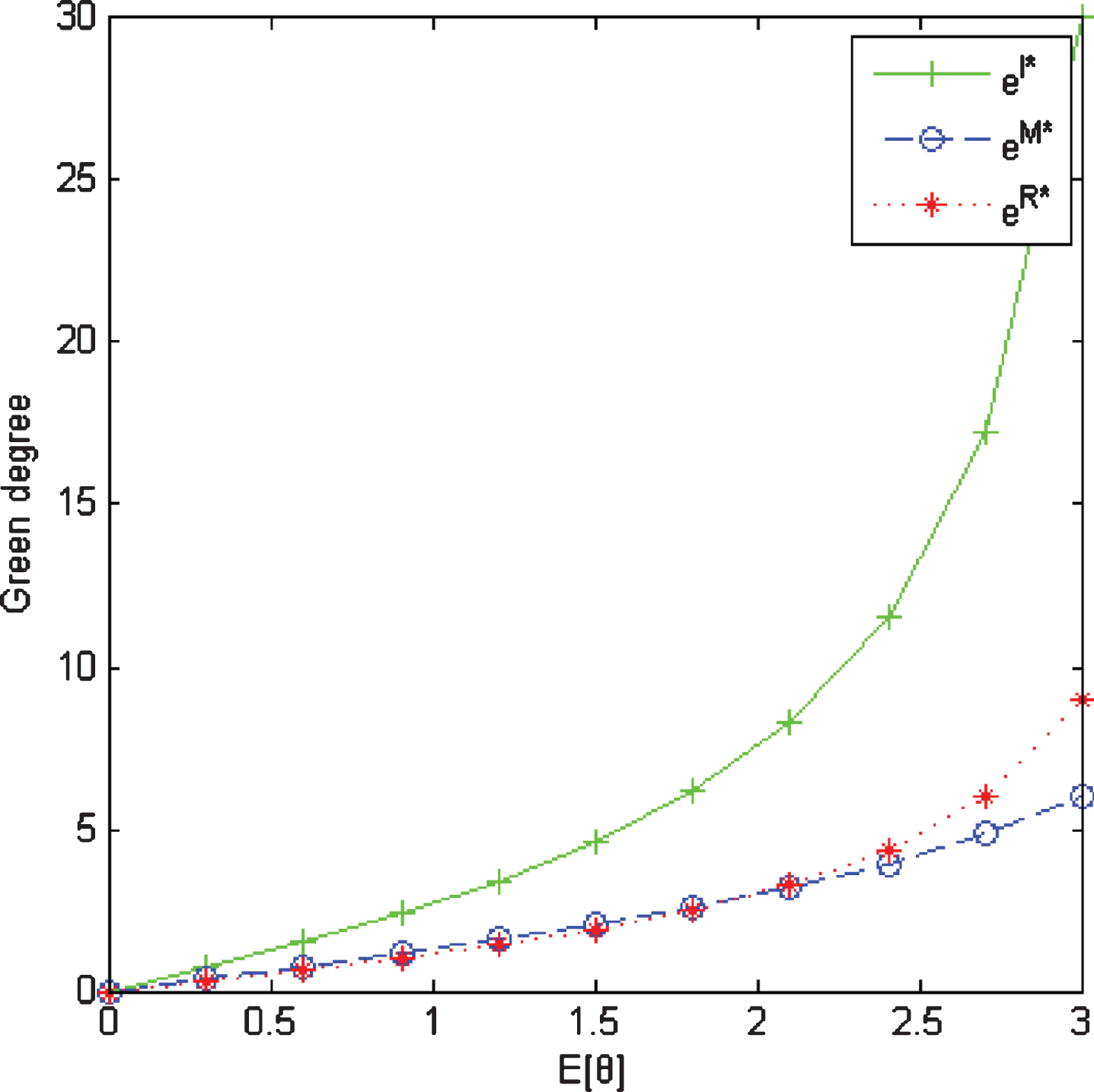
The effect of E [θ] on green degree.

The effect of E [θ] on sales effort.
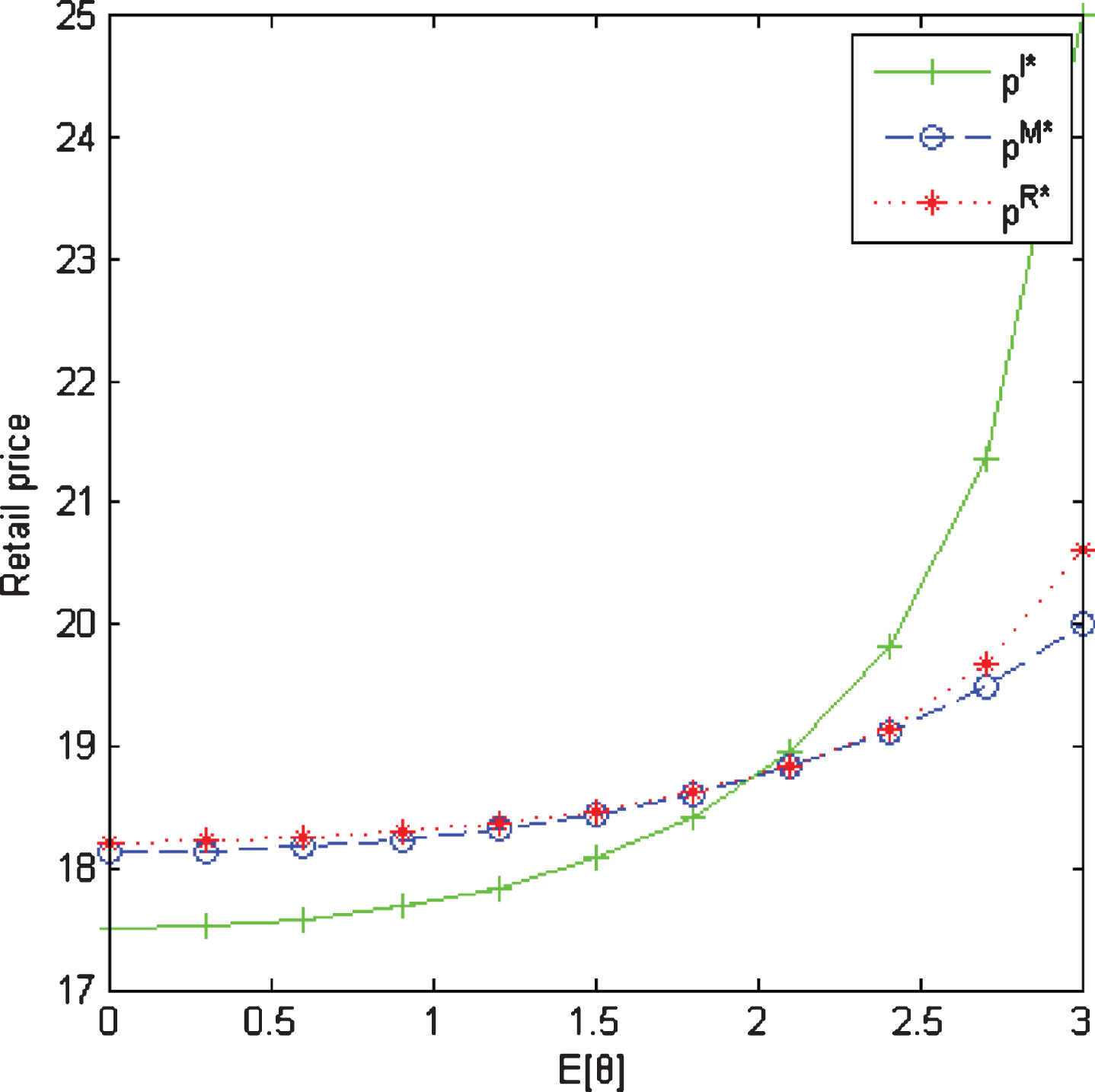
The effect of E [θ] on retail price.
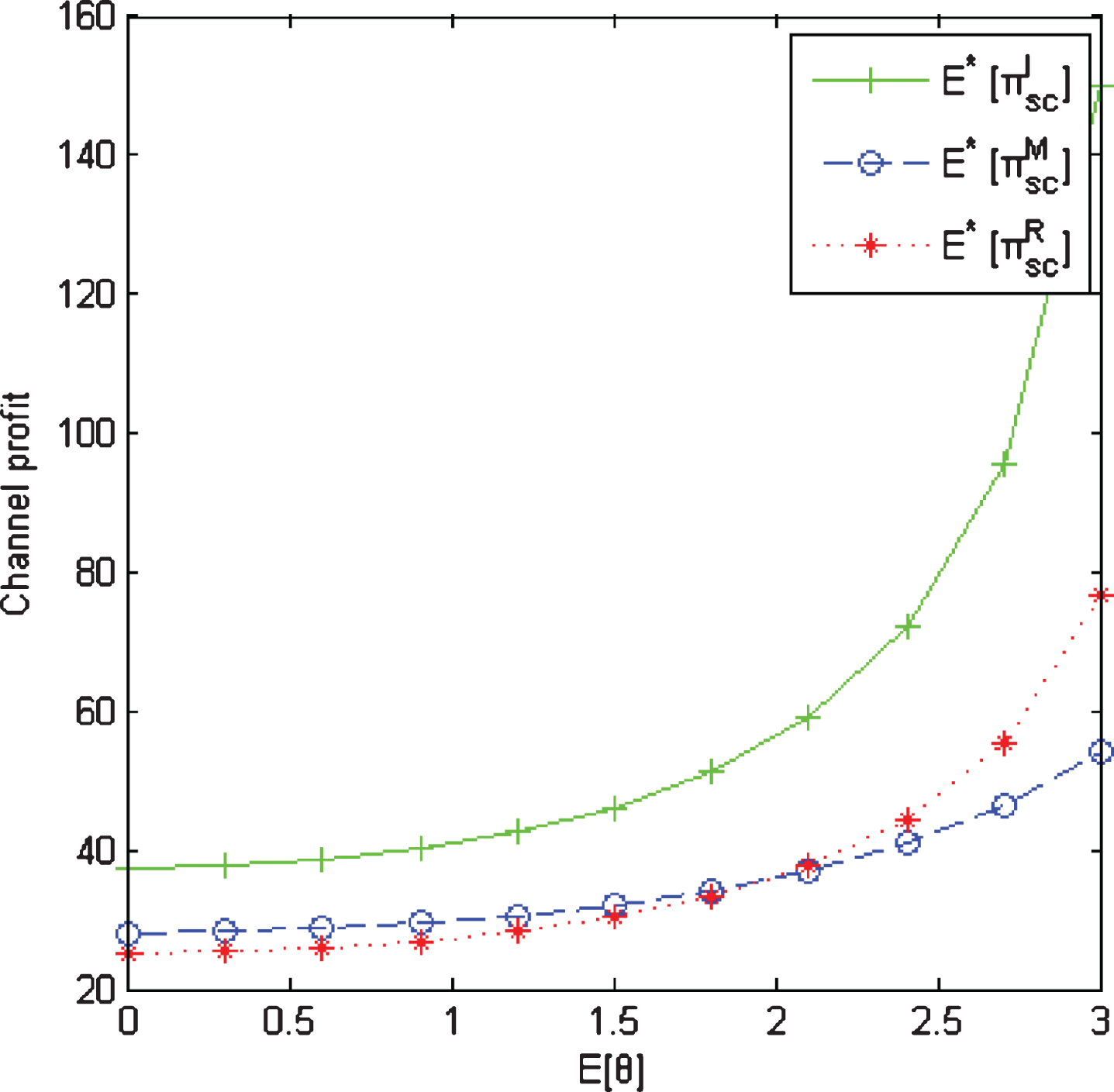
The effect of E [θ] on the expected channel profit.
As shown in Figure 3, when E [θ] increases, the retail price rises in these three scenarios because the greening investment increases concerning E [θ] leading to high cost. The retail price is highest in retailer-dominant scenario and lowest in integrated scenario when E [θ] is small enough. As E [θ] increases, the difference of green degree in three scenarios decreases. When E [θ] is larger than a threshold in Corollary 2, the retail price in integrated scenario is higher than that in other two scenarios.
As shown in Figure 5, the expected profit of manufacturer expands when E [θ] increases in manufacturer-dominant scenario and retailer-dominant scenario because the rise of E [θ] can bring about an improvement of demand. As E [θ] grows, the order of the expected profit of manufacturer in such two scenarios is changing. Similarly, the comparison of the expected profit of retailer in such two models shown in Figure 6, it claims that the expected profit of retailer increases with the rise of E [θ] in such two scenarios and is larger in retailer-dominant scenario than that in manufacturer-dominant scenario.
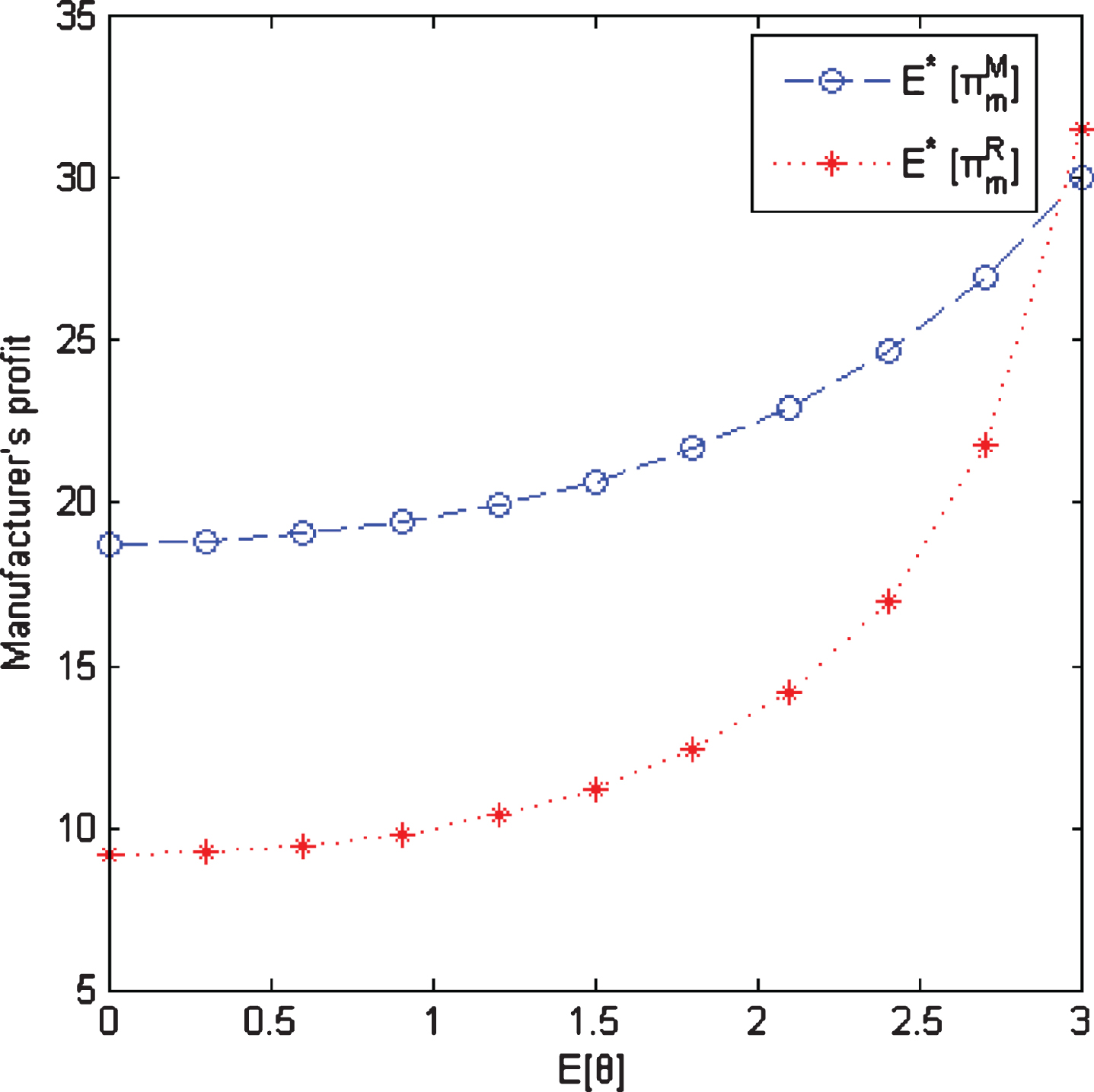
The effect of E [θ] on the expected profit of manufacturer.
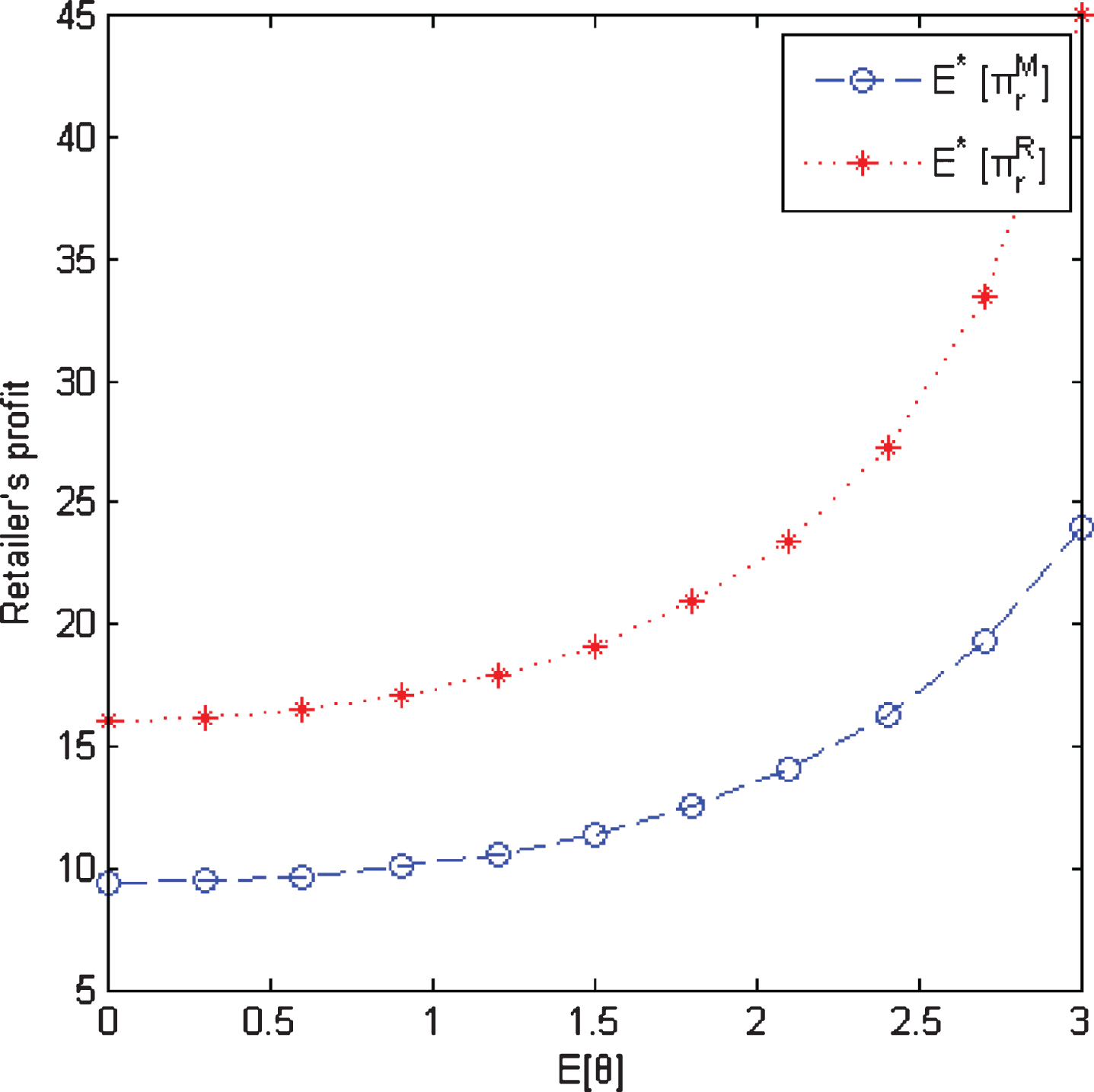
The effect of E [θ] on the expected profit of retailer.
In this subsection, we analyze the influence of parameter γ on the green degree, sales effort, retail price, expected profit of manufacturer, expected profit of retailer and expected channel profit in three models. The remaining parameters are assumed as follows: a = 150, c = 15, h = 1, k = 1, β = ℒ (7, 9) , θ = ℒ (1, 3).
As Figure 7 shows, the green degree in these three scenarios is growing with the increase of E [γ] and is highest in integrated scenario. The green degree in manufacturer-dominant scenario is higher than that in retailer-dominant scenario when E [γ] is below a threshold in Corollary 2. While the green degree in retailer-dominant scenario is larger than that in manufacturer-dominant scenario when E [γ] is larger than this threshold. From Figure 8, we can obtain similar results that the sales effort and the expected channel profit are rising with increasing E [γ] in three scenarios and are greatest in integrated scenario.
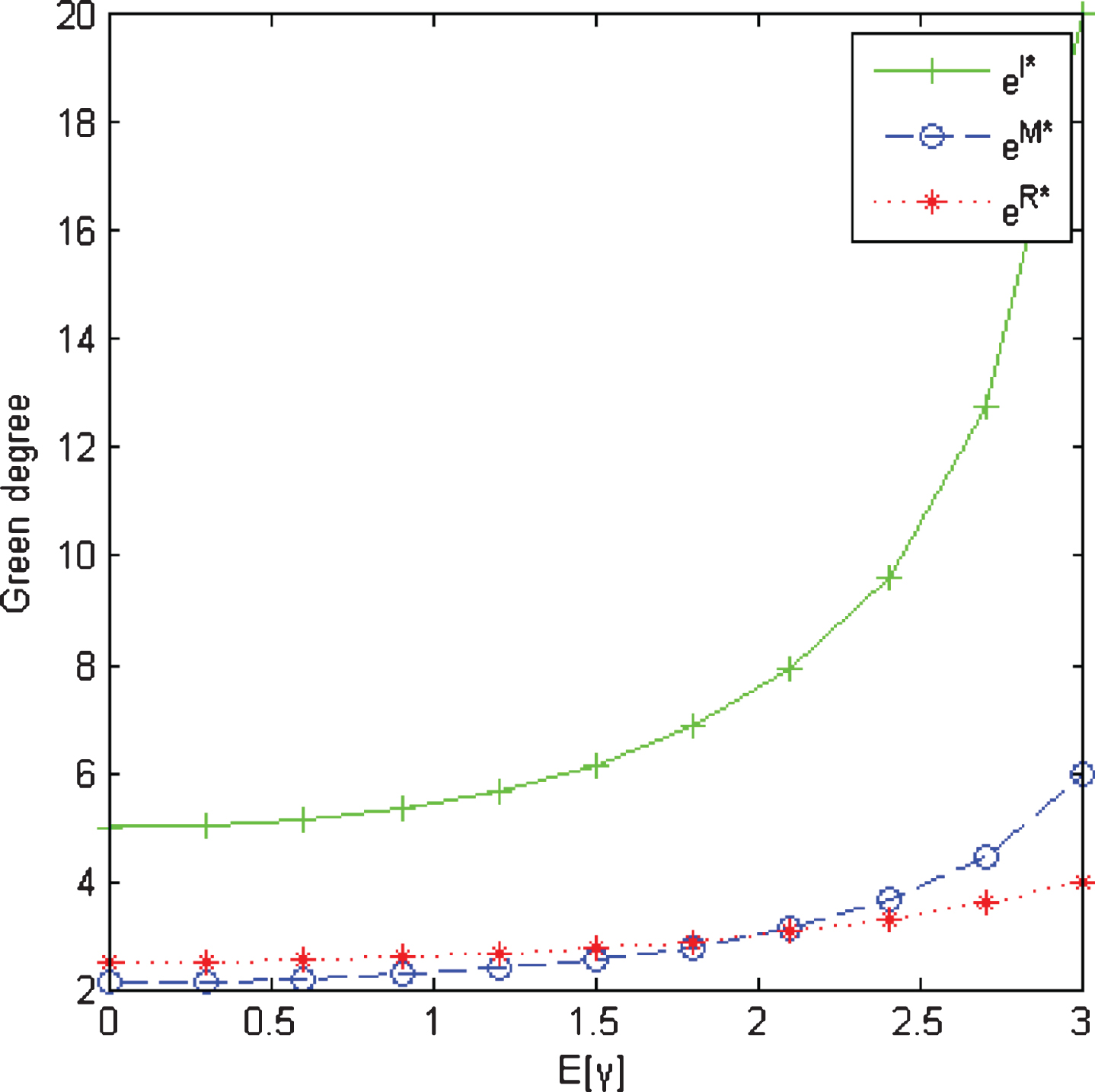
The effect of E [γ] on green degree.
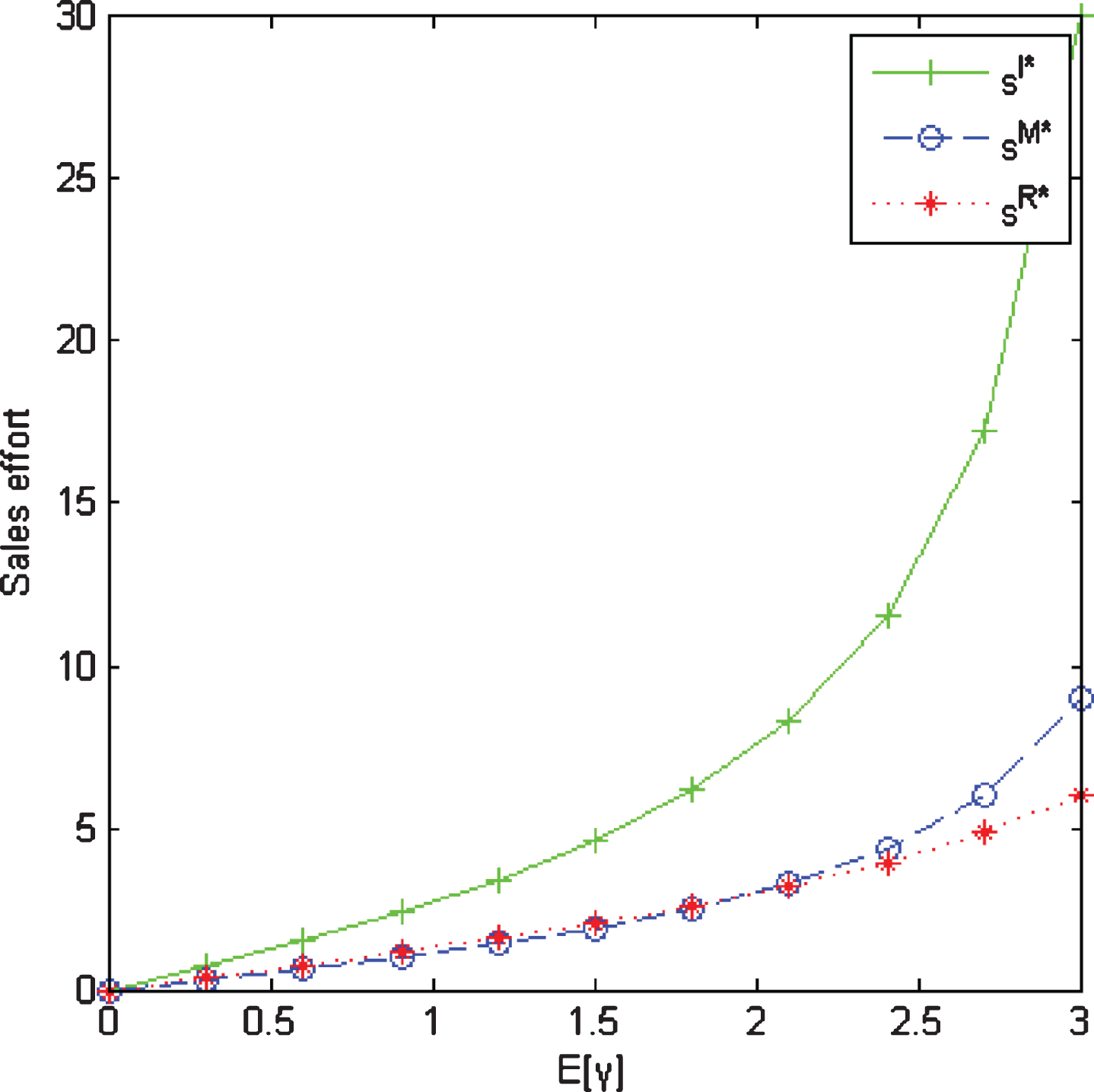
The effect of E [γ] on sales effort.
In Figure 9, we have the result that the retail price rises in these three scenarios when E [γ] increases because the sales effort investment increases with growing of E [γ]. When E [γ] is below a threshold in Corollary 3, the retail price is highest in manufacturer-dominant scenario and lowest in integrated scenario. And when E [γ] is greater than this threshold, the retail price increases quickly and is highest in retailer-dominant scenario as E [γ] increases.
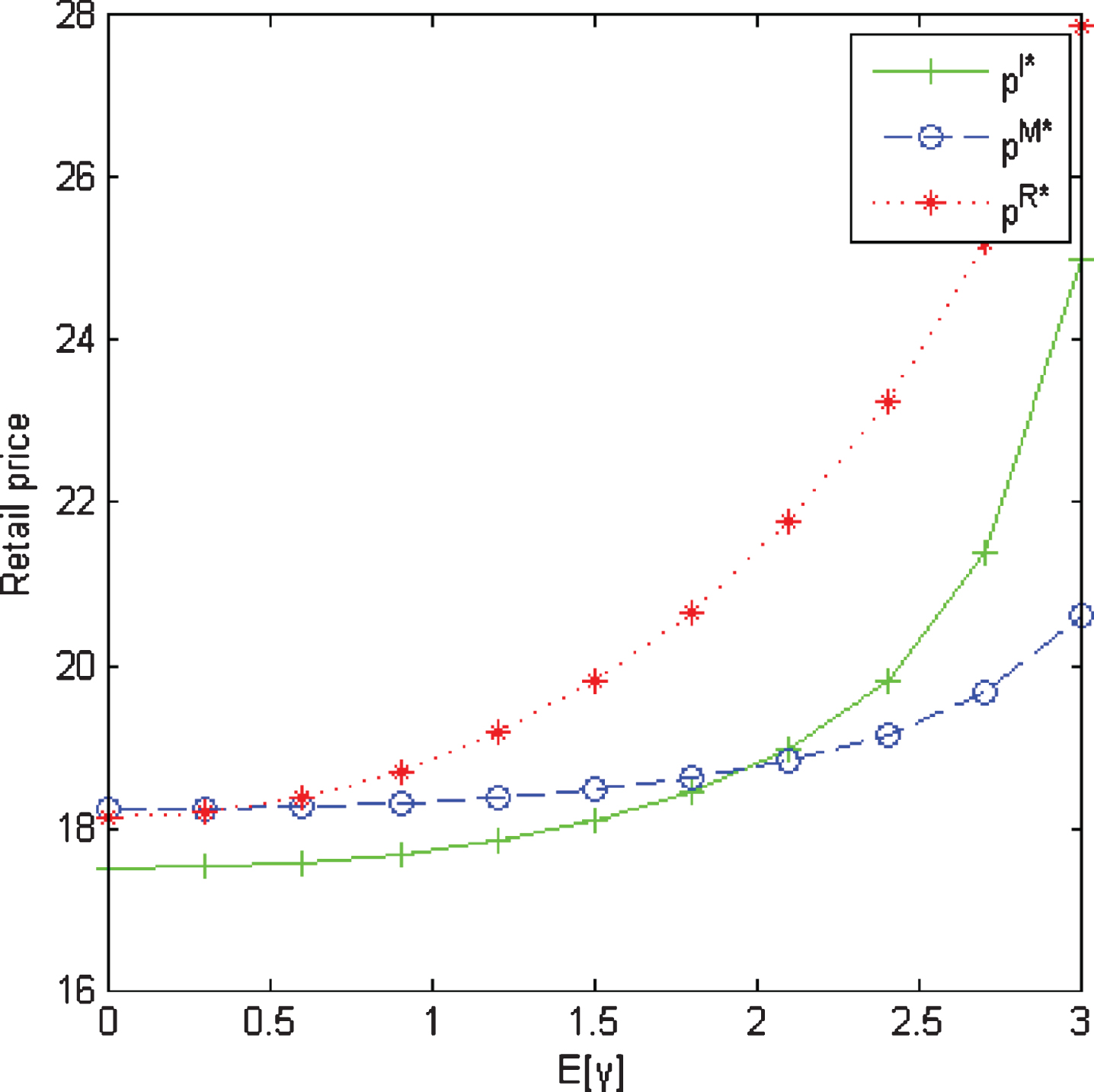
The effect of E [γ] on retail price.
Figure 10 shows that the expected channel profit is increasing in these three scenarios with rising of E [γ], and the expected channel profit is largest in integrated scenario. The results above are in line with the common sense.
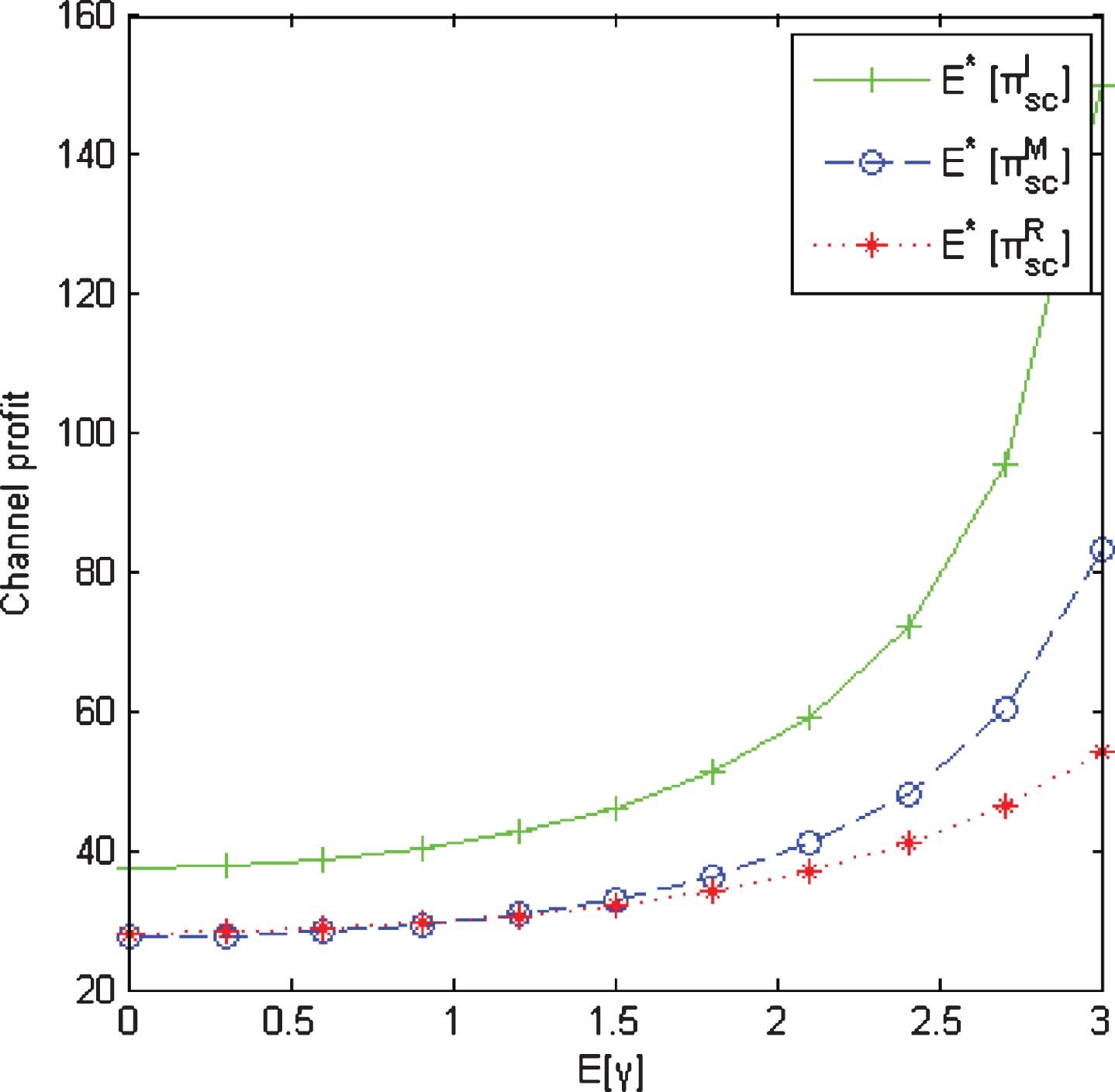
The effect of E [γ] on the expected channel profit.
As shown in Figure 11 and Figure 12, the expected profits of manufacturer and retailer increase when E [γ] rises in manufacturer-dominant scenario and retailer-dominant scenario. The increase of E [γ] leads to the expansion of demand, which results in an increase of profit. For given parameter values, the expected profit of manufacturer is higher in manufacturer-dominant scenario than that in retailer-dominant scenario. The ranking of the expected profit of retailer in such two scenarios changes as E [γ] increases.
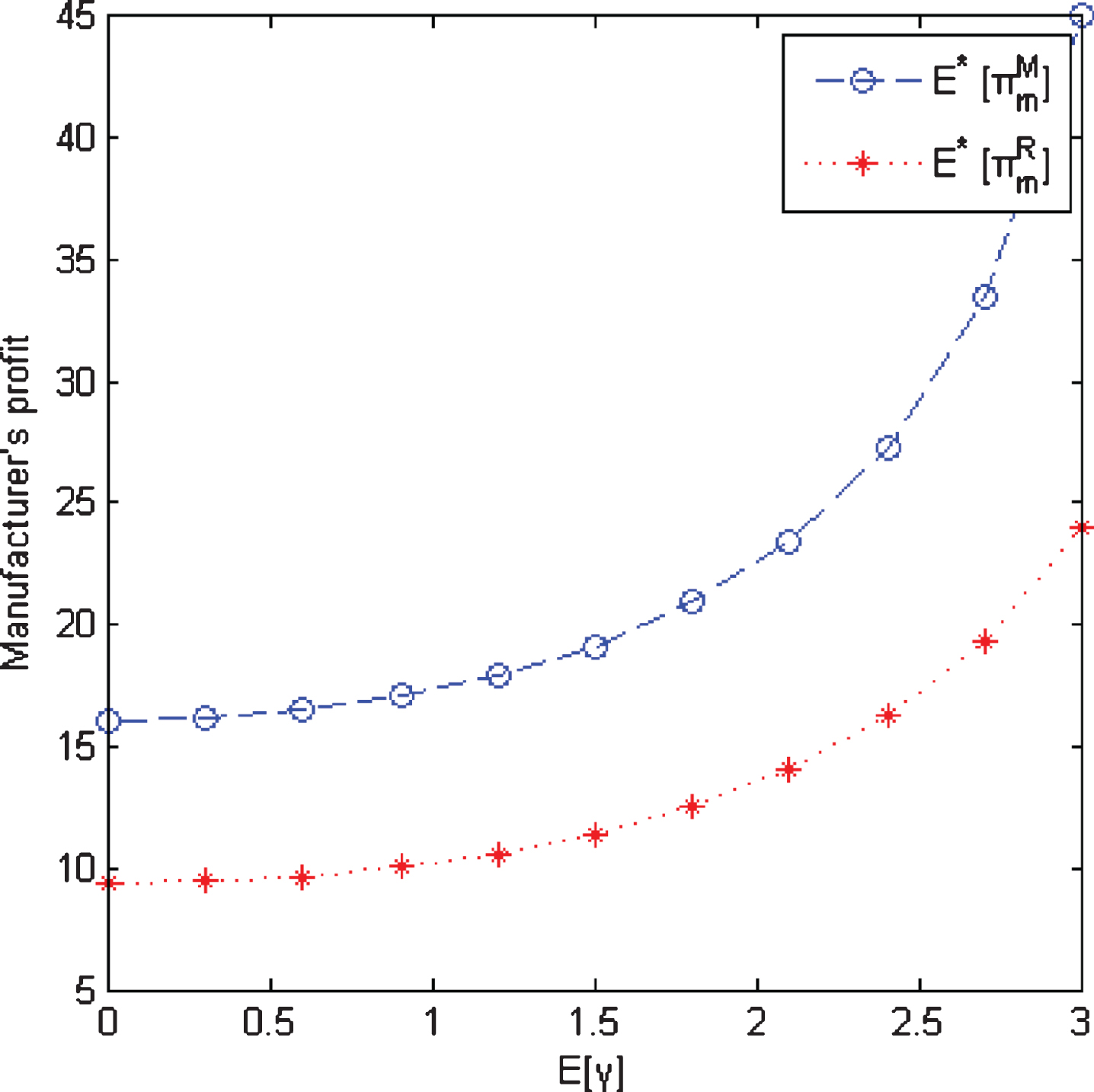
The effect of E [γ] on the expected profit of manufacturer.
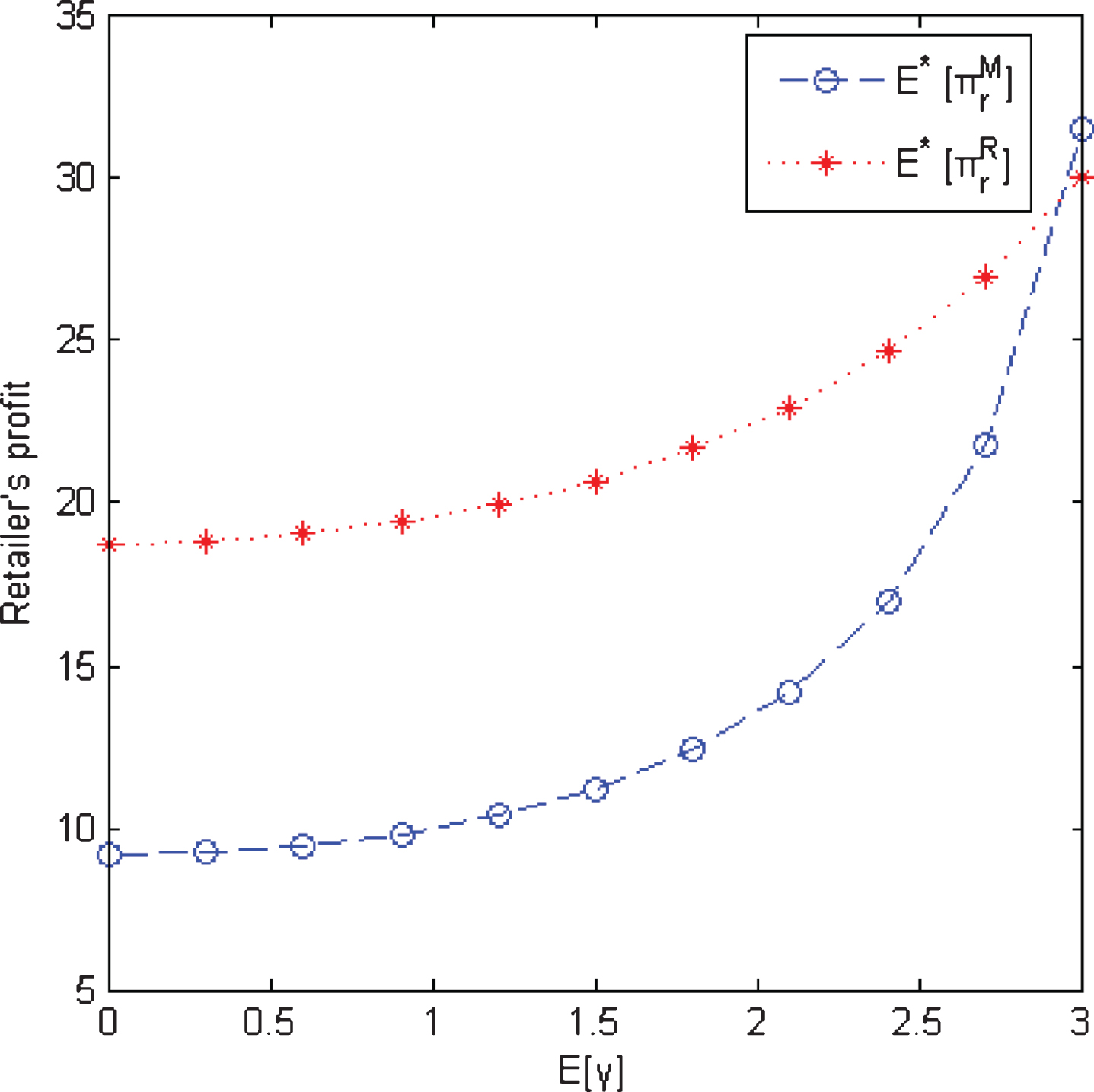
The effect of E [γ] on the expected profit of retailer.
In this paper, considering the uncertainty in the demand of new environmental-friendly products, we used uncertain variable to deal with demand due to lacking historical data. Then three models in different power structures were established to obtain the optimal green degree, pricing and sales effort decisions of green supply chain. Following that, we analyzed how power structures and uncertain parameters influence the optimal green degree, retail price and sales effort. Finally, numerical simulations are introduced to verify the correctness of the result and analyze the sensitivity of parameters.
Our study provides some managerial insights on the pricing, green degree and sales effort decisions of a two-stage supply chain under uncertain demand. Firstly, the price parameter β has a negative impact on the optimal green degree, pricing and sales effort, while the green degree parameter θ and sales effort parameter γ have positive impact on the optimal green degree, pricing and sales effort, respectively. Secondly, green degree and sales effort level are affected by the sequence of decision making, while their ranking is also related to the value of parameters. Finally, when manufacturer has high bargaining power in the supply chain, he does not necessarily benefit more from his high bargaining power. Therefore, in some cases, it is better for manufacturer to abandon the dominance.
This paper only investigated the pricing, green degree and sales effort decisions issue of green supply chain with a manufacturer and a retailer in uncertain environment. It is interesting in extending our research to the competitive of two manufacturers or retailers in the future. In addition, carbon emission reduction is encouraged all over the world, therefore the government can play an important role in green supply chain management. It will be worthy to explore the function of government strategy in pricing decision of green supply chain.
Footnotes
Appendix
After calculating, the first-order partial derivatives are as follows,
The second-order partial derivatives are as follows,
By the above equations, Hessian matrix of
When 2kE [β] - E2 [θ] >0 and 2hkE [β] - kE2 [θ]) - hE2 [γ] >0 holds, Hessian matrix H1 is negative definite, and the expected channel profit
Setting the first-order partial derivative as 0, we derive
By substituting the above expressions into the expected channel profit E [π sc (p, e, s)], we obtain
Then Proposition 1 is proved.
After calculating, the first-order partial derivatives are as follows,
The second-order partial derivatives are as follows,
According to the above equations, Hessian matrix of
When 2kE [β] - E2 [γ] >0 holds, Hessian matrix H2 is negative definite, and the expected profit of retailer
Setting the first-order partial derivatives as 0, we obtain
Substituting the above expressions into the expected profit of manufacturer
Then, after calculating, the first-order partial derivatives of
The second-order partial derivatives are as follows,
Following the above equations, Hessian matrix of
When kE2 [θ] +2hE2 [γ] -4khE [β] <0 holds, Hessian matrix H3 is negative definite, and the expected profit of manufacturer
Setting the first-order partial derivatives as 0, we obtain
Substituting the results of wM∗ and eM∗ into the expressions of p M (w, e), s M (w, e) and the profit functions, we get
After calculating, the first-order partial derivatives are as follows,
The second-order partial derivatives are as follows
According to the above equations, Hessian matrix of
When 2hE [β] - E2 [θ] >0, H4 is negative definite, and the expected profit of manufacturer
Setting the first-order derivatives as 0, we have
Substituting the expressions of w R (p, s) and e R (p, s) into the expected profit of retailer, we have
After calculating, the first-order partial derivatives of
When kE2 [θ] +2hE2 [γ] -4khE [β] <0, H5 is negative definite. Thus, the expected profit of manufacturer
Setting the first-order partial derivatives as 0, we obtain
(1)Integrated scenario:
(2)Manufacturer-dominant scenario:
(3)Retailer-dominant scenario:
eI∗ - eM∗
eI∗ - eR∗
eM∗ - eR∗
sI∗ - sM∗
sI∗ - sR∗
sM∗ - sR∗
When hE2 [γ] = kE2 [θ], we have eM∗ = eR∗, sM∗ = sR∗ and
When hE2 [γ] > kE2 [θ], we have eM∗ > eR∗, sM∗ > sR∗ and
When hE2 [γ] < kE2 [θ], we have eM∗ < eR∗, sM∗ < sR∗ and
When hE2 [γ] = kE2 [θ], we have pM∗ = pR∗.
When
When hE2 [γ] > kE2 [θ], we have pM∗ > pR∗.
When
When hE2 [γ] > kE2 [θ], we have
When hE2 [γ] = kE2 [θ], we have
When hE2 [γ] < kE2 [θ] and
When hE2 [γ] < kE2 [θ] and
When hE2 [γ] > kE2 [θ] and
When hE2 [γ] > kE2 [θ] and
When hE2 [γ] = kE2 [θ], we have
When hE2 [γ] < kE2 [θ], we have