






Abstract
One of the most important problems in directional sensor networks is k-coverage in which the orientation of a minimum number of directional sensors is determined in such a way that each target can be monitored at least k times. This problem has been already considered in two different environments: over provisioned where the number of sensors is enough to cover all targets, and under provisioned where there are not enough sensors to do the coverage task (known as imbalanced k-coverage problem). Due to the significance of solving the imbalanced k-coverage problem, this paper proposes a learning automata (LA)-based algorithm capable of selecting a minimum number of sensors in a way to provide k-coverage for all targets in a balanced way. To evaluate the efficiency of the proposed algorithm performance, several experiments were conducted and the obtained results were compared to those of two greedy-based algorithms. The results confirmed the efficiency of the proposed algorithm in terms of solving the problem.
Introduction
A Visual Sensor Network (VSN), also recognized Smart Camera Network (SCN), comprises a set of targets that are to be covered by a set of visual sensors that can control their own orientation and sensing range. VSNs are of high popularity since they can be applied to real-world situations such as surrounding observation, surveillance systems, intelligent traffic control systems, etc. [1].
Coverage in visual sensor network
In VSNs, one of the most significant issues is coverage referring to collecting data from a certain environment. Complexity of coverage depends upon the type of the sensors utilized; whether they are directional or omnidirectional. Fig. 1. displays how the directional and omnidirectional sensors work. In the former, sensors are assumed to have a disk-like sensing range; that is, a target is covered if it is positioned within the sensing range of a sensor. In the latter, sensors are assumed with a sector-like sensing range. It means that their sensing angle is limited; therefore, they can cover a target if it is positioned not only in their sensing range but also in their sensing angle [2].
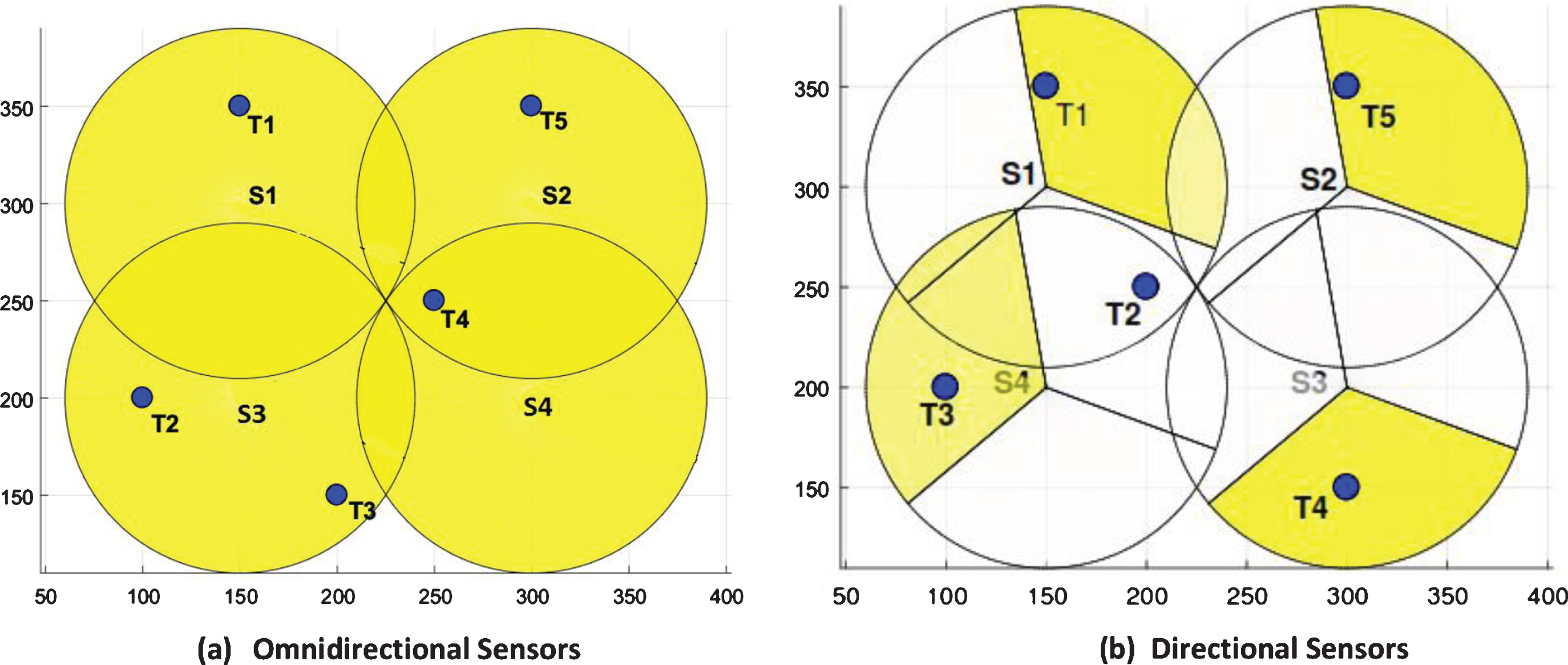
Omnidirectional and directional sensor.
Figure 2 explains the term “coverage”. In this figure, two sensors (S1 and S2) and five targets (T1-T5) are displayed. Each sensor in this figure has three directions each of which can monitor the targets positioned within the sensor’s scope and in the path of its activated direction (i.e., the yellow-colored direction). Remember that each sensor can activate only one of its own directions at each unit of time. Accordingly, in Fig. 2. T1 and T5 are not covered by any sensor. Sensor S2 covers only T3, while S1 covers no sensor currently. T2 and T4 will not be covered since they are not positioned in the path of an activated direction of any sensor in the network.
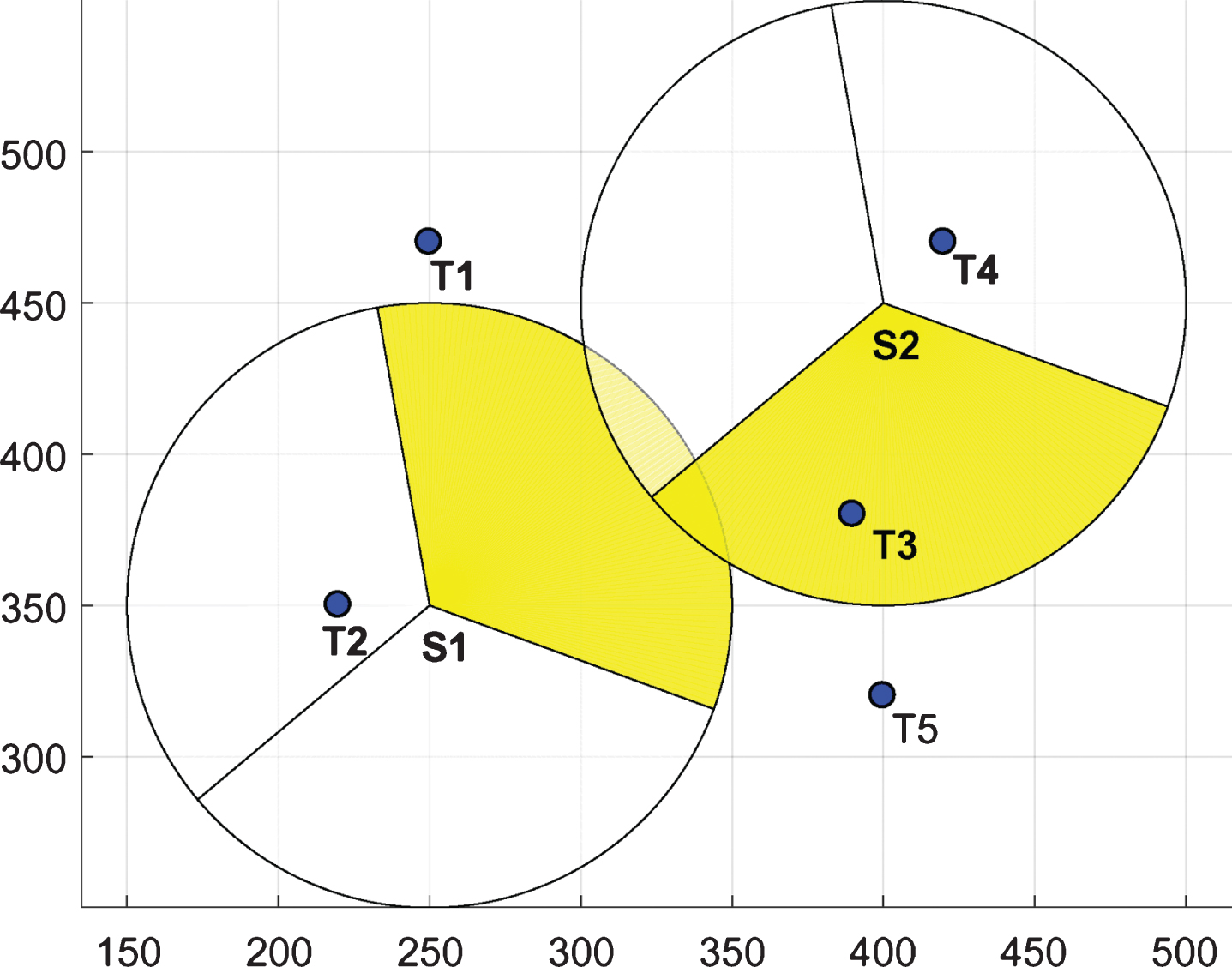
Sensor covering target.
In general, coverage problem is addressed under three different titles: area coverage, target coverage, and barrier coverage [3]. The target coverage is aimed to determine a set of sensors to monitor some particular points within the area of study. However, the aim of the area coverage is to provide coverage on a part or the whole area regardless of any certain point, and the barrier coverage can be considered as the coverage with the goal of minimizing the probability of undetected penetration through the barrier. Generally, coverage falls into three different categories: simple coverage, k-coverage, and Q-coverage. In the simple coverage, each target is monitored by only one visual sensor. The problem is that in case the covering sensor functions inefficiently or exhausts its energy or if a preparatory blocks the line of sight, the corresponding target may become suddenly uncovered. Such drawbacks have resulted in shifting researchers’ attention towards the k-coverage into which the fault tolerance can be also incorporated. In other words, in k-coverage, each target is monitored by at least k visual sensors (k denotes a predefined integer constant). Note that a higher value of k results in higher accuracy in the monitoring operation [4, 5]. In the Q-coverage, different numbers of visual sensor nodes are appointed to satisfy the coverage requirement of different targets.
The objective of the k-coverage problem is to cover each target by k sensors. This end cannot be accomplished when the network does not contain enough sensors, e.g., in case of an under-provisioned network. To provide a better solution, there is a need for a new metric in such networks; here, the Balancing Index (BI) proposed in [1] is used. The BI obtained is given by Equation (1).
Balancing index.
In this paper, the target k-coverage problem is addressed, where there are not enough sensors to monitor all the targets; this shortage is generally known as under provisioned VSN. The whole problem, whose NP-completeness has been proved, is addressed as coverage imbalance problem [1]. This problem is significant mainly due to four reasons. First, directional sensors have a limited sensing angle, which causes them not to sense a full circular region. Second, sensors are susceptible to environmental damages and sensing data can get noised. This is why the sensing region requires to be covered by at least k sensors. Third, the under provisioned networks cannot provide a full k-coverage; thus, there is a need for providing a solution with a higher fault resilience. Fourth, the efficiency of the solutions proposed for this problem is dependent on the number of cameras activated for monitoring operation. Remember that the fewer activated cameras, the less amount of energy is consumed. Therefore, it is necessary to minimize the camera usage and provide coverage on each target in a fault-tolerant way.
The literature consists of several solutions to coverage imbalance problem; although, the up-to-date heuristic methods have not been taken into consideration despite their proved capabilities in solving the problems of NP-completeness. In this paper, an learning automata-based algorithm is proposed in order to balance the coverage using minimum number of sensors in under-provisioned networks. LA is used to address a problem in which some of the targets are monitored for k times, while others have remained uncovered or partly covered. This paper involves several experiments conducted to test the performance of the proposed algorithm. A comparison was made between the obtained results of the proposed algorithm and those of two greedy-based ones introduced in [1] in order to test the efficiency of the proposed algorithm. The results confirmed the capability of the LA-based algorithm and also its superiority over the greedy-based one in terms of solving the problem in hand.
The main contributions of the present study are as follow: A new algorithm was proposed using learning automata to solve the imbalanced k-coverage. Some pruning rules were designed to enhance the efficiency of the proposed algorithm. In this project, due to some limitations of our problem, multiple learning automata were used to solve the k-coverage problem in an effective way. A number of experiments were conducted to evaluate the performance of the proposed algorithm and the results were compared to those of a recently-introduced greedy-based algorithms.
The remainder of this article is organized as follows. In Section 1, the research already conducted on target coverage problem is presented. In Section 1, the problem of target k-coverage is discussed. In Section 1, the theory of LA is introduced. In Section 1, an LA-based algorithm is proposed to solve the problem in hand. In Section 1, the performance of the proposed algorithm is evaluated through several experiments. Finally, in Section 1, the whole paper is concluded.
Related work
The primary aim of designing sensor networks is monitoring and collecting data from a certain geographical area. The target coverage in such areas is an important task since the sensor nodes are generally distributed in a random way. In a general view, the term “target coverage” refers to monitoring some predefined targets in an area using a minimum number of sensors. In the following, some outstanding studies conducted into the target coverage problem in Wireless Sensor Networks (WSNs) and Directional Sensor Networks (DSNs) are discussed.
There are many studies in literature working on the target coverage problem in WSNs. In [6], the target coverage was modeled for the first time as a disjoint problem and some solutions were proposed. The authors extended the same problem to a non-disjoint problem and offered some ways to solve it [7]. In [8, 9], in an attempt to address the target coverage problem in WSNs, LA was used to identify active sensors capable of effectively covering the area of interest. As shown by their final results, the LA-based algorithms were more successful than other types of algorithms in terms of solving the target coverage problem.
Literature contains numerous studies conducted into the k-coverage problem, in which only the omnidirectional sensors have been considered by researchers [10–13]. A circular range of radius r was used by Li-Hsing Yen et al. [10] in order to work on n sensors. A definite mathematical expression was developed for the supposed region that would be k-covered. In another study, a new method was introduced by Hafeeda and Bagheri [11] to elaborate the k-coverage problem and demonstrate it as ideal hitting set problem, which is an NP-hard [12]. The k-coverage algorithm suggested [11] in their study was stimulated by the approximation algorithm in [13]. Both centralized randomized k-coverage and distributed randomized k-coverage algorithms were discussed in their paper. In [14], connectivity and coverage of WSN in 3D space were investigated. It was shown that all the targets in a Reuleaux tetrahedron would have a k-coverage when that Reuleaux tetrahedron possesses k sensors with a spherical sensing range. In the studies mentioned above, the locations are known. The algorithm introduced in [15] can successfully confirm the k-coverage with no previously provided information regarding the location. In [13], a solution was offered for k-coverage problem, in which the majority of nodes are in the sleep state at any given time. By applying various sorts of node disseminations, including grid mode, random uniform distribution, and Poisson distribution, the network lifetime was also investigated.
The algorithms proposed in the above-mentioned studies work efficiently in WSNs; although, due to limitation of sensing angle of directional sensors, they fail to work in DSNs. Therefore, there is a need to design new algorithms to solve the target coverage problem specifically in case of DSNs. The literature contains a number of studies attempting to solve the target coverage problem in DSNs (for more detailed information, see [16]). In [2], the coverage problem was formulated using directional sensors as maximum coverage by means of minimum sensors. They proposed both centralized and decentralized greedy solutions to the problem. In [17], the NP-completeness of the multiple directional cover set problem was proved and also a number of heuristic algorithms were proposed to form appropriate non-disjoint cover sets in such a way that each cover set can monitor all the targets in network. In [18], to solve the target coverage problem, two algorithms were proposed; one of them was based on greedy approach and the other one was based on genetic algorithm.
In [19–21], a number of algorithms were proposed based on LA in order to solve the target coverage problem in DSNs. All the algorithms included two phases in common: working direction selection and cover set formation. In the first phase, one algorithm was applied to selecting the most appropriate working direction, and in the second phase, several algorithms were introduced to form cover sets consisting of a minimum number of active sensor directions. Additionally, in [22], LA were applied to solving the connected target coverage problem. LA was used for two objectives: to choose appropriate sensor directions for providing coverage on the area of study, and to find a path for transferring the data collected from the area. LA in some other studies (see [23, 24]) were used to solve the priority-based target coverage problem so that appropriate sensor directions can be identified in such a way to satisfy the coverage quality requirement of targets. In [25], two greedy-based algorithms were proposed to solve the target coverage problem in networks that comprised sensors with more than one power level (i.e., adjustable sensing range). Their results confirmed the positive effect of adjusting the sensing ranges of sensors on extending the network lifetime. The studies mentioned above were focused on solving the simple coverage problem where a single sensor was determined to cover a target. However, in real situations, a target may need to be covered by multiple sensors. Note that a network that has a higher coverage scope offer higher reliability since it shows further resistance to erroneous sensor measurements and sensor failures, which may take place during the operation of an algorithm. Reliability, especially in networks lacking the chance to identify and replace the failed sensors, is of a great significance. For that reason, new algorithms offering reliability and fault tolerance are required to solve the target coverage problem more effectively.
All studies mentioned earlier have been focused on solving merely simple target coverage problem in networks where sensors had only a single power level. Recently, two greedy-based algorithms were proposed by Mohamadi et al. [26, 27] addressing the target coverage problem in networks containing sensors with multiple power level (i.e., adjustable sensing ranges). In [26], it was confirmed that adjusting the sensing ranges of sensors significantly prolonged the network lifetime. In [27], a genetic-based algorithm was proposed in order to solve the target coverage problem in networks containing sensors with adjustable sensing ranges.The latest mentioned studies were also centered on the simple coverage problem where only one sensor was assigned to monitoring a target. The remained challenge is that in real conditions, each target in the field may require to be covered by more than one sensor. Remember that the networks with higher coverage scope generally offer a higher level of reliability because they show further resistance to sensor failures and erroneous sensor measurements that can happen in a monitoring operation. The factor of reliability is of high importance, particularly in applications where there is not opportunity to identify and replace the failed sensors. Therefore, to more efficiently address the target coverage problem, new algorithms are needed to be proposed, capable of offering not only reliability and fault tolerance, but also maximizing the network lifetime through adopting two techniques of scheduling sensor directions and adjusting the sensing ranges of sensors.
The problem of target k-coverage
The notations used in this paper are listed in Table 1.
Notations
Notations
In the present paper, the k-coverage problem is addressed, where the number of sensors is not sufficient to provide k-coverage for all targets; this is known as imbalanced k-coverage problem whose NP-completeness has been already proved in [28]. Let us assume that several targets are positioned at known locations within a 2-D Euclidean field. The targets need to be monitored by multiple sensor directions (the number of sensor directions depends on the value of k). A number of directional sensors are also distributed in the vicinity of the targets to cover them. Each directional sensor possesses a number of non-overlapped pans among which only a single pan is activated at each unit of time. In the rest of this paper, a sensor together with one of its pans is called a pair. Similar to [1], this study is limited to pan-only cameras. That is, it is assumed that a camera is capable of moving only in a horizontal direction and its Field of View (FoV) is only defined by its pan. The pan of a camera is defined based on two parameters: the maximum coverage range of the camera and the maximum sensing/covering angle of a camera. Each directional sensor can monitor all targets situated within both its working direction and its sensing range.
A learning automaton is a unit that is adapted to a given environment and makes decisions suitable to the situation. It enhances the quality of its own performance through learning how to choose an optimal action from among a set of available actions [17]. For this purpose, learning automata have to interact with random environment.
Optimal action is chosen in a statistical way on the basis of the probability distribution of the actions. Each action selected through this process has an effect on the environment, which is returned to LA. Based on the feedback received from the environment, the action probability vector is updated. This theory is mainly aimed to choose the most appropriate action from among an available set of actions.
The interaction between LA and environment is displayed in Fig. 4. In a general view, LA are divided into two types: LA of changeable structure and those of unchangeable structure. In the present study, LA with changeable structure is used, which is explained in the following.
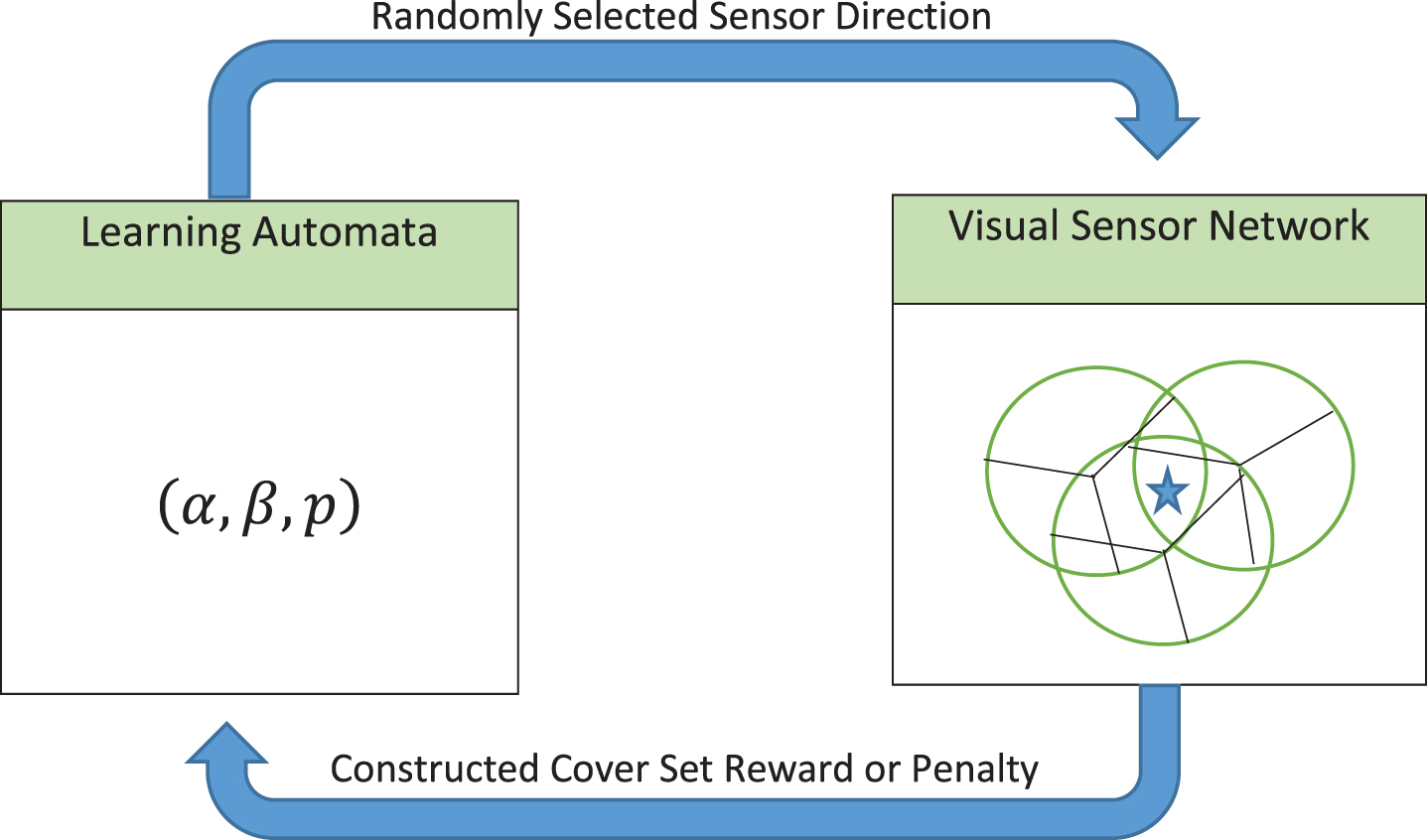
Visual sensor network and learning automata interaction.
LA with changeable structure is signified by a quadrable E = (α, β, c, T), where α = {α1, α2, . . . , α r } denotes the input provided by the environment (action-sets), β = {β1, β2, . . . , β r } represents the set of inputs, and c = {c1, c2, . . . , c r } signifies the set of probabilities for the actions. In addition, the learning algorithm (the reinforcement scheme of the automaton) for each action is presented below [29].
The theory of LA is suitable for learning in cases where there is no complete information about the environment; in addition, it appropriately works in complex, dynamic, or random environments that suffer from many uncertainties. Literature consists of different types of automata that are able to address an extensive range of problems in different domains, including computer networks.
In this section, an LA-based algorithm is proposed to solve the k-coverage problem in under provisioned networks. The aim of the algorithm is to select and activate the <sensor, pan> pair from among inactive sensors in a way to provide a balanced coverage through managing the critical targets. The balanced coverage generally refers to a maximum coverage on all the targets existing within an under provisioned network where there is insufficiency sensors for the monitoring operation. In the following, the proposed algorithm is explained in detail.
In a general view, the proposed algorithm involves two phases: initialization and selection of appropriate pairs. In the initialization phase, the basic parameters of the algorithm (i.e., LA network, action-set, and action probability vector) are determined. In the second phase, LA attempt to select the minimum number of appropriate pairs that can provide a balanced coverage for all the targets. In the following, these two phases are elaborated.
Initialization
Three operations are involved in the initialization phase: construction of an LA network, formation of the LA action-set, and adjusting the action probability vector of LA. To create an LA network, multiple LA are first allocated to each target. The level of coverage required for the application determines the maximum number of automata involved in this step. For example, in case the application requires k coverage, the number of automata is fixed at k. This is because the output of each automaton is the selection of a pair. The selected pair may monitor only the target corresponding to the given automaton or it may monitor some other targets. If the first state takes place, the algorithm has to activate the other automata that are corresponding to that target (recognized as next-level target). The created LA network can be modeled by means of a duple 〈A, α〉, where A = {Ai,j| ∀ t
i
∈ T, 1 ≤ j ≤ k} denotes the set of LA corresponding to the targets that exist in the network, and α = {αi,j| ∀ Ai,j ∈ A} signifies the set of LA action-sets, where
After the formation of an LA network, the action-set of LA needs to be defined. For this purpose, each learning automaton forms its action-set by assigning an action to each pan that covers its corresponding target. It means that with selection of an action, the automaton actually chooses a pan of the sensor so that both its corresponding target and the targets situated within the sensor’s sensing range can be under a full coverage. Let α
i
=
To further clarify, let us consider the example network depicted in Fig. 5(a). comprising four visual sensors and three targets. As can be observed in this figure, target t1 is monitored by three pans ({d1,2, d2,1, d3,3}), target t2 is monitored by two pans ({d1,1, d4,2}), and target t3 is monitored by two pans ({d2,1, d3,3}). Let us assume that the desired coverage level is 2. Therefore, at most, 2 automata are assigned to each of the targets. As mentioned earlier, the action-set of each learning automaton is formed by assigning an action to each pan that covers the target corresponding to that learning automaton. For example, the learning automaton A1,1 that is assigned to target t1 has three actions. This is because target t1 is covered by three pans ({d1,2, d2,1, d3,3}). Note that the action-set of the automaton corresponding to one target is similar to the action-set of other automata corresponding to that particular target. For instance, learning automaton A1,2, which is allocated to target t1, possesses three actions (see Fig. 7). The covering power of the pans is as follows: CP (d1,2) =1, CP (d2,1) =2, and CP (d3,3) =2. Here, the total covering power ∑CP (di,j) equals 5. Thus, the initial action probability vector of automaton A1,1 is defined as
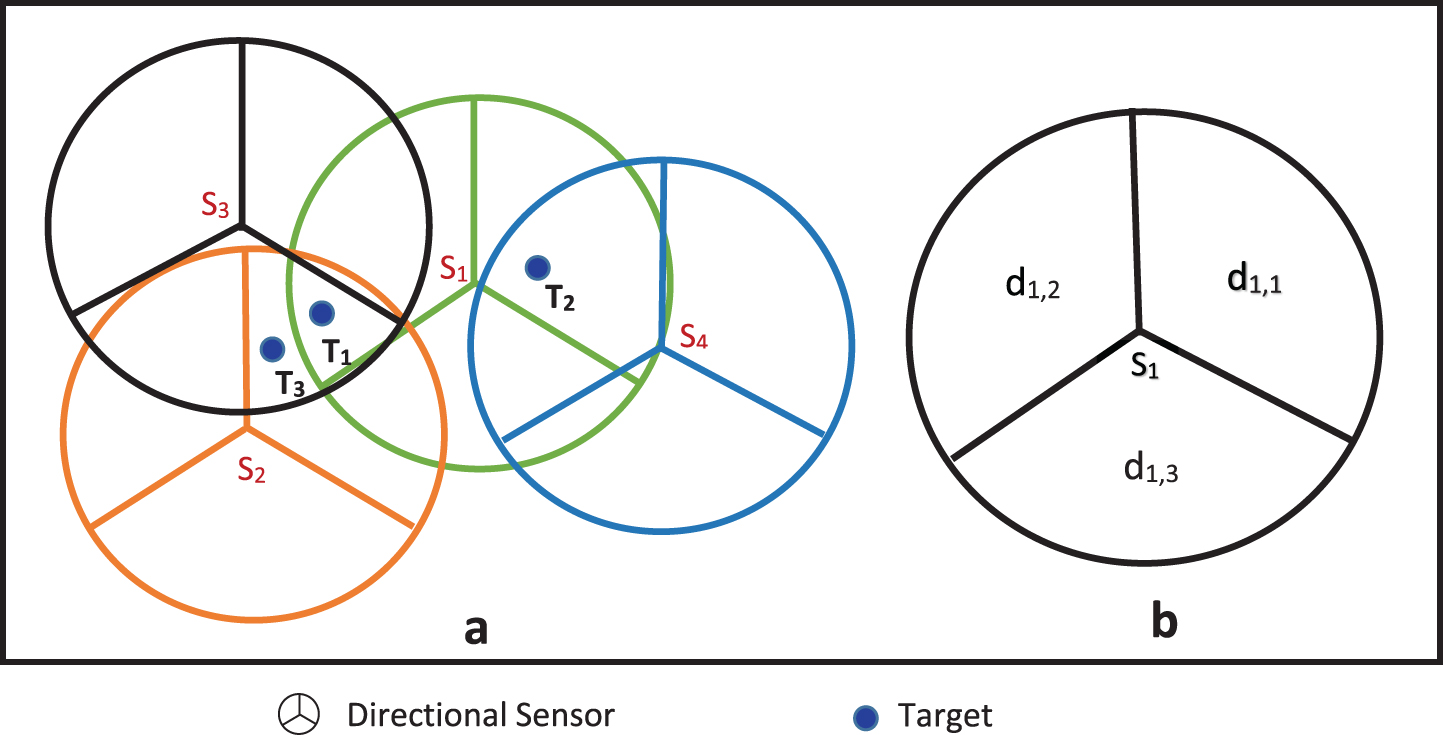
An example network with four directional sensors and three targets.
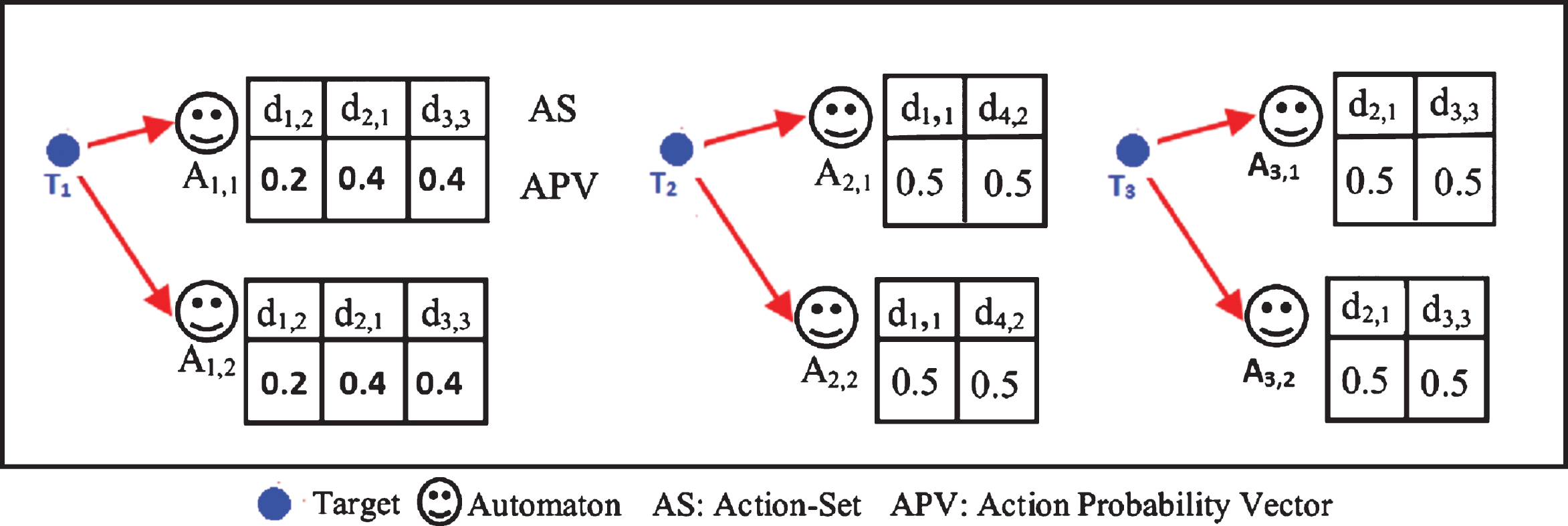
Three operations of initialization phase.
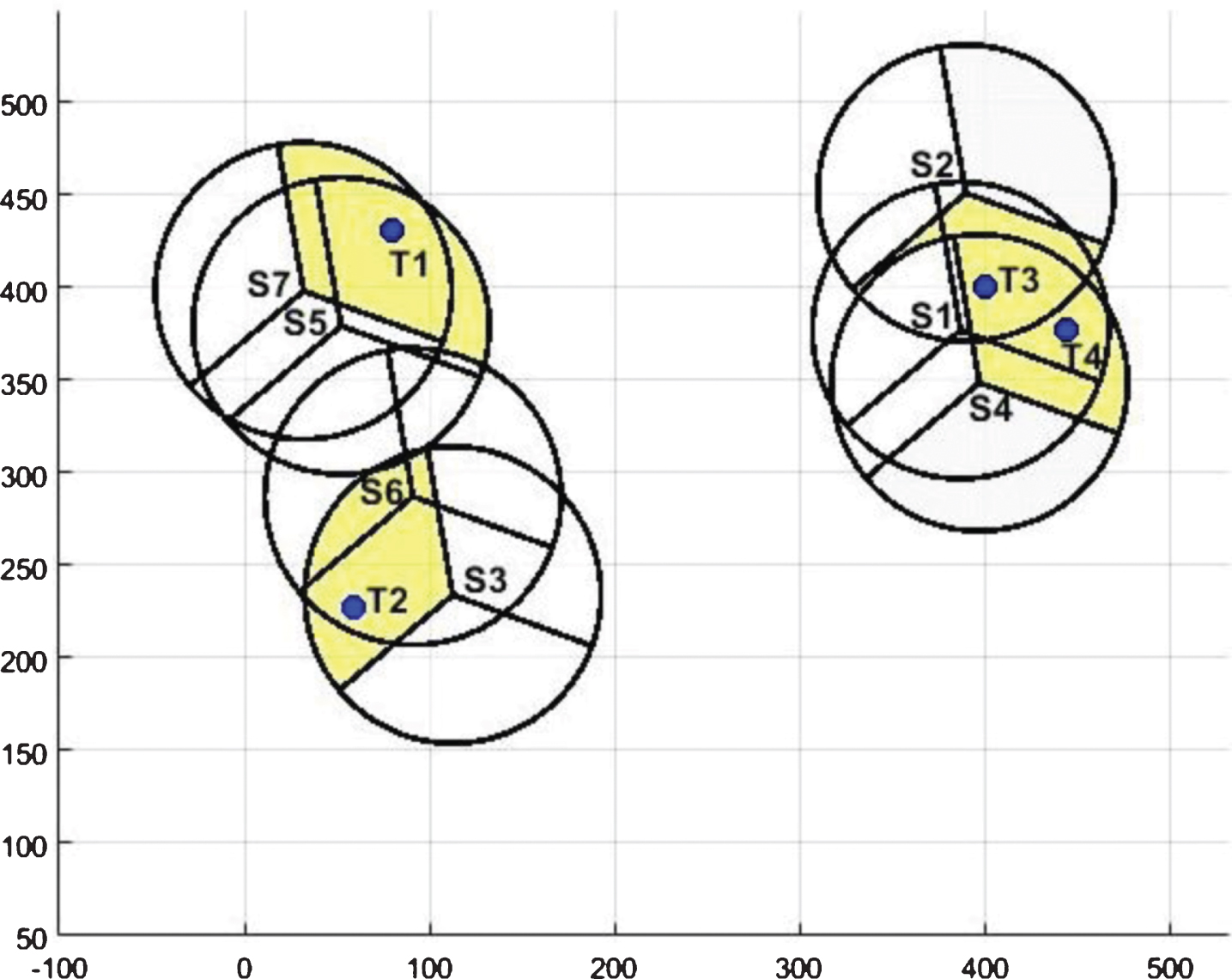
Snapshot of the simulation environment.
As stated earlier, the proposed algorithm has been assigned with LA possessing variable action-set. This is because the action-set can vary during the operation time. Such variation may take place in two conditions; first, when a sensor has exhausted its energy; and second, when the action-set of a learning automaton is going to be pruned in a way to find a better action from among the available action-set. For instance, in case pan (di,j) gets disabled at stage q + 1, the action-set of learning automaton A
i
is updated by eliminating the action corresponding to the pan. After that, the choice probability of the eliminated action (
In this phase, LA choose a subset of pans in a way to create an optimal cover set that can provide all the targets with a balanced coverage using minimum active pans in under-provisioned networks. To obtain such a cover set, several stages are run by the algorithm; each stage results in a cover set cooperatively constructed by LA. Afterward, the optimality of the created cover set is calculated by a random environment whose role is played by VSN. The task of environment is computing the total BI by the pans within the cover set and producing a response to optimality based on which the chosen actions are either rewarded or penalized. This process, which includes the formation of a cover set and updating the action probability vectors, is iterated until a cover set with the most balanced coverage is generated using the minimum number of active pans. The pseudo code of the proposed algorithm is displayed by Algorithm 1. In the following, the q-th stage of the algorithm is elaborated. In the beginning of the cover set formation process, the algorithm identifies the most critical target and then activates its corresponding automaton, which is known as critical automaton. Afterward, the critical automaton uses a pruning rule to prune its action-set. Next, it selects one of its actions corresponding to a pan covering its corresponding target. After that, the pan that is corresponding to the chosen action is added to the cover set (i.e., C cur ); then, those targets whose balanced coverage has been provided are removed from T cur . In the next step, the passive automata corresponding to the balanced coverage-provided targets together with the activated automaton (i.e., Ai,1) are added to the list of dominated automata (i.e., D cur ). This helps to avoid not only the activation of these automata, but also the selection of redundant pans in the following stages. In other words, with selection of a pan covering multiple targets, the automata that are corresponding to the covered targets must be added to D cur .This way, the algorithm is able to choose only the automata whose actions cover a new target (i.e., a target whose balanced coverage has not been provided yet).
LA-based Algorithm
The whole process explained above continues until all targets are provided with balanced coverage. Note that as the under provisioned environments in their nature lack sufficient sensors for monitoring operation, we have to take into consideration the issue of critical targets. In each stage of this system, the algorithm determines the most critical target and activates its corresponding automaton in a way to finally achieve a balanced coverage. The ultimate aim of activating these critical targets is to let the sensors activate only one of their pans that covers a critical target and to avoid the activation of the pans corresponding to non-critical ones. This results in preparing more pans to cover the critical targets, hence providing a more balanced coverage on the whole under provisioned environment.
The output of the above process is a cover set comprising a set of pans. The next step is calculating the optimality of the constructed cover set. To do this, we make use of a factor termed BI [1]; higher value of the BI is normally associated with a better coverage rate. Next, a comparison is made between the value of BI and a dynamic threshold (i.e., T q ). Based on the result, the selected actions of the chosen automata are either rewarded or penalized. If the BI is higher than the T q , the selected actions of the activated automata are rewarded; otherwise, they are penalized. Once the initialization process begins, T q is set to zero; the reason is that our aim is to maximize the BI. In each stage, if a cover set is found, whose BI is equal to or greater than the dynamic threshold, the set of pans gathered in that cover set is kept as the best solution ever found; in addition, the value of T q is set to the BI value of that cover set. When the action probability vectors of the activated automata are updated, the q-th iteration ends with re-enabling the disabled actions of each activated learning automaton. As the algorithm operation goes on, the automata learn how to choose a subset of pans in such a way that they can ultimately create a cover set with a maximally-balanced coverage through activating the minimum number of pans. The proposed algorithm ends in two conditions: either the probabilities of all selected pans become greater than a definite threshold, or the number of created cover sets gets higher than a certain threshold. The final output of the algorithm is a cover set capable of providing the most balanced coverage using the minimum number of activated pans. An example network depicted in Fig. 5. is presented in order to show the cover set formation process performed in the proposed algorithm. Each round of the proposed algorithm comprises several stages. In the following, a possible execution scenario of the algorithm is explained.
To begin the cover set formation process, first, the algorithm identifies the most critical target and then activates the learning automaton corresponding to that target. In this exemplified network, let us assume that target t1 is selected. Therefore, the first learning automaton corresponding to this target (i.e., A1,1) is activated. Afterward, automaton A1,1 prunes its action-set by means of the above-mentioned pruning rule and chooses one of its actions. Assume that the learning automaton has chosen the action that is correspondent to the pan (d3,3). Next, the chosen pan (d3,3) is added into C cur . After that, set T cur is updated by removing the targets whose k-coverage has been already provided. As the k-coverage has not been so far provided for any target, no target is eliminated from the list of T cur . Next, the activated automaton (i.e., A1,1) and the passive automata that are correspondent to those targets whose k-coverage has been provided by (d3,3) are added into D cur . Up to this stage, the cover set, the list of uncovered targets, and the set of dominated automata are updated to C cur = {(d3,3)}, T cur = {t1, t2, t3}, and D cur = {A1,1}, respectively.
In case the set T cur is an empty set (that is, the k-coverage of all the targets has been provided), the current iteration is terminated. Otherwise, the learning automaton corresponding to the next critical target is activated. The automaton then prunes its action-set. Let us assume that the next automaton that needs to be activated is A1,2. Assume that (d2,1) is selected as the second pan. As can be observed, with selecting pan (d2,1), target t1 is provided with k-coverage (i.e., k=2); whereas target t2 lacks the k-coverage. The process of activating a critical automaton and choosing an action goes on until all the existing targets are provided with k-coverage, or no automaton has remained to be activated. Assume that the constructed cover set is C cur = {(d2,1) , (d3,3) , (d4,2)}. Then, the BI provided by the cover set C cur is computed. Afterward, the value of the BI is compared with the dynamic threshold T q .
In the first iteration of the algorithm, T
q
is set to zero. Therefore, the BI value (i.e., 0.772), which belongs to the constructed cover set, is greater than T
q
. As a result, the threshold is set to 0.772. In case the BI value of the cover set is greater than the dynamic threshold, all activated LA give reward to their chosen actions using the reinforcement scheme LR-I and they also re-enable the actions formerly disabled. This condition enhances the probability of selecting the pans existing in the cover set to be applied to future iterations. The process of cover set construction is repeated until the stopping criteria are met. At each iteration, the pans are rewarded when they succeed in constructing a cover set with a BI value greater than T
q
; otherwise, they are penalized. Finally, the algorithm selects the cover set with maximum value of BI as the output of current round.
Time complexity
To measure the time complexity of the proposed algorithm, we consider the following parameters. Here, |S| signifies the number of sensors in the network, while |T| shows the number of targets. In each round of the algorithm, a subset of sensor directions capable of covering targets is selected; then, an activation time is assigned to the selected subset, and the energy of the sensors is updated. If the remained sensors are capable of providing k-coverage for all targets, a new round of algorithm begins. Accordingly, the complexity of the algorithm is as follows.
Simulation results
This section evaluates the efficiency of the algorithm in solving the imbalanced k-coverage problem in under-provisioned environments. To this end, the results obtained from the proposed algorithm were compared to those of greedy-based ones [1] recently introduced to literature. The criterion of this comparison was the BI of both algorithms; higher BI showed more balanced coverage. Similar to the previous algorithm, to configure a network, a field (of the size of 500(m) ∗ 500(m)) was created containing some targets accompanied with a number of directional sensors. Each target required to be monitored by k sensors. Initially, each directional sensor possessed three directions. The simulation parameters are presented in Table 2, and Fig. 7. shows a snapshot of the simulation environment. Each simulation scenario was run for 30 times and the average BI of each scenario was computed.
Simulation parameters
Simulation parameters
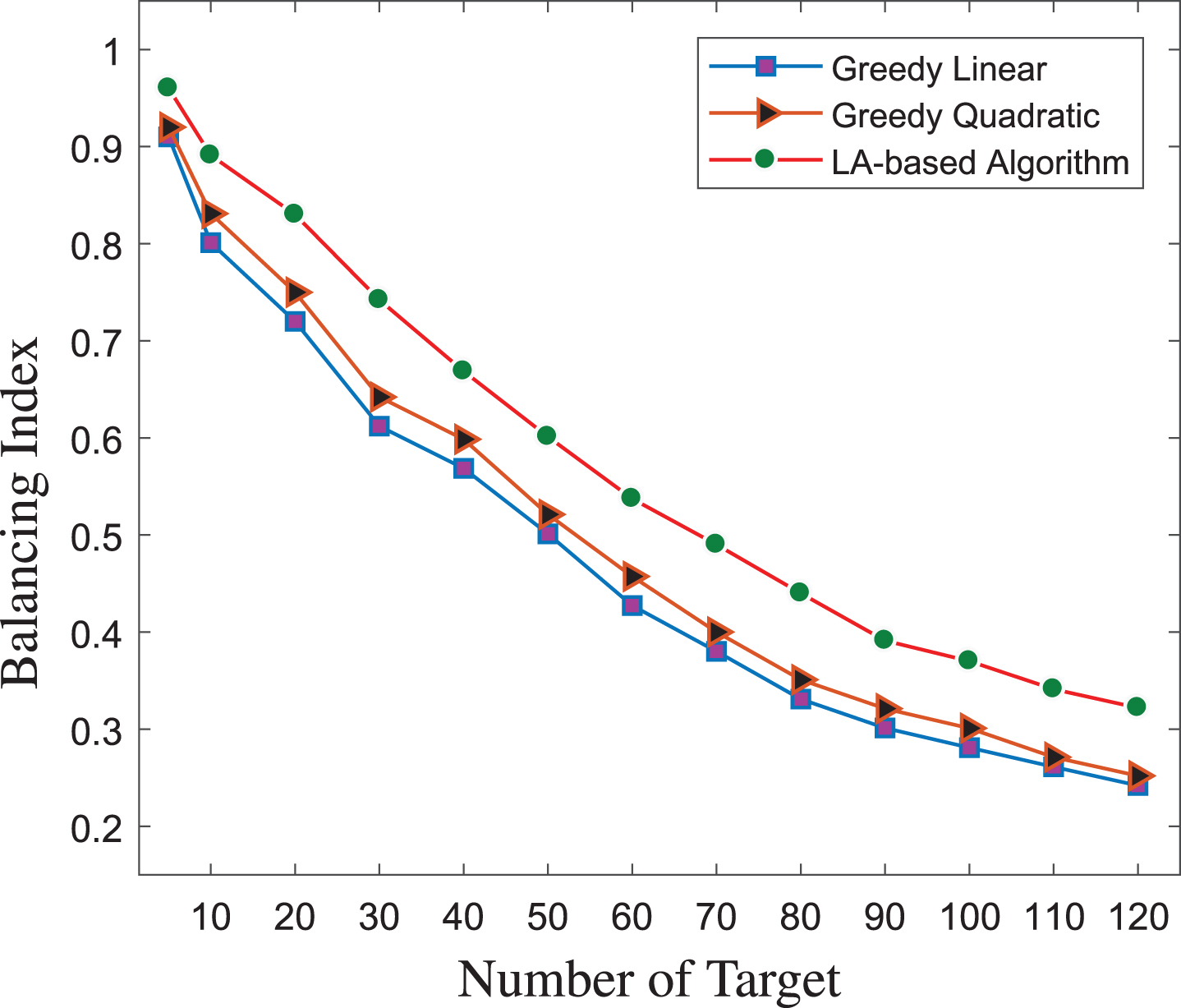
Effect of the number target on the balancing index.
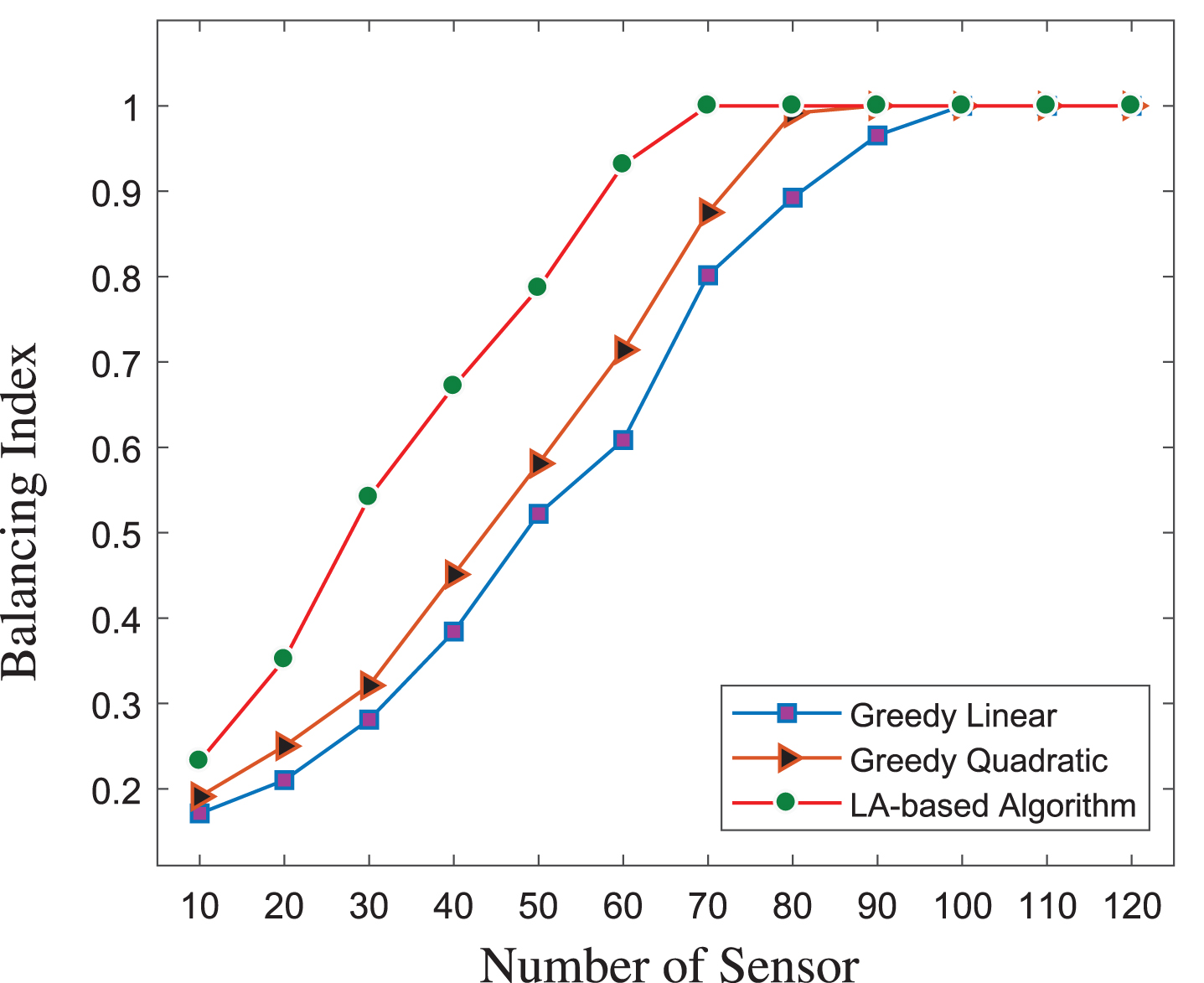
Effect of the number sensor on the balancing index.
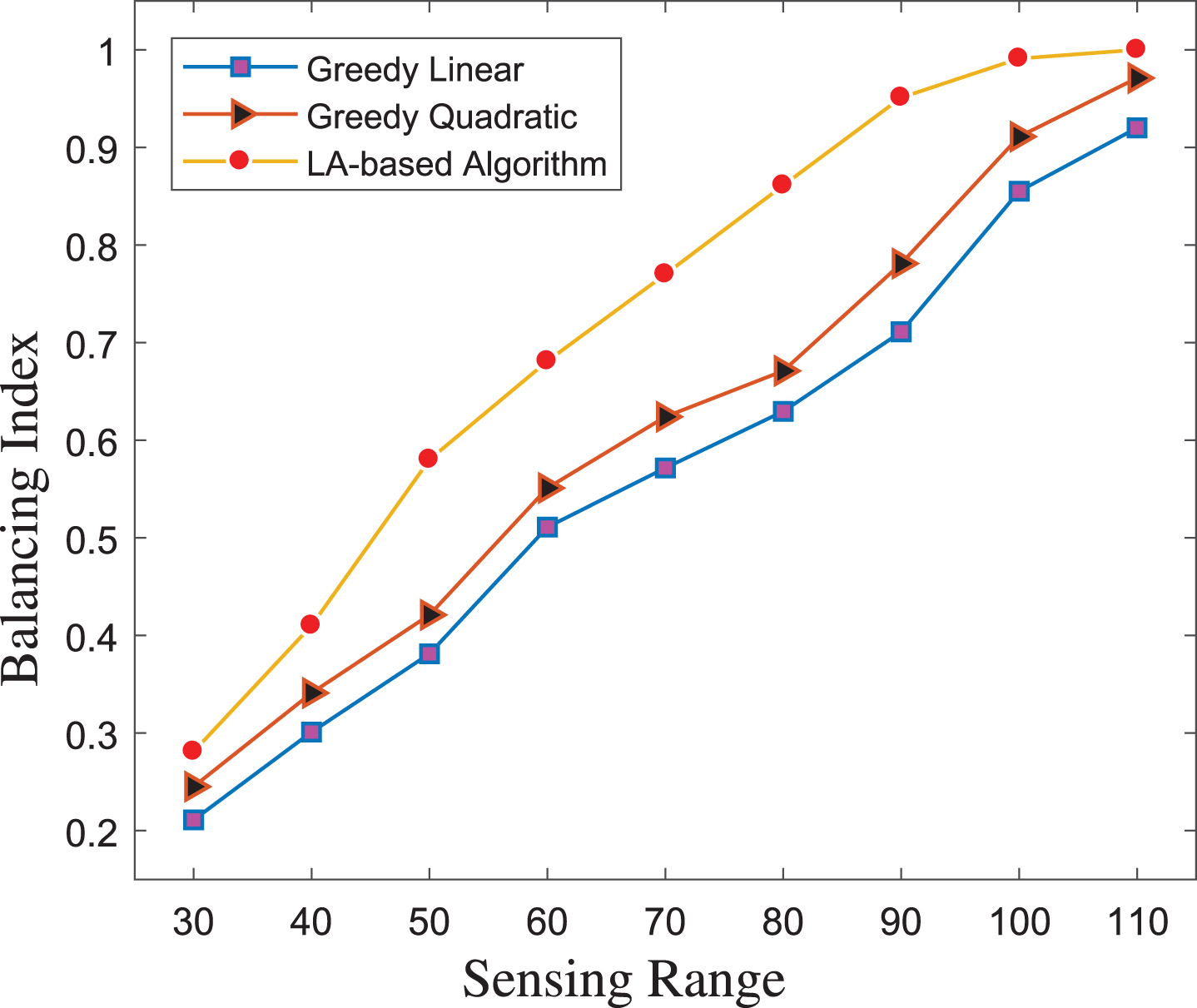
Effect of the sensing range on the balancing index.
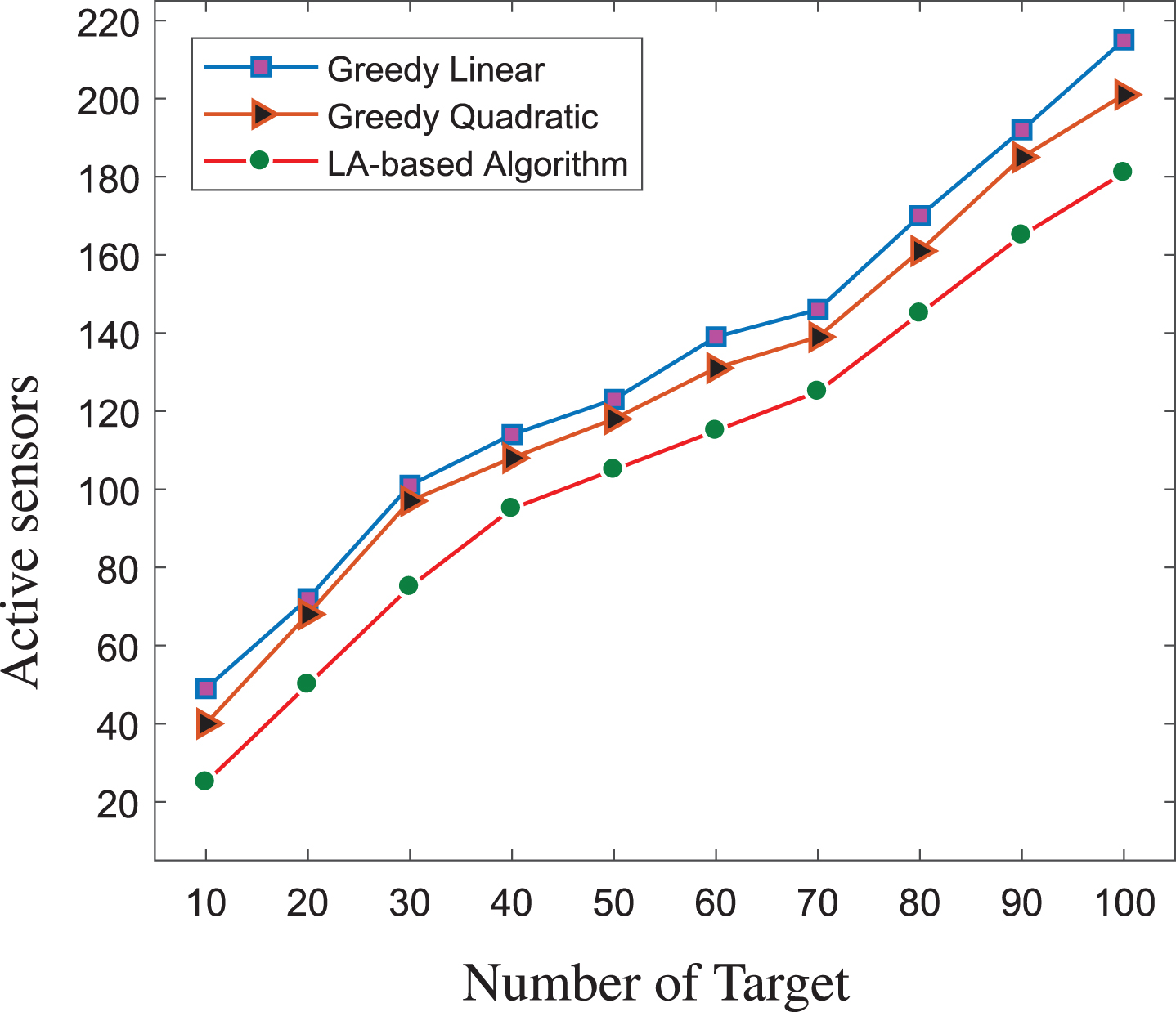
Effect of number of target and the size of constructed cover set.
The final results confirmed the capability of the proposed algorithm in solving the problem and it was shown superior to the greedy-based ones in doing its defined task.
Due to increasing popularity of low cost video-transmitting sensors, it is of a high significance to address the problems associated with them. One of the key problems in this field is imbalanced coverage referring to cases where there are not enough sensors to provide k-coverage for all targets in a network. To solve this problem, a learning automata-based algorithm equipped with a pruning rule was proposed, which was capable of selecting a set of minimum number of sensors that could provide balanced k-coverage for all the targets. Moreover, attempts were made to identify and manage critical targets to provide k-coverage with higher balance. This study also involved a number of experiments conducted to evaluate the efficiency of the proposed algorithm performance. The results were compared to those of two greedy-based algorithms. As confirmed by the final results, the proposed algorithm succeeded in solving the imbalanced k-coverage problem, and compared to the greedy-based ones, it could provide a higher BI. In future, it is planned to make use of distributed algorithm for solving the imbalanced k-coverage and the Q-coverage problem can be also addressed with LA in both WSNs and DSNs. Additionally, the present work is limited to Pan only cameras; though, there is a need for developing possible balanced k-coverage formulations for Pan-Tilt-Zoom (PTZ) cameras.