







Abstract
An intelligent decision analytic framework for dealing with complex decision-making risk system is presented and Bayesian network (BN) approach is utilized to evaluate the influence of multilevel uncertainty in various risks (e.g., social, natural, economic, intracompany risks) on decision-making deviation of Chinese hydropower corporations. The technique of fuzzy probability is approached to calculate intricate parameters to the question of inference learning through the sensitivity and influence power analysis, the results of back inference show that there exists the risk transformation mechanism from external uncertain risks (e.g., social risks, ecological environment factors) to hydropower corporations’ internal uncertainties closely relating to economic uncertainties through strategic planning. The study concerning identification and intelligent analysis of uncertain risks in decision-making process illustrates the feasibility and validity of applying BN and its pragmatic implications on hydropower corporations strategic planning and guidance in operational management.
Keywords
Introduction
With economic rapid development on the condition of state-orchestrated market in China, more than 9% increase of average annual GDP has been witnessed [1]. In the context of vigorous economy, Chinese hydropower industry corporations not just suffer immense internal pressure to make sustaining profits but also have to get rid of external adverse impacts such as ecological environment factors, electric market, national policy inclination, macro-economy, stakeholders et al. And the ascending competition within Chinese market prompts hydro corporations to look for effective ways of commercial strategy [2]. For example, some large-scale Chinese state-owned hydro corporations implement the ‘Going out’ strategy [3, 4]. Mostly, the hydro decision-making behaviors are prone to be bound in the harmonious unification of social and environmental elements [5]. In response to this situation, it is essential to maintain a desirable balance among economic, environmental, and social uncertain elements which take their tolls on corporations sustainability [6] inclusive of strategic and implementation level [7].
Previous studies have made meaningful contributions to the aspects of hydropower decision-making uncertainties, several of which are given the following statements. From hydroelectric market trades’ perspective. Multifarious programming methods were employed frequently to estimate the question of stochastic uncertainties, such as mixed-integer linear stochastic programming, a mixed-integer nonlinear programming, and a mixed-integer quadratic programming. Ref. [8] points out that more than a few realistic market uncertainties of hydropower producers ought to be given adequate attention in the modelling when a market trade analysis is conducted. Considerations of maximizing profitability and minimizing risks are contingent on the core of benefits of hydropower producers amongst drastic and competitive markets [9]. Ref. [10–12] put forth the idea that hydropower corporations are the undertakers of market prices which are viewed as exogenous variables. The measures of risk aversion are taken in order to control the volatility of expected revenue and get the maximization of power trading under water dispatching planning. Marginal costs and start-up time for hydropower are the bases of optimizing hydropower production, which has effects on the behaviors of market bidding for power generation [13]. From hydrologic and environmental perspective, Ref. [14] uses the method of multidimensional stress test to classify different kinds of risk factors, taking climatic and hydrologic models as its carriers and targeting at economic benefits of hydropower project investment. They have a further study of these dubious factors how to as to affect hydropower project investment through hydropower production. And simultaneously, an identifying pattern by generating the gap of economic performance is built. Ref. [15] opines that physical impacts of global GHG mitigation will slow down the growth of producers’ benefit considering CO2 reduction cost in hydropower generation. Even now, however, at the very least, environmental constraints on hydroelectricity can lead to the gradual increase of economic surplus to some extent [16]. From Stakeholders’ perspective, stakeholders’ impacts conceivably arise from the same category of hydropower companies. E.g., there is a profitable interaction between a newly established hydropower corporation who pays compensations for water usage and an incumbent corporation who provides the former with reservoir of water resources on the same river basin [17]. Additionally, Diaz et al. [18] have classified stakeholders’ perspectives into three disparate kinds of values and belief by a prior application of Q methodology, each type of which respectively prioritizes the implementation of hydropower projects in decision-making processes. Indeed, a regiment of hazardous decision-making factors have been emphasized in hydroelectric operational management, the importance of which has been incorporated into analytic framework formulated by many scholars as a whole, as reviewed above in recent literatures. Nevertheless, attention relating to comprehensive and anfractuous interaction of risky uncertainties is not sufficiently given in a decision-making process. And also, the probability distribution of these uncertain factors has been neglected [19]. Fuzzy linguistics is considered to be a good way to estimate the uncertain probability of hydro power corporations, as Ref. [20–22] opine that Fuzzy linguistics provides linguistic group decision makers with a fuzzy logic and system for computing with words that have potential for application in real-life scenarios.
Motivated by the multiple hazardous factors affecting the market working efficiency of hydro corporations, the previous research focused on control of uncertainties in the process of scheduling hydro power generation. However, in order to better cope with such complex decision-making risk system of decision-makers in hydro corporations, a sort of intelligent decision approach to Bayesian network is proved to be one of sound tools for efficient risk forecasting, which is widely used in a various range of risk analysis or assessment. This technique used in decision making of hydro power is the biggest difference from the existing literature. And the following questions raised then by our study will be addressed in this article: How do we use the identified hazardous factors to construct Bayesian network structure? And how do we employ triangular fuzzy numbers to solve probabilistic prediction of parameters? In terms of business strategy, are the hazardous factors with low sensitivity unimportant? And what is the internal nexus with other important risk parameters with high sensitivity? Is it possible to transfer external risks to internal decision-making risks? And what are the characteristics of corporations’ strategic planning correspondingly?
Addressing the above-mentioned critical issues will produce an ideal effect. That is, adding probability estimates of these peculiar hazard factors can alleviate the degree of extraneous loss due to decision-making mistakes in the presence of multiple strategic planning; synchronously, this method provides correct results of decision-making risk analysis in the decision-making realm of hydropower corporations.
Therefore, to find the answers, applying intelligent analysis framework considering necessary natural, social, economic and intracompany aspects can surmount the issues of intricate decision-making risks with a vision of comprehensiveness. To be more specific, this study proceeds in three steps. Firstly, domain experts’ knowledge and empirical statistics have been applied to discern the operation risk factors of hydro corporations, which is the basis of probability prediction utilizing Bayesian network structure. Secondly, the computational method of triangular fuzzy numbers is presented to calculate the probability of parameters in BN network nodes. Thirdly, this study assesses these hazardous factors as to how to affect the decision-making deviation through probability change and sensitivity analysis of parameters when multidimensional uncertain elements occur.
The structure of the rest of this manuscript is organized in the following way: Section 2 briefly introduces the intelligent methodological approach called Bayesian network; Section 3 describes the formulation procedure of Bayesian network structure; Section 4 puts forth the computational method of Bayesian network nodes; Section 5 analyzes the modelling results and further discusses the findings; and Section 6 concludes this work and future directions.
Methodological approach
The Bayesian Network has been employed to estimate the uncertain effects of hazardous factors on decision making of hydropower corporations. Bayesian Network (BN) is also called belief network, or probabilistic network, which is probabilistic causal graphics composed of a node variable pointing to other ones, standing for the dependence between random variables. Bayesian Network encompasses two components of graphical structure (directed acyclic graph, DAG) and numerical parameters (conditional probability distribution table) [23], in which DAG includes a set of random variables X = {X1, X2, …, X
N
}, each node X
i
is independent of its descendants in a given parent node Pa (X
i
) network, and the conditional probability over random variables X is calculated as [24].
Bayes theorem is the foundation of BN, which employs prior knowledge and observation sample updating prior probability, i.e., posterior probability, to forecast the occurrence of indeterminate events. Given variables I1, I2, …, I
n
are the experiment E of mutually exclusive and complete events with P (I
i
) >0, A is any event of E, then conditional probability can be calculated by (2).
Where P (I i ) is prior probability, and P (I i |A) is posterior probability.
Identification of hazardous factors
Before establishing a Bayesian Network (BN) modelling structure, it is necessary for a modeler to identify hazardous factors in a decision-making process which are composed of the nodes of the BN network. Therefore, two auxiliary methods are needed to identify these risk factors. One is that domain experts’ knowledge is deemed as a critical approach to attaining actual hazardous elements from operation of hydro corporations; the other is empirical statistics to improve the empirical judgment scientifically.
Domain experts’ knowledge: Domain experts’ judgment can be treated as an important knowledge resource characteristic of subjective perceptions. In consideration of expert judgment ability chiefly [25], three senior and sophisticated decision makers who have been employed in hydropower industry for a long time have participated in the interviews requiring preliminary data information.
Empirical statistics: To precisely acquire and better discern interference factors, another approach to making it discreet is presented, i.e., existing empirical statistics from heteroid research provide investigators with theoretical basis and practical guidance. Hence, combining with domain expert knowledge, the potential hazards which possess disparate state attributes are provided, as shown in Table 1.
Descriptions of variables
Descriptions of variables
In line with the above-mentioned identification of discretizing variables, the hazardous factors and causal relationships among them are supposed to be elicited. Two approaches can achieve the process of construction. One qualitative way is domain experts’ knowledge. For instance, Delphi technique [26] serves as a method of back-to-back survey feedback from experts’ opinions. From the design of the basic questionnaire to the collection of questionnaire data, the integrated procedures are grouped into four steps:
Step 1: Expertise of fundamental questions: At first, it’s necessary to determine the preparative but essential issues consisting of expertise in the field of hydropower industry. The first round of questionnaires are designed to acquire the first-hand information related to risks from the perspectives of the operating environment and stakeholders. Then, the questionnaires investigated by three senior decision makers are returned in sequence at different intervals.
Step 2: Identification of hazardous factors: According to the first round of questionnaires answered by three senior decision makers, their suggestion feedback is sorted into and screened by four types of risk factors after coming to a consensus. The second round of questionnaires performed by eight experts are designed to further investigate the possibility of risk factors occurring and the degree of impact on hydropower corporations’ operation.
Step 3: Bayesian network structure learning: On the basis of that, a small data set considering reliability and validity is gained to have a more particular knowledge of learning BN structure via different algorithms such as Augmented Naive Bayes. By combining with expert knowledge, a corrected and exquisite Bayesian network structure can be obtained after learning an unshaped network structure.
Step 4: The formation of Bayesian network structure: On the grounds of the complete structure of Bayesian network, we design the third round of questionnaires based on the conditional dependence among network parameters to collect the basic data required by the running model. A fully functional and effective BN structure is formed at this point.
Consequently, by combining the qualitative and quantitative methods, the constructed BN network of decision-making risks of hydro power corporations is mapped ultimately. See Fig. 1.
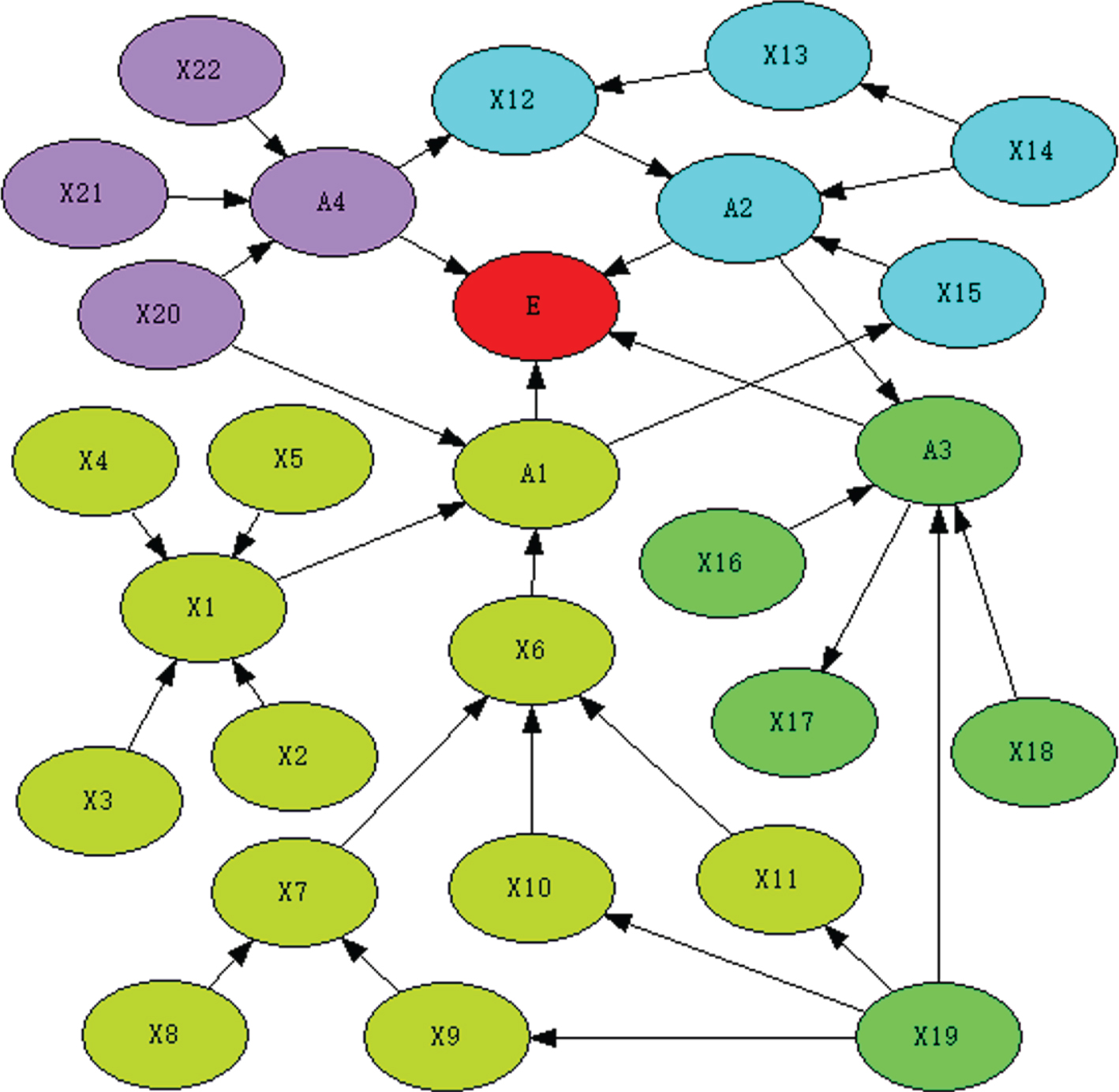
Constructed BN network of decision-making risks of hydropower corporations.
In most cases, the calculation of conditional probability can be performed by Equation 2. As the formula shows, all calculation of conditional probability depends on masses of data, and the more nodes there are, the more intricate the computation is. In addition, it’s hard to ensure the accuracy of data in allusion of characters of crowds of root nodes involving different states. Therefore, experts expertise and trustworthiness [27] need to be introduced with the help of group decision making [28, 29]. In a bid to reduce the difficulty and complicacy of calculation simultaneously, the method of triangular fuzzy numbers has been utilized to tackle with the probability of uncertain random events. The aforesaid idea can be expressed in a acknowledged way of linguistic variables by experts using the pre-designed language comment set [30], and then can be smoothly transferred into triangular fuzzy numbers in Table 2.
The probability of linguistic variables and relevant triangular fuzzy numbers
The probability of linguistic variables and relevant triangular fuzzy numbers
Linguistic variables can be denoted in the form of triangular fuzzy numbers [31]:
Where
Then, in order to ensure the relative rationalization of fuzzy probability from several experts’ final judgement, the method of arithmetic mean value can integrate the knowledge and experience of experts and obtain objective evaluation results, i.e., averaging different triangular fuzzy numbers that are converted from the subjective scoring of hazardous factors by industry experts. Then triangular fuzzy numbers mean value of nodes X
i
in j state is expressed by
The next process is defuzzification, that is, precision of fuzzy probability. In general, the peculiarity of defuzzification is the utilization of the general equation for the calculation of the geometric shapes [32]. The method of mean area is a common approach to defuzzification as follows:
Normalize the root nodes states value to make each criterion value limited between 0 and 1, and satisfy the condition that the sum of probabilities with different states of nodes is equal to one. The states value can be normalized as:
In accordance with the aforementioned rule of calculating parameter of BN and data required questionnaire survey, the triangular fuzzy number and probability of each root node can be deduced step by step, as shown in Table 3. And the conditional probability of other nodes can be chosen as appropriate parameter values according to Table 1 from investigation. In present study, academically available software GeNIe 2.0 is used to simulate and run the Bayesian Network of uncertain decision making. See Fig. 2.
Triangular fuzzy number and probability of each root node
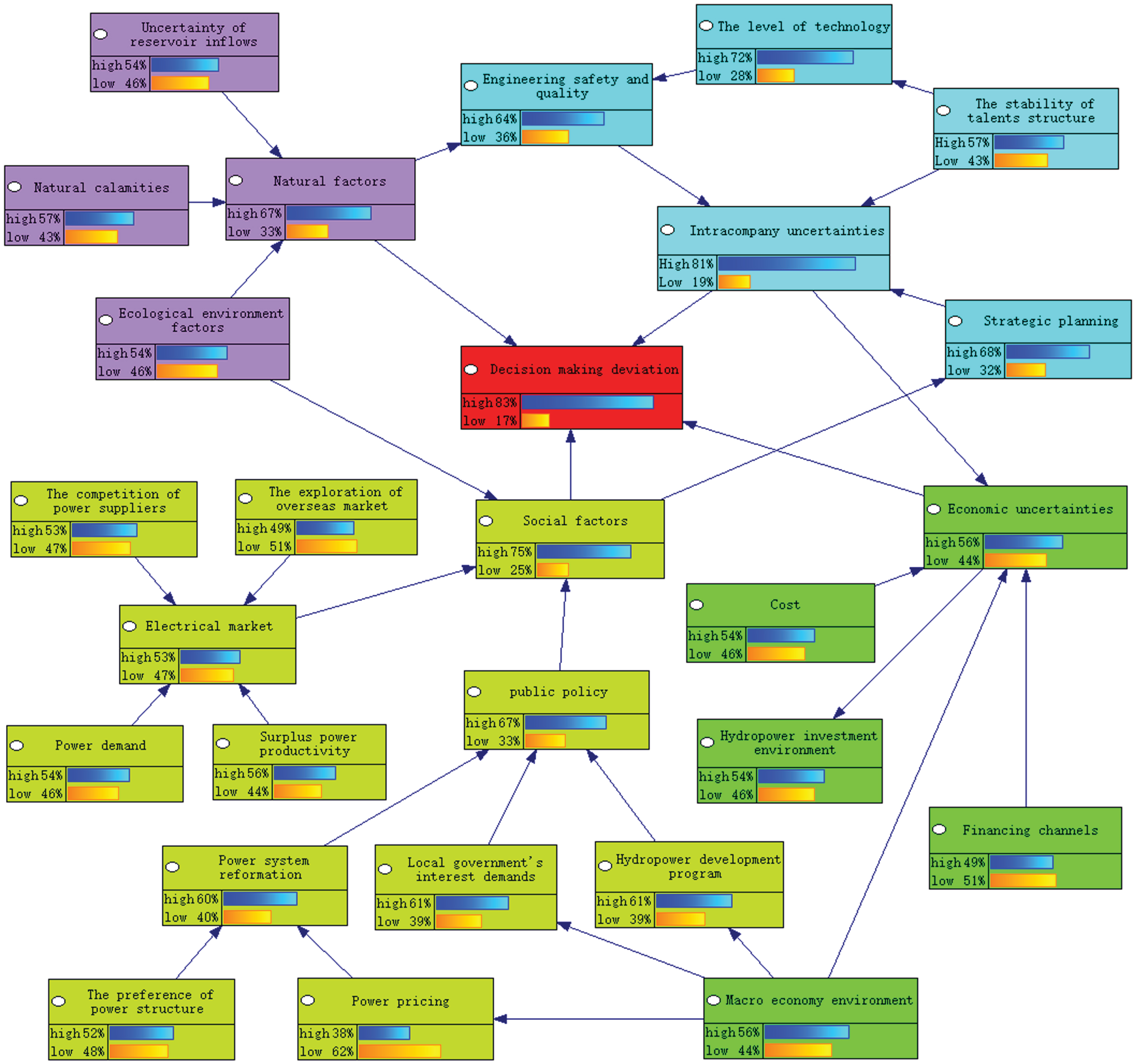
Hydropower policy-makers’ decision making deviation using BN network.
Analysis of results
Probability change of parameters
There are many risky uncertainties that result in low decision-making efficiency. Figure 2 illustrates the fact that the decision making deviation has a high proportion with approximation 0.83, the intracompany uncertainties (0.81), social factors (0.75) and natural factors (0.67) principally, which send up the deviation of probabilistic occurrence in decision making process, in comparison with small percentage 0.56 of economic uncertainties. For instance, the internal uncertainties of hydro corporations show that the predominant consequences of multiple risky factors are strategic planning (0.68), the level of technology (0.72), engineering safety and quality (0.64), and the stability of talents structure (0.57).
Under terms of the back inference of Bayesian network, control the lowest deviation from decision making, i.e., p (state0 = low) =1, as shown in Fig. 3. The share of economic uncertainties has an undulant downtrend with approximately 0.18 of declining volume, which has a momentous and immediate relationship with intracompany uncertainties in the decision-making behaviors of decision makers in hydro corporations. And intracompany uncertainties, social factors and natural factors decrease by 0.12, 0.15, 0.08 respectively.
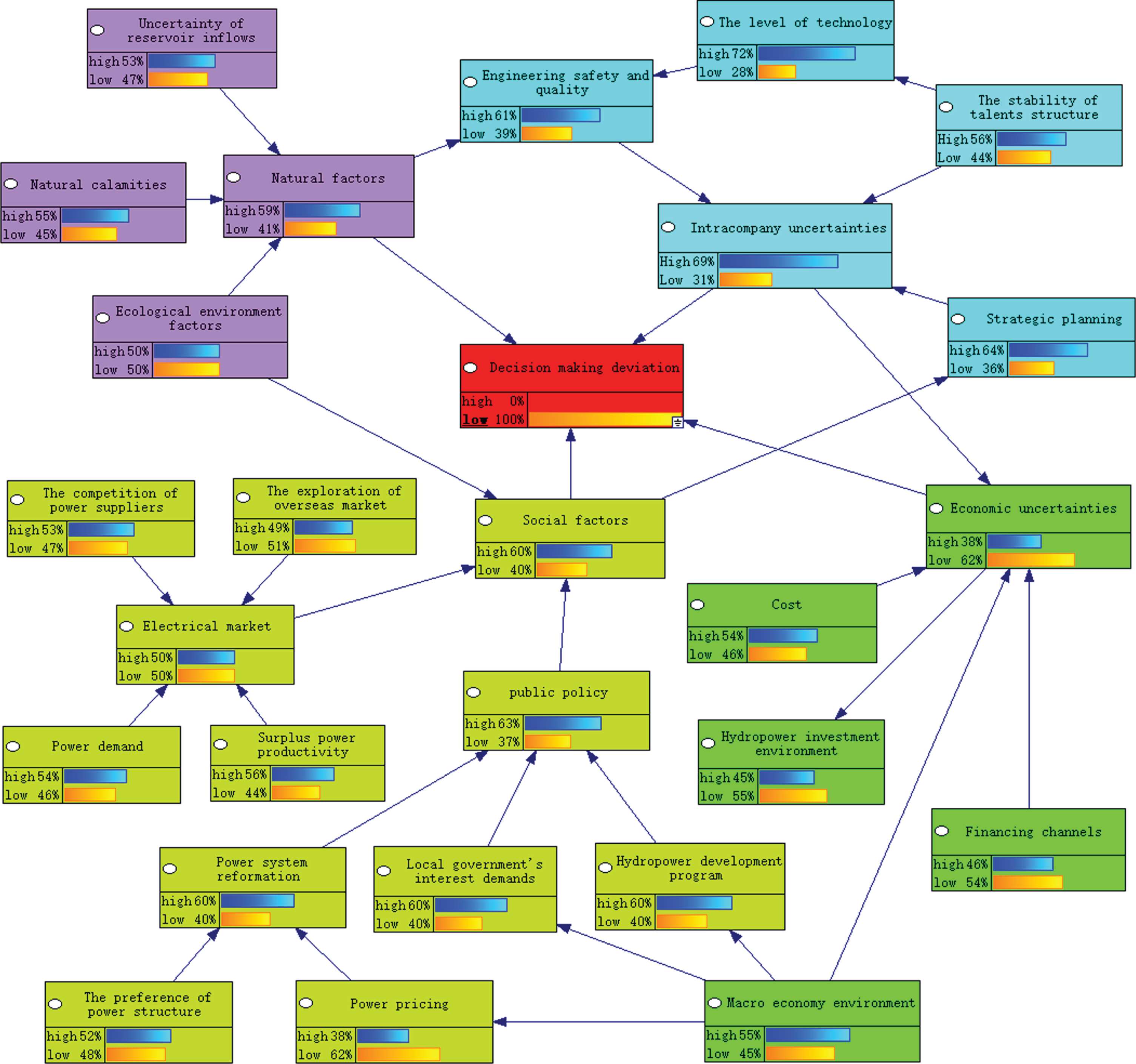
The back inference (posterior probability) of decision making deviation.
Nevertheless, it is not sufficient to be acquaint with what the probability is. Getting the big picture and refraining from superfluous errors in policy making require decision makers to detect uncertain information inclusive of infaust risks and adopt effective strategies. Therefore, sensitivity analysis has been performed to examine these procedures. Nodes colored in gradient red embrace important parameters, and the color of those individual nodes manifests the location of the sensitive parameters in BN, as shown in Fig. 4. For example, the most critical sensitive factors from three dimensions are natural factors, social factors and intracompany uncertainties. Important sensitivity parameters as three nodes are, it is hard to grapple with operable decision making information that can settle a particular matter, and corresponding sensitivity mean value of sub risks can raise hydro corporations’ decision-makers’ concern to a certain extent listed, such as engineering safety and quality (16.3), the level of technology (8.82), economic uncertainties (9.11), and strategic planning (6.02), as shown in Fig. 5.
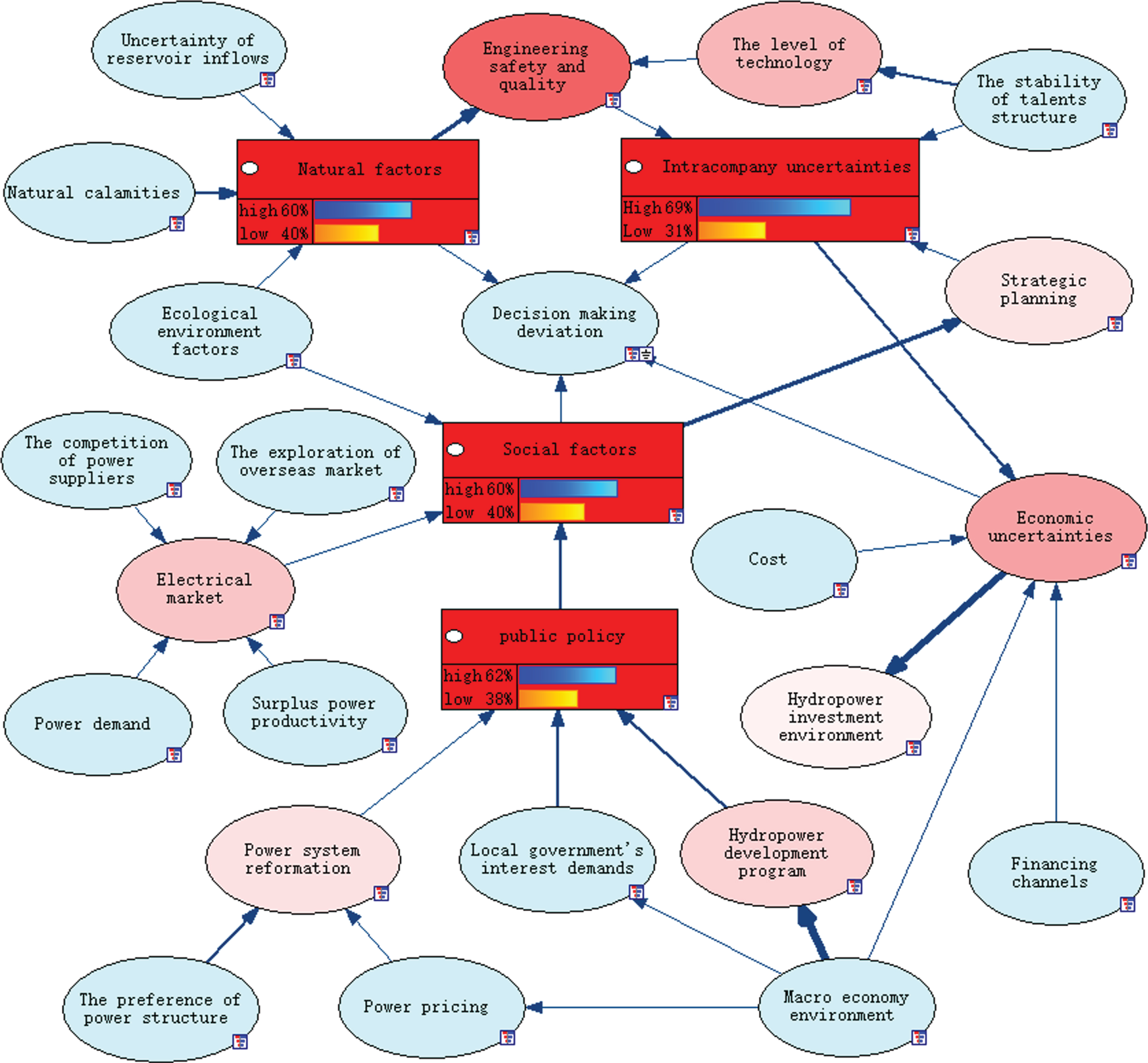
Sensitivity and corresponding influence power of uncertain factors.
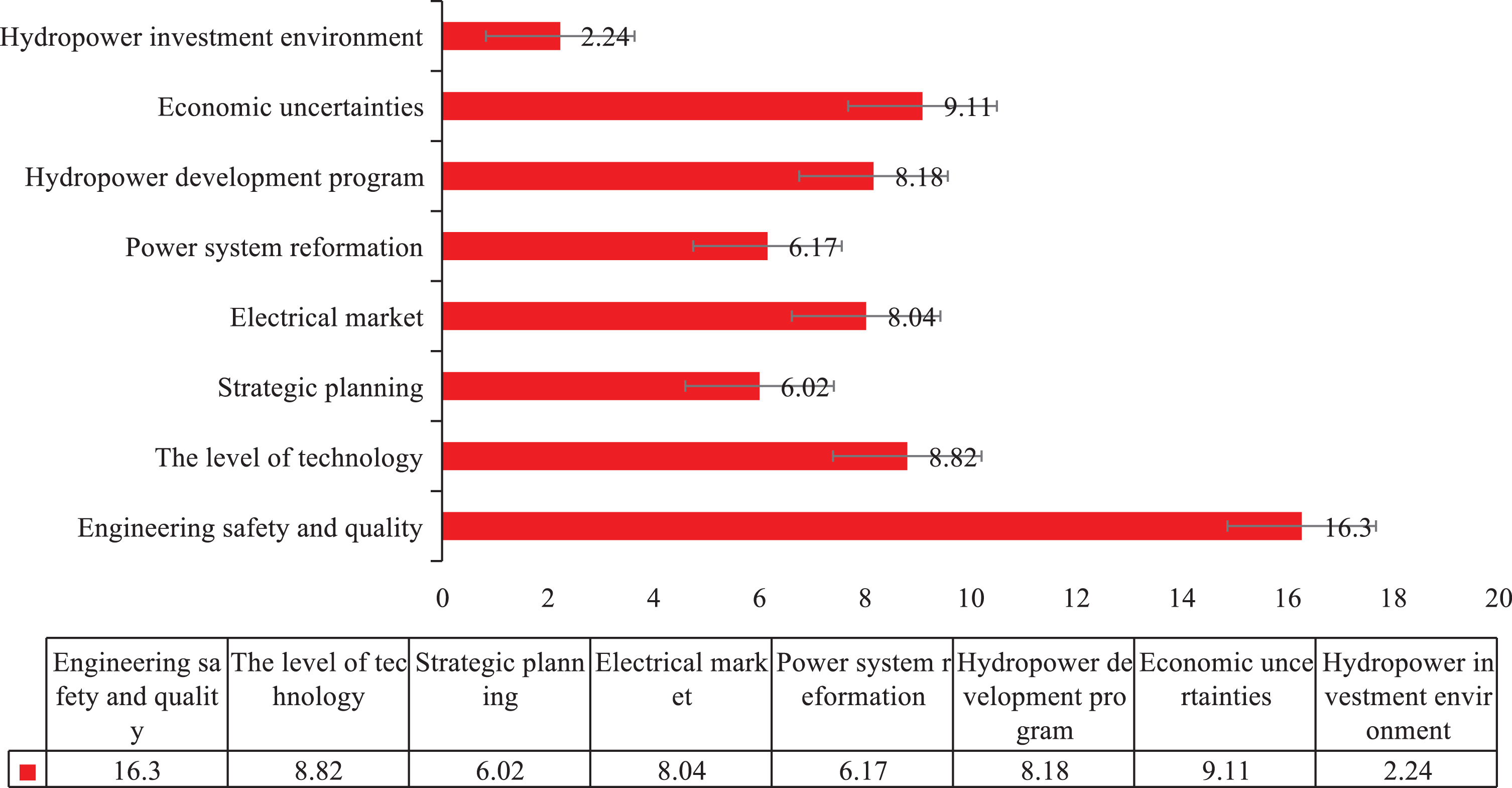
Sensitivity mean value of important sub parameters.
The foremost concern is that any good decision making model is the reliability of the results [33]. The dependability of results analysis has been examined through the proposed intelligent approach. Note that two pivotal clues from Bayesian network and results of data have been revealed intuitively from an exercisable point of view.
First of all, in terms of corporations’ strategy, among the investigated casual relationships, strategic planning with a low sensitivity (6.02) plays an important role in all uncertain decision making risks (See Fig. 4 thick lines), which stands to be seriously affected by multiple social factors inclusive of unmanageable electric market, public policy and ecological environment factors. In order to lower decision deviation and make effective choices for decision makers of hydropower corporations in daily operational management, it is, therefore, of great importance to perform appropriate corporations’ strategic adjustments about the problem of power productivity according to high risk probability of the policy preference of power structure and hydropower development program, as shown in Fig. 3.
Secondly, from multilevel interactivity point of view, one can see that the influence of economic uncertainties on hydropower investment environment is so distinctly salient that thick lines imply their strength of mutual interaction (see Fig. 4). Figures 2 and 3 illustrate the fact that the less economic uncertainties are, the less investment environment impacts are, both of which correlate strongly. Economic uncertainties are determined by internal uncertainties of hydropower corporations which have the most significant influence on the decision making deviation. In particular, engineering safety and quality and strategic planning are the results of comprehensive effects of natural factors and social factors respectively. The strategic planning that contains multilevel external social factors has been specially analyzed, which is viewed as a critical node affecting the internal risks of hydropower corporations, i.e., the internal and external duality of strategic factors [34]. Nature is deemed to be the factor of outwardness with unpredictable and elusive attributes. Then another external constraint except for level of technology on engineering safety and quality gives rise to an increase in events probability. Consequently, economic uncertainties reduce along with internal risks of corporations, as indicated above. Economic uncertainties have obvious internal characteristics of hydropower corporations, which is also coherent with experts’ opinion that several informed decision makers in the realm of hydropower bring their expertise together to imply the internality of economic risk.
Conclusions
This work seeks to present an intelligent method called Bayesian network for solving sufficient complicated decision-making risks of hydropower operational corporations. In comparison with other analytical techniques such as programming methods, two essential merits of implementing BN model are here: (i) describe the conditional dependence of each kind of uncertain risk and provide a probabilistic approach to reasoning on the condition of complex risk system; (ii) predict and assess the real risks by monitoring the deviation of main variables [35]. The proposed fuzzy probability is usage of method to calculate parameters of uncertain risks under a number of variables, which gives us a sound tool for tackling with such rather intractable parameters estimation.
The findings of this study demonstrate a truth in which corporations’ strategic risk closely relating to others bridges their independence of scattered uncertain risks, whose function is liable to transform multiple external uncertainties into internal problems that can be manipulated [36] smoothly by hydro corporations’ policy makers to lessen the influence of economic uncertainties on decision-making deviation and investment environment. However, the limitation is the lack of system analysis of the internal risks mechanism. In consequence, some future research proposals are raised to have a further study of this indication.
Studies can be exploration of what the risk transformation mechanism is, how the risk transformation mechanism will be carried out through viable strategic design and whether the mechanism will improve the decision-making efficiency so as to evaluate the benefits and drawbacks of strategic planning. The findings motivate future research. Additionally, the method of triangular fuzzy numbers is introduced to estimate parameters of BN network nodes. However, the applied range of risk factors’ parameters forecasting technique needs to be further improved in the future by extending of fuzzy linguistic approach to calculating the fuzzy probabilities and the fuzzy probability mean value to other aggregation functions.
Conflicts of interest
The authors declare that there are no conflicts of interest regarding the publication of this article.
Footnotes
Acknowledgements
The work presented in this research has been financially supported by Postgraduate Research & Practice Innovation Program of Jiangsu Province (Grant no. KYCX20_0511).