







Abstract
A polygonal fuzzy numbers can describe fuzzy information by means of finite ordered real numbers. It not only overcomes the complexity of traditional fuzzy number operations, but also keeps some good properties of trapezoidal fuzzy numbers, and it can approximate general fuzzy numbers with arbitrary precision. In this paper, a weighted arithmetic average operator is defined by the ordered representation and its operations of the polygonal fuzzy numbers, and a new Euclidean distance for measuring the polygonal fuzzy numbers is given. Secondly, in view of cost attribute and benefit attributes, the polygonal fuzzy decision matrix is normalized, and the weighted Euclidean distance is used to solve the positive (negative) ideal solution and the relative closeness of the decision matrix, and then a new decision method is given. Finally, the effectiveness of the proposed decision-making method is illustrated by an example of the evaluation of logistics companies by shopping websites.
Keywords
Introduction
With the rapid development of China’s economy and the fierce competition of market operators, shopping websites are increasingly demanding for logistics companies. At present, these websites mainly conduct comprehensive evaluation of logistics companies through multiple attribute indicators, such as transport efficiency, transport cost, transport safety, service attitude and throughput, and through the evaluation results choose a satisfactory logistics company. In reality, some logistics companies are often limited by their transport capacity and scale, inevitably some indicators can not meet the requirements of shopping websites or consumers, so they may be mercilessly eliminated by the market. Nowadays, popular shopping websites mainly focus on optimizing the selection of indicators such as high transportation efficiency, low transportation cost, good security and good service attitude to win reputation, which is undoubtedly the fundamental guarantee for shopping websites to maximize profits. Actually, logistics evaluation mainly uses some relevant data and mathematical models to evaluate the whole logistics system, so as to establish a control system that is conducive to the reasonable planning of the logistics system, and can accurately reflect the internal rationalization status of the logistics system and establish a sustainable development business model.
In 2014, Kao and Liao [1] proposed an evaluation method for logistics transportation and its service system based on fuzzy set theory and objective programming. In 2016, J Q Wang et al. utilized the likelihood-based TODIM approach of fuzzy language information to study the evaluation system of logistics outsourcing in [2], and a likelihood function was established for multi-hesitant fuzzy linguistic term elements based on a generalized function of the possibility degree of real numbers. In 2017, Cagliano and Marco et al. studied the most important factors that influence the productivity of the urban fleet of a logistics service provider in [3], and through a regression analysis they proposed that three main levers are shown to have significant impacts on productivity. In 2018, Singh and Qunasekaran et al. [4] put forward the fuzzy AHP and fuzzy TOPSIS methods with the help of the third party logistics in cold chain management. In recent years, some work on evaluating logistics enterprise and decision-making has been gradually increased. See [5–7]. These beneficial results provide some new evaluation techniques and methods for logistics companies from different perspectives.
In 2006, Wang [8] put forward an interval intuitionistic fuzzy decision-making method for incompletely determined multi-attribute information, and gave a multi-criteria programming method [9], the evidence reasoning method is extended to the multi-attribute decision making of intuitionistic trapezoidal or interval fuzzy numbers. See [10, 11]. In 2007, Xu first suggested the multi-attribute decision-making model with intuitionistic fuzzy number as attribute value in [12], a linear programming model was established, and proposed a multi-attribute group decision-making scheme based on a variety of aggregators. See [13–16]. In 2009, Wei defined the expected value and score function of intuitionistic trapezoidal fuzzy numbers by weighted arithmetic average operator in [17], and suggested a new multi-attribute group decision-making method [18]. In 2010, Wan et al. [19] studied the group decision-making problem of multi-attribute information based on intuitionistic trapezoidal fuzzy numbers, and gave the multi-attribute decision-making method of interval intuitionistic trapezoidal fuzzy numbers. In 2014, Lan et al. [20] not only discussed the completeness of trapezoidal fuzzy number space, but also put forward a new practical decision methods. Although these results provided some new evaluating methods for logistics companies from different perspectives, the old trapezoid or interval intuitionistic fuzzy number is still used as a basic element in the description of fuzzy phenomena. It has to be said that it is a weak point.
The polygonal fuzzy numbers are different from intuitionistic fuzzy nmbers or Pythagorean fuzzy soft sets, it can approximate or represent the general fuzzy number by means of a finite number of ordered real numbers, and it may describe the fuzzy information according to the arbitrary accuracy. It is not only a generalization of triangular or trapezoidal fuzzy numbers, but also its operation is simple and clear and satisfies the closeness. In 2011, Wang [21] first studied the approximation performance of forward polygonal fuzzy neural network by using n- polygonal fuzzy numbers. In Ref. [22], the construction and approximation process of single input and single output polygonal fuzzy neural network were studied. Later, a FCM clustering algorithm and TOPSIS decision-making method of multi-attribute index information were proposed by using the ordered representation of polygonal fuzzy numbers. See [23, 24]. These results show many advantages of the polygonal fuzzy numbers from different aspects, and it also lays a theoretical foundation for the wide application of trapezoid or interval fuzzy numbers.
The main contents of this paper are as follows: In section 2, the ordered representation of polygonal fuzzy numbers, examples and their operation rules are given; In section 3. A new Euclidean distance of the polygonal fuzzy numbers is proposed, and the approximation accuracy of the polygonal fuzzy numbers is discussed. In section 4, the expression of multi-attribute information and information aggregation of logistics companies are described by the ordered representation, and the expression of linear function is given. In section 5, a new normalization method for polygonal decision matrix is given, and the relative closeness degrees are solved by the weighted Euclidean distance and positive (negative) ideal solutions. Finally, a new decision method is given. Finally, the effectiveness of the proposed method is illustrated by an example of evaluating logistics companies through shopping websites in section 6.
Polygonal fuzzy numbers and their ordered representation
Normally, the operations of general fuzzy numbers are not linear, it can only rely on the complex Zadeh expansion principle for arithmetic operations, even for triangular or trapezoidal fuzzy numbers is very difficult. This brings serious inconvenience to the further application of fuzzy numbers. In fact, trapezoidal fuzzy numbers are not only generalizations of triangular fuzzy numbers, but more importantly, it can approximate to a fuzzy number by superposition of several small trapezoids. In other words, a fuzzy number can intercept n small trapezoids according to different n values, and the finite superposition of these small trapezoids can approximate to express a fuzzy numbers, as shown in Fig. 1.
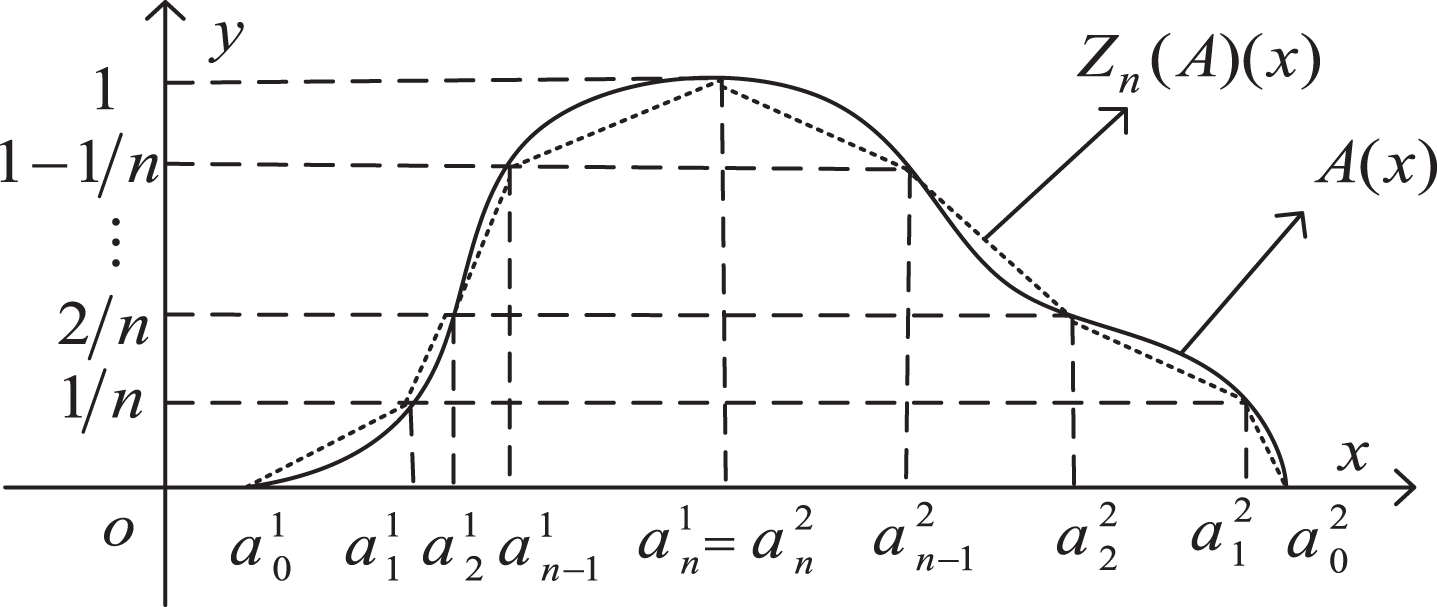
Intercepting several small trapezoidal images on the membership function A (x).
According to Fig. 1, it is not difficult to see that the number of small trapezoids intercepted on a given fuzzy number A depends on the value of n. The larger the value of n, the more the number of small trapezoids and the more intersections they have. These small trapezoids have stronger ability to approximate fuzzy numbers, but their complexity also increases.
Then A is called an n-polygonal fuzzy number on
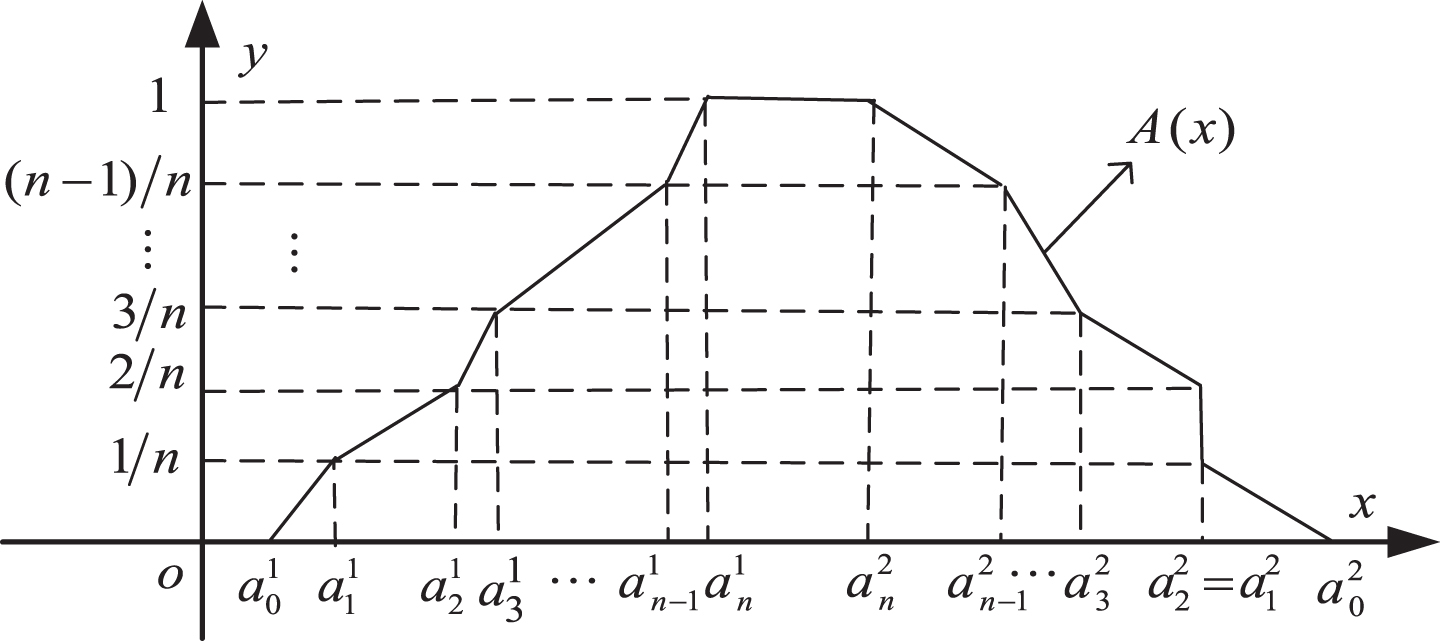
Images of the membership function of n-polygonal fuzzy number A.
According to Fig. 2, there are obviously support set Supp
In fact, it is obvious that the support set Supp A = [-4, 7], Ker A = [1, 2], and there are eight ordered real numbers in the given ordered representation. so that 2n + 2 =8 and the solution is n = 3. This means inserting two points λ1 = 1/ - 2 and λ2 = 2/ - 3 into the closed interval of y- axis [0, 1]. Therefore, the intersection coordinates of the membership function of 3- polygonal fuzzy number and the horizontal lines y = 1/ - 3 and y = 2/ - 3 can be expressed as
Then the above eight coordinate points and its positions can easily determined in the plane coordinate system, and then connect the adjacent intersections with straight line segments in turn. Finally, we can obtain the membership function image of the obtained 3-polygonal fuzzy number A and its analytic formula as follow. See Fig. 3.
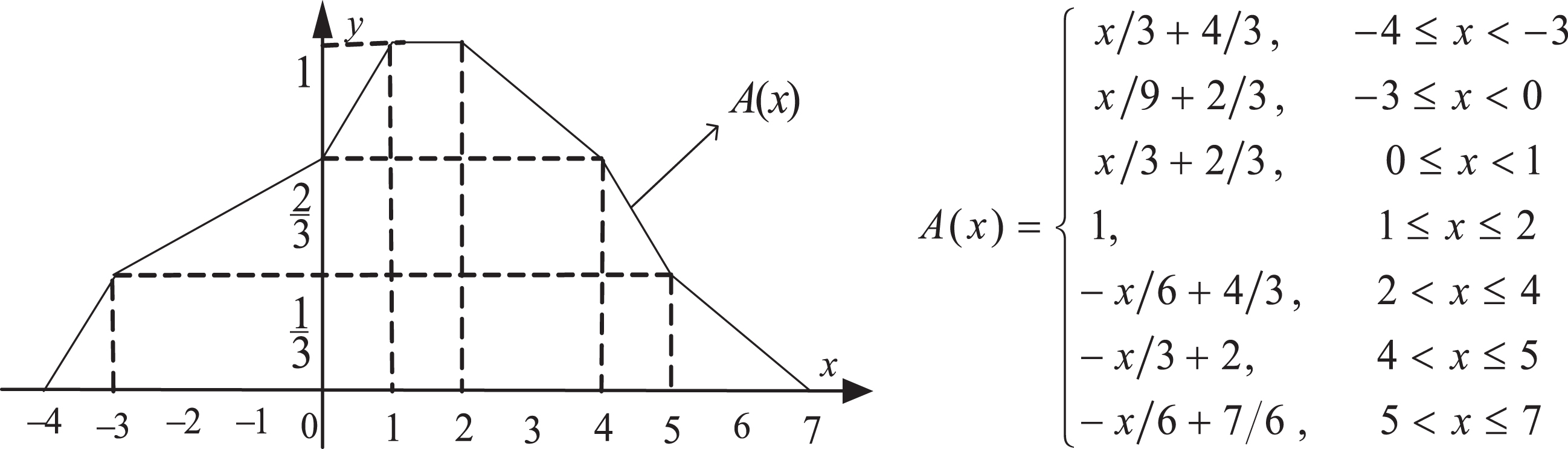
Membership function image and its analytic expression of 3-polygonal fuzzy number A.
In addition, it is easy to obtain an ordered representation Z
n
(A) of the n-polygonal fuzzy number by n-equidistant subdivision for the membership function A (x), so that the fuzzy number A approximated by finite ordered real numbers can be realized. But the better the approximation effect of Z
n
(A) is, the greater the value of n, and satisfies
Let
When n = 2, 3, 4, try to solve the ordered representation of the corresponding n-polygonal fuzzy number A.
In fact, Supp A = [0, 9], when n = 2, only one subdivision point λ = 1/ - 2 on the y-axis. Let the left function
Let n = 3, it has only two subdivision points λ1 = 1/ - 3 and λ2 = 2/ - 3 on the closed interval [0, 1] of y-axis. Let left function
Similarly, let n = 4, then there are three subdividing points λ 1 = 1/ - 4, λ2 = 2/ - 4 and λ3 = 3/ - 4. It is not difficult to obtain the ordered representation of Z4 (A) as follows
In particular, when n = 2, 3, the membership function image and the ordered representation of n-polygonal fuzzy number corresponding to A are shown in Figs. 4-5.
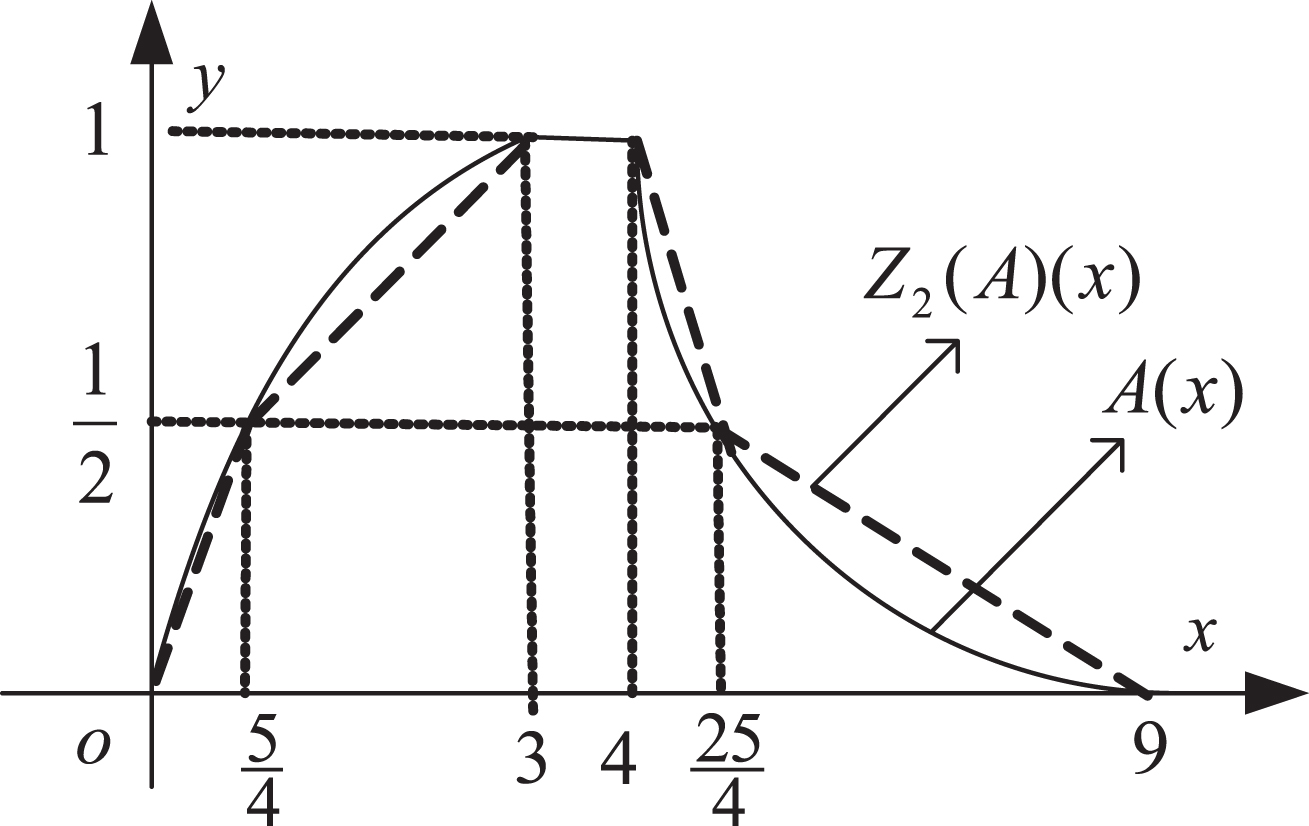
Membership function images of A and Z2 (A).
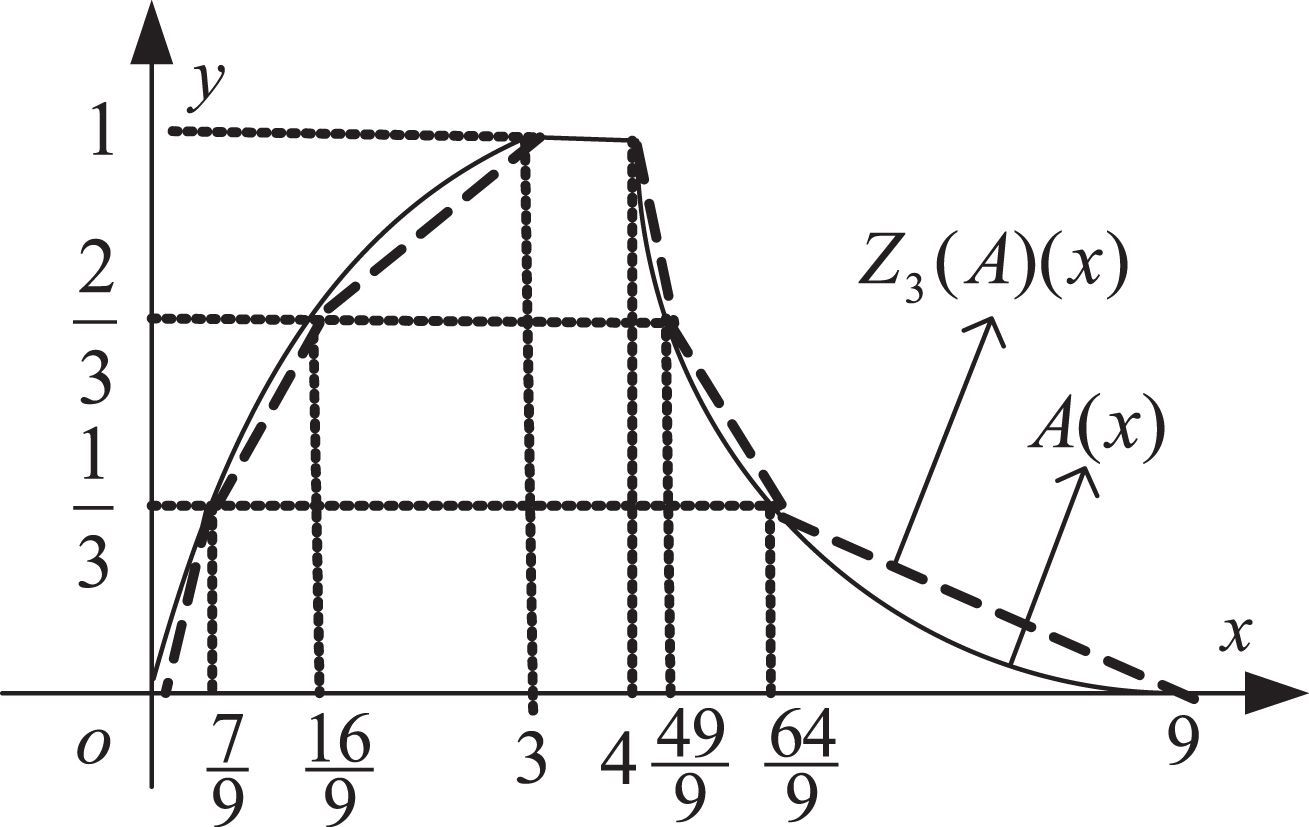
Membership function images of A and Z3 (A).
Next, we will give the operations of n-polygonal fuzzy numbers on
①
②
① Z n (A) = Z n (B) ⇔ Ai/-n = Bi/-n ⇔ Z n (A) i/-n = Z n (B) i/-n, i = 0, 1, 2, ·· · , n .
② Z n (A + B) = Z n (A) + Z n (B),
③ Z n (A · B) = Z n (A) · Z n (B) and Z n (k · A)) = k · Z n (A),k > 0.
In 2011, it is proved that the fuzzy distance on the polygonal fuzzy number space
For a given natural number
It is not difficult to verify that the mapping E
n
constitutes a distance (metric) on
Next, we will verify that the operator E
n
really constitutes a metric on the space
In fact, the non-negativity and symmetry of E
n
(A, B) are evident, so it only need to prove that E
n
satisfies three-point inequality, i.e., for any
Actually, as
Similarly, under the condition
Let
That is to say, E
n
(A, B) ⩽ E
n
(A, C) + E
n
(C, B). Then E
n
is an Euclidean metric on
In addition, since the polygonal fuzzy number Z
n
(A) can approximate to a general fuzzy number A, people are more concerned about how to determine the minimum n value to make the approximation accuracy ɛ > 0, and satisfies D (Z
n
(A) , A) < ɛ. Actually, as a special fuzzy number, the polygonal fuzzy number must satisfy the traditional fuzzy distance formula
Next, for a given precision ɛ > 0, we will use an example to find a smaller n value so that D (Z n (A) , A) < ɛ. In fact, if we do equidistant subdivision on the closed interval [0, δ]: δ/ - n ⩽ 2δ/ - n < ·· · < iδ/ - n < ·· · < (n - 1) δ/ - n < δ, then there is i ∈ {1, 2, ·· · , n} makes (i - 1) δ/ - n ⩽ α ⩽ i1ptδ/ - n and Ai1ptδ/-n ⊂ A α ⊂ A(i-1)δ/-n = Z n (A) (i-1) 1ptδ/-n for arbitrary α ∈ (0, δ]. According to the three-point inequality of Hausdorff metric d H , then the following conclusion can be obtained that
It should be noted that formula
Suppose the membership function of fuzzy number A is
Therefore, according to the definition of the above-mentioned fuzzy distance D, it is obtained immediately that
Let ɛ = 0.1, if
It is well known that triangular fuzzy numbers can be expressed by three ordered real numbers, trapezoidal fuzzy numbers can be expressed by four ordered real numbers, and the polygonal fuzzy numbers can not only be expressed by six, eight or even 2n + 2 ordered real numbers, but also can approximate the given general fuzzy numbers with arbitrary precision, and can guarantee the closeness of the arithmetic operations and the excellent properties of trapezoidal fuzzy numbers, so as to ensure less loss of useful information. Usually, when shopping websites evaluate logistics companies synthetically, they are often disturbed by internal or external factors. If they use simple triangular or trapezoidal fuzzy numbers to express fuzzy information, they often lose some useful information, which leads to unreliable evaluation results or inaccurate evaluation. However, broken-line fuzzy numbers can make up for these shortcomings. Especially, the description for multi-attribute information by the polygonal fuzzy number is more comprehensive and specific. In fact, for a given natural number n, it is not difficult to transform the general fuzzy number into an ordered representation of n-polygonal fuzzy number (See Example 2), and then transform the complex fuzzy number operation which originally relied on the Zadeh extension principle to a simple linear operation (Definition 2.2). See [22, 25]. Consequently, it is more practical and in line with the operators’ vital interests to evaluate the multi-attribute index system of logistics companies by using the ordered representation of polygonal fuzzy numbers.
Usually, a shopping website platform evaluates logistics companies synthetically through multiple indicators such as transportation cost, transportation efficiency, transportation reliability, service attitude and commodity throughput, and then evaluates and chooses satisfactory logistics companies. Actually, the total volume of goods transported by each logistics company is limited by the company’s own size and operational capacity. For example, if there are too few goods transported every day, the transportation cost is low, but the profit is small, so logistics companies and shopping websites are certainly not satisfied. If there are too many goods transported every day, the transportation cost will increase naturally, and even the logistics companies can not afford to exceed their own carrying capacity, which will lead to the decline of transportation efficiency. This situation is certainly unsatisfactory for shopping websites. Therefore, under the premise of not expanding reproduction, only the appropriate transportation cost of logistics companies can make logistics companies satisfied. However, how to make the transportation capacity of logistics companies “appropriate” is not a simple problem.
For this reason, we can quantitatively study this problem by means of mathematical modeling. For example, we use smooth Gaussian fuzzy number to describe the satisfaction degree of shopping websites to logistics companies’ transportation costs, and assume that road transportation costs mainly include vehicle attrition, toll collection, fuel consumption and labor cost. If a shopping website uses the Gaussian fuzzy number G to evaluate the logistics cost of a logistics company, and the Gaussian membership function is
Here, the x-axis represents the transportation cost of the logistics company; the y-axis represents the satisfaction degree of the shopping website. When the transportation cost is less than RMB 40,000/day, the satisfaction degree of logistics company increases with the increase of transportation cost; when the transportation cost reaches RMB 40,000/day, the satisfaction degree reaches the highest level; when the daily transportation cost exceeds RMB 40,000/day, the satisfaction degree decreases with the increase of transportation cost; when the transportation cost is RMB 80,000/day, the satisfaction degree is G (8) = G (0) = e-8/-3 ≈ 0.0695; when the transportation cost exceeds RMB 80,000/day, the satisfaction degree is 0.
For simplicity, let n = 2, 3, 4, according to Example 1 the ordered representation of Gaussian membership function G (x) = e-(x-4)2/- 6 can be obtained as follows:
The images of the membership function Z n (G) (x) corresponding to the n-polygonal fuzzy number can also be obtained as shown in Figs. 6–8.
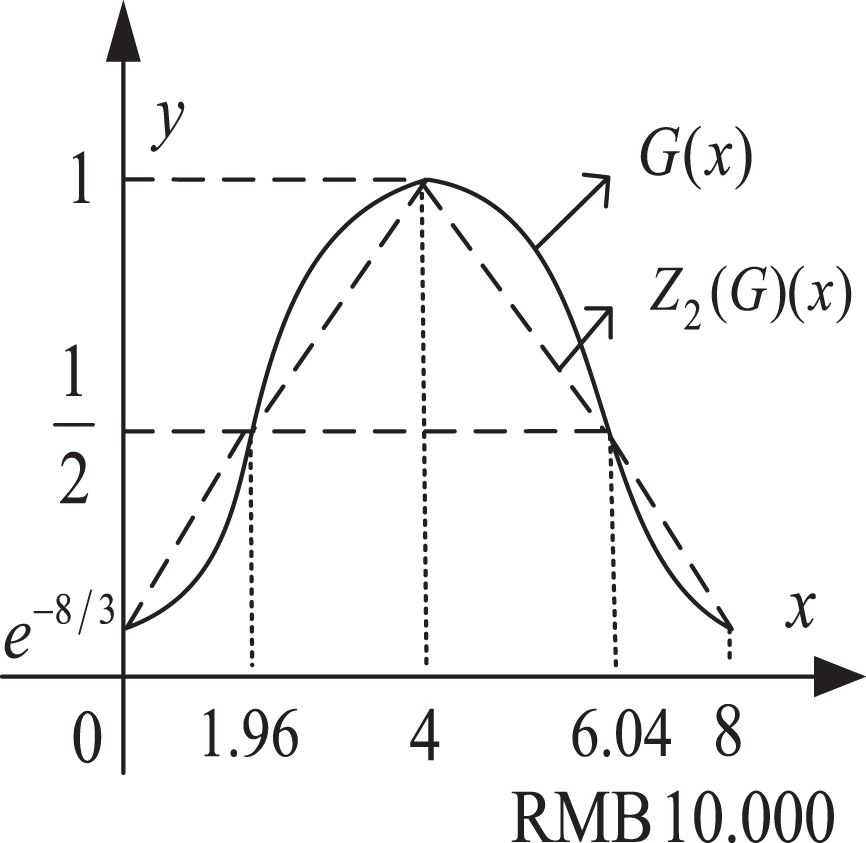
Images of G (x) and Z2 (G) (x).
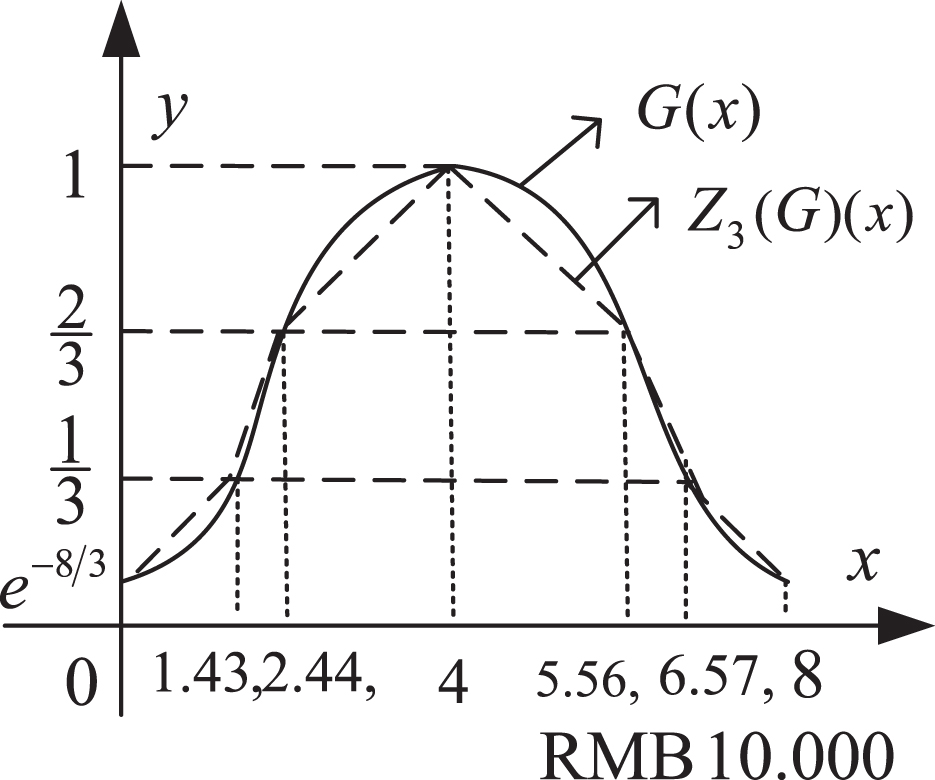
Images of G (x) and Z3 (G) (x).
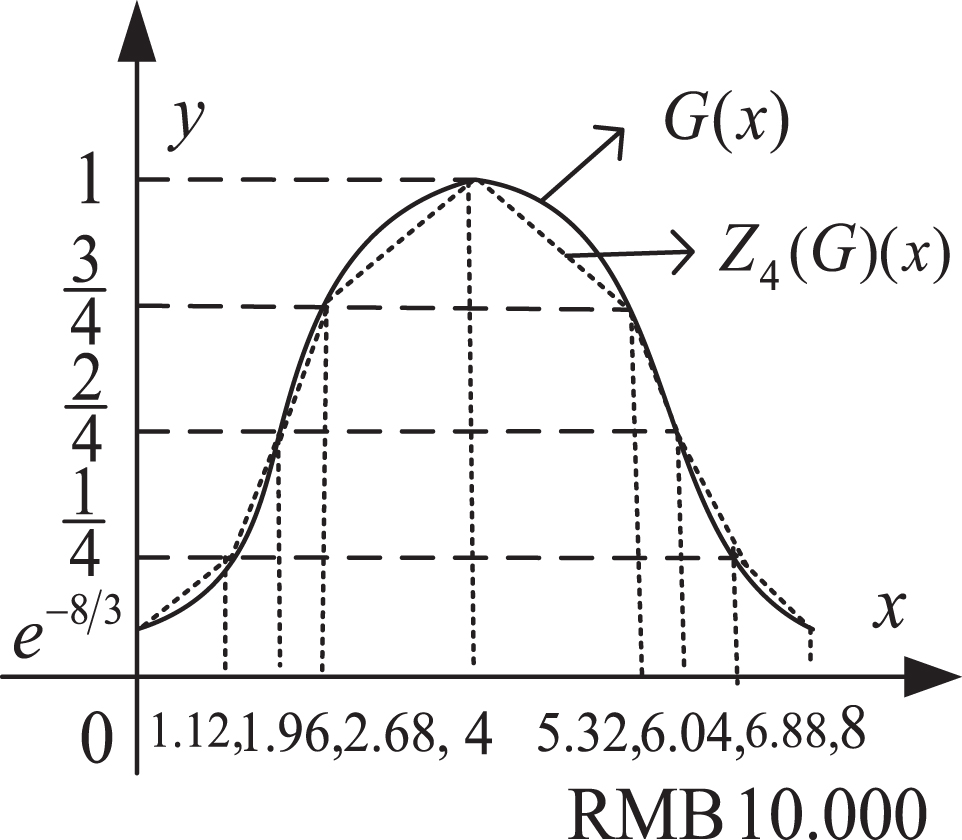
Images of G (x) and Z4 (G) (x).
From Figs. 6– 8, it is easy to see that with the increase of n value, the ability of Z n (G) (x) to approximate the Gauss function G (x) is stronger, but its complexity is also increased. Therefore, the index information can not only reduce the loss of useful information based on the ordered representation of fuzzy numbers, but also enhance the comprehensiveness and accuracy of describing fuzzy information. This is because the ordered representation of a fuzzy number can be 2n + 2 ordered real numbers. To describe the information of an index, the traditional triangular or trapezoidal fuzzy numbers can only be represented by 3 or 4 ordered real numbers, and they are only special cases of the polygonal fuzzy numbers.
Let’s take Fig. 7 as an example (n = 3) to illustrate that the ordered representation Z3 (G) describes the satisfaction degree of shopping websites with transportation costs. The ordered representation can be abbreviated to Z3 (G) = (0, 1.43, 2.44, 4, 4, 5.56, 6.57, 8), which indicates the satisfaction degree of shopping websites with transportation costs. For example, when the daily transportation cost variable x of logistics companies is [1.43, 2.44], the satisfaction function is Z3 (G) (x) =0.3307x - 0.1386. In particular, its satisfaction is Z3 (G) (2) =0.5228 when x = 2. Similarly, if the transportation cost x is graded continuously according to the arrow trend: 0 → 1.43 → 2.44 → 4 =4 → 5.56 → 6 . 57 → 8 (RMB 10.000), the shopping network will be satisfied, and the satisfaction of stations to transport costs can be expressed by a linear function Z3 (G) (x), i.e.
In fact, it is very easy to obtain an analytic expression of a linear function Z3 (G) (x) based on the two point equation. in which the ordered representation Z3 (G) and the linear function Z3 (G) (x) are only two different forms, and they are mutually unique. Obviously, the ordered representation is much simpler than the linear function. Hence, the satisfaction of transportation cost described by the ordered representation Z3 (G) is not only closer to the smooth Gaussian membership function G (x), but also more accurate than the triangular or trapezoidal fuzzy number. Of course, in practical problems we do not have to divide the points equally along the y-axis points
For example, we choose the Gauss membership function
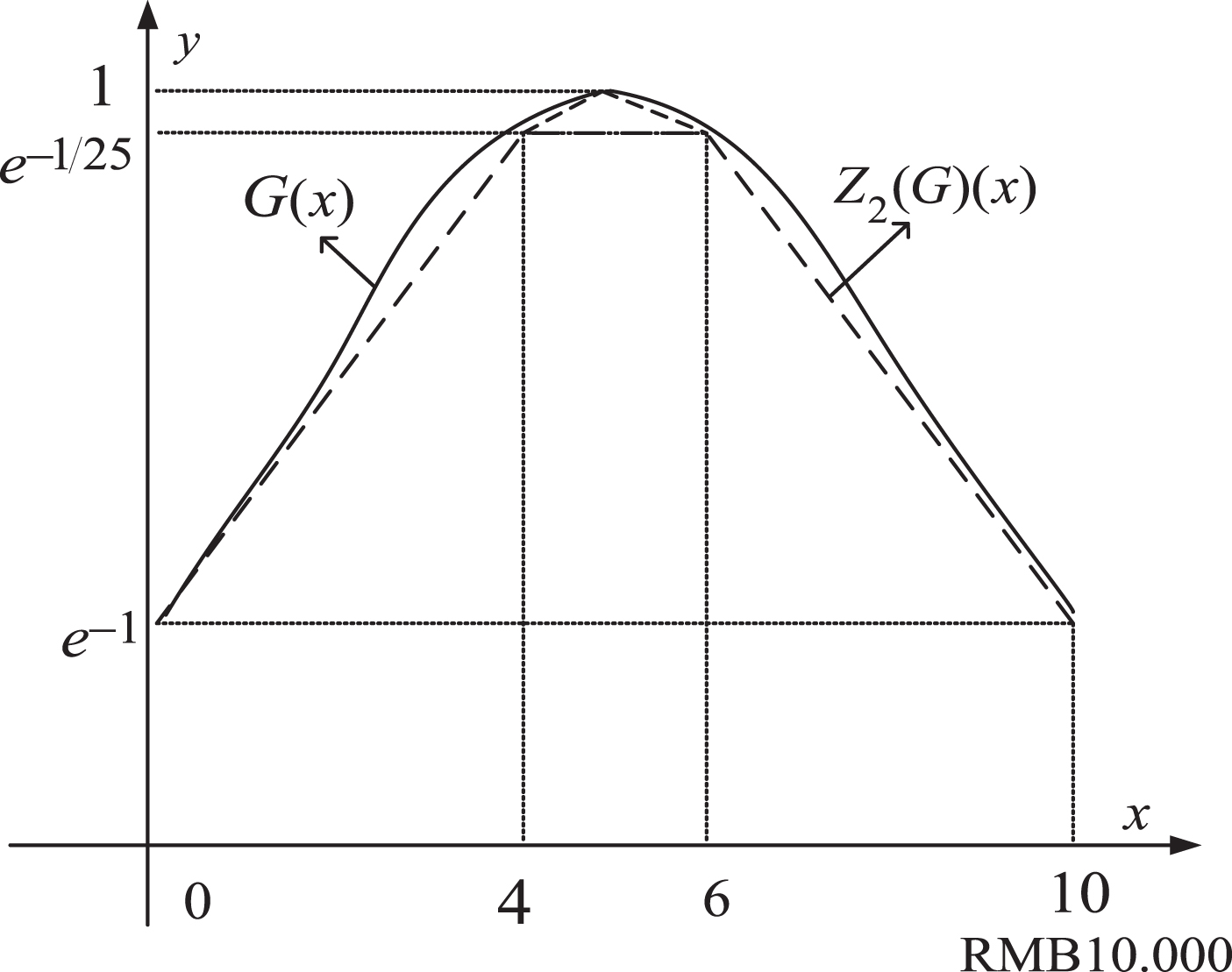
Non-equidistant subdivision determined by the ordered representation on when n = 2.
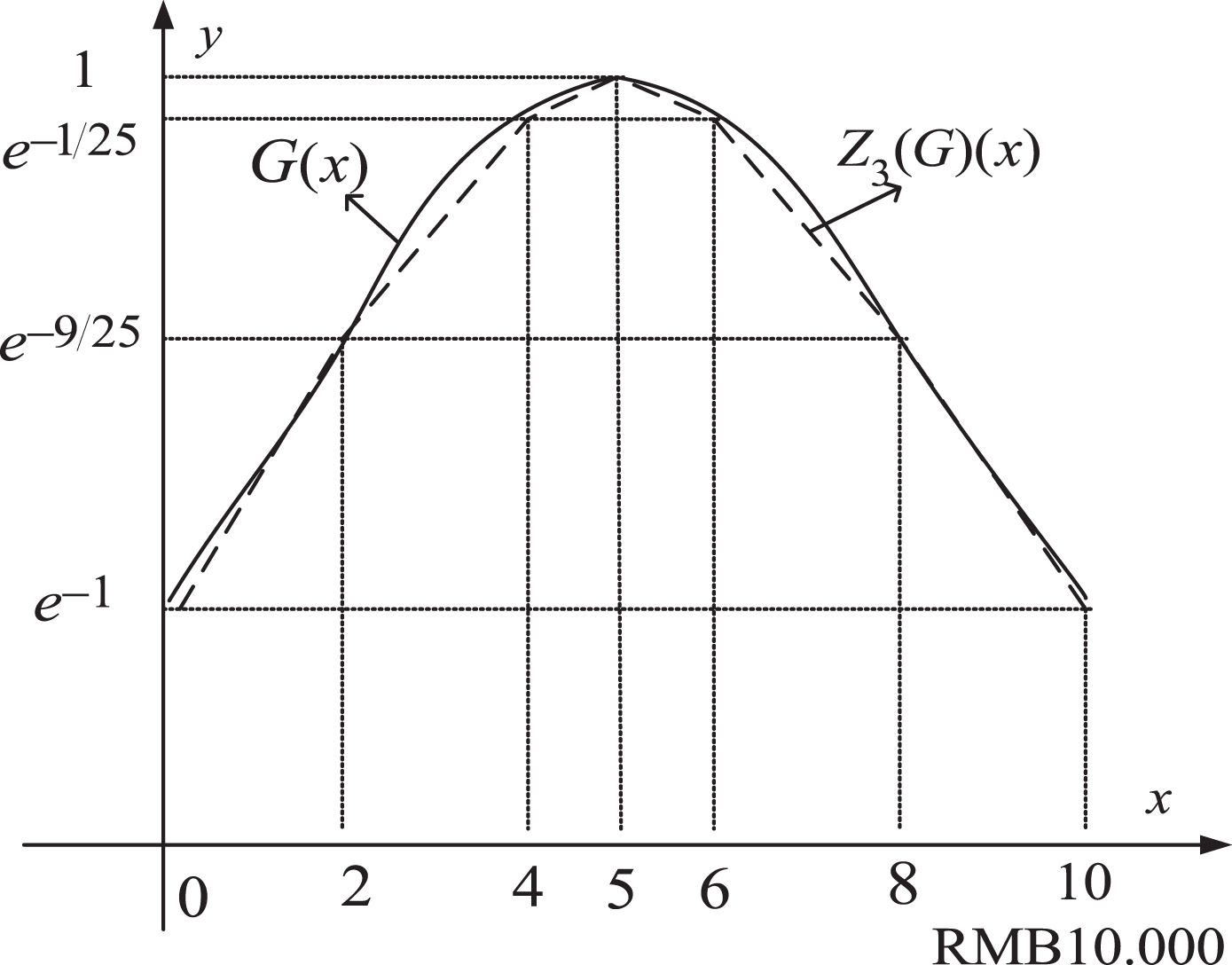
Non-equidistant subdivision determined by the ordered representation on when n = 3.
Because the ordered representation of a polygonal fuzzy number can describe in more detail the satisfaction degree of shopping websites with multi-index information such as transportation cost, transportation efficiency and service attitude of some logistics companies. For this reason, the aggregation method of multiple weighted arithmetic average operators is proposed below.
According to the addition and multiplication operations of polygonal fuzzy numbers given in Definition 2.1, it is not difficult to obtain the value of weighted arithmetic average operator after aggregation, which can be expressed as
Obviously, according to Formula (3), the aggregation value W (A1, A2, A3) of three ordered representations can be directly calculated as
At present, logistics companies are the key departments of commodity circulation in some developed countries, and the transportation cost is a core index of the whole logistics activity. Hence, how to reduce the transportation cost is the most important task for logistics companies. Of course in the increasingly competitive market economy, how to maximize the company’s profits and efficiency are the most concerned issue of all entrepreneurs. In addition, for consumers, how to aggregate multiple evaluation index values of logistics companies into a comprehensive evaluation value through a suitable mathematical model is a most concerned issue. Especially for some large-scale decision-making problems, multiple decision makers are often required to participate, which is also a popular decision-making method at present.
Let {A1, A2, ·· · , A1ptm} be a set of all alternative schemes for evaluating a logistics company on a shopping website, in which each scheme A i has l attributes indexes to be evaluated, and the attribute index set is {p1, p2, ·· · , p l }, and the corresponding weight vector of the attribute set is {ω1, ω2, ·· · , ω l }. Without loss of generality, let the evaluation index value of each alternative scheme A i (i = 1, 2, ·· · , m) for the attribute p j (j = 1, 2, ·· · , l) may be expressed in the form of the polygonal fuzzy number as follows:
It is not difficult to obtain the polygonal fuzzy decision matrix M by the transformation criteria of some given linguistic variables and n-polygonal fuzzy numbers, and this concrete decision matrix M = (M ij (p j )) m ×l is expressed as
where each attribute p
j
occupies the weight ω
j
∈ [0, 1], and it satisfies
Generally speaking, the attributes of schemes are divided into cost attributes and benefit attributes, in which the larger the value of benefit attributes, the higher the performance value obtained; the smaller the value of cost attributes, the higher the performance value.
Next, a new decision-making method from the alternative schemes according to the attribute value of each scheme will be given as follows:
For the cost attribute, let
For the benefit attribute, let
Obviously, the denominator
That is to say, the each representative element s ij of the normalized polygonal fuzzy decision matrix (s ij ) m ×l is still an n-polygonal fuzzy number.
where j = 1, 2, ·· · , l. Let
In fact, the relative closeness degree determined in
Next, the validity of the proposed method will be illustrated by multi-attribute evaluation of logistics companies through shopping websites.
A shopping website intends to conduct a comprehensive evaluation of logistics companies in order to select the most satisfactory partners. After primary selection, there are three alternative logistics companies A i (i = 1, 2, 3), and the alternative set is {A1, A2, A3}. the website intends to evaluate the above alternative logistics companies on the basis of four attribute indicators information {p1, p2, p3, p4}, and use the p1 to express transportation cost, p2- transportation efficiency, p3- service attitude and p4- commodity throughput. Assuming that {p1, p2, p3} is a benefit attribute, and p4 is a cost attribute, the weights of the four attributes indexes are ω1 = 0.22, ω2 = 0.36, ω3 = 0.18 and ω4 = 0.24, and the given parameters are n = m = 3 and l = 4. Try to choose the best logistics company to distribute goods through the proposed method.
Suppose that the shopping website intends to evaluate the satisfaction of logistics companies in terms of transportation cost, transportation efficiency, service attitude and commodity throughput. According to Section 4, the method of an ordered representation of transportation cost is given by introducing the Gauss function, we can similarly obtain the ordered representation of other three indicators information such as transportation efficiency, service attitude and commodity throughput. For simplicity, when n = 3, only the conversion criteria between the fuzzy linguistic variables and the ordered representation of transportation cost of logistics companies will be directly given (others are omitted). See the following Table 1 for specific conversion data.
Conversion criteria between fuzzy linguistic variables and ordered representations of transportation cost
Conversion criteria between fuzzy linguistic variables and ordered representations of transportation cost
According to the conversion criteria of the above-mentioned fuzzy linguistic variables, four attribute indices p
j
(j = 1, 2, 3, 4) of three logistics companies {A1, A2, A3} are evaluated by random selection of group customers by experts. The evaluation results are expressed as the initial polygonal fuzzy decision matrix (M
ij
) 3 ×4 according to the arithmetic operations of the polygonal fuzzy number. Then the polygonal decision matrix (M
ij
) 3 ×4 is normalized by
According to
Calculating results of positive (negative) ideal solution G+ (G-) of the matrix (s ij ) 3×4
This moment, if the calculation is based on the method given in Ref. [20], a new transformation criteria between fuzzy linguistic variables and trapezoidal fuzzy numbers need be given. That is to say, the elements 2-3 and 6-7 should be removed in the original ordered representation, such as, Δ1 = (1, 5, 11 – mdash mdash, 13, 17, 19, 25 mdash mdash mdash, 30) modify them into Δ1 = (1, 13, 17, 30), other original ordered representation Δ2 to Δ7 are also modified in a similar approach. Therefore, the normalized trapezoidal decision matrix
From this, the component elements
Calculating results of positive (negative) ideal solution G+ (G–) of the matrix
According to
Comparison of two weighted Euclidean distances and their relative closeness degrees
By comparing the data in Table 4, it is obvious that the relative closeness degree of the proposed method satisfies 0.72 > 0.68 > 0.63, that is to say, ranking of three logistics companies is
In fact, the weighted Euclidean distances
At present, China’s logistics enterprises and e-commerce are becoming more and more developed and leading in the world. As the proportion of logistics cost in the total expenditure of an enterprise is second only to the cost of goods sold, reducing the logistics cost can make the enterprise occupy a larger market share in the market, so as to improve the competitiveness and sustainable development of the enterprise. Therefore, it is a well-known key problem to reduce the logistics transportation cost by scientific and reasonable logistics mode, control the distribution and packaging of goods. In this sense, the proposed decision method is a comprehensive evaluation of multi-source index information of logistics companies, it is more accurate than the decision-making method based on the triangular or trapezoidal fuzzy number. This is mainly due to the fact that polygonal fuzzy numbers can more accurately describe the fuzziness of objective things.
In fact, some important indexes to evaluate logistics companies are composed of transportation cost, transportation management fee, order processing fee, warehouse management fee, receiving and sending return fee, etc. In order to make logistics companies obtain the maximum profit and good evaluation, each of these processes must be closely coordinated and sustainable development. Otherwise, if the logistics cost is too high, the quality of goods can not be guaranteed, and the evaluation of after-sales service is poor, the logistics companies will It will make it difficult for logistics companies to survive and develop. Therefore, logistics providers should improve the logistics transportation system by adjusting the external transportation cost, reducing the logistics cost, expanding the sales volume and reducing the transportation cost, so as to make our own logistics companies occupy a place among many competitors. In this paper, a new Euclidean distance is proposed based on the orderly representation of polygonal fuzzy numbers, and a new normalization process is implemented for the polygonal decision matrix. Logistics companies are evaluated by solving the positive (negative) ideal solution and relative closeness of the decision matrix. Here, the evaluation and decision-making analysis of the important index of logistics transportation cost are mainly focused on, as for the evaluation of other indexes can be handled by adopting the similar method. Of course, the weight used in this method is still given, but in many practical problems, the weight is not known. Therefore, how to determine the weight more accurately is also one of the key issues to solve practical problems, which we need to continue to explore in depth next.