







Abstract
Dombi operations which include the Dombi product and Dombi sum are special cases of t-norms and t-conorms besides the algebraic operations. Recently, operations and aggregation operators for q-rung orthopair fuzzy values (q-ROFVs) based on Dombi operations were proposed. In this paper, we further discuss some additional issues relating to Dombi operations and Dombi aggregation operators of q-ROFVs. First, we give a reasonable explanation for the definition of the Dombi scalar multiplication and Dombi exponentiation which are constructed respectively by the Dombi sum and Dombi product over q-ROFVs, and then investigate the fundamental properties of these operations. Subsequently, the shift-invariance and homogeneity properties of the q-rung orthopair fuzzy Dombi weighted averaging/geometric operators are analyzed. And the boundedness of aforementioned aggregation operators are precisely characterized with respect to the parameter in Dombi operations. Finally, a method for multiattribute decision making is proposed by utilizing the developed operators under the q-rung orthopair fuzzy environment and an example of the selection of investment companies is given to illustrate the detailed decision making process.
Introduction
The concept of fuzzy set was initiated by Zadeh [1] to deal with imprecision and uncertainty, especially in multiattribute decision making (MADM) problems. In fuzzy set theory, the degree of membership lying in the unit interval is given and the degree of nonmembership is taken as one minus the membership degree naturally. To tackle more complex problems with vague information in the real world, several extensions of fuzzy sets were developed, such as intuitionistic fuzzy sets [2], Pythagorean fuzzy sets [3], Fermatean fuzzy sets [4], generalized orthopair fuzzy sets [5], picture fuzzy sets [6], and T-spherical fuzzy sets [7]. Orthopair fuzzy sets are fuzzy sets in which each membership grade is described by a pair of values both from [0, 1], the former indicating the degree of support for membership and the latter support against membership. Yager [5] proposed the q-rung orthopair fuzzy sets (q-ROFSs, q ≥ 1) in which the sum of the qth powers of the support for and the support against is equal to or less than one. It is proved that with the increase of the rung q, the space of acceptable orthopairs increases. Thus it gives the decision makers more freedom in expressing their beliefs about the membership grade.
Due to its wide scope of applications in practice, the q-rung orthopair fuzzy set theory has attracted the attention of many scholars since its inception. Du [8, 9] presented the Minkowski distances and correlation coefficients between q-ROFSs and discussed their applications in MADM and cluster analysis, respectively. Liu and Wang [10] proposed the addition and multiplication operations for q-rung orthopair fuzzy values (q-ROFVs) via the algebraic t-(co)norm, while Du [11] defined the subtraction and division operations over q-ROFVs in two different ways. Gao et al. discussed continuities, derivatives and differentials of q-rung orthopair fuzzy functions based on arithmetic operations over q-ROFVs [12] and further studied the q-rung orthopair fuzzy integrals under additive operations [13]. Shu et al. [14] developed the q-rung orthopair fuzzy definite integrals to aggregate q-rung orthopair fuzzy continuous information. In the seminal paper [5], Yager provided a general framework of constructing aggregation operators of q-ROFVs. Specially, Yager et al. [5, 15] developed the Sugeno and the Choquet aggregation operators on q-ROFVs based on a pair of dual aggregation operators. Along this line of research, Liu and his colleagues introduced a large number of operators on q-ROFVs, such as the weighted averaging/geometric operators [10], (weighted) Archimedean Bonferroni mean operators [16], power (weighted) Maclaurin symmetric mean operators [17], and weighted generalized (geometric) Maclaurin symmetic mean operators [18]. Wei et al. [19] put forward the generalized (weighted) Heronian mean operators for q-ROFVs. Wang et al. [20] presented the q-rung orthopair fuzzy (weighted, dual) Muirhead mean operators for fusing q-ROFVs. Du [21] developed the (ordered) weighted power means of q-ROFVs and presented their applications in MADM. To arrange a pleasant decision, Garg and Chen [22] established some neutrality aggregation operators based on neutral operational laws for q-ROFVs.
It deserves mentioning that in the most existing literature, operations on q-ROFVs are established with the help of the algebraic t-norm and algebraic t-conorm which are employed to model intersection and union of q-ROFVs, respectively. Besides the algebraic operations, there are many other operational laws that are often used in the fuzzy set theory, Dombi operations, for example. Dombi operations are special cases of t-(co)norms which have the advantage of good flexibility with a general parameter, the sign of which determines the type of the operations [23, 24]. According to Dombi, there are two main reasons for a great interest in such parametrical families from the practical viewpoint: in applications, by changing a single parameter, a different logic can be modeled; through a learning algorithm, the appropriate parameter and the appropriate operator can be found. Due to these advantages, Liu et al. [25] proposed some Dombi Bonferroni mean operators to deal with the aggregation of intuitionistic fuzzy values. He [26] developed some Dombi aggregation operators for hesitant fuzzy elements by utilizing Dombi operations under hesitant fuzzy environment and further extended them to interval-valued intuitionistic fuzzy cases [27]. Jana et al. presented some Dombi operations based aggregation operators to fuse picture fuzzy information [28], bipolar fuzzy elements [29], and Pythagorean fuzzy values [30]. Ashraf et al. [31] defined some aggregation operators on the basis of Dombi operations in the spherical fuzzy context. Recently, Jana et al. [32] introduced some aggregation operators for aggregating q-ROFVs based on Dombi operations, and demonstrated that these aggregation operators are idempotent, monotonic and bounded. In Ref. [32], a realistic instance for implement emerging software system was provided to show the applicability and the effectiveness of the proposed operations in MADM. However, there are still some additional issues that need to be addressed. Why do we define the Dombi scalar multiplication and Dombi exponentiation of q-ROFVs in such a way? Are there any other properties of the Dombi aggregation operators on q-ROFVs? Could the boundedness of the aggregation results be further characterized? The initial motivation of this paper is to solve these problems and the main contributions are listed as follows: It is shown that how to construct the Dombi scalar multiplication and Dombi exponentiation by the Dombi sum and Dombi product, respectively. The fundamental properties of four Dombi operations over q-ROFVs are investigated as well. Two more properties, the shift-invariance property and the homogeneity property, of the q-rung orthopair fuzzy Dombi weighted averaging/geometric operators are proposed. As for the boundedness property, we present a more accurate characterization of these two aggregation operators in terms of the parameter in Dombi operations. The results are finer than those determined by the max and min operators.
Moreover, we apply the proposed operators to MADM problems in the q-rung orthopair fuzzy setting. The results show that the developed operators can be used to aggregate any fuzzy information by choosing suitable q; the aggregations obtained by the operators are monotonic with respect to the parameter therein; and the best selection obtained by the proposed method are consistent with most of the other existing approaches.
The other parts of this paper are organized as follows. In Section 2, we recall some basic concepts of Dombi operations and q-rung orthopair fuzzy values. In Section 3, we investigate the operational rules of Dombi operations over q-ROFVs. In Section 4, we examine some essential properties of aggregation operators for q-ROFVs based on Dombi operations. In Section 5, we provide a new method for handling MADM problems based on the proposed operators under q-rung orthopair fuzzy environment and give a numerical example to illustrate the detailed decision making procedure. In Section 6, we conclude the present paper with a summary and suggestions for further work.
Preliminaries
In this section, we briefly review basic concepts concerning Dombi operations, q-rung orthopair fuzzy values and some operations defined on them.
Dombi operations
Dombi [23] proposed the Dombi sum and Dombi product which are special cases of t-norms and t-conorms, respectively.
The Dombi t-norm and Dombi t-conorm satisfy the following properties: [33] For each κ, the Dombi t-norm and Dombi t-conorm are dual to each other.
The Dombi t-(co)norms are continuous Archimedean and strict. The family of Dombi t-norms is strictly increasing and the family of Dombi t-conorms is strictly decreasing with respect to the parameter κ. Additive generators of the Dombi t-norms and Dombi t-conorms are
q-Rung orthopair fuzzy values
Note that if q = 1, 〈a, b〉 is an intuitionistic fuzzy value [34]; if q = 2, 〈a, b〉 is a Pythagorean fuzzy value [35]; if q = 3, 〈a, b〉 is a Fermatean fuzzy value [4]. In this way, we can see that q-rung orthopair fuzzy values are generalizations of these three types of fuzzy values.
Denote S
q
the space of all q-rung orthopair fuzzy values, namely,
In this section, some primary properties of operational laws of q-ROFVs based on Dombi operations are examined.
Because function f (κ) = (a
κ
+ b
κ
) 1/κ is monotonic decreasing (by f′ (κ) ≤0), we have
x ⊕ Dy = y ⊕ Dx, x ⊗ Dy = y ⊗ Dx, x ⊕ Dy = (x
c
⊗ Dy
c
)
c
, x ⊗ Dy = (x
c
⊕ Dy
c
)
c
, x ⊕ D (y ⊕ Dz) = (x ⊕ Dy) ⊕ Dz, x ⊗ D (y ⊗ Dz) = (x ⊗ Dy) ⊗ Dz.
Theorem 3.3 reveals that operations ⊕D and ⊗D are dual to each other and that they are both commutative and associative, i.e., they preserve the most desired properties of classical addition and multiplication operations. In this way, for x
i
∈ S
q
, x1 ⊕ Dx2 ⊕ D ⋯ ⊕ Dx
n
and x1 ⊗ Dx2 ⊗ D ⋯ ⊗ Dx
n
can be shortly denoted without any confusion by
Then, when n = k + 1, we have
Eq. (6) holds similarly.□
For a positive integer n, denote
Denote
Furthermore, it is well known that for rational number λ, there exist integers m, n such that
Extending the above parameter λ to any positive real number comes the following definition.
It deserves mentioning that for λ > 0, if x is a q-ROFV, then its Dombi scalar multiplication λ · Dx and Dombi exponentiation
λ · D (x ⊕ Dy) = (λ · Dx) ⊕ D (λ · Dy), (x ⊗ Dy)Dλ=xDλ ⊗ DyDλ, (λ1 + λ2) · Dx = (λ1 · Dx) ⊕ D (λ2 · Dx), , λ1 · D (λ2 · Dx) = (λ1λ2) · Dx, .
(3) For x = 〈a, b〉 ∈ S
q
,
The others can be proved by the duality.□
In this section, a brief proof of the expression of the q-rung orthopair fuzzy Dombi weighted averaging/geometric operators are provided and some of their fundamental properties are investigated.
Based on results presented in Section 3, the aggregations obtained by the q-ROFDWA and q-ROFDWG operators are still q-ROFVs.
In Ref. [32], Jana et al. gave a routine but a little tedious proof of Theorem 4.2. The following we give a briefer and more effective proof of this theorem.
If q = 1, Eqs. (28) and (29) reduce to the intuitionistic fuzzy Dombi weighted averaging/geometric (IFDWA/IFDWG) operators as follows: for x
i
= 〈μ
i
, ν
i
〉, [36]
If q = 2, these two formulae reduce to the Pythagorean fuzzy Dombi weighted averaging/geometric (PFDWA/PFDWG) operators as follows: for x
i
= 〈μ
i
, ν
i
〉, [30, 37]
(Shift-invariance). Let x, x
i
∈ S
q
, i = 1, 2, …, n. Then
(Homogeneity). Let λ > 0 and x
i
∈ S
q
, i = 1, 2, …, n. Then
(2) For x i = 〈a i , b i 〉 ∈ S q ,
The other parts of the theorem follow similarly.□
It has been proven the boundedness property of the q-ROFDWA/q-ROFDWG operators as follows. Denote
By the monotonicity of the weighed power mean function
From the above analysis, the following conclusions hold: ∀κ > 0,
we then conclude that the boundedness property characterized by Eqs. 25 and 26 are more refined than those determined by Eqs. 19 and 20.
Moreover, by
Similar conclusions hold for the q-rung orthopair fuzzy Dombi ordered weighted averaging/geometric (q-ROFDOWA/q-ROFDOWG) operators, which are defined as follows: [32]
These two aggregation operators are computed by
The boundedness of the q-ROFDOWA/q-ROFDOWG operators can be expressed by
In this section, we apply the developed operators to multiattribute decision making problems in the q-rung orthopair fuzzy setting.
In an MADM problem within the q-rung orthopair fuzzy context, there are m (m ≥ 2) feasible alternatives A1, A2, …, A
m
, which are evaluated in terms of n attributes U = {u1, u2, …, u
n
} whose weighting vector being
[Step 1.] Normalize the decision matrix.
Since there are two types of attributes, that is, the benefit type and cost type, in order to relieve the effect of the different attribute types, we need convert the cost type to benefit one by the following formula (For convenience of expression, the converted value is still denoted by γ
ij
):
[Step 2.] Aggregate attribute values.
For each alternative A
i
, calculate the aggregation of γi1, γi2, …, γ
in
, denoted by η
i
= 〈a
i
, b
i
〉, by the
[Step 3.] Rank all the alternatives.
Rank all the alternatives by virtue of the score and accuracy of η
i
for each A
i
given by the following formulae:
[Step 4.] End.
vq-Rung orthopair fuzzy decision matrix
First, because all six attributes are the benefit type, there is no need to normalize the decision matrix.
Second, take q = 3 and κ = 0.5. Then the aggregations of these five alternatives by the
Then, the scores of η
i
are
Finally, we can rank all the alternatives in descending order as follows:
If one employs the
Then, the scores of η
i
are
Finally, we can rank all the alternatives in descending order as follows:
In order to analyze the sensitivity of parameter κ in the developed operators, we set different κs to rank the alternatives while keeping other conditions unchanged. Then, based on the proposed operators we can obtain the aggregations and ranking of alternatives. The detailed results are shown in Tables 2 and 3.
Aggregations and ranking of alternatives based on the
Aggregations and ranking of alternatives based on the
As can be seen from Table 2, the ranking results are slightly different with respect to different parameter κ. But the best selection is always the company A1, which demonstrates the robustness of the proposed approach from one facet. And with the increase of κ, the aggregation of each alternative based on the
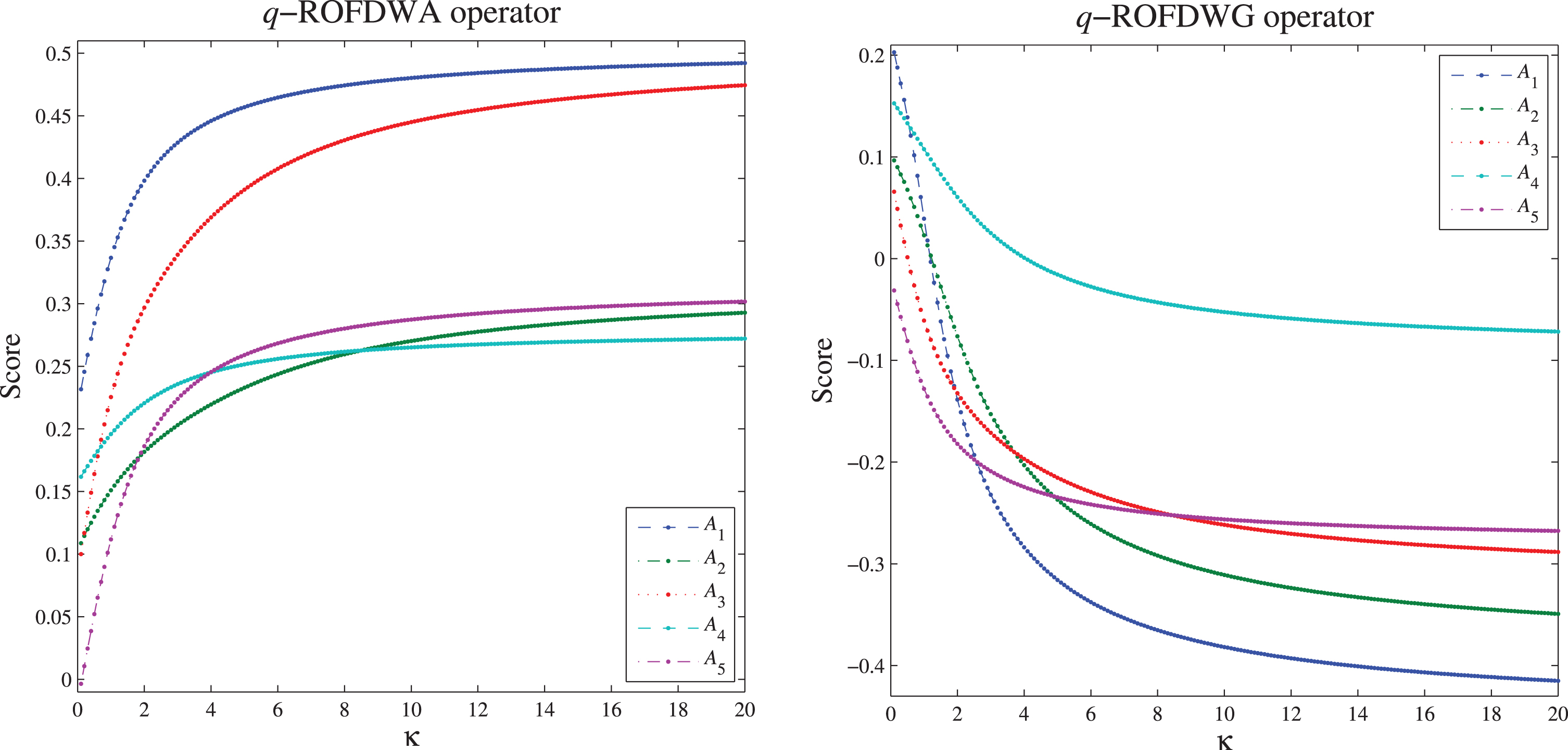
Scores of aggregations of alternatives based on the q - ROFDWA and q - ROFDWG operators with different parameters κ.
Now turn our attention to the rung q, since γ12 = 〈0.8, 0.3〉 is not an intuitionistic fuzzy value, aggregation operators on intuitionistic fuzzy values do not work in this problem. If γ12 is changed to 〈0.8, 0.7〉, by the fact that 〈0.8, 0.7〉 is not a Pythagorean fuzzy value, aggregation operators on Pythagorean fuzzy values will not work neither. But aggregation operators on q-rung orthopair fuzzy values can always work by choosing suitable q. The following we set different qs to rank the alternatives, and the results based on the
Aggregations and ranking of alternatives based on the
Aggregations and ranking of alternatives based on the
From Tables 4 and 5, one can see that for any q ≥ 2 we can aggregate each of the alternatives by the q - ROFDWA and q - ROFDWG operators. And with the increase of q, the aggregation of each alternative becomes larger and larger based on the q - ROFDWA operator while smaller and smaller based on the q - ROFDWG operator. The scores of aggregations of all five alternatives by the q - ROFDWA and q - ROFDWG operators are presented in Fig. 2. On the other hand, for all the listed cases, although the ranking results of these alternatives are slightly different, the best selection is always the company A1 based on the q - ROFDWA operator while the company A4 based on the q - ROFDWG operator when q > 3, which shows the robustness of this approach from another facet.
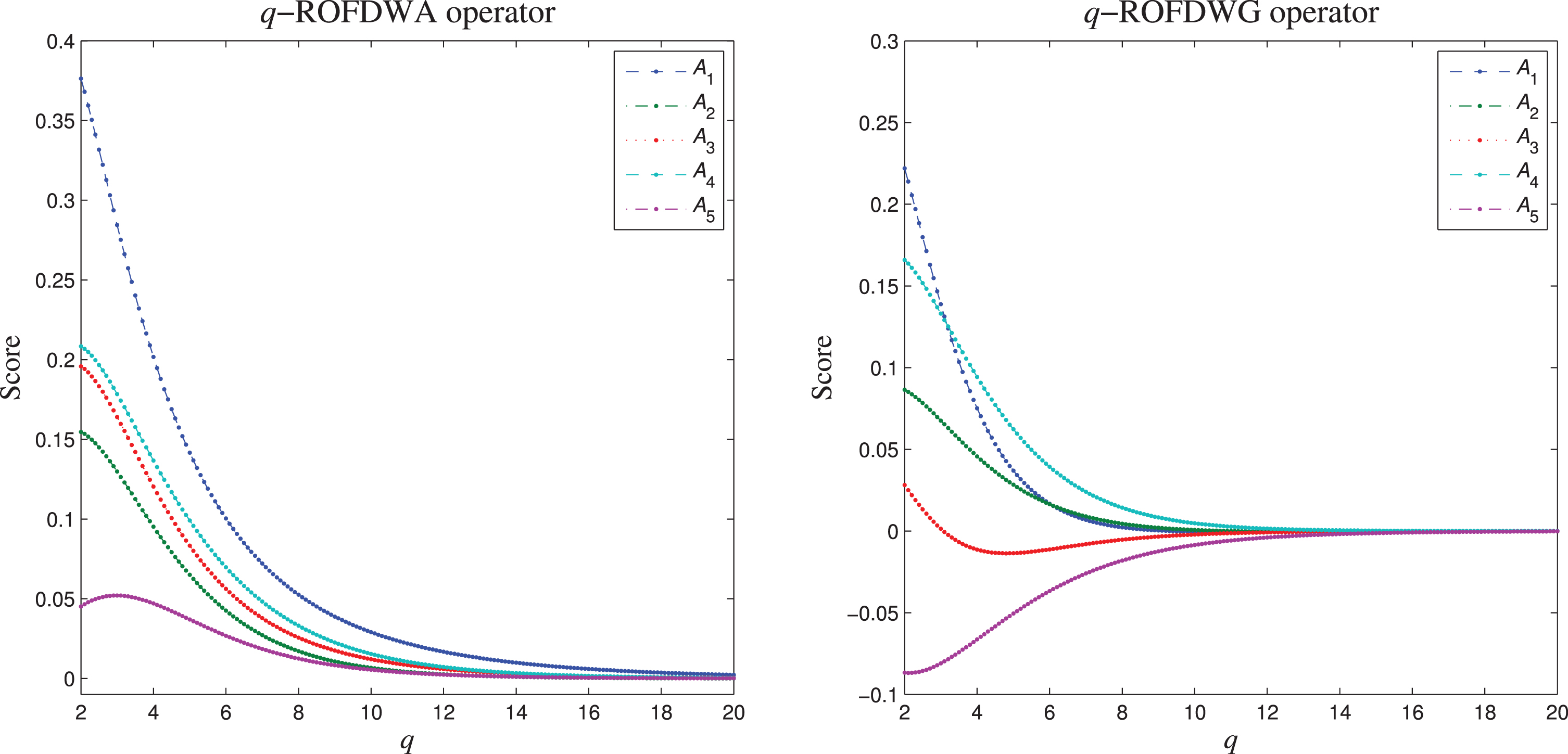
Scores of aggregations of alternatives based on the q - ROFDWA and q - ROFDWG operators with different rungs q.
The following we compare the q - ROFDWA and q - ROFDWG [32] operators with other aggregation operators in MADM, including the IFWDBM (intuitionistic fuzzy weighted Dombi Bonferroni mean) [25], IFDGBM (intuitionistic fuzzy Dombi geometric Bonferroni mean) [25], q-ROFWA [10], q-ROFWG [10], q-ROFEWA (q-rung orthopair fuzzy Einstein weighted averaging), and q-ROFEWG (q-rung orthopair fuzzy Einstein weighted geometric) operators. The aggregated results and ranking of alternatives based on these operators are summarized in Table 6.
Aggregations and ranking of alternatives based on the existing aggregation operators (q = 3)
As seen from Table 6, these operators can be applied to aggregate the fuzzy information in this example except the IFWDBM and IFDGBM operators. Moreover, the ranking results corresponding to the q-ROFDWA operator are the same as those corresponding to the q-ROFEWA operator; the ranking results corresponding to the q-ROFDWG operator are the same as those corresponding to the q-ROFEWG operator. And the best selection is always the company A1 based on these aggregation operators except the q-ROFWG operator, which shows our methods may serve as an alternative approach in practical MADM problems. Additionally, for the operators designed for handling q-rung orthopair fuzzy information, the fact that the q-ROFDWA and q-ROFDWG operators having a dedicated parameter in their operational rules makes them more flexible than the others.
Dombi operations with a general parameter are a special class of operations that are usually used in the fuzzy set theory. Jana et al. introduced some Dombi operations and Dombi aggregation operators of q-ROFVs which are extensions of (intuitionistic/Pythagorean/Fermatean) fuzzy values. In this paper, we show how to construct the Dombi scalar multiplication and Dombi exponentiation over q-ROFVs by their Dombi sum and Dombi product, respectively. These operations satisfy the same laws of arithmetic as those for real numbers, which confirms that they are indeed well-defined. For aggregation operators of q-ROFVs based on Dombi operations, we discuss some of their desirable properties including the shift-invariance and the homogeneity. Moreover, the boundedness of aggregations obtained by the q-rung orthopair fuzzy Dombi aggregation operators are narrowed down by the parameter in Dombi operations. Finally, we propose a novel method for solving multiattribute decision making problems based on developed operators under q-rung orthopair fuzzy circumstance. A numerical example of investment selection is given to illustrate the decision making procedure in detail. The experimental results show that the parameter κ in the model reflects the attitude of decision makers. More precisely, as κ trends to infinity, the decision makers are the most optimistic for the q-ROFDWA operator based model, and the most pessimistic for the q-ROFDWG operator based model.
Considering that there are many other types of aggregation manners on q-ROFVs based on algebraic operations, such as Bonferroni mean, Heronian mean, Maclaurin symmetric mean and Muirhead mean. Our future work will combine them with Dombi operations and develop some new aggregation operators on q-ROFVs. Moreover, we can extend this work to the environment of picture fuzzy sets and T-spherical fuzzy sets.
Footnotes
Acknowledgments
The author gratefully appreciates the anonymous reviewers for their constructive comments and suggestions that greatly helped to improve the quality of this paper. This research was supported by the National Natural Science Foundation of China (Grant no. 61806182), the Scientific Research Fund for Young Teachers of Zhengzhou University (Grant no. 32220326), the Research Base Program of New Disciplines in Economics and Management of Zhengzhou University (Grant no. 101/32610168) and the Training Project for Young Backbone Teachers of Colleges and Universities of Henan Province.