







Abstract
In this study, a hybrid approach is presented for the evaluation and selection of transformers in a power distribution project. Ranking transformers and selecting the best among alternatives is a complex multiple criteria decision making (MCDM) problem with various possibly conflicting quantitative and qualitative criteria. In this research, two hesitant fuzzy MCDM methods; hesitant fuzzy Analytic Hierarchy Process (hesitant F-AHP) and hesitant fuzzy Preference Ranking Organization Method for Enriching Evaluations II (hesitant F-PROMETHEE II) are combined to evaluate and rank transformers. In the hesitant fuzzy AHP-PROMETHEE II, hesitant F-AHP is implemented to determine criteria weights and hesitant F-PROMETHEE II is applied to rank transformer alternatives, utilizing obtained criteria weights. An illustrative example is presented to demonstrate the effectiveness and applicability of the proposed approach. In the example, five transformers are evaluated based on twelve criteria by three decision makers (DMs) and best alternative is selected. For comparison analysis, integration of hesitant F-AHP and hesitant fuzzy Technique for Order Preference by Similarity to Ideal Solution (hesitant F-TOPSIS) is used and results are compared.
Keywords
Introduction
A Transformer is the hub equipment of a power system and it is a significant equipment of electrical power transmission and distribution system since the stability of a power network system is directly related to the safety and reliability of the transformer [27, 42]. The transformer manufacturing industry is overcapacity and the quality and type of transformers vary, therefore it is really significant to evaluate and select the best transformer in order to ensure the safety and reliability of the power grid [10]. In power distribution industry, long lasting and reliable transformers are desired which is related to the health condition and degradation rate of transformer’s insulation [42]. Evaluation and selection of a transformer for a power distribution project is naturally a MCDM problem since there are various possibly conflicting qualitative and quantitative criteria that need to be taken into consideration. Therefore, a MCDM method is needed to manage the decision making process efficiently.
In the literature, as the MCDM method, AHP or its fuzzy extension F-AHP is frequently used for the evaluation of conditions of transformers, detection methods and design of the components. Song et al. [43] applied failure mode and effects analysis to understand severity and occurrence of failures and detection methods of transformer faults and then implemented AHP to prioritize these detection methods. Sun et al. [44] used F-AHP and modified weighted averaging to assess conditions of power transformers. Daneshmand et al. [16] implemented AHP to evaluate winding schemes and select the best geometry for the high-temperature superconducting transformers. Suwanasri et al. [45] implemented AFP to determine criteria weights of the components that effect the conditions of power transformers for risk-based maintenance. Tee et al. [46] applied principal component analysis and AHP to evaluate and rank in-service transformers based on their insulation conditions. Wan et al. [54] developed a transformer health state evaluation method, where they applied association rules for the transformer faults and AHP for the calculation of weights of comprehensive states. Wang et al. [56] first applied Kano model to collect and classify user requirements for oil-immersed distribution transformer product service system and then applied AHP to sort these requirements and recombine.
In this research, as the MCDM method, hesitant F-AHP is incorporated with hesitant F-PROMETHEE II to have both methods’ advantages in the transformer evaluation and ranking process. The key advantage of PROMETHEE methods is that they are easy to apply and they deliver stable results [31, 53]. However, this integration is needed, since just like TOPSIS, ELECTRE and VIKOR methods, PROMETHEE methods also do not provide precise guidelines for assigning criteria weights, assuming DM(s) are able to determine those, properly [29, 53]. Moreover, PROMETHEE methods are weaker in assessing qualitative criteria then AHP, and when the number of criteria is more than seven, with PROMETHEE methods, it may be difficult for DMs to obtain a clear view and evaluate criteria and alternatives [29, 37]. On the other hand, with (hesitant fuzzy) AHP, utilizing pairwise comparisons of both quantitative and qualitative criteria and consistency checks of these comparisons, dependable criteria weights can be determined. However, when there are many alternatives and criteria in the problem, implementing (hesitant fuzzy) AHP both to the evaluation of criteria and to the ranking of alternatives (without the integration) can take a lot of time and effort and be burdensome since a large number of pairwise comparisons are needed [38–40]. Therefore, integration of both methods is essential. In the hesitant fuzzy AHP-PROMETHEE II, reliable results are obtained without large number of pairwise comparisons, especially when there are many alternatives. Also, with the utilization of hesitant fuzzy linguistic term sets (HFLTS) and hesitant fuzzy set concepts in the hesitant fuzzy AHP-PROMETHEE II, uncertainty, ambiguity and hesitations DMs might have in their preferences can be reflected in the decision making process and this makes the process more flexible and real.
AHP [36] has a multi-level, hierarchical structure and alternatives are evaluated with respect to each criterion utilizing pairwise comparisons and then ranked based on a total weighted score. To capture the ambiguity and fuzziness of DMs’ judgements, concepts of fuzzy set theory [61, 63] was integrated to AHP and F-AHP was developed. PROMETHEE, developed by Brans [6], is a family of outranking methods. PROMETHEE, different versions of PROMETHEE and F-PROMETHEE, and their real life application areas are given in details in the authors previous work [38].
Traditional (fuzzy) AHP-PROMETHEE integration has been used to benefit from both methods’ advantages in several applications in the literature such as selection of milling machines to be purchased in a company [15], ranking the tasks of the assignments [3], evaluation of energy supply configuration of autonomous desalination units [19], evaluation of location alternatives of solar power plants [38]. In the traditional F-AHP and F-PROMETHEE II, DMs give a single linguistic expression to evaluate criteria and alternatives and this does not reflect the hesitation DM might have in reality. Instead, in hesitant F-AHP and hesitant F-PROMETHEE II, DM might use “hesitant” terminologies and HFLTS. For example, while doing pairwise comparisons of criteria in hesitant F-AHP, DM might asses as “criterion 3 is between absolutely weak and fairly weak in comparison to criterion 9”. Also, while evaluating alternatives with respect to criteria in hesitant F-PROMETHEE II, DM might assess as “alternative 1 is between medium good and poor in terms of criterion 1”. In this manner, DMs might express their opinions in a more flexible, practical and accurate manner with multi-linguistic expressions [23].
Hesitant fuzzy set concepts and HFLTS, introduced by Torra and Narukawa [49] and Rodrigez et al. [34] are integrated with several MCDM in the literature. Some of these integrations with application areas are: hesitant F-AHP for evaluation of performance of a cargo company [50], CNC router selection in woodwork manufacturing [9] and evaluation of sustainability of hydrogen production methods [1]; hesitant F-TOPSIS and F-VIKOR for quality evaluation of teachers [52]; hesitant F-AHP and TOPSIS for evaluation of summer sport schools [4]; hesitant F-AHP and then F-VIKOR for ranking power generation enterprises [23]; interval-valued intuitionistic hesitant fuzzy entropy based VIKOR for selection of industrial robots [32]; Superiority and Inferiority Ranking (SIR) method with FFLTS for evaluation of sustainable energy technologies such as natural fossil fuel, hydrogen and renewable energy technologies [62]; hesitant fuzzy AHP-VIKOR for evaluation of innovation projects [39]; proportional hesitant fuzzy linguistic term set (PHFLTS) TOPSIS for evaluation of hazardous materials transportation alternatives [11]; proportional interval type-2 hesitant fuzzy TOPSIS for evaluation of data science and machine learning platform vendors [13]; hesitant fuzzy AHP, VIKOR and TOPSIS for evaluation of energy technologies [14], hesitant F-AHP and GRA for performance evaluation of bank regions [51] and HFLTS ARAS for selecting ecofriendly cities [8].
PROMETHEE methods are applied with hesitant fuzzy set concepts and HFLTS in various applications in the literature. Wu et al. [57] first applied ANP to determine the weights of indicators and then used hesitant fuzzy PROMETHEE to rank social sustainability of small hydropower stations in China. Mahmoudi et al. [30] presented an extension of PROMETHEE with typical hesitant fuzzy sets and gave two examples about ranking overseas outstanding teachers and strategy initiatives. Liu et al. [26] applied double hierarchy hesitant fuzzy linguistic PROMETHEE with subjective and objective information to evaluate public-private-partnership advancement from stakeholder perspective. Tian et al. [47] implemented hesitant F-PROMETHEE to rank start-up firms for venture capitalists. Feng et al. [17] presented a new hesitant fuzzy linguistic PROMETHEE method where they proposed to use possibility theory instead of preference functions. Liang et al. [17] developed a projection-based hesitant F-PROMETHEE and applied it to a green supply chain management problem to evaluate green practices for the domestic organizations in China. Li and Wang [22] used hesitant probabilistic fuzzy sets with QUALIFLEX and PROMETHEE II and gave an illustrative example about evaluation of candidates in doctoral entrance interviews. Liao et al. [24] implemented hesitant F-PROMETHEE method to evaluate green logistic providers.
At present, to the best of the authors knowledge, integration of hesitant F-AHP and hesitant F-PROMETHEE II has never been studied, especially for the evaluation of transformers in a power distribution project. With the proposed hesitant fuzzy AHP-PROMETHEE II, transformers are evaluated and ranked without too many tiresome pairwise comparisons and complex calculations. Application steps of hesitant fuzzy AHP-PROMETHEE II are explained in Section 2. For comparison analysis, hesitant fuzzy AHP-TOPSIS is applied and its steps are presented in Section 3. An illustrative example and comparison analysis are given in Section 4 along with the conclusions in Section 5.
Hesitant fuzzy AHP-PROMETHEE II
Fuzzy set theory includes classes with unsharp boundaries [21, 28] and sets in crisp theories can be fuzzified by applying the concept of fuzzy sets [61]. In the proposed hesitant fuzzy AHP-PROMETHEE II approach, and in hesitant fuzzy AHP-TOPSIS, triangular fuzzy numbers (TFNs) are utilized due to its uncomplicatedness. A fuzzy number is a special fuzzy set F ={ (x, μ
F
(x)) , x ∈ R } where x is a real number, R : - ∞ < x < + ∞ and μ
F
(x) is from R to [0, 1]. A TFN,
Arithmetic operations between two positive TFNs
The graded mean integration approach [59] is applied for defuzzification of TFNs as seen below:
While making judgements, DMs might have some hesitations in deciding the membership degree of an element since there may be more than one likely value. To reflect these hesitations, the concept of hesitant fuzzy sets (HFS) was introduced [48, 49]. In Triangular Fuzzy Hesitant Fuzzy Sets (TFHFS), the membership degree of an element to a given set is expressed by several possible TFNs.
If X is a fixed set, the HFS on X returns a subset of [0, 1] by:
Basic operations for 3 HFS h, h1, h2 are given as:
An Ordered Weighting Averaging (OWA) operator that can be implemented is given as:
where, b
j
is the jth largest of a1, a2, …, a
n
,
Fuzzy envelope approach [25] is implemented to combine DM evaluations in hesitant F-AHP, hesitant F-PROMETHEE II and hesitant F-TOPSIS steps. Scales given for DM evaluations are sorted from the lowest s o to the highest s g so if the DM’s evaluations are between s i and s j , then s o ⩽ s i ⩽ s j ⩽ s g .
Based on the HFLTS, linguistic expressions can be represented by a triangular fuzzy membership function
Weight vector in OWA operator [18] is defined as:
Here, l depends on the number of terms in DM’s evaluation scale (in Table 1 or Table 2), j is the rank of the highest, and i is the rank of the lowest evaluation value. i and j can take ranks starting from 0 to l and n = j - I [5, 39].
Scale for the evaluation of alternatives in hesitant F-PROMETHEE II and hesitant F-TOPSIS [41]
In hesitant F-AHP, the DMs make pairwise comparisons of criteria using the linguistic terms given in Table 1.
Steps of hesitant F-AHP:
Step 1: Identify K DMs, n criteria; and linguistic terms and scale for the pairwise comparison of criteria. Based on the scale used in Table 1 and Eqs. (23)-(27), combine DM’s evaluations with fuzzy envelope approach and obtain TFNs corresponding to the evaluation of each DM. Calculate
Step 2:
with elements
The consistency index (CI) is determined as:
The consistency ratio (CR) in Eq. (30) is used to estimate the consistency of pairwise comparisons.
RI is the average index for randomly generated weights [36]. If CR < 0.10, the comparisons are acceptable, otherwise they are not. [36] If comparisons are not acceptable (inconsistent), then DMs are asked to re-evaluate and adjust their judgements. Note that, also, there are several studies [12, 55] in the literature about adjusting inconsistencies and improving consistency.
w = (w1, w2, . . . , w n ) obtained with hesitant F-AHP is used in hesitant F-PROMETHEE II to rank the alternatives. In hesitant F-PROMETHEE II, the alternatives are evaluated using the linguistic terms given in Table 2.
Steps of hesitant F-PROMETHEE II: [38, 60]
Step 1: Specify m alternatives; and linguistic terms and scale for the evaluation of alternatives with respect to each criterion. Based on the scale used in Table 2 and Eqs. (23)–(27), combine DM’s evaluations with fuzzy envelope approach and obtain TFNs corresponding to the evaluation of each DM. Calculate
Step 2:
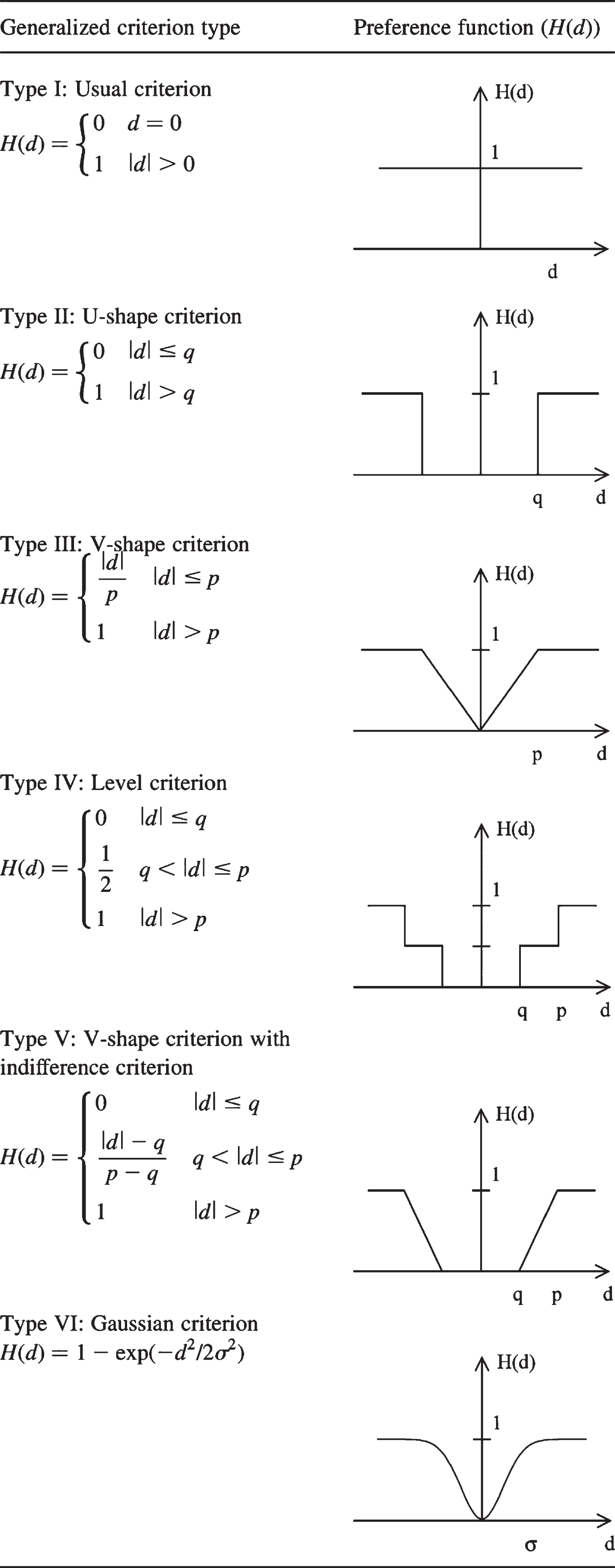
Step 3: Calculate aggregated preference indices: P j (A i , A k ) = P j (d (A i , A k )) = P j (r ij - r kj ) is a preference function showing how much DM prefers A i to A k with respect to c j . From the generalized functions in Table 3, Gaussian criterion was selected. The Gaussian criterion is generally preferred especially when there is continuing data in practical applications and the major criteria in this study contain continuing data. Here, the preference function is:
Generalized criteria [7]
Generalized criteria [7]
for maximum criterion and
for minimum criterion.
Aggregated preference index π (A
i
, A
k
) expresses the degree of how much DM prefers A
i
to A
k
with respect to all the criteria. The aggregated preference indices are given as:
Step 4: Calculate the outranking flows to rank the alternatives. Each alternative A
i
faces (m-1) other alternatives in A. The positive outranking flow defines howA
i
outranks other and it is given as:
The negative outranking flow articulates how A
i
is outranked by others and it is given as:
Step 5: Finally, the net outranking flow is determined as:
Based on the net outranking flow alternatives are ranked; highest Ø (A i ) specifies the best alternative.
For comparison analysis, hesitant fuzzy AHP-TOPSIS is applied. After the determination of weights of criteria with hesitant F-AHP, hesitant F-TOPSIS is implemented to determine the best alternative. The steps of hesitant F-TOPSIS are given below.
Step 1: After implementing Steps 1 and 2 of hesitant F-PROMETHEE II in Section 2.3, normalize D and obtain normalized decision matrix F such that elements of F are
Step 2: Construct the weighted normalized decision matrix G such that elements of G are g ij = w j f ij .
Step 3: Determine the positive ideal A* and negative ideal A- solutions.
Also
Step 4: Calculate the separation measures of ach alternative. Separation from ideal solution is
Step 5: Calculate closeness index values C
i
for each alternative as:
Illustrative example and comparison analysis
For the evaluation of transformers in a power distribution project, 12 benefit (maximization) criteria (C1, C2, ... ,C12) are determined which are listed in Table 4 along with detailed explanations [35, 65]. Five alternative transformers (A1, A2, A3, A4, A5) are going to be evaluated with respect to these criteria by three DMs (DM1, DM2, DM3).
Evaluation criteria for transformers and explanations
Evaluation criteria for transformers and explanations
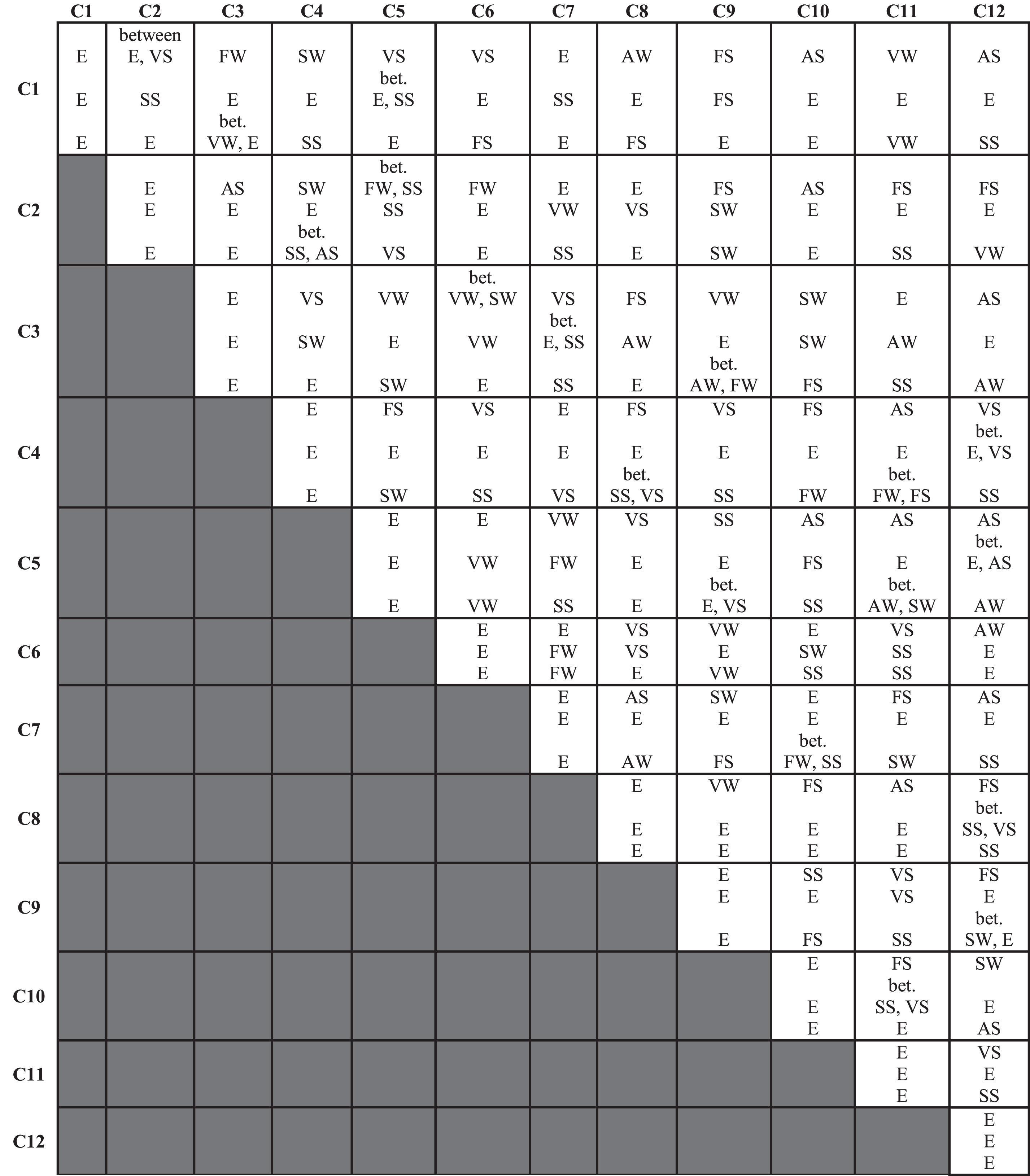
First, with hesitant F-AHP, w = (w1, w2, . . . , w n ) is determined. In hesitant F-AHP, DMs compare criteria pairwise with the help of linguistic terms in Table 1 and these are given in Table 5.
Pairwise comparison of evaluation criteria by 3 DMs
After the combination of each DM’s evaluations with fuzzy envelope approach and aggregation of the corresponding TFNs of 3 DMs evaluations, the fuzzy evaluation matrix for the criteria weights (
The fuzzy evaluation matrix for the criteria weights (
X and criteria weights (w)
In hesitant F-PROMETHEE II, DMs evaluate alternatives with respect to each criterion using the linguistic terms in Table 2 and these are given in Table 8. After the combination of each DM’s evaluations, the fuzzy evaluation matrix
3 DMs’ evaluations of the transformers with respect to each criterion
Fuzzy decision matrix
Decision matrix D
Aggregated preference index matrix
Outranking flow indices and rank
For comparison analysis, hesitant fuzzy AHP-TOPSIS is applied to the same example. Decision matrix D in Table 10 is normalized and after multiplication with weight matrix, weighted normalized decision matrix G is obtained as seen in Table 13. Positive and negative ideal solutions (A*andA-), separation measures (S*, S-), and closeness index of each alternative (C i ) are also presented in Table 13. Alternatives are ranked based on closeness indices and the ranking is given in Table 13. As seen in Table 13, based on the hesitant fuzzy AHP-TOPSIS, the best alternative is also A3 (same as hesitant fuzzy AHP-PROMETHEE II) due to the highest closeness index.
Weighted normalized decision matrix G, A*andA-, separation measures (S*, S-), closeness indices (C i ) and ranking of alternatives
In this paper, an integrated hesitant fuzzy AHP-PROMETHEE II method is proposed to evaluate transformer alternatives in a power distribution project. In this integration, hesitant F-AHP is applied to determine the weights of criteria, and hesitant F-PROMETHEE II method is implemented to evaluate and rank alternatives utilizing the obtained weights.
At present, there does not appear to be a study in the literature that integrates hesitant F-AHP and hesitant F-PROMETHEE II for transformer evaluation problem. Adoption of hesitant fuzzy linguistic terms in F-AHP and F-PROMETHEE II captures the ambiguity and fuzziness in decisions of DMS, provides flexibility in decision making and reflects the degree of hesitation DMs might have in reality. With hesitant fuzzy AHP-PROMETHEE II, transformers are evaluated and ranked without large number of monotonous pairwise comparisons and dense calculations. For comparison analysis, hesitant fuzzy AHP-TOPSIS is applied to the same example. The aim of this study is to determine the best transformer alternative among all alternatives. Proposed hesitant fuzzy AHP-PROMETHEE II method is determined to be credible in selecting the best alternative since it chose the same best alternative (A3) as the compared hesitant fuzzy AHP-TOPSIS method.
In this research the DMs are thought to be at the same hierarchical level in the decision making process, however in reality this might not be the case. For future research, different hierarchical levels of DMs might be taken into consideration in the group decision making process. Also, correlations between criteria, outer and inner dependence and feedback relations between criteria can be studied with hesitant correlated F-AHP and hesitant F-ANP and these methods can be incorporated with hesitant F-PROMETHEE II and hesitant F-TOPSIS for evaluation and selection problems.