







Abstract
Wireless Sensor Networks (WSNs) consist of various low-cost devices with limited battery power for surveillance of certain vicinity. The main concern was to prolong the network lifetime to save energy. The heterogeneous nodes are deployed in the given setting divided into two INSTANT-OFF and NEVER-OFF states. Then each one is further subdivided by a Fuzzy Inference System (FIS). The INSTANT-OFF (Good, Better, and Best) has three states active, idle, sleep, and always worked as Cluster Members (CMs) to sense the physical environment. The NEVER-OFF (Good, Better, and Best) has active and idle states. The first two most optimum NEVER-OFF selected as Cluster Head (CH) and Data Collector (DC), and the remaining belonged to CMs. The cluster boundary was defined by parameter Distance from Base Station (DisBS) to meet the unequal clustering approach. The energy consumes during sensing, processing, and transmission phases by its appropriate nodes. The CMs worked reactively and saved energy by idle and sleep states, while the CH and DC worked in a proactive mode and saved energy in an idle state. The sensing job was done by CMs that consumed a minor amount of energy and transmitted packets of 200 bits length to DC. The DC received packets of 200 bits length from CMs and aggregated them into 6400 bits length packets, then delivered them to CH. The reactive and proactive mechanisms saved the energy as 85.1033% in 2000 rounds; increased lifetime up to 774 rounds, re-clustering setup took place after 1912 rounds, and enhanced the throughput as 100% and latency time 0.001123 by experiment evaluation. The result shows that most energy consumption job were communicated with BS performed by CH hop by hop through other CH. The unequal clustering approach maintained the consumption of energy levels throughout WSNs processing.
Keywords
Introduction
The vital task of WSNs is to accomplish giving assignments in limited resources. The most common one is the energy constraint. This research aims to make the use of energy consumption during sensing, processing, and transmission phases by appropriate nodes in an efficient manner. In proactive mode comes to an active state from the idle state; it takes fewer amounts of time and energy with respect coming from sleep to active state in reactive mode. Therefore NEVER-OFF (active, idle) and INSTANT-OFF (active, idle and sleep) strategies are best than the node that has only two states active and sleep.
Consequently, the consumption of energy and time are taken by processing and forwarding the packets less than energy and time were taken by a sleep to active setup. Two main categories for the routing protocol, the first one was a flat routing that worked reactively and opportunistically [1–3] and had problems like over listening, overhearing packets collision. In contrast, the second one was the hierarchical routing that bases on clustering [4–8]. The Cluster-based protocol reduced the consumption of energy to remove the redundancy during transmission. Different approaches had been presented to address these issues. In Low Energy Adaptive Clustering Hierarchy (LEACH), CH selection was based on threshold value or Residual Energy (RE). When a Sensor Node (SNs) is selected as CH, it cannot be re-selected as CH again. It used single-hop communication that restricted its scalability and depleted more energy of CH than far away from BS. In all of them, the intra-cluster communication schedule was not presented for saving energy. In the Random Event arrival model [8], CH and CMs were based on Normal Node (Nn) and Advanced Node (AN). But the limitation was that the SNs Schedule has not proposed. In the multi-tier clustering method [5], BS is lying in the center of the WSN, and the CH hierarchy is at the primary-secondary level, but multilevel. Scalability issue, because CH is near the BS station, consumed more energy to forward the packets of nested levels CH.
In this research, the objective is to minimize the setup time of the INSTANT-OFF and NEVER-OFF nodes in WSNs to make energy efficient. The second one can use proactive and reactive techniques simultaneously to resolve the issues regarding Latency and Throughput for the better performance of WSNs. The selection of NEVER-OFF and INSTANT-OFF states made by the Fuzzy Inference System (FIS). When we come across some vague or uncertain situation where decision-making becomes difficult, therefore, under these circumstances, fuzzification plays a vital role in moving toward actual results. These results can also be termed as crisp values. For fuzzification, some modified methodologies are used, such as Hungarian methodology, to solve fuzzy Assignment Problems (AP) and α-cut methodology. With the help of these methodologies, fuzzy numbers are converted into crisp numbers. When it tackle the heterogeneous nodes for their selection as CH or CMs due to their different parameters regarding their capabilities. Under such circumstances, the fuzzification methodology has used the selection that would be quite easy and precise [9–13]. When each heterogeneous node has four input parameters, and each parameter has five fuzzy linguistic states. In this way, 625 fuzzy rules are executed to select appropriate linguistic SNs according to their jobs regarding sensing processing and transmitting. The fuzzy set on each input parameter is Residual Energy (ResEng) defined as very low, low, medium, high and very high, and exists Distance from Base Station (DisBS) defined as very close, close, medium, far or very far distance to BS. The Received Signal Strength Indicator (RSSI) value is as very low, low, average, high or very high, and the Memory Buffer Size (MBS), which is defined as very small, small, medium, large or very large. The triangular and trapezoidal function plays a role in selecting NEVER-OFF and INSTANT-OFF as three linguistic states (Good, Better and Best). The cluster boundary was defined by parameter DisBS and its linguistic terms such as very close, close, medium, far, and very far to meet the unequal clustering approach. The INSTANT-OFF maintains three active, idle, and sleep states and works in reactive mode, while NEVER-OFF transit into two states active and idle and works in proactive mode. The idle and sleep state saved the energy significantly. The INSTANT-OFF (Good, Better, and Best) always as Cluster Members (CMs) and sense the data from the physical environment. In the case of NEVER-OFF, it depended on how many numbers of (Good, Better, and Best) are available in a cluster. If more than one No. of NEVER-OFF (Best) available, then the first one played a role as CH and the second one worked as Data Collector (DC) from CMs while the remaining NEVER-OFF (Good, Better, or Best) became as CMs. If only one NEVER-OFF (Best) is available, then the remaining optimal NEVER-OFF (Good or better) became DC in the cluster. If there is none NEVER-OFF (Best) available and more than one NEVER-OFF (Better) available, the first one became as CH while the second one became as DC and all the remaining NEVER-OFF (Better or Good) became as CMs. If only one NEVER-OFF (Better) is available, then the remaining optimal NEVER-OFF (Good) became DC in the cluster. If there is no NEVER-OFF (Better) available and more than one NEVER-OFF (Good) available, the first one became as CH while the second one became as DC and all the remaining NEVER-OFF (Good) became as CMs. If only one NEVER-OFF from (Good, Better or Best) is available, it performs both functionalities as CH and DC. On the other hand, if none NEVER-OFF existed, then the re-clustering setup takes place. In NOEA-INCFL, all CMs sense packets of length 200 bits and forward them to DC. The DC aggregates the received packets and transmits them to CH when the packet’s length became 6400 bits. The CH forward these packets hop by hop to the BS. CH and DC have active and idle states and work in a proactive mode and forward packets deterministically to minimize the challenges regarding latency and throughput. While the CMs have active, idle, and sleep states and work in reactive mode to avoid overhearing and over listening during internal cluster communication. Consequently, the sensing, processing and communicating jobs are performed by their appropriate linguistic nodes. The reactive and proactive mechanisms have saved energy and were implemented and evaluated through MATLAB.
Five sections are presented in the paper. The significance of INSTANT-OFF and NEVER-OFF described. Section 2, is the background literature of the related work. Section 3, provides a detailed analysis of the research methodology. In section 4 provides a detailed analysis of the experimental results of the work. Section 5 and 6 presents a discussion and concludes the future direction of this domain.
Review of literature
The Belief Desire Intention (BDI) architecture [14] is classified into different subsets, and each subset has its BS. In a higher-level Multi-Agents System (MAS), all members to be rich concerning resources and worked freely without the cost constraint. The BS monitors the overall environment and manages the load to prolong the lifespan of WSNs. Some of them work as focal agents, and their local decision also affect the global level. The local decision is taken place with the help of fuzzy, and theoretically, the reasoning is combined with practical reasoning to deliver the energy-aware WSNs dynamically supported. The discussion in Duplicate Detectable Opportunistic Forwarding (DDOF) in Duty-Cycled Wireless Sensor Networks [2] enables the sensor to obtain the information of all potential forwarders by the slotted acknowledgment scheme. In this way, a data packet can be forwarded in a deterministic way. It is based on lightweight coordination. The future work is to develop a forwarding approach that can detect the simultaneous waking up forwarders and inherently avoid the duplicate. In Opportunistic Duty cycle-based routing protocol for wireless sensor networks (ODYSSE) [15] has three elements’ duty cycles, which consists of an active and sleep period, opportunistic routing (it relays node not rigidly fixed), and source coding. The following points that exist in ODYSSE are an un-coordinating duty cycle, modeling the average delay forward, robust low complexity protocol, highly constrained node, and simple relay selection strategy. In [3], Crowed Cloud Routing Protocol based on Opportunistic computing for WSNs, the SN is divided into three main category nodes, the node, and the core node. The main node is a combination of a sensor node with strong communication delivery. The energy-efficient routing protocol was classified into four main schemes the network structure, communication model, topology-based model, and Energy Efficient Secure and Reliable Routing (E-STAR). In [1], Opportunistic Geographic Forwarding in WSNs for rare Critical Event, the Swift Opportunistic Forwarding of Infrequent Event (SOFIE) approach is adopted. The SOFIE was a low-power radio transceiver duty cycle for sensing is run. The WSNs are classified based on data delivery, continuous, event-driven, and observer initiated. A different challenge to be addressed in this SOFIE is geography (location-aware), collision avoidance, energy conservation, and hole avoidance. The future work is on multi-sink, and in the dense area, the event de-duplication issue has occurred, which is needed to address. In [16], Spectrum-Aware-Bio-Inspired in Cognitive-Radio Sensor Network, the chances of packet loss had decreased and link quality between the sensor node to be stabled during the harsh environment. It is to address the issues related to transmission delay, delivery ratio packets and consumption of energy efficiently. Quality of services can be gained through bandwidth, latency, and reliability. The packet loss is due to noise, obstruction, electromagnetic interference, multipath effect, and fading. In [17], Progressive Sleep Scheduling with Opportunistic Routing protocol, the selection neighbor node plays a vital role in WSNs. The Sensor node in WSNs performs the trivial role, such as data processing, data gathering, and communication with other nodes. Each SN in WSNs consists of four units such as processing, transmission, power, and sensing units. During the communication process of WSNs, the Problems are fading and interfacing. In [18], addressed the hot spot problems. The CH near the BS consumed more power than its depleted energy early and created hotspot issues and re-clustering initiated in advance that is also consume energy as extra overhead and time in WSNs. The Energy Efficient Unequal Clustering (EECU) overcomes the above problems. Cluster near the BS has a small size and contains a smaller number of sensor nodes to maintain the energy level but not guaranteed it. Therefore, ECH-DUAL efficiently addresses the given scenario. The whole scenario addresses the ongoing events, while rare and random events did not address them. In [19], discussed the PSO approach is used within the cluster rather than BS. The fuzzy approach is used to decide based on residual energy, intra-cluster distance, node degree, and headcount among the cluster. The PSO fitness function depends on the distance, energy, node degree, and headcount of a sensor node in the cluster. The PSO-SD Sami Distributed reduces the intra-cluster distance among CM to CH and optimize the position of CH. The future work is to introduce distributed PSO for heterogeneous WSNs. In Get-Up-And-Go-Efficient Memetic Algorithm Based Amalgam Routing Protocol [20], a new hybrid technique is used to select CH. Memetic Algorithm Based Hybrid Routing Protocol (MAHRP) is the best option to Elect the CH. In this way, the MA best cluster and CH are formed that support the lifetime of networks. In Modeling the Impact of Clustering with Random Event Arrival on the Lifetime of WSN [8], was discussed. Every event in the network is a key factor in energy consumption. The occurring of a random event is directly influenced by the frequency of cluster or cluster head formation. There is a technique that is addressed the path loss model of the signal, such as log-distance. The Traffic in WSN is based on event-driven, Time-driven and query-driven. The event-driven is performed by reactive while the other two are proactive. In the proactive phase, the setup phase requires more energy while in the event-driven the setup is accomplished as an opportunistic way that consumes less energy. In Weight Driven Cluster Head Rotation for WSN (WDCR) [6], has presented an energy-efficient routing protocol. WDCR performance can be enhanced by introducing a fuzzy logic and genetic algorithm to rotate the CH. The improved WSN Lifetime Duration through Adaptive Clustering Duty-Cycling and Sink Mobility [4] protocol is accomplished by three steps. In duty, cycling the sensed data buffered in the active period of CH and then goes to sleep state. This protocol has a Synchronized node that is proactive manner. In sink mobility, the BS should be location-aware. This protocol is also integrated with LEACH to enhance the network’s lifetime. Other works were also discussed clustering routing [7, 21–27]. In [28], addressed to Energy Managing System EMS by Fuzzy Logic. In Hybrid Energy System HES different components coordinate with each other’s in full or partial mode. The given tasks are accomplished by the Multi-Agents System (MAS). The main feature of MAS in which agents make an autonomous decision without interfering the central control therefore it adopts the behavior according to the situation. MAS is more flexible and adds a new node during the execution of tasks without affecting the main jobs and any agents fail, then a ready agent take-place the victim. The MAS depends on both crisp and fuzzy logic to implement the HES. If this approach is used in WSNs, then the reactive and proactive feature of WSNs can be achieved simultaneously. In [29], the power management scheme is managed by fuzzy logic to enhance the lifespan. The microcontroller can use fuzzy logic to implement the various mode of sensors like idle mode, power-down mode, power save mode and standby mode. The energy of the WSNs can be managed by dynamic scheduling with time categories or time fuzzy. The experimental results show that time-fuzzy scheduling is better in terms of using the battery. However, if the clustering approach to be used then may be more performance can be achieved. In [30], defined different forms of classification of evaluation. Fuzzy logic is flexible and accommodates numerous evaluations. Therefore, fuzziness accommodates vagueness situation. Fuzzy logic uses a variable like contain values low, normal and high rather than yes, no, true, false. Fuzzy sets constructed via membership function. Crisp sets contain only one membership function while fuzzy sets contain considerable membership function. The fuzzy model consists of three steps the first one is fuzzification, the second one is rules and inference system, and the last one is de-fuzzification. Fuzzy rules determined the relationship among inputs and outputs values by inferences process. The fuzzy logic is not only suitable for laboratory applications but also the evaluation of theoretical scenarios. In [31], addressed the issues to use energy inefficient manners by fuzzy logic. The system decides in real-time and gives optimum results in the context of several parameters. In the real-time decision Fuzzy Logic controller (FLC) transit on/off or active, idle and sleep state. Most of the energy is consumed during transmission time. In WSNs the actuators spend a lot of time in a sleep state and wake up with a specific period when an event occurred. In [32], make the use of energy-efficient in idle and sleep mode. In the given scenario a considerable amount of energy consumption due to synchronization and inefficient coordination. To overcome the presented problem the effective fuzzy-based energy model introduced. With the help of a fuzzy approach, the energy-rich nodes always are part of routing messages based on MAC retransmission and current radio state, the mobile node, as well as congestion, is also controlled by this approach. The holding delay is inversely proportional to currently available energy nodes. This given scenario can also be implemented in clustering in WSNs. In [33], discussed the “Fuzzy Inference Based Delay Channel Aware Communication in Low Power Sensor Networks” (FI-DACC) decide according to a situation who is to increase the transmission power to achieve the immunity against link error and how to decrease the transmission power when need to save the energy as well as prevent interference. This approach to be implemented on IEEE802.15.4 based energy-constrained WSNs. The cascade fuzzy system is used to configure the bakeoff duration and FEC during runtime before any data packets transmission. The source node first determines the following parameters no. of hops to BS and time latency or throughput, but it is all done by the fuzzy logic decision.
In [34], elaborated with the help of fuzzy logic, uncertainty can be handled efficiently. In this way, quality information can be enhanced by making decisions accurate. To extend the LEACH by making routing decisions and collecting data based on it and forming cluster-based on fuzzy logic temporal rules on the performance of cluster-based routing. In the given model, two types of CH introduce extra overhead during the election or selection of CH and SCH in the mobility phase. The given approaches also created extra overhead during synchronization. In [35], discussed the drawback of LEACH is that the CH is selected randomly without caring for the alive node in the cluster, residual energy, and distance of the source to sink. The fuzzy logic has been used to select the CH that enhances the lifespan of WSNs. CH is elected based on three parameters: residual energy, no nodes alive in the cluster, and distance from the BS using fuzzy logic. The concurrent CH node calculates their chance of values using fuzzy and broadcasts a message to all nodes in its communication radius. Meanwhile, if any concurrent CH has a higher chance is becomes the node member of the given final CH. After that, each elected CH generates a TDMA schedule for their members. In [36], elaborated on the MANET Fuzzy Hierarchical Ant Colony Optimization (FHACO) based on three parameters. The first one is ant colony optimization, the fuzzy rules for cluster head selection and cluster gateway. In the same way, a CH sends its packets to other CH by Euclidean formula. The CH was selected with the help of residual energy, speed, buffer size, and node degree. The CH controls the process of packets delivering within the cluster as well as inters CH. In this way, the purposed strategy enhanced the packets delivery ratio, throughput and overcome the setup overhead. On Lifetime-Aware Data Collection Using a Mobile Sink in WSNs with unreachable Regions [37], to collect data from CH by mobile BS. To accomplish this task various challenges, exist. The first one is to find a good routing topology. The second one is to create clusters without any obstacle and then CH selection. The third one is to construct a tour for mobile BS in such a way the total tour cost to be minimized. Sink mobility is divided into three classes such as uncontrollable, restricted, and unrestricted mobility. With the help of these types of mobility, two types of objective can be achieved. The author suggested that is to make a reliable communication between the sensor nodes. In [38], the discussed author issue of energy and computational cost, for this purpose robust key management technique is used. In this way, many problems of security-related attacks would also be resolved. The Cognitive Key Management Technique (CKMT) is very fruitful in maintaining a cluster-based mobile environment that reduced the rekeying process required for the mobile node when it goes into another location. In this way, the computational overhead is minimized, and the scalability of the networks is increased. In CKMT, first of all, the cluster is formed after that CH will be elected. CH keeps all the private keys of other CHs. When it goes into another region, then it handover its responsibility to neighbor CH.. In CKMT, three types of keys are used among the nodes of WSNs. The local key, the foreign key, and the pair-wise key. Local and pair-wise keys are formed during the initialization phase. A foreign key is established between CHs for secret communication. The algorithm used for the generation of keys is Elliptic Curve Digital Signature Algorithm (ECDSA). The ECDSA is an encryption algorithm that can make encryption faster with less energy consumption. The CKMT algorithm consists of two phases. In Phase, one cluster initialization and portioning of the whole network is performed. In phase two adding and removal of the internal nodes, changing the CH in the WSNs if required. In [39], the authors focused on reducing energy consumption, computational overhead and delay, and minimizing the security attacks on WSNs. To protect the network from security attacks, the hash key-based key management scheme with the multi-hop approach is used. Each node in the networks has two keys, local and pair-wise key. The local key is distributed among all the nodes by the coordinator nodes and the pair-wise key is generated among the nodes for single hop and multi-hop nodes. This comprises of two phases. In phase one, master key is established in the network. In phase two the key pre-distribution performed which enable the security of WSNs. First of all initial key Ki is pre-distributed to all the nodes in the network. Then by using Ki value master key Km is generated through hash function. When the Km is generated then the CH send it to the SNs. In this way, all the nodes formed secured cluster for communication purpose. In [40], A multi-layer Security approach for DDoS, tackle the layer wise security issues in IoT and to obtain the effective security mechanisms for jamming attacks. Although different proposed algorithm have been applied for security of the WSNs. But in this research Thresh-hold Based Countermeasure (TBC) work is proposed. By TBC the result was gained very impressive because computational cost as well as energy consumption reduced significantly. The layered security works on Transmission Control Protocol (TCP)/IP modal, including five layers. The TBC worked in two phases. In the first phase, TBC is deciding to send the threshold value to all the nodes. This value fixed by BS. In the second phase the TBC algorithm will check upon sending threshold value. All nodes will keep three states, ordinary, suspicious and attack state. In ordinary state node does not do any things, i.e. there will be no attack. In a suspicious state, the node might be turned harmful. In an attack state, the node is completely turned into attacking nodes, and they start destroying the environment. If the data received by BS from any source more than the threshold value, then that source will be isolated from WSNs. The synthesis NOEA-INCFL with Literature Review as shown in Table 2.1 as appendix 2 link due to page shortage.
Materials and methods
Motivation for proposed solution
The proposed NOEA-INCFL consisted of heterogeneous Sensor Nodes (SNs). In Fig. 3.1.1 the SN is subdivided into INSTANT-OFF (Good, Better, and Best) and NEVER-OFF (Good, Better, and Best). The INSTANT-OFF always became CMs and worked in reactive mode and maintained three states active, idle, and sleep according to its linguistic terms (Good, Better and Best), and its jobs were only to sense the physical environment. While from the optimal NEVER-OFF (Good, Better, and Best) became as CH and DC and worked in a proactive mode and maintained only two states active and idle. After selecting CH and DC, the remaining NEVER-OFF (Good, Better, and Best) also became CMs and maintained active and idle states to save energy. Figure 3.1.2, the graphical representation of two hundred nodes was divided into INSTANT-OFF that worked as CMs in a circle shape. The NEVER-OFF worked as DC in square form and the NEVER-OFF that worked as CH in pentagon while the remaining NEVER-OFF also became as CMs and had a circle shape. The BS had a hexagon shape. The CMs had three states sleep, active and idle. The CMs sensed the physical environment and sent the sensing data in small packets of 200 bits to DC. The DC processed and aggregated the small packets to large packets of 6400 bits and delivered them to CH for communication with BS through another CH hop by hop.
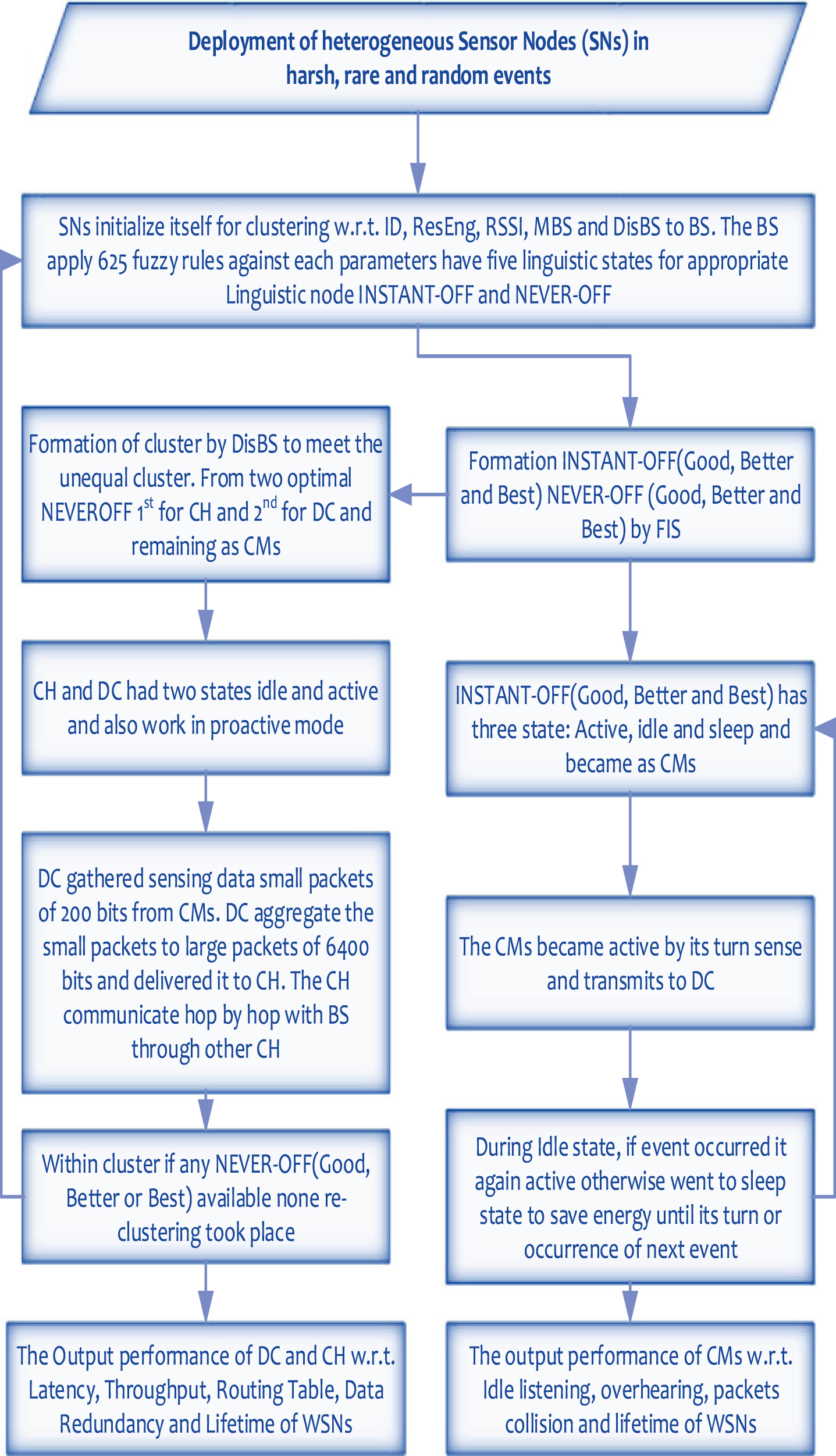
Methodology of research work.

CMs, DC, CH, and BS of 200 WSNs nodes.
Therefore sensing, processing, and communication jobs were done by its appropriated linguistic nods. In that way, all the functions had done appropriately to maintain the energy level. All tasks performed flatly and hierarchically enhanced the life span of WSNs. Therefore, the NOEA-INCFL hybrid model had the optimum to tackle the energy constraint during the sensing, processing, and transmission phase. By that mechanism, the unequal cluster could be achieved to maintain the energy level for prolonging the life span of WSNs.
This section provides an overview of the methodology based on fuzzy rules. Every heterogeneous node consisted of node Identification (ID), RSSI, ResEng, MBS and deployed different DisBS. During the setup phase, every node transmitted a packet to BS that contained node ID, RSSI value, ResEng, MBS, and DisBS. Node ID was unique value while other parameters each of one contained five linguistic variable terms such as ResEng (very low, low, medium, high and very high), RSSI (very low, low, medium, high and very high), MBS (very small, small, average, large and very large), and DisBS (very close, close, medium, far, and very far). Meanwhile, 625 fuzzy rules were executed by BS that played a vital role in the precise selection of INSTANT-OFF (Good, Better, and Best) as well as NEVER-OFF (Good, Better, and Best), as shown in the appendix. The INSTANT-OFF adjusted its active, idle and sleep states according to its fuzzy terms (Good, Better and Best) while NEVER-OFF also established its active and idle states according to its fuzzy terms (Good, Better and Best). All INSTANT-OFF and NEVER-OFF based on triangle function except NEVER-OFF Better that was based on trapezoidal function. It worked as a backup for DC and CH in case of unavailability or met a threshold level of DC and CH without entering into a re-clustering setup.
Result
The primary objective is to maintain the energy level during sensing, processing, and especially during communication to prolong the lifespan of WSNs. A hybrid approach achieves these objectives. This work is not compared for performance measure by other WSNs. Still, it examined by selecting and performing jobs of 114 fuzzy-based sensor nodes according to its linguistic parameter’s terms by fuzzy rules.
Mathematical calculation of NOEA-INCFL in MATLAB
The 114 fuzzy nodes were deployed in the 275*75-meter area as in Fig. 4.2.1. Five different zones were mentioned to attain the unequal numbers of a node in each cluster. In the very close, close, medium, far, and very far cluster zone had 10, 22, 23, 27, and 32 nodes, respectively. Figure 4.1.1, the CH in staric“*” form, DC in a pentagon shape, and the CMs in dot form while the BS in the square. The CH, DC and CMs were selected according to the algorithm in figure 4.1.2. The detailed description of CH and DC is listed in the appendix (Table 4.1.1 and 4.1.2), respectively. According to Fig. 4.1.1 INSTANT-OFF did the sensing jobs while NEVER-OFF performed processing and communication. The NEVER-OFF and INSTANT-OFF selected by the Fuzzy Inference System (FIS) according to methodology section 3. In the given parameters, the triangular and trapezoidal function played a role in selecting NEVER-OFF and INSTANT-OFF that had one state from three linguistic states (Good, Better, and Best).
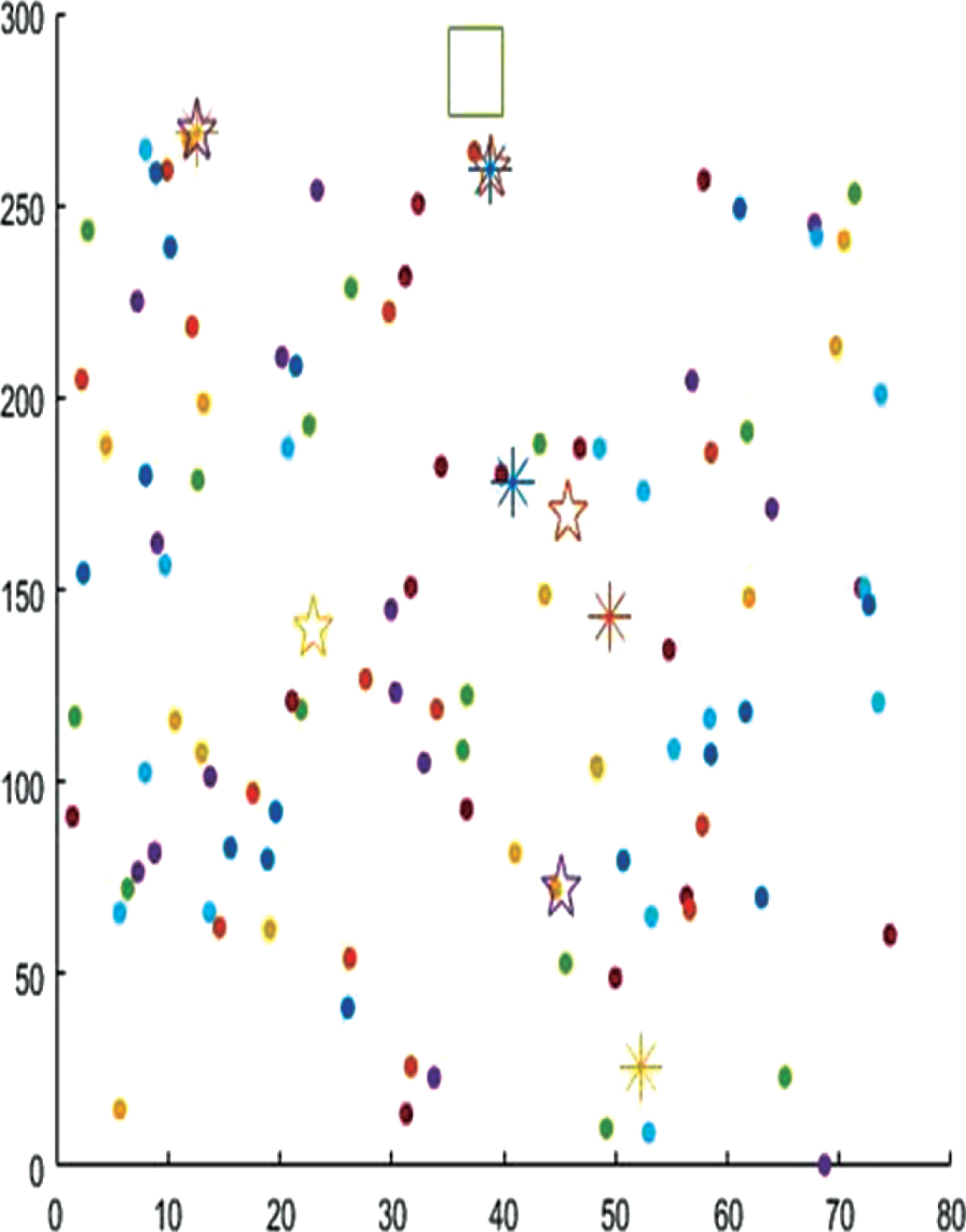
Graphical Representation of BS, CH, DC and CMs in MATLAB.
Algorithm flow of DC and CH Selection.
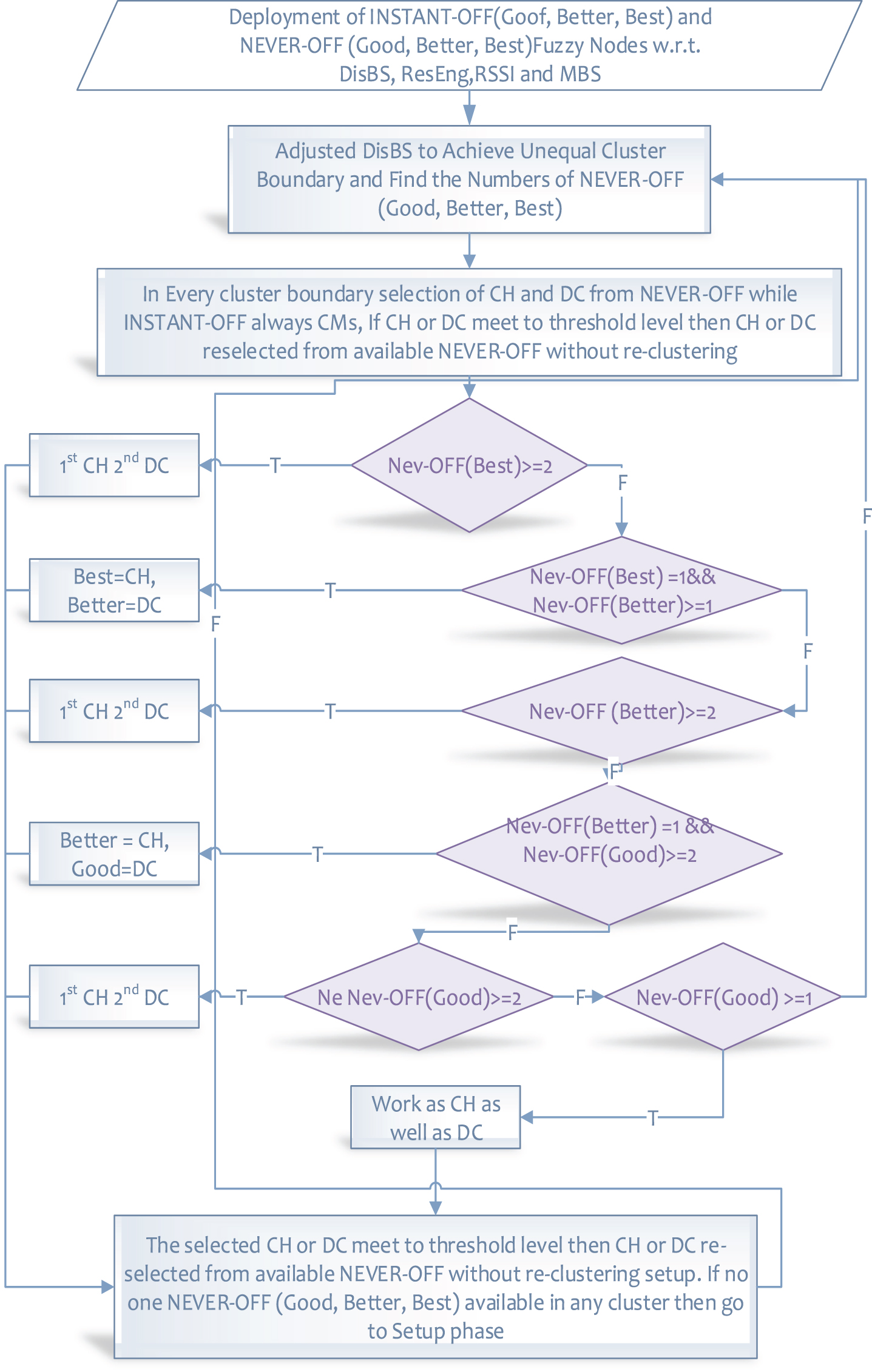
Consequently, the sensing, processing and communication jobs done by its appropriate linguistic states such as the INSTANT-OFF (Good, Better and Best) played a role as Cluster Members (CMs) and sense the data from the physical environment. Figure 4.1.2 the NEVER-OFF depended on how many (Good, Better, and Best) were available in a cluster. If more than one No. of NEVER-OFF (Best) available, then the first one played a role as CH and the second one worked as DC from CMs while the remaining NEVER-OFF (Good, Better, or Best) became as CMs.
If only one NEVER-OFF (Best) was available, then the remaining optimal NEVER-OFF (Good or Better) became DC in the cluster. If there was no NEVER-OFF (Best) available and more than one NEVER-OFF (Better) available, the First one became CH while the second one became DC and all the remaining NEVER-OFF (Better or Good) became CMs. If only one NEVER-OFF (Better) was available, then the remaining optimal NEVER-OFF (Good) became DC in the cluster. If there was no NEVER-OFF (Better) available and more than one NEVER-OFF (Good) available, the First one became CH while the second one became as DC and all the remaining NEVER-OFF (Good) became as CMs. If only one NEVER-OFF from (Good), was available then it performs both functionalities as CH as well as DC. On the other hand, if no one NEVER-OFF existed, then the re-clustering setup took place. After selecting CH, DC and CMs, the CMs sense the physical environment and send it to DC. The DC processes the data to remove the redundancy, compress it and send it to CH for communication with BS through others CH in predetermined opportunistic paths.
In an appendix (Table 4.1.3), the very close cluster consisted of eight CMs. One NEVER-OFF (Good) existed in the first cluster. Three belong to INSTANT-OFF (Good) and four INSTANT-OFF (Best).
Detail of 2nd cluster zone that close to BS CMs
In an appendix (Table 4.1.4), the 2nd cluster that lies close to BS had twenty CMs. Three NEVER-OFF (Better) also worked for both CH and DC if the selected CH and DC meet a threshold level. Eleven numbers of INSTANT-OFF (Best) and one for INSTANT-OFF (Better) while five for NEVER-OFF (Good).
Detail of 3rd cluster zone that close to BS CMs
In an appendix (Table 4.1.5), the 3rd cluster that lies at medium away to BS had twenty-two CMs. Sixteen numbers of INSTANT-OFF (Best) and four for INSTANT-OFF (Better) while two for NEVER-OFF (Good).
Detail of 4th cluster zone that far away to BS CMs
In an appendix (Table 4.1.6), the 4th cluster far away from BS had twenty-five CMs. Three nodes belong to NEVER-OFF (Better) that also worked for CH and DC in case the selected CH and DC meet a threshold level. Eighteen numbers of INSTANT-OFF (Best) and one for INSTANT-OFF (Better) while three for NEVER-OFF (Good).
Detail of 5th cluster zone that very far away to BS CMs
In an appendix (Table 4.1.7), the 5th cluster that lies very far away from BS had thirty CM. Two for NEVER-OFF (Best) and five for NEVER-OFF (Better) also worked for CH and DC in case the selected CH and DC meet a threshold level. Sixteen of INSTANT-OFF (Best) and four for INSTANT-OFF (Better) while three for NEVER-OFF (Good).
Throughput and latency
The hybrid routing was a combination of flat and hierarchical protocols that efficiently use energy. CH and DC had active and idle states, worked in a proactive mode, and forwarded packets deterministically to minimize the challenges regarding latency and throughput. While the CMs had active, idle, sleep states, and worked in reactive mode to avoid overhearing, over listening, and packets collision during internal cluster communication.
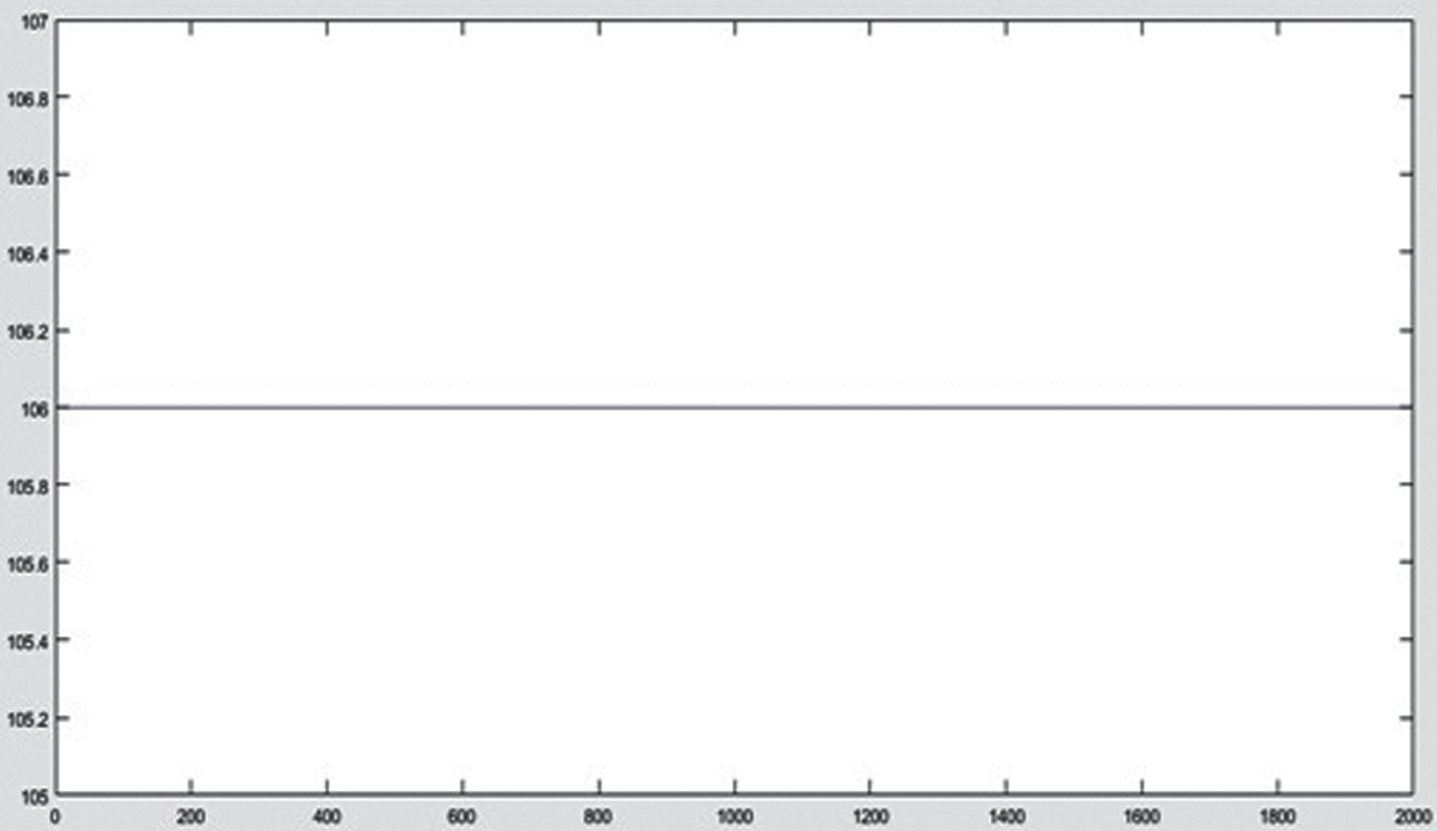
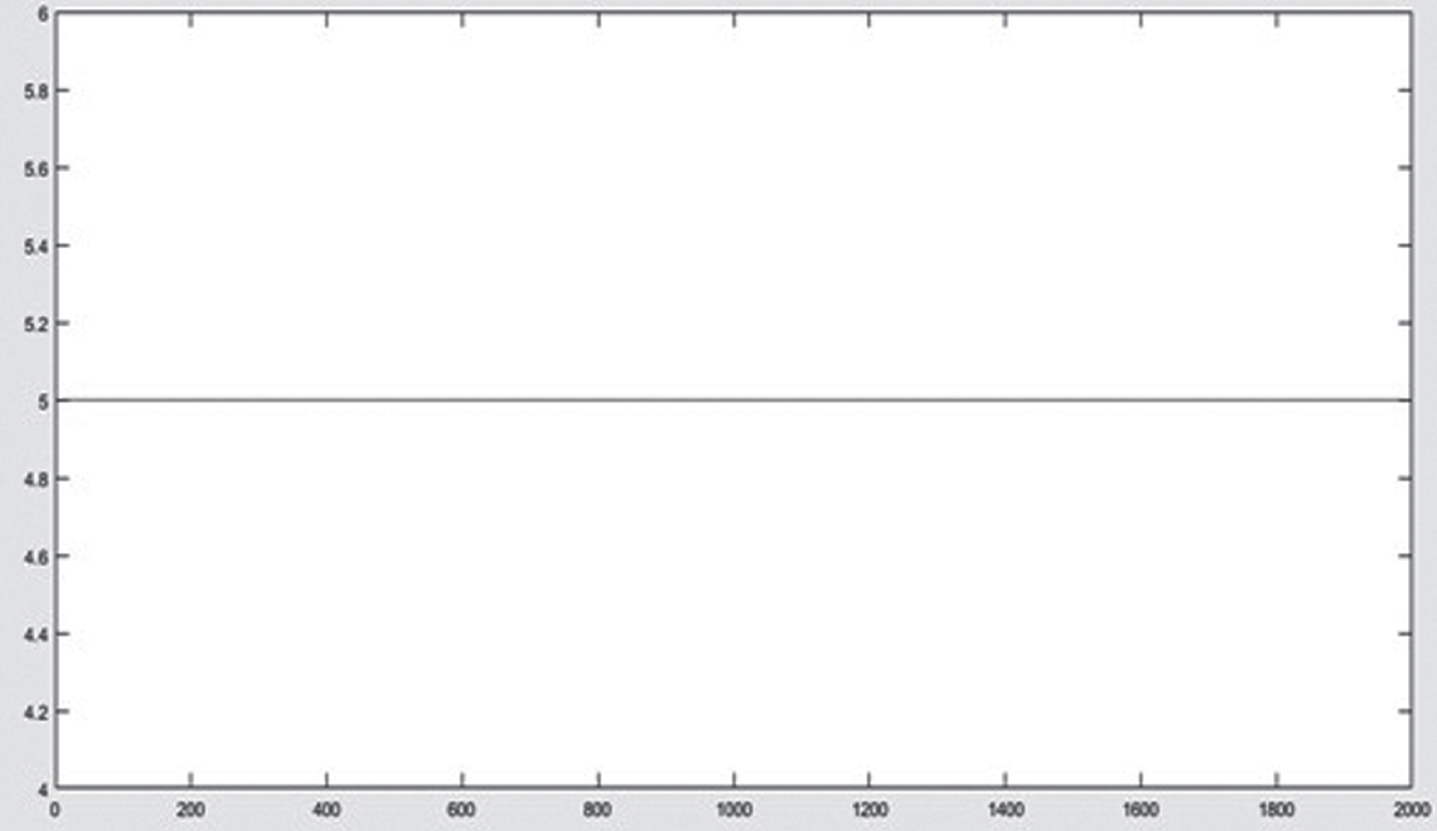
In the proposed NOEA-INCFL, all CMs sensed packet length of 200 bits and forwarded to DC. The DC aggregated the received packets and transmitted them to CH when the packet’s length became 6400 bits. The CH forwarded these packets hop by hop to the BS. In each round, 106 packets were sensed by CMs. Therefore, in two thousand rounds the sensor nodes sensing packets of length 200 bits was 212000, the DC aggregated the 212000 packets of length 200 bits into 12000 of length 6400 bits. The DC forwarded these 12000 of length 6400 bits to CH. The CHs transmitted these 12000 packets of length 6400 bits to BS. The BS received these 12000 packets. In this way, the throughput of 100% was achieved by NOEA-INCFL. Figures 4.2.1 and 4.2.2 explain 2000 rounds.
200 bits Length 106 packets in each round Sensed by CMs in 2000 Round.
6400 bits Length 5 Packets in each round Transmitted by DC, CH and Received through BS in 2000 Rounds.
According to the appendix (Table 4.2.1), the Latency time was minimized by the proactive and reactive techniques simultaneously used to enhance the performance of NOEA-INCFL. The hybrid routing was a combination of flat and hierarchical protocol that addressed the issues related to latency and throughput. CH and DC had active and idle states, worked in a proactive mode, had sufficient MBS, and forwarded packets deterministically.
Latency Time of First 25 Rounds in MATLAB
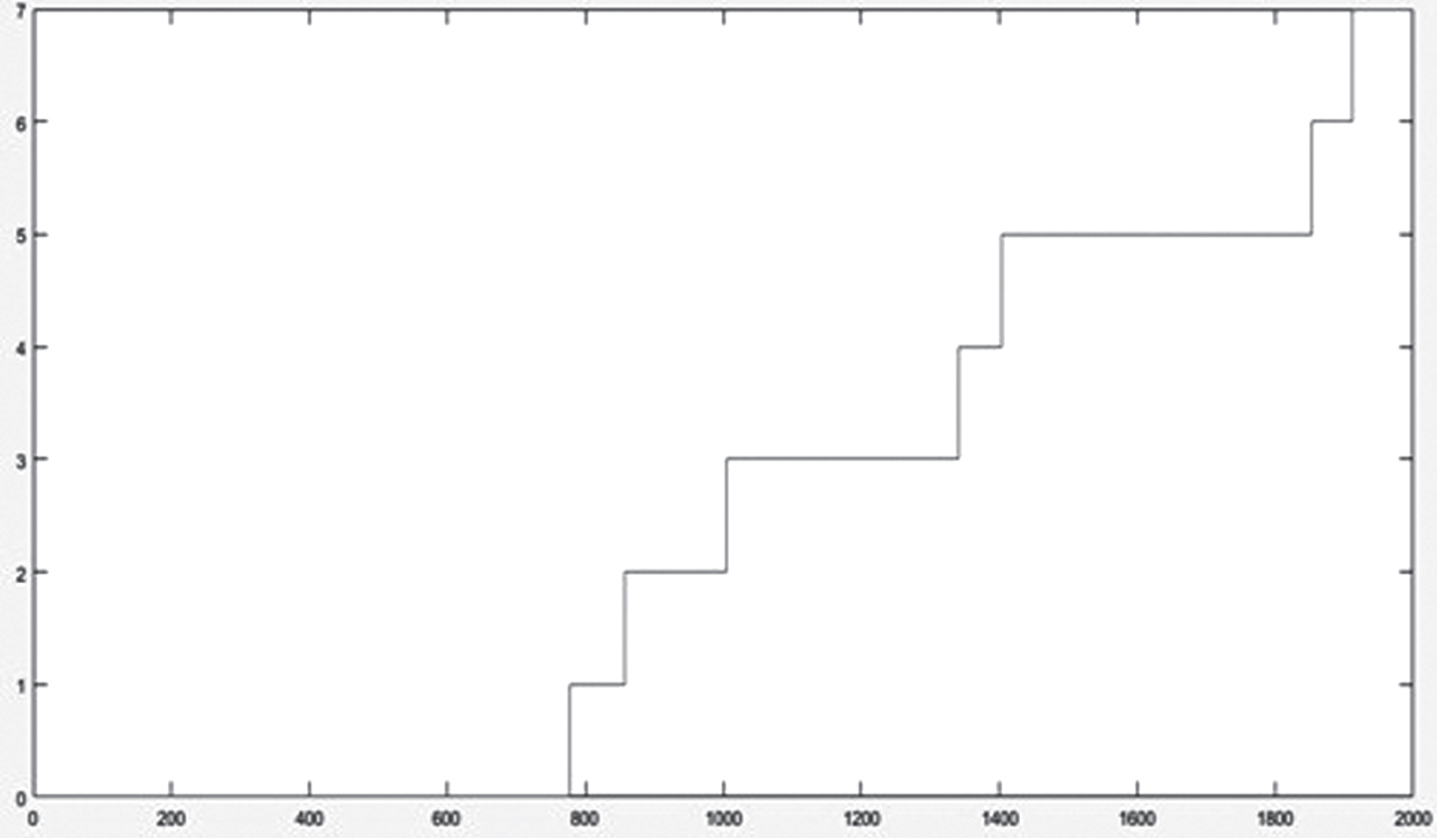
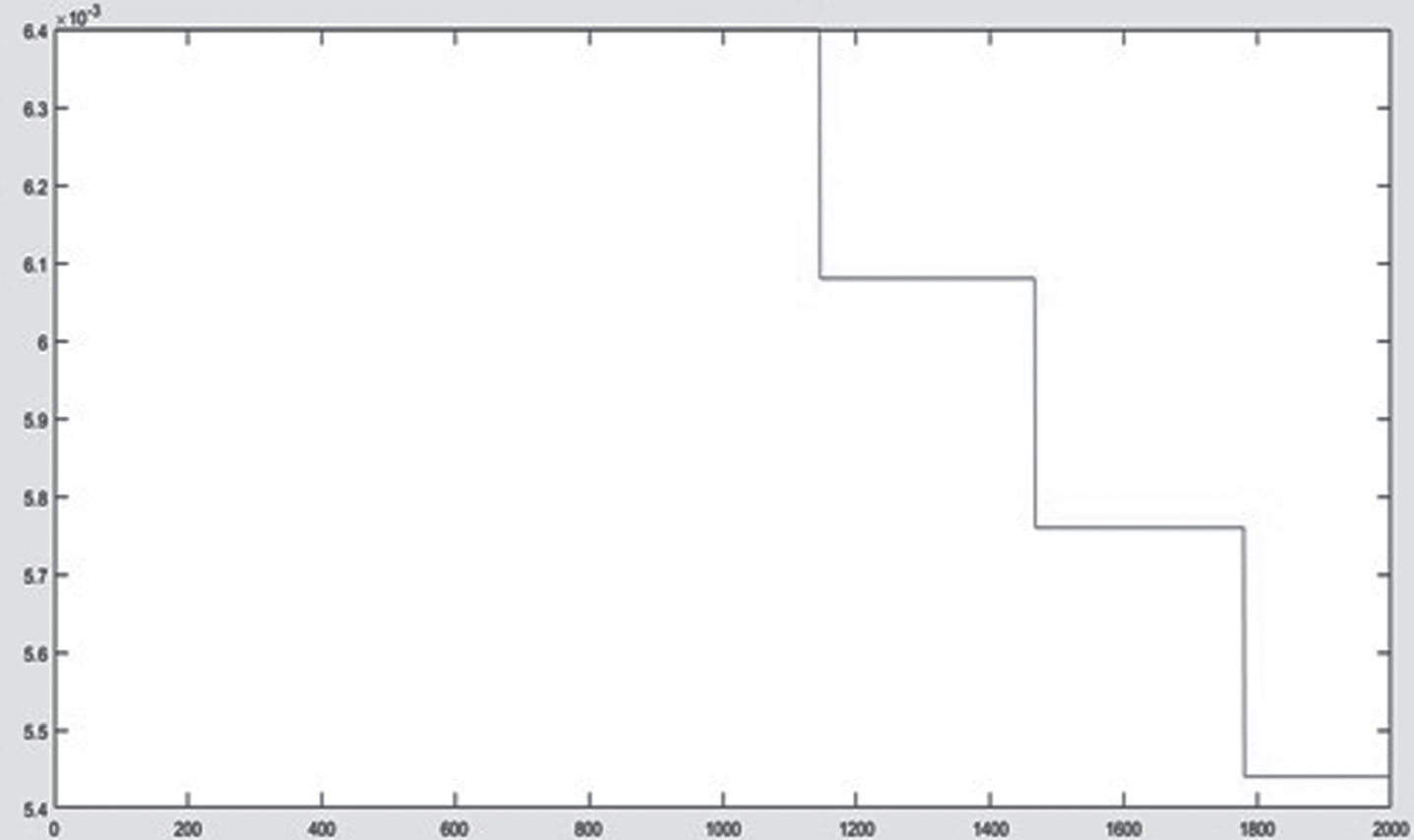
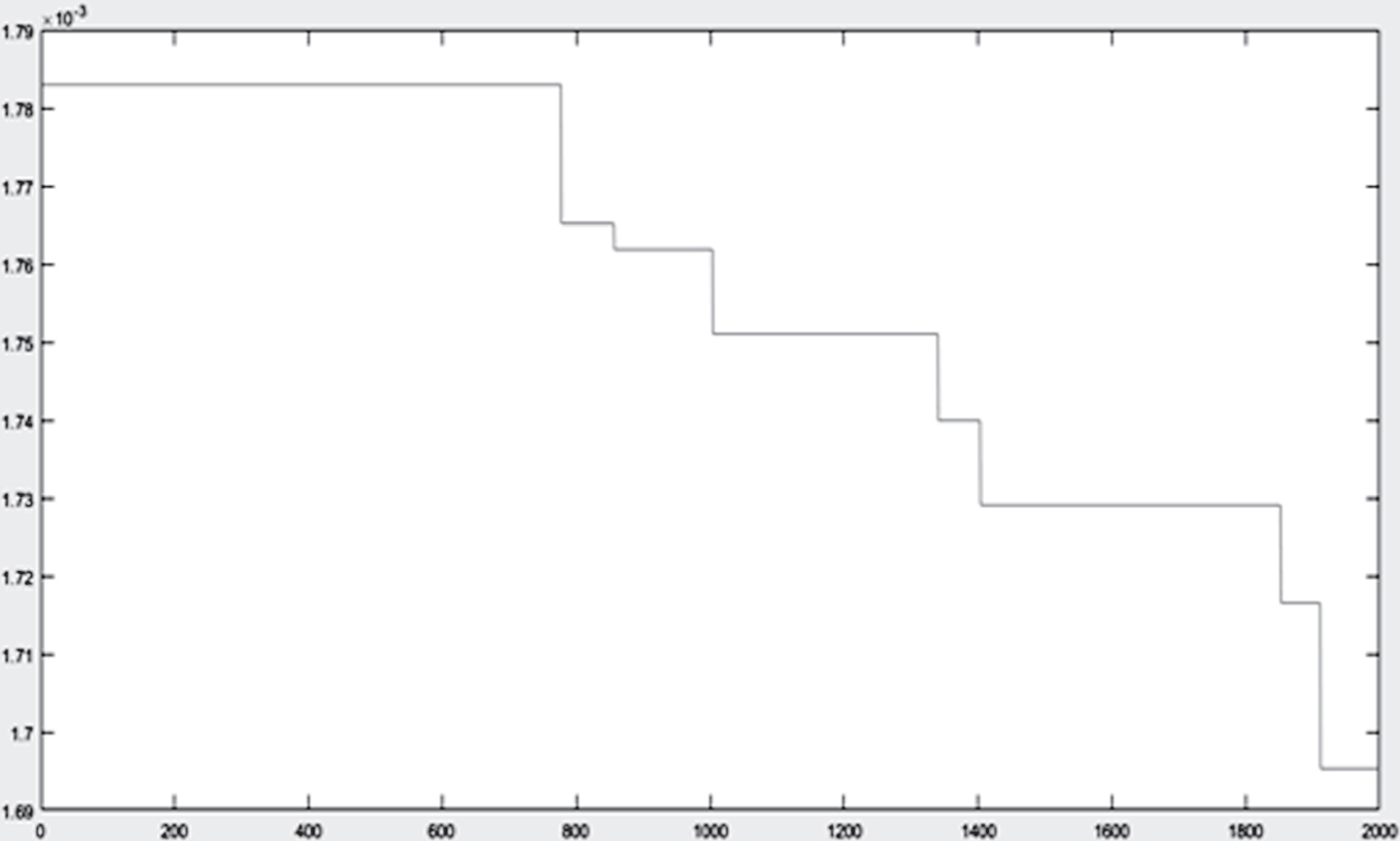
Energy consumes during sensing, processing and transmission phases. The energy consumed during transmission was the primary concern but maintained the consumption of energy level during sensing and processing also addressed. The proactive and reactive techniques were simultaneously used to enhance the performance of the proposed NOEA-INCFL. The Energy Consumption by Sensing, Processing, and Communicating units during 2000 rounds are shown in Figs. 4.3.2, 4.3.3, and 4.3.4. In an appendix (Table 4.3.1) and Fig. 4.3.1, only seven nodes were dying from 114 nodes. The dead nodes belonged to CH and DC. The first dead node was the CH of the 1st cluster zone during 775 rounds; thus, the lifetime of the proposed NOEA-INCFL was up to 774. Now the re-cluster setup takes place, the DC of the 1st cluster performed the duty of CH without re-clustering. The second node that died was the CH of the 2nd cluster during 857 rounds now the DC of the 2nd cluster also worked as CH without a re-clustering setup. The third node was died belong to CH of 3rd cluster during 1004 rounds now its DC also worked as CH. The 4th node was CH of the 4th cluster died after 1341 rounds now its duty performed by its DC. The 5th node that failed was the DC of the 1st cluster during 1404. Now the NEVER-OFF (Good), which ID#77 in the appendix (Table 4.1.3) worked and CH and DC without entering into re-clustering setup. The 6th node that died was the DC of the 3rd cluster during 1857 rounds, so the available NEVER-OFF in that cluster worked as CH and DC. After the 1912 round, the 7th node died was the DC of the 2nd Cluster; in that cluster, none NEVER-OFF was available; thus, the re-clustering setup took place. In this way, the lifetime and lifespan significantly be enhanced by the proposed NOEA-INCFL.
The Detail of 7 Dead Nodes during 2000 rounds.
Energy Consumed During 2000 Sensing Rounds by CMs.
Energy Consumed During Receiving Packets in 2000 rounds.
Energy Consumed during Communication by CH and DC in 2000 rounds.
Total Network energy = 120.3647J
Setup Energy Consumption = 0.0098J
Total Network Energy Consumed during 2000 rounds = 17.9303J
Remaining Energy after 2000 rounds was = 102.4344J
Energy Consumed During Receiving Packets = 3.200000000000000e-04J
Energy Consumed During Sensing by CMs = 1.100000000000000e-05J
Energy Consumed during Communication by CH and DC = 3.730572191182969e-05J
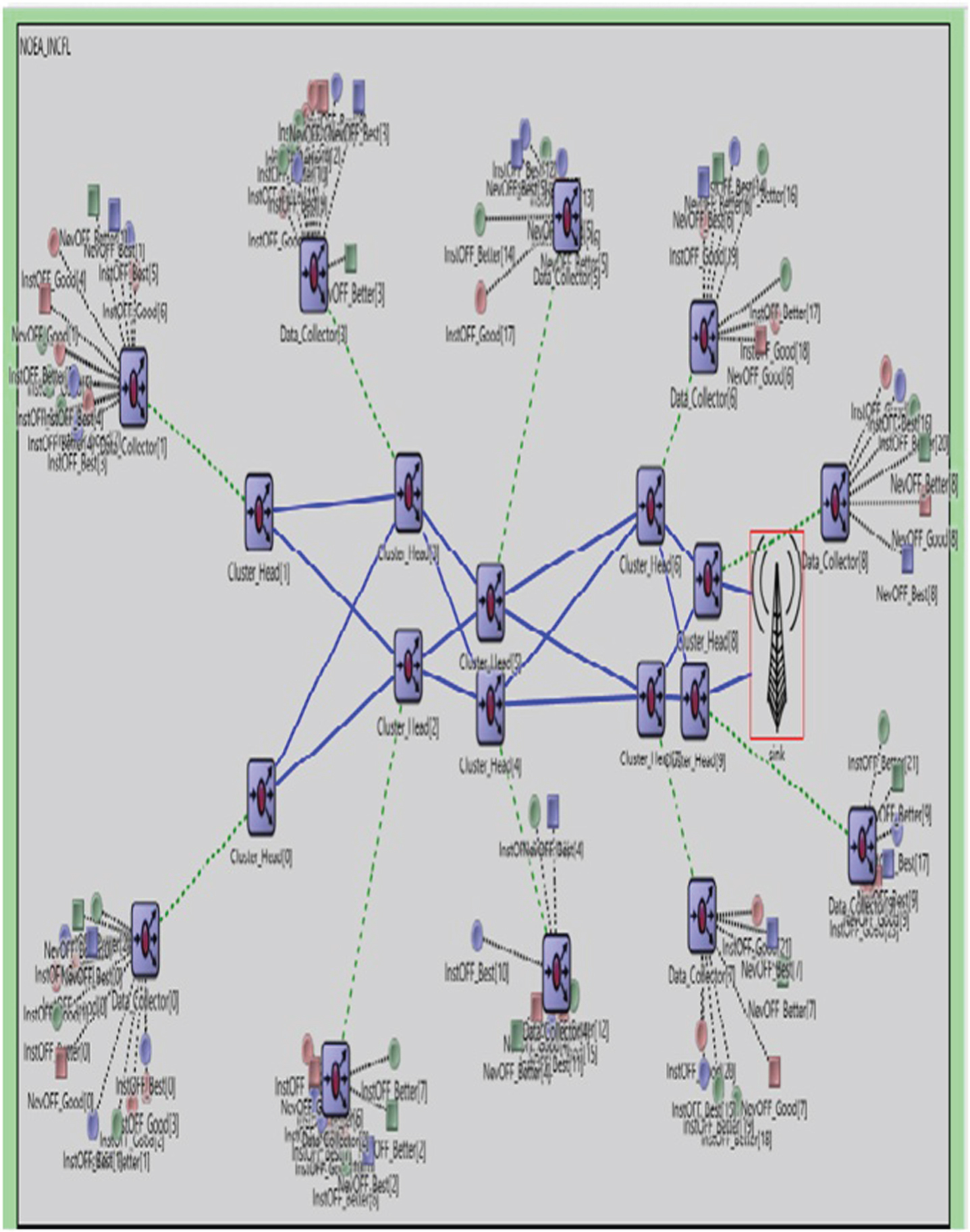
Nodes were divided into two INSTANT-OFF in a desk or rounded shape and NEVER-OFF in a square form in Figure 4.4.1. The INSTANT-OFF had three states sleep, active, and idle, as in the appendix (Table 4.4.1) in Event#2. The INSTANT-OFF was further subdivided into three fuzzy-based linguistic’s terms INSTANT-OFF (Good, Better, and Best) that was differentiated with the color red, green and blue as in Figure 4.4.1, which adjusted its states of active, idle and sleep duration according to (Good, Better and Best). In the targeted
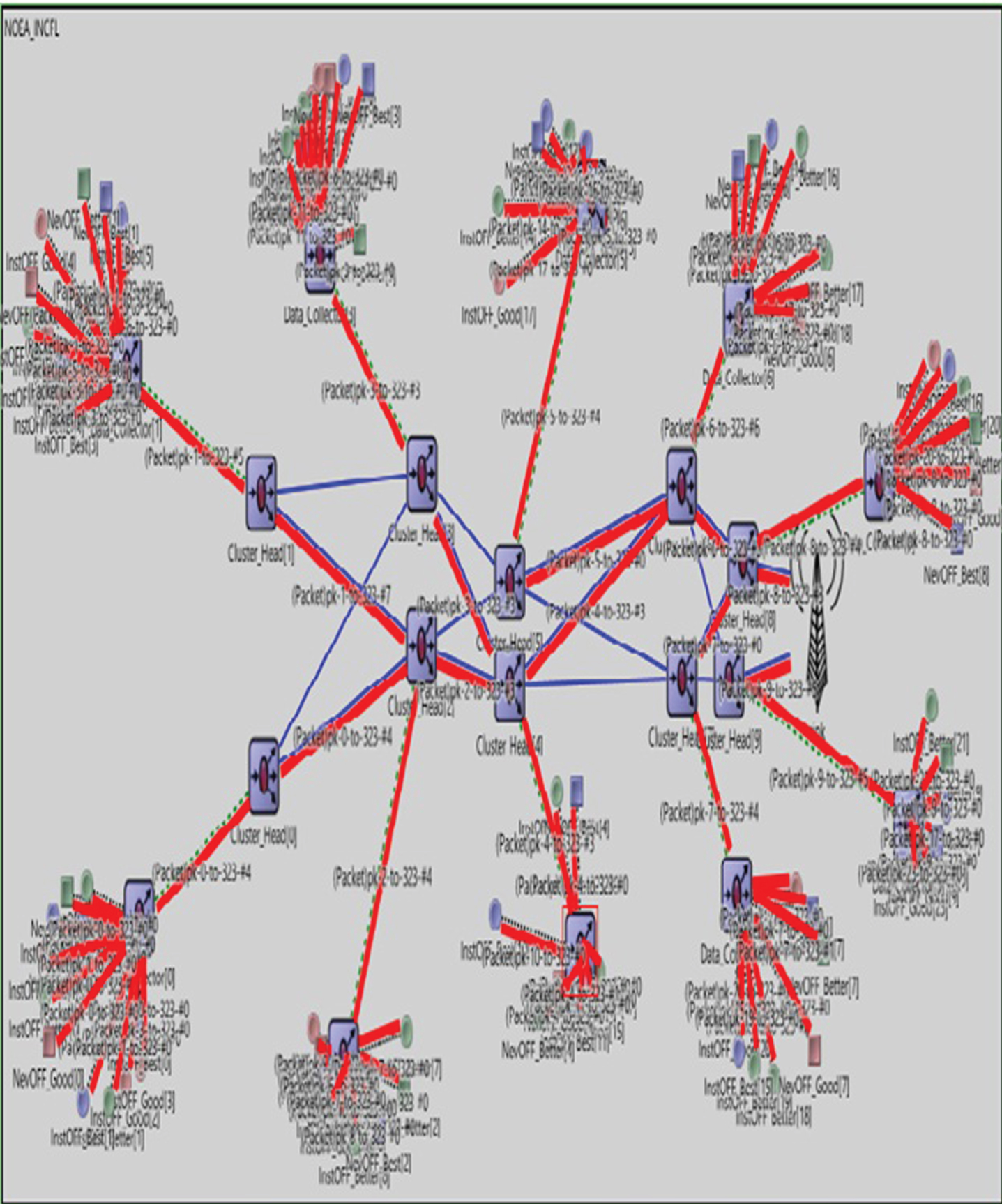
Pictorial Representation of proposed NOEA-INCFL in OMNET++.
Surveillance vicinity, when no event occurred, then INSTANTOFF went into the idle state for some moments. If no further event occurred, it went into a sleep state and saved its energy. The idle state took less time and energy come to an active state concerning sleep state. Because the energy consumption was less during transforms from idle to active state w.r.t sleep to active setup period and time. The NEVERO-FF maintained only two states, active and idle as in appendix (Table 4.4.1) Event#339, but it also categories (Good, Better and Best) in a square with red, green and blue colored respectively as in Figure 4.4.1. Figure 4.1.2 the NEVER-OFF depended on many numbers of (Good, Better and Best) available in a cluster. If more than one No. of NEVER-OFF (Best) available, then the first one played a role as CH and the second one worked as DC in fork form as in Fig. 4.1.2 while the remaining NEVER-OFF (Good, Better or Best) became as CMs. If only one NEVER-OFF (Best) was available, then the remaining optimal NEVER-OFF (Good or Better) became DC in the cluster. If there was no NEVER-OFF (Best) available and more than one NEVER-OFF (Better) available, the First one became CH while the second one became DC and all the remaining NEVER-OFF (Better or Good) became as CMs. If only one NEVER-OFF (Better) was available, then the remaining optimal NEVER-OFF (Good) became DC in the cluster. If there was no NEVER-OFF (Better) available and more than one NEVER-OFF (Good) available, the First one became CH while the second one became as DC and all the remaining NEVER-OFF (Good) became as CMs. If only one NEVEROFF from (Good, Better or Best)nd was available, it performs both functionalities as CH and DC. On the other hand, if no one NEVER-OFF existed, then the re-clustering setup took place. In Fig. 4.4.1, two clusters at each level that lie very far away, far away, medium, close, and very close from BS, consisted of 15, 13, 11, 9, and 8 nodes. By that mechanism, the unequal cluster could be achieved to maintain the energy level for prolonging the lifespan of WSNs. The DC gathered the sensing data from CMs and delivered it to CH. The CH forwarded it to BS via another CH opportunistically and hierarchically, as in Fig. 4.4.2. In that way, all the functions had done appropriately to maintain the energy level. All tasks performed flatly and hierarchically enhanced the lifespan of WSNs. Therefore, the proposed NOEA-INCFL is a hybrid model and optimum for tackling energy constraints on all levels. In Fig. 4.4.2, the manageability also existed in that hybrid model. The NEVER-OFF worked as a backup. If somehow the CH and DC were not available or went down due to ResEng or some other reasons, then the NEVEROFF based on trapezoidal function plays a role for backup both. In this way, the re-clustering setup was delayed, and the life span was enhanced. The presented WSNs.
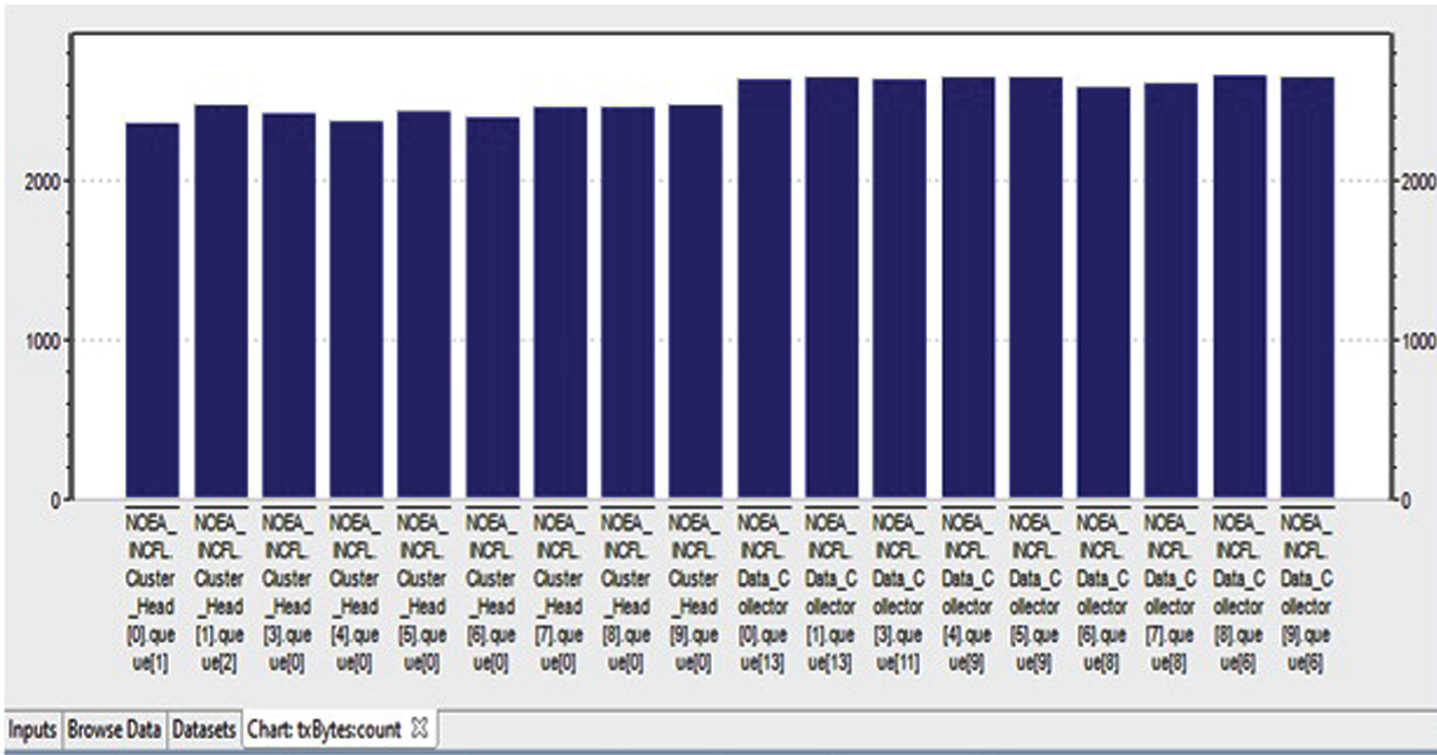
Pictorial Representation of proposed NOEA-INCFL in OMNET++during simulation to select opportunistic path by CH.
Model ensured the availability of the system services andthe inter-cluster communication was performed hierarchically and opportunistically. If any link broke down or busy, then the second link was available to work as a backup.
Therefore, security issues could also be addressed efficiently in the proposed NOEA-INCFL model. If the intruders affected any link or cluster, then the whole network was not affected; only the victim link or cluster was cured by BS without interrupting the whole network. The ability to grown-up existed in the proposed NOEA-INCFL model network. The efficiency and time execution factors have not affected scalability. Because that model presented in such a way the sensing jobs were performed by INSTANT-OFF while the processing and communication jobs performed from NEVER-OFF by DC and CH respectively in opportunistic and hierarchical way, thus 100% throughput was achieved as in Figs. 4.4.3 and 4.4.4. The latency time was also minimized by the shortest routing table as in the appendix (Table 4.4.2).
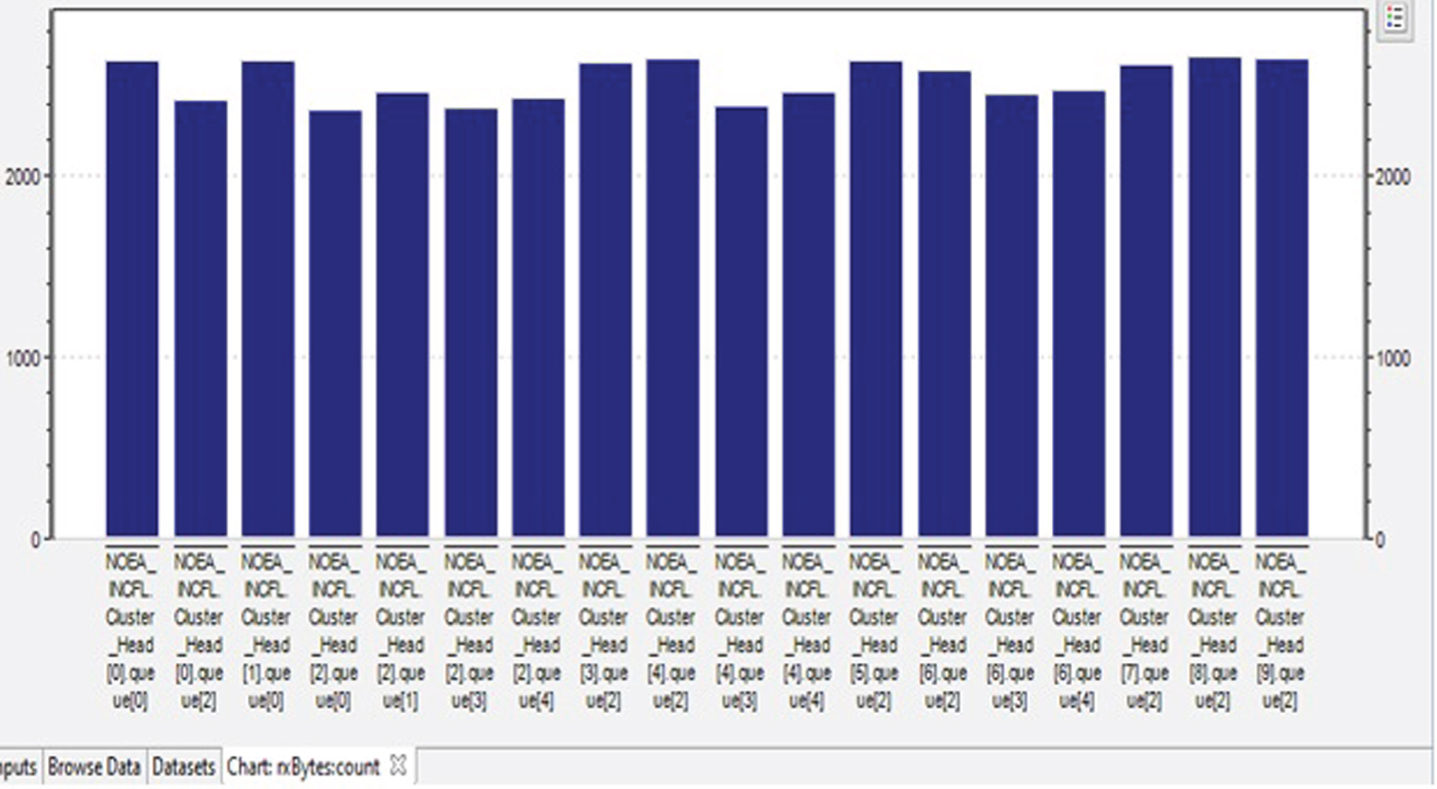
Bytes transmitted by DC and CH in OMNET++.
Bytes received by DC and CH in NOEA-INCFL in OMNET++.
Manageability & usability
The sensing, processing, and transmission jobs are done by their appropriate linguistic states such as the INSTANT-OFF played a role as CMs and sensed the data from the physical environment. In the case of NEVER-OFF, it depended on many numbers of (Good, Better and Best) were available in a cluster. If more than one No. of NEVER-OFF (Best) available, then the first one played a role as CH and the second one worked as DC while the remaining NEVER-OFF (Good, Better or Best) became as CMs. If only one NEVER-OFF (Best) was available, then the remaining optimal NEVER-OFF (Good or Better) became DC in the cluster. If there was no NEVER-OFF (Best) available and more than on NEVER-OFF (Better) available, the First one became as CH while the second one became as DC and all the remaining NEVER-OFF (Better or Good) became as CMs. If only one NEVER-OFF (Better) was available, then the remaining optimal NEVER-OFF (Good) became DC in the cluster. If there was no NEVER-OFF (Better) available and more than one NEVER-OFF (Good) available, the First one became as CH while the second one became as DC and all the remaining NEVER-OFF (Good) became as CMs. If only one NEVER-OFF (Good, Better or Best) was available, then only one NEVER-OFF performs both the task of CH as well as DC. When none NEVER-OFF (Good, Better, Best) has existed in a cluster, then the re-clustering setup starts.
Scalability
The ability is too grown-up existed in this model network. The efficiency and time execution factors are not affected by scalability because that model presented so that the sensing jobs were performed by INSTANT-OFF (Good, Better and Best) that worked as CMs. In contrast, the processing jobs performed DC and CH. The CH transferred the data deterministically as well as hierarchically hop by hop to BS. That is why the given network model could be scaled up.
Availability
The presented WSNs model assured the availability of the system services. The inter-cluster communication was performed hierarchically and opportunistically. If any link broke down or busy, then the second link was available to work as a backup. Therefore, security issues could also be addressed efficiently in the proposed NOEA-INCFL WSNs model. If the intruders affect any link or cluster, then the whole network was not affected; only the victim link or cluster was cured by BS without interrupting the whole network.
Hybrid strategy
The reactive, proactive, and backup characteristics were also presented in the given WSNs model. Therefore, the system performance, as well as a security issue, was also tackled efficiently. Over hearing, over listening, packets collisions, and congestions could be reduced significantly, which enhanced the performance of the proposed NOEA-INCFL.
Response time
In the proposed NOEA-INCFL WSNs model, the amount of time for some network services requests and response to that request was significantly reduced because this model was specifically deterministic and opportunistic due to the presented latency network model was automatically decreased.
Throughput
Throughput is the combination of Good-put and Bad put. The Good-put is the error-free packets, while the Bad put consisted of erroneous packets. But the overhearing in proposed NOEA-INCFL, over listening, and packets collision addressed by communication took place-specific turn. While traffic congestion was controlled by sufficient MBS for processing and queuing upcoming packets, the throughput was 100%.
Conclusion and future work
In this research, the main concern was to prolong the lifetime and lifespan of WSNs by saving energy. The energy consumption during the sensing, processing and transmission phase was addressed. For this purpose, the heterogeneous nodes divided into INSTANT-OFF and NEVER-OFF. The INSTANT-OFF maintained active, idle, sleep states and worked in reactive mode while the NEVEROFF transformed into active, idle states and worked in proactive mode. The INSTANT-OFF and NEVER-OFF are subdivided into linguistic terms (Good, Better and Best) by FIS rules based on triangular and trapezoidal functions. The sensing jobs were performed by INSTANT-OFF that worked as CMs. The processing and transmission jobs were performed by NEVER-OFF that worked as DC and CH. The algorithm in Fig. 4.1.2 selected DC and CH. To maintain the energy level in overall WSNs, DisBS and its linguistic variables as very close, close, medium, far, and very far adopted the unequal clustering mechanism. In this research, The CMs worked reactively and saved energy by idle and sleep states while the CH and DC worked proactively and saved energy in an idle state. The sensing job was done by CMs that consumed 1.100000000000000e-05J energy and sensed 212000 packets of 200 bits length in 2000 rounds. The more energy consumption phases were processing and transmission performed by DC and CH, respectively. The energy consumed on receiving packets was 3.200000000000000e-04J by DC and CH. During transmission, 3.730572191182969e-05J of energy consumed by DC and CH to deliver 12000 packets in 2000 rounds of 6400 bits length to BS hop by hop and saved the energy as 85.1033% in 2000 rounds. The unequal clustering approach maintained the level of energy consumption throughout WSNs.
Consequently, only seven nodes die from 114 and increase the lifetime up to 774 rounds. In contrast, the re-clustering setup took place after 1912 rounds. The reactive and proactive mechanisms enhanced the throughput by 100% while latency time 0.001123 in the first round and so on as in Table 4.2.1.
The future work plan will have to implement all decisions such as the selection of active, idle and sleep duration, re-selection of DC and CH within-cluster or re-clustering of WSNs by FIS in a real scenario remove the redundancy by DC during the processing and aggregating of packets.