






Abstract
The aim of this study is to introduce fuzzy filters of Sheffer stroke Hilbert algebra. After defining fuzzy filters of Sheffer stroke Hilbert algebra, it is shown that a quotient structure of this algebra is described by its fuzzy filter. In addition to this, the level filter of a Sheffer stroke Hilbert algebra is determined by its fuzzy filter. Some fuzzy filters of a Sheffer stroke Hilbert algebra are defined by a homomorphism. Normal and maximal fuzzy filters of a Sheffer stroke Hilbert algebra and the relation between them are presented. By giving the Cartesian product of fuzzy filters of a Sheffer stroke Hilbert algebra, various properties are examined.
Introduction
The concept of fuzzy theory was originally introduced by Lotfi Zadeh [14]. Since this theory are closely related to human’s intelligence and behaviors, it has been commonly used by many researchers who want to produce devices imitating human behaviors. Thus, the fuzzy theory plays an important role to improve artificial intelligence, industry, science and technology. Filter theory has an important role in logic, and so there exist some applications in logical algebras. Therefore, this theory arrests many scientist’s attention. Hilbert algebras were introduced by L. Henkin and T. Skolem for studies in intuitionistic and other non-classical logics [6] in the 1950’s. Then A. Diego analyzed Hilbert algebras, their deductive systems and various properties. He proved that Hilbert algebras form a variety [5]. Also, Hilbert algebras, related concepts and deductive systems are examined by Busneag ([1, 2]) and Jun [7]. In the meantime, Sheffer operation was introduced by H.M. Sheffer [13]. And later, McCune et al. proved that any Boolean operation can be expressed by this operation [8]. Sheffer operation has all diods on the chips in a computer, and so it leads to generate a single diod instead of different diods for every Boolean operation. Hence, it has importance in producing computer chips. In addition to this, due to properties of Sheffer operation, many algebraic structures with the operation have quitely useful axiom systems. For that reason, checking these axiom systems is easy and effortless. Therefore, scientists have started to study algebraic structures with Sheffer operation such as Sheffer stroke non-associative MV-algebras [4], (fuzzy) filters of Sheffer stroke BL-algebras [10], filters of strong Sheffer stroke non-associative MV-algebras [11] and Sheffer stroke BG-algebras [12]. Also, Sheffer stroke Hilbert algebras, their properties, deductive system and ideals are presented in [9]. We give a deductive system and a filter of a Sheffer stroke Hilbert algebra, and prove that its filter is equivalent to its deductive system. By describing a fuzzy filter and a homomorphism on a Sheffer stroke Hilbert algebra, it is shown that a new fuzzy filter of a Sheffer stroke Hilbert algebra is defined by the compound function of fuzzy filter and a homomorphism on this algebra. Thereafter a quotient a Sheffer stroke Hilbert algebra is built by its fuzzy filter, and then it is shown that this quotient is also a Sheffer stroke Hilbert algebra. Also, normal and maximal fuzzy filters of a Sheffer stroke Hilbert algebra are introduced and some properties are given. It is proved that f+ is a normal fuzzy filter of a Sheffer stroke Hilbert algebra H if f is its fuzzy filter, and f is a fuzzy filter of H if f+ is its fuzzy filter, where f+ (x) = f (x) +1 - f (1), for any x ∈ H. Besides, it is demonstrated that f is a normal fuzzy filter of a Sheffer stroke Hilbert algebra if and only if f+ = f. It is stated that the compound function of a fuzzy filter f of a Sheffer stroke Hilbert algebra H and an increasing function g : [0, f (1)] ⟶ [0, 1] is a fuzzy filter of H. Indeed, it is shown that the sets of all normal fuzzy filters of a Sheffer stroke Hilbert algebra is a poset while it is not a lattice. Then the relationships between normal and maximal fuzzy filters of a Sheffer stroke Hilbert algebra are expressed. After determining (strongest) fuzzy relation S g on a Sheffer stroke Hilbert algebra H for a fuzzy subset g of H, it is proved that g is a fuzzy filter of H if and only if S g is a fuzzy filter of a Sheffer stroke Hilbert algebra H × H. Finally, the Cartesian product of fuzzy filters and related concepts presented.
Preliminaries
In this section, we give fundamental definitions and notions about Sheffer stroke Hilbert algebras.
x|y = y|x, (x|x) | (x|y) = x, x| ((y|z) | (y|z)) = ((x|y) | (x|y)) |z, (x| ((x|x) | (y|y))) | (x| ((x|x) | (y|y))) = x .
(SHa1) (x| ((y| (z|z)) | (y| (z|z)))) | (((x| (y|y)) | ((x| (z|
z)) | (x| (z|z)))) | ((x| (y|y)) | ((x| (z|z)) | (x| (z|
z))))) = x| (x|x) ,
(SHa2) If x| (y|y) = y| (x|x) = x| (x|x) then x = y.
The Cayley table of Sheffer stroke | on H
The Cayley table of Sheffer stroke | on H
The Hasse diagram of this algebra follows:
The Cayley table of Sheffer stroke | on H
The Hasse diagram of this algebra follows:
x| (x|x) =1, x|(1|1) =1, 1| (x|x) = x .
(Shb1) x ≤ y| (x|x),
(Shb2) x| ((y| (z|z)) | (y| (z|z))) = (x| (y|y)) | ((x| (z|z)) | (x| (z|z))) ,
(Shb3) (x| (y|y)) | (y|y) = (y| (x|x)) | (x|x) ,
(Shb4) x| ((y| (z|z)) | (y| (z|z))) = y| ((x| (z|z)) | (x| (z| z))) ,
(Shb6) ((x| (y|y)) | (y|y)) | (y|y) = x| (y|y) ,
(Shb7) x| (y|y) ≤ (y| (z|z)) | ((x| (z|z)) | (x| (z|z))) .
(i) 1 ∈ S,
(ii) x ∈ S and x| (y|y) ∈ S imply y ∈ S.
(x| (y|y)) | (((z| (x|x)) | ((z| (y|y)) | (z| (y|
y)))) | ((z| (x|x)) | ((z| (y|y)) | (z| (y|y)))))
= (x| (y|y)) | ((z| ((x| (y|y)) | (x| (y|
y)))) | (z| ((x| (y|y)) | (x| (y|y)))))
= z| (((x| (y|y)) | ((x| (y|y)) | (x| (y|y))))
| ((x| (y|y)) | ((x| (y|y)) | (x| (y|y)))))
= z|(1|1)
= 1
from (Shb2), (Shb4), Lemma 2.1 (i) and (ii), it follows that x| (y|y) ≤ (z| (x|x)) | ((z| (y|y)) | (z| (y|y))) , for all x, y, z ∈ H.
In this section, we introduce a filter of Sheffer stroke Hilbert algebras. Assume that H states a Sheffer stroke Hilbert algebra unless otherwise specified.
(f1) 1 ∈ F,
(f2) x| (y|y) ∈ F for x ∈ H and y ∈ F, (f3) (x| (y1|y2)) | (y1|y2) ∈ F for x ∈ H and y1, y2 ∈ F.
= ((((x|x) |y) |y) |y) | (((x|x) |y) |y)
= (y| ((x|x) |y)) | ((x|x) |y)
= ((((x|x) |y) | ((x|x) |y)) | (y|y)) | (y|y)
= ((x|x) | ((y| (y|y)) | (y| (y|y)))) | (y|y)
= ((x|x) |(1|1)) | (y|y)
= y ∈ F .
(⇐) Let F be a deductive system of H. Then
(f1): 1 ∈ F from Definition 2.3 (i).
(f2): Let x ∈ H and y ∈ F. Since y ≤ x| (y|y), then
(f3): Let x ∈ H and y1, y2 ∈ F. Since y1| (((y1|y2) |y2) | ((y1|y2) |y2)) = (y1|y2) | ((y1|y2) | (y1|y2)) =1 ∈ F from (Shb4), Lemma 2.1 (i) and Definition 2.3 (i), it is obtained from Definition 2.3 (ii) that (y1|y2) |y2 ∈ F. Also, since y2| (((y1|y2) | (y1|y2)) | ((y1|y2) | (y1|y2))) = (y1|y2) |y2 ∈ F from (S1)-(S2), we have from Definition 2.3 (ii) that (y1|y2) | (y1|y2) ∈ F. It follows from (f2) and (S2) that (x| (y1|y2)) | (y1|y2) = (x| (((y1|y2) | (y1|y2)) | ((y1|y2) | (y1|y2)))) | (((y1|y2) | (y1|y2)) | ((y1|y2) | (y1|y2))) (x| (y1|y2)) | (y1|y2) ∈ F.
Fuzzy filters of sheffer stroke hilbert algebras
In this section, we introduce fuzzy filters of Sheffer stroke Hilbert algebras.
The inclusion ⊆ between two fuzzy subsets f and g of H is defined by
(FH1) f (x) ≤ f (1),
(FH2) f (y) ≤ f (x| (y|y)),
(FH3) min {f (y1) , f (y2)} ≤ f ((x| (y1|y2)) | (y1|y2)).
We demonstrate that x ≰ y whenever f (x) ≤ f (y) for all x, y ∈ H.
We give an example to show that, in general, an order-preserving fuzzy subset of H is not fuzzy filter of H.
(a) f is order-preserving,
(b) min {f (x) , f (y)} ≤ f ((x|y) | (x|y)), for all x, y ∈ H.
(⇐) Let f be a fuzzy subset of H satisfying (a) and (b).
(FH1): Since x ≤ 1, by using (a) we have f (x) ≤ f (1), for all x ∈ H.
(FH2): Since y ≤ x| (y|y), it is obtained from (a) that f (y) ≤ f (x| (y|y)), for all x, y ∈ H.
(FH3): By substituting [x : = y1] and [y : = y2] in (b), it follows that min {f (y1) , f (y2)} ≤ f ((y1|y2) | (y1|y2)) ≤ f ((x| (y1|y2)) | (y1|y2)), for all x, y1, y2 ∈ H, from (Shb1), (S2) and (a).
Let f be a fuzzy subset of H. We define a subset
Conversely, let A be a filter of H. Since 1 ∈ A, f A (x) ≤ f A (1) = t1, for all x ∈ H. Let x and y be any elements in H. If y ∈ A, then x| (y|y) ∈ A from f2. Thus, f A (x| (y|y)) = t1 = f A (y). If y ∉ A, then f A (y) = t2. Hence, f A (y) ≤ f A (x| (y|y)). Moreover, let x, y1 and y2 be any elements in H. If y1, y2 ∈ A, then (x| (y1|y2)) | (y1|y2) ∈ A from f3. Thus, f A ((x| (y1|y2)) | (y1|y2)) = t1 = min {f A (y1) , f A (y2)}. If y1, y2 ∉ A, then t2 = min {f A (y1) , f A (y2)} ≤ f A ((x| (y1|y2)) | (y1|y2)). Also, if y1 ∈ A and y2 ∉ A (or y1 ∉ A and y2 ∈ A), then f A (y1) = t1 and f A (y2) = t2 (or f A (y1) = t2 and f A (y2) = t1). So, t2 = min {f A (y1) , f A (y2)} ≤ f A ((x| (y1|y2)) | (y1|y2)).
Since A is a filter of H,
Conversely, let f
t
≠ ∅ be a filter of H. Let some x ∈ H such that f (1) < f (x). If
Conversely, assume that there is no a0 ∈ H such that s ≤ f (a0) < t. Let f s ≠ f t . Then there exists a0 ∈ H such that s ≤ f (a0) < t. This is a contradictionn. Thus, f s = f t
(⇐) It is clear that f s = f t for s, t ∈ Im (f) if s = t.
(⇐) Let a0 ∈ f t and a0 ∉ f s , for all s > t. Then t ≤ f (a0) < s. Assume that t ≤ f (a0) = s0. So, a0 ∈ f s 0 which is a contradiction. Thus, f (a0) = t.
Let h be an endomorphism and f be a fuzzy subset of H. Define a new fuzzy subset f
h
of H by
Theorem 4.1 expresses that the compound function of an endomorphism h and a fuzzy filter f of a Sheffer stroke Hilbert algebra H is a fuzzy filter of H.
Theorem 4.2 states that the inverse of Theorem 4.1 holds when h is a surjective endomorphism of H.
f ((x| (y1|y2)) | (y1|y2))
= f ((h (u) | (h (v1) |h (v2))) | (h (v1) |h (v2)))
= f (h ((u| (v1|v2)) | (v1|v2)))
= f h ((u| (v1|v2)) | (v1|v2))
≥min {f h (v1) , f h (v2)}
= min {f (h (v1)) , f (h (v2))}
= min {f (y1) , f (y2)} ,
where x = h (u), y = h (v), y1 = h (v1) and y2 = h (v2), for all x, y, u, v, y1, y2, v1, v2 ∈ H.
Conversely, let h (f t ) = f t , for all t ∈ Im (f), and f (x) = t. Then x ∈ f t and x ∉ f s , for all s > t by Lemma 4.6. Thus, it follows that h (x) ∈ h (f t ) = f t , and so f h (x) = f (h (x)) ≥ t. Assume that f h (x) = s. Since f h (x) = f (h (x)) = s, h (x) ∈ f s = h (f s ). Due to the fact that h is one-to-one, it is obtained that x ∈ f s , which is a contradiction. Hence, f h (x) = f (h (x)) = t = f (x), for every x ∈ H which means f h = f.
If h is not an automorphism on H, Theorem 4.3 does not hold.
Conversely, suppose that xαy and zαt imply x|zαy|t for all x, y, z, t ∈ H. Let x, y and z be any elements in H such that xαy. Since zαz, x|zαy|z. Then α is a congruence relation on H.
•Reflexive: since f (x| (x|x)) = f (1) from Lemma 2.1 (i), it follows x ∼ f x, for all x ∈ H.
•Symmetric: let x and y be any elements in H such that x ∼ f y. Then f (x| (y|y)) = f (1) and f (y| (x|x)) = f (1). Since f (y| (x|x)) = f (1) and f (x| (y|y)) = f (1), it follows that xy ∼ f x.
•Transitive: let x, y and z be any elements in H such that x ∼ f y and y ∼ f z. Then f (x| (y|y)) = f (1) = f (y| (x|x)) and f (y| (z|z)) = f (1) = f (z| (y|y)). Since f (1) = f (x| (y|y)) ≤ f ((y| (z|z)) | ((x| (z|z)) | (x| (z|z)))) from (Shb7) and Lemma 4.2, we have f ((y| (z|z)) | ((x| (z|z)) | (x| (z|z)))) = f (1). So, y| (z|z) ∈ ff(1) and (y| (z|z)) | ((x| (z|z)) | (x| (z|z))) ∈ ff(1). Since ff(1) is a filter of H, x| (z|z) ∈ ff(1) by Theorem 3.1 and Definition 2.3 (ii). Thus, f (x| (z|z)) ≥ f (1) which implies f (x| (z|z)) = f (1). Also, it follows that f ((z| (y|y)) | ((z| (x|x)) | (z| (x|x)))) = f (1) since f (1) = f (y| (x|x)) ≤ f ((z| (y|y)) | ((z| (x|x)) | (z| (x|x)))) from Lemma 2.4 and Lemma 4.2. Then z| (y|y) ∈ ff(1) and (z| (y|y)) | ((z| (x|x)) | (z| (x|x))) ∈ ff(1). Since ff(1) is a filter of H, it is obtained from Theorem 3.1 and Definition 2.3 (ii) that z| (x|x) ∈ ff(1). Hence, f (z| (x|x)) ≥ f (1) which means that f (z| (x|x)) = f (1). Therefore, x ∼ f z.
Now, it is shown that the equivalence relation ∼ f is a congruence relation on H. Let x, y, z and t be any elements in H such that x ∼ f y and z ∼ f t. Then f (x| (y|y)) = f (1) = f (y| (x|x)) and f (z| (t|t)) = f (1) = f (t| (z|z)).
(a) Since f (1) = f (x| (y|y)) = f ((y|y) | ((x|x) | (x|x))) ≤ f ((z| ((y|y) | (y|y))) | ((z| ((x|x) | (x|x))) | (z| ((x|x) | (x|x))))) = f ((y|z) | ((x|z) | (x|z))) from (S1), (S2), Lemma 2.4 and Lemma 4.2, we have f ((y|z) | ((x|z) | (x|z))) = f (1), and similarly, f ((x|z) | ((y|z) | (y|z))) = f (1). Hence, x|z ∼ f y|z.
(b) by substituting [x : = z], [y : = t] and [z : = y] in (a), simultaneously, it follows from (S1) that y|z ∼ f y|t.
Therefore, it is obtained from the transitivity of ∼ f that x|z ∼ f y|t.
| (([x] ∼|∼ ([z] ∼|∼ [z] ∼)) |∼ ([x] ∼|∼ ([z] ∼|∼ [z] ∼)))))
= [(x| ((y| (z|z)) | (y| (z|z)))) | (((x|
(y|y)) | ((x| (z|z)) | (x| (z|z)))) | ((x
| (y|y)) | ((x| (z|z)) | (x| (z|z)))))] ∼
= [x| (x|x)] ∼
= [x] ∼|∼ ([x] ∼|∼ [x] ∼) .
Let [x] ∼|∼ ([y] ∼|∼ [y] ∼) = [y] ∼|∼ ([x] ∼|∼ [x] ∼) = [x] ∼|∼ ([x] ∼|∼ [x] ∼). Then [x| (y|y)] ∼ = [y| (x|x)] ∼ = [x| (x|x)] ∼ = [1] ∼ from Lemma 2.1 (i). Thus, x| (y|y) ∼1 and y| (x|x) ∼1, and so, f ((x| (y|y)) |(1|1)) = f (1) = f (x| (y|y)) = f (1| ((x| (y|y)) (x| (y|y)))) and f ((y| (x|x)) |(1|1)) = f (1) = f (y| (x|x)) = f (1| ((y| (x|x)) (y| (x|x)))) from Lemma 2.1 (ii) and (iii). Hence, x ∼ y which implies [x] ∼ = [y] ∼.
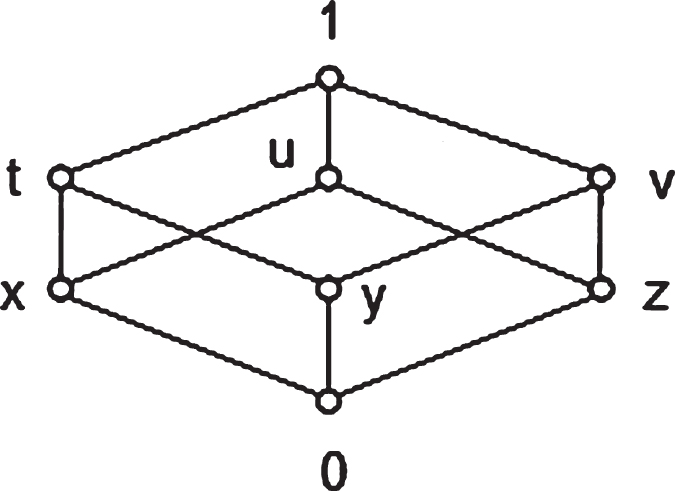
The Hasse diagram of the Sheffer stroke Hilbert algebra in Example 2.1.
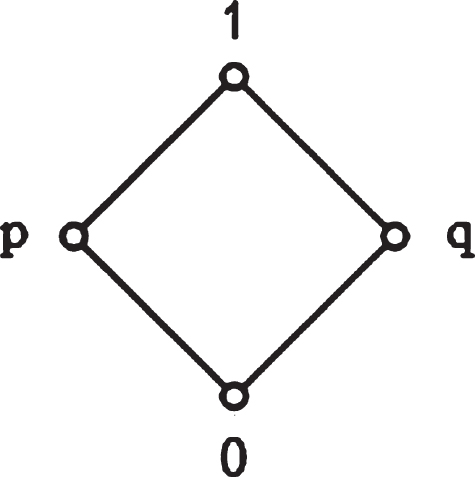
The Hasse diagram of the Sheffer stroke Hilbert algebra in Example 2.2.
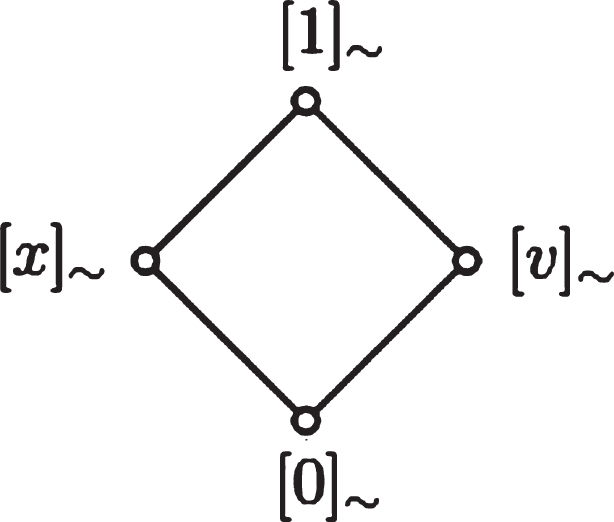
The Hasse diagram of the Sheffer stroke Hilbert algebra in Example 4.7.
The Cayley table of Sheffer stroke |~ on H/~
In this section, we introduce {normal and maximal fuzzy filters of Sheffer Stroke Hilbert algebras.
(⇐) Let f be a fuzzy filter of H such that f (1) =1. Since there exists x = 1 ∈ H such that f (x) =1, it follows that f is normal.
(FH1): f+ (1) = f (1) +1 - f (1) ≥ f (x) +1 - f (1) = f+ (x),
(FH2): f+ (x| (y|y)) = f (x| (y|y)) +1 - f (1) ≥ f (y) +1 - f (1) = f+ (y) and
(FH3):
f+ ((x| (y1|y2)) | (y1|y2))
= f ((x| (y1|y2)) | (y1|y2)) +1 - f (1)
≥min {f (y1) , f (y2)} +1 - f (1)
= min {f (y1) +1 - f (1) , f (y2) +1 - f (1)}
= min {f+ (y1) , f+ (y2)} , for x, y, y1, y2 ∈ H.
Since f+ (1) = f (1) +1 - f (1) =1, f+ is normal from Proposition 5.1. Moreover, f ⊆ f+ since f (x) ≤ f (x) +1 - f (1) = f+ (x), for all x ∈ H.
(FH2): Since f (y) +1 - f (1) = f+ (y) ≤ f+ (x| (y|y)) = f (x| (y|y)) +1 - f (1) , it is obtained f (y) ≤ f (x| (y|y)).
(FH3): Since
min {f (y1) , f (y2)} +1 - f (1)
= min {f (y1) +1 - f (1) ,
f (y2) +1 - f (1)}
= min {f+ (y1) , f+ (y2)}
≤f+ ((x| (y1|y2)) | (y1|y2))
= f ((x| (y1|y2)) | (y1|y2)) +1 - f (1) ,
we have min {f (y1) , f (y2)} ≤ f ((x| (y1|y2)) | (y1|y2)) , for x, y, y1, y2 ∈ H.
Conversely, it is obvious that f is normal by the fact that f+ is normal and f+ = f.
However, the converse of Proposition 5.5 and Corollary 5.4 is not true.
Conversely, let f be a normal fuzzy filter of H. Since f+ = f from Proposition 5.4, there exists a fuzzy filter g of H such that g+ ⊆ f, if we choose g = f.
(FH1): f g (x) = g (f (x)) ≤ g (f (1)) = f g (1),
(FH2): f g (y) = g (f (y)) ≤ g (f (x| (y|y))) = f g (x| (y|y)) and
(FH3):
for x, y, y1, y2 ∈ H. Thus, f g is a fuzzy filter of H.
If f g (1) = g (f (1)) =1, then f g is a normal fuzzy filter of H by Proposition 5.1.
Let t ≤ g (t) for all t ∈ [0, f (1)]. Then f (x) ≤ g (f (x)) = f g (x), for all x ∈ H, which means f ⊆ f g .
Reflective: since f (x) ≤ f (x) for all x ∈ H, we have f ⊆ f, for all fuzzy filters f of H.
Antisymmetric: let f ⊆ g and g ⊆ f. Then f (x) ≤ g (x) and g (x) ≤ f (x), i.e., f (x) = g (x), for all x ∈ H. Thus, f = g.
Transitive: let f ⊆ g and g ⊆ h. Then f (x) ≤ g (x) and g (x) ≤ h (x), for all x ∈ H. Hence, f (x) ≤ h (x), for all x ∈ H, which implies f ⊆ h.
It is demonstrated that
(FH1):
(FH2):
(FH3):
g ((x| (y1|y2)) | (y1|y2))
= min {g (y1) , g (y2)} .
Also, g+ is normal by Proposition 5.2. Since
Let x ∈ A. Then x ∈ B, and so 1 = f A (x) ≤ f B (x) =1. Also, let x ∉ A. Thus, 0 = f A (x) ≤ f B (x), for all x ∈ H. Hence, f A (x) ≤ f B (x) for all x ∈ H, that is, f A ⊆ f B .
Conversely, let f A ⊆ f B . Then f A (x) ≤ f B (x), for all x ∈ H. Since there is no x ∈ H such that x ∈ A but x ∉ B, it follows that A ⊆ B.
f is normal, f takes only the values 0 and 1, f
H
f
= f and H
f
is a maximal filter of H.
(1) and (2): Then f+ is a non-constant maximal elemant of
(3): Since
(4): Since f is non-constant, H
f
is a proper filter of H from Proposition 4.1. Let F be a filter of H such that H
f
⊆ F. Then f = f
H
f
⊆ f
F
by Lemma 5.3 and (3). Since f and f
F
are normal and f = f+ is a maximal element of
However, any normal fuzzy filter of a Sheffer stroke Hilbert algebra H is generally not maximal.
Cartesian product of fuzzy filters
In this section, we state the Cartesion product of fuzzy filters of Sheffer Stroke Hilbert algebras and some properties.
Conversely, let (x, y) ∈ g t × g t . Then x, y ∈ g t , and so g (x) ≥ t and g (y) ≥ t. Thus, S g (x, y) = min {g (x) , g (y)} ≥ min {t, t} = t which means (x, y) ∈ (S g ) t . Hence, g t × g t ⊆ (S g ) t .
Therefore, (S g ) t = g t × g t for all t ∈ [0, 1].
S g ((x1, x2) |H×H ((y1, y2) |H×H (y1, y2)))
= S g (x1| (y1|y1) , x2| (y2|y2))
= min {g (x1| (y1|y1)) , g (x2| (y2|y2))}
≥min {g (y1) , g (y2)}
= S g (y1, y2)
and
S g (((x1, x2) |H×H ((y1, y2) |H×H (y3,
y4))) |H×H ((y1, y2) |H×H (y3, y4)))
= S g ((x1| (y1|y3)) | (y1|y3) , (x2| (y2|y4)) | (y2|y4))
= min {g ((x1| (y1|y3)) | (y1|y3)) ,
g ((x2| (y2|y4)) | (y2|y4))}}
≥min {min {g (y1) , g (y3)} , min {g (y2) , g (y4)}}
= min {min {g (y1) , g (y2)} , min {g (y3) , g (y4)}}
= min {S g (y1, y2) , S g (y3, y4)} ,
for all x1, x2, y1, y2, y3, y4 ∈ H. Thus, S g is a fuzzy filter of a Sheffer stroke Hilbert algebra H × H.
Conversely, let S
g
be a fuzzy filter of a Sheffer stroke Hilbert algebra H × H. Then min {g (x) , g (y)} = S
g
(x, y) ≤ S
g
(1, 1) = min {g (1) , g (1)}, for all x, y ∈ H. So, it follows g (x) ≤ g (1), for all x ∈ H. It follows from Lemma 2.1 (ii) that
g ((x| (y1|y2)) | (y1|y2))
= min {g ((x| (y1|y2)) | (y1|y2)) , g (1)}
= min {g ((x| (y1|y2)) | (y1|y2)) , g ((x|(1|1)) |(1|1))}
= S g ((x| (y1|y2)) | (y1|y2) , (x|(1|1)) |(1|1))
= S g (((x, x) |H×H ((y1, 1) |H×H (y2,
1))) |H×H ((y1, 1) |H×H (y2, 1)))
≥min {S g (y1, 1) , S g (y2, 1)}
= min {min {g (y1) , g (1)} , min {g (y2) , g (1)}}
= min {g (y1) , g (y2)} ,
for all x, y, y1, y2 ∈ H. Hence, g is a fuzzy filter of H.
(1) either f (x) ≤ f (1) or g (x) ≤ g (1) for all x ∈ H,
(2) if f (x) ≤ f (1) for all x ∈ H, then either f (x) ≤ g (1) or g (x) ≤ g (1),
(3) if g (x) ≤ g (1) for all x ∈ H, then either f (x) ≤ f (1) or g (x) ≤ f (1), and
(4) either f or g is a fuzzy filter of H.
(1) Let f (x) > f (1) and g (y) > g (1) for some x, y ∈ H. Then (f × g) (x, y) = min {f (x) , g (y)} > min {f (1) , g (1)} = (f × g) (1, 1) which is a contradiction. Thus, either f (x) ≤ f (1) or g (x) ≤ g (1) for all x ∈ H.
(2) Let f (x) ≤ f (1) for all x ∈ H. Suppose that f (x) > g (1) or g (y) > g (1) for some x, y ∈ H. Since g (1) < f (x) ≤ f (1), it is obtained (f × g) (1, 1) = min {f (1) , g (1)} = g (1), and so (f × g) (x, y) = min {f (x) , g (y)} > g (1) = (f × g) (1, 1) which is a contradiction. Then either f (x) ≤ g (1) or g (x) ≤ g (1) if f (x) ≤ f (1) for all x ∈ H.
(3) Let g (x) ≤ g (1) for all x ∈ H. Assume that f (x) > f (1) or g (y) > f (1) for some x, y ∈ H. Since f (1) < g (y) ≤ g (1), it follows (f × g) (1, 1) = min {f (1) , g (1)} = f (1), and so (f × g) (x, y) = min {f (x) , g (y)} > f (1) = (f × g) (1, 1) which is a contradiction. Then either f (x) ≤ f (1) or g (x) ≤ f (1) if g (x) ≤ g (1) for all x ∈ H.
(4) By (1), either f (x) ≤ f (1) or g (x) ≤ g (1) for all x ∈ H. Assume that g (x) ≤ g (1) for all x ∈ H. It is obtained from (3) that either f (x) ≤ f (1) or g (x) ≤ f (1), for all x ∈ H.
We show that g is a fuzzy filter of H.
= min {f (1) , g ((x| (y1|y2)) | (y1|y2))}
= (f × g) (1, (x| (y1|y2)) | (y1|y2))
= (f × g) ((x|(1|1)) |(1|1) , (x| (y1|y2)) | (y1|y2))
= (f × g) (((x, x) |H×H ((1, y1) |H×H
(1, y2))) |H×H ((1, y1) |H×H (1, y2)))
≥min {(f × g) (1, y1) , (f × g) (1, y2)}
= min {min {f (1) , g (y1)} , min {f (1) , g (y2)}}
= min {g (y1) , g (y2)} ,
i.e., (FH3) holds for all x, y1, y2 ∈ H.
Now, it is shown that f is a fuzzy filter of H.
f ((x| (y1|y2)) | (y1|y2))
= (f × g) ((x| (y1|y2)) | (y1|y2) , 1)
= (f × g) ((x| (y1|y2)) | (y1|y2) , (x|(1|1)) |(1|1))
= (f × g) (((x, x) |H×H ((y1, 1) |H×H
(y2, 1))) |H×H ((y1, 1) |H×H (y2, 1)))
≥min {(f × g) (y1, 1) , (f × g) (y2, 1)}
= min {min {f (y1) , g (1)} , min {f (y2) , g (1)}}
= min {f (y1) , f (y2)}
from Lemma 2.1 (ii), (FH3) is satisfied for all x, y1, y2 ∈ H.
By the following example, it is shown that if f × g is a fuzzy filter of H × H, then f and g both need not to be fuzzy filters of H.
Conclusion
In this study, a deductive system and a filter of Sheffer stroke Hilbert algebras are introduced also their properties are given. It is stated that the Cartesian product of two Sheffer stroke Hilbert algebras is a Sheffer stroke Hilbert algebra. Then it is showed that a filter of a Sheffer stroke Hilbert algebra is equivalent to its deductive system. After giving some properties of fuzzy filters, it is proved that a nonempty subset A of a Sheffer stroke Hilbert algebra H is a filter of H if and only if f
A
is a fuzzy filter of H, and f is a fuzzy filter of H if and only if the level subset f
t
of H is its filter called level filter. A homomorphism on a Sheffer stroke Hilbert algebra is described and a new fuzzy filter of this algebra is determined by its fuzzy filter and homomorphism. Indeed, a quotient of a Sheffer stroke Hilbert algebra is constructed by its fuzzy filter. Besides, normal fuzzy filters of a Sheffer stroke Hilbert algebra are introduced and it is shown that the set
In our future works, we want to study neutrosophic structures and annihilators on Sheffer stroke Hilbert algebras.
Footnotes
Acknowledgment
The authors are thankful to the referees for a careful reading of the paper and for valuable comments and suggestions. This study is partially funded by Ege University Scientific Research Projects Directorate with the Project Number 20772.