In this article, we introduce and study some difference sequence spaces of fuzzy numbers by making use of λ-statistical convergence of order (η, δ + γ) . With the aid of MATLAB software, it appears that the statistical convergence of order (η, δ + γ) is well defined every time when (δ + γ) > η and this convergence fails when (δ + γ) < η. Moreover, we try to set up relations between (Δv, λ)-statistical convergence of order (η, δ + γ) and strongly (Δv, p, λ)-Cesàro summability of order (η, δ + γ) and give some compelling instances to show that the converse of these relations is not valid. In addition to the above results, we also graphically exhibits that if a sequence of fuzzy numbers is bounded and statistically convergent of order (η, δ + γ) in (Δv, λ), then it need not be strongly (Δv, p, λ)-Cesàro summable of order (η, δ + γ).
The hypothesis of statistical convergence was first presented by Fast [11] in 1951 and further by Schoenberg [33] in 1959, which brings the attention of many researchers from different fields of mathematics. Connor [9], Fridy [12], Šalát [31] linked the notion of statistical convergence with that of summability theory. In 1980 Gadjiev and Orhan [13] studied the order of statistical convergence for a sequence of numbers and later on, Çolak [8] introduced the statistical convergence of order β and strongly p-Cesàro summability of order β. After that, the concept of λ-statistical convergence of order β and strongly λp-summability of order β for the sequence of fuzzy numbers were given by Altinok [1]. Also, Altinok [2] gave the idea of statistical convergence of order β and strongly p-Cesàro summability of order β for generalized difference sequences of fuzzy numbers which was further enlarged to a statistical convergence of order (β, γ) by Altinok and Et in [4]. Recently, E. Gülle studied double Wijsman asymptotically statistically equivalence of order α in [14] and U. Ulusu and E. Gülle study the concept of double Wijsman asymptotically ideal statistically equivalence of order η in [38]. For a detailed study of statistical convergence, one can refer ([16, 39]).
In 2000 Savas initiated the idea of λ-statistical convergence of sequence of fuzzy numbers. Let us consider Λ be a class of increasing sequence of positive real numbers λ = (λn) such that
satisfying λn+1 ≤ λn + 1 where λ1 = 1.
Kizmaz [21] in 1981 gave the concept of difference sequence spaces which was generalized by Et and Çolak [10], Altinok et al. [3] and Çolak [7]. For a literature in difference sequence spaces one can refer to ([5, 19]). Let Ω (F) be the set of all sequences of fuzzy numbers, then Δv : Ω (F) → Ω (F) is defined by
for all A sequence Y = (Ys) of fuzzy numbers is called Δv-bounded if there exists fuzzy numbers a and b such that a ≤ ΔvYs ≤ b, for each and Δv-convergent to a fuzzy number Y0 if for every ε ≥ 0 there exists a positive integer s0 such that d (ΔvYs, Y0) < ε, for s > s0.
The idea of fuzzy numbers and its arithmetic operation were introduced by Zadeh [42] in 1965. Later, many other authors discussed various applications of the fuzzy sets such as fuzzy ordering, the fuzzy measure of fuzzy event, fuzzy mathematical programming, etc. Matloka [22] first studied the theory of a sequence of fuzzy numbers. Later on, Nanda [24] introduced the sequences of fuzzy numbers and studied that set of all convergent sequences of fuzzy numbers form complete metric space. Further, Savas and Mursaleen [32], Tripathy and Nanda [36], Hazarika and Savas [15] and many others discussed the theory of sequences of fuzzy numbers. Sakhre [30] studied some applications of fuzzy number system and used fuzzy counter-propagation network (FCPN) model to control different discrete time nonlinear systems with unknown distances and in [34] Singh et al. used the fuzzy numbers about an adaptive fuzzy model-based controller (AFMBC), which is studied and implemented for class of nonlinear discrete-time system with dead zone. To know more about fuzzy sequence spaces (see [17, 41]).
A fuzzy number is a fuzzy set of real numbers which satisfies the given assertions:
(i) Normal, that is Y (u) =1 for some
(ii) Fuzzy convex, that is Y (u) ≥ min {Y (p) , Y (q)} where p < u < q,
(iii) Y is upper semi continuous,
(iv) The closure of is compact.
Also, for α ∈ (0, 1] , the α-level cut of a fuzzy number Y can be defined as
Hence, Y is a fuzzy number iff [Y] α is a closed interval for each α ∈ (0, 1] and [Y] 1 ≠ φ . The space of all fuzzy numbers is denoted by L (R).
Let X and Y be two fuzzy numbers. Then Matloka [22] introduce the distance between X and Y which is given by
where dH is Hausdorff metric defined by
where and are the lower and upper bound of α-level cut.
As defined by Nuray and Savas [25], let Y = (Ys) be the sequence of fuzzy numbers, then (Ys) is said to be statistical convergent to a fuzzy number Y0, if
for each ε > 0, where the vertical bar indicates cardinality of the enclosed set.
Throughout the paper, λ = (λn) will be the increasing sequence of positive numbers tending to infinity such that
As defined by P. D. Srivastava and S. Ojha [35], a sequence Y = (Ys) is said to be λ-statistical convergent of order η to a fuzzy number Y0 if for every ε > 0
where In = [n - λn + 1, n] and a sequence Y = (Ys) is said to be strongly p-Cesàro summable of order η if
where p is a positive real number.
In this article, our main motive is to present new results related to (Δv, λ)-statistical convergence and strongly (Δv, p, λ)-Cesàro summability of order (η, δ + γ). To achieve these advance results we have studied Altinok et al. [4] and extend it by making use of (Δv, λ)-statistical convergence and the parameters η, δ and γ. Further, these results are also present graphically which proves that if a sequence of fuzzy numbers is bounded and statistically convergent of order (η, δ + γ) in (Δv, λ), then it need not be strongly (Δv, p, λ)-Cesàro summable in general when 0 < η ≤ δ ≤ γ ≤ 1 such that 0 < η ≤ δ + γ ≤ 1.
Main results
Definition 2.1. Let 0 < η ≤ δ ≤ γ ≤ 1 such that 0 < η ≤ δ + γ ≤ 1. A sequence Y = (Ys) of fuzzy numbers is said to be (Δv, λ)-statistical convergent of order (η, δ + γ) or convergent to a fuzzy number Y0 if for every ε > 0,
where In = [n - λn + 1, n], (λn) ∈ Λ. We may write convergent to fuzzy number Y0 as .
Definition 2.2. Let 0 < η ≤ δ ≤ γ ≤ 1 such that 0 < η ≤ δ + γ ≤ 1 and 0< p < ∞. A sequence Y = (Ys) of fuzzy numbers is said to be strongly (Δv, p, λ)-Cesàro summable of order (η, δ + γ) or summable if there exists a fuzzy real number Y0 such that
or .
We know that the statistical convergence is well defined for order (η, δ + γ) every time (δ + γ) > η and statistical convergence fails for order (η, δ + γ) every time (δ + γ) < η as shown in the example below.
Example 2.3. Consider Y = (Ys) be a sequence of fuzzy numbers defined as
if s is odd and
if s is even. Now, the α-level set of sequences for (Ys) and (ΔvYs) are as follows
and
where . Thus, we have
and
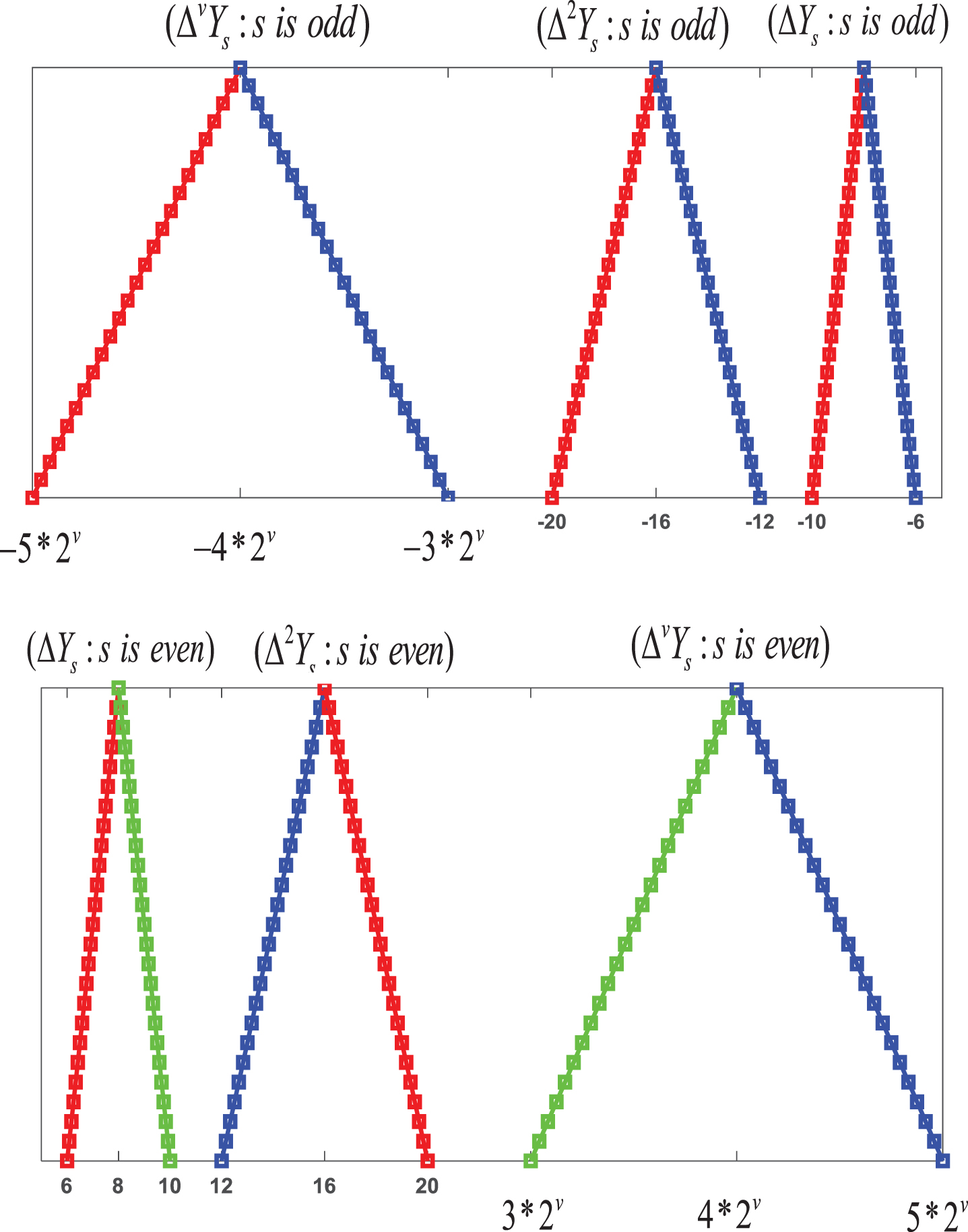
for δ + γ < η. Here [Y′] α = [2v (-5 + α) , 2v (-3 - α)] and [Y″] α = [2v (3 + α) , 2v (5 - α)]. Thus, it is clear from Figure 1 that Y = (Ys) is (Δv, λ)- statistical convergent of order (η, δ + γ) both to fuzzy numbers Y′ and Y″, that is and . Thus Y = (Ys) is not statistically convergent i.e. limit of Y = (Ys) is not unique.
Y = (Ys) is (Δv, λ)- statistical convergence of order (η, δ + γ), both to fuzzy number Y′ and Y″ .
Theorem 2.4. Let 0 < η ≤ δ ≤ γ ≤ 1 such that 0 < η ≤ δ + γ ≤ 1 and suppose that X = (Xs), Y = (Ys) be two fuzzy sequences and, if
(i) , then
(ii) If and then
Proof. (i) This proof is easily obtained from the equality
(ii) This can also be obtained easily from the inequality
Remark 2.5. Here, it is easy to see that (Δv, λ)-conv-ergent sequence of fuzzy numbers is (Δv, λ)-statistical convergent of order (η, δ + γ). But the converse need not be true as shown in the following example.
Example 2.6. Let us take a fuzzy sequence Y = (Ys) such that
If s = j4
and if s ≠ j4
For j = 1, 2, 3, . . ., the α- level set of sequences (Ys) and (ΔYs) are as follows
and
For instance, if we take (λn) = n and proceed similarly by taking difference v times for . It is easily seen that for (δ + γ) <4η, Y = (Ys) is (Δv, λ)-statistical convergent of order (η, δ + γ) to fuzzy number Y0, where Y0 = [2v-1 (-5 + 5α) , 2v-1 (5 -5α)]. But it is not (Δv, λ)-convergent.
Remark 2.7. For 0 < η ≤ δ ≤ γ ≤ 1 such that 0 < η ≤ δ + γ ≤ 1 . If , then , that is . But the converse does not hold as shown below.
Example 2.8. Let us take (λn) = n and
If s = j4
and if s ≠ j4
Now, the α-level set of sequences for (Ys) and (ΔYs) are as follows
and
After some routine operation, when we take the difference v-times, we see that for , where [Y0] α = [2v (-1 + α) , 2v (1 - α)], but for and ,
Theorem 2.9. Let 0 < η1 ≤ η2 ≤ δ1 ≤ δ2 ≤ γ1 ≤ γ2 ≤ 1 such that 0 < η1 ≤ η2 ≤ δ1 + γ1 ≤ δ2 + γ2 ≤ 1 . If, then
Proof. Suppose that and take δ1 + γ1 ≤ δ2 + γ2 and η1 ≤ η2, then
for every ε > 0, which implies that The converse of this result does not exists. For this, if s = j3
and if s ≠ j3
The α- level set of sequences of (Ys) and (ΔYs) are as follows
and
Here, for j > 1 and λn = n we see that, if we take difference v times, we get , where [Y0] α = [2v (-1 + α) , 2v (1 - α)] for , and , but for , and
Corollary 2.10. Let 0 < η1 ≤ η2 ≤ δ1 ≤ δ2 ≤ γ1 ≤ γ2 ≤ 1 such that 0 < η1 ≤ η2 ≤ δ1 + γ1 ≤ δ2 + γ2 ≤ 1. Then
(i) If δ1 + γ1 = δ2 + γ2 and η1 = η2, then
(ii) If δ1 + γ1 = δ2 + γ2 = 1 and η1 = η2, then
(iii) If δ1 + γ1 = δ2 + γ2 = 1 and η2 = 1, then
(iv) δ2 + γ2 = 1, then
Theorem 2.11. Let 0 < η1 ≤ η2 ≤ δ1 ≤ δ2 ≤ γ1 ≤ γ2 ≤ 1 such that 0 < η1 ≤ η2 ≤ δ1 + γ1 ≤ δ2 + γ2 ≤ 1 . If, then
Proof. Let . Let 0 < η ≤ δ ≤ γ ≤ 1 such that 0 < η ≤ δ + γ ≤ 1 and 0< p < ∞. Then from the inequality
we have But the converse does not exists as shown below.
Example 2.12. Let us consider (λn) = n and the fuzzy sequence (Ys) defined as
if s = j3 and
if s ≠ j3. Here, we find respectively the α- level set of sequences (Ys) and (ΔYs) as follows
and
For j = 1, 2, 3, . . . , if we take difference v-times, we get the inequality
by using addition of fuzzy real numbers by α-level set. For p=1, where [Y0] α = [2v-1 (-3 + 3α) , 2v-1 (3 -3α)] . On the other hand
for p = 1 . From equation (1), it is clear that Ys is summable of order (η2, δ1 + γ1) for , and . From equation (2), Ys is not summable of order (η1, δ2 + γ2) to fuzzy number Y0 for and , . Hence, the converse is not valid.
Corollary 2.13. Let 0 < η1 ≤ η2 ≤ δ1 ≤ δ2 ≤ γ1 ≤ γ2 ≤ 1 such that 0 < η1 ≤ η2 ≤ δ1 + γ1 ≤ δ2 + γ2 ≤ 1 and 0< p < ∞. Then the following hold
(i) If η1 = η2 and δ1 + γ1 = δ2 + γ2, then
(ii) If η1 = η2 and δ1 + γ1 = δ2 + γ2 = 1, then
(iii) If 0 < η1 ≤ 1, then
(iv) If 0 < δ1 + γ1 ≤ 1, then
Theorem 2.14. Let 0 < η1 ≤ η2 ≤ δ1 ≤ δ2 ≤ γ1 ≤ γ2 ≤ 1 such that 0 < η1 ≤ η2 ≤ δ1 + γ1 ≤ δ2 + γ2 ≤ 1 and 0< p < ∞. If then
Proof. Let and given ε > 0. Then
and
To prove that converse is not true. Consider the sequence Y = (Ys) from Theorem 2.6, we have
when , and but
when and , Therefore, sequence Y = (Ys) is not strongly (Δv, p, λ)-Cesàro summable of order (η1, δ2 + γ2) .
Remark 2.15. We know that if sequence (Ys) of fuzzy numbers is (Δv, λ)-bounded and (Δv, λ)-statistical convergent, then the sequence is strongly summable. But this is not possible in our definition. We will show the contradiction via example.
Example 2.16. Let us take (λn) = n and s ≠ j4, the fuzzy sequence (Ys) is defined as
and if s = j4, the fuzzy sequence is defined as
Then for j = 1, 2, 3, . . . we find respectively the α-level set of sequences (Ys) and (ΔYs) as
and
[ΔYs] α
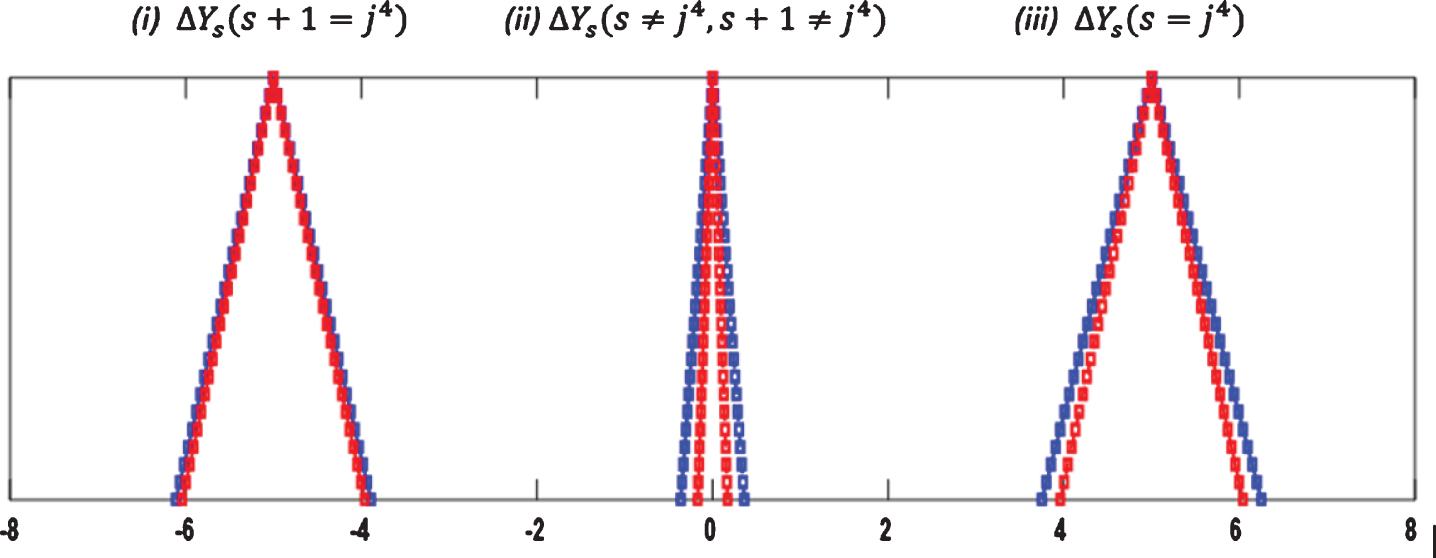
Here, we know that (Ys) is (Δv, λ)- bounded and statistical convergent for and and as shown in the Figure 2. But (Ys) is not strongly (Δv, p, λ)-Cesàro summable. For this, let us suppose that and . Now, we have
for v = 1 and p = 1. Thus, the sequence (Ys) is not strongly summable for , and
The blue lines graph in (i), (ii) and (iii) shows for particular values of s i.e. when s=15, s=2, s=1 respectively. The red lines in the graph (i), (ii) and (iii) shows that when s+1 is a fourth power i.e. s=80,255..., when neither s nor s+1 is a fourth power i.e. 3,4,5,..., and when s is a fourth power i.e. 16,81,256,..., respectively.
References
1.
AltınokH., On λ statistical convergence of order β of sequences of fuzzy numbers, International Journal of Uncertainty, Fuzziness and Knowledge-Based Systems20 (2012), 303–314.
2.
AltınokH., Statistical convergence of order β for generalized difference sequences of fuzzy numbers, Journal of Intelligent & Fuzzy Systems26(2) (2014), 847–856.
3.
AltınokH., ÇolakR. and EtM., λ–difference sequence spaces of fuzzy numbers, Fuzzy Sets and Systems160(21) (2009), 3128–3139.
4.
AltınokH. and EtM., Statistical convergence of order (β;γ) for sequences of fuzzy numbers, Soft Computing23 (2019), 6017–6022.
5.
BaşarırM. and KaraE.E., On some difference sequence spaces of weighted means and compact operators, Annals of Functional Analysis2(2) (2011), 114–129.
6.
BaşarırM., KoncaS. and KaraE.E., Some generalized difference statistically convergent sequence spaces in 2-normed space, Journal of Inequalities and Applications177 (2013), 10.
7.
ÇolakR., AltınokH. and EtM., Generalized difference sequences of fuzzy numbers, Chaos Solitons & Fractals40(3) (2009), 1106–1117.
8.
ÇolakR., Statistical convergence of order α, Modern Methods in Analysis and its Applications (Anamaya Publ. New Delhi, India), (2010), 121–129.
9.
ConnorJ.S., The statistical and strong p- Cesàro convergence of sequences, Analysis8 (1988), 47–63.
10.
EtM. and ÇolakR., On some generalized difference sequence spaces, Soochow Journal of Mathematics21(4) (1995), 377–386.
11.
FastH., Sur la convergence statistique, Colloquium Mathematicae2 (1951), 241–244.
12.
FridyJ.A., On statistical convergence, Analysis5(4) (1985), 301–313.
13.
GadjievA.D. and OrhanC., Some approximation theorems via statistical convergence, Rocky Mountain Journal of Mathematics32(1) (2002), 129–138.
14.
GülleE., Double Wijsman asymptotically statistical equivalence of order α, Journal of Intelligent and Fuzzy Systems38(2) (2020), 2081–2087.
15.
HazarikaB. and SavaşE., Some-convergent λ–summable difference sequence spaces of fuzzy real numbers defined by a sequence of Orlicz functions, Mathematical and Computer Modelling54 (2011), 2986–2998.
16.
IlkhanM. and KaraE.E., On statistical convergence in quasimetric spaces, Demonstratio Mathematica52 (2019), 225–236.
17.
IlkhanM. and KaraE.E., A new type of statistical Cauchy sequence and its relation to Bourbaki completeness, Cogent Mathematics & Statistics5 1487500 (2018), 9.
18.
KaraE.E. and DemirizS., Some new paranormed difference sequence spaces derived by Fibonacci numbers, Miskolc Mathematical Notes16(2) (2015), 907–923.
19.
KaraE.E. and IlkhanM., On some Banach sequence spaces derived by a new band matrix, British Journal of Mathematics & Computer Science9(2) (2015), 141–159.
20.
KhanV.A., KaraE.E., AltafH., KhanN. and AhmadM., Intuitionistic fuzzy I-convergent Fibonacci difference sequence spaces, Journal of Inequalities and Applications202 (2019), 7.
21.
KizmazH., On certain sequence spaces, Canadian Mathematical Bulletin24(2) (1981), 169–176.
22.
MatlokaM., Sequences of fuzzy numbers, Busefal28 (1986), 28–37.
23.
MursaleenM. and MohiuddineS.A., Statistical convergence of double sequences in intuitionistic fuzzy normed spaces, Chaos Solitons and Fractals41(5) (2009), 2414–2421.
24.
NandaS., On sequences of fuzzy numbers, Fuzzy Sets and Systems33 (1989), 123–126.
25.
NurayF. and SavaşE., Statistical convergence of sequences of fuzzy numbers, Mathematica Slovaca45(3) (1995), 269–273.
26.
OnasanyaB.O. and Hoskova-MayerovaS., Some Topological and Algebraic Properties of alpha-level Subsets’ Topology of a Fuzzy Subset, Analele Stiintifice ale Universitatii Ovidius Constanta26(3) (2018), 213–227, DOI: 10.2478/auom-2018-0042
27.
RajK. and PandohS., On some spaces of Cesàro sequences of fuzzy numbers associated with λ–convergence and Orlicz function, Mathematica11(1) (2019), 156–171.
28.
RajK., SharmaC. and ChoudharyA., Applications of Tauberian theorem in Orlicz spaces of double difference sequences of fuzzy numbers, Journal of Intelligent & Fuzzy Systems35(2) (2018), 2513–2524.
29.
RajK., JamwalS. and SharmaS.K., Multiplier generalized double sequence spaces of fuzzy numbers defined by sequence of Orlicz functions, International Journal of Pure and Applied Mathematics78(4) (2012), 509–522.
30.
SakhreV., SinghU.P. and JainS., FCPN approach for uncertain nonlinear dynamical system with unknown disturbance, International Journal of Fuzzy Systems19 (2017), 452–469. htpps://org/10.1007/s40815-016-0145-5.
31.
ŠalátT., On statistically Convergent sequences of real numbers, Mathematica Slovaca30(2) (1980), 139–150.
32.
SavaşE. and MursaleenM., On statistically convergent double sequences of fuzzy numbers, Information Sciences162 (2004), 183–192.
33.
SchoenbergI.J., The integrability of certain functions and related summability methods, The American Mathematical Monthly66(5) (1959), 361–775.
34.
SinghU.P., JainS., GuptaR.K. and TiwariA., AFMBC for a class of nonlinear discrete-time systems with dead zone, International Journal of Fuzzy Systems21 (2019), 1073–1084. htpps://org/10.1007/s40815-019-00621-1.
35.
SrivastavaP.D. and OjhaS., λ–Statistical convergence of fuzzy numbers and fuzzy functions of order θ, Soft Computing18 (2014), 1027–1032.
36.
TripathyB.C. and NandaS., Absolute value of fuzzy real number and fuzzy sequence spaces, The Journal of Fuzzy Mathematics8 (2000), 883–892.
37.
TuranN., KaraE.E. and IlkhanM., Quasi statistical convergence in cone metric spaces, Facta Univ (NIS) Ser Math Inform33(4) (2018), 613–626.
38.
UlusuU. and GülleE., Wijsman asymptotical I2-statistically equivalent double set sequences of order η, Communications Faculty of Sciences University of Ankara Series A1 Mathematics and Statistics69(1) (2020), 854–862.
39.
UlusuU. and GülleE., Some statistical convergence types for double set sequences of order α, Facta Universitatis, Series: Mathematics and Informatics35(3) (2020), 595–603.
40.
YavuzE., Tauberian theorems for statistical summability methods of sequences of fuzzy numbers, Soft Computing23 (2019), 5659–5665.
41.
YavuzE., Euler summability method of sequences of fuzzy numbers and a Tauberian theorem, Journal of Intelligent & Fuzzy Systems32(1) (2017), 937–943.
42.
ZadehL.A., Fuzzy set, Information and Control8 (1965), 338–353.