Soft set (SfS) theory is a basic tool to handle vague information with parameterized study during the process as compared to fuzzy as well as q-rung orthopair fuzzy theory. This research article is devoted to establish some general aggregation operators (AOs), based on Yager’s norm operations, to cumulate the q-rung orthopair fuzzy soft data in decision making environments. In this article, the valuable properties of q-rung orthopair fuzzy soft set (q - ROFSfS) are merged with the Yager operator to propose four new operators, namely, q-rung orthopair fuzzy soft Yager weighted average (q - ROFSfYWA), q-rung orthopair fuzzy soft Yager ordered weighted average (q - ROFSfYOWA), q-rung orthopair fuzzy soft Yager weighted geometric (q - ROFSfYWG) and q-rung orthopair fuzzy soft Yager ordered weighted geometric (q - ROFSfYOWG) operators. The dominant properties of proposed operators are elaborated. To emphasize the importance of proposed operators, a multi-attribute group decision making (MAGDM) strategy is presented along with an application in medical diagnosis. The comparative study shows superiorities of the proposed operators and limitations of the existing operators. The comparison with Pythagorean fuzzy TOPSIS (PF-TOSIS) method shows that PF-TOPSIS method cannot deal with data involving parametric study but developed operators have the ability to deal with decision making problems using parameterized information.
In our daily life problem, we face uncertainties in making right decisions. Several decision making methods have been investigated in medical field. Decision making is a technique of nominating the best option among various objects. That’s why decision making performs an important role in the human life problems. The life style can be changed by a good decision. First of all, a decision maker tries to know about the restrictions, advantages and qualities of each alternative and then he/she finds out the final decision. To handle with such situations, Zadeh [45] proposed the prominent model of fuzzy set (FS). FS brought the revolution in different fields of science. In FS, a membership degree (MD) within the interval [0, 1] is assigned to each object. Atanassov [9] proposed the intuitionistic fuzzy set (IFS) which is characterized by both the MD μ and the nonmembership degree (NMD) ν within the interval [0, 1], respectively such that the summation of these two values is less than or equal to 1. From last few years, different researchers developed various operators on the existing ideas in which the best one idea is the AOs. Yager [40] introduced the dominant concept of ordered weighted (OW) AOs. The concepts of novel geometric AOs for IFS in multi attribute decision making (MADM) were presented by Xu and Yager [39]. The study of intuitionistic fuzzy (IF) AOs was given by Xu [37]. Wang and Liu [36] discussed the IF Einstein weighted geometric (IFEWG) operators. Li [21] studied the generalized OW averaging operators for IF data. Garg and Rani [13] initiated the idea of complex IF AOs and applied this concept in MADM problems. IFS is a robust concept and many researchers have done work on it. However, there are some drawbacks in the model of IFS, due to which this theory fails to handle the problems.
To overcome such difficulties, Yager [42] discussed the model of Pythagorean fuzzy set (PFS). This model has the quality to replace the constraint of IFS with the condition μ2 + ν2 ≤ 1. Yager [41] proposed PF arithmetic and geometric operators. Peng and Yang [28] developed interval-valued PF AOs. A hybrid structure for PF MADM was proposed by Zeng et al. [46]. Akram et al. [1] worked for the development of Pythagorean Dombi fuzzy AOs with applications. Shahzadi et al. [31] developed the theory of Yager AOs under PF data. However, the PFS has also some limitations, if MD of an element is 0.9 and NMD is 0.6, then sum of square of these values is greater than 1 and PFS cannot deal such situations. That’s why researchers needed some new extensive model for such type of shortcomings.
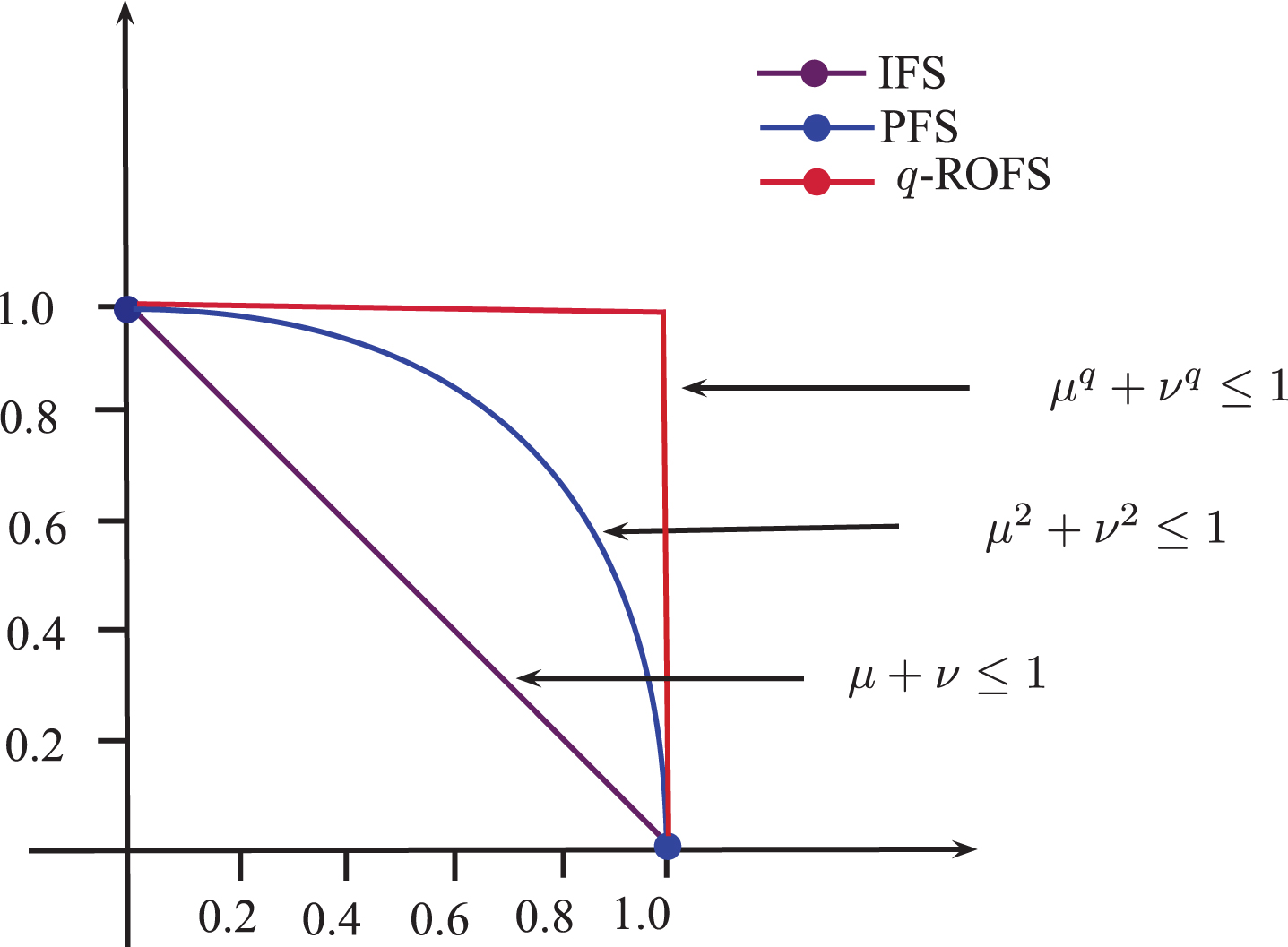
Yager [43] investigated new notion of q-rung orthopair fuzzy set (q-ROFS) in which μq + νq ≤ 1. In decision making problems, q-ROFS is more capable than IFS and PFS, as shown in Fig. 1. All IF numbers (IFNs) and PF numbers (PFNs) are q-rung orthopair fuzzy numbers (q-ROFNs) but converse is not true. Jana et al. [17] studied q-rung orthopair fuzzy Dombi AOs. Joshi and Gegov [20] developed the confidence levels q-rung orthopair fuzzy AOs. Akram and Shahzadi [4] introduced Yager AOs for q-ROFS. Garg [10] defined some trigonometric operations laws for q-ROFS. The concept of neutrality AOs of q-ROFS was studied by Garg and Chen [12]. As FS, IFS, PFS, q-ROFS and so forth are generally applied by researchers to deal with vagueness and uncertainty during analysis but all these concepts have no information about parameterized study.
Comparison of q-ROFN, PFN and IFN spaces.
In 1999, a pioneer model of SfS was proposed by Molodstov [27] which maintains the parametrization tool to handle with vague data. Many ideas are combined with SfS and established new theories. Maji [25, 26] discussed the models of fuzzy SfS (FSfS) and intuitionistic fuzzy SfS (IFSfS). The intuitionistic fuzzy soft (IFSf) AOs were studied by Arora and Garg [8]. Garg and Arora [11] discussed the generalized IFSf power AOs and their application in MADM. q-rung orthopair fuzzy soft (q - ROFSf) average operators were initiated by Hussain et al. [16]. Zhang et al. [47] developed the theory of consensus reaching for social network group decision making. Zhang et al. [48] discussed the concept of consistency improvement for fuzzy preference relations with self-confidence. For other terminologies not discussed in the paper, the readers are suggested to [3, 44].
The motivations of this article are described as:
Advantages of q - ROFSfS:q - ROFSfS, a remarkable extension of IFSfS and Pythagorean fuzzy SfS (PFSfS), permits modeling of the situations with higher more generality than IFSfS and PFSfS, because it still applies in cases where μ + ν ≤ 1 and μ2 + ν2 ≤ 1 but it satisfies μq + νq ≤ 1 corresponding to different parameters.
Importance of SfS:SfS theory handles the uncertainty problems with parameterized information.
Logics behind the use of Yager AOs: Yager AOs are the simplest and quite creative approach for dealing with decision making affairs. Basically, this article is devoted to Yager AOs in q - ROFSf surroundings to face complex issues corresponding to different parameters. The outcomes based on conclusion are quite accurate under Yager AOs when it is put on to the reality based MADM problems in q - ROFSf data.
The limitations of previously existing operators can be overcome by the proposed operators as these operators are more general that work excellently not only for q - ROFSf information but also for IFSf and PFSf data.
The contributions of this article are outlined as:
The idea of Yager AOs is extended to q - ROFSf numbers (q - ROFSfNs) and fundamental properties are discussed.
To handle complex realistic problems with q - ROFSf data, an algorithm is developed. The proposed algorithm is supported by an illustrative example for the diagnosis of the illness of patients.
The comparison analysis with existing operators shows the superiority of proposed model.
The remaining paper is composed as follows: In Section 2, some basic definitions are discussed. In Section 3, we study Yager operations for q - ROFSfNs, q - ROFSfYWA operator and discuss some results in the light of these operations. Section 4 presents q - ROFSfYOWA operator and some properties related to them. In Sections 5 and 6, we discuss q - ROFSfYWG and q - ROFSfYOWG operators to aggregate the q - ROFSfNs. Section 7 gives an algorithm for MAGDM and discuss a numerical example in the field of medical diagnosis based on q - ROFSfNs. Section 8 gives the comparison analysis with existing operators to show the superiority and validity of proposed theory. In Section 9, we have concluded results about proposed theory.
Preliminaries
In this section, we recall some basic definitions.
Definition 2.1. [29] Let be a universe of discourse and be the set of all parameters, . represents the set of all PFSs over . is called a PFSfS over , where is a function given by , which is
with condition .
Definition 2.2. [16] Let be a universe of discourse and be the set of all parameters, . represents the set of all q-ROFSs over . is called a q - ROFSfS over , where τ is a function given by , which is
with condition . is the hesitancy degree, where denotes and denotes .
Definition 2.3. [41] For any two real numbers x and y, Yager’s t-norms and Yager’s t-conorms are given as:
q-rung orthopair fuzzy soft Yager weighted average operators
In this section, we develop Yager t-norm and t-conorm for q - ROFSfNs and Yager weighted average operators for q - ROFSfNs.
Definition 3.1. Let and τ = (f, g) be three q - ROFSfNs and λ > 0, ϑ ∈ (0, ∞). Then, Yager norm operations for q - ROFSfNs are
Definition 3.2. The score function and accuracy function for q - ROFSfNs are represented by and respectively.
Definition 3.3. Let τe11 = (f11, g11) and τe12 = (f12, g12) be two q - ROFSfNs,
if S (τe11) > S (τe12), then τe11≻ τe12 ;
if S (τe11) < S (τe12), then τe11≺ τe12 ;
if S (τe11) = S (τe12), then
if H (τe11) > H (τe12), then τe11≻ τe12 ;
if H (τe11) < H (τe12), then τe11≺ τe12 ;
if H (τe11) = H (τe12), then τe11 ∼ τe12 .
Definition 3.4. Let be a collection of q - ROFSfNs and , are the weight vectors (WVs) for the experts and parameters , respectively, satisfying with and . Then q - ROFSfYWA operator is a function q - ROFSfYWA: , where is the set of q - ROFSfNs.
Theorem 3.1.The aggregated value by utilizing q - ROFSfYWA operator is given by
Proof. Applying mathematical induction to prove it.
(i) When , q - ROFSfYWA (τe11, τe12)
Hence, result is true for .
Suppose Equation 3 is true for ,
Now for ,
Hence, Equation 3 is true for . Therefore, by mathematical induction the Equation 3 is true, .□
Remark 3.1. (a) For q = 1, q - ROFSfYWA operator becomes intuitionistic fuzzy soft Yager weighted average (IFSfYWA) operator.
(b) For q = 2, q - ROFSfYWA operator becomes Pythagorean fuzzy soft Yager weighted average (PFSfYWA) operator.
(c) For only one parameter, i.e., e1, q - ROFSfYWA operator becomes q-rung orthopair fuzzy Yager weighted average (q-ROFYWA) operator.
From Remark 3.1, we conclude that q - ROFSfYWA operator is generalized case of IFSfYWA, PFSfYWA and q-ROFYWA operators.
Example 3.1. Suppose Mr. wants to purchase a watch from a set of four watches in the domain set and let be the set of parameters for the selection of a watch, i.e., where e1 =expensive, e2 =beautiful, e3 =synthetic sapphire crystal and e4 =water resistance. Suppose the WVs for experts and parameters are w = (0.34, 0.24, 0.20, 0.22) T and v = (0.25, 0.20, 0.30, 0.25) T, respectively. By applying Equation 3, q - ROFSfYWA (τe11, τe12, ⋯ , τe44)
Example 3.2. Suppose Mr. wants to purchase a car from a set of four cars in the domain set and let be the set of parameters for the selection of a car, i.e., where e1 =fuel efficiency, e2 =good quality, e3 =safety and e4 =good warranty. Suppose the WVs for experts and parameters are w = (0.35, 0.25, 0.15, 0.25) T and v = (0.30, 0.20, 0.20, 0.30) T, respectively. By applying Equation 3, q - ROFSfYWA (τe11, τe12, ⋯ , τe44)
Property 3.1. (Idempotency) If all are identical, then
Proof. As , then
□
Property 3.2. (Boundedness) Let be a family of q - ROFSfNs and and ,
Proof. Let and . The inequalities for membership value are
Similarly, for nonmembership value
Therefore,
□
Property 3.3. (Monotonicity) Let be another collection of q - ROFSfNs such that , then
Proof. Consider and First, we show that I ≤ I′. As Moreover,
This implies
Therefore, I ≤ I′. Similarly we can show that J ≥ J′. Hence, □ Property 3.4. (Shift Invariance) If is another q - ROFSfN, then
Proof. Since and are q - ROFSfNs, so
Therefore,
From Equations 30 and 31, □ Property 3.5. (Homogeneity) Let λ ≥ 0 then
Proof. As
Now
and
From Equations 32 and 33, □
q-rung orthopair fuzzy soft Yager ordered weighted average operators
q - ROFSfYWA operator only weighted the q - ROFSfN′s values. But q - ROFSfYOWA operator weights the ordered positions via scoring the q - ROFSf values rather than weighting the q - ROFSf values themselves. In this section, we develop q - ROFSfYOWA operator and related properties.
Definition 4.1. Let be a family of q - ROFSfNs and , are the WVs for the experts and parameters , respectively, satisfying with and . Then q - ROFSfYOWA operator is a function q - ROFSfYOWA:
Theorem 4.1.The aggregated value by utilizing q - ROFSfYOWA operator is given by
where , is the permutation of th and th largest object of the collection of q - ROFSfNs
(b) For q = 2, q - ROFSfYOWA operator becomes Pythagorean fuzzy soft Yager ordered weighted average (PFSfYOWA) operator.
(c) For only one parameter, i.e., e1, q - ROFSfYOWA operator becomes q-rung orthopair fuzzy Yager ordered weighted average (q-ROFYOWA) operator.
Therefore, IFSfYOWA, PFSfYOWA and q-ROFYOWA operators are special cases of q - ROFSfYOWA operator.
Example 4.1. Consider the collections q - ROFSfNs of Example 3.2 as given in Table 2, by using definition of score function, the tabular representation of is given in Table 3. By using Equation 8, q - ROFSfYOWA (τe11, τe12, ⋯ , τe44)
We give some properties without their proofs.
Tabular representation of q - ROFSfNs
e1
e2
e3
e4
x1
(0.7, 0.40)
(0.96, 0.44)
(0.67, 0.40)
(0.91, 0.43)
x2
(0.91, 0.50)
(0.62, 0.11)
(0.44, 0.20)
(0.89, 0.11)
x3
(0.81, 0.62)
(0.5, 0.35)
(0.69, 0.51)
(0.65, 0.34)
x4
(0.7, 0.32)
(0.81, 0.40)
(0.8, 0.61)
(0.6, 0.24)
Tabular representation of q - ROFSfNs
e1
e2
e3
e4
x1
(0.72, 0.40)
(0.76, 0.44)
(0.47, 0.30)
(0.81, 0.43)
x2
(0.81, 0.67)
(0.69, 0.11)
(0.46, 0.20)
(0.89, 0.31)
x3
(0.84, 0.62)
(0.78, 0.55)
(0.89, 0.51)
(0.67, 0.34)
x4
(0.75, 0.42)
(0.87, 0.47)
(0.67, 0.61)
(0.91, 0.20)
Tabular representation of q - ROFSfNs
e1
e2
e3
e4
x1
(0.91, 0.50)
(0.96, 0.44)
(0.8, 0.61)
(0.89, 0.11)
x2
(0.70, 0.32)
(0.81, 0.40)
(0.67, 0.40)
(0.91, 0.43)
x3
(0.81, 0.62)
(0.62, 0.11)
(0.69, 0.51)
(0.65, 0.34)
x4
(0.70, 0.40)
(0.50, 0.35)
(0.44, 0.20)
(0.60, 0.24)
Property 4.1. (Idempotency) If all are identical, then
Proof. It is similar to Property 3.1.□
Property 4.2. (Boundedness) Let be a collection of q - ROFSfNs and and ,
Proof. It is similar to Property 3.2.□
Property 4.3. (Monotonicity) Let be another collection of q - ROFSfNs such that , then
Proof. It is similar to Property 3.3.□
Property 4.4. (Shift Invariance) If is another q - ROFSfN, then
In this section, we develop Yager weighted geometric operators for q - ROFSfNs.
Definition 5.1. Let be a family of q - ROFSfNs and , are the WVs for the experts and parameters , respectively, satisfying with and . Then q - ROFSfYWG operator is a function q - ROFSfYWG:
Theorem 5.1.The aggregated value by utilizing q - ROFSfYWG operator is given by
q - ROFSfYWG operator only weighted the q - ROFSfN′s values. But q - ROFSfYOWG operator weights the ordered positions via scoring the q - ROFSf values rather than weighting the q - ROFSf values themselves. Here, we will develop q - ROFSfYOWG operator and related properties.
Definition 6.1. Let be a family of q - ROFSfNs and , are the WVs for the experts and parameters , respectively, satisfying with and . Then q - ROFSfYOWG operator is a function q - ROFSfYOWG:
Theorem 6.1. The aggregated value by utilizing q - ROFSfYOWG operator is given by
where , is the permutation of th and th largest object of the collection of q - ROFSfNs
(b) For q = 2, q - ROFSfYOWG operator reduces to Pythagorean fuzzy soft Yager ordered weighted geometric (PFSfYOWG) operator.
(c) If parameter is only one, i.e., e1 then q - ROFSfYOWG operator reduces to q-rung orthopair fuzzy ordered weighted geometric (q-ROFYOWG) operator.
Therefore, IFSfYOWG, PFSfYOWG and q-ROFYOWG operators are special cases of q - ROFSfYOWG operator.
We give some properties without their proofs.
Property 6.1. (Idempotency) If all are identical, then
Proof. It is similar to Property 3.1.□
Property 6.2. (Boundedness) Let be a collection of q - ROFSfNs and and ,
Proof. It is similar to Property 3.2.□
Property 6.3. (Monotonicity) Let be another collection of q - ROFSfNs such that , then
Proof. It is similar to Property 3.3.□
Property 6.4. (Shift Invariance) If is another q - ROFSfN, then
Proof. It is similar to Property 3.4.□
Property 6.5. (Homogeneity) Let λ ≥ 0 then
Proof. It is similar to Property 3.5.□
Model for MAGDM under q-rung orthopair fuzzy soft information
In this section, we give a mathematical description of proposed theory for MAGDM under q - ROFSf data. The basic idea and steps of an algorithm for given theory are as follows:
Let be the set of alternatives, assessed by senior experts under the constraints of parameters . These experts give their preferences for the l alternatives in terms of q - ROFSfNs with WVs and for experts and parameters, respectively such that and . The collective information is given in the form of decision matrix (DMx) . By using proposed AOs, the aggregated q - ROFSfNΩs (s = 1, 2, ⋯ , l) for alternative xs is given by Ωs = (fs, gs) . For getting the optimal solution, determine the score values for the alternatives and rank them.
The algorithm consists on the following steps:
Step 1. First of all, collect the assessment information of expert’s corresponding to their parameters for each alternative and compose a DMx in the following way:
Step 2. Find the normalize DMx by interchanging the assessment value of cost parameter (CP) into benefit parameter (BP) by using the expression taken from [38], i.e.,
Step 3. For each alternative xs (s = 1, 2, ⋯ , l), aggregate the q - ROFSfNs by using proposed operators in the collective DMx Ωs.
Step 4. Find the score values for Ωs of all alternatives by utilizing the score function.
Step 5. Arrange the alternatives in the decreasing order of score value and choose the best result.
Numerical example
This section gives presentation of an illustrating example to indicate the importance and validity of proposed model under q - ROFSf data.
The team of experts involve five senior doctors and whose WVs w = (0.16, 0.20, 0.21, 0.22, 0.21) T present their judgment for different patients x1, x2, x3, x4 under the parameters
having WV v = (0.26, 0.24, 0.27, 0.23) T. Doctors give their interpretation for alternatives to their corresponding symptom in the form of q - ROFSfNs. Now, we utilize the proposed algorithm of our model to interpret the illness of desirable patients.
By applying q - ROFSfYWA operator:
Step 1. The evaluation of doctors for the illness of patients in terms of q - ROFSfNs is given in Tables7, respectively.
q - ROFSf matrix for x1
Experts
e1
e2
e3
e4
(0.8,0.4)
(0.91,0.1)
(0.5,0.1)
(0.55,0.44)
(0.7,0.5)
(0.83,0.45)
(0.7,0.5)
(0.61,0.3)
(0.4,0.3)
(0.7,0.5)
(0.8,0.55)
(0.7,0.1)
(0.8,0.1)
(0.33,0.11)
(0.9,0.33)
(0.8,0.4)
(0.7,0.3)
(0.77,0.4)
(0.8,0.11)
(0.9,0.3)
q - ROFSf matrix for x2
Experts
e1
e2
e3
e4
(0.6,0.5)
(0.71,0.21)
(0.74,0.2)
(0.8,0.18)
(0.66,0.4)
(0.8,0.14)
(0.8,0.17)
(0.5,0.24)
(0.78,0.56)
(0.6,0.1)
(0.7,0.24)
(0.75,0.2)
(0.91,0.4)
(0.64,0.33)
(0.77,0.14)
(0.86,0.15)
(0.7,0.33)
(0.54,0.2)
(0.6,0.4)
(0.6,0.23)
q - ROFSf matrix for x3
Experts
e1
e2
e3
e4
(0.7,0.24)
(0.77,0.11)
(0.87,0.11)
(0.8,0.17)
(0.8,0.14)
(0.84,0.12)
(0.9,0.1)
(0.64,0.24)
(0.77,0.1)
(0.87,0.13)
(0.83,0.11)
(0.85,0.1)
(0.79,0.21)
(0.74,0.24)
(0.74,0.28)
(0.74,0.24)
(0.6,0.23)
(0.7,0.18)
(0.73,0.17)
(0.6,0.1)
q - ROFSf matrix for x4
Experts
e1
e2
e3
e4
(0.75,0.21)
(0.74,0.21)
(0.84,0.14)
(0.77,0.2)
(0.71,0.11)
(0.78,0.17)
(0.65,0.11)
(0.72,0.14)
(0.81,0.15)
(0.82,0.12)
(0.84,0.13)
(0.81,0.11)
(0.59,0.26)
(0.69,0.31)
(0.71,0.21)
(0.82,0.21)
(0.54,0.11)
(0.8,0.11)
(0.8,0.14)
(0.71,0.16)
Step 2. The normalize DMx is not required because all parameters are of same type.
Step 3. The evaluation of doctors for each patient is aggregated by using Equation 3, given by
Step 4. The score values of aggregated value Ωs are
Step 5. Rank the patients in the decreasing order of score values. The ranking order (RO) is
Hence, patient x3 has more severe illness as compared to other patients.
By applying q - ROFSfYWG operator:
Step 1. Same as above.
Step 2. Same as above.
Step 3. The evaluation of doctors for each patient is aggregated by using Equation 3, given by
Step 4. The score values of aggregated value Ωs are
Step 5. Rank the patients in the decreasing order of score values. The RO is
Hence, patient x3 has more severe illness as compared to other patients.
Comparison analysis
This section gives comparison analysis of proposed operators with existing operators to show the effectiveness and superiority of proposed model. It is clear from Tables4-7, there are some values for which sum of MD and NMD is greater than 1. Therefore, methods given in [8, 11] are fail to handle the situations.
Comparison with q-rung orthopair fuzzy soft aggregation operators
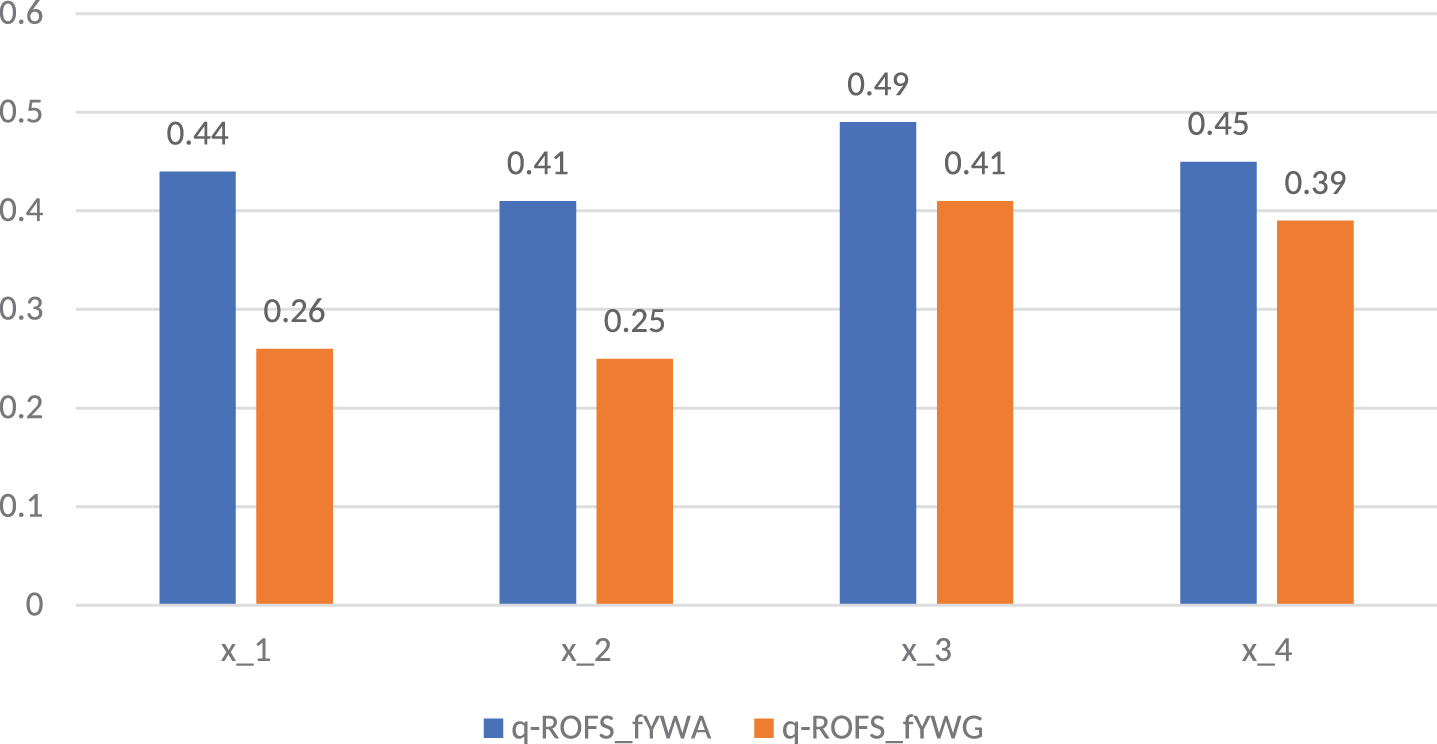
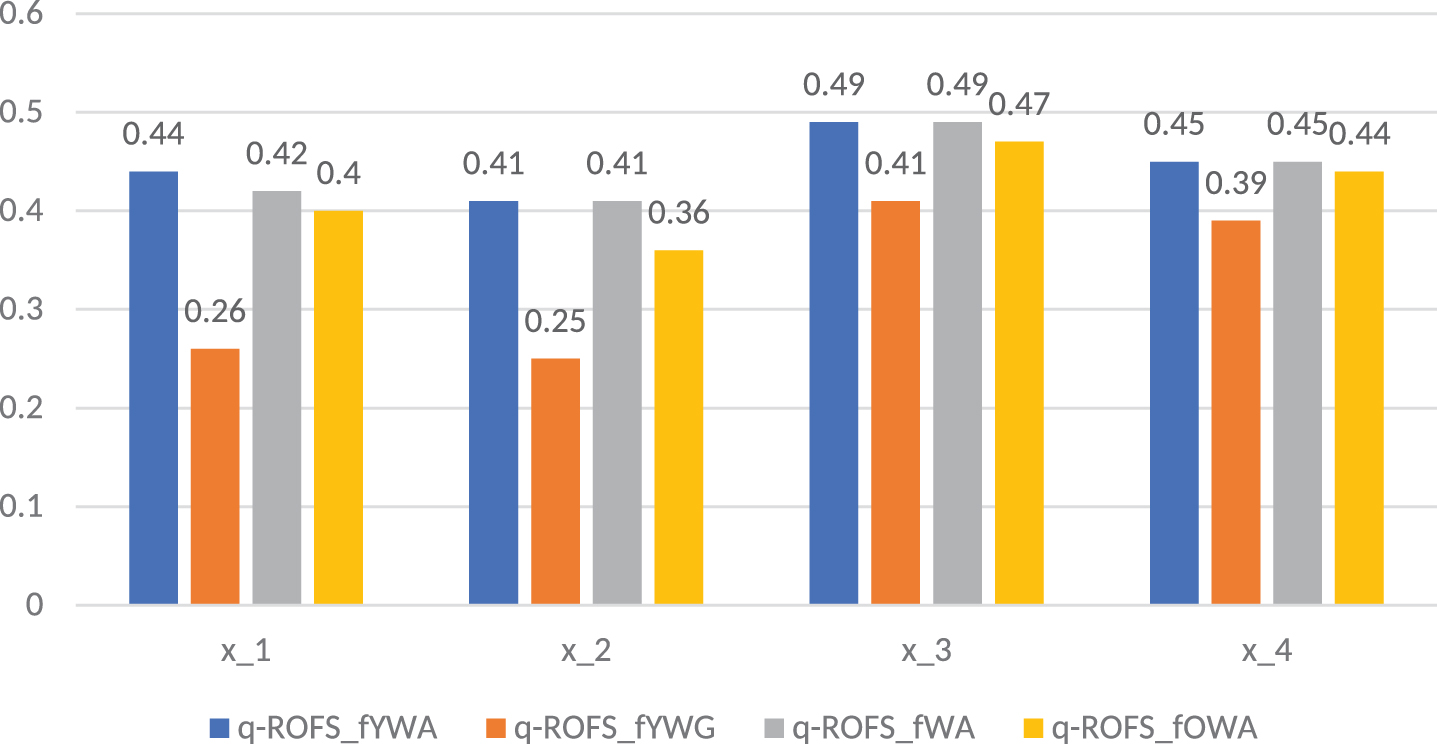
Here, we discuss the comparison of proposed operators with q - ROFSf weighted averaging (q - ROFSfWA) [16] and q - ROFSf ordered weighted averaging (q - ROFSfOWA) [16] operators. The computed results by applying these operators are summarized in Table 8 and shown in Fig. 4. It is clear from Table 8 and Fig. 4 that best alternative obtained by using q - ROFSfWA and q - ROFSfOWA operators remain same as obtained from using proposed operators. This implies our proposed methods are authentic and can be applied in MAGDM problems.
Comparison with q - ROFSfWA and q - ROFSfOWA operators
Methods
S (x1)
S (x2)
S (x3)
S (x4)
RO
q - ROFSfYWA
0.44
0.41
0.49
0.45
x3 > x4 > x1 > x2
q - ROFSfYWG
0.26
0.25
0.41
0.39
x3 > x4 > x1 > x2
q - ROFSfWA
0.42
0.41
0.49
0.45
x3 > x4 > x1 > x2
q - ROFSfOWA
0.40
0.36
0.47
0.44
x3 > x4 > x1 > x2
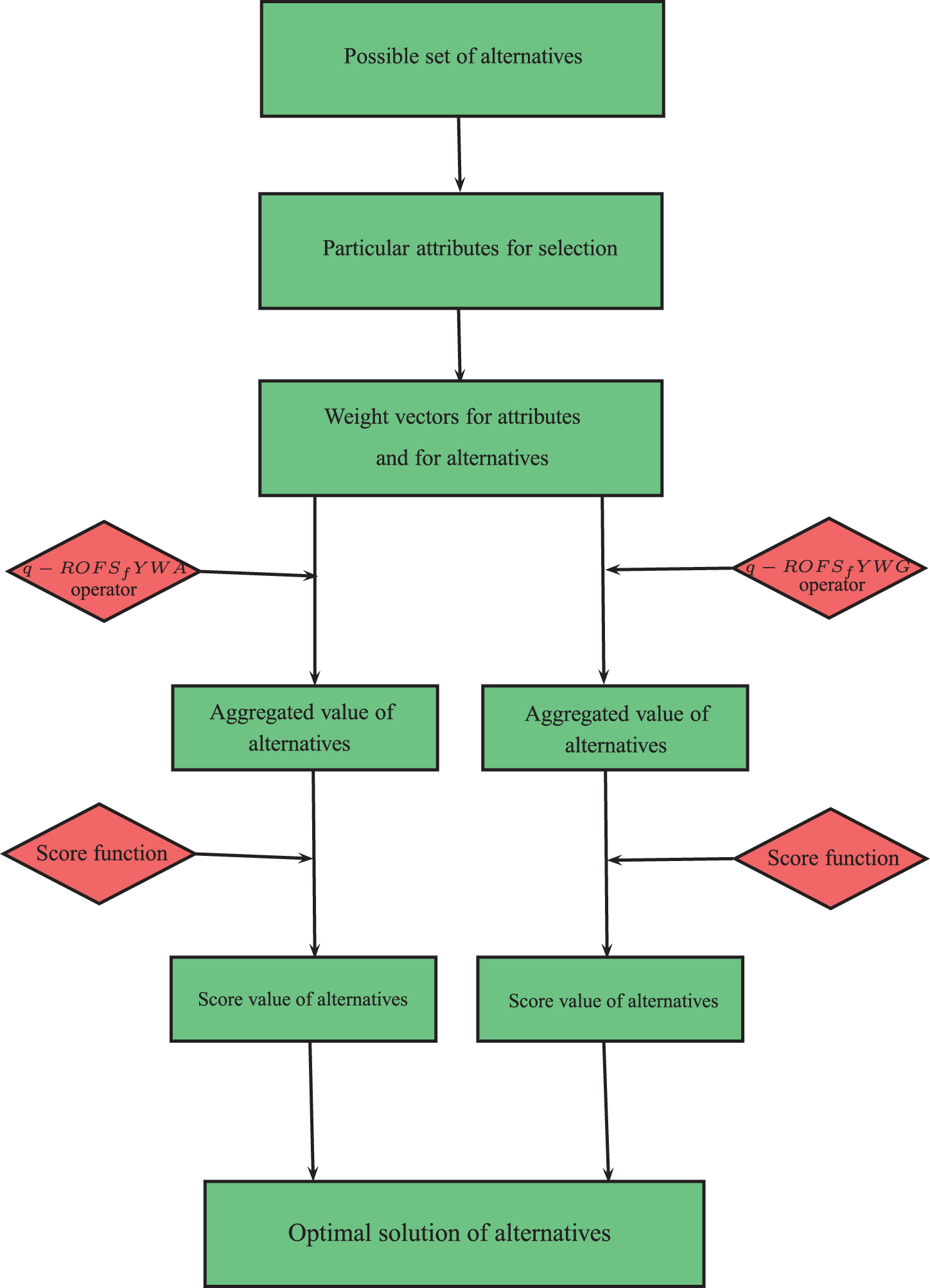
Framework for the selection of best alternative.
RO of alternatives.
Comparison with existing operators.
Comparison with Pythagorean fuzzy yager aggregation operators
This subsection discusses the comparison with PF Yager weighted averaging (PFYWA) [31] and PF Yager weighted geometric (PFYWG) [31] operators. If we consider the data given in Tables4-7, then the methods presented in [31] are fail to handle the problems but proposed theory cover all such situations. For that reason distinct parameters of q - ROFSfNs are aggregated by utilizing weighted averaging operator with WV w = (0.16, 0.20, 0.21, 0.22, 0.21) T and aggregated q - ROFSf matrix for different patients is given in Table 9. Using this evaluated matrix, comparison with PFYWA and PFYWG operators is given in Table 10. From above table. it is clear that x3 is more serious patient of given diseases as compared to others.
Aggregated q - ROFSf matrix
x1
x2
x3
x4
e1
(0.675,0.312)
(0.739,0.4349)
(0.7335,0.1819)
(0.6753,0.1674)
e2
(0.6929,0.3192)
(0.4349,0.1972)
(0.7837,0.1595)
(0.7664,0.1841)
e3
(0.754,0.3272)
(0.7208,0.2312)
(0.8096,0.158)
(0.765,0.1473)
e4
(0.6976,0.3024)
(0.7007,0.2001)
(0.7233,0.17)
(0.7668,0.1629)
Comparison with PFYWA and PFYWG operators
Methods
S (x1)
S (x2)
S (x3)
S (x4)
RO
q - ROFSfYWA
0.44
0.41
0.49
0.45
x3 > x4 > x1 > x2
q - ROFSfYWG
0.26
0.25
0.41
0.39
x3 > x4 > x1 > x2
PFYWA
0.58
0.52
0.66
0.63
x3 > x4 > x1 > x2
PFYWG
-0.02
-0.03
0.15
0.13
x3 > x4 > x1 > x2
Comparison with Pythagorean fuzzy TOPSIS method
Here, we discuss the comparison of proposed operators with PF-TOPSIS [2] method. The steps to find out the best alternative by PF-TOPSIS method are:
Construction of a PF DMx in which each entry corresponds to a PFN.
Construction of a weighted PF DMx, which is given in Table 11.
The PF positive ideal solution (PFPIS) and PF negative ideal solution (PFNIS) are given as
The distance between the alternative and PFPIS together with the PFNIS are given in the Table 12.
The revised closeness degree of each alternative is given as ξ (x1) = -0.4770, ξ (x2) = -0.6096, ξ (x3) = -0.2980, ξ (x4) =0.4570 .
We get the following ranking list by arranging the alternatives in decreasing order with respect to :
x3 has more serious diseases.
Weighted PF DMx
x1
x2
x3
x4
e1
(0.1755,0.0811)
(0.1921,0.1132)
(0.1907,0.0473)
(0.1756,0.0435)
e2
(0.1663,0.0766)
(0.1043,0.047)
(0.1881,0.0383)
(0.1839,0.0442)
e3
(0.2036,0.0883)
(0.1946,0.0624)
(0.2186,0.0462)
(0.2065,0.0397)
e4
(0.1534,0.0665)
(0.1542,0.0440)
(0.1591,0.0374)
(0.1687,0.0358)
Distance of alternatives from PFPIS and PFNIS
)
)
0.0197
0.0147
0.0301
0.0225
0.0187
0.0179
0.0194
0.0148
We observe from Table 13 that the methods given in [2, 31] have no knowledge about parameterized study. The superiority of proposed theory is that it has the ability to handle real life problems by utilizing parametrization information. Therefore, developed approach can be applied for handling decision making problems involving parameters.
In our daily life problem, we face uncertainties in making right decisions. In this study, we have proposed two different decision making methods in medical diagnose. SfS is a parametrization tool to deal with uncertainty and vague information. q - ROFSfS as an extension of IFSfS and PFSfS is more flexible tool to solve decision making problems involving vagueness corresponding to different parameters. Moreover, Yager’s t-norm and t-conorm have more generalized structure that operate efficiently to integrate the complex information. By combining these two structures, we have developed a new hybrid model to solve MAGDM problems. We have proposed four families of AOs, namely, q - ROFSfYWA, q - ROFSfYOWA, q - ROFSfYWG and q - ROFSfYOWG operators. Some properties of proposed operators including idempotency, boundedness, monotonicity, shift invariance and homogeneity have been established. The main objective of this article is to develop a method based on the proposed operators to handle decision making problem under q - ROFSf data. A practical example for the diagnosis of illness of patients is given to demonstrate the application of the proposed strategy. To show the validity and authenticity of our model, we have performed the comparison analysis of proposed theory with existing operators. In short, this article builds up a tool that has the rich properties of Yager AOs and flexibility of q - ROFSf model. In future, we will extend our models to q-rung picture fuzzy soft set data.
Conflict of iterest: The authors declare no conflict of interest.
References
1.
AkramM., DudekW.A. and DarJ.M., Pythagorean Dombi fuzzy aggregation operators with application in multi-criteria decision making, International Journal of Intelligent Systems34(11) (2019), 3000–3019.
2.
AkramM., DudekW.A. and IllyasF., Group decision making based on Pythagorean fuzzy TOPSIS method, International Journal of Intelligent Systems34 (2019), 455–1475, DOI: 10.1002/int.22103
3.
AkramM., GargH. and ZahidK., Extensions of ELECTRE-I and TOPSIS methods for group decision making under complex Pythagorean fuzzy environment, Iranian Journal of Fuzzy Systems17(5) (2020), 147–164.
4.
AkramM., ShahzadiG., A hybrid decision making model under q-rung orthopair fuzzy Yager aggregation operators, Granular Computing (2020), https://doi.org/10.1007/s41066-020-00229-z
5.
AkramM., ShahzadiG., PengX., Extension of Einstein geometric operators to multiattribute decision-making under qrung orthopair fuzzy information, Granular Computing (2020), https://doi.org/10.1007/s41066-020-00233-3.
6.
AliM.I., A note on soft sets, rough soft sets and fuzzy soft sets, Applied Soft Computing11(4) (2011), 3329–3332.
7.
AliM.I., FengF., LiuX., MinW.K. and ShabirM., On some new operations in soft set theory, Computers and Mathematics with Applications57(9) (2009), 1547–1553.
8.
AroraR. and GargH., Robust aggregation operators for multicriteria decision-making with intuitionistic fuzzy soft set environment, Scientia Iranica. Transaction E, Industrial Engineering25(2) (2018), 931–942.
9.
AtanassovK.T., Intuitionistic fuzzy sets, Fuzzy Sets and Systems20(1) (1986), 87–96.
10.
GargH., A novel trigonometric operation based q-rung orthopair fuzzy aggregation operator and its fundamental properties, Neural Computing and Applications (2020), https://doi.org/10.1007/s00521-020-04859-x
11.
GargH. and AroraR., Generalized intuitionistic fuzzy soft power aggregation operator based on t-norm and their application in multicriteria decision-making, International Journal of Intelligent Systems34(2) (2019), 215–246.
12.
GargH. and ChenS.M., Multi-attribute group decision making based on neutrality aggregation operators of q-rung orthopair fuzzy sets, Information Sciences517 (2020), 427–447.
13.
GargH. and RaniD., Some generalized complex intuitionistic fuzzy aggregation operators and their application to multicriteria decision making process, Arabian Journal for Science and Engineering44(3) (2019), 2679–2698.
14.
GargH., ShahzadiG., AkramM., Decision-making analysis based on Fermatean fuzzy Yager aggregation operators with application in COVID-19 testing facility, Mathematical Problems in Engineering (2020), Article ID 7279027, 16 pages.
15.
HeJ., WangX., ZhangR. and LiL., Some q-rung picture fuzzy Dombi Hamy Mean operators with their application to project assessment, Mathematics7(5) (2019), 468.
16.
HussainA., AliM.I., MahmoodT. and MunirM., q-Rung orthopair fuzzy soft average aggregation operators and their application in multi-criteria decision making, International Journal of Intelligent Systems35(4) (2020), 571–599.
17.
JanaC., MuhiuddinG. and PalM., Some Dombi aggregation of q-rung orthopair fuzzy numbers in multiple-attribute decision making, International Journal of Intelligent Systems34(12) (2019), 3220–3240.
18.
JanaC. and PalM., A robust single-valued neutrosophic soft aggregation operators in multi-criteria decision making, Symmetry11(1) (2019), 110.
19.
JanaC., PalM. and WangJ., A robust aggregation operator for multi-criteria decision-making method with bipolar fuzzy soft environment, Iranian Journal of Fuzzy Systems16(6) (2019), 1–16.
20.
JoshiB.P. and GegovA., Confidence levels q-rung orthopair fuzzy aggregation operators and its applications to MCDM problems, International Journal of Intelligent Systems35(1) (2020), 125–149.
21.
LiD.F., Multi-attribute decision making method based on generalized OWA operators with intuitionistic fuzzy sets, Expert Systems With Applications37 (2010), 8673–8678.
22.
LiuP., AkramM. and SattarA., Extensions of prioritized weighted aggregation operators for decision making under complex q-rung orthopair fuzzy information, Journal of Intelligent and Fuzzy System39(5) (2020), 7469–7493.
23.
LiuP., ShahzadiG. and AkramM., Specific types of q-rung picture fuzzy Yager aggregation operators for decision making, International Journal of Computational Intelligence Systems13(1) (2020), 1072–1091.
24.
LiuP. and WangP., Some q-rung orthopair fuzzy aggregation operators and their applications to multiple-attribute decision making, International Journal of Intelligent Systems33(2) (2018), 259–280.
25.
MajiP.K., BiswasR.K. and RoyA., Fuzzy soft sets, Journal of Fuzzy Mathematics9(3) (2001), 589–602.
26.
MajiP.K., BiswasR.K. and RoyA., Intuitionistic fuzzy soft sets, Journal of Fuzzy Mathematics9(3) (2001), 677–692.
27.
MolodtsovD., Soft set theory Ufirst results, Computers and Mathematics with Applications37(4-5) (1999), 19–31.
28.
PengX. and YangY., Fundamental properties of intervalvalued Pythagorean fuzzy aggregation operators, International Journal of Intelligent Systems31(5) (2016), 444–487.
29.
PengX.D., YangY., SongJ.P. and JiangY., Pythagorean fuzzy soft set and its application, Computer Engineering41(7) (2015), 224–229.
30.
RaniD. and GargH., Complex intuitionistic fuzzy power aggregation operators and their applications in multi-criteria decision making, Expert Systems35(6) (2018), e12325.
31.
ShahzadiG., AkramM. and Al-KenaniA.N., Decision making approach under Pythagorean fuzzy Yager weighted operators, Mathematics8(1) (2020), 70.
32.
ShahzadiG., AkramM., Group decision-making for the selection of an antivirus mask under fermatean fuzzy soft information, Journal of Intelligent and Fuzzy Systems (2020), DOI: 10.3233/JIFS-201760
33.
ShaistaH. and AkramM., Diagnostic methods and risk analysis based on fuzzy soft information, International Journal of Biomathematics11(8) (2018).
34.
SongQ., KandelA. and SchneiderM., Parameterized fuzzy operators in fuzzy decision making, International Journal of Intelligent Systems18(9) (2003), 971–987.
35.
TanC., YiW. and ChenX., Generalized intuitionistic fuzzy geometric aggregation operators and their application to multicriteria decision making, Journal of the Operational Research Society66(11) (2015), 1919–1938.
36.
WangW. and LiuX., Intuitionistic fuzzy geometric aggregation operators based on Einstein operations, International Journal of Intelligent Systems26(11) (2011), 1049–1075.
XuZ. and HuH., Projection models for intuitionistic fuzzy multiple attribute decision making, International Journal of Information Technology and Decision Making9(02) (2010), 267–280.
39.
XuZ. and YagerR.R., Some geometric aggregation operators based on intuitionistic fuzzy sets, International Journal of General Systems35(4) (2006), 417–433.
40.
YagerR.R., On ordered weighted averaging aggregation operators in multi-criteria decision making, IEEE Transactions on systems Man and Cybernetics18(1) (1988), 183–190.
41.
YagerR.R., Aggregation operators and fuzzy systems modeling, Fuzzy Sets and Systems67(2) (1994), 129–145.
42.
YagerR.R., Pythagorean fuzzy subsets, In 2013 Joint IFSA World Congress and NAFIPS Annual Meeting (IFSA/NAFIPS). IEEE, (June 2013), 57–61.
YuW., ZhangZ., ZhongQ., Consensus reaching for MAGDM with multi-granular hesitant fuzzy linguistic term sets: A minimum adjustment-based approach, Annals of Operations Research (2019), 1–24.
45.
ZadehL.A., Fuzzy sets, Information and Control8(3) (1965), 338–353.
46.
ZengS., ChenJ. and LiX., A hybrid method for Pythagorean fuzzy multiple criteria decision making, International Journal of Information Technology and Decision Making15(02) (2016), 403–422.
47.
ZhangZ., GaoY. and LiZ., Consensus reaching for social network group decision making by considering leadership and bounded confidence, Knowledge-Based Systems204 (2020), 106240.
48.
ZhangZ., KouX., YuW., GaoY., Consistency improvement for fuzzy preference relations with self-confidence: An application in two-sided matching decision making, Journal of the Operational Research Society (2020), 1–14.
49.
ZhaoH., XuZ., NiM. and LiuS., Generalized aggregation operators for intuitionistic fuzzy sets, International Journal of Intelligent Systems25(1) (2010), 1–30.