






Abstract
Knowledge acquisition in intuitionistic fuzzy information systems is of importance because those fuzzy information systems are often encountered in many real-life problems. Formal concept analysis is a simple and effective tool for knowledge acquisition. However, there is still little work on introducing knowledge acquisition methods based on formal concept analysis into intuitionistic fuzzy information systems. This paper mainly extends the formal concept theory into intuitionistic fuzzy information systems. Firstly, two pairs of adjoint mappings are defined in intuitionistic fuzzy formal contexts. It is verified that both pairs of adjoint mappings form Galois connections. Secondly, two types of intuitionistic fuzzy concept lattices are constructed. After that, we also present the main theorems and propositions of the intuitionistic fuzzy concept lattices. Thirdly, we deeply discuss the attribute characteristics for type-1 generalized one-sided intuitionistic fuzzy concept lattice. Furthermore, a discernibility matrix-based algorithm is proposed for attribute reduction and the effectiveness of this algorithm is demonstrated by a practical example. The construction of intuitionistic fuzzy conceptS is meaningful for the complex and fuzzy information in real life.
Keywords
Introduction
Formal concept analysis (short for FCA), as an effective and simple tool for knowledge acquisition and data analysis, was first initiated by Wille in 1982 [1]. The fundamental issue in FCA is to acquire formal concepts from the discussed formal context. According to a hierarchical order, these formal concepts form a complete lattice (also called concept lattice). The complete lattice is usually expressed by a Hasse diagram, which vividly and succinctly embodies the relationship between those formal concepts. Over the past three decades, FCA has drawn more attention, many scholars have done a lot of research works on the theory and application of FCA. Now it has been successfully applied in machine learning [2], knowledge acquisition [3], data mining [4] and many other disciplines [5].
In the classical FCA theory, a formal context is always expressed by a triple (G, M, I), where G and M are nonempty, finite object and attribute sets, respectively. I ⊆ G × M is a crisp binary relation, and is usually expressed as “1” or “0” (depending on whether the object has the attribute). This is also denoted as a one-valued context. However, with the further research of FCA, many scholars [6] have found this theory is too restrictive for many real-life problems. In other words, most of the attributes are many-valued or fuzzy-valued between 0 and 1. In such circumstances, many extended models have been proposed, among which fuzzy FCA theory is the most popular one introduced by Burusco and Fuentes-Gonzáles [7]. By considering complete residuated lattice, Belohlavek [8] developed a fuzzy logical framework for FCA. Inspired by Belohlavek’s work, Georgescu and Popescu [9] further extended the fuzzy logic framework by the view of non-commutative logic. Recently, many efforts [10, 11] are still attempting to extend FCA to fuzzy formal contexts. Jaoua and Elloumi [12] constructed the corresponding Galois connection to generalize FCA to a real binary relation. Yahia et al. [13] generalized the FCA and proposed a so-called one-sided fuzzy concept. In order to handle various truth-value structures of attributes, Halaš and Pócs [14] put forward the generalized one-sided formal concept.
Attribute reduction is both important for rough sets and formal concept analysis. Ferone [15] introduced a new attribute reduction approach based on attribute granulation. In order to meet the requirement of complex problems, Li et al. [16] defined a multi-objective attribute reduction method. To minimize various types of costs, Fang and Min [17] proposed the cost-sensitive approximate attribute reduction method. According to attribute dependency calculated by direct dependency calculation, Raza and Qamar [18] presented a rough set-based attribute reduction method. On the other hand, with the increasing of attributes and objects, the concept lattice will become larger and larger, and its computation will become more and more complex. Many scholars [19–21] have made great efforts to develop new approaches for attribute reduction with different purposes. For instance, by the view of object granule, Wu et al. [22] proposed a method to acquire attribute reduction in formal contexts. In order to reduce the size of the concept lattice, Kumar and Srinivas [23] presented a K-means clustering-based approach. To keep the maximum rules unchanged, Shao [24] introduced a model to acquire attribute reduction in fuzzy formal decision contexts. Based on the notion of congruence on lattices, Aragón and Medina [25] introduced a special kind of equivalence relation to reduce concept lattices. In [26], Wang proposed four kinds of attribute reduction of SE-ISI concept lattices based on different criteria. On the other hand, to maintain lattice structure unchanged, many attribute reduction approaches have been proposed [27]. However, calculating all reducts based on the Boolean approach is still an NP-hard [28]. Based on graph theory, Chen et al. [29] designed an approximation algorithm for obtaining a minimum reduct in formal decision contexts, which avoided generating all the formal concepts.
No matter the classical or fuzzy formal context, the acquisition of information is often a single aspect. However, in the process of cognition, people tend to show positive, negative, and hesitant results. Intuitionistic fuzzy (short for IF) set [30] is a natural generalization of the fuzzy set. The membership and the non-membership are adopted to express the ambiguities of the real world. Recently, the combination of IF set theory and rough set theory has been studied intensively. Those works mainly focused on model extension [31], property discussion [32] and measure description [33, 34]. Meantime, the study on the relationship between FCA theory and rough set theory has attracted the attention of many researchers [35]. Those studies show that both FCA theory and rough set theory have common goals and methodologies. Both theories provide formal tools for representing and acquiring knowledge from similar types of information systems (or formal contexts) [36]. One of the emerging problems in the usage of concept lattices is connected to make a rational decision. The information data corresponding to these real-life multi-attribute decision-making problems are usually represented as fuzzy (or intuitionistic fuzzy) attribute sets. IF sets and FCA are two important ways of data mining and knowledge representation in the real world. In recent years, some scholars have tried to combine IF sets and FCA together to generalize the concept lattice models. According to the attribute correlation degree, Xin and Song [37] proposed an IF three-way formal concept analysis model. Based on the intuitionistic fuzzy lattice implication algebra, Zhou and Lin [38] proposed linguistic-valued intuitionistic fuzzy layer concept lattice. Using dominance relation, Hong and Hong [39] turned the intuitionistic fuzzy information systems into 0-1 formal contexts and then get the formal concept lattices in the IF information systems. In essence, this method is still classical formal concept analysis. Using Intuitionistic L-fuzzy Sets, Kridlo and Ojeda-Aciego [40] extended formal concept analysis. However, to construct a Galois connection, the IF formal context has to provide values without indetermination.
The main contribution of this paper is to present a way to combine the IF theory and FCA theory. We then formulate an approach to acquire attribute reduction from the obtained IF concept lattice. Finally, we apply the proposed method to the multi-attribute decision-making problems. The remainder paper is organized as follows. Section 2 briefly reviews some basic definitions and notions in this study. In Section 3, we propose two types of IF concept lattices. Some related theorems and propositions have been also checked. Section 4 deeply discusses attribute characteristics for type-1 generalized one-sided IF concept lattice. After that, an algorithm is formulated to compute the attribute reduction for type-1 generalized one-sided IF concept lattice. At last, we conclude this paper and give an outlook for further work in Section 5.
Preliminaries
This section briefly recalls the preliminary notions and concepts, such as FCA, Galois connections, and generalized one-sided concept lattice.
FCA and Galois connections
A formal context is known as a triple
X∗ = {a ∈ M : ∀ x ∈ X, (x, a) ∈ I},
A★ = {x ∈ G : ∀ a ∈ A, (x, a) ∈ I},
where
If X∗ = A and A★ = X, then the pair (X, A) is referred to as a formal concept of
All formal concepts of
(X1, A1) ≤ (X2, A2) ⇔ X1 ⊆ X2 (A2 ⊆ A1).
The complete lattice is denoted by
(X1, A1) ∧ (X2, A2) = (X1 ∩ X2, (A1 ∪ A2) ★∗);
(X1, A1) ∨ (X2, A2) = ((X1 ∪ X2) ∗★, A1 ∩ A2).
In fact, the pair of operators (∗ , ★) forms a Galois connection between the power sets of object and attribute. The original use of the Galois connections [41] was to express transformations that reverse (rather than preserve) order in symmetric but contravariant form. Wille studied the Galois connection and introduced formal concepts and concept lattices. Inspired by Wille, Belohlavek [42] and Pollandt [43] defined a pair of fuzzy derivation operators in residuated lattice and formal fuzzy context, and developed the notion of formal fuzzy concept and fuzzy concept lattice. Later, another type of operators framework of conceptual structures was proposed by addressing the objectives of knowledge processing, which form an isotone Galois connection. Gediga and Düntsch [44] put forward a new type of concept lattice called the attribute-oriented concept lattice by the isotone Galois connection. Yao [45] defined the notion of object-oriented concept lattice in a similar way. Now we recall the basic definitions of Galois connection and isotone Galois connection, respectively.
p ≤ φ (q) ⇔ q ≤ φ (p),
then (φ, φ) is called an Galois connection between (P, ≤) and (Q, ≤).
(1) p1 ≤ p2 ⇒ φ (p1) ≥ φ (p2);
(2) q1 ≤ q2 ⇒ φ (q1) ≥ φ (q2);
(3) p ≤ φ (φ (p)) and q ≤ φ (φ (q)).
p ≤ φ (q) ⇔ φ (p) ≤ q,
then (φ, φ) is called an isotone Galois connection between (P, ≤) and (Q, ≤).
(1) p1 ≤ p2 ⇒ φ (p1) ≤ φ (p2);
(2) q1 ≤ q2 ⇒ φ (q1) ≤ φ (q2);
(3) p ≤ φ (φ (p)) and q ≥ φ (φ (q)).
An intuitionistic fuzzy information system (IFIS) is defined as IFIS = (U, AT, {V a : a ∈ AT} , {f a : a ∈ AT}), in which U and AT are nonempty, finite object set and attribute set respectively. V a consists of all IF values of a ∈ AT, f a is an information function, such that f a (x) = 〈μ a (x), ν a (x), and ∀x ∈ U, ∀a ∈ AT, 0 ≤ μ a (x) + ν a (x) ≤1.
Moveover, if C and D are conditional and decision attribute sets with C∩ D = ∅ and AT = C ∪ D, then IFIS is denoted as intuitionistic fuzzy decision information system (short for IFDS).
Generalized one-sided formal contexts
Considering the multi-valued formal contexts, Butka and Pócs [9] proposed generalized one-sided formal context.
(1) G and M are non-empty sets of objects and attributes, respectively.
(2)
(3) R is a generalized incidence relation between G and M such that
According to Definition 4, two operations are defined between
X▽ (a) = ⋀ x∈XR (x, a) , a ∈ M,
g△ = {x ∈ G : ∀ a ∈ M, g (a) ≤ R (x, a)}.
It is clear that the pair of operators (▽, △) forms a Galois connection between
According to Shao’s definition [49], if we use ⋁x∈XR (x, a) instead of ⋀x∈XR (x, a) in operator ▽, and g (a) ≥ R (x, a) instead of g (a) ≤ R (x, a) in operator △, then the Shao’s definition of adjoint operators on
X↑ (a) = ⋁ x∈XR (x, a) , a ∈ M,
g↓ = {x ∈ G : ∀ a ∈ M, g (a) ≥ R (x, a)}.
From the results in [49], the pair (↑, ↓) forms a isotone Galois connection between
Let
A generalized one-sided formal context
A generalized one-sided formal context
According to Definition 4, we have
Generalized one-sided concept lattice is a special case of fuzzy FCA, where the extents are considered as crisp subsets of objects and intent sets are fuzzy values of attributes. The interpretation of the one-sided concept is straightforward as in the classical FCA.
Let G be a nonempty set of objects, and an IF set
The two mappings μ
According to Xu [50], the score function and accuracy function are applied to rank intuitionistic fuzzy numbers. The score function is defined as the difference of the certainty degree to which one alternative is preferred to another. The accuracy function is defined as the sum of the certainty degree to which one alternative is non-preferred to another. The relation between the score function and the accuracy function is similar to the relation between mean and variance in statistics. There are some problems in the practical application of this method. For example: in an election, if a candidate’s support rate is 60% and the opposition rate is 40%, the candidate wins the election. If the candidate’s support rate is 40% and the opposition rate is 0%, the candidate’s election fails. That means <0.6, 0.4>> <0.4, 0.0 >. However, we can easily verify that <0.4, 0.0>> <0.6, 0.4 > by score function and accuracy function. Now we introduce a new sort method of intuitionistic fuzzy numbers.
(1) Boundary condition: N (1) =0, N (0) =1;
(2) Monotonicity: a ≤ b ⇒ N (a) ≥ N (b).
∀a ∈ [0, 1], if N (a) =1 - a is always established, the fuzzy complement N is called the standard fuzzy complement, and is denoted by N S .
(1) Boundary condition: T (a, 1) = a;
(2) Monotonicity: b ≤ c ⇒ T (a, b) ≤ T (a, c);
(3) Commutative: T (a, b) = T (b, a);
(4) Associativity: T (a, T (b, c)) = T (T (a, b) , c).
(1) Boundary condition: S (a, 0) = a;
(2) Monotonicity: if b ≤ c ⇒ S (a, b) ≤ S (a, c);
(3) Commutative: S (a, b) = S (b, a);
(4) Associativity: S (a, S (b, c)) = S (S (a, b) , c).
∀a, b ∈ [0, 1], if N (T (a, b)) = S T (N (a) , N (b)) or N (S T (a, b)) = T (N (a) , N (b)), we call T and S T satisfy the duality w.r.t. a fuzzy complement N. (T, S T , N) is called the dual triples. Some particular dual triples are as following [10]:
min-max dual triples: (min {a, b} , max {a, b} , N S );
product dual triples: (ab, a + b - ab, N S );
Łukasiewicz dual triples: (max {0, a + b - 1} , min {1, a + b} , N S ).
Let α = 〈μα, να〉 be an intuitionistic number. According to t-norm and t-conorm, we have following operators:
T (α) = T (μα, N S (να));
S (α) = S (μα, N S (να)).
For α = 〈μ1, ν1〉 and β = 〈μ2, ν2〉, if T (α) > T (β), then α > β; if T (α) = T (β) and
S T (α) = S T (β), then α = β;
S T (α) > S T (β), then α > β;
S T (α) < S T (β), then α < β.
Generalized one-sided IF concept lattices
In this section, two kinds of IF concept lattices are introduced in an IF formal context. We first give the notion of IF formal contexts.
A 4-tuple
An IF formal context IFK = (G, M, V, f)
An IF formal context
g↓ = {x ∈ G : ∀ a ∈ M, g (a) ≤ f (x, a)}.
(1)
(2) X ⊆ X↑↓, g ≤ g↓↑;
(3) X↑ = X↑↓↑, g↓ = g↓↑↓;
(4)
where I is an index set.
(2) For any
We know that ∀x ∈ X, a ∈ M,
∀a ∈ M,
(3) First, it is evident that X↑ ≥ X↑↓↑ and g↓ ⊇ g↓↑↓ from (1) and (2). Then, according to Definition 9, X↑ ∈ ∑a∈MV and
(4) It is straightforward.□
As a consequence of Proposition 3, we have the following conclusion.
g▽ = {y ∈ G : ∀ a ∈ M, g (a) ≥ f (y, a)}.
(1)
(2) X ⊆ X△▽, g ⊇ g▽△;
(3) X△ = X△▽△, g▽ = g▽△▽;
(4)
where I is an index set.
As a consequence of the Proposition 4 and Definition 2, we have the following conclusion.
It is clear that (X, g) is a type-1 generalized one-sided IF concept.
All type-1 generalized one-sided IF concepts of
⋀i∈I (X i , g i ) = (⋂ i∈IX i , (⋁ i∈Ig i ) ↓↑);
⋁i∈I (X i , g i ) = ((⋃ i∈IX i ) ↑↓, ⋀ i∈Ig i ).
Now, we need to check that ⋀i∈I (X1, g1) is the infimum of (X i , g i ) (i ∈ I) while ⋁i∈I (X1, g1) is the supremum.
Note that ⋂i∈IX i ⊆ X i , by Proposition 3 (1), ⋀i∈I (X1, g1) = (⋂ i∈IX i , (⋁ i∈Ig i ) ↓↑) ≤ (X i , g i ). That means ⋀i∈I (X1, g1) is a lower bound of all type-1 generalized one-sided IF concepts (X i , g i ). Suppose that (X, g) is an arbitrary lower bound of all type-1 generalized one-sided IF concepts (X i , g i ). ∀i ∈ I, X i ⊇ X, this means ⋂i∈IX i ⊇ X. According to Proposition 3 (1), ⋀i∈I (X i , g i ) ≥ (X, g). Thus, we conclude that ⋀i∈I (X i , g i ) is the infimum of all concepts (X i , g i ).
By the same way, ⋁i∈I (X1, g1) is the supermum of all concepts (X i , g i ).□
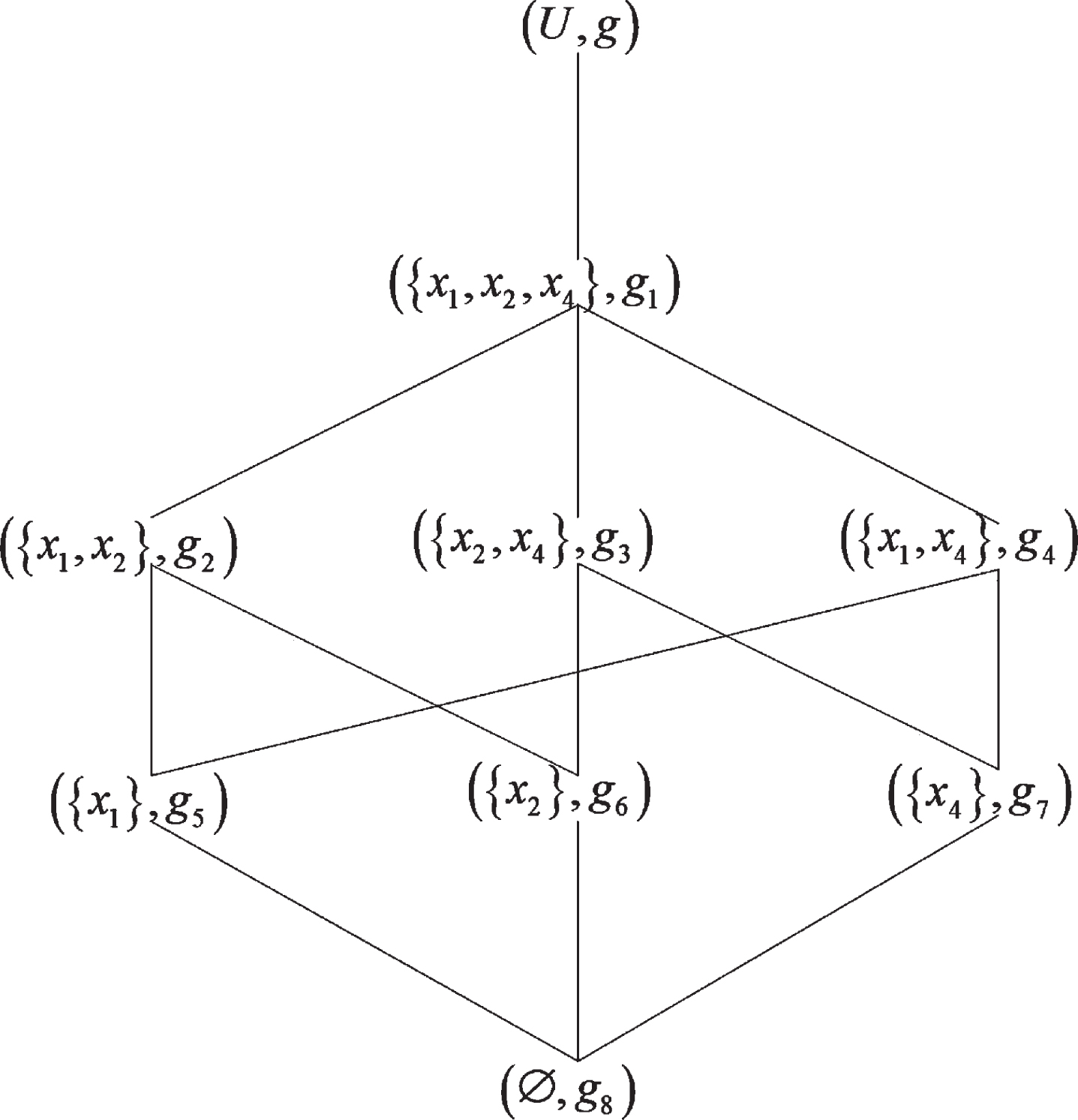
Type-1 generalized one-sided IF concept lattice
It is clear that (X, g) is a type-2 generalized one-sided IF concept.
All type-2 generalized one-sided IF concepts of
⋀i∈I (X1, g1) = (⋀ i∈IX i , (⋀ i∈Ig i ) ▽△);
⋁i∈I (X1, g1) = ((⋁ i∈IX i ) △▽, ⋁ i∈Ig i ).
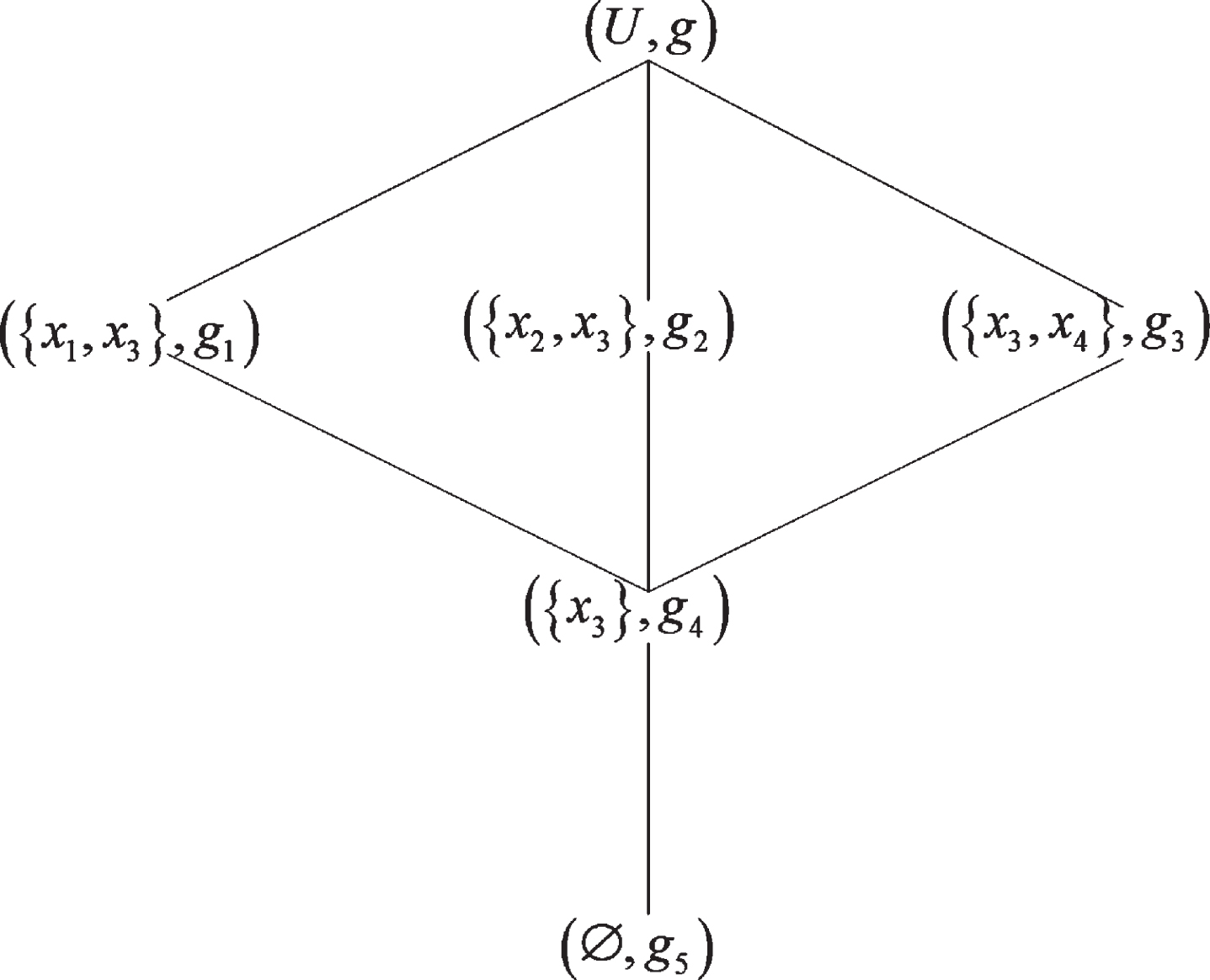
Type-ćò generalized one-sided IF concept lattice
Attribute reduction
Now we mainly discuss the basic issue of attribute reduction for type-1 generalized one-sided IF concept lattice in an IF formal concept. In the same way, one can also obtain the attribute reduction for type-2.
Therefore, {x1} ↑↓ ⊆ {x2} ↑↓. □
Given an IF formal context
Suppose that y ∉ X, then ∃a ∈ D such that f (y, a) < X↑D (a). Since D ⊆ M, then ∃a ∈ M, such that f (y, a) < X↑ (a). Therefore, x ∉ X↑↓. That is X↑↓ ⊆ X. Thus, we conclude that X = X↑↓. According to Definition 13,
Corollaries 1 and 2 follow immediately from Definition 14 and Theorem 7.
(⇐) Suppose that D is not a type-1 generalized one-sided consistent set. We know that
From Theorem 8, we obtain the following conclusion.
(⇐) For any type-1 generalized one-sided concept
From Theorem 9, one can easily prove the following results.
Suppose that (X, g1) , (Y, g2) are two type-1 generalized one-sided IF concepts in
(⇐) Suppose that D is not a type-1 generalized one-sided consistent set, then
Case 1. If there exists (Y↑D↓D, Y↑D) ∈ Θ (Y), then it is easy to know that Y↑D = Y↑D↓D↑D = (Y↑D↓D) ↑D, which means Y↑D↓D = Y. It contradicts with the assumption that D is not a type-1 generalized one-sided consistent set.
Case 2. If (Y↑D↓D, Y↑D) ∉ Θ (Y), then there exist
Therefore, D is a type-1 generalized one-sided consistent set. □
Dis (X
i
, X
j
) is called the type-1 generalized one-sided discernibility attribute set of (X
i
, g
i
) and (X
j
, g
j
).
(⇐) Suppose that D is not a type-1 generalized one-sided consistent set, by Theorem 8, there exist
Let
Δ = ⋀ ⋁ Dis (X i , X j ),
where Dis (X
i
, X
j
) ∈
Case study
Now, we would like to verify the feasibility of attribute reduction in IF concept lattices and apply the conclusions to a real multi-attribute decision-making problem.
An IF formal context IFK = (G, M, V, f)
An IF formal context
Using the min-max dual triple, by Definition 10, all extents of type-1 generalized one-sided IF concepts are as shown in the following:
∅ =∅;
X1 = {x1}; X2 = {x2};
X3 = {x3}; X4 = {x1, x2};
X5 = {x1, x3}; X6 = {x2, x3};
X7 = {x1, x2, x3}; X8 = {x1, x2, x3, x4};
X9 = {x1, x2, x3, x5}; G = G.
From Definition 16, we can compute the discernibility matrix, as shown in Table 4.
The discernibility matrix
Based on discernibility function, we can obtain two reducts.
Therefore, {a1, a2, a3} and {a1, a2, a4} are two reducts of
We know that if each performance attribute of a car is higher than the consumer’s expectation, the consumer will buy the car. Let
In this example, if
In addition, the reduction obtained above conveys the relations between these characteristics. In a way, the attribute reduction of type-1 generalized one-sided IF concept lattice, presented in the paper, can be used to facilitate the consumer to make a decision, since he only needs to consider attributes in the reduction.
Based on the concept of one-sided concept lattice, this paper extended and developed the formal concept lattice theory in an intuitionisitc fuzzy formal context. After defining two types of Galois connections, two types of generalized one-sided intuitionistic fuzzy concept lattices were constructed. Relative theorems and properties were also examined. By discussing and analyzing the attribute characteristics for the type-1 generalized one-sided intuitionistic fuzzy concept lattice, we constructed the type-1 generalized one-sided discernibility matrix to acquire the attribute reduction. The proposed approach keeps the hierarchy of concepts and the number of concepts unchanged without loss of the required knowledge, which can be used to deal with practical problems such as rule acquisition, data processing, and classification. With data constantly changing, dynamic approach for updating the generalized one-sided intuitionistic fuzzy concept lattice and the fast lattice-keep-based attribute reduction algorithm should be an issue for further research.
Footnotes
Acknowledgements
This paper is supported by the National Natural Science Foundation of China (No. 62076088,72101082) and by the Natural Science Foundation of Hebei Province (No. A2020208004).