







Abstract
As a generalization of Pythagorean fuzzy sets and picture fuzzy sets, spherical fuzzy sets provide decision makers more flexible space in expressing their opinions. Preference relations have received widespread acceptance as an efficient tool in representing decision makers’ preference over alternatives in the decision-making process. In this paper, some new preference relations are investigated based on the spherical fuzzy sets. Firstly, the deficiency of the existing operating laws is elaborated in detail and three cases are described to identify the accuracy of the proposed operating laws in the context of t-spherical fuzzy environment. Also, a novel score function is proposed to obtain the consistent value in ranking of the alternatives. The backbone of this research, t-spherical fuzzy preference relation, consistent t-spherical fuzzy preference relations, incomplete t-spherical fuzzy preference relations, consistent incomplete t-spherical fuzzy preference relations, and acceptable incomplete t-spherical fuzzy preference relations are established. Additionally, some ranking and selection algorithms are established using the proposed novel score function and preference relations to tackle the uncertainty in real-life decision-making problems. Finally, evaluation of the product quality of the online shopping platform problem is demonstrated to show the applicability and reliability of proposed technique.
Keywords
Introduction
The multi-criteria decision making (MCDM) techniques have been rigorously investigated by many researchers around the sphere of the real world. This pursuit gave rise to many resourceful techniques to deal with real world problems. The methodologies developed for this objective essentially rely on the description of the problem under contemplation. The problems of imperfect, uncertain and vague information have been focused by many researchers in the last three decades. To deal with uncertainties and vagueness Zadeh instigated fuzzy sets (FSs) [41] which have been attracted the attention of the many researchers. The notion of fuzzy set is characterized by a membership function which assign a real number in the unit closed interval [0, 1], to each object in the universe, to express vague and uncertainty in the data. A fuzzy set (FS) is a significant mathematical model to characterize an assembling of objects whose boundary is obscure. This concept is widely utilized in MCDM problems, medical diagnosis, artificial intelligence. To date, limitations of fuzzy sets revealed due to reasons like increasing information, development world, noise data so on and a lot of extensions were produced based on fuzzy set.
Atanassov [13] proposed the intuitionistic fuzzy sets (IFS) by using both positive and negative membership degree in [0, 1] such that 0⩽ positive membership degree+negative membership degree ⩽1. Despite of this, to model an information which contains fuzziness and vagueness, if sum of positive membership degree and negative membership degree is greater than 1, the IFSs are not suitable for expressing this kind of the fuzziness and vagueness information. Therefore, the q-rung orthopair fuzzy set (q-ROFS) is developed by Yager (2017) [40], as an extension of IFS. The sum of the qth powers of degree of membership and non-membership is equal to or less than 1, is the important aspect of q-ROFS. Nevertheless, IFS and q-ROFS cannot directly express the neutral degree. By implementation of neutral membership in IFSs and Yager’s q-ROFS, Cuong [17] filled these deficiencies recently. Picture fuzzy set (PFS) in a finite fixed set
In some practical decision making problems, however, the decision-makers have evaluation-value in the form of (P
b
, I
b
, N
b
) but may not fulfil the constraint of 0 ⩽ P
b
+ I
b
+ N
b
⩽ 1 and beyond the upper bound 1. In 2018 Ashraf et al., [3] set up a new theory of spherical fuzzy set (SFS) to deal with this situation, pointing at this constraint which a picture fuzzy number (PFN) cannot deal. SFS is a generalized structure of PFS by slackening the constraint
Despite of this, to model an information which contain fuzziness and vagueness, if the squared sum of positive, negative and neutral degrees is greater than 1, the spherical fuzzy sets are not suitable for expressing this kind of the fuzziness and vagueness information. Therefore, Mahmood et al. [29] expanded the PFSs and SFSs and proposed the t-spherical fuzzy sets (t-SFS) which have three membership functions, called positive, negative and neutral degrees, with restriction that
In the case of DM problems, for each criterion, comparisons between alternatives are more adaptable to DMs than allocating assessment values for all alternatives. Preference Relations (PRs) are an important and standard method for evaluating DMPs, through which decision-makers express their preference for alternatives by pair comparisons. Furthermore, it has been observed that establishment of a PR by pair wise comparisons between alternatives is much more efficient and accurate than comparisons which are not pairwise [37]. Multiplicative [31, 45] and fuzzy preference relations [23, 38] are two most common types of the preference relation. Fan et al., [19] established the two-level multi-criteria comprehensive evaluation for preference vectors in online shopping platform evaluation. Saaty [34] has developed a classical AHP technique that focuses on the multiplicative relationship of preference, that used a linguistic scale to reflect decisions taken by paired comparisons of alternatives, where all decisions are of crisp quality. However, deterministic qualities cannot express the complexity of real-life DM information. Consequently, Orlovsky [32] established a fuzzy preference relationship (FPR) where each component has assigned a degree of membership from 0 to 1. Since, negative membership cannot be considered by FSs, although IFSs can compensate this weakness; therefore, Xu [39] developed intuitionistic fuzzy preference relations (IFPRs). Furthermore, Mandal and Ranadive [30] improved the IFPRs and proposed some PRs under Pythagorean fuzzy environments. Li et al [27] strengthen the PRs to developed q-rung orthopair fuzzy (q-ROF) based list of PRs to tackle the uncertainty in selection of alternatives for decision makers. Utilizing these categories of methodology, DMs could characterize their ambiguous cognitions from a positive, negative, and hesitant point of view when attempting to compare alternatives. Although q-ROFPRs can communicate DM preferences more comprehensively and flexibly than intuitionistic and Pythagorean fuzzy PRs. There are still some limitations in q-ROFPRs that go beyond the capability of q-rung orthopair fuzzy numbers (q-ROFNs) to manage uncertain data that may be useful in complex decision-making circumstances.
In order to address the deficiencies identified above, this paper presented a novel list of t-spherical fuzzy preference relations (t-SFPRs). In real decision-making scenarios, t-SFPRs are more common and can handle more DM preference data than q-ROFPRs. For instance, assume that teams are appointed by key stakeholders to respond as DMs (reviewers) in order to overcome a massive selection of green suppliers; then, samples are collected over two shifts. Initially, stakeholders are requested to express their preference to any pair ∂ i and ∂ j of alternatives with respect to each criterion. Due to the limited information and indeterminacy inherent in the behavior of the DMs, it is much more likely that the t-SFN will be assessed by voting in favour, voting against or abstaining from each index test. Within that manner, the final preference relations could be achieved with respect to the criteria as allocated by t-SFNs. The information of preferences is considerably more extensive and accurate if described in this way. The experts also conduct the survey anonymously and do not interact with each other so as not to influence one another. Using such strategy, the information found in the evaluation provided by t-SFNs is composed of components on μ (υ) , ℘ (υ) and ∂ (υ). We will concentrate our focus on this topic and establish novel preference relations under t-SFSs. In general, the proposed preference relations have a better modeling technique than the IFPRs and q-ROFPRs for evaluating uncertain information in the emergency decision-making scenario.
To achieve the list of goals the structure of the paper is arranged as: In Section 2, some basic concepts are introduced. In Section 3, proposed the new operating laws for t-spherical fuzzy numbers. Section 4 presents the new way to rank the alternative (t-SFNs) more accurately and correctively. Section 5, gave the main contribution of the paper, introduced the t-spherical fuzzy preference relations. Section 6 proposed the ranking and selection algorithms based on the highlights preference relations and numerical example are demonstrated to shows the applicability and effectiveness of the proposed technique. Concluded remarks are discussed in section 7.
Preliminaries
In this segment, we briefly recall the rudiments of fuzzy sets and their generalized structures like spherical fuzzy sets. Following are some related definitions.
where membership grade is μ (υ) ∈ [0, 1].
where μ (υ) ∈ [0, 1] positive, ℘ (υ) ∈ [0, 1] neutral and ∂ (υ) ∈ [0, 1] negative membership grades respectively. In addition
For all υ ∈ U.
For all υ ∈ U & κ > 2 ∈ N+.
We shall signify the t-spherical fuzzy number (t-SFN) with the triplet F ts = (μ (υ) , ℘ (υ) , ∂ (υ)) for simplicity.
F
ts
(1)
⊆ F
ts
(2)
if and only if μ1 ⩽ μ2, ℘ 1 ⩽ ℘ 2 and ∂1 ⩾ ∂2. Clearly F
ts
(1)
= F
ts
(2)
if F
ts
(1)
⊆ F
ts
(2)
and F
ts
(2)
⊆ F
ts
(1)
. F
ts
(1)
∩ F
ts
(2)
= { min(μ1, μ2) , min(℘ 1, ℘ 2) , max(∂1, ∂2) }, F
ts
(1)
∪ F
ts
(2)
= { max(μ1, μ2) , min(℘ 1, ℘ 2) , min(∂1, ∂2) },
∥
Novel operating laws for t-spherical fuzzy sets
In merging data into one shape and in addressing MCDM issues, aggregation operators (AOs) perform a valuable role. AOs based on FSs and their various hybrid compositions have given a considerable deal of publicity in recent years and proven popular because they can conduct functional areas of different regions quickly. From Definitions [5–8]: we know that authors proposed different operating laws-based AOs for t-SFN to tackle the uncertainty in decision making problems. However, these operating laws have some deficiency to fulfil the basic condition of t-SFN (0 ⩽ μ κ (υ) + ℘ κ (υ) + ∂ κ (υ) ⩽ 1, ∀ υ ∈ U & κ > 2 ∈ N+), which is demonstrated by the examples below.
Similarly,
Operating laws defined in Definition 5 is not valid because it does not satisfy the basic condition of t-SFN that 0 ⩽ μ κ (υ) + ℘ κ (υ) + ∂ κ (υ) ⩽ 1, ∀ υ ∈ U & κ > 2 ∈ N+.
Operating laws defined in Definition 6 is not valid because it does not satisfy the basic condition of t-SFN that 0 ⩽ μ κ (υ) + ℘ κ (υ) + ∂ κ (υ) ⩽ 1, ∀ υ ∈ U & κ > 2 ∈ N+.
Operating laws defined in Definition 7 is not valid because it does not satisfy the basic condition of t-SFN that 0 ⩽ μ κ (υ) + ℘ κ (υ) + ∂ κ (υ) ⩽ 1, ∀ υ ∈ U & κ > 2 ∈ N+.
Operating laws defined in Definition 8 is not valid because it does not satisfy the basic condition of t-SFN that 0 ⩽ μ κ (υ) + ℘ κ (υ) + ∂ κ (υ) ⩽ 1, ∀ υ ∈ U & κ > 2 ∈ N+.
Examples [1–4] shows that there is a deficiency in meeting the basic requirement of t-SFS that 0 ⩽ μ κ (υ) + ℘ κ (υ) + ∂ κ (υ) ⩽ 1, ∀ υ ∈ U & κ > 2 ∈ N+ be made on the basis of Definitions [5–8]. A new operating law are proposed in this article in order to overcome the shortcomings of the basic operating laws based on Definitions [5–8].
The novel operating laws are proposed in the following Definition:
Validation of the proposed operating laws is shown by the following extreme situation using t-SFNs: F
ts
(1)
= (1, 0, 0) and F
ts
(2)
= (0, 1, 0); F
ts
(1)
= (0, 1, 0) and F
ts
(2)
= (0, 0, 1); F
ts
(1)
= (1, 0, 0) andF
ts
(2)
= (0, 0, 1).
Case-1:
Case-2:
Case-3:
Similarly, for addition:
Case-1:
Case-2:
Case-3:
Hence, novel operating laws satisfies the extreme situations, so proposed operating laws are valid for aggregating the t-spherical fuzzy information to tackle the uncertainty more effectively in decision making problems.
A new way to rank t-spherical fuzzy numbers
Here, in the current portion, we will create a new methodology for ranking t-SFNs. This new method is being used to rank relations of preference and select the appropriate alternative. We know from the definition 9, that Mahmood et al. gave us an t-SFNs ranking system. This framework is therefore sensitive to a minor variation in the t-SFNs, as seen in the following example.
Since
The results in the aforesaid example show how the rating of t-SFNs, which is measured on the basis of the Definition 9, would change entirely, even if the t-SFNs were to change a bit. In order to address the limitations of the ranking system based on the Definition 9 a new ranking approach is suggested in this article. The following definition develop a new ranking framework:
If μ1 > ∂1, then
If μ1 < ∂1, then
Proved.
Let
If μ1 = μ2 and ∂1 < ∂2, then we have
Thus,
If ∂1 = ∂2 and μ1 > μ2, then we have
Thus,
Proved.
It’s also noted that the score function we have defined does not differentiate t-SFNs in some cases. Consider, for instance, the following: F
ts
(1)
= (0.6, 0.5, 0.6), F
ts
(2)
= (0.7, 0.5, 0.7) ∈t - SFS (U) with κ = 3. According to the Definition 11,
If If If If
Since
Incorporating Examples 5 & 6, we can conclude that the new ranking framework is more reliable and less sensitive than in the previous process.
t-Spherical fuzzy preference relations and incomplete t-spherical fuzzy preference relations
In order to illustrate the expert preferences, Orlovsky [32] established a fuzzy preference relationship using a unit interval [0,1]. Although it is nearly impossible for experts to provide appropriate value due to the complex nature of the DMPs and the limited expertise of the experts, which reduces the application. Fuzzy preference relations are a reasonable choice to identify the uncertain and ambiguous decisions of the experts. In this section, t-spherical fuzzy preference relation, the consistent t-spherical fuzzy preference relation, the incomplete t-spherical fuzzy preference relation, the consistent incomplete t-spherical fuzzy preference relation and the acceptable incomplete t-spherical fuzzy preference relation are proposed.
t-Spherical fuzzy preference relations
μ
pq
∈ [0, 1], ℘
pq
∈ [0, 1] and ∂
pq
∈ [0, 1],
μ
qp
= ∂
pq
, ∂
qp
= μ
pq
, ℘
pq
= ℘
qp
and μ
pp
= ∂
pp
= 0.5, ℘
pp
= 0
where μ
pq
, ℘
pq
and ∂
pq
known to be preferred, neutral and non-preferred grades of the alternative ν
p
over ν
q
.
Let M = (m
pq
) n×n be a t-SFPR, where m
pq
= (μ
pq
, ℘
pq
, ∂
pq
), p, q ∈ N. The different properties of t-SFPR are examined according to Definition 13. If m
pr
⊕ m
rq
⩾ m
pq
, ∀p, q and r ∈ N, then we conclude that M validates the axiom of the triangle. If m
pr
⩾ (0.50, 0.00, 0.50), m
rq
⩾ (0.50, 0.00, 0.50) ⇒ m
pq
⩾ (0.50, 0.00, 0.50), ∀p, q and r ∈ N, then we conclude that M validates the axiom of weak transitive. If m
pq
⩾ min { m
pr
, m
rq
}, ∀p, q and r ∈ N, then we conclude that M validates the axiom of max-min transitive. If m
pq
⩾ max { m
pr
, m
rq
}, ∀p, q and r ∈ N, then we conclude that M validates the axiom of max-max transitive. If m
pr
⩾ (0.50, 0.00, 0.50), m
rq
⩾ (0.50, 0.00, 0.50) ⇒ m
pq
⩾ min { m
pr
, m
rq
}, ∀p, q and r ∈ N, then we conclude that M validates the axiom of restricted max-min transitive. If m
pr
⩾ (0.50, 0.00, 0.50), m
rq
⩾ (0.50, 0.00, 0.50) ⇒ m
pq
⩾ max { m
pr
, m
rq
}, ∀p, q and r ∈ N, then we conclude that M validates the axiom of restricted max-max transitive.
Incomplete t-spherical fuzzy preference relations
μ
pq
∈ [0, 1], ℘
pq
∈ [0, 1] and ∂
pq
∈ [0, 1],
μ
qp
= ∂
pq
, ∂
qp
= μ
pq
, ℘
pq
= ℘
qp
and μ
pp
= ∂
pp
= 0.5, ℘
pp
= 0.
then, M1 is additive incomplete consistent t-SFPR by Definition 17.
Let M = (m
pq
) n×n be an incomplete t-SFPR, where m
pq
= (μ
pq
, ℘
pq
, ∂
pq
), p, q ∈ N and φ be the set of all known elements, then different properties of an incomplete t-SFPR are examined according to Definition 16. If m
pr
⊕ m
rq
⩾ m
pq
, ∀m
pr
, m
rq
and m
pq
∈ φ, then we said M validates the triangle axiom. If m
pr
⩾ (0.50, 0.00, 0.50), m
rq
⩾ (0.50, 0.00, 0.50) ⇒ m
pq
⩾ (0.50, 0.00, 0.50), ∀m
pr
, m
rq
and m
pq
∈ φ, then we said M validates the weak transitive axiom. If m
pq
⩾ min { m
pr
, m
rq
}, ∀m
pr
, m
rq
and m
pq
∈ φ, then we said M validates the max-min transitive axiom. If m
pq
⩾ max { m
pr
, m
rq
}, ∀m
pr
, m
rq
and m
pq
∈ φ, then we said M validates the max-max transitive axiom. If m
pr
⩾ (0.50, 0.00, 0.50), m
rq
⩾ (0.50, 0.00, 0.50) ⇒ m
pq
⩾ min { m
pr
, m
rq
}, ∀m
pr
, m
rq
and m
pq
∈ φ, then we said M validates the restricted max-min transitive axiom. If m
pr
⩾ (0.50, 0.00, 0.50), m
rq
⩾ (0.50, 0.00, 0.50) ⇒ m
pq
⩾ max { m
pr
, m
rq
}, ∀m
pr
, m
rq
and m
pq
∈ φ, then we said M validates the restricted max-max transitive axiom.
In this situation, the element m pq can be acquired indirectly by the known element values m pr and m rq .
Let M = (m pq ) n×n be an acceptable incomplete t-SFPR. Then, using Definition 17 and 18, every unknown element m pq can be indirectly computed by
Some ranking and alternative selection algorithms are established in this section based on the preference relations described in Section 5.
t-SFPR based algorithm for rank the alternatives
We build a novel algorithm in this subsection to rank the alternatives based on t-SFPRs. Following are the algorithm steps:
In this section, we presented the real-life example to shows the applicability and reliability of the proposed technique.
In the first half of 2019, the Director of Quality Enhancement in Pakistan randomly inspected 280 batches of products from 200 companies involved in 10 e-commerce platforms and the result showed that the unqualified rate even exceeded 30%. Poor product quality is the key indicator of customer churn which restricts the online shopping platforms’ sustainable development.
Online shopping platforms have potentially transformed consumer ideas and shopping mechanisms of people whose satisfaction is guaranteed by the quality of products on the platform. Online shopping platforms are getting a massive number of sellers, and buyers spend a huge amount of time and energy collecting and comparing commodity information. Severe information asymmetry between the two parties, however, still exposes buyers to problems with quality of product. The ‘bad money drives out good’ situation caused by unfavorable selection forces some high-quality sellers to retreat and form a vicious circle. Because of the low entrance threshold, competitive environment between various online shopping platforms is exceptionally strong. Product homogenization indicates that the price advantage is disappeared and therefore online shopping platforms need to pay attention to evaluating and controlling product quality in order to retain users and maintain competitive advantages. Therefore, this study needs to determine the indicators through multi-criteria decision-making (MCDM) and propose a multi-criteria comprehensive evaluation to evaluate the product quality of online shopping. We enlist the indicators to evaluate the product quality of online shopping, which are as follows: Online business alliance ∂1; The third-party payment security and convenience ∂2; Quality-search technology ∂3; Product diagnostic ∂4; Quality assurance and commitment (Punishment of violations or fraud) ∂5;
The decision maker needs to evaluated the preference information on ∂ i by t-SFNs and describe the t-SFPR with t = 3 in Table 1 as follows:
t-SFPR information
t-SFPR information
Ranking results based on t-spherical arithmetic averaging operator with different t
By Equation 6.1, we have
Thus,
That is
In addition, we assigned t the various value to sort alternatives for analysis of parameter t′s consistency and sensitivity. The ranking results based on the t-spherical fuzzy arithmetic averaging operator with different t are listed in Table 2.
The graphical representation of t-spherical averaging operator with different t is given in Fig. 1:
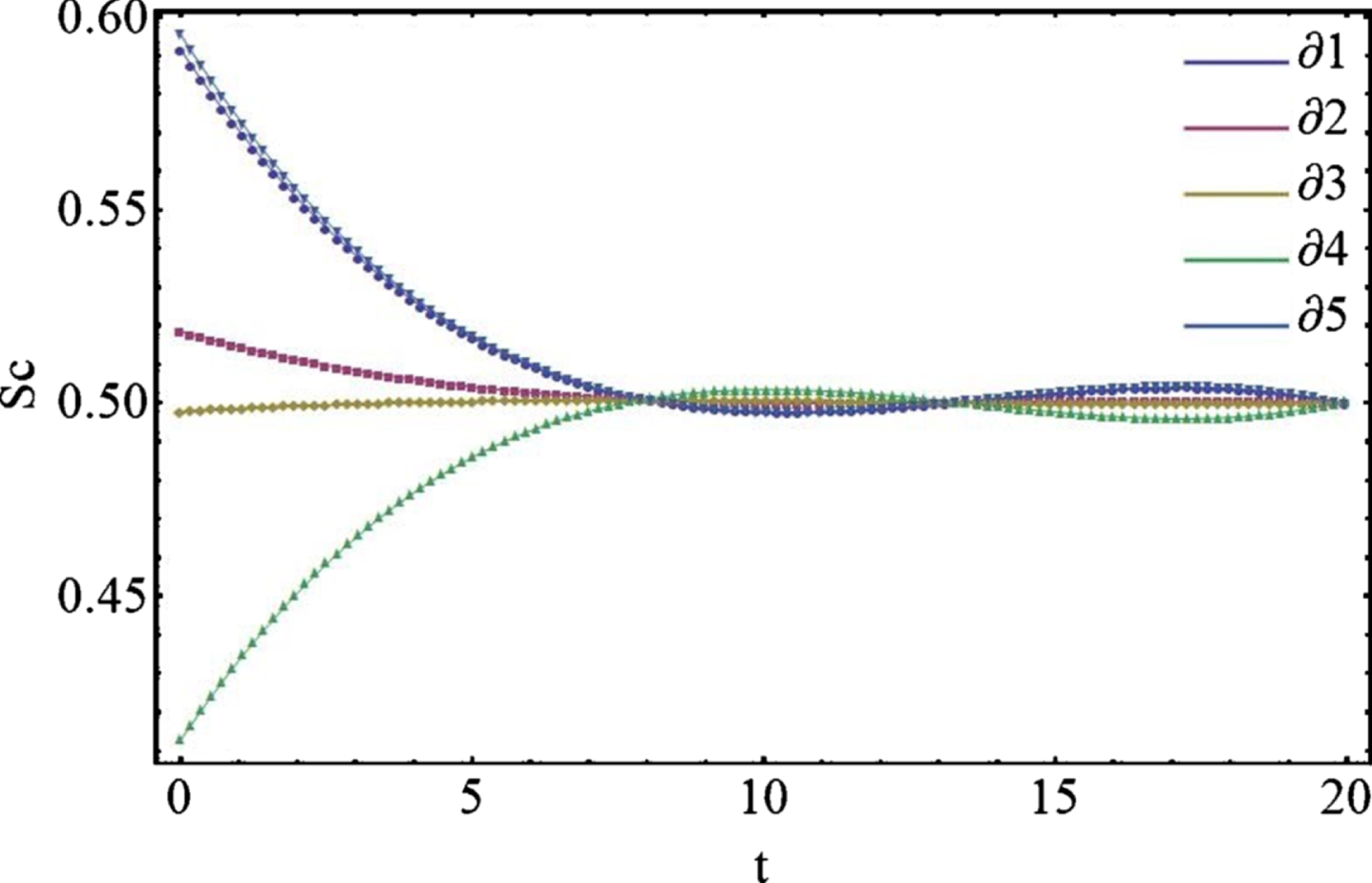
Representation of t-spherical averaging operator with different t.
Table 2 conclude that the outcomes of the ranking are consistent with the increase in parameter t. In addition, we will consider that parameter t has a relatively large value, and a relatively small score function.
By using Equation 6.2, we get
Thus,
That is
In addition, we assigned t the various value to sort alternatives for analysis of parameter t′s consistency and sensitivity. The ranking results are listed in Table 3 based on the t-spherical fuzzy geometric averaging operator with different t.
Ranking results based on t- spherical geometric averaging operator with different t
The graphical representation of t-spherical geometric operator with different t is given in Fig. 2:
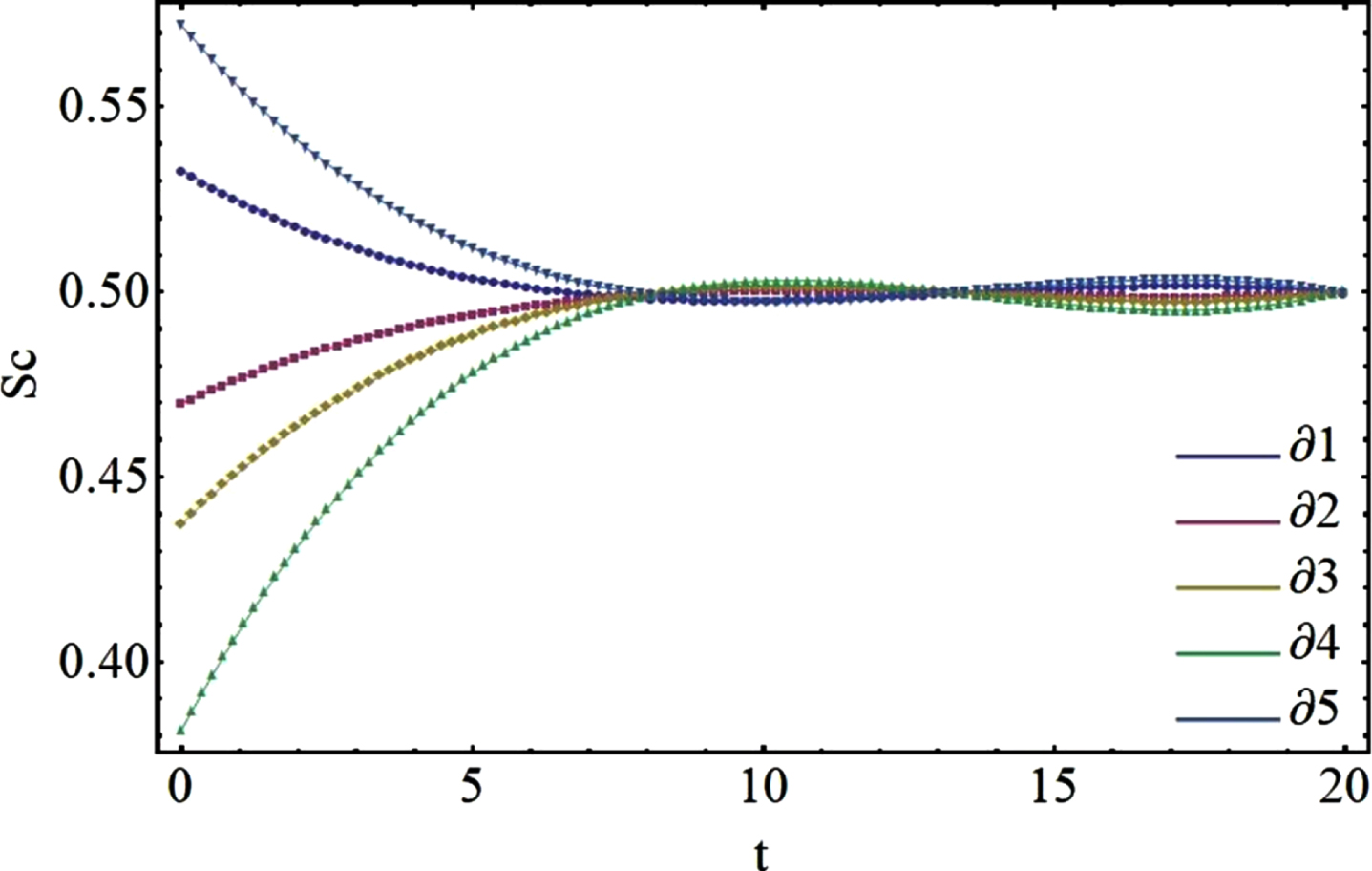
Representation of t-spherical geometric operator with different t.
Table 3 conclude that the outcomes of the ranking are consistent with the increase in parameter t. In addition, we will consider that parameter t has a relatively large value, and a relatively small score function.
We build a novel algorithm in this subsection to rank the alternatives depending on incomplete t-SFPRs. The algorithm steps are as follows:
Suppose ∂ i (i = 1, 2, . . . , 5) be the non-empty family of alternatives. The decision maker need to evaluated the preference information on ∂ i by t -SFNs and describe an acceptable incomplete t-SFPR with t = 3 in Table 4 as follows:
Acceptable incomplete t- SFPR information
Acceptable incomplete t- SFPR information
Complete t-SFPR information
Ranking results based on t-SFAA operator with different t
Firstly, we find out the incomplete elements. We have
Then, using above calculation of incomplete information and Equation (5.2), we have complete t-SFPR
By Equation (6.1), we have
Thus,
That is
In addition, we assigned t the various value to sort alternatives for analysis of parameter t′s consistency and sensitivity. Table 6 listed the ranking results based on the t-spherical fuzzy averaging (t-SFAA) operator with different t.
The graphical representation of t-spherical averaging operator with different t is given in Fig. 3:
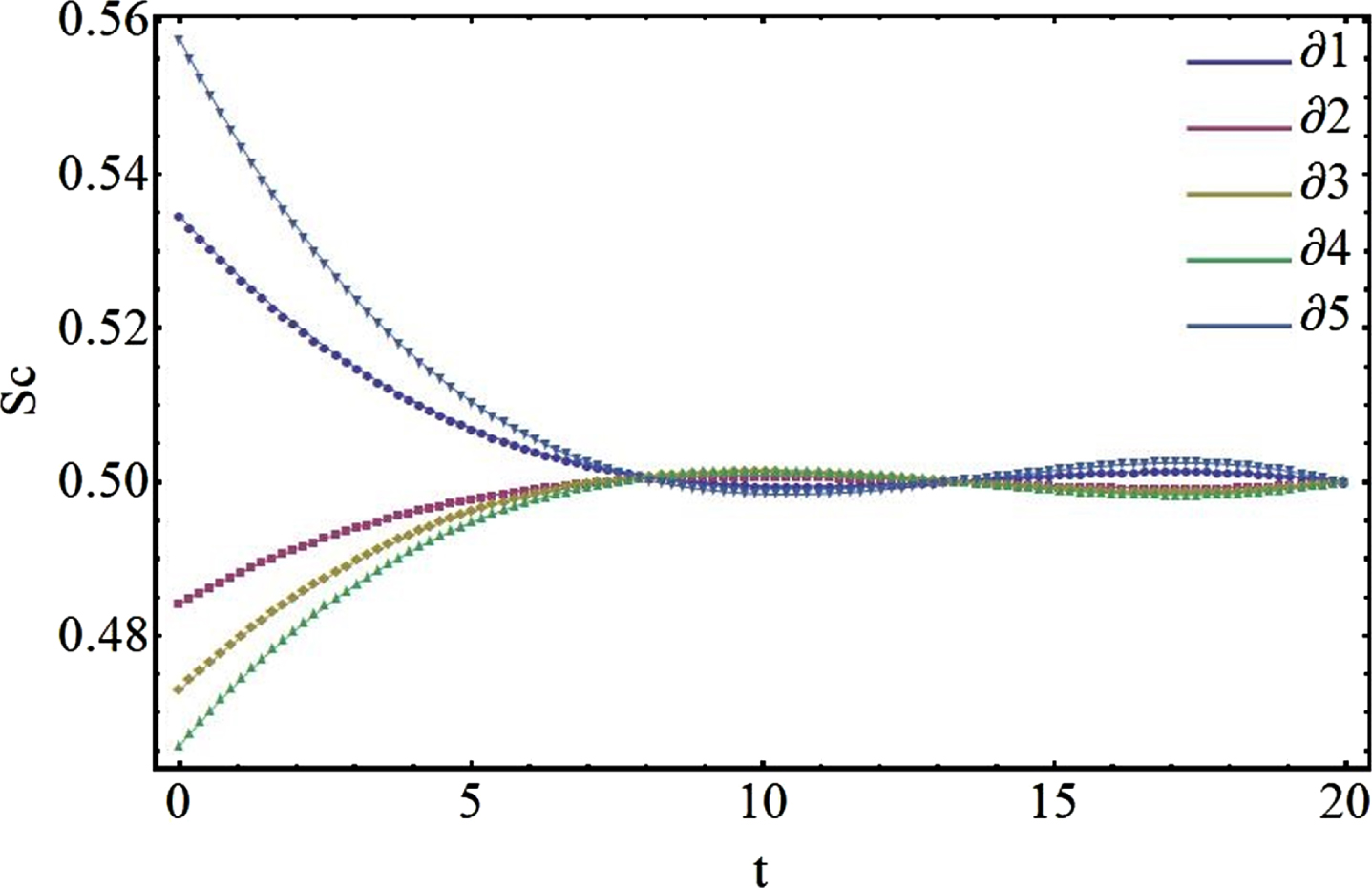
Representation of t-spherical averaging operator with different t.
Table 6 conclude that the outcomes of the ranking are consistent with the increase in parameter t. In addition, we will consider that parameter t has a relatively large value, and a relatively small score function.
Ranking results based on t-SFGA operator with different t
By using Equation (6.2), we get
Thus,
That is
In addition, we assigned t the various value to sort alternatives for analysis of parameter t′s consistency and sensitivity. Table 7 listed the ranking results based on the t-spherical fuzzy geometric (t-SFGA) operator with different t.
The graphical representation of t-spherical geometric operator with different t is given in Fig. 4:
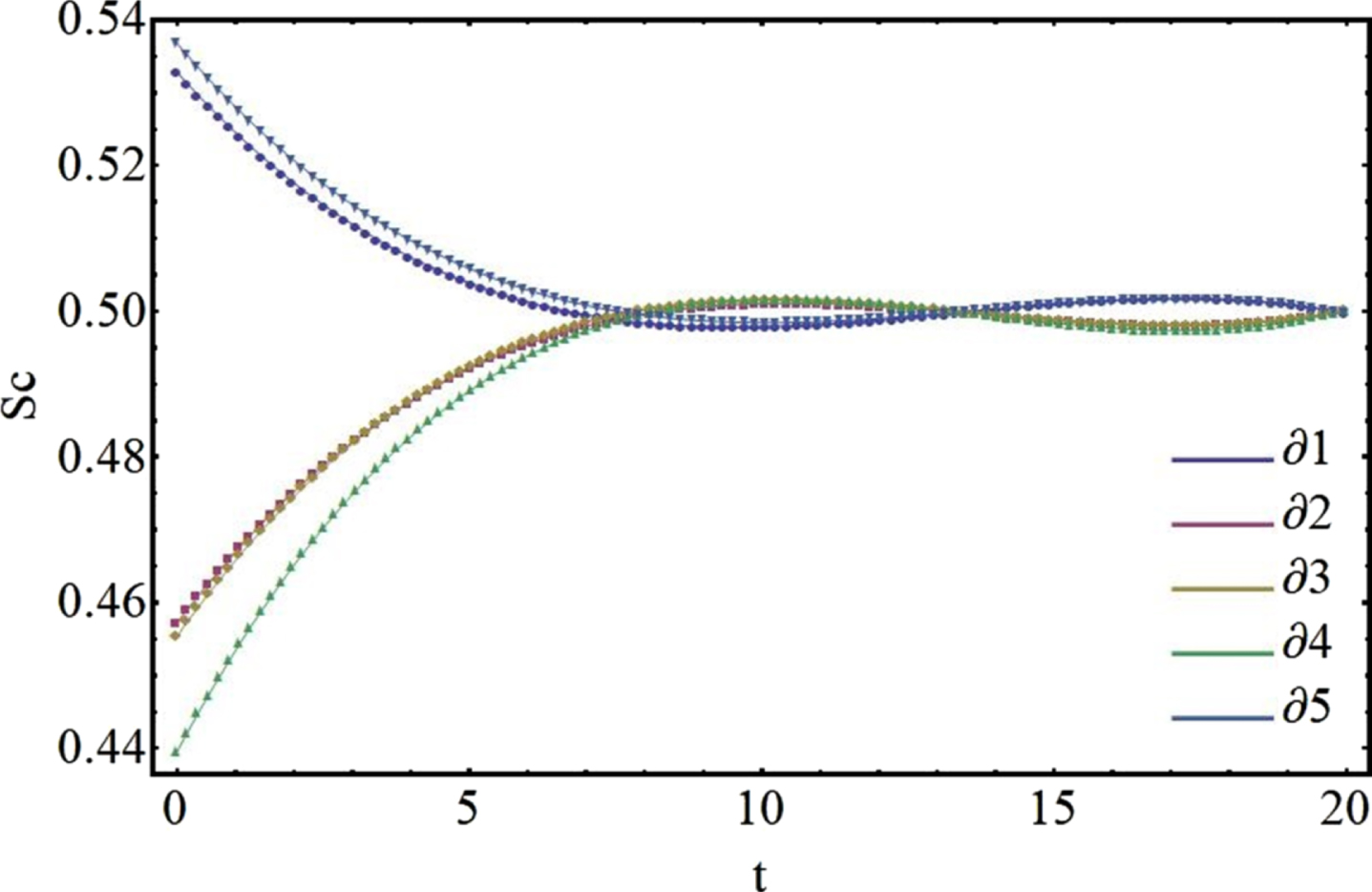
Representation of t-spherical geometric operator with different t.
Table 7 conclude that the outcomes of the ranking are consistent with the increase in parameter t. In addition, we will consider that parameter t has a relatively large value, and a relatively small score function.
The notions of preference relation, fuzzy preference relations and spherical fuzzy decision making have been focused by numerous researchers to deal with uncertainties by positive, neutral and negative membership grades. In order to deal with real life circumstances when it became necessary to consider all these notions in a single hybrid model, we introduced the concept of t-spherical fuzzy preference relations by hybridizing the concepts of fuzzy preference relations and SFSs. To achieve our goal, the paper is divided into three parts, first part elaborated the deficiency in the existing operational laws of t-SFSs and then proposed novel improved operating laws that tested with three extreme conditions. Second part of the paper discussed the new way to rank the t-SFNs, that can deliver a consistent effect with a minor t-SFN modification. Final part is the main contribution of the paper, the t-SFPR, the consistent t-SFPR, the incomplete t-SFPR, the consistent incomplete t-SFPR, and the acceptable incomplete t-SFPR were defined. Applications of proposed t-spherical fuzzy preference relation in multi-criteria decision-making is demonstrated by a numerical example related to evaluation of the product quality of the online shopping platform. The novel score method and t-SFPR-based operational laws were implemented to the numerical example and rank the considered alternation by selecting the finest alternatives in a given list of alternatives. The comparison analysis of the final ranking computed by proposed techniques given to justify the feasibility, applicability and reliability of the proposed techniques.
We will continue to explore various preferential relations to address ambiguous information in the future and will apply them to real decision-making problems.
Footnotes
Acknowledgments
The authors extend their gratitude to the Deanship of Scientific Research at King Khalid University for funding this work through research groups program under grant number R. G. P. 2/48/42.