






Abstract
In order to improve the distribution efficiency of cold chain logistics and reduce the distribution cost, an optimization model of cross-docking scheduling of cold chain logistics based on fuzzy time window is constructed. According to the complexity of cold chain logistics network, a multi-objective optimization model of cross-docking scheduling of cold chain logistics vehicle routing with fuzzy time window is established. In order to ensure the lowest total cost of cold chain logistics distribution and improve the overall customer satisfaction with service time, the Drosophila optimization algorithm is used to solve the model to obtain the optimal vehicle routing of cross-docking scheduling optimization of cold chain logistics. The simulation test results show that: after the application of the model, the cold chain logistics distribution time is significantly shortened, the distribution cost is significantly reduced, the damage cost is reduced, the carbon emission of vehicles is reduced, and the economic and low-carbon benefits are significantly improved, which can be used as an effective tool to solve the cross-docking scheduling optimization problem of cold chain logistics.
Keywords
Introduction
The development of economy has led to the improvement of people’s living standards. People have gradually changed their concern from the quantity of food to the quality of food. However, the contradiction between the current situation of China’s backward cold chain logistics development and the industrialization of fresh product production and circulation has become increasingly prominent [1, 2]. There is a close relationship between agricultural products logistics and economic development in China for a long time, and there is a two-way causal relationship between them. With the passage of time, the disturbance and contribution proportion of agricultural products logistics to product sales gradually increase.
With the development of cold chain logistics infrastructure equipment and the expansion of social demand for cold chain logistics services, cold chain logistics enterprises are gradually increasing. Now most of the cold chain logistics enterprises are developing to a certain scale, and because of the particularity of the goods carried by the cold chain logistics, they need certain information technology as support, and most of the cold chain logistics enterprises have the development trend of informatization. Enterprises now emphasize to be bigger and stronger, and cold chain logistics enterprises are no exception. Their development also has the trend of collectivization and standardization [3]. In real life, customers’ requirements for service time are not completely rigid. Customers tend to accept that they start to get delivery service at a certain time point or a certain period of time. Early arrival or late arrival will affect customer satisfaction. Therefore, using the fuzzy time window to deal with the booking service time can more accurately reflect the customer needs and psychology, in line with the actual logistics distribution management. Due to the late start of cold chain logistics in China, the scale and institutionalization of cold chain logistics system has not yet been formed, and the contradiction between the development of modern agriculture and the expansion of cold chain logistics products export still exists. The specific performance is: the proportion of fresh agricultural products through the cold chain circulation is low, the circulation information is weak, the circulation efficiency is low, and the cold chain logistics industry is weak. Due to the serious lack of infrastructure capacity, the lag of cold chain logistics technology promotion, the lag of the development of third-party cold chain logistics enterprises, and the imperfection of cold chain logistics laws and regulations system and standards, cold chain logistics has gradually become a hot spot in China [4, 5].
Cross-docking is a kind of logistics strategy, which aims at the rapid transportation and sorting of goods in the supply chain. Cross-docking is also a storage strategy, which aims to reduce or eliminate the storage, so as to reduce the cost of the supply chain. Cross-docking strategy has been widely used in retail, manufacturing and other industries [6]. As a special way of logistics, the biggest technical difficulty of cold chain logistics lies in strict time and low temperature control. Cold chain logistics emphasizes the overall control in the process of goods transportation. If there is a link “broken chain”, that is, the temperature of goods is higher than its maximum storage temperature, it will affect the product quality and safety, and greatly reduce the reliability of the whole supply chain. In addition, the high cost of cold storage also hinders the application and development of cold chain logistics. Many scholars and enterprises have been looking for a timely and efficient operation method for cold chain logistics [7].
Cross-docking scheduling strategy has the characteristics of timeliness, high efficiency and low cost in the logistics system. As the transfer station and connection point in the supply chain, cross-docking greatly improves the logistics efficiency and reduces the storage cost. Therefore, the application of cross-docking scheduling strategy in cold chain logistics, on the one hand, reduces the cold storage demand, greatly reduces the cost; on the other hand, cross-docking makes the goods have the ability to be sorted and loaded quickly, greatly reduces the time of goods exposed to normal temperature, and reduces the risk of “chain breaking”. With the rapid development of storage technology, cold chain logistics, as a new form of logistics, has developed rapidly in China [8–10]. The cold chain logistics distribution of agricultural products not only has the characteristics of relatively short distribution distance, relatively more distribution points, crisscross distribution road network, small single point distribution volume and various distribution varieties, but also has high time requirement for distribution service because most of the goods transported by cold chain logistics are perishable. Therefore, considering the constraints of time window, planning the distribution route in advance can not only reduce the transportation cost of the enterprise, but also improve the service level of the seller and meet the customer demand [11].
At present, most of the cold chain logistics distribution enterprises, especially some small-scale cold chain logistics product distribution enterprises of fresh food, have the problem of low level of informatization. The distribution related business is basically completed by relying on the experience of scheduling personnel, and the level of informatization management is low. But in the process of distribution, if there are many demand points and uneven distribution, and the road network is more complex, if only relying on human experience management, there is no way to efficiently complete the distribution of cold chain logistics products. In addition, cold chain logistics products are generally perishable products, so it is particularly important to ensure the quality of cold chain logistics products in the process of cold chain logistics distribution, so cold chain logistics has strong timeliness and higher quality requirements in the process of distribution. Therefore, how to achieve fast and punctual cold chain logistics distribution business under the condition of reducing the cost of cold chain logistics distribution is a difficult problem faced by many cold chain logistics service providers [12]. In this paper, under the condition of fuzzy time window, the vehicle’s distribution path of cold chain logistics is optimized, to improve the efficiency of cold chain logistics distribution, provide a certain degree of decision-making basis for logistics service providers, an make the decision-making more scientific.
Optimization model of cross-docking scheduling of cold chain logistics based on fuzzy time window
Complexity of cold chain logistics network
Cold chain logistics network is a general term of logistics service network system which is developed under the condition of network economy and information technology to meet the requirements of systematization and socialization of cold chain logistics. It is formed by the organic combination of internal network of cold chain logistics organization, network between logistics organization and other organizations, logistics infrastructure network and logistics information network. Based on the dual constraints of warehouse capacity and path capacity, the customer service time window is fuzzified by deeply describing the customer time preference. The traditional time window constraint (based on hard time window or soft time window) refers to that the customer’s starting service time needs to be within the time range of his appointment. If the customer meets the requirements, the service level is good and the satisfaction is 1; otherwise, the service level is poor and the satisfaction is 0. In real life, customers’ requirements for service time are not completely rigid. After booking service time, customers may expect to get service in a specific period of time. If the service starts within this period, the customer will be satisfied; If the customer gets the service outside the time period, the degree of satisfaction will be reduced. The fuzzy time window is exactly the time window reflecting the customers’ flexible time preference. The network organization chart of cold chain logistics is shown in Fig. 1.
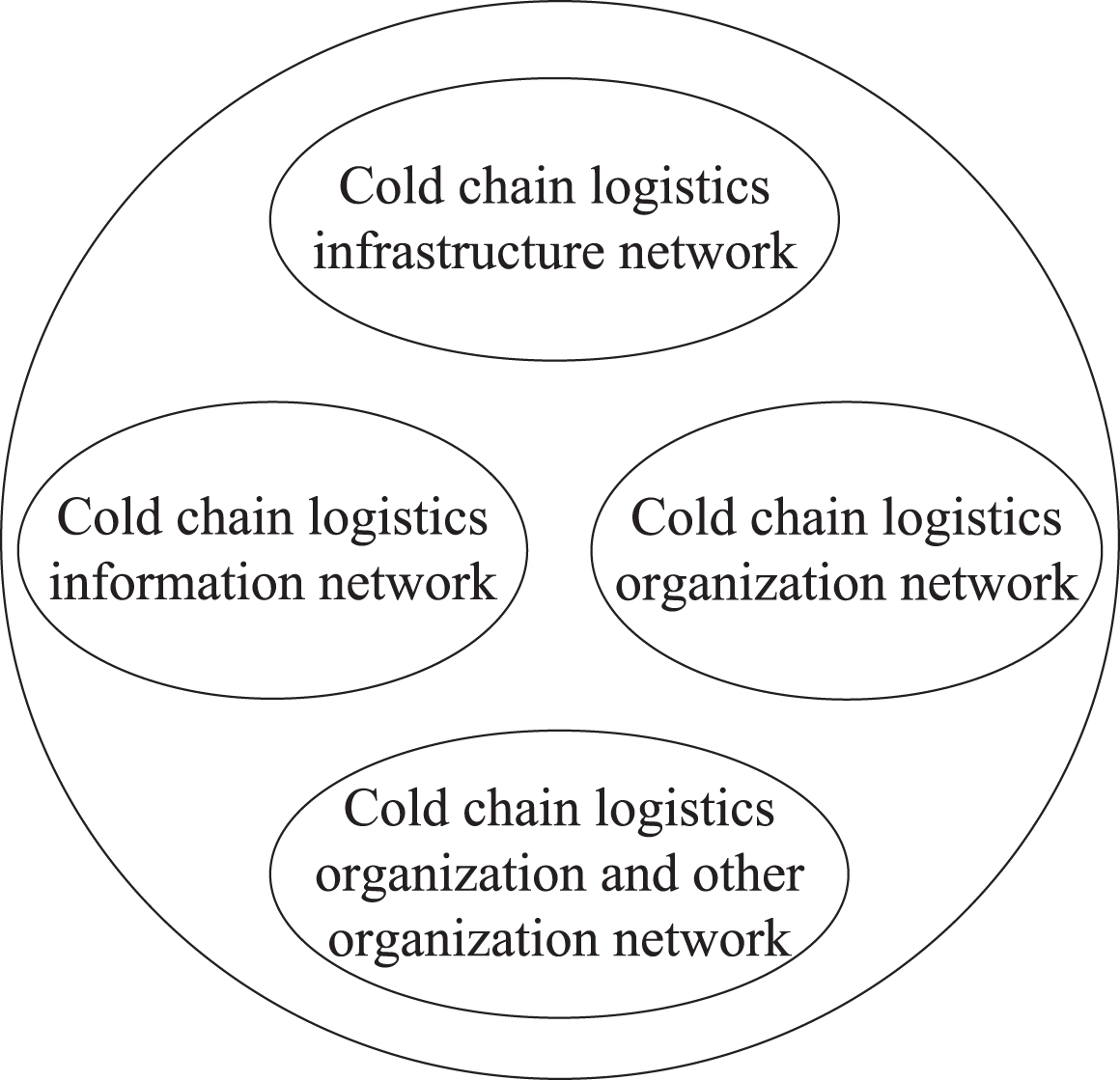
Organization chart of cold chain logistics network.
By analyzing the organization structure of the cold chain logistics network and combining with the operation structure of the cold chain logistics network as shown in Fig. 2, the characteristics of the cold chain logistics network are summarized. It can be concluded that the cold chain logistics network is essentially a complex network, and its complex network characteristics are reflected in the following aspects:
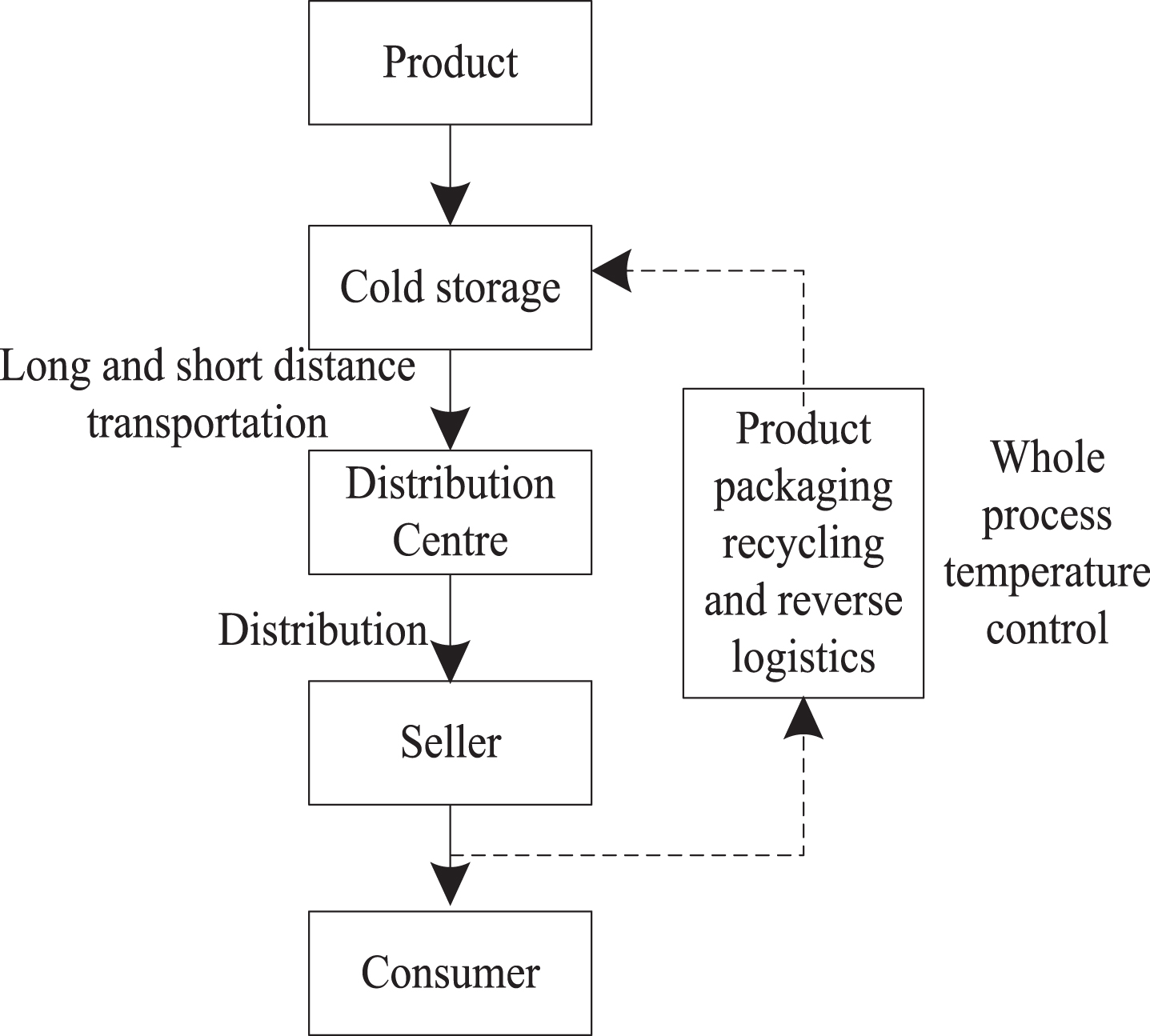
Operation structure of cold chain logistics network.
The network structure of cold chain logistics network is very complex. There are many kinds of network types involved: the logistics network built by each cold chain enterprise, the complex network formed by merger, reorganization, alliance and other ways between enterprises, cold chain enterprises and other enterprises. The mode of transportation involved may be a complex network composed of single or combined transportation. The organizational structure of cold chain logistics network presents the characteristics of open, dynamic and other complex systems. Cold chain logistics network is evolving. At present, the third-party logistics is booming, the domestic cold chain logistics organization is not perfect, and the third-party logistics is also experiencing the transformation from the subordinate organization of cold chain enterprises to the independent organization node. With the increasing number of logistics network nodes, the connection between nodes becomes more and more complex. The cold chain logistics network is composed of several interdependent and interactive internal modules, and the overall structural characteristics of its distribution are highlighted through the mutual coordination and interaction among the modules. Each module of the network has the function of self-adaptation and self-regulation, and does not rely entirely on the regulation of its external environment. The transaction of frozen food has the characteristics of diversity. The connection relationship between cold chain logistics network includes relatively stable relationship, single cooperation relationship, multiple cooperation relationship, competition relationship and so on. The complexity of dynamics of cold chain logistics network. The node enterprise of cold chain logistics network itself is usually a behavior subject, its behavior will constantly change, and different nodes have different behavior characteristics. Cold chain logistics network often has some big key nodes, which plays a very important role in the smooth flow of the whole logistics network. Clustering characteristics of cold chain logistics network. The relationship between nodes of cold chain logistics network is not random, but usually has more frequent business transactions, which has much higher clustering characteristics than completely random network.
Therefore, cold chain logistics network is a complex network in the economic field. These unique characteristics of cold chain logistics network determine that we can abstract the cold chain logistics network as a complex network, build a description model, and then apply the related theories and methods of complex network to study the organizational structure and optimization of cold chain logistics network. This is of great value for us to better understand the cold chain logistics network and promote the development of cold chain logistics in China.
In the process of cold chain logistics cross-docking, it is necessary to establish a mathematical model of the total transportation cost. The general total transportation cost model should include some other forms of logistics cost besides transportation cost, such as the loss cost of goods in the distribution process, the fixed cost of vehicle use, and the goods carried by cross-docking scheduling of cold chain logistics are perishable. Therefore, it is necessary to use some transport vehicles with refrigeration facilities and these refrigeration facilities and equipment in the use of the process is bound to consume a certain amount of energy, so the distribution process is good to produce some additional costs, that is, the cost of energy consumption. In real life, cold chain logistics distribution service providers should not only consider the total cost of transportation, but also consider the level of customer satisfaction with service time, that is, the problem of service quality [13, 14].
Constraints of model establishment
In the cross-docking scheduling and distribution activities of cold chain logistics, the characteristics of the goods should be fully considered, and the appropriate low temperature should always be maintained in the distribution activities process of cold chain logistics. In this paper, the fuzzy membership function is used to transform the fuzzy time window into the customer satisfaction level of cross-docking scheduling service time of cold chain, and the service quality of cold chain cross-docking scheduling is described appropriately.
The vehicle routing problem of cold chain cross-docking scheduling can be described as follows: the cold chain goods required by customers are of a single variety; the demand of each customer for the cold chain product is known; the customer’s location is known; the customer has requirements for the distribution service time of cold chain product; the vehicles with refrigeration and refrigeration facilities are used in the cold chain product distribution process [15]. On the one hand, the research of this paper should ensure the conditions of customer satisfaction with the service time; on the other hand, it should optimize the total cost of cold chain logistics distribution, so as to achieve the goal of minimizing the cost of cold chain logistics distribution while ensuring the service quality. In order to meet these goals, some conditions need to be constrained. The total demand of customers on each cold chain product distribution line must be less than or equal to the maximum load of distribution vehicles; In cross-docking scheduling of cold chain logistics, the vehicles are single type, with the same carrying capacity and limited capacity; The cross-docking scheduling and distribution goods of cold chain logistics is the same commodity; These vehicles are running at a constant speed v; The distance between nodes of cross-docking scheduling of cold chain logistics network is linear.
Fuzzy processing of customer time window
In this paper, the fuzzy processing method of customer time window is used to reflect the actual requirements of customers for cross-docking scheduling of cold chain logistics. The satisfaction degree U (S i ) of customer i on cross-docking scheduling time is defined as membership function of the service start time:
The lower limit and upper limit of fuzzy time window of customer point i are EET i and ELT i . The sensitivity coefficient of customers to time is β. When customer i is serviced in the expected period of time [ET i , LT i ], then his satisfaction with time must be 100%. At other times, the customer satisfaction level of cross-docking scheduling service time of cold chain logistics will decrease with the deviation between vehicle arrival time and expected time. S i is the service start time of customer i.
There are many ways to deal with customers’ satisfaction with cross-docking scheduling of cold chain logistics time. If each customer’s satisfaction with cross-docking scheduling of cold chain logistics time is taken into account, the objective function S1 of customers’ overall satisfaction with cross-docking scheduling of cold chain logistics time can be defined as:
Where, q i is the demand for goods at customer point i; n is the number of customer points.
This processing method is based on the overall customer satisfaction with time. If one of the customers has low satisfaction with time, it will lead to the decline of the overall customer satisfaction. Therefore, in this way, if the overall customer satisfaction is the best, it must be that each customer’s satisfaction with the cross-docking scheduling time is the best [16].
If we consider the average satisfaction of customers on the cross-docking scheduling time, we can use the harmonic average to deal with the overall satisfaction of customers on the cross-docking scheduling time of cold chain logistics. In the field of cold chain logistics cross docking scheduling, time is the key factor of optimization, and cost is regarded as a constraint. In this case, the objective function S2 of customer satisfaction with cross-docking scheduling of cold chain logistics time can be defined as follows:
The importance of customers can also be expressed by the proportion of the quantity of goods required by customers for cross-docking scheduling of cold chain logistics in the distribution plan. This method considers that as long as the customer with large quantity of goods has the best satisfaction with time, the overall satisfaction may reach the best, while the customer with small quantity of goods has little influence on the overall customer satisfaction with time. The objective function S3 of the overall satisfaction of customers to cross-docking scheduling of cold chain logistics time can be set as:
Taking into account the interests of customers and cold chain logistics distributors, the objective function S4 of customers’ overall satisfaction with cross-docking scheduling of cold chain logistics time is defined as:
(1) Fixed cost of distribution vehicles
In the process of goods distribution, the fixed cost of cold chain logistics vehicles mainly includes the cost of vehicle damage, rent and driver’s salary. It can be considered that it does not change with the distance of customers and distance, then the general formula of the fixed cost of distribution vehicles C1 is as follows:
Where m is the number of distribution vehicles and f k is the fixed cost of the k-th distribution vehicle.
(2) Transportation cost of distribution vehicles
The transportation cost here refers to the fuel consumption, repair and maintenance cost of the vehicle, which is related to the number of customers and the distance of the route. Then the transportation cost C2 of cross-docking scheduling and distribution vehicles of cold chain logistics is
Where, c1 is the transportation cost per unit distance; d
ij
is the distance between customer point i and customer point j;
(3) Damage cost
In the cross-docking scheduling and distribution activities of cold chain logistics, although it is refrigerated transportation, due to the accumulation of distribution time, over a certain period of time, the goods will still deteriorate [17]. There are many factors causing the cost of goods damage. In this paper, we mainly consider two kinds of cost of goods damage: one is that the goods are rotten due to the long transportation time, and the other is that the goods damage is caused by the influx of hot air when the distribution vehicles unload the goods at the customer point and open the door. Damage cost C3 can be expressed as:
Where P is the price of cold chain goods;
(4) Energy consumption cost in the process of vehicle configuration
The temperature inside the refrigerated transport vehicle is low, which can ensure that the fresh products do not rot, but there will be heat conduction between the high temperature outside the vehicle and the low temperature inside the vehicle, resulting in the energy consumption of the refrigerated transport vehicle. In addition, every time we arrive at a customer point, we have to open and close the door to load and unload products, and the hot air from outside will enter the vehicle, which will also increase the energy consumption cost of distribution vehicles [18]. This paper assumes that the energy consumption of refrigerated vehicles is only related to the driving time of vehicles and the number of customer points. Then the energy consumption cost can be expressed as follows:
Where, a3 and a4 are the energy consumption per unit time and the proportion of energy consumption cost due to product handling in turn; Tk0 and T0k are the time for the k-th vehicle to leave the distribution center, and the time for completing the distribution task to return to the distribution center respectively.
Based on the above cost elements of cold chain logistics, the total distribution cost F1 of cold chain logistics is calculated as follows:
To sum up, the objective function of the distribution path optimization model for cold chain logistics is as follows:
Where, θ i is the lowest level of customer service; A i is the time when cold chain logistics cross depot scheduling vehicles arrive at customer point i.
There are two objective functions in this model. The first objective function is to maximize customer satisfaction with the cross-docking scheduling time on the basis of considering the value of goods. In this paper, the customer satisfaction of cross-docking scheduling time U (S i ) is defined as the membership function of the service start time, so the overall customer satisfaction with cross-docking scheduling time of cold chain logistics is defined as the weighted average of the quantity of goods. The second objective function is to minimize the cost of cold chain logistics vehicle distribution.
The constraint condition (13) indicates that the number of cross-docking scheduling paths of cold chain logistics should not exceed the total number of vehicles;
The constraint condition (14) indicates that both the starting point and the return point of cross-docking vehicles are distribution centers;
Constraint conditions (15) and (16) indicate that each demand point (customer point) is delivered only once by a delivery vehicle;
The constraint condition (17) indicates that the total load of goods on each route cannot exceed the total load of freight vehicles;
The constraint condition (18) represents the process of fuzzy time window processing;
The constraint condition (19) indicates that each customer’s satisfaction with time must be higher than the minimum satisfaction specified by the customer;
The constraint condition (20) represents an expression of the vehicle arriving at the customer point;
The constraint condition (21) represents a constraint on the service start time in a fuzzy time window.
The path optimization problem with fuzzy time window is more complex than the general one. In the actual distribution, cold chain logistics distribution enterprises often have a predetermined minimum service level of a single customer, and on the premise of not less than this customer service level, and then it can optimize the effect of cross-docking scheduling and distribution of cold chain logistics. On the one hand, it can make the total cost of cold chain logistics distribution lowest; on the other hand, it can improve the overall customer satisfaction level of service time. Based on this fact, the model processing includes two parts: fuzzy time window processing and multi-objective function processing.
The first part is the processing of time window: each customer has two time windows, one is the expected time window, that is, [ET i , LT i ]. The other is the tolerable time window, that is, a period of time extended at both ends of the time window expected by customers, i.e., [EET i , ET i ] and [LT i , ELT i ]. According to the minimum service level of a single customer θ i and fuzzy membership function, it can calculate the time window range [e i , l i ] of cross-docking scheduling for single customer point i, as the constraint of customer service time window.
The second part is to deal with the multi-objective function: the overall satisfaction level of customers to the service time of cross-docking scheduling is set as a fixed value, and it is taken as the constraint condition of the objective function of cold chain logistics distribution cost, so that the multi-objective programming problem is transformed into a single objective optimization problem,
Where,
Target model after processing:
The objective function is to minimize the distribution cost of cold chain logistics.
The constraint condition (25) represents the overall satisfaction level of customers to the cross-docking scheduling service time;
The constraint condition (26) indicates that the number of cross-docking scheduling paths of cold chain logistics must be less than or equal to the number of vehicles;
The constraint condition (27) indicates that both the starting point and the return point of the distribution vehicle are the distribution center;
Constraint conditions (28) and (29) indicate that each demand point is delivered only once by a delivery vehicle;
The constraint condition (30) indicates that the total load of goods on each path cannot exceed the total load of freight vehicles;
A constraint condition (31) represents an expression of a vehicle arriving at a customer point;
A constraint condition (32) represents a constraint on the service start time in a fuzzy time window.
Drosophila optimization algorithm is a swarm intelligence optimization algorithm based on Drosophila foraging behavior. Drosophila melanogaster has good olfactory and visual organs. It can sense the food source 40 km away by olfaction, and then find the specific location of food by keen vision when it is close to the food source. The process is simulated by Drosophila optimization algorithm, and the iterative search is based on olfactory and visual behavior. Through the optimization of Drosophila population location center, the optimal solution of cross-docking scheduling optimization problem of cold chain logistics is finally obtained [19]. The basic flow of Drosophila optimization algorithm is as follows: Initialize the position of individuals in the population; Olfactory search: select the direction and position randomly from the current position of the individual to search; Individual evaluation: calculate the concentration judgment value and taste concentration of the new location searched by the individual; Visual search: select the position with the highest flavor concentration, and individuals search the position according to their vision; Determine whether the algorithm ends. If yes, the optimal solution will be output; if not, go to step (2) for iteration.
The basic Drosophila algorithm is mainly used for function optimization. When it is applied to the cross-docking vehicle scheduling problem, we need to improve the coding method, taste concentration decision function, olfactory search and visual search.
Encoding and decoding scheme
In the cross-docking vehicle scheduling problem of cold chain logistics with constraints, it is necessary to schedule vehicles and handling equipment. The coding of Drosophila individual includes not only the scheduling of vehicles, but also the scheduling of transportation tasks. Therefore, this paper uses the integer based coding method, Drosophila individual X
i
= (xi,1, xi,2, xi,3, …, xi,I+O) is represented by vehicle ordering, where xi,n represents the vehicle code, the first I elements represent I inbound vehicles, and the last O elements represent O outbound vehicles. On this basis, a two-stage decoding algorithm is proposed. The first stage is vehicle decoding, that is, the order of Drosophila individual representing the vehicles entering the customer point. The second stage is the decoding of handling equipment. According to the generated vehicle sequencing, the task processing sequence is obtained, which is assigned to W handling equipment to generate W sub scheduling sequences under the condition of meeting the constraints. The decoding process is as follows: According to the Drosophila individual code, the order of vehicles in and out of customer points is obtained. According to the order of vehicles entering and leaving the customer point, the sequence of handling tasks Task = (t1, t2, …, tk) is obtained. The task processing sequence Aw of W handling equipment is obtained by assigning the handling task sequence to W handling equipment according to constraints.
Population initialization
In order to enhance the global search ability of the algorithm and take into account the quality of the initial population, 30% of the individuals in the initial population are generated by greedy search method, and the remaining 70% are generated by random method.
Taste judgment function
According to the Drosophila individual coding, the cross-docking vehicle scheduling scheme of cold chain logistics is generated after decoding. The completion time of each handling equipment is calculated, and the maximum equipment completion time is the taste value (fitness value) of the individual.
Olfactory search and visual search
For the scheduling problem of cross-docking vehicle with constraints, the sequence of vehicles entering the customer point and the sequence of handling equipment operation tasks have an impact on the quality of the solution. The order in which the vehicle enters the customer point determines the total task processing order. Therefore, the ranking of vehicles has a great influence on the quality of the solution. However, the order of handling equipment processing task has little effect on the quality of solution, so the olfactory search is also divided into two stages, namely vehicle sorting adjustment and handling equipment scheduling.
In the vehicle sorting adjustment stage, the insertion operation is adopted, that is, to randomly select the inbound vehicle at position r and the outbound vehicle at corresponding position. They are inserted into the inbound vehicle or outbound vehicle at position k, and then the corresponding tasks of vehicles with position change are adjusted. In the stage of task processing sequence adjustment of handling equipment, two adjacent tasks of t k and t l in the task processing matrix are made exchange operation. In the process of exchange, only the task processing sequence is adjusted, and the sequence of vehicles entering the customer point is not changed.
In the visual search stage, each population center generates SP individuals, that is, SP olfactory search operations are performed to achieve local search. Visual search belongs to trend replacement, that is, each individual in the population updates its position to its optimal domain individual.
Cooperative guided evolution strategy
Traditional Drosophila algorithms rely on olfactory search and visual search to update the population, and lack of cooperation among individuals. In order to improve the global search ability and search efficiency of the algorithm, and make the individual be guided in a direction, this paper proposes a cooperative guiding evolution strategy based on the dominant individual, and designs a two-point crossover cooperative operator.
At the same time, the top 30% individuals with the highest evaluation are kept as the guide set. For each Drosophila individual, individuals in the guidance set or individuals outside the guidance set are selected according to the probability for cooperative operation [20]. The cooperative operation method is as follows:
Drosophila individual X i chooses another individual X r through roulette. Then, two numbers q1 and q2 are generated randomly from 1 to L. A new individual X new is obtained by crossing two points, i.e., position 1∼q1 inherits from X r , position q1 ∼ q2 inherits from X i , and position q2∼L inherits from X r . At the same time, the task corresponding to the vehicle with position change is adjusted to obtain the optimal vehicle distribution path of cross-docking scheduling of cold chain logistics.
Results
Known conditions
This study takes a cold chain logistics distribution center in a city as an example, mainly aims at the 20 distribution points (customer points) around to optimize the cross-docking scheduling of agricultural products’ cold chain logistics. According to the speed limit of vehicles in a city, without considering the traffic congestion, assuming that the vehicles are driving at a constant speed of 50 km / h, four vehicles are allowed to cross the warehouse and dispatch according to the total distribution amount of the cold chain logistics distribution center. The unit refrigeration cost of vehicles is set to take No. 92 gasoline as an example, and the distance from the cross depot dispatching distribution center to each distribution point is shown in Table 1. The time window, service time and demand of each distribution point are shown in Table 2.
The distance from the distribution center to each distribution point
The distance from the distribution center to each distribution point
Time window, service time and demand of each distribution point
Matlab simulation software is used to test the application effect of the model in this paper. After running the program, the example is randomly solved for many times, and the optimal solution results of selected group are shown in Table 3.
Solution results of this model
Solution results of this model
Before and after the application of the proposed model, the specific situation of vehicle carbon emissions in cross-docking scheduling of cold chain logistics is shown in Fig. 3.
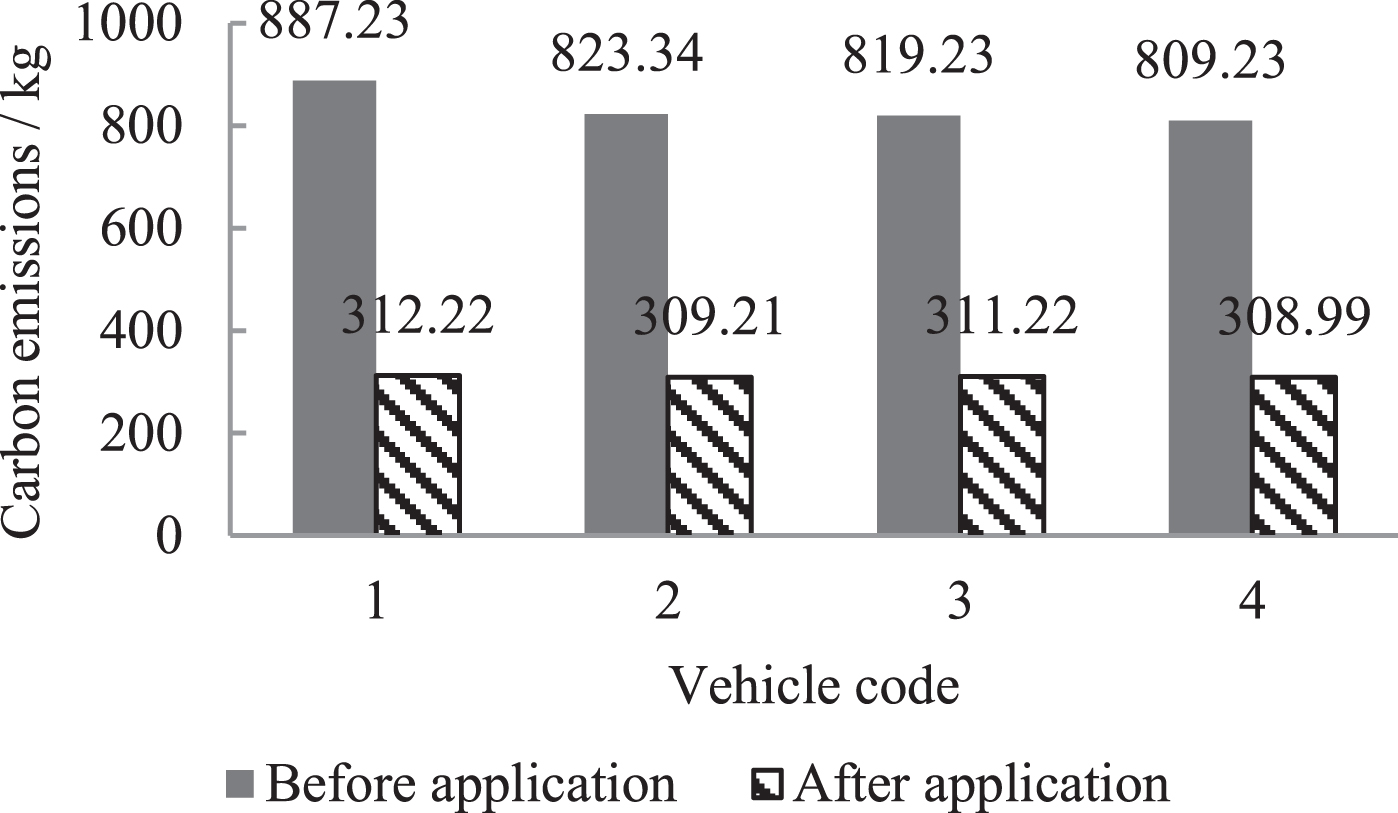
Changes of vehicle carbon emissions in cross-docking scheduling of cold chain logistics before and after the application of this model.
As shown in Fig. 3, before and after the application of the proposed model, the carbon emission of vehicles in cross-docking scheduling of cold chain logistics changes significantly. The carbon emission of vehicles before the application is greater than 800 kg, and the carbon emission of vehicles after the application of the proposed model is less than 320 kg, with significant difference. After the application of this model, it can effectively shorten the path, greatly reduce the carbon emission of vehicles in cross-docking scheduling of cold chain logistics, with significant low-carbon effect.
Before and after the application of the proposed model, the cost change of cross-docking scheduling and distribution of cold chain logistics is shown in Fig. 4.
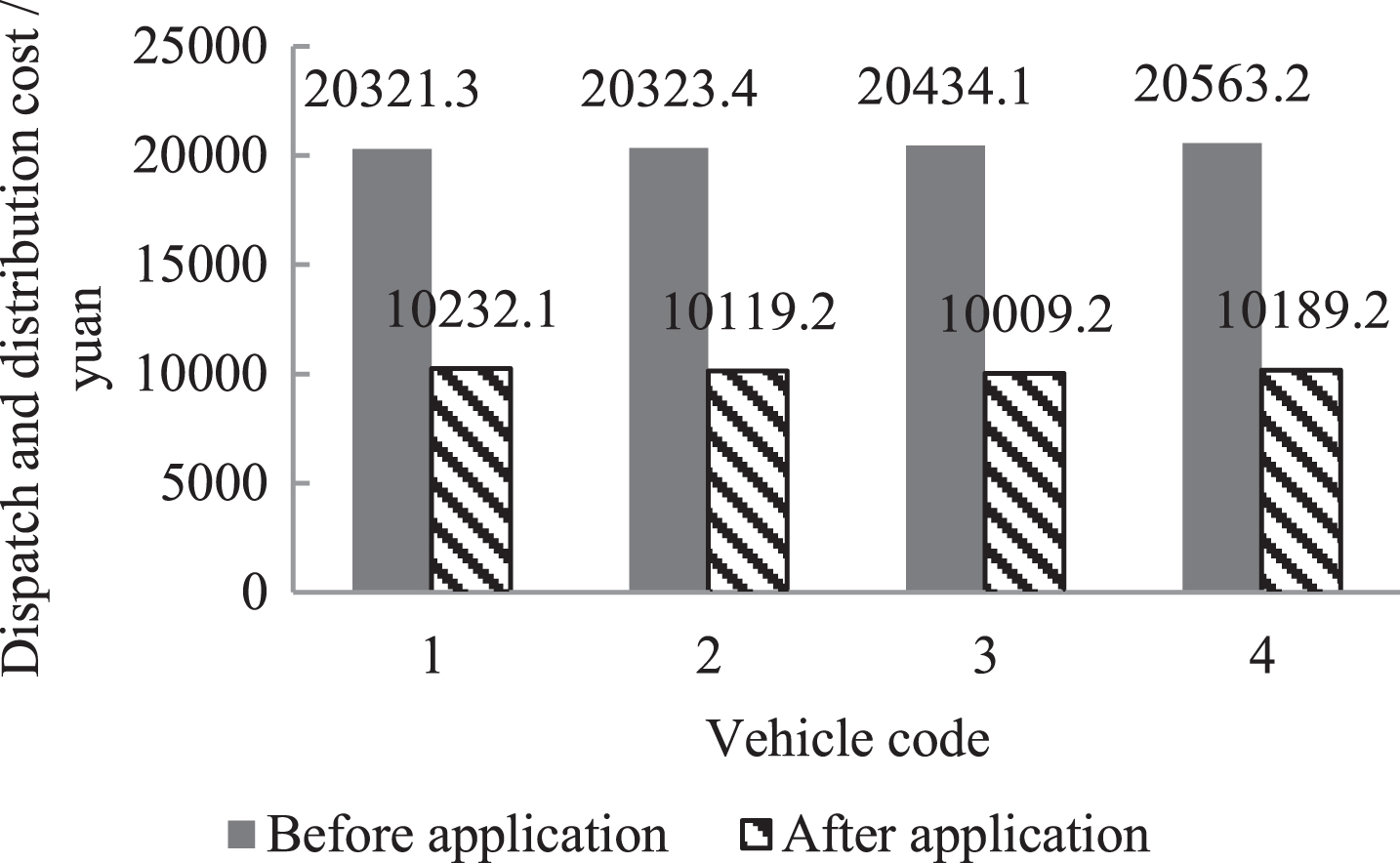
The change of cold chain logistics delivery cost before and after the application of this model.
As shown in Fig. 4, before and after the application of the proposed model, the cost of cross-docking scheduling and distribution of cold chain logistics changes significantly. Before the application, the maximum cost of cross-docking scheduling and distribution of cold chain logistics is as high as 20563.2 yuan. After the application, the maximum cost of cross-docking scheduling and distribution of cold chain logistics is only 10232.1 yuan. It can be seen that after the application of this model, the cost of cross-docking scheduling and distribution of cold chain logistics can be reduced, and the economic profit can be improved significantly.
Before and after the application of the proposed model, the change of delivery time of cold chain logistics is shown in Fig. 5.
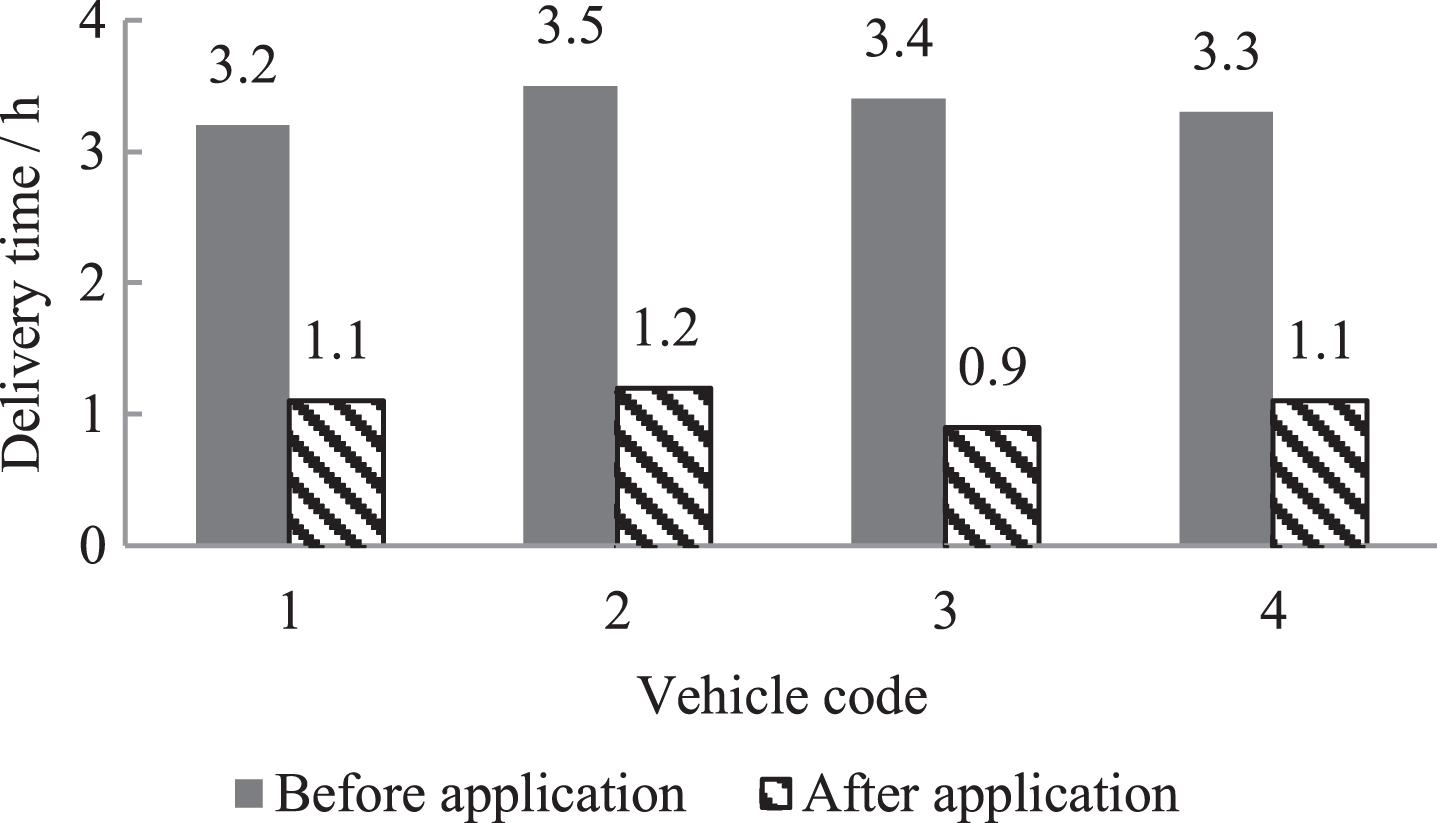
The change of cold chain logistics delivery time before and after the application of this model.
As shown in Fig. 5, before and after the application of the proposed model, the delivery time of cross-docking scheduling of cold chain logistics is significantly shortened. After the application of this model, the delivery time of cold chain logistics is at least 2.5 h shorter than before.
Before and after the application of the proposed model, the change of damage cost in cold chain logistics is shown in Fig. 6.
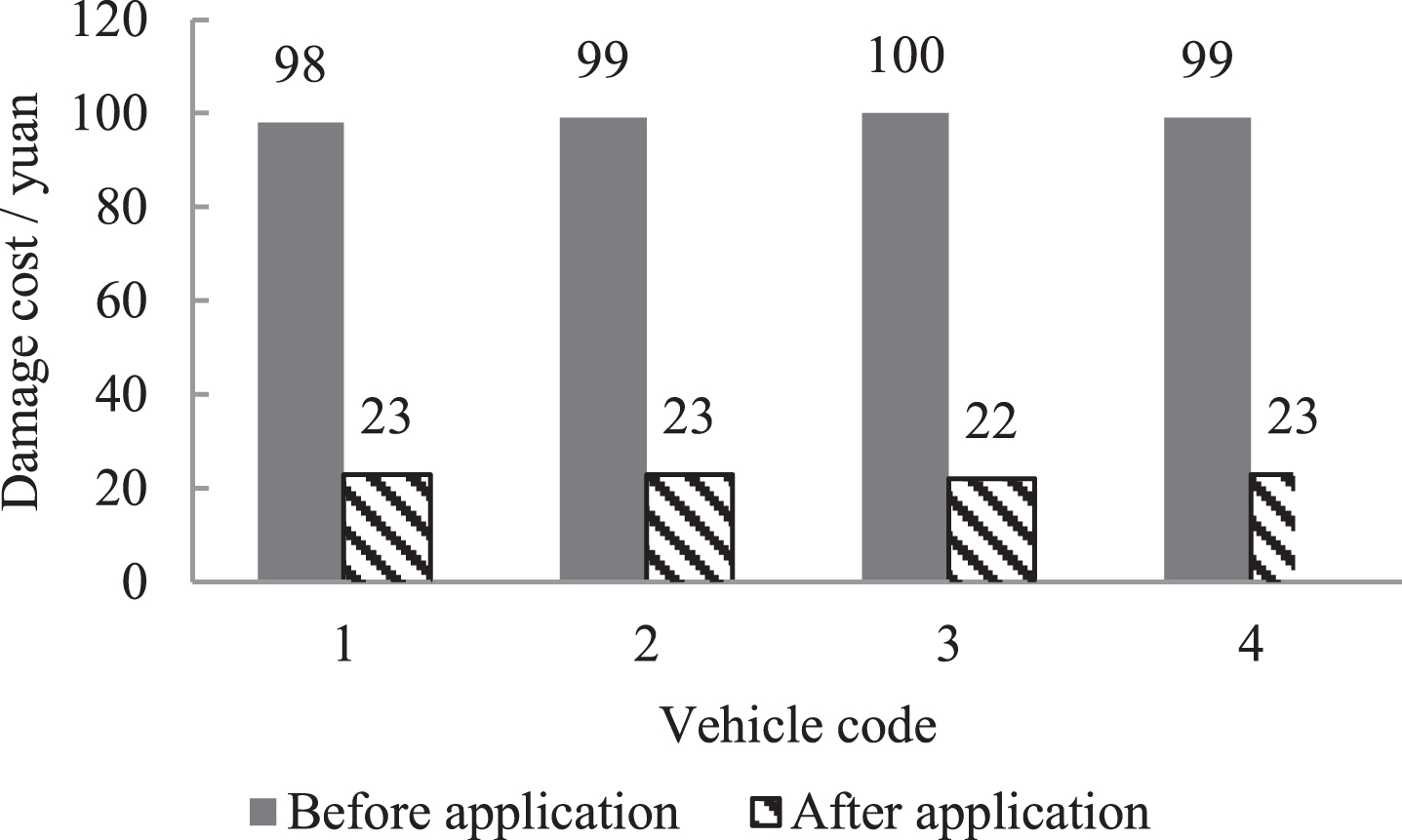
The change of damage cost in cold chain logistics cross-docking distribution before and after the application of this model.
As shown in Fig. 6, before and after the application of the proposed model, the change of damage cost in cross-docking scheduling of cold chain logistics is obvious. Before the application of this model, the damage cost of cross-docking scheduling and distribution of cold chain logistics is as high as 100 yuan; after the application of this model, the damage cost of cross-docking scheduling and distribution of cold chain logistics is only 23 yuan. The comparison shows that the proposed model can effectively reduce the damage cost of cross-docking scheduling and distribution of cold chain logistics, and the economic benefit is significant.
After the application of the proposed model, the number of goods delivered on time in cross-docking scheduling of cold chain logistics is shown in Table 4.
The number of goods delivered on time after the application of this model
The number of goods delivered on time after the application of this model
As shown in Table 4, after the application of the proposed model, when making cross-docking scheduling of cold chain logistics, the number of goods delivered on time is consistent with the actual demand, and there is no difference. This model can accurately cross-docking distribution according to the demand of goods, and has application value.
Analysis of the current situation and causes of China’s cold chain logistics
Now the variety and resources of food are more and more abundant. In some coastal areas of China, the cold chain logistics develops rapidly, and after continuous improvement, it has the characteristics of standardization and specialization, but it is still a little less than the United States and other developed countries. China produces an average of 2 trillion yuan of food every year, but a small part of food spoils. The main reason is that the refrigeration technology is not perfect, leading to food waste. In particular, fruits and vegetables are most likely to be damaged in the process of picking, transportation and preservation. At present, because of the increase of China’s national income, we need more frozen or fresh food. Therefore, it needs more complete freezing logistics, more advanced freezing technology, and more frozen capacity. The process of cold chain logistics is gradually standardized. In recent years, a large number of food and drug enterprises have outsourced the business process of cold chain. Restricted by various national systems, cold chain logistics is becoming more and more standardized. This industry has gradually developed from the initial stage, and the technical level has also been improved. With the combination of intelligent means and positioning system, it can accurately understand the freezing information. However, in China, the cold storage facilities are not perfect, the distribution is not balanced, and the operation efficiency is too low due to the limitation of network technology. It lacks of some targeted regulatory system and leading enterprises, and there is no good leading enterprise to lead the way. Therefore, the above reasons limit the development of cold chain logistics, leading to these reasons, including that the relevant laws and regulations are not perfect, enterprises do not have a standard, and always can not achieve the desired effect. Because it is an emerging industry, there are still many competitors. As people’s demand for refrigerated products increases, all small and medium-sized enterprises are nervous and rush to join the refrigerated industry, so there will be exclusion and competition. In China, the global positioning system is not perfect in cold storage, and occasionally the cold storage temperature can not be controlled, so there is no way to ensure the quality of products. There is no professional staff for management control, in order to develop refrigeration technology better, we need to cultivate more professional management personnel.
Development countermeasures of cold chain logistics
Through a comprehensive understanding of cold chain logistics technology at home and abroad, the development of China’s cold chain technology needs the help of foreign experience and the strong support of Chinese government departments. The government must formulate more relevant systems to supervise and control this, so as to make it gradually standardized. At the same time, a series of preferential policies should be formulated correspondingly and appropriately to encourage enterprises to develop forward, improve the industry standard, make the enterprise on the right track, and make every procedure have standardization, so as to create a good corporate image, and let the enterprise get sustainable development.
It is necessary to do a good job in infrastructure construction. Infrastructure construction is the primary condition for the development of cold chain logistics, there is no good foundation, in other procedures may also appear a variety of problems, hinder its development. To cultivate professional talents, enterprises should recruit more talents with high knowledge level in the future recruitment process, and regularly carry out professional training for enterprise employees, strengthen the study and research of refrigeration system, and realize information management. So far, information technology is developing all over the world. It is imperative to combine cold chain logistics with information technology. By means of global positioning system and intelligent temperature regulation, cold chain logistics will become more and more international and intelligent, which is convenient for residents.
Conclusion
In recent years, China’s national economy continues to improve, the level of national consumption has also improved, and people’s lifestyle and rhythm have changed. People’s demand for food that is easy to deteriorate and needs to be refrigerated is also increasing. Nowadays, the society attaches great importance to the low-carbon economy, and the cold chain logistics has been advocated by the society and has been growing. At the same time, cold chain logistics is restricted by the domestic and international environment. Although the demand for cold chain logistics has increased a lot and the technical level and procedures of cold chain logistics have developed rapidly, there are still many problems that are difficult to solve.
The particularity of cold chain logistics is reflected in two aspects: one is the particularity of the object, the object of cold chain logistics is perishable fresh food. The second is the particularity of the working environment. The storage, transportation and working environment of cold chain logistics must be limited in the suitable low temperature environment. According to this particularity, combined with my own research, this paper defines cold chain logistics as: cold chain logistics refers to a set of comprehensive facilities and management means that use certain technical means to make fresh food in the whole process of harvesting, processing, packaging, storage, transportation and sales under certain suitable conditions, and maintain the quality of fresh food to the greatest extent. Cold chain logistics is a kind of logistics system composed of various logistics links in a completely low temperature environment. Cold chain logistics is a low-temperature system engineering with high-tech content, which focuses on the production, transportation, sales, economy and technology of perishable and fresh food, coordinates the relationship between them, and ensures the quality and safety of perishable food in the process of processing, transportation and sales.
Aiming at the optimization problem of cross-docking scheduling of cold chain logistics, this paper designs the cross-docking scheduling optimization model of cold chain logistics based on fuzzy time window, and verifies its application effect in the experiment. Before the application of this model, the carbon emission of cold chain logistics vehicles is more than 800 kg, and after the application, the carbon emission of vehicles is less than 320 kg; Before the application of the model, the maximum cost of cross-docking scheduling of cold chain logistics is 20563.2 yuan. After the application, the maximum cost of cross-docking scheduling of cold chain logistics is 10232.1 yuan; Before and after the application of this model, the delivery time of cross-docking scheduling of cold chain logistics is significantly shortened. After the application of this model, the delivery time of cold chain logistics is at least 2.5 h shorter than before; Before the application of this model, the damage cost of cross-docking scheduling and distribution of cold chain logistics is as high as 100 yuan; after the application of this model, the damage cost of cross-docking scheduling and distribution of cold chain logistics is only 23 yuan; In the cross docking scheduling and distribution activities of cold chain logistics, the characteristics of goods should be fully considered, and the appropriate low temperature should always be maintained in the process of cold chain logistics distribution activities. The fuzzy membership function is used to transform the fuzzy time window into the customer satisfaction level of cold chain cross docking scheduling service time. The model designed in this paper can effectively improve the customer satisfaction level. After the application of this model, the number of goods delivered on time is consistent with the actual demand, and there is no difference.
To sum up, this model can optimize the effect of cross-docking scheduling of cold chain logistics, and has application value.
Footnotes
Acknowledgments
This work was supported in part by the Social Science Research Foundation of Fujian Province, China, Grant NO FJ2018B020.