







Abstract
WSN (Wireless Sensor Network) is a network of devices which can transfer the data collected from an examined field via wireless links. Thus secure data transmission is required for accurate transfer of data from source to destination as data passes through various intermediate nodes. The study intends to perform shortest, secure path routing on the basis of trust through novel Hybridized Crow Whale Optimization (H-CWO) and QoS based bipartite Coverage Routing (QOS-CR) as well as to analyze the system’s performance. Nodes are randomly deployed in the network area. Initially, a trust metric formation is implemented via novel H-CWO and the authenticated nodes are selected. Then through the secure routing protocol, Cluster head (CH) is selected to perform clustering. Neighbourhood hop prediction is executed to determine the shortest path routing and secure data transfer is performed through novel QOS-CR. The proposed system is analyzed by comparing it with various existing methods in terms of delay, throughput, energy and alive nodes. The results attained from comparative analysis revealed the efficiency of the proposed system. The proposed novel H-CWO and QOS-CR exhibited minimum delay, high throughput, energy and maximum alive nodes thereby ensuring safe transmission of data from source node to destination node.
Keywords
Introduction
Wireless sensor networks comprises of nodes like sensor and sink node. Nodes are intersected with each other. Nodes are collectively connected to sink. This kind of wireless network is named as low power low loss networks. This network can be used as distinct node and consuming less power which are functioned in hazardous situations. Nodes, which are not squarely in transmission path to sink, data is informed within a multi hop manner. The closest node connecting to sink, finish relaying of data for next node, this makes hotspots near sink. Nodes which are located near hotspot, will mitigate the energy rapidly, this would affect lifetime of WSN [1]. Scalability of WSN can be obtained from hierarchical scheme of routing. Neighbourhood energy scheme is fixing the problem of energy hole in conventional approaches [2]. Thus WSN is preferred for its advantages less cost, and less power consumption nodes. Cluster aided routing protocol for dynamic networks would mitigate consumption of energy as well as enhance efficiency of energy [3]. Clustering is propounded in wireless sensor networks for the power consumption. Continuously varying nature of nodes is problem in reality. Selection of Cluster head is burdensome that mitigates performance of network [4]. Clustering mode of analysis is familiar scheme in data mining. In this process, data in similar nature are incorporated collectively. K-means algorithm in clustering is used in clustering process of numerical data. Implementing clustering algorithm is quite simple. And clustering has capability of manipulating massive data. Computing in mobile edges are utilized as carriers in so many mobile intelligence supporting applications. There is requirement of suggestion making for user regarding appropriate services. For this process, quality of service is embedded for recommendation of applications. The dynamic complicated world needs computational intelligence for handling. Algorithm of whale optimization was built from nature of hunting intelligence of whales. As surrounding and examining in hunting nature of whale, this optimisation algorithm of whale is finding finest agent. In addition, Routing protocol of multi-hop was propounded for security reason and energy efficient in internet of things aided wireless sensor network. The nodes are integrated into clusters by implementing nearest neighbourhood method [5]. The present study proposed a novel Hybridized Crow Whale Optimization (H-CWO) and novel QoS based bipartite Coverage Routing (QOS-CR) for secure and trustworthy data transfer from source to destination. The H-CWO is employed to perform optimization and trust metric formation. This trust metric formation is essential to eliminate the malicious nodes and find the authenticated nodes for further processing. The authenticated nodes are further considered for routing. This study employed QOS-CR to perform routing in the shortest path. This method also performs efficient clustering. In bipartite coverage routing, each node is connected with every other node in the network. This eventually increases the routing performance as it selects the shortest path among all the connected paths. Both the algorithms are employed to accomplish secure data transfer with minimum delay and efficient throughput.
The major contributions of this study is discussed below: To perform trust metric formation for individual nodes in WSN through novel Hybridized Crow Whale Optimization (H-CWO). To implement shortest path routing and neighbourhood hop prediction through novel QoS based bipartite Coverage Routing (QOS-CR). To analyse the performance of the system through comparison of the existing and proposed techniques in terms of energy, throughput, delay and alive node.
Paper organization
The forthcoming section II explains the existing techniques that pertains to secure data transmission in a trustworthy way. The proposed work that includes novel H-CWO and QOS-CR is discussed in section III. The results of the proposed system is discussed in section IV. The entire proposed system is concluded in section V.
Review of Existing work
Algorithm of crow for clustering in wireless sensor networks
WSNs are sources which are controlled by less power distribution. Hierarchical method of routing like lower energy adaptive cluster process is efficient scheme, of organized clusters. Water Cycle Algorithm (WCA) was propounded for the protocol of clustering hierarchy in WSN. LEACH using WSN are cost efficacious while to find best node as cluster head [6]. Wireless sensor networks prefers so many clustering approaches to optimize efficiency of energy. Novel method of integration of selecting of cluster head and also algorithm of whale was propounded in name of optimization of whale in clustering [7]. Cluster heads are decided in energy constrain [8]. For efficacious communication in wireless sensor network, the routing protocol of energy aware in hybridised optimisation approach. Setup, transmission and measurement are the three phases in this algorithm. Delay, energy, distance between cluster and connection time, were calibrated by this method. Setup phase decides cluster head during communication of base station through consuming energy. Measurement phase utilized residual energy [9]. In addition, algorithm of crow search is population kind of Meta heuristic optimisation scheme. Base idea of framing this algorithm is intellectual behavioural nature of crows. Optimal results of global was acquired by incorporating the algorithm k-means and crow search [10]. On the other hand, the process of clustering utilizing the Crow Search Algorithm (CSA), had implemented with novel approach of fast-fuzzy-c-means. Fast-fuzzy-c-means was proposed for selecting cluster centre [11]. Major advantage of algorithm of crow search, has capability of global analysis even in complicated optimisation threats [12]. Similarly, the CSA was considered as optimisation method from nature inspiration. The method of meta heuristic was considered one of the efficient method which need only couple of parameters adjusting such as time of execution as well as rate of coverage [13]. In addition, Taylor series as well as crow search were incorporated together, to form novel method which is on the basis of functions about distance between nodes and cluster, energy and density of traffic and delay in packet transmission [14]. Moreover, for the process of cluster head selection, two methods were integrated collectively such as algorithm of crow search and hybridised grey wolf for fixing the problem of early coverage to preserve from exploration of search space. The novel technique of elephant herd optimisation type of clustering was said to be developed in future for balancing energy and mitigating network lifespan in clustering of WSN [15]. Besides, FUZZY C-MEANS is the technique which is efficient in selecting cluster head in random manner. There is probability of occurring delay in coverage during selection. Crow search is recommend for optimising global and rapid coverage. So by integrating above two techniques, would fix problem of coverage delay. This method analysed with bench mark databases and two artificial database to find efficiency. From the result, crow search need minimum parameter consideration in reducing complexity [16]. From this context, multi swarm collective approaches was propounded to find agent that stabilises phases like examination and utilisation. This paper also analysed numerical efficient challenge in clustering. Optimal solution for finding centre of cluster, intra and inter distances of clusters was propounded for enhancing optimisation in finding greatest agent in algorithm of whale [17].
In addition to this, Data mining utilizes clustering to find similar object groups by attributes value. Algorithm of whale optimisation is one of the algorithm meta-heuristic, whale optimisation is propounded for swam hunting nature of whale (megaptera novaeangliae (scientific term)). There were seven number of benchmark dataset and one artificial dataset in machine learning of unique client identification repository [18]. The disadvantage of k-means kind of distributed clustering in WSN is problem with relative minimum in partition of cluster. This results inaccuracy. To conquer this problem novel robust method of distributed clustering was proposed. For optimising global in partition, optimisation of moth flame was propounded. This technique helps to find out shortest path for every node. The collective diffusion method was propounded for finest moth fixing and optimal value for neighbour node [19]. Detecting process on the basis of weight was recommended to robust. De-process of outlier was conducted in detection on the basis of weight. Increase in size and number of sensors, there will be challenge in complexity in this algorithm [20]. Furthermore, Algorithm of multi objective (k-means and swarm are incorporated for comparison analysis) optimisation of whale was propounded for network of peer to peer. The deviance in Euclidean and symmetry was conquered by this propounded study. Finding shortest path was considered as solution in objective space [21]. To achieve better performance of watermarking, clustering was referred. This is some sort of digital marking which is in robustness using clustering optimisation scheme. The process are included in this study, such as image scaling, separation of blocks, calibration of feature vector (values of pixel), and placing region. Reverse process were used for rearranging messages [22]. Moreover, Novel opposition based chaotic was propounded for algorithm of whale optimisation for prediction in accurate as well as reliability. In exploration and exploiting process, opposition based chaotic WOP generates populations [23]. On the other hand, Process of selecting clusters was embedded in self-sustainable optimisation algorithm of whale in wireless sensor networks built in internet of things. This method resulted efficiency of network, other parameters required for cluster heads like load, temperature and energy [24]. In the same way, Optimization algorithm of whale was implanted along with bee colony (artificial) in domain of data clustering. Algorithm of bee colony is some sort of algorithms of meta-heuristic [25]. Delay coverage was conquered by imbedding random memory (for searching in algorithm of whale optimisation) and elite memory (develops the coverage performance) in algorithm of bee colony [26]. Likewise, Optimisation of whale algorithm was utilized along with fuzzy clustering for recognition of fraudulent for insurance of automobile [27].
Quality of service in WSN
Most of the existed edge computing techniques are utilized the approach of collaborative filtering. Due to the disadvantage of cold start problem (only suitable for already known data base) in collaborative filtering, the proposed approach was suggested for recommendation system. Collaborative filter was embedded with neighbourhood for novel model. Auto decoder is propounded for evaluating missed data by quality of service [28]. In addition, Delegating sources for the applications of IOTs for WSN, is quite difficult to attain in quality of service constrain. So delegation of sources was attained by a novel approach of adoptive distributed AI in hierarchical method of allocation of source [29]. Adaptive particle swarm optimisation was propounded in this study for function of nodes and load for energy [30]. Likewise, for optimising energy, a novel method of routing algorithm for clustering of neuro fuzzy was propounded in IOTs for WSN [31]. Considering all other nodes are as reliable is disadvantageous in this work. Novel trust model is said to be imbedded in future [32]. Furthermore, the forecast of quality of service in internet of things was imbedded in this study in the context constrain. This method is on the basis of collaborative filtering of neural type. Clustering is embedded with the algorithm of fuzzy for contextual data [33]. Additionally, Medium-access-control, is more vulnerable for security in communication in wireless networks. In this paper, approaches of content based (which interacts with peer) and schedule based (on time division multiple access, frequency division multiple access, and code division multiple access) medium access control were implemented for their advantages [34]. In addition, Edge computing requires recommendation of service on task based module of quality of service. Deep neutral networks are suggested for the network facing complexity [35]. For learning deep features, a novel factorisation for matrix was incorporated with convolutional neural networks in wireless sensor networks [36]. Besides, incorporation of cyber and physical system requires more secure and recommendation of great quality of service. There is requirement of robust quality of service to be developed [37]. Due to the problem of cold start in collaborative filtering, a method of collaborative filtering in the location constrain, was propounded for forecasting quality of service [38]. Moreover, on the node of hexagonal-grid-lattice, grants the coverage only in twenty one percentage for connection failed node. On the node of square-grid-lattice, is appropriate and provides optimal solution to multipoint relay problem in wireless sensor networks. Using both type of nodes in hexagonal and square grid lattice, for tracking in triangular model as well as three dimensional hull building [39].
Research gap
The traditional basic Crow Search algorithm is unable to find the non-inferior solutions and possible optimum areas. On the other hand, the Whale Optimization algorithm possess various issues like slow convergence and minimum accuracy [40]. Hence, the present study hybridised Crow and Whale optimization that helps in calculating the trust factor for each node. This removes the attacker nodes from the network that ultimately results in safe data transmission and is found as the main advantage of the study. Moreover, the study includes QoS based bipartite Coverage Routing (QOS-CR) due to its computational efficiency and scalability that performs clustering for only the authenticated nodes and performs shortest path routing securely. Thus, this study increases the security in data transfer from source to destination in the shortest path by only permitting the authenticated nodes. This proves the efficacy of the proposed method.
Proposed system
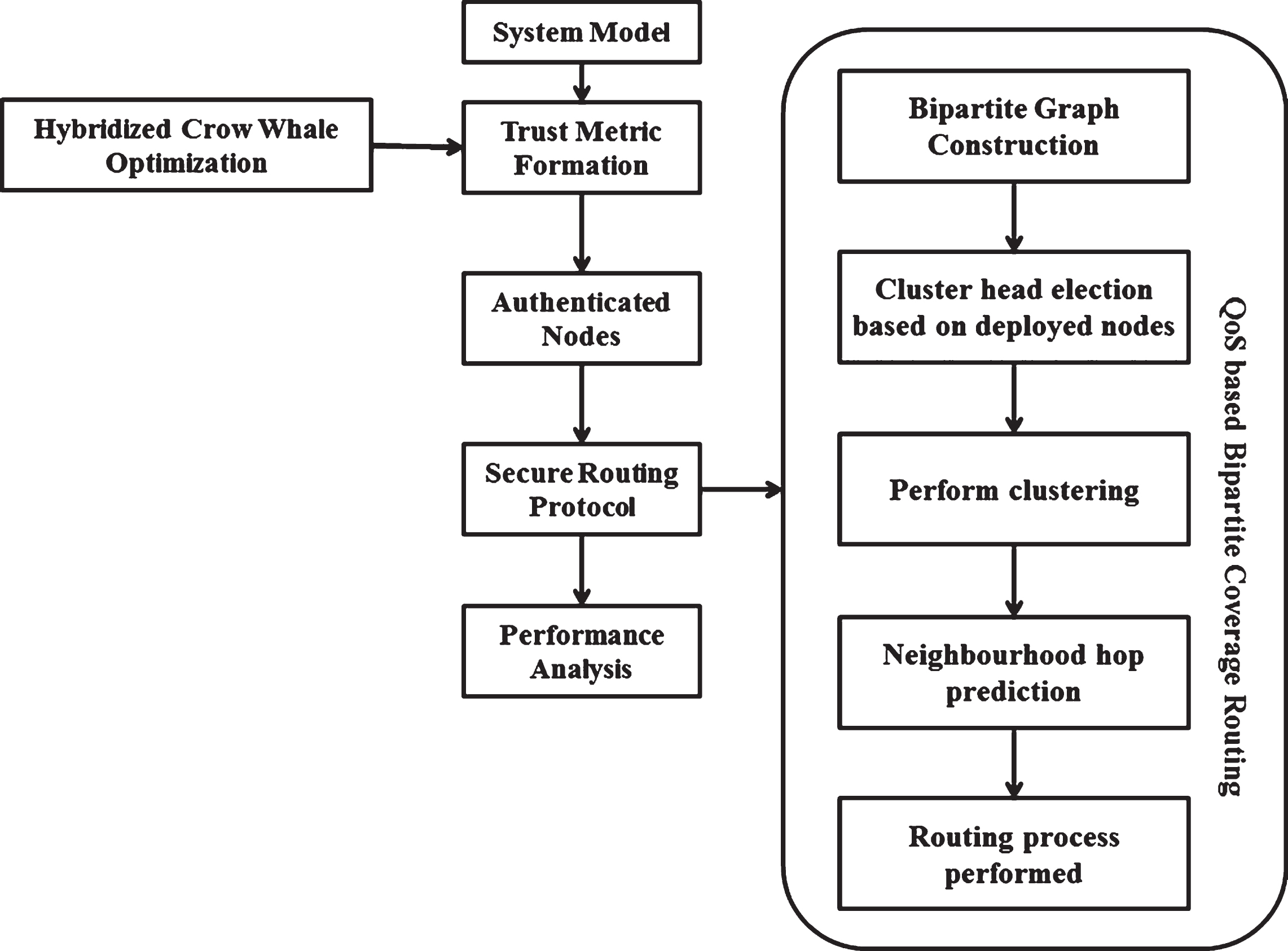
In this proposed study, the effective trust factor based attack nodes detection using Novel QoS based bipartite Coverage Routing (QOS-CR) and developed optimization namely novel hybridized Crow Whale Optimization- (H-CWO). The proposed QoS approach provides enhanced network performance by partitioning the network into areas and assigning a cluster head (CH) for the individual region. This CH assigns the correct scheduling for all the WSN nodes. For optimization and trust metric formation novel hybridized Crow Whale Optimization- (H-CWO) is implemented. Depends on trust and energy, mobile nodes in IoT network have been exposed to trust factor evaluation. For the optimal routes selection, optimal attack nodes selection are discovered based on secure nodes selection. Based on H-CWO, the routes have been selected. Followed by updating of trust and energy, the data transmission is performed by the optimal chosen path. At the individual transmission end, the individual nodes’ trust and energy updating is performed, the trust factor continues to follow with respect to the selection of attack node. The following Fig. 1 shows the overall flow of the effective multi-cast routing based on Novel QoS based bipartite Coverage Routing (QOS-CR) and developed optimization namely hybridized Crow Whale Optimization (H-CWO).
Proposed flow.
As per the above Fig. 1, the trust metric formation performed by the novel H-CWO in which the authenticated nodes have been selected. In the QOS-CR routing process, the authenticated nodes are participated. For QoS parameters energy, latency and PDR constraints have been considered and for designing the routing protocol coverage region is considered. For data transmission, the shortest routing protocol is performed.
WSN mobility model- the mobility of nodes illustrates the nodes’ velocity, acceleration and position in the WSN environment. The routing protocol performance is evaluated based on the distance of mobility model. Two nodes S
i
and S
k
are considered which are located at (x
i
, y
i
) and (x
j
, y
j
) in which δ
i
ɛ (x
i
, y
i
) andδ
j
ɛ (x
j
, y
j
). Based on variable velocity with θ1 and θ2 angle, S
i
and S
k
pass through in specific direction. Through d1 and d2 distance, S
i
and S
k
nodes are travelled and the respected nodes obtains a new
For example, the positions are considered as S
i
(x
i
, y
i
) = (2, 4) and S
j
(x
j
, y
j
) = (4, 6). Thus, the nodes’ Euclidean distance is expressed as
S
i
and S
j
are the nodes velocity resulted as vel
s
i
and vel
s
j
, and to travel d1 and d2 distances, makes an angle θ1 and θ2 which are expressed as,
At t, a new position is acquired by the node which is expressed as,
When S
k
(x
k
, y
k
) node travels o2 distance makes d2 angle, a new position acquired by S
j
node,
After new position attained by the nodes, the distance among the nodes evaluated by,
The trust factor (TF) is important factor to select the secure nodes so as to enhance the network communication in a secure manner. This enhances the data integrity as well as confidentiality. The TF is computed on the basis of energy and trust of each nodes residing in the network, the node that consists of maximum trust and energy is considered as a secure node. The TF is calculated by the following equation.
For example, the trust factors is calculated from the above equation as follows.
Here N
s
indicates the total count of neighbours, ρ
i
denotes the i
th
node’s energy in the IoT network, and
The energy and trust model corresponding to IoT nodes are calculated as per the following equation.
For instance, the trust is computed as follows.
The trust utilized for computing the trust of the node is of four types that include
The Direct Trust rely on the deviation in the estimated as well as actual time. This evaluation is on the basis of witness factor that contributes for improvement of nodal trust. Hence the trust value rely on node’s approximation time and the direct trust is given as follows:
Here K T denotes the appropriate time needed for sending the key, K R indicates the probable time for acceptance of the key and ϑ denotes the witness factor of destination j.
The indirect trust is important when a node accepts the public key with other nodes for the purpose of authentication that do not possess a witness value. Hence the indirect trust indicates the node’s trustworthiness and is given by the following formula:
Here N S denotes the entire neighbour nodes in the node i.
The recent trust is calculated as node regression of node’s direct as well as indirect trust in the network, authenticity of key and the ACK (acknowledgement) that corresponds to the destination node that is the time function. It is computed as,
The routing strength is improved by including the trust factor that rely on the data bytes. This is on the basis of total count of data bytes that are sent from source node to the count of data bytes accepted via the sink node. It is computed as follows:
Here
The IoT sensors are completely operated with battery. Thus the node’s energy requires to be controlled and it is needed for enhancing the IoT network’s lifetime. An assumption has been made by taking E0 as the node’s initial energy at the communication beginning. An energy loss occurs when the transmitted data is received by the receiver. This relay on the node’s nature as well as node’s transmission that can be nodes existing in the specific cluster or in any cluster head. The transmission rely on the energy dissipation and routing protocol as an outcome of use of power amplifier and radio electronics in the transmitter. The dissipation in the energy occurs in the node during the data packet transmission. It rely on the below equation,
Here E elec denotes the Electrical Energy. The count of bytes that is sent by i th node and is represented as b i and E pa is the power amplifier’s energy. R i ’s energy dissipation is calculated on the basis of below equation.
Here E
fs
represents the free space energy. The EE (Electrical Energy) rely on the filtering, coding, modulation etc. that is related with data aggregation and transmitter. It is given by the following equation,
Here E tx represents the transmitter energy, E aggr indicates the data aggregation’s energy.
When node R
i
attempts to communicate with G
j
, there occurs an energy loss in CH (Cluster Head) that rely on EE at the receiver side as well as data bytes accepted by CH. The dissipation of energy at the cluster head j is computed as follows:
When the data reception and transmission ends, entire CHs and sensor nodes are updated that rely on the energy and dissipated energy of the nodes. It is represented as follows:
Here G i denotes the receiver or CH’s energy dissipation during the data packet transmission by the normal node. The node’s energy update continues till the node’s energy becomes zero or until the node reaches the dead state.
In this study, the Crow Search and whale optimization is hybrid to perform trust metric formation. The algorithm of Hybrid Crow Whale Optimization is explained below. Randomly initialize the sensor location as crows with N dimension in the SS. Initialize memory of every crow whileiter < itermax
forg = 1 : C // individual crow of the group Randomly choose a crow to follow, Mention an awareness probability, Authenticate the probability of new locations. Upgrade the crow’s memory.
C crows are located randomly in an environment corresponding to N dimension as the members of the group. Individual crow indicates the probable solution of the problem, d
v
denotes the number of decision variable.
Individual memory of the crow is initialised. Once the first iteration is completed, the crow will not have any experience. An assumption has been made that the crows would hide its food at its initial place.
Crows yield new positions in SS as if a particular crow wants to create a new location/ position. For this purpose, the crow selects one of the crows in random in the group and follow it to determine the hidden food’s location by the crow.
The awareness probability of individual crow is mentioned. If the new position is probable, then the crow updates its position or location. Otherwise, the crow stays in the particular position and do not shift to the new created position.
The probability of new location for individual crow is assessed.
The memory of the Crow is upgraded by the following equation:
Here f () indicates the objective function value.
It is taken into account that if the objective function value of the new place of the crow was higher than the objective function value of the stored position, then the crow updates its memory.
The QoS-CR is employed to perform shortest path routing and neighbourhood hop prediction. The Clustering algorithm is explained below.
Let Cfmax maximum congestion threshold factor
Cf > Cfmax
And Cfmin be a minimum congestion threshold factorCfmin
(Cf < cfmin)
Then,
(Cfmin ⩽ Cf < = Cfmax)
Sid: |Set of ID’s of neighbours according to the hop count including the current node ID
Where
cluid = clusterid
If (cluid = = min(Sid))
Clusterid = cluid ;
Sid = Sid -{ cluid } ;
while (sid ! = empty)
Then crid = clusteridon receiving neighbours(id, crid, loc) mnd = difference of the member node
TDum,vn = D(CHum,sink) + D(CHum,CHvn)
D(CHum,sink) Distance between CHum and sink node.
D(CHum,CHvn) Distance between CHum and CHvnnode.
TDum,vn Threshold valueor the formation of CH between CHum and CHvnnode.
if (id = crid) and (clusterid = = UNKNOWNorclusterid > crid) and (mnd = = NOTSETorTDum,vn > diff (cluloc - loc)
clusterid = crid ;
mnd = diff (cluloc - loc);
Sid = Sid -{ id } ;
If (cluid = = min(Sid))
If (clusterid = = UNKNOWN)
Sid = Sid -{ cluid } ;
In the proposed QoS based bipartite neighbourhood Clustering Algorithm, individual node needs one or many neighbourhood data to implement the creation of cluster as well as for algorithm maintenance. The count of neighbours depends on the ad hoc network’s congestion factor. The node’s degree is utilized as the congestion factor denoted byc f . Here C fmax is the threshold factor with maximum congestion and C fmin is the threshold factor with minimum congestion. If c f –congestion factor is greater than C fmax ., then it indicates that the population of ad hoc is maximum and hence the hop count is set to one. If the congestion factor is amongst C fmin and C fmax , then it denotes that the particular node is in area that is medium populated. Here the hop count is set to two. When C fmin is greater than the congestion factor (c f ), then the node exists in an area that is sparsely populated. Here the hop count is set to three. Finally the cluster head and member is predicted based on step 3 and step 4 where based on bipartite edge transmission occurs.
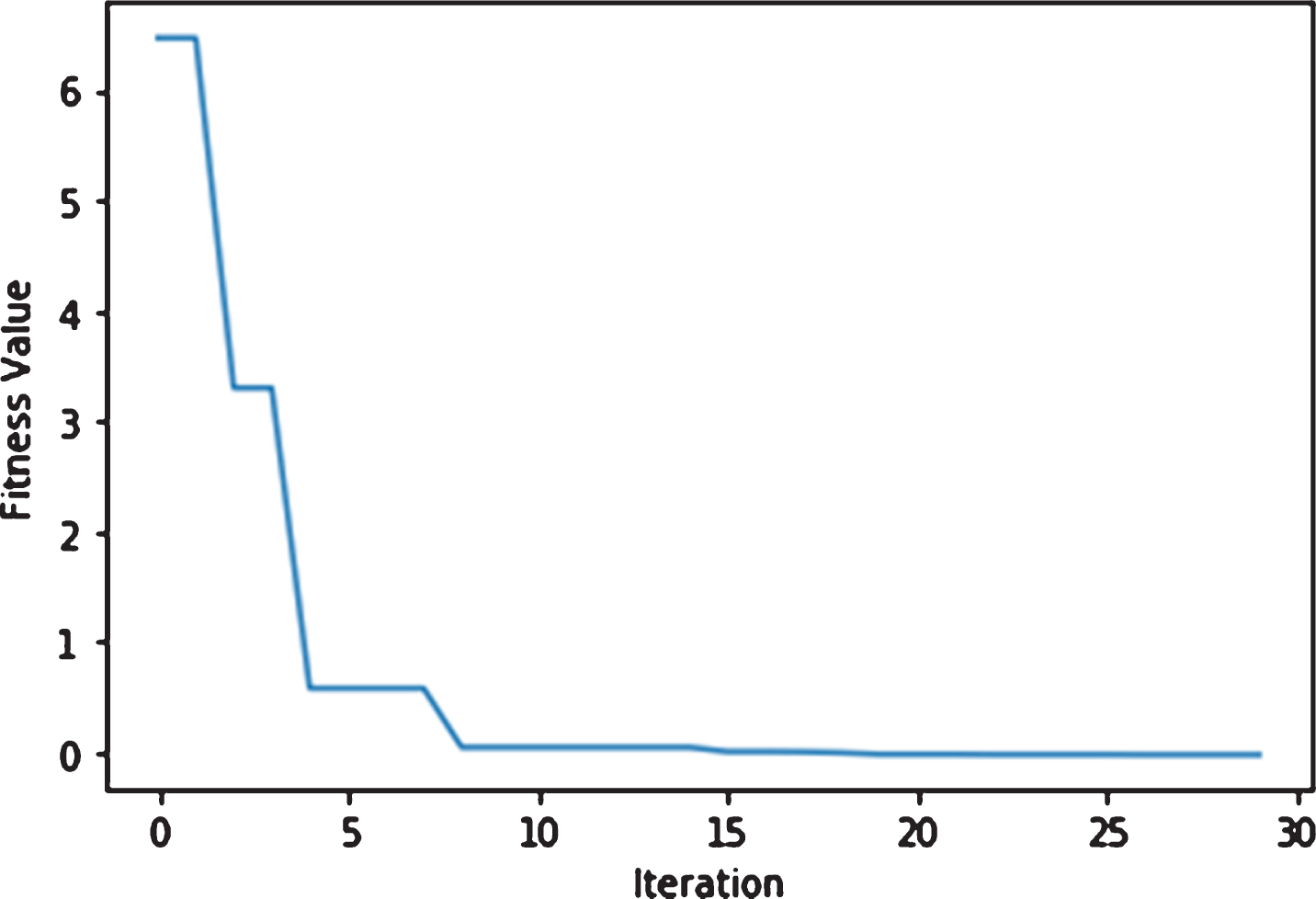
In addition, the convergence of the algorithm is studied to validate the algorithm performance. It is shown in the Fig. 2.
Fitness value.
The Fig. 2 reveals that the fitness value remains in the peak in the initial iterations and decreases slowly after the fifth iteration. This indicates that the implementation of the proposed methodologies helps the fitness value to remain steady and decreases only after the 5th iteration.
On the other hand, the proposed QoS based bipartite Coverage Routing (QoS-CR) has various merits like inherent scalability which comes from its polynomial time complexity. It is also computationally efficient. Due to these merits, the proposed QoS-CR performs routing in the shortest path by predicting the neighbourhood hop easily. Additionally, the proposed Hybridized Crow Whale Optimization (H-CWO) has the ability to relieve the malicious attack burden and to afford the optimal solution. H-CWO is also capable of converging to the search space global solution to enhance security. Thus, the implementation of this proposed algorithms affords a high secure data transmission thereby minimizing delay which is explored in the below results section.
The experimental outcome of the proposed method that pertains to secure transmission of data from source to destination is explained in the below section. Further, the proposed system is analysed through comparison of various techniques with the proposed approach in terms of various parameters. It is also included in the below section.
Experimental design
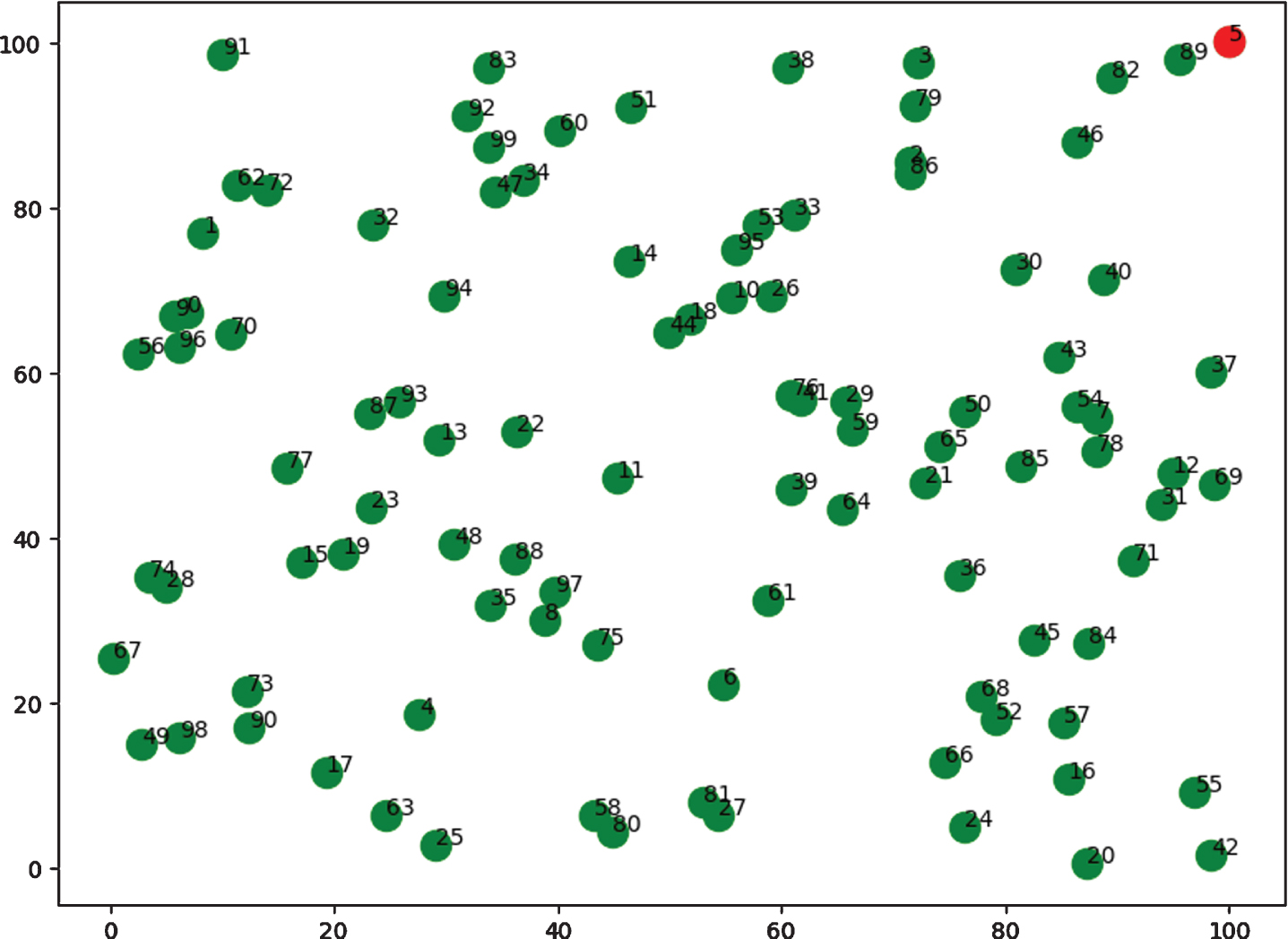
The proposed methods are employed and simulation is carried out for secure data transfer from source node to destination. Various nodes are taken into account. Here the nodes are randomly deployed in the network area. Here node 5 is set as destination node which is shown in the below Fig. 3.
Random deployment of nodes.
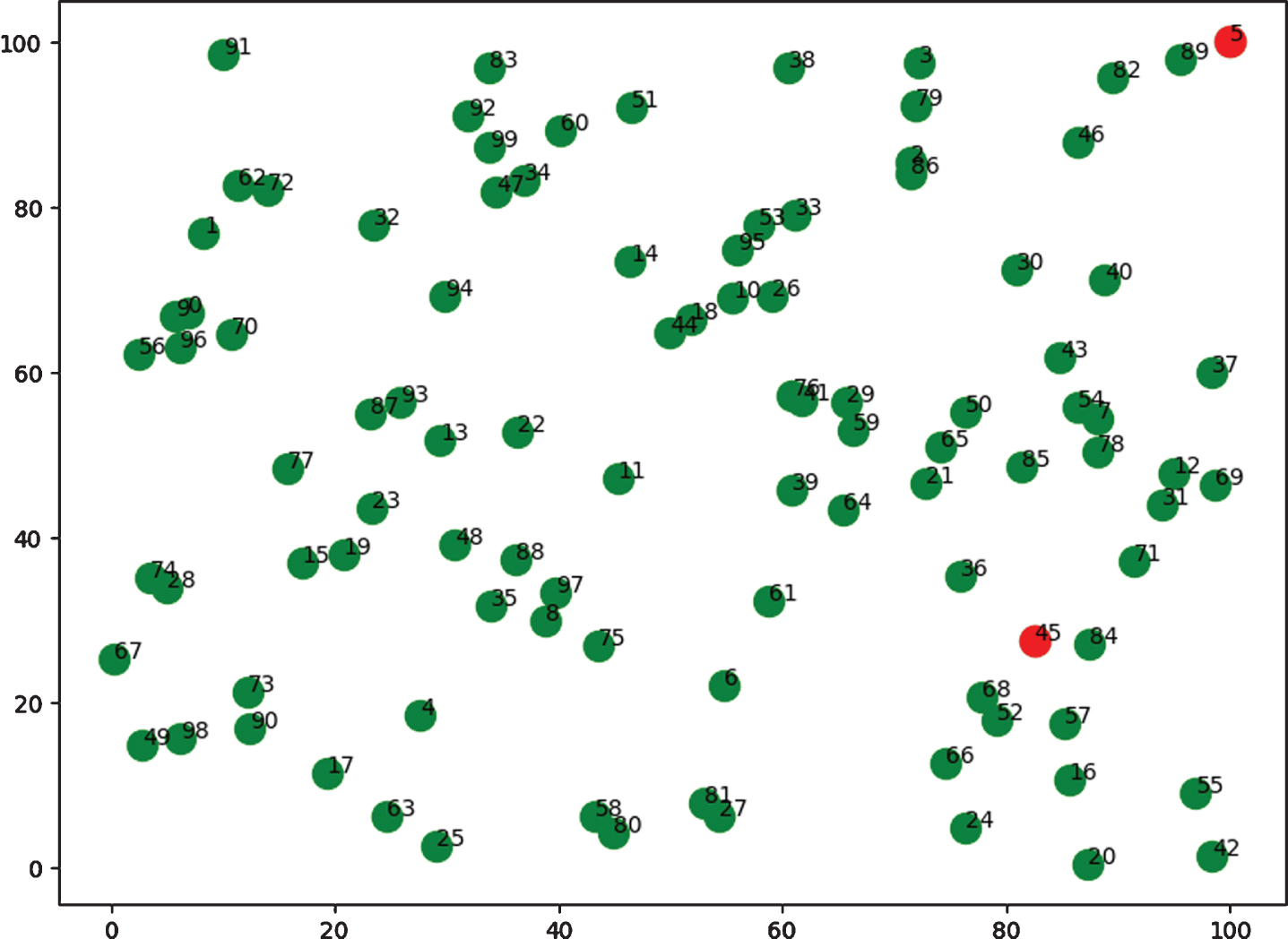
Subsequently the source node is set as 45. The transfer of data packets initiates in the source node. It is shown in Fig. 4.
Initializing source and destination node.
Then the hacker nodes present within the network area is shown in below Fig. 5. The black nodes as shown in Fig. 5 are the hacker nodes. Removal of hacker nodes is required for safe transmission of data from source to destination which is shown in Fig. 6.
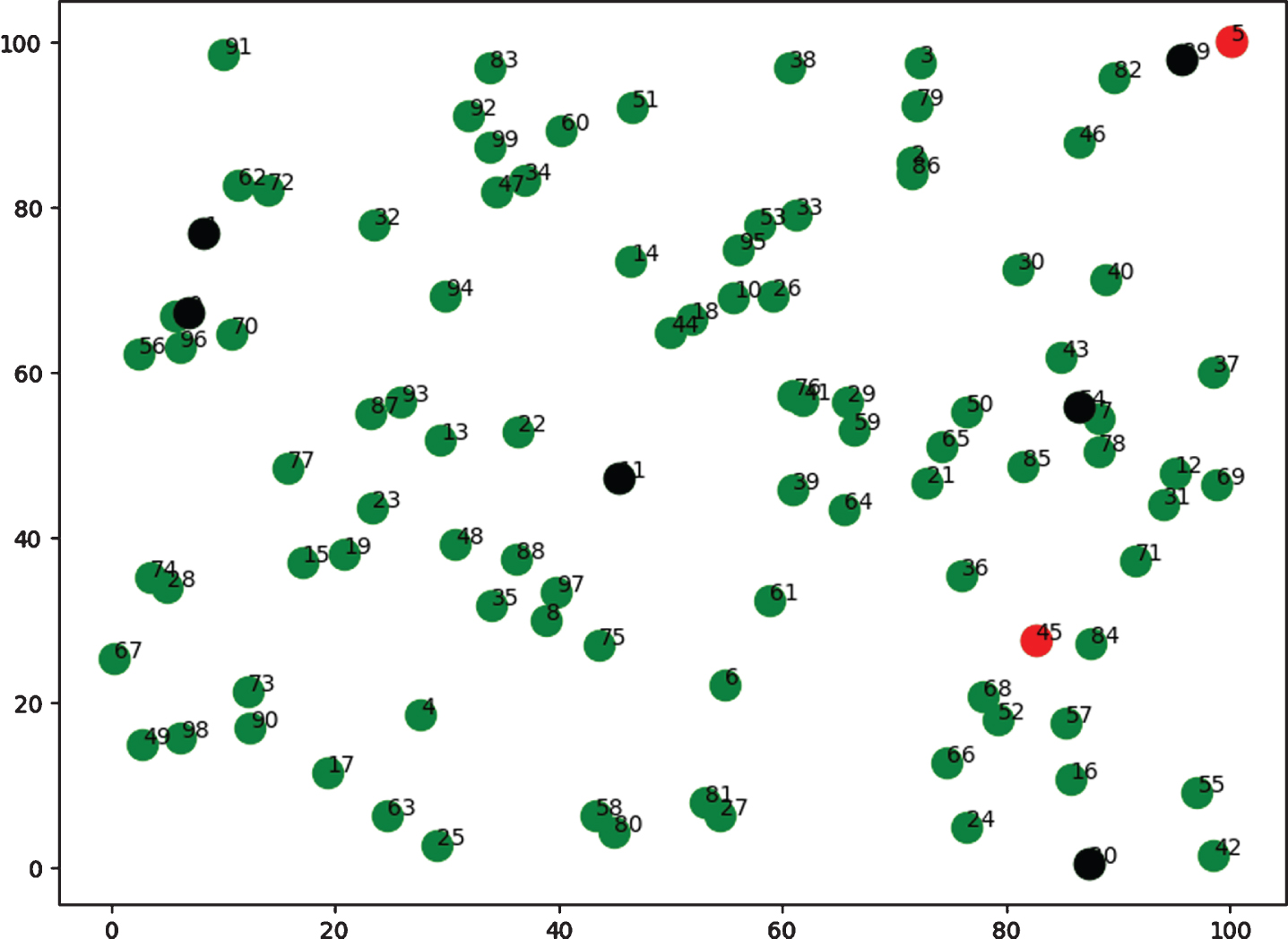
Identification of Hacker nodes within the network area.
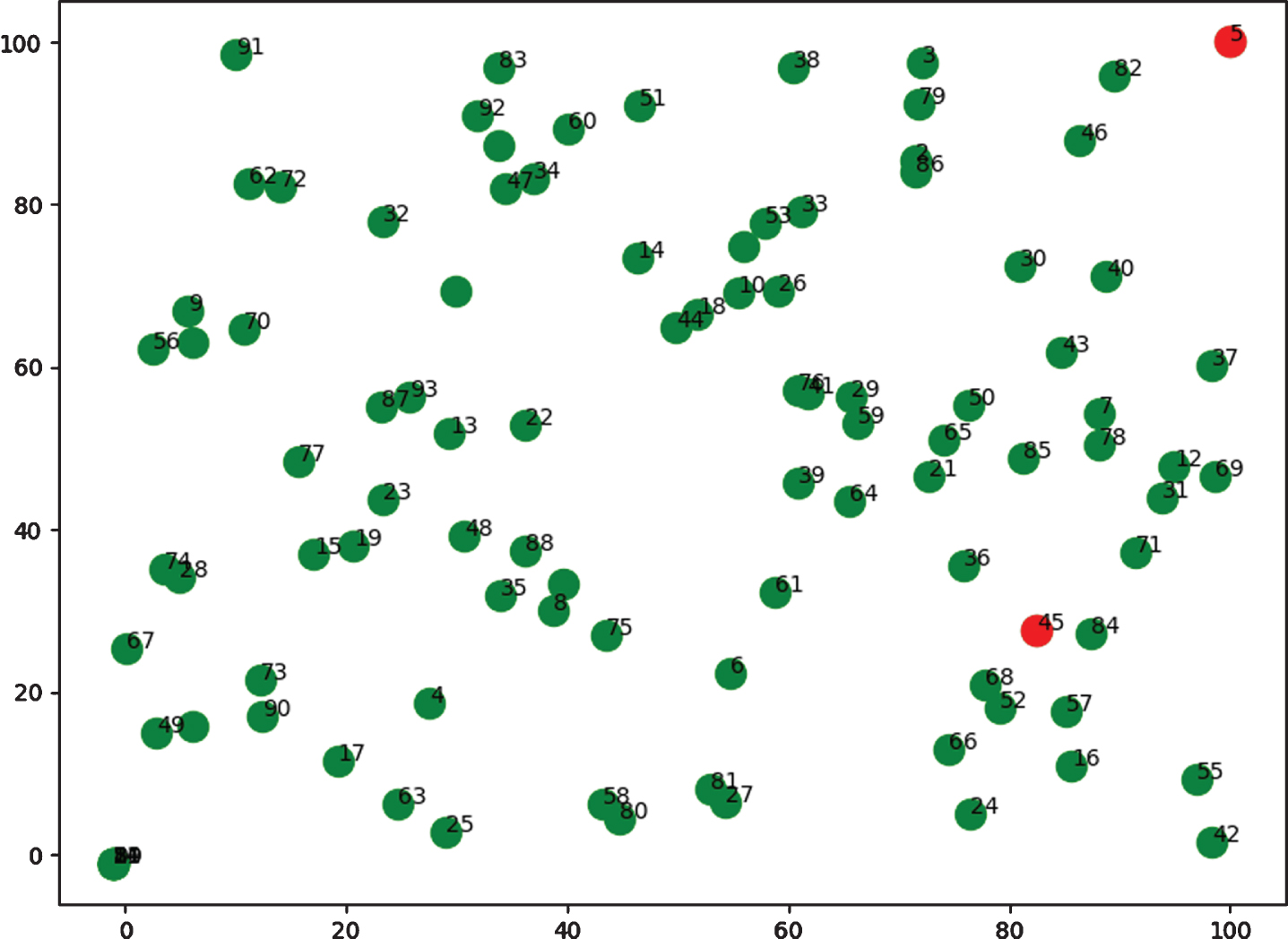
Removal of attacker nodes.
The trust metric formation implemented by H-CWO helps to identify the hacker nodes. As the malicious nodes harm the network by various malicious activities, it is significant to remove these kinds of nodes for transferring the data in a secure way.
The implementation of the proposed H-CWO helps to form trust metrics that automatically filters the authenticated nodes for data transmission by removing the hacker (malicious) nodes. After removing the attacker nodes, cluster formation is implemented which is shown in the below Fig. 7.
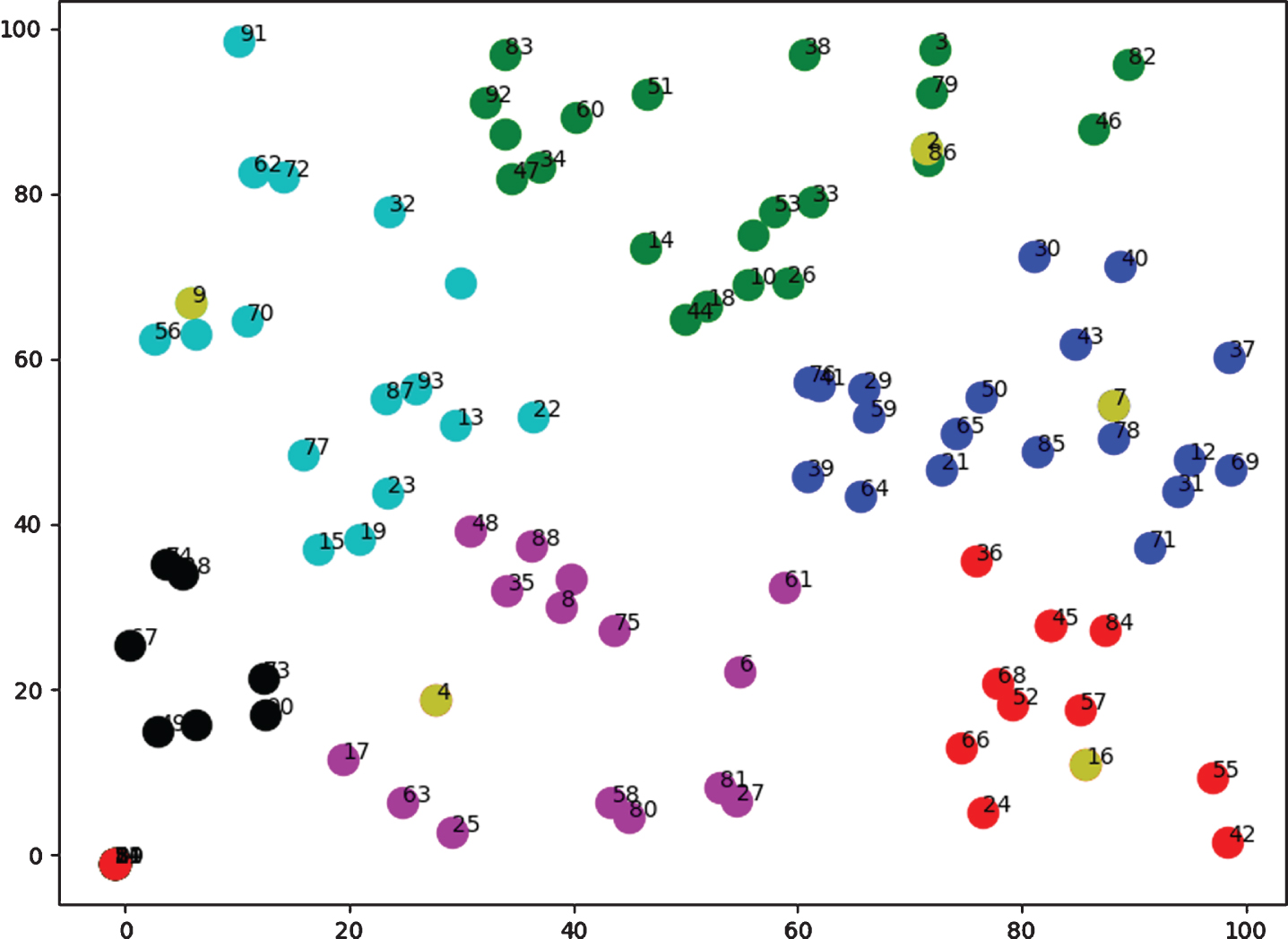
Formation of cluster in the network area.
Once the cluster formation is implemented, cluster heads are chosen. The shortest routing path is selected and source node sends data to the particular CH which resides in the shortest path and this CH then sends the data to the destination.
Thus, the authenticated nodes alone are considered for clustering and routing is performed accordingly to transfer the data packets from source to destination with high security.
The proposed system is analysed by comparing with the existing methods to validate the extent to which the proposed method is effective than the existing methods. Various performance metrics are taken into account for analysis that consists of energy, throughput, delay and alive nodes are discussed below.
Analysis in terms of energy
The proposed system is compared with various existing methods [41] in terms of energy. The obtained results are shown in Fig. 9.
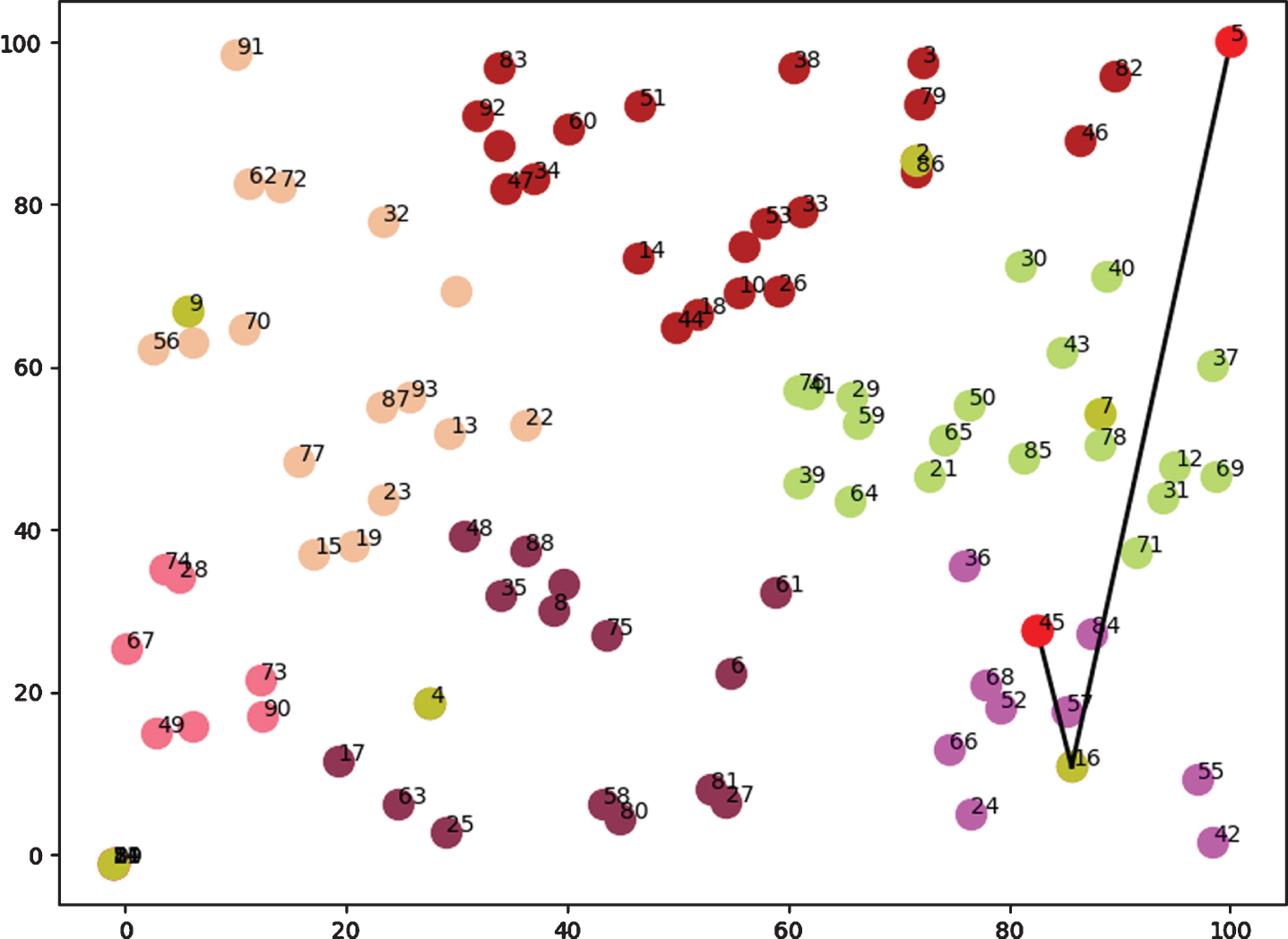
Selection of cluster head in the network area.
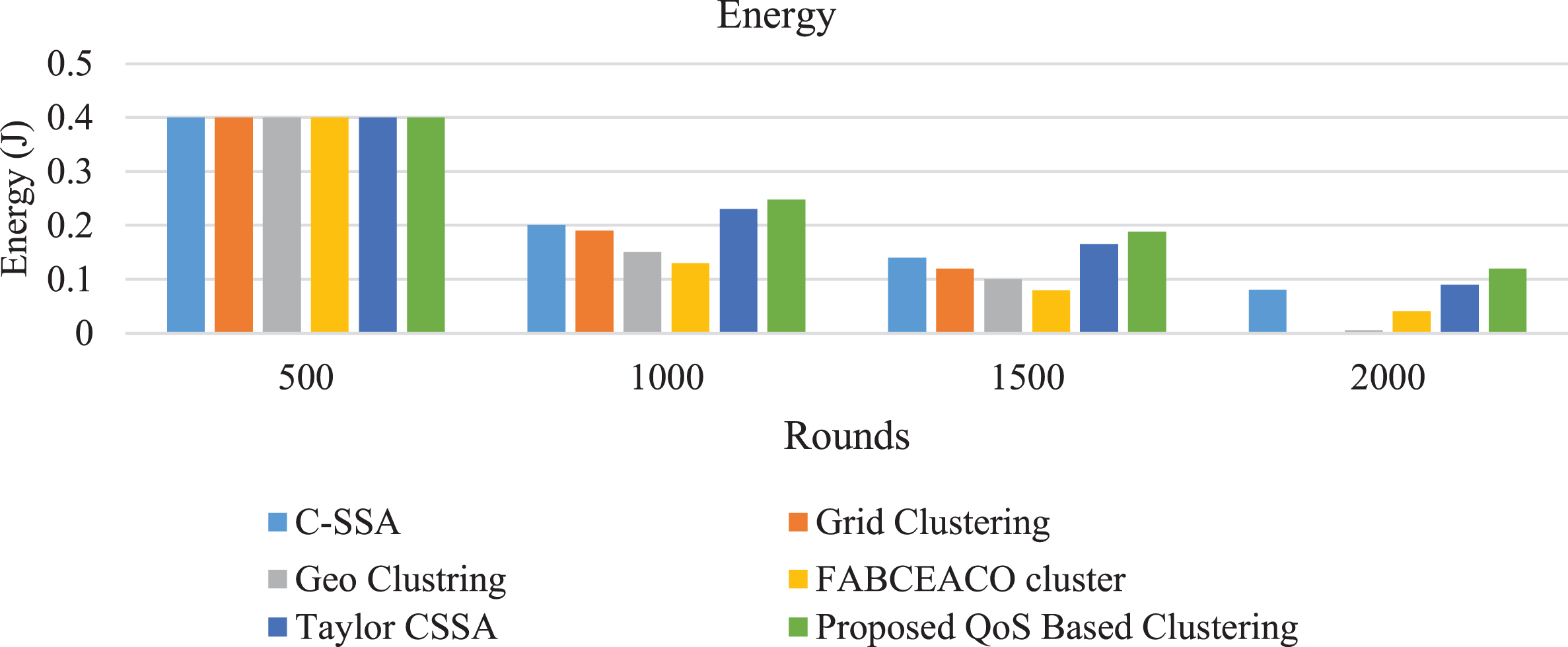
Comparative analysis of the proposed and existing methods in terms of energy [41].
The results revealed that compared to the traditional C-SSA, Grid clustering, Geo clustering, FABCEACO cluster, Taylor CSSA, the proposed method had high energy for transmitting the data from source to destination [41]. At the 500th round, the energy of the existing C-SSA, Grid clustering, Geo clustering, FABCEACO cluster, Taylor CSSA and the proposed system is found to be 0.4. But, as the rounds increased the energy started fluctuating. At the 2000th round, the energy of the existing Grid clustering and Geo clustering completely exhausted and remained zero. While the other existing methods namely C-SSA, FABCEACO cluster and Taylor CSSA shows minimum energy in comparison to the proposed system. Thus, the energy is found to remain high when compared to the existing methods even at the 2000th round when using the proposed methods.
The proposed system is compared with various traditional methods (C-SSA, Grid clustering, Geo clustering, FABCEACO cluster, Taylor CSSA) [41] in terms of delay which is shown in Fig. 10.
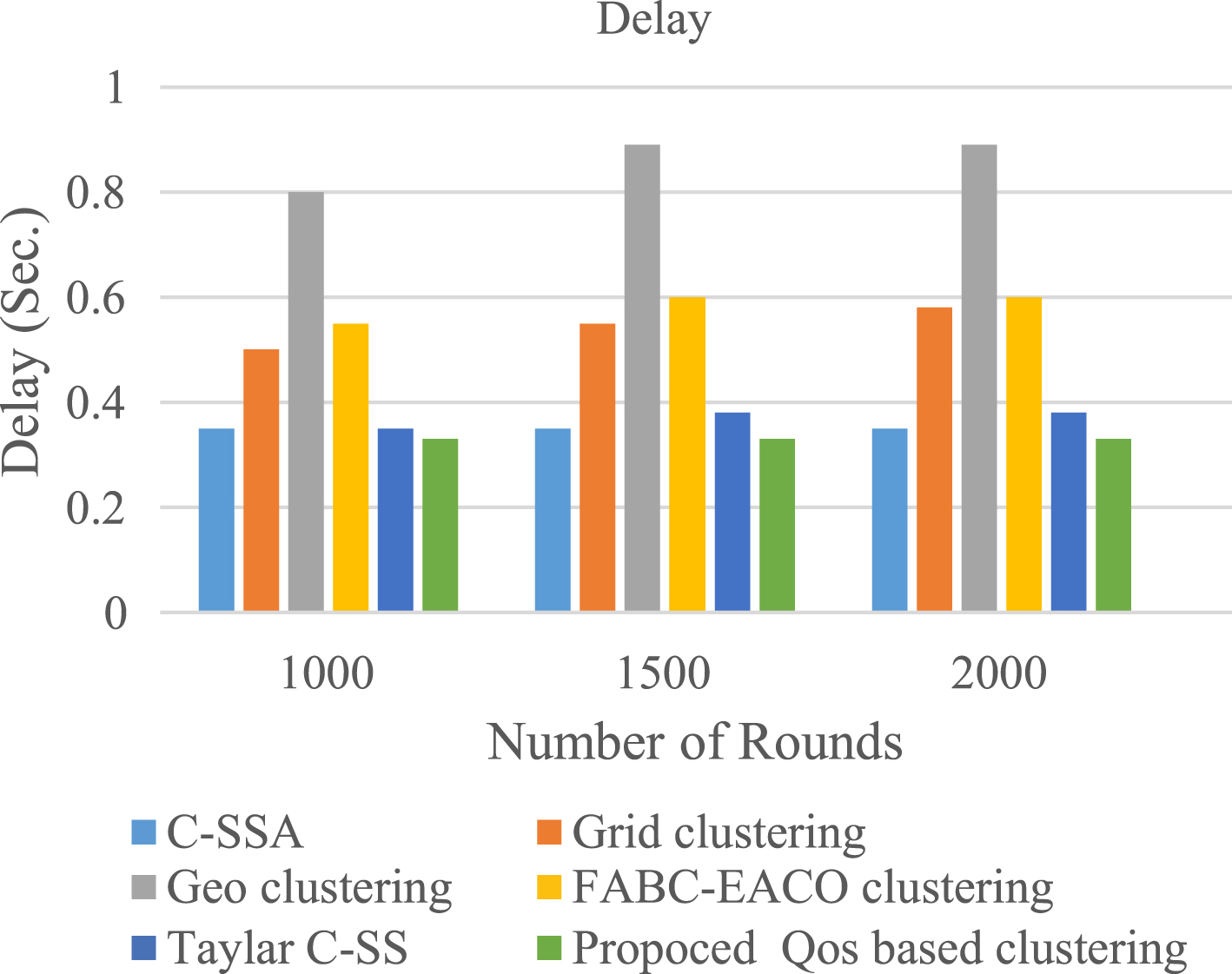
Comparative analysis of the proposed and existing methods [41] in terms of delay.
The results explored that compared to the traditional C-SSA, Grid clustering, Geo clustering, FABCEACO cluster, Taylor CSSA, the proposed method had minimum delay for transmitting the data from source to destination. The delay of the existing C-SSA, Grid clustering, Geo clustering, FABCEACO cluster, Taylor CSSA and the proposed system is analysed in 1000th, 1500th and 2000th round. The existing methods shows maximum delay in comparison to the proposed methods. Thus, the delay is minimized by implementation of the proposed system as shown in the above Fig. 10.
A comparative analysis of the proposed and various existing techniques [41] is performed which is shown in Fig. 11.
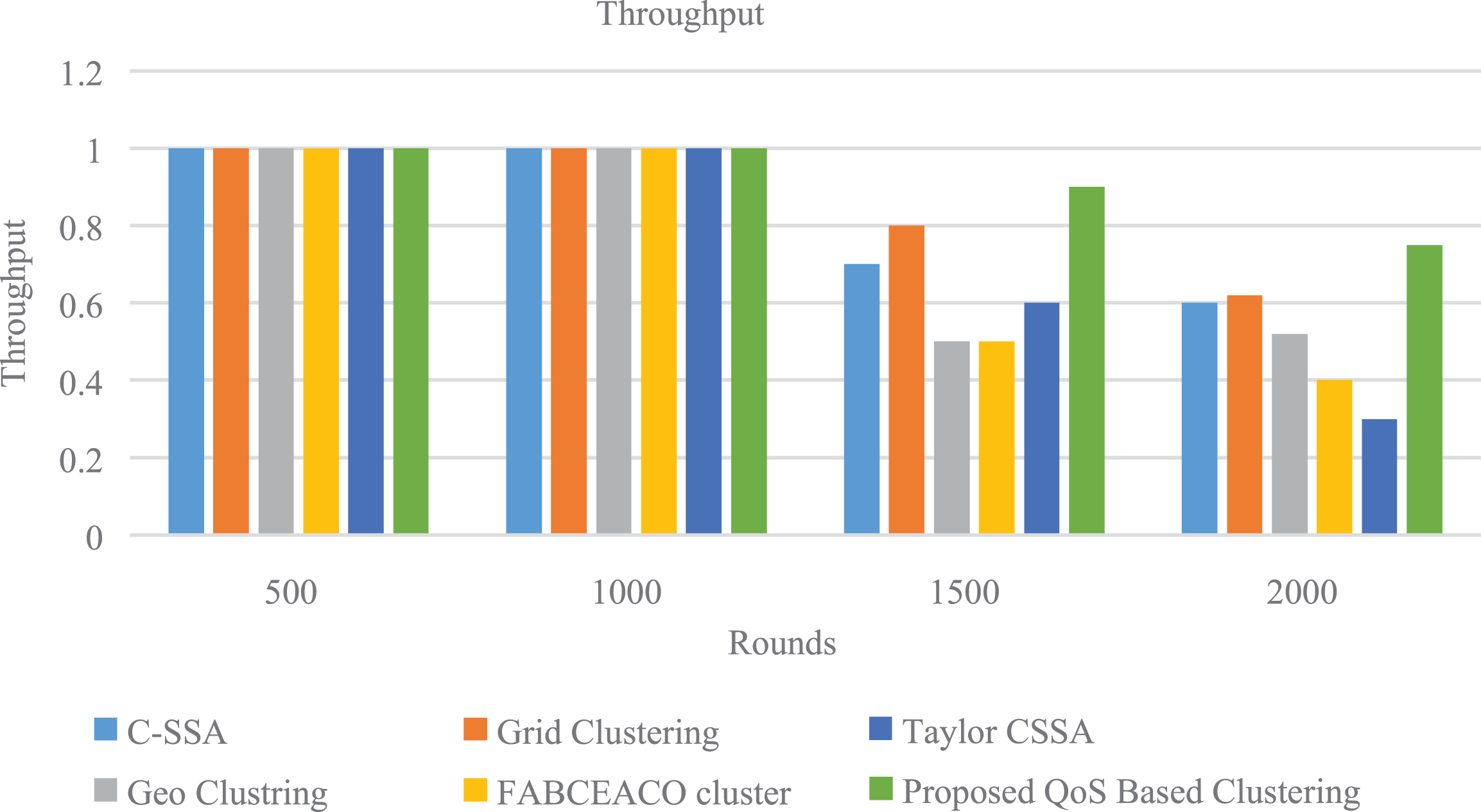
Comparative analysis of the proposed and existing methods [41] in terms of throughput.
The proposed and the existing methods are analysed with respect to throughput. At the initial two rounds, the throughput of all the methodologies remained same as 1 pps (packets per second). But as the rounds increased the throughput started fluctuating. At the last round, the proposed method reveals high throughput than the traditional methods thereby indicating that many data packets are sent in minimum time.
The proposed system is compared with various traditional methods (C-SSA, Grid clustering, Geo clustering, FABCEACO cluster, Taylor CSSA) [41] in terms of alive nodes which is shown in Fig. 12.
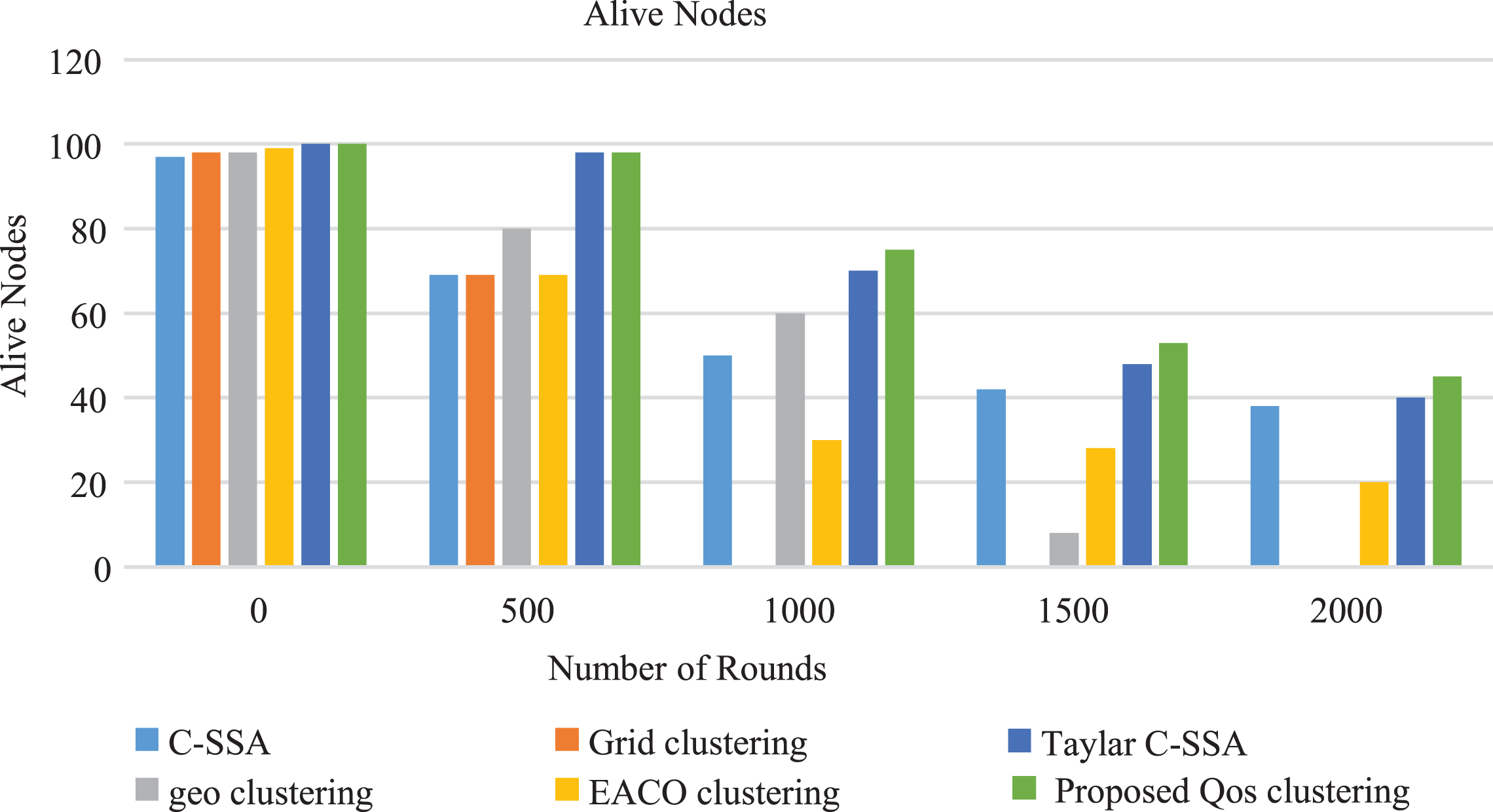
Comparative analysis of the proposed and existing methods [41] in terms of alive nodes.
Various intermediate nodes involve in transmitting the data packets from source to destination. Initially, all the nodes are alive. But, as the round increases, the number of alive nodes decreases. At the last round, the alive nodes have been found to be more for the proposed QoS clustering. Forty two nodes are found to be alive when employing the proposed methodology. Thus, the results explored that through the proposed methodology, more nodes are found to be alive than the other traditional techniques.
The below Table 1 shows the comparative analysis of the proposed and existing techniques (C-SSA, Grid clustering, Geo clustering, FABCEACO cluster, Taylor CSSA) in terms of various metrics such as energy, throughput, delay and alive nodes [41].
Comparative analysis of the proposed and existing techniques [41] in terms of various metrics
Comparative analysis of the proposed and existing techniques [41] in terms of various metrics
Comparison is made for two cases by taking the nodes 50 and performing comparative analysis. On the other hand, the results of the system when 100 nodes are taken into account are also considered. It has been concluded that, the proposed QoS based Clustering outperformed other methods in terms of energy, delay, throughput and alive node by exploring high energy, minimum delay, high throughput and maximum alive nodes for secure transfer of data from source node to destination node.
The proposed methodologies have various advantages-
The Crow Search algorithm has the ability to determine optimal solutions for several optimization issues. It also has various other merits like easy implementation, few parameter count and flexibility. On the other hand, Whale Optimization algorithm has the capacity to avert the local optima and attain a global and optimal solution. This makes the algorithm to be suitable for practical security applications. This study hybridises both these algorithms for forming trust metrics for individual nodes which eventually leads to effective results due to the above mentioned advantages. As, the proposed novel Hybridized Crow Whale Optimization (H-CWO) performs trust metric formation efficiently, the data transmission occurs in a secured way that makes this algorithm effective as highly reliable nodes are selected for routing which is significant for routing. In addition, QoS based bipartite Coverage Routing.
(QOS-CR) typically has the ability to ensure a packet’s end-to-end delay. Hence, implementation of this algorithm enhances the routing performance that is, this makes the proposed method effective as shortest path is chosen for routing that minimizes delay than the traditional methods as shown in the above Table 1. All these advantages make the proposed system to achieve secure data transmission that minimizes delay, enhances throughput, alive nodes and energy of the node. As the proposed method is effective with respect to all the four metrics, it is effective than the traditional methods.
This study has introduced a novel Hybridized Crow Whale Optimization (H-CWO) and novel QoS based bipartite Coverage Routing (QOS-CR) to achieve secure data transfer from source to destination. Through H-CWO, trust metric formation is implemented for predicting the authenticated nodes.
Subsequently, QOS-CR is used for neighborhood prediction and shortest path routing is executed for transmitting the data quickly and in a secure manner. The performance and comparative analysis is undertaken to evaluate the efficiency of the proposed methods. The results of the comparative analysis revealed that proposed novel H-CWO and QOS-CR is better than other conventional methods with energy 0.22 when 50 nodes are considered and 0.151 when 100 nodes are considered. Similarly, the delay is found to be 0.258 when taking 50 nodes into account and 0.342 when taking 100 nodes into account. This delay rate is minimum in comparison to the existing methods (C-SSA, Grid Clustering, Geo Clustering, FABCEACO cluster and Taylor CSSA). The throughput remains the same as 0.1 when considering 50 and 100 nodes showing its efficacy. Moreover, 27 nodes are found to be alive out of 50 nodes and 46 nodes are found to be alive out of 100 nodes when using the proposed methods. Thus, the proposed methods are efficient than the existing methods by showing maximum throughput, energy and alive nodes thereby minimizing delay. The convergence of the algorithm is also studied that explores the time as 235.187 sec and order of complexity as O (n2 log n). In future, the cluster based routing protocol has to be implemented with data aggregation that can be used to employ on huge data. This can eventually be processed into some kind of aggregation quicker when the aggregate data is already present.