







Abstract
The interaction operation laws (IOLs) between membership functions can effectively avoid the emergence of counterintuitive situations. The power average (PA) operator can eliminate the negative effect of extremely or improperly assessments on the decision results. The Heronian mean (HM) operator is capable of examining the interrelationship between the two attributes. To synthesize the powers of the IOLs, PA and HM operators in this paper, the PA and HM operators are extended to process T-spherical fuzzy evaluation information perfectly based on the IOLs, and the T-spherical fuzzy interaction power Heronian mean (T-SFIPHM) operator and its weighted form are proposed. We further present some properties of these proposed AOs and discuss several special cases. Moreover, a novel method to T-spherical fuzzy multiple attribute decision making (MADM) problems applying the proposed AO is developed. Lastly, we present a numerical example to validate its feasibility and reasonableness, and the superiority of the developed method is further illustrated by sensitivity analysis of parameters and comparison with existing methods. The results show that proposed AOs not only can capture the interactivity among membership degree (MD), abstinence degree (AD) and non-membership degree (NMD) of T-spherical fuzzy numbers (T-SFNs), bust also ensure the overall balance of variable values in the process of information fusion and realize the interrelationship between attribute variables, so the decision results can be closer to reality and more reliable.
Keywords
Introduction
MADM is one of the important branches of decision science. Its goal is to find the optimal solution(s) or option(s) from a limited set of alternatives under a series of different attributes. The accurate expression of attribute evaluation value is the key link in the decision-making process. With the complexity and uncertainty of economic and social development in the real world and people’s in-depth understanding of cognition and consciousness research, using real or crisp numbers to describe evaluation information has been unable to effectively and accurately express the real intentions, preferences and opinions of decision-makers on the object. Therefore, it is necessary to choose an appropriate theory to deal with the vagueness and uncertainty of evaluation informationeffectively in the decision-making process. Fuzzy set (FS) [1] is an information representation method, which is widely used to solve information modeling problems with vague and uncertain information in many fields, but the FS has only MD Μ(ℏ) (0 ⩽ Μ(ℏ) ⩽1), so it is difficult to comprehensively describe and depict the uncertainty degree of human’s cognition to things. In view of this, Atanassov [2] extended FS and proposed intuitionistic fuzzy set (IFS), which using the MD Μ(ℏ) and NMD Ν(ℏ) (0 ⩽ Ν(ℏ) ⩽1) to describe more detailed information than the FS. The characteristic of IFS is Μ(ℏ) + Ν(ℏ) ⩽1. In order to overcome the shortcoming that the IFS cannot be used in decision scenarios where the sum of Μ(ℏ) and Ν(ℏ) greater than one, some scholars successively proposed Pythagorean fuzzy set (PyFS) [3, 4] and Fermatean fuzzy set (FFS) [5, 6] with a wider range of decision information, and more generalized q-rung Othopair fuzzy set (q-ROFS) [7]. Their Μ(ℏ) and Ν(ℏ) meet the conditions: (Μ(ℏ))2 + (Ν(ℏ))2 ⩽ 1, (Μ(ℏ))3 + (Ν(ℏ))3 ⩽ 1 and (Μ(ℏ)) q + (Ν(ℏ)) q ⩽ 1, respectively. Obviously, the IFS, PyFS and FFS are the special cases of q-ROFS, the boundary of assessment information described by the MD and NMD also becomes larger when the parameter q value in q-ROFS increases. Therefore, the comparison between q-ROFS and IFS, PyFS and FFS shows that the q-ROFS can provide more free space and flexibility for people to describe assessment information with preference. In recent years, the q-ROFS have been widely applied to engineering and social fields [8–27].
The MD and NMD in q-ROFS (including IFS, PyFS, FFS) respectively represents the part belonging to and not belong to a given set, while the rest is called uncertainty or hesitation degree, that is, the q-ROFS can only deal with the fuzzy concept of “neither this nor the other”. However, in some decision-making situations (such as voting), people need to find more ways to respond in their opinions: Yes, Abstain, No and Refuse [28]. Obviously, the q-ROFS is inadequate and unsuitable for expressing the opinions of decision-makers. Cuong [28] first proposed an extended notion of picture fuzzy set (PFS), and it can accurately express the evaluation opinions of decision-makers as an extension of the IFS. The MD (0 ⩽ Μ(ℏ) ⩽1) stands for “Yes”, the abstinence degree (AD) (0 ⩽ Λ (ℏ) ⩽1) expresses “Abstain”, the NMD (0 ⩽ Ν(ℏ) ⩽1) indicates “No”, and the rest of the whole set (i.e. Refuse degree (RD): π (ℏ) =1 - Μ(ℏ) - Λ (ℏ) - Ν(ℏ) means “Refuse” in the opinion [29]. And they must meet the restrictive condition that the sum is at most one. We can know that the PFSs can more accurately express the assessment information by extending the two-dimensional plane consisting of MD NMD to the three-dimensional space consisting of MD AD NMD. Therefore, the PFS can improve the consistency of the captured data with the real-world decision-making environment to avoid loss of estimation information [30]. In view of the fact that PFS cannot deal with the decision problem of Μ(ℏ) + Λ (ℏ) + Ν(ℏ) >1, the Spherical fuzzy set (SFS) is an extended concept introduced by Ashraf and Abdullah [31] in 2018. It has a larger decision space than the PFS, in other words, the restriction that the quadratic total of its functions is not over one must be met. Inspired by the PyFS and q-ROFS, a more generalized T-spherical fuzzy set (T-SFS) ((Μ(ℏ)) q + (Λ (ℏ)) q + (Ν(ℏ)) q ⩽ 1 (q≥1)) was advanced by Mahmood, Ulah, Khan and Jan [32]. It enables decision-makers to express “Yes”, “Abstain”, “No” and “Refuse” in their opinions with higher freedom and greater decision-making space. From the above, we can easily find that the T-SFS has obvious generalizability, and this concept is related to the FS, IFS, PyFS, q-ROFS, PFS and SFS. As shown in Fig. 1, the relationship between T-SFS and other fuzzy sets.
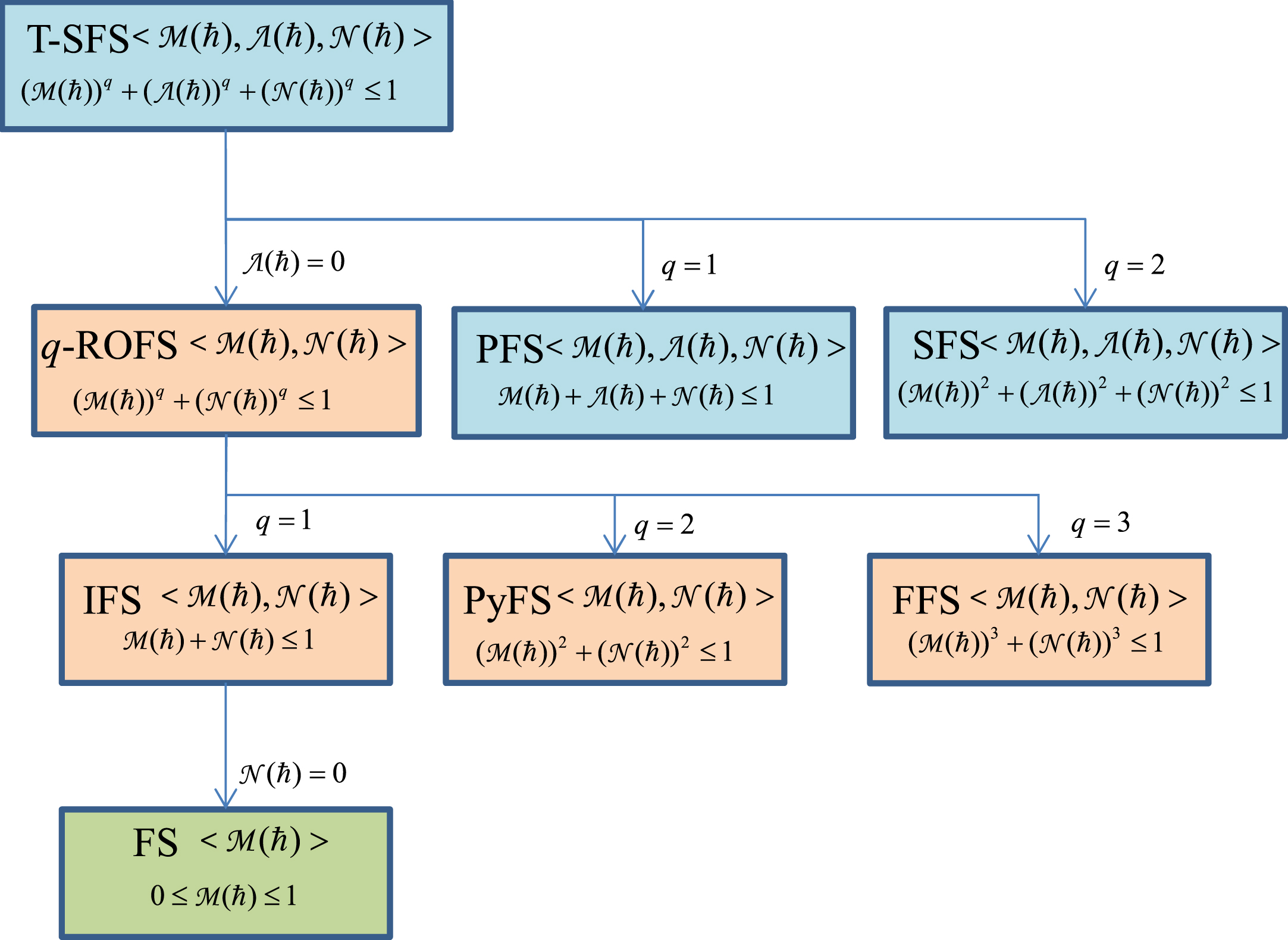
The relationship between T-SFS and other fuzzy sets.
At present, the T-SFS has achieved abundant research results from theoretical study [32–34], information measurement [35–39] and practical application [32, 40–43]. As an important part of T-SFS theory research, T-spherical fuzzy information aggregation technology has been concerned by many scholars. Mahmood, Ulah, Khan and Jan [32] produced the weighted geometric AO for T-SFS. The T-spherical fuzzy generalized Maclarurin symmetric mean (MSM) (T-SFGMSM) operator and its weighted form were introduced by Liu, Zhu and Wang [40]. On the basis of some Hamacher operations, Ullah, Mahmood and Garg [41] developed the Hamacher AOs with T-spherical fuzzy information. Some AOs with interval-valued T-SFNs were proposed by Ullah, Hassan, Mahmood and Jan [42]. Ullah, Garg, Gul, Mahmood, Khan and Ali [43] advanced some AOs based on Dombi t-norm and Dombi t-conorm with interval valued T-spherical fuzzy information. Zeng, Garg, Munir, Mahmood and Hussain [44] took the IOLs of T-SFNs into account and advanced some interactive average AOs with T-spherical fuzzy information. Grag, Munir, Ullah, Mahmood and Jan [45] introduced some interactive geometric AOs with T-SFNs. Combining the superiority of the Muirhead mean (MM) operator and the PA operator, some power MM and power dual MM AOs were developed in the T-spherical fuzzy environment by Liu, Khan, Mahmood and Hassan [46], as well as their weighted forms. Munir, Kalsoom, Ullah, Mahmood and Chu [47] put forward some Einstein AOs of T-SFNs. Ju, Liang, Luo, Dong, Gonzale and Wang [48] produced some AOs considering the interaction of functions in T-SFN and applied them to MADM. Taking the advantages of T-SFS and PA operator into account, Garg, Ullah, Mahmood, Hassan and Jan [49] defined several power AOs. Munir, Mahmood and Hussain [50] studied some associated immediate probability interactive geometric aggregation operation operators. Liu, Wang, Zhang, Yan, Li and Rong [51] developed the MSM AOs with normal T-spherical fuzzy information considering the interrelationship among multiple input arguments.
From the above, we can find that different AOs are expressed by different functions in T-spherical fuzzy environment. Some AOs focus on eliminating the influence of absurd or biased data provided by people’s preferences on the results, such as the PA operator [52]. Some AOs concern the correlation among input arguments, like the MM [53] and MSM operators [54]. Other AOs emphasize on the operation laws between T-SFNs, for example, Algebraic [31], Hamacher [41], Dombi [43], Einstein [47] and interactive operations [44, 48]. At present, these studies only focus on the advantages of a certain dimension, and there are still insufficient studies on T-spherical fuzzy AOs that comprehensively consider the advantages of multi-dimensions. Therefore, until now, no AO has been proposed to fuse T-spherical fuzzy evaluation information based on the comprehensive consideration of the interaction of membership functions, the balance of input data and the interrelationship of attributes. To bridge this gap, the motivations of this paper are summarized as follows: In terms of the IOLs of T-SFNs, the existing algebraic, Einstein and Hamacher operations do not consider the interaction among the MD, AD and NMD in T-SFNs. For example, assuming that The decision-makers may give too high or too low abnormal preference value due to personal emotion or insufficient understanding of the decision object in the real-life, which have a negative impact on the decision result, so that the decision-making loses the impartiality. In order to eliminate this negative influence, we choose the PA operator [52], which can mine the relative closeness of variables through the support degree, and then make the variables support and strengthen each other by assigning different power weights, to reflect the overall balance in the process of information fusion. In some decision situations, attribute variables are correlated with each other, which is objective and should not be ignored in the process of information aggregation. Existing AOs such as Bonferroni mean (BM) [56], HM [57, 58], MM [53] and MSM [54] have the ability to capture the interrelationship between attribute variables. The MM and MSM operators have been extended in T-spherical fuzzy environment [40, 46 and 50]. Although the MM and MSM operators have more advantages than the HM and BM operators in this aspect [53, 59], the calculation amount and computational complexity of the MM and MSM operators are much higher than the HM and BM operators, especially when the number of attribute variables is large. In addition, Yu and Wu [60] indicated the HM operator is more powerful than the BM operator, it is because the HM operator is capable to concern the interrelationship between on attribute variable and itself and reduce computational redundancy. In recent years, the HM AOs have been triumphantly utilized to various kinds of fuzzy MADM [61–66], but there is no study on the HM AOs with T-SFNs.
Fully considering the advantages of IOLs, PA operator and HM operator, our primary purposes are to integrate them organically, develop a novel AOs and build a new MADM framework. In this paper, the T-SFIPHM and T-spherical fuzzy interaction power weighted HM (T-SFIPWHM) operators are proposed. Then we propose the MADM method based on the T-SFIPWHM operator. The feasibility and reasonableness of the developed method are validated by a presented a numerical example. In summary, the contribution of our work lies in the following three points: The paper proposes the T-SFIPHM and T-SFIPWHM operators, which can not only reflect the interaction among the functions of T-SFNs and realize the overall balance of attribute variables, but also capture the interrelationship among attribute variables in the procedure of evaluation information fusion. The paper proposes a novel MADM method based on T-SFIPWHM operator and provides detailed algorithms. A numerical example and sensitivity analysis demonstrate the effectiveness and feasibility of the proposed approach. The paper makes a comprehensive comparative study between the proposed method and existing methods from five perspectives, and then shows the comparative analysis of the characteristics of these methods, so as to illustrate the superiority of the proposed method.
The other segments are structured as follows. We review succinctly basic notions about the T-SFS, HM and PA operators in Section 2. The T-SFIPHM and T-SFIPWHM operators are proposed in Section 3. The T-SFIPWHM operator approach is developed to solve T-spherical fuzzy MADM problems in Section 4. Then, we use this approach to a given numerical example, and the sensitivity analysis and comparison analysis are conducted in Section 5. The concluding remarks are showed in Section 6.
T-SFS
Where the functions
If If
The PA is known as power average operator.
The HMη,ρ is known as Heronian mean operator.
In this segment, we combine the HM and PA operators to aggregate T-SFNs based on IOLs of T-SFNs, then the T-SFIPHM and T-SFIPWHM operators are developed. Meanwhile, several properties of these AOs are presented, and their some special cases are discussed.
T-SFIPHM operator
The T - SFIPHMη,ρ is known as the T-SFIPHM operator with parameters η and ρ. Ω means a family of entire T-SFNs.
Where
Let
Let
Let
Further, when κ = 2,
When κ = r,
And when κ = r + 1, we get
Thus,
Further
Then
Since
Therefore, Eq. (9) holds, and we complete the proof of Theorem 2.
ϖ1 = 0.281, ϖ2 = 0.275, ϖ3 = 0.247, ϖ4 = 0.197.
Thus,
So,
If we use the T-SFWA and T-SFWG operators [31, 32] to aggregate the above four T-SFNs, the results are
According to Theorem 2, this operator has the Idempotency and Boundedness. These properties are expressed as follows:
Where
However, the T-SFIPHM operator has not the Monotonicity. We can easily prove these properties of T-SFIPHM operator in accordance with Definition 5, it is omitted.
Next, several special cases of this AO concerning the parameters q, s, t are discussed.
Where
The PFILAWA and SFILAWA operators can neither catch the correlation between input arguments nor reflect the overall balance of data.
Where
Notably, the importance of each input T-SFN of the T-SFIPHM operator in Definition 8 is not considered. However, the weight of attribute, as an important input parameter, has a crucial part in the aggregation process of attribute variables and can affect the result of AOs in many actual MADM problems. Therefore, we further develop the T-SFIPWHM operator.
The
Same as the proof of Theorem 2, we omitted the proof of Eq. (21) here. This weighted AO reduces to the T-SFIPHM operator when
In the MADM problem with T-spherical fuzzy information, suppose 𝒜 = {𝒜1, 𝒜2, …, 𝒜
κ
} is a finite set of alternatives and Z = {Z1, Z2, Z
θ
} is a finite set of attributes. The corresponding weight vectors of the attributes is
The T-SFIPWHM operator is applied to solve the MADM problems with T-SFNs, and we present the following detail procedure.
Where d
H
(
A T-spherical fuzzy MADM problem about risk assessment of green construction project (revised from Wang et al. [67]) is presented to examine the practicability of our proposed method.
Green construction can maximize the use of resources, such as energy consumption, land, water, raw materials, etc., This concept not only provides a healthy and efficient use of space for people, but also enables human beings to live in harmony with nature. Nevertheless, green construction is a process involving some ambiguous and vague risks. Taking into account the root cause of the risk of the green construction project and consulting relevant experts, this paper adopts seven key risk factors, and the risk factor set is 𝒜 = {𝒜1 𝒜7} shown in Table 1. The four evaluation attributes of risk factors are adopted: risk occurrence probability (Z1), risk impact (Z2), risk unpredictability (Z3) and risk urgency (Z4) [67, 68]. In this example, suppose that the corresponding weight vector is W = (0.288, 0.262, 0.200, 0.250)
T
. Furthermore, the decision makers provide the evaluation values by using T-SFNs, and the T-SFDM
T-SFDM
To determine the ranking of risk factors for green construction project (q = 3, η = ρ = 1), the steps are as follows.
ɛ11 = 0.228, ɛ12 = 0.249, ɛ13 = 0.206, ɛ14 = 0.256; ɛ21 = 0.287, ɛ22 = 0.265, ɛ23 = 0.195, ɛ24 = 0.253;
ɛ31 = 0.276, ɛ32 = 0.263, ɛ33 = 0.212, ɛ34 = 0.249 ; ɛ41 = 0.299, ɛ42 = 0.251, ɛ43 = 0.207, ɛ44 = 0.243;
ɛ51 = 0.299, ɛ52 = 0.276, ɛ53 = 0.176, ɛ54 = 0.249 ; ɛ61 = 0.268, ɛ62 = 0.260, ɛ63 = 0.206, ɛ64 = 0.266;
ɛ71 = 0.289, ɛ72 = 0.269, ɛ73 = 0.206, ɛ74 = 0.236.
It is easy to see that the highest risk factor 𝒜4 is safety risk, which is the final result after comprehensively considering the interaction between membership functions, the correlation between attributes and the overall data balance. Therefore, it can be proved that the proposed method can be deal with the complexity of decision-making problems in real life. Furthermore, this result is the same as that obtained in Ref. [67], which shows that the proposed method is usefulness.
Sensitivity analysis
From the proposed approach in this paper, we know that the parameters q, η, ρ have a crucial part in the decision-making process. So, this sub-section studies the effect of diverse parameter values on the decision results.
First, we use different q values in the proposed approach and fix parameters η and ρ as 1. The ranking result of the alternatives is shown in Fig. 2. The ranking of risk factors 𝒜4 and 𝒜3 has never changed when the value of q increases from 3 to 8, while the ranking of other risk factors has changed slightly. This result shows that the T-SFIPWHM operator has no strong influence on data aggregation results when the parameter q is different.
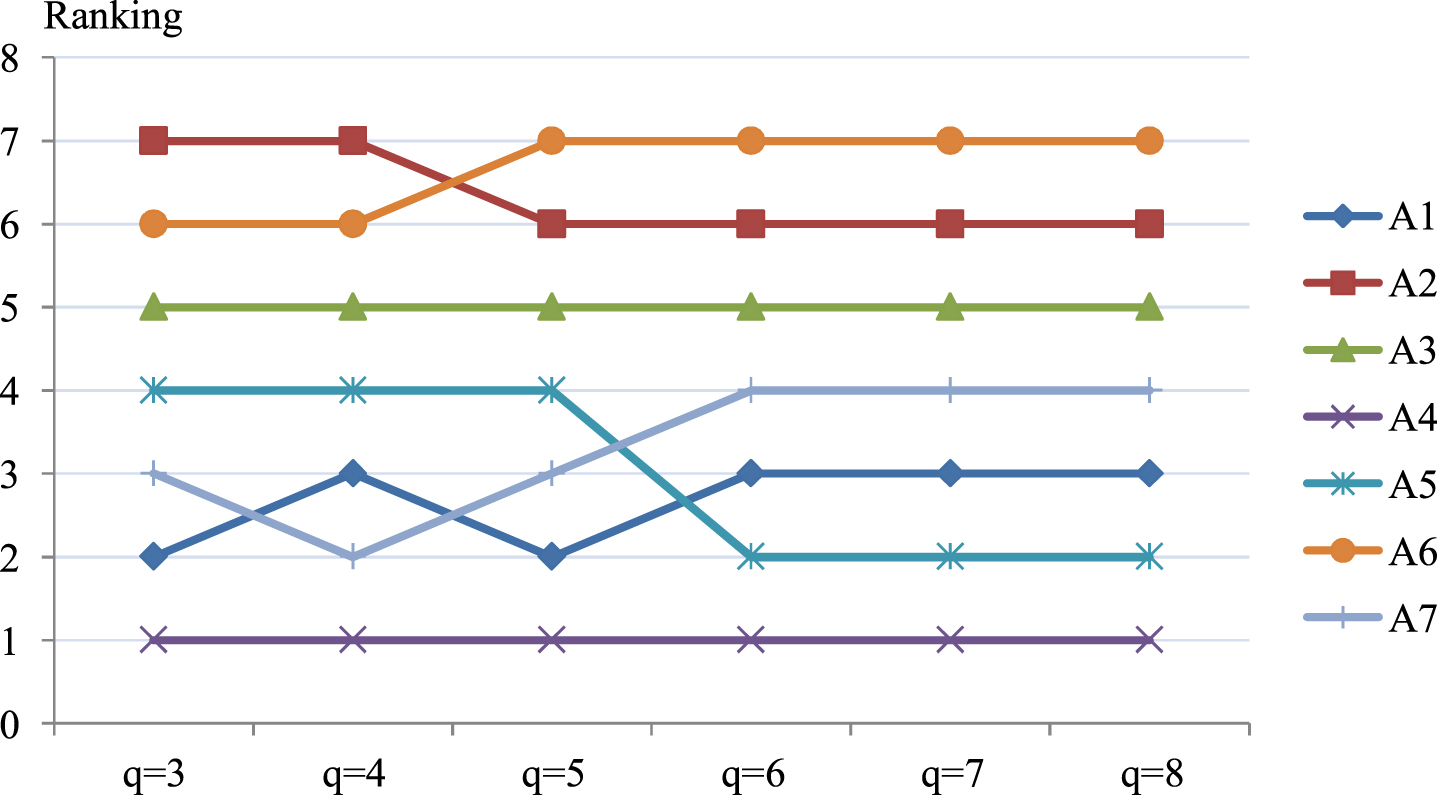
The rankings of risk factors with different q (η = ρ = 1).
Then, we use values of η and ρ in Step 4 in Section 4 to investigate the ranking situation of each factor (we fix q = 3). The score function and ranking results of the comprehensive value of each risk factor in Table 3. As shown in Table 3, the score function of risk factor decreases slightly at first and then increases slightly with the increase of η and ρ. When the values of η and ρ are less than 7, the highest risk factor is 𝒜4. When the values of η and ρ are not less than 5, the first risk factor is 𝒜7. In addition, the values of η and ρ indicate the degree of correlation between attribute variables, that is, the larger the value is, the stronger the correlation is. When η = 0 or ρ = 0, the T-SFIPWHM operator can not reflect the interrelationship between attribute values. In general, in order to simplify the calculation, η = ρ = 1 is taken.
The score functions and rankings of risk factors with various values of η, ρ (q = 3)
In summary, the parameters q, η and ρ of the T-SFIPWHM operator are the generality of the decision method and the flexibility of the decision process. In fact, we need to make reasonable choice of the alternative according to the realistic conditions of decision-making.
The effectiveness of our proposed method is confirmed and its advantages are elucidated by comparing the proposed method with existing methods.
(1) Compare with the methods without interaction
We select the T-spherical fuzzy weighted average (T-SFWA) [31] and T-spherical fuzzy weighted geometric (T-SFWG) [31, 32] operators, the T-spherical fuzzy Einstein weighted average (T-SFEWA) [47] and T-spherical fuzzy Einstein weighted geometric (T-SFEWG) [47] operators, the T-spherical fuzzy Hamacher weighted average (T-SFHWA) [41] and T-spherical fuzzy Hamacher weighted geometric (T-SFHWG) [41] operators. The above AOs are utilized to obtain the results respectively, as listed in Table 4.
The aggregation results of different methods
The aggregation results of different methods
Since the T-SFWA, T-SFWG, T-SFEWA, T-SFEWG, T-SFHWA and T-SFHWG operators do not consider the interaction among the MD, AD and NMD. Compared with T-SFIPWHM operator, the aggregation results of these operators have the situation that the MD or AD or NMD is 0. For example, there are this type of T-SFN in Table 4: <0.565,0.000,0.747>, <0.557,0.612,0.000>, <0.000,0.331,0.588>. From Table 4, the maximum or minimum results and information loss may occur in the T-SFNs aggregation process, and the proposed T-SFIPWHM operator based on IOLs can deal with this kind of problem in the aggregation process. Therefore, it can be explained that the T-SFIPWHM operator has scientific and superiority.
Except for the T-SFEWG operator, the highest risk factor 𝒜4 obtained by the above existing methods is the same as our proposed method in this paper. In terms of the order of other factors, our method is also different from the ranking of the T-SFWA, T-SFWG, T-SFEWA, T-SFEWG, T-SFHWA and T-SFHWG operators. In addition, the T-SFWA, T-SFEWA and T-SFHWA operators belong to the AO of the arithmetic averaging class, and they obtain exactly the same risk factors ordering. While the T-SFWG and T-SFHWG operators belong to the geometric averaging class AO and get consistent results.
(2) Compare with the methods considering interaction
We utilize the existing methods to deal with this example, such as the T-spherical fuzzy weighted interactive average (T-SFWIA) operator (improved by T-spherical fuzzy ordered weighted interactive average (T-SFOWIA) operator [44]), T-spherical fuzzy weighted geometric interactive aggregation (T-SFWGIA) operator [45], T-spherical fuzzy weighted averaging interaction (T-SFWAI) operator [48] and T-spherical fuzzy weighted geometric interaction (T-SFWGI) operator [48]. The decision results of existing methods are listed in Table 5.
Compared with existing methods considering interaction
The T-SFWIA and T-SFWGIA operators adopt IOLs-ZG, while the T-SFWAI and T-SFWGI operators use IOLs-J. Among them, the ranking results of risk factors got by the T-SFWIA and T-SFWAI operators are the same, while the results of the T-SFWGIA and T-SFWGI operators are basically similar. Compared with the results of proposed method, there results showed significant differences in the ranking of other risk factors except the first best 𝒜4 and the second best 𝒜1. The comparison indicates our proposed method is not only viable and effective, but also takes into account the equilibrium and correlation about input arguments.
(3) Compare with the methods considering balance
We apply the T-spherical fuzzy power weighted average (T-SFPWA) and T-spherical fuzzy power weighted geometric (T-SFPWG) operators [49] considering overall date balance to fuse the evaluation values of risk factors, then the results are compared with the T-SFIPWHM operator, see Table 6.
The aggregation results of T-SFPWA, T-SFPWG and T-SFIPWHM operators
From Table 6, we know that the T-SFPWA, T-SFPWG and T-SFIPWHM operators can obtain the highest risk factor 𝒜4, while the ranking of other risk factors is slightly different. Although the T-SFWA and T-SFPWG operators can consider the balance of the overall data, they ignore the interaction among the MD, AD and NMD in the attribute value as well as the interrelationship between attribute variables. In the process of T-SFNs aggregation, the MD or AD or NMD is also 0. Considering IOLs of T-SFNs is more intuitive, and there is usually attributes correlation in the practical decision problems, thus, our method is more conducive to practical application.
(4) Compare with the method only considering interrelationship
The T-SFWGMSM operator [40] is applied to collect the evaluation information of each risk factor and compare it with the T-SFIPWHM operator. The results are listed in Table 7.
The aggregation results of T-SFWGMSM and T-SFIPWHM operators
From Table 7, the T-SFWGMSM and T-SFIPWHM operators obtain the same highest risk factor 𝒜4 and the ranking of other risk factors is slightly different. In the T-SFIPWHM operator, we consider the interrelationship between two attribute variables, while the T-SFWGMSM operator can consider the correlation between multiple attribute variables (three attribute variables are considered in this paper). Although the correlation degree between attribute variables is higher than the proposed operator in this paper, the interaction among the membership functions of T-SFNs and the overall equilibrium of input T-SFNs are overlooked in the T-SFWGMSM operator. Therefore, the T-SFIPWHM operator is more scientific and reasonable in solving practical problems.
(5) Compare with the methods considering equilibrium and interrelationship
We apply the weighted T-spherical fuzzy power MM (WT-SFPMM) and weighted T-spherical fuzzy dual power MM (WT-SFDPMM) operators [46] to aggregate the evaluation information of each risk factor and compare it with the T-SFIPWHM operator (see Table 8).
The aggregation results of WT-SFPMM, WT-SFDPMM and T-SFIPWHM operators
From Table 8, the highest risk factor 𝒜4 is obtained by the WT-SFPMM operator and our proposed method, while 𝒜1 obtained by the WT-SFDPMM operator is the highest risk factor and the ranking of other risk factors is also quite different. In the WT-SFPMM and WT-SFDPMM operators, the advantages of the PA and MM operators are comprehensively considered, but the interaction relationships among the MD, AD and NMD of T-SFNs are ignored, and the MD or AD or NMD is also 0 in the process of T-SFNs aggregation. Therefore, the T-SFNs aggregation process of the T-SFIPWHM operator in this paper is more reasonable and advantageous.
From the above discussion, it can be seen from Tables 4–8 that the highest risk factor 𝒜4 obtained by the method proposed in this paper is basically the same as that obtained by existing methods. However, we find that the proposed method can integrate the advantages of membership functions interaction, balance unreasonable data and attribute variables’ interrelationship, while the existing methods only focuses on one or two advantages. In contrast, the results of the proposed method are more reasonable and scientific. We further compare the characteristics of the above AOs, as shown in Table 9. It is worth mentioning that the calculation process of T-SFIPWHM operator is relatively complicated, because it comprehensively considers IOL, PA and HM operators with T-spherical fuzzyinformation.
Comparison of the characteristics of AOs
(6) Compare with some MADM tools in T-spherical fuzzy environment
We compare the proposed method with the existing TOPSIS [69], MULTIMOORA [70] and TODIM [48] methods in T-spherical fuzzy environment to verify our results. The comparison results are shown in Table 10. In Ref. [70], T-SFDPWA operator (see Eq. (27)) calculates the ratio system value, T-spherical fuzzy Hamming distance measure calculation reference point value and T-SFDPWG operator (see Eq. (28)) calculates the utility function value. Finally, the final ranking is determined by dominanceconcept.
Comparison with some MADM methods
However, Eqs. (27, 28) cannot be applied when MD and AD of T-SFNs are 0. Thus, the MULTIMOORA method is not applicable. Both TOPSIS and our approach can get that the highest risk factor is 𝒜4, while the ranking of other options are slightly different. The ranking result of TODIM method is very different from that of our approach, 𝒜1 is the highest risk option, followed by 𝒜4. The reason may be that the attenuation parameter of loss in TODIM is taken 1. In short, it can be seen that the method proposed has usefulness and effectiveness by comparing with the existing methods.
In order to ensure the information rationality of the variables, extract the correlation information between the T-spherical fuzzy variables and the overall information on the decision object effectively, and study the management decision problems with the multi-dimensional perspective, we propose a new T-spherical fuzzy AOs, namely, the T-SFIPHM and T-SFIPWHM operators, which integrates some superiorities of the IOLs of T-SFNs, the PA and HM operators. On this basis, we develop a T-spherical fuzzy decision approach for the MADM problems based on the T-SFIPWHM operator. The application and analysis of the example show the effectiveness and feasibility of this method. The AOs proposed in this paper can be applied to complex decision-making situations and can integrate the aggregation advantages from different perspectives. Therefore, this paper enriches the technical means of information fusion and extends the decision-making theory system. In summary, we can summary the superiority of our proposed method as below: Based on the IOLs-J [48], the T-SFIPWHM operator considers the interaction among the MD, AD and NMD in T-SFNs, so as to avoid the irrational decision result when the membership function is 0 in the aggregation value of T-SFNs, which makes the method of this paper more reasonable and scientific. The T-SFIPWHM operator with the PA operator can effectively remove the negative effect of abnormal preference information given by decision-makers due to his/her personal feelings or lack of understanding of the decision objects. Thus, this operator can ensure the overall data balance and improve the fairness of decision-making. Compared with the aggregation characteristic that the T-SFWA [31], T-SFWG [31, 32], T-SFEWA [47], T-SFEWG [47], T-SFHWA [41] and T-SFHWG [41] operators are unable to catch the interrelationship between attribute variables, our proposed AO in this paper can obtain more evaluation information by considering the interrelationship of attribute variables, so as to ensure the accuracy of decision-making. Meanwhile, the proposed operator can flexibly choose the appropriate parameters η and ρ according to the actual situation, so that it can obtain more reasonable and flexible decision results. The advantages of IOLs, PA operator and HM operator are taken into account in our proposed AO. It can systematically and reasonably integrate the interaction among membership functions in T-SFNs, the overall balance of input T-SFNs and the interrelationship between attribute variables to realize evaluation information fusion. Therefore, our approach can solve practical complex MADM problems with T-SFNs more reasonably.
However, the proposed method also has three weaknesses: (1) although the amount of computation of the T-SFIPWHM operator is higher than the existing AOs, it can accurately obtain the calculation results and meets the complexity of the actual decision-making problems. (2) The AOs proposed cannot satisfy the Monotonicity and other properties. We will try to consider operation laws containing parameter, such as Frank operations, so that these AOs can satisfy relevant properties with respect to this parameter. (3) The attributes weight vector is assumed rather than got by a certain approach. In the follow-up study, we will adopt subjective or objective or combined weighting methods to obtain attribute weights according to the actual situation conditions and requirements of T-spherical fuzzy decision-making problems. In the future work, our proposed AOs can be further extended to different decision-making environments, such as simplified Neutrosophic sets [71], hesitant fuzzy sets [72], and we can also study the combination of sine trigonometric operational laws with T-SFNs [73]. We will focus on the integration of the proposed AOs with other sorting methods (e.g., TOPSIS, VIKOR, WASPAS, MARCOS, etc.) and apply them to different real-life decision problems.
Footnotes
Acknowledgments
This work is supported by the National Natural Science Foundation of China (No. 41661116), the Humanities and Social Sciences Foundation of Ministry of Education of the People’s Republic of China (No. 19YJC630164), and the Postdoctoral Science Foundation of Jiangxi Province (No. 2019KY14).