







Abstract
The difference operation for fuzzy number is an essential concept for the fuzzy set theory. There are several differences proposed: generalized difference, generalized Hukuhara difference and granule difference. Based on these differences, generalized differentiability, generalized Hukuhara differentiability and granule differentiability are also proposed, respectively. In this paper, the relations among these three kinds of differences and that of related three kinds of differentiability are clarified.
Keywords
Introduction
Related works
Zadeh [30] put forward the fuzzy set theory in 1965, and soon it attracted many scientists who were committed to apply it to the field of mathematics. Up to now, there are still a large number of literatures using fuzzy set theory to expand the traditional four arithmetic operations and differentiability. In most cases, the results of information obtained are often uncertain due to the errors brought about by the inherent subjectivity of human thinking and the complex and changing environment. Quantifying uncertain information with clear and accurate numbers is therefore a challenge. According to fuzzy set theory, we express this uncertainty as fuzzy number, that is, a class of possible sets, and then analyze the information or model with uncertainty. Furthermore, using fuzzy set theory one can investigate fuzzy dynamical systems control [16, 17] and fuzzy differential equations [2, 7]. In terms of practical application, [29] combined the fuzzy set theory and a technique for order preference by similarity to ideal solution (TOPSIS), the Fuzzy-Rough-TOPSIS model of project risk assessment is established. And [31] introduced a new rough fuzzy set and studied its application in TOPSIS multi-attribute decision making. Moreover, Sarwar et al. [21] proposed rough ELECTRE II approach which can be effectively applied to enhance the efficiency of working conditions and handle the uncertainty in real world.
The Hukuhara [6] difference (H-difference, for short) is defined in such a way that the "difference" between two identical intervals is zero, but in general the results are not the same with the traditional difference between two different intervals. And it requires that the interval length of the subtractor is not less than the interval length of the minuend, which limits its practical application (see [22, 23]). This restriction continued until 2008, the appearance of a new difference—generalized Hukuhara difference (gH-difference, for short) has been broken that restriction, which was introduced by Stefanini [22]. It is also proved that the gH-difference has much wider application range than that of H-difference, and that gH-difference is equal to the H-difference when H-difference exists. Based on the gH-difference between two fuzzy numbers Bede in 2013 [1] defined generalized Hukuhara derivative (gH-derivative, for short) of fuzzy-number-valued functions. One of the advantage of gH-difference is that there is no need to limit the length of the interval, that is to say, the gH-difference always exists between two intervals. However, this is not the case for any two fuzzy numbers, there are also some limitations to gH-difference of fuzzy numbers. The μ-level sets of fuzzy numbers x and y are denoted as
It can be seen that gH-difference between two FNs may not be obtained except in some simple cases. Similarly, the same limitation exists for gH-derivative that based on gH-difference. Thus, generalized difference (g-difference for short), a much wider difference, was proposed by Stefanini [22, 23] and Bede [1] with a corresponding derivative called generalized derivative (g-derivative, for short). Although it was originally proved that g-difference exists between any two fuzzy numbers, a counterexample presented in 2015 [5] by Gomes demonstrated that a little modification is necessary for the definition of g-difference such that the g-difference is invariably guaranteed to be a fuzzy number between two fuzzy numbers. Moreover, this modification does not change the corresponding properties and theorems that proposed with g-derivative.
It should be noted that the gH-difference is calculated on the basis of the α-level sets, by only considering the endpoint values of the α-level sets. Unfortunately, if someone want to acquire the full information of the points in this interval, it cannot get the desired result by applying the gH-difference.
In the early 21st century, Untiedt [10, 11] had presented the Constraint Fuzzy Interval (CFI, for short) representation which Piegat et al. [18, 27] called the horizontal membership function. Mazandarani et al. [13] proposed the granule difference (gr-difference, for short) based on horizontal membership function. It should be noted that the α-level sets are originated from the result granule which is the full result. The result granule is of great help if someone is interested in complete information result which including lower and upper points of uncertainty. But if someone just prefers to consider the uncertainty information that only include the maximum and minimum values, then the α-level sets is enough for their work. Similarly, Mazandarani et al. [13] also proposed the granule derivative (gr-derivative, for short) based on gr-difference.
Innovative contribution
What are the relations between these kinds of differences and the corresponding derivatives? Mazandarani et al. in [13] discussed the relations among these derivatives. But in this paper, we will analyze the relations of these derivatives more specifically. We will discuss the following problems to help people reasonably select the corresponding difference operation and derivative in practice.
1) Although we have already known that there exists the g-difference and the gr-difference between any two fuzzy numbers, do they get the same results? Do they have the same derivative with the corresponding differentiability?
2) It is also known that the g-differentiability is more general than the gH-differentiability and have the same derivatives if the gH-derivative exists, then does the gH-differentiability have the same relation with gr-differentiability or not?
Framework of the paper
We divided this paper into four sections. In Section 2, we will introduce some basic concepts and definitions that we will use throughout the paper. The Section 3 is divided into two parts including Differences 3.1 and Differentiability 3.2, and proposed the main results on these three differences and differentiability. The Section 4 gives the conclusions.
Basic Concepts
In this section, we will introduce the necessary notations and give some definitions that will be used in the later sequel.
The sets of all real numbers, positive real numbers, bounded closed intervals of real numbers and fuzzy numbers on real numbers are denoted by
According to Definition 2.1, the gH-difference always exists between any two intervals X = [x-, x+] , Y = [y-, y+] and it is equal to
However, the gH-difference between two fuzzy numbers does not exists all the time. Please refer to [1] for more details. If their exists the gH-difference between
Bede and Stefanini proposed the following definitions of derivatives according to the gH-difference and the g-difference for fuzzy-number-valued function in [1, 25].
Chalco-Cano and Romĺćn-Flores [4], Chalco-Cano and Rodrĺłguez-Lĺőpez [3] and Stefanini and Arana-Jim|nez [24] proposed the sufficient and necessary conditions of gH-differentiability. Furthermore Qiu [20] clarified the relations of gH-differentiability for a fuzzy-number-valued function and for these functions given a complete characterization of the gH-differentiability at a point.
The following theorem indicates a practical formula for the g-derivative.
Next, we will introduce the horizontal membership functions which Piegat, Landowski and Tomaszewska [18, 27] showed that without using Zadeh’s extension principle [30] they are great of direct introduction of fuzzy numbers in conventional mathematical formulas.
Next is the definition of four arithmetic operations between two fuzzy numbers based on horizontal membership functions.
Before introducing gr-differentiability we first review a related definition.
This section is divided into two parts. First in subsection 3.1 we will clarify the relations among gH-difference, g-difference and gr-difference. Moreover, we give some properties when two trapezoidal fuzzy numbers making these subtractions. Next in the subsection 3.2, we propose the relations among gH-differentiability, g-differentiability and gr-differentiability, and some examples are given to understand them better.
Differences
For any two fuzzy numbers the g-difference and gr-difference always exist, but they are not always equivalent. Let
Next, we will give the relations of these differences for fuzzy numbers. For any
Based on Definition 2.9, the horizontal membership functions of x, y, z can be written as
It is easy to see that z
gr
(μ, α
x
, α
y
) is monotonically increasing with respect to α
x
or α
y
. Therefore the extreme values of z
gr
(μ, α
z
) can be achieved at the following four cases: If α
x
= 0, α
y
= 0, then
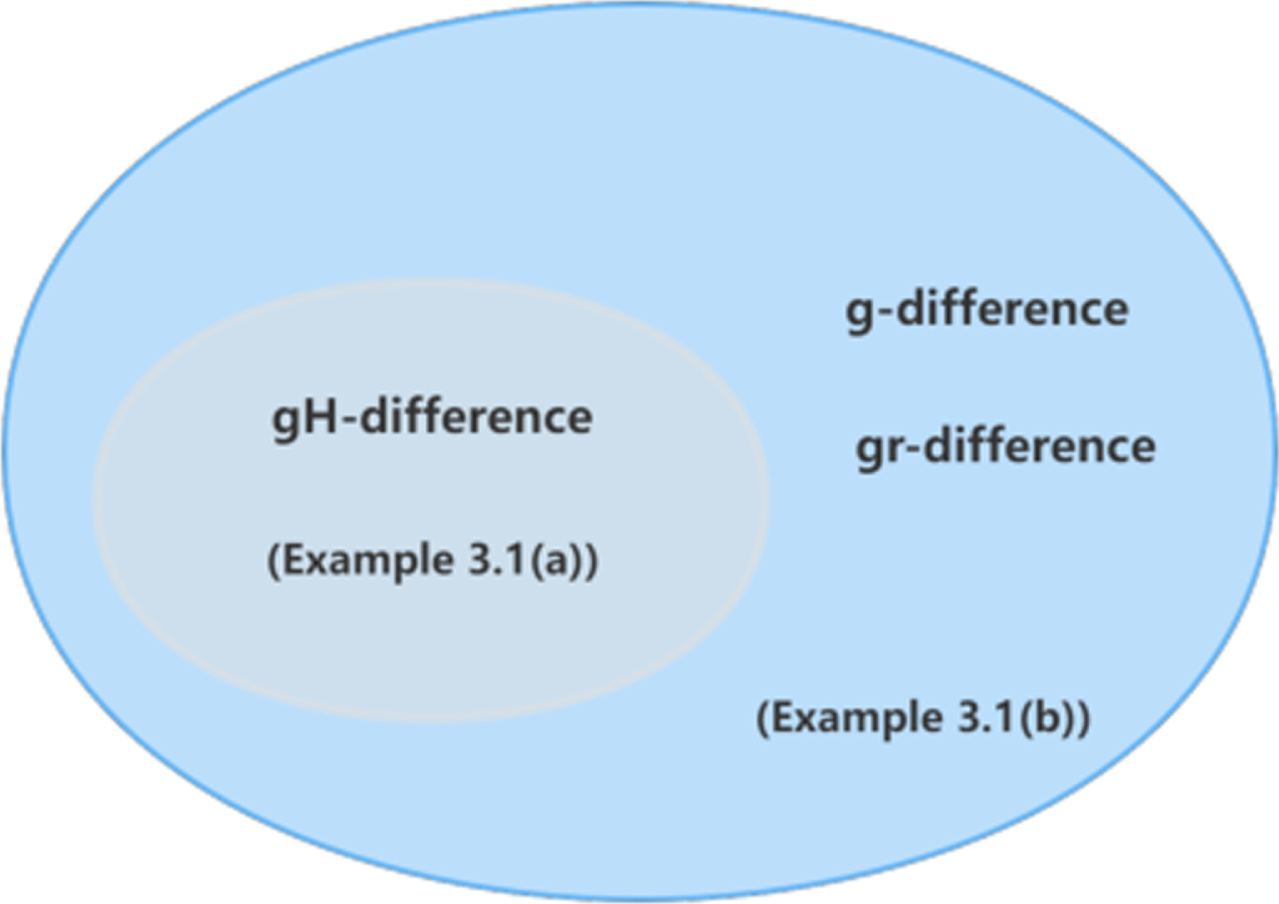
IGSO-ISSCTA framework. In terms of existence.
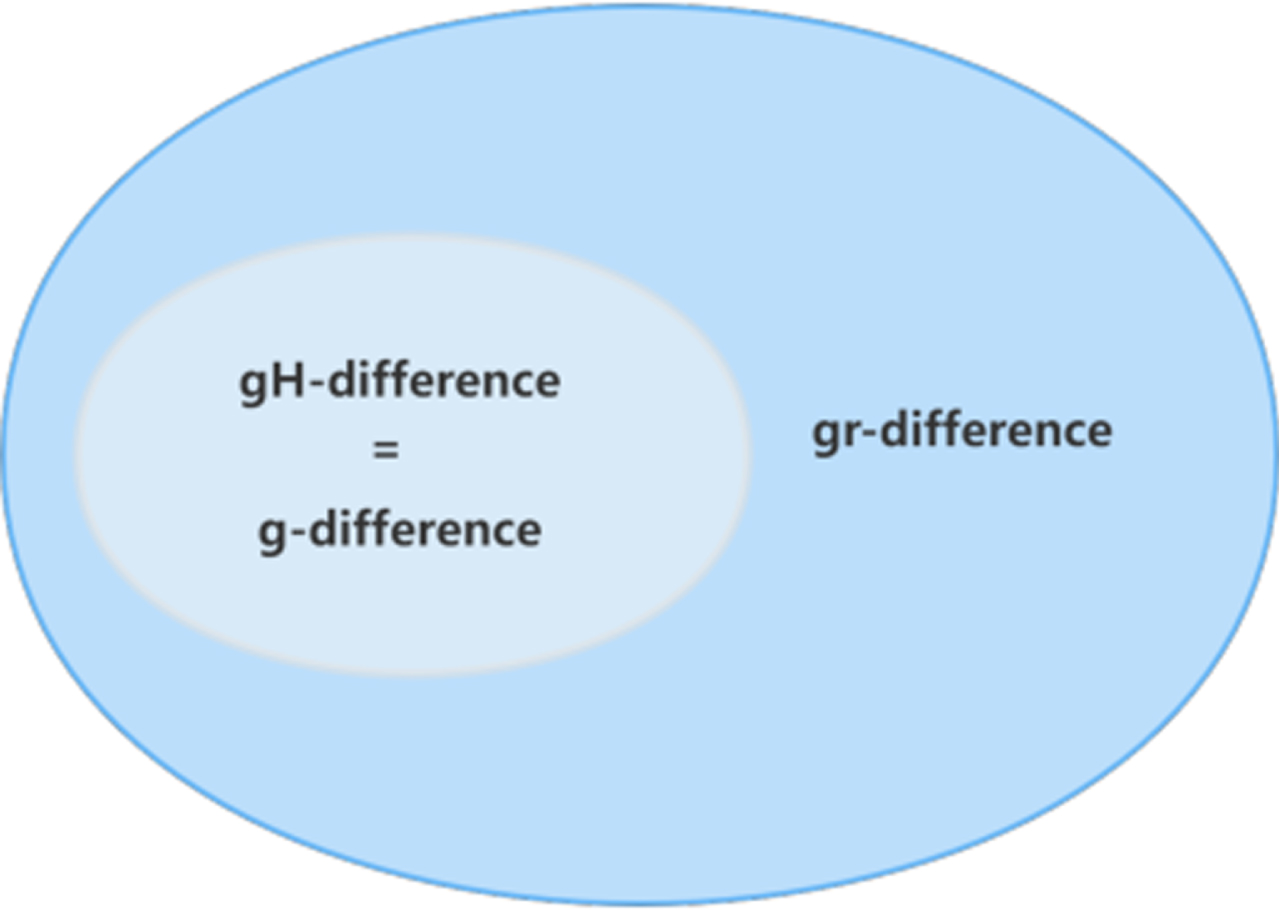
In terms of result if gH-difference exists.
The following proposition can be obtained.
If
Specially, if u i = (a i , b i , c i ) are triangular fuzzy numbers, then w gr = (a1 - c2, b1 - b2, c1 - a2), w gH = (min {a1 - a2, c1 - c2} , b1 - b2, max {a1 - a2, c1 - c2}).
If the gH-difference between u1 and u2 do not exists, then we have
Moreover,
(1) u2 is a real number and c1 = d1, or
(2) u2 is a real number and a1 = b1.
Specially, if u
i
= (a
i
, b
i
, c
i
) are triangular fuzzy numbers, then
Next, the Table 2 shows the laws of different differences between two trapezoidal fuzzy numbers u1 and u2 in Proposition 3.1. Detailed prove of Proposition 3.1 is in the Appendix A.
The relations between w gH , w g and w gr according to Proposition
(b) Let u = (2, 4, 7) , v = (1, 8, 9). After a simple calculate we can find the gH-difference between u and v do not exists, then from Proposition 3.1. we have
(c) Let u = (1, 2, 3, 7) , v = (-1.5, - 1, 0, 3.5). By Proposition 3.1. we get
We have already known the existence conditions of gH-difference in [23]. As for the other two differences, as is observed, if one want more information dates for the research, gr-difference is the best chose. However, if one want relatively accurate dates then g-difference will be more helpful.
It is necessary to study the characterizations of gr-differentiability since this differentiability becomes more and more popular in the literature [8, 28]. First we give a necessary and sufficient condition of gr-differentiability and discuss the relation between g-differentiability and gr-differentiability.
Sufficiency. If
It is easy to get that if g is gr-differentiable then it is g-differentiable as well and
Next, we illustrate the theorem with an example.
In the end of this subsection, we will give the relationship between gr-differentiability and gH-differentiability. Using the function in Example , we have the α-level sets of gH-derivative as follows,
It can be seen that if ∣u ∣ <1, then the resulting intervals
We can find from Example 3.2 (gr-differentiable but not gH-differentiable) and Example 3.3 (gH-differentiable but not gr-differentiable) that these two derivatives are incomparable.
Just for the sake of convenience, the case (i) in Theorem 2.1 is denoted by gH i -differentiable. Then we can get the following corollary.
Moreover, by Theorem 2.1, we have
The following example will illustrate this corollary.
If a function is gH-differentiable (or gr-differentiable) at a point, then it may not be gr-differentiable (or gH-differentiable) at that point. However, if a function is g-differentiable at a point, then it may not be gH-differentiable or gr-differentiable at that point. The following example will illustrate this conclusion.
It is easy to check that gH-difference does not exist at t = 0, thus f is not gH-differentiable at t = 0. Indeed, for
The relations between
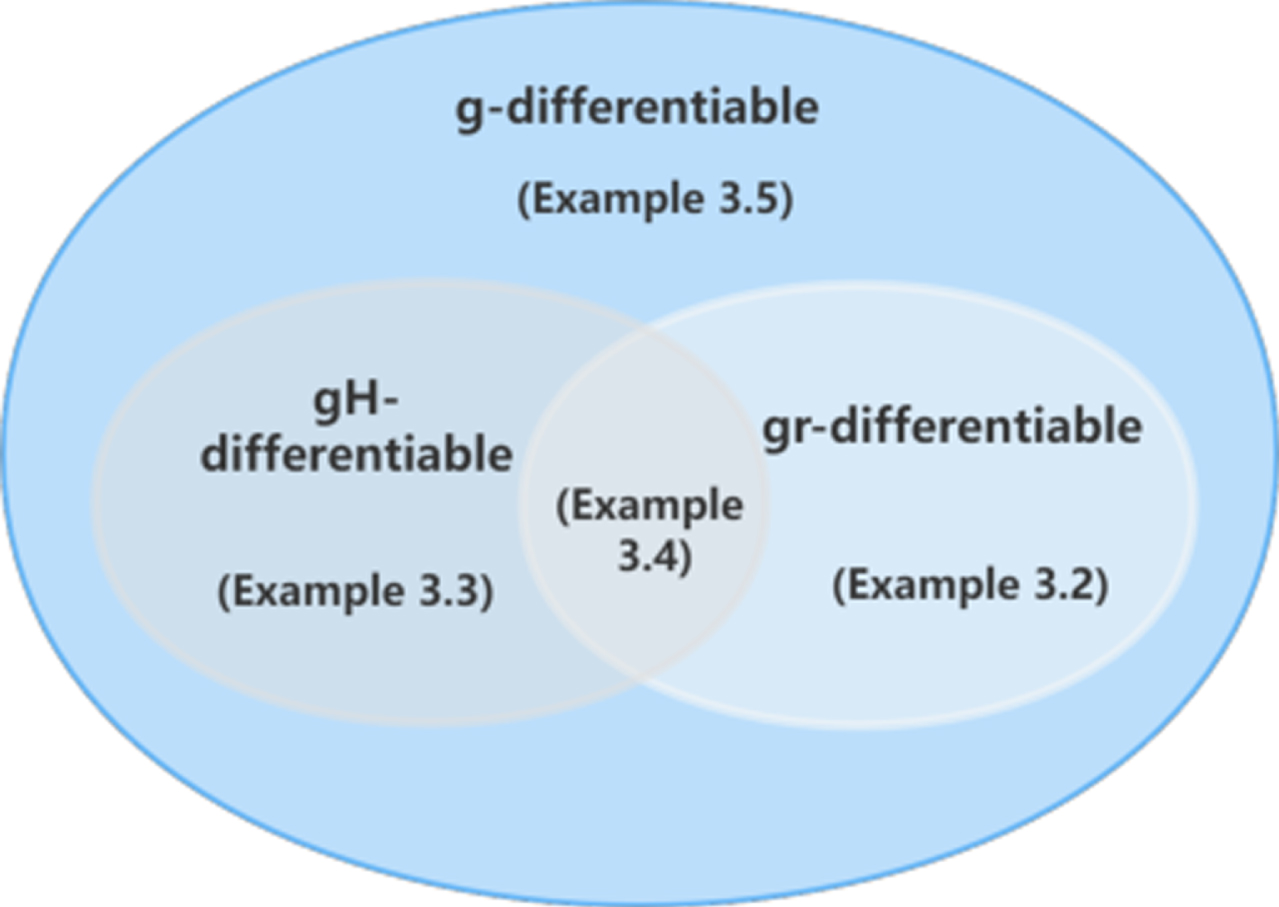
In terms of existence. The relations among gH-differentiability, g-differentiability and gr-differentiability.
By studying the relations among three kinds of fuzzy differences we find that the gr-difference exists between any two fuzzy numbers just like g-difference, but the result of g-difference is contained in that of gr-difference. See Table 1. Specially, we also find some special propositions about the gH-difference, g-difference and gr-difference between two fuzzy numbers in Table 2. By studying these three kinds of derivative relations, we get that the gr-derivative is not more general than g-derivative and it is incomparable between gr-derivative and gH-derivative. Mazandarani et al. [13] also discussed the relations among some derivatives and get that the gr-derivative is more reasonable. The relations of these three derivatives is pointed out in this paper more specifically.
The relations between z gH , z g and z gr
It should be noted that since the practical problems are different, we can choose a reasonable derivative to deal with the specific issues. Therefore, in this sense, the three derivatives have their respective applicable scope and are meaningful. In the further, we can use different approaches such as gH-derivative, g-derivative and gr-derivative dealing with fuzzy differential equations, such as fuzzy linear differential equations of motion for the Boeing 747 in longitudinal direction. Fuzzy dynamical systems control [16, 17] with the concept of gr-differentiability is also an interesting potential application.
Acknowledgements
The authors would like to thank the referee for his valuable comments. This work was supported by the National Natural Science Foundations of China (Grant no. 12171065, 11671001 and 61901074) and the Science and Technology Research Program of Chongqing Municipal Education Commission (Grant No. KJQN201900636).
Appendix A the detailed prove of Proposition 3.1
Let u
i
= (a
i
, b
i
, c
i
, d
i
) and having β-level sets
We have already known that
If
It is obvious that
If
We can see
I) : [w g ] α = [b1 - b2, d1 - d2 + (c1 - d1 - c2 + d2) α], then w g = (b1 - b2, b1 - b2, c1 - c2, d1 - d2), the difference between the endpoints of α-level sets of g-difference and gr-difference are
II) : [w
g
]
α = [b1 - b2, c1 - c2], then w
g
= (b1 - b2, b1 - b2, c1 - c2, c1 - c2), and
III) : [w
g
]
α = [b1 - b2, d1 - d2], then w
g
= (b1 - b2, b1 - b2, c1 - c2 (= d1 - d2) , d1 - d2), and
IV) : [w
g
]
α = [a1 - a2 + (b1 - a1 - b2 + a2) α, d1 - d2 + (c1 - d1 - c2 + d2) α], then w
g
= (a1 - a2, b1 - b2, c1 - c2, d1 - d2), and
V) : [w
g
]
α = [a1 - a2 + (b1 - a1 - b2 + a2) α, c1 - c2], then w
g
= (a1 - a2, b1 - b2, c1 - c2, c1 - c2), and
VI) : [w
g
]
α = [a1 - a2 + (b1 - a1 - b2 + a2) α, d1 - d2], then w
g
= (a1 - a2, b1 - b2, c1 - c2 (= d1 - d2) , d1 - d2), and
VII) : [w
g
]
α = [a1 - a2, d1 - d2 + (c1 - d1 - c2 + d2) α], then w
g
= (a1 - a2, b1 - b2 (= a1 - a2) , c1 - c2, d1 - d2), and
VIII) : [w
g
]
α = [a1 - a2, c1 - c2], then w
g
= (a1 - a2, b1 - b2 (= a1 - a2) , c1 - c2, c1 - c2), and
IX) : [w
g
]
α = [a1 - a2, d1 - d2], then w
g
= (a1 - a2, b1 - b2 (= a1 - a2) , c1 - c2 (= d1 - d2) , d1 - d2), and