






Abstract
Since people express their opinions and feelings more openly than ever before, sentiment analysis proves to be a promising research area that effectively analyses the opinion expressed over the entities. In this context, Sentiment analysis is utilized to gather valuable insights from users’ opinions. These insights would benefit a lot for the business concerns and institutions to improve their respective products/services. Aspect-based sentiment analysis (ABSA) is the most robust technique that offers a more fine-grained analysis. The objective of this paper is to improve the efficacy of ABSA by framing a robust and enhanced set of rules. Several experiments were carried out to detect explicit and implicit aspects. The hybrid approach comprising of enhanced rule-based approach (ERBA) and domain-specific lexicon (DSL) is used to improve the solution of the aspect-based sentiment analysis problem. The proposed approach employs a domain-specific adjective-noun collocation list(DSANCL) tailored to the domain for fine-tuning the process of implicit aspect detection(IAD). The proposed model frames a new nine-point scale for measuring the sentiment strength by introducing a ternary classification of intensifiers based on their degree of intensification. The performance of the proposed model is evaluated using the university reviews dataset.
Keywords
Introduction
With the exponential growth of social media, blogs, and review websites, students are extensively using these media for posting reviews about their university of study. They express their opinion regarding the various aspects of their institution such as facilities offered, academics, infrastructure, career services, sports clubs, and a lot more. These reviews serve as valuable sources to gather insights about the strengths and weaknesses of an institution based on each aspect. Students and their parents hope to get valuable insights from the analysis based on which they can choose the right institution for their higher education. On the other hand, institutions hope to master their strengths and weaknesses in each area and also come to know about their students’ expectations. The proposed work conducts a fine-grained sentiment analysis to address this problem.
ABSA aims to detect the opinions expressed about each relevant aspect present in the user content. As far as educational institutions are concerned, sentiment analysis techniques can greatly aid in analyzing students’ opinions regarding various aspects of the university. By gauging the students’ reviews, valuable insights can be obtained that would contribute to the proper restructuring of the lacking aspects.
The capability of distinguishing whether an input is subjective or objective, in particular, can be highly beneficial for a more effective sentiment classification [22]. On a broader picture, audits given by users are unstructured to a large extent [23]. Several challenges are to be faced while performing ABSA. The first challenge is that majority of the user reviews are unstructured. So, as a prerequisite to ABSA, the reviews must be pre-processed.
The second challenge is regarding the presence of multiple aspects in a review sentence where the user expresses the same opinion regarding all those aspects. For example, consider a review posted by a student about his/her university, “I would like to specify that the library, Wi-Fi coverage, and café are too good in my university”. In this example, the student expresses the same opinion “too good” regarding all the three aspects library, Wi-Fi coverage, and café. The third challenge is to deal with multiple opinions expressed over the same aspect in a single review sentence. To understand this notion, let us consider another review, “Nottingham university campus is large, very clean, and full of green life”. In this review, the student expresses multiple opinions such as “large”, “very clean” and “green life” over the single aspect “campus”. Apart from these challenges, there are some more complexities to be dealt with in the user reviews. Certain review sentences are too complex to extract the aspects and opinions, owing to the complex nature of the dependency relationship between the words. This complexity demands to frame customized patterns of grammatical relationships that would contribute to extracting the aspects and opinions. Moreover, majority of the previous works in ABSA have contributed techniques and approaches for extracting explicit aspects only. Comparatively, less number of papers only proposed methods for identifying the implicit aspects which is a far more challenging task.
The rest of the paper is organized as follows; Section 2 describes the related work for the aspect-based sentiment classification task. Section 3 describes the proposed framework. Section 4 describes the experimentation and discussion of results. The last section presents the conclusion and suggested future work.
Related work
Most of the previous works in ABSA concentrated on detecting explicit aspects. This is due to the reason that the majority of the aspects are directly mentioned in the reviews. Comparatively, less number of papers has dealt with detecting implicit aspects which is a challenging task. Few works only focus on this task [1] describes sentic computing that enables the analysis of text not only at document, page, or paragraph level, but also at the sentence, clause, and concept level [2] worked on conversational sentiment analysis to exploit the context information for sentiment detection using a bidirectional emotional recurrent unit [3] proposed an effective and novel method using attention mechanism and graph convolutional network for aspect-based sentiment classification [4] proposes an interpretable learning method using Tsetlin machines in such a way that the information on the aspect and context words are retained for sentiment classification [5] presented a model that relies on NLP techniques, rules, machine learning models, and dictionaries to carry out ABSA [6] used a combination of static and dynamic lexicons that outperforms isolated use of each type. They also showed that Parts-of-Speech(PoS)-based filtering of terms improves the quality of dynamic lexicon generation [7] detected implicit aspects by utilizing semantic relationships and opinion words as clues. The domain-based ontologies were applied to improve the accuracy further. It has been shown that the newly identified implicit aspects reasonably increased the performance of their approach. But, creating an ontology for every specific domain is costly. Moreover, this task takes more time [8] used Dependency parser. A feature vector was formed in a 6-tuple format. The vector includes aspect, opinion words, number of modifiers, an average score of modifiers, number of negative words, and punctuation [9] proposed a hybrid approach based on association rule mining to extract implicit aspects. A set of mined association rules is utilized in their work. As the initial step, an algorithm to find the candidate aspect indicators was developed. Then, a co-occurrence matrix was constructed to calculate the degree between the candidate aspect indicators and their associated aspects. At last, by using the generated rules of the form: aspect indicator ->aspect, the correct implicit aspects are identified [10] proposed a novel probabilistic supervised joint aspect and sentiment model (SJASM) which represents each review document in the form of opinion pairs, and can simultaneously model aspect terms and corresponding opinion words [11] contributed rules for extracting aspect-opinion word pairs specific to a particular domain [12] proposed a method using syntactic dependency and framed ten handcrafted dependency paths. This method generates a syntactic dependency tree by using a dependency parser and extracts the aspect-opinion pairs. Synonyms are clustered using WordNet and polarity of opinions is found using SentiWordNet [13] proved that the syntactic structures of the aspects can be used for aspect extraction. The drawback of this method is that it could not generalize for new data [14] used a rule-based method to extract explicit aspects and a classification technique was used to identify implicit aspects [15] employed a novel co-occurrence association-based method to identify implicit aspects [16] found that, if the same noun has more adjacent adjectives in different sentences then the aspect has been ranked by more opinion words [17] created a list of pre-defined aspects. A dependency parser was also used to find the aspects. Certain templates of dependency relation were identified from training data and using these templates, aspect-opinion pairs were detected from test data [18] proposed a rule-based approach to aspect extraction from product reviews. The method exploits common sense knowledge and sentence dependency trees to detect both explicit and implicit aspects [19] extracts candidate aspect rules based on phrase detection in constituency parse. Word similarity is used to categorize the candidate aspects [20] discussed that most of the previous works were unable to extract implicit aspects and predict the polarity of implicit sentiments [21] proposed a new hybrid sentiment classification using the feature selection method.
Proposed work
Data set
According to certain review papers on ABSA, it is inferred that around 25 papers conducted the research solely based on product reviews. This makes product review datasets as the most frequently used dataset. It is also mentioned that other popular data domains used in sentiment analysis works include movies, restaurants, hotels, tourism, phone and laptop reviews. Some domain areas are almost unexplored and require further work. One such domain is university reviews. As a measure of exploring this domain, the proposed work is carried out based on the student reviews about their university collected from the website, studentcrowd.com. The data size is around 380 reviews. The users’ reviews incorporate simple as well as complex sentences.
Domain-specific Lexicon
The primary limitation of using a generalized Lexicon-based approach is the incorrect sentiment scoring of opinion words. To mitigate this issue, DSL is constructed as part of the proposed work. The lexicon is also used in the detection of implicit aspects. The lexicon resource for the university domain used in this research is developed based on:
(1) Aspects about the university domain are gathered by parsing the university reviews, by collecting the frequently discussed aspects in this domain, and through brainstorming.
(2) Adjective–noun collocation list about the relevant aspects to aid in IAD.
(3)Weightage for three categories of intensifiers(maximizers, boosters, and downtoners).
Methodology
The research work includes various methods for efficiently performing ABSA. The proposed architecture of the research is shown in Fig. 1. Usually, online reviews contain a lot of noise factors, so, they cannot be directly used for analysis. Therefore, initially, the reviews in the dataset are pre-processed to remove the noise from the text. The Pre-processing task involves case conversion, stop-word removal, spell-check, and lemmatization. As an outcome of the noise reduction process, split review sentences were obtained that are ready to be used in the subsequent tasks of ABSA. Followed by Pre-processing, the subsequent methods used in the proposed research work include i) Enhanced rule-based model for aspect-opinion word extraction ii) Extraction of Implicit aspects iii)Sentiment Scoring using improved intensifier handling.
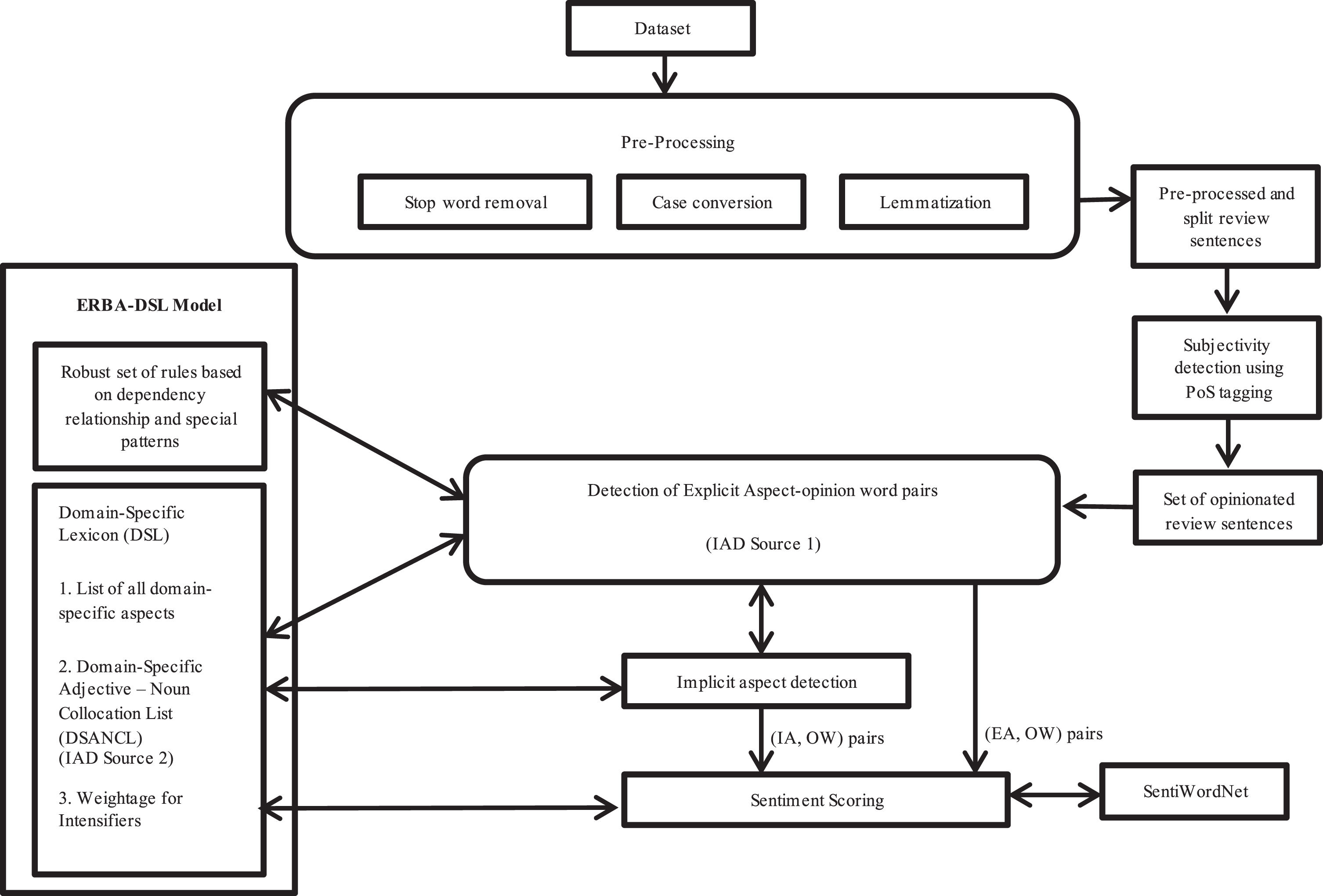
Proposed System Architecture. (Note: EA denotes explicit aspect, IA denotes implicit aspect and OW denotes opinion word).
One of the main contributions of this research work is the enhanced set of rules framed through a detailed study of dependency relationships between the words present in review sentences. For this study, the CoreNLPDependencyParser is used and the implementation was carried out in python.
Even though some of the previous works had employed a rule-based scheme for aspect-opinion word extraction, only a limited set of rules were used. Most of the works using this approach had utilized only simple dependencies such as amod, nsubj, obj, xcomp. Still, several valuable and complex dependency relationships can be helpful in the extraction of more relevant aspects and opinion words. In the proposed work, several unexplored dependencies were found. For example, complex dependency relationships were explored.
Novelty in Rule based scheme
Some of the valuable insights obtained while framing the new rules based on the complex dependency relationships are presented below.
(1) Even though in some sentences, a noun and an adjective are not directly connected by any dependency relation, it is found that they can still be associated indirectly via an additional dependency relation in the same sentence. In the proposed work, such complex relationships are captured as new rules that bring out the relevant aspects and opinion words that would otherwise be left out.
(2) Rules that are capable of extracting multiple aspects and multiple opinion words present in the same sentence were framed.
(3) It was identified that a nummod relation connecting a cardinal number in fractional form (a/b) and a noun can be a valuable source of opinion about the noun. This rule is capable of extracting the aspect and opinion from review sentences which involve rating for an aspect in the sentence itself. In such types of sentences, the opinion word is present in numerical form. For example, consider the review sentence, “10/10 for library facilities”. Here, the user has expressed his/her opinion in the numerical form. 10/10 is the cardinal(CD) in fractional form (a/b). If a = b, then the user has given a strong positive opinion for the aspect.
The Proposed work (ERBA-DSL model) has contributed the enhanced set of rules given below:
If amod relation exists between a noun (NN1) and an adjective (JJ) and nmod-of relation exists between the first noun(NN1) and second noun(NN2) then label concatenation(NN1,NN2) as an aspect and JJ as an opinion word.
For example, consider the review sentence “good selection of courses”. In this sentence, amod relation exists between good (adjective) and selection(noun1). Moreover, nmod-of relation is there between selection(noun1) and courses(noun2). So, “selection of courses” is extracted as an aspect and “good” is extracted as an opinion word.
Even though there is no direct dependency between the noun and an adjective, they are linked indirectly via an obj-with relationship.
If ccomp relation exists between an adjective and verb and obj-with relation is also there between that verb and a noun, then label the noun as an aspect and adjective as an opinion word.
If csubj relation exists between an adjective and a noun then label the noun as an aspect and adjective as an opinion word.
If nmod-of relation exists between two nouns, then label the noun (NN2) as an aspect and the noun(NN1) as an opinion word.
For example, consider the sentence “lack of communication”, nmod-of relation exists between lack and communication. Here, regarding the aspect of “communication”, the student has expressed an opinion of “lack”.
This rule extracts an aspect with two opinion words. If amod relation exists between an adjective and noun and conj-and relation is there between that noun and a verb (in past tense) then label the noun as an aspect, adjective as an opinion word and also label the verb in past tense as another opinion word.
The specialty of this rule is, it detects the fact that an opinion is expressed over an aspect even though they are not directly dependent.
This rule states that if nsubj relation is between a noun and a verb, followed by xcomp relation between the same verb and an adjective, then label the noun as an aspect and adjective as an opinion word.
This is a complex rule that brings out multiple aspects and multiple opinion words from the review sentence.
If conj-and relation is there between NN1 and NN2 and the same relation exists between NN1 and NN3, followed by a nsubj relation between NN3 and JJ1 which in turn is in conj-and relation with JJ2, then label NN1,NN2,NN3 as aspects and JJ1 and JJ2 as opinion words expressed over all those aspects.
This rule can extract multiple opinion words associated with a single aspect.
If nsubj relation exists between a noun NN and an adjective JJ1, followed by a conj-and relation between JJ1 and another adjective JJ2, then label NN as an aspect and JJ1, JJ2 as opinion words for the same aspect.
This rule again stands out as an example of how complex dependencies can bring out every possible opinionated aspect that could contribute to the improvement of ABSA.
If nmod-for relation exists between a noun NN1 and another nounNN2(s) (i.e., the noun may be in plural form too) followed by an object relation between a verb and the first noun NN1 then label NN2(s) as an aspect and VBN+NN1 as an opinion word.
For example, consider the sentence “had support for services”, Rule 9 will extract “services” as an aspect and “had support” as an opinion word.
If along with nsubj relation, nmod:at relation also exists between the noun and another noun phrase(NNP), then label the NN+”at”+NNP as an aspect and JJ as an opinion word. This rule can bring out the aspect-opinion word pairs from a reasonable number of review sentences as discussed in the example below.
For example, consider the sentence “My experience at NG university was incredible”. Here, “experience at NG university” is labeled as an aspect and “incredible” is the opinion expressed over the aspect.
This rule is capable of extracting the aspect and opinion from review sentences which involve rating for an aspect in the sentence itself. This is not the normal rating that comes as part of the review text. Instead, in such types of sentences, the opinion word is not present in textual form rather it is specified in numerical form.
If nummod relation exists between CD and NN, then label NN as an aspect and CD as an opinion. Later, in the sentiment score calculation part, this CD component is analyzed and its sentiment polarity and score are found using specific formulae. CD denotes the cardinal in fractional form(x/y). Here, x is the score given to the aspect, y is the maximum marks, for example,7/10 for teaching, here a score of 7 is given out of 10 regarding the teaching aspect.
Sometimes an aspect is implied by noun+verb. Such aspects can be identified by this rule. For example, “Great place to study”, Here, the place is a noun and study is a verb.
Together, this noun and verb (“place to study”) form an aspect and the opinion expressed over this aspect is “great”.
This rule is composed of a double amod relationship. For example, “Good online workspace”, where Good is an adjective (JJ1), online is an adjective (JJ2) and workspace is a noun (NN). This rule labels “online workspace” (JJ2 + NN) as an aspect and “Good” (JJ1) as an opinion word.
[Here, nmod:of dependency is optional. If only obl:with dependency is present in the sentence, then aspect(NN1) and opinion word(JJ)]
This rule is a combination of obl:with and nmod:of dependencies. It labels NN1 + NN2 as an aspect and JJ as an opinion word. For example, “pleased with the quality of service”, where “quality of service” (NN1+“of”+NN2) is labeled as an aspect and “pleased”(JJ) is labeled as an opinion expressed over the aspect.
The following are the simple basic rules that are applied in the extraction process. It is the baseline model.
If nsubj relation is there between a noun (NN) and an adjective (JJ) then label NN as an aspect and JJ as an opinion word.
For example, consider the sentence “loved all the facilities”, obj relation exists between facilities (noun) and loved(verb in past tense). So, “facilities” is extracted as an aspect and “loved” is extracted as an opinion word. In all the rules presented above, advmod relation is used to extract the intensifiers that may enhance or reduce the strength of the opinion expressed over an aspect. The following forms of advmod relation are used:
i) advmod(JJ,RB/RBR)
ii) advmod(VBD,RB/RBR)
In the above dependencies i) & ii), RB represents adverb and RBR means comparative adverb. The tags RB and RBR denote the intensifiers present in the review sentence. For example, “really great campus”, here, “really” is the adverb(RB) that denotes the intensifier.
Special Patterns to identify Aspect-Opinion word pairs
In addition to the above rules, special patterns were framed to identify aspects and their corresponding opinion words. It was found that the patterns that are framed, contribute to extracting a reasonably good percentage of aspect-opinion word pairs.
The most promising patterns that could match up with a reasonably good number of review sentences are selected and applied in the extraction process. Those patterns that are more specific and apply to only a very few sentences are filtered out and not used. Table 1 shows some of the patterns used in the proposed model. Each pattern shown in the Table 1 could extract several sentences matching the corresponding sequence of tags.
Special patterns framed to extract aspect-opinion word pairs
Special patterns framed to extract aspect-opinion word pairs
For example, consider the pattern NN-VBZ-[RB]-JJ, where [RB] is optional. It can extract several review sentences matching its sequence such as “campus seems really nice”, “café looks extremely awesome”, “library looks spacious”, “university appears modern”, “staff teaches really nice” and a lot more. So, to facilitate in selecting the most generic patterns and thereby remove the specific ones, a threshold was fixed, say, t.
If the number of review sentences with which a pattern could match up is greater than or equal to the threshold, t, then that pattern is categorized as a generic pattern and included in the model for extracting aspect-opinion word pairs. Otherwise, the pattern is treated as more specific in the sense that it could match up with only a few sentences, and hence it is not included in the extraction process due to less efficiency. The threshold value is fixed as given below:
Let n_op denote the number of opinionated sentences present in the reviews. Let x_op denote the number of opinionated sentences that match up with the sequence of tags in a given pattern p. Let t denote the threshold. Let t = 10 percent of the number of opinionated sentences.
This implies, t = 0.1*n_op
Based on the above threshold, a pattern is classified as generic or specific as below:
If x_op> =t, then label p as a generic pattern, otherwise, label p as a specific pattern.
Using the above condition, each pattern was tested against the opinionated review sentences, and those patterns that are labeled as generic are utilized for the extraction process and those patterns labeled specific are excluded.
The DSL includes a dedicated sub-lexicon for compound noun aspects that are specific to the domain. The compound noun aspects were collected from the university reviews dataset. Even though, the compound noun aspects would be comparatively less in number than the single noun aspects, still, these compound nouns would be beneficial in improving the aspect extraction accuracy of the proposed work.
Compound nouns occur in several patterns, such as a noun followed by another noun (NN-NN) and a noun connected with another noun through the preposition IN(NN-IN-NNS).
An interesting compound noun pattern occurs in the format (JJ-NN). Actually, if a noun is preceded by an adjective, the adjective will be considered as an opinion expressed about the noun such as “brilliant professor”. But in certain circumstances, the JJ-NN pattern contributes to compound nouns such as “academic ability”. Here, the adjective “academic” is not an opinion word, but it’s a part of the compound noun. The compound noun patterns detected from the review sentences are presented in Table 2.
Patterns used to extract compound nouns aspects
Patterns used to extract compound nouns aspects
To check how the detected patterns are used to identify the compound noun aspects, a few examples are shown below:
Review sentence 1: Academic ability of the faculty is really excellent.
PoS tagged sentence:
Academic/JJ ability/NN of/IN the/DT faculty/NN is/VBZ really/RB excellent/JJ
Compound noun pattern detected from this sentence: academic/JJ ability/NN
Review sentence 2: Good selection of courses in the university.
PoS tagged sentence:
Good /JJ selection /NN of/IN courses/NNS in /IN the/DT university/NN
Compound noun pattern detected from this sentence: selection/NN of/IN courses/NNS
Review sentence 3: The wifi coverage in the campus is superb.
PoS tagged sentence:
The/DT wifi/NN coverage/NN in/IN the/DT campus/NN is/VBZ superb/JJ
Compound noun pattern detected from this sentence: wifi/NN coverage/NN
Implicit Aspect Detection (Phase II)
In some of the review sentences, the aspect over which an opinion is expressed is not directly mentioned. Instead, the aspect is hidden which is to be detected through some means. Such aspects are termed as implicit aspects. In the university reviews dataset that was taken for analysis, nearly 6.44 percent of opinionated sentences contained implicit aspects. Even though the number of implicit aspects is very small when compared with explicit aspects, detection of those aspects would surely contribute to an improvement in the overall extraction of aspects. Based on the analysis of the sentences containing implicit aspects, it is inferred that the majority of the implicit aspects can be detected by inspecting the adjacent sentences, in particular, the previous sentences. For example, consider the review sentence, “find that amazing for students especially”. In this review sentence, an opinion “amazing” is expressed over an aspect, but the aspect word is not directly mentioned in the sentence. Instead, the word “that” serves as a clue for finding the aspect over which the opinion is expressed. To find the hidden aspect, the review sentences preceding the current sentence were inspected.
Previous sentence:
“So many restaurants and bars and fun things to do right on the doorstep”
In this sentence, the nouns are “restaurants” and “bars”. Therefore, the word “that” in the current sentence refers to these previous nouns, and hence the implicit aspects of the current sentence that are opinionated as “amazing” are the previous nouns “restaurants” and “bars”. Table 3 shows some samples sentences containing implicit aspects and how those aspects are detected. Figure 2 illustrates the methodology developed in the proposed work to perform IAD.
Sample sentences containing implicit aspects and clues for their detection
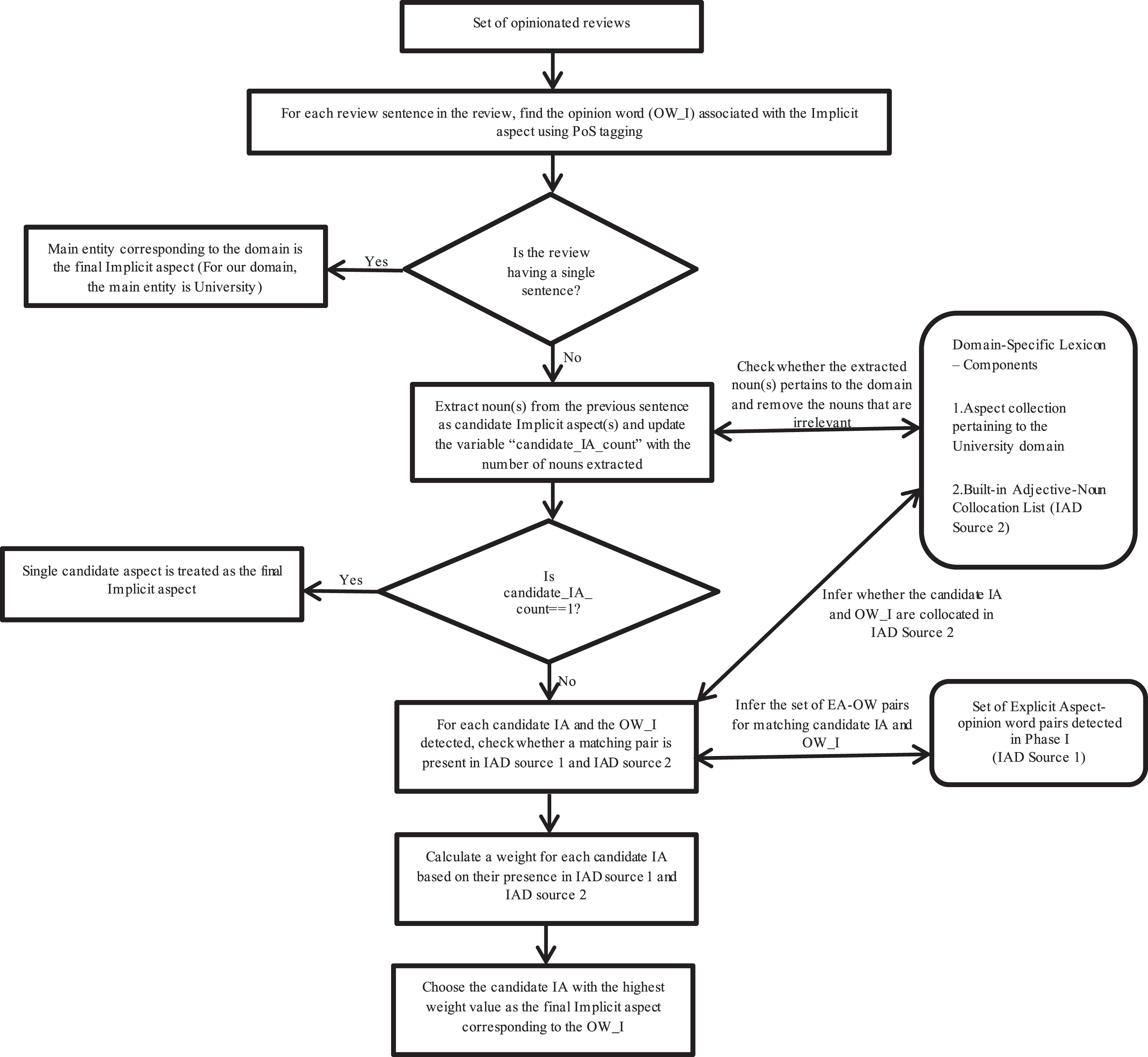
Detection of Implicit Aspects using DSANCL and EA-OW pairs extracted in Phase –I.
For every review in the set of opinionated reviews with hidden aspects, first, extract the opinion expressed in the review sentence using PoS tagging.
Adjectives and verbs are the possible sources that denote opinion words. Let OW_I denote the opinion word associated with the implicit aspect (hidden aspect). The proposed work identifies three different categories of reviews that might occur concerning IAD which are discussed below:
If there is only a single sentence in the review, and an opinion is expressed over some hidden aspect, then it can be concluded that the main entity of the domain is the implicit aspect. In the proposed work, the university reviews dataset is chosen for analysis. Around 6.44 percent of the reviews contained implicit aspects. A thorough analysis of independent review sentences reveals the fact that the opinion expressed about the hidden aspect is actually the opinion expressed over the overall entity in the domain. For example, consider the student reviews in the university reviews dataset shown in Table 4.
Sample single review sentence with opinion and implicit aspect
Sample single review sentence with opinion and implicit aspect
In all the sentences shown in Table 4, an opinion is expressed about some hidden aspect. In sentence 1, the opinion word “good” is mentioned repeatedly, and it shows that the student or alumnus wishes to stress and emphasize his/her opinion. However, the aspect over which the opinion was targeted is not mentioned anywhere. Moreover, the most crucial fact is that the review has only a single sentence, which implies that it is not possible to search for any nouns in the previous sentence for candidate implicit aspects. Therefore, in such cases, the logical conclusion would be to consider the overall entity as the implicit aspect which serves as the opinion target. Therefore, in sentence 1, it can be considered that the opinion “good” is expressed about the overall entity, “university”, which is the implicit aspect. Likewise, in the subsequent sentences also, users express their views such as “definitely recommend”, “awesome”, “loved it”, “absolutely love it”, and such other opinion words without mentioning the target aspect. It implies that these opinions were all expressed over the main entity, “university”. It is logically correct because if the user wishes to express his/her opinion on a specific aspect of the entity, then the aspect would be explicitly specified in the review or else if the user writes a review with two or more sentences, in that case, the implicit aspect may be referred from the nouns in previous sentences. Therefore, in a short review with at most only one sentence, the only possibility of the opinion target is the overall entity of the domain.
In this case, the user review may contain two or more sentences. The first sentence would contain an opinion regarding a single aspect. In the subsequent sentence, the user may express another opinion regarding the previously mentioned aspect without mentioning the aspect explicitly. This way of expressing an opinion regarding the previously mentioned aspect leads to the notion of implicit aspect in the current sentence. Consider the following two examples:
Example 1-Review#1
Sentence#1: “my university is one of the most amazing in UK.”
Sentence#2: “glad and honored to be a part of it.”
In sentence #1, the user describes the aspect “university” with the opinion word “amazing”. In subsequent sentence #2, the user expresses some more opinions (glad and honored) about the same aspect specified in the previous sentence. To avoid repetition, the user avoided the term “university” in the second sentence, and therefore mentions “glad and honored to be part of it.” In this case, the word “it” denotes the implicit aspect of this sentence. Logically, it denotes the aspect discussed in the previous sentence. Therefore, it can be concluded that the aspect “university” present in the previous sentence is the implicit aspect in sentence #2.
Example 2-Review#2:
Sentence#1: “the societies are all lovely.”
Sentence#2: “found some hard to fit in.”
In sentence #1, user describes the aspect “societies” with the opinion word “lovely”. In subsequent sentence #2, the user mentions “found some hard to fit in”. Here, the user mentions an opinion word “hard to fit” over an implicit aspect. The word “some” implies the hidden aspect. Tracing back to the previous sentence #1, it was found that the aspect “societies” is exactly what the user refers to in sentence #2 through the words “found some”. Actually, the user tries to convey that all societies are lovely but he/she found some of the societies were hard to fit in. In sentence #2, by using the term “some”, the user refers to the previous noun “societies” which is the implicit aspect hidden in sentence #2.
Case 3: Review containing more than one sentence with two or more previous nouns
The third case is actually the extension of case 2, where the change lies in the occurrence of more than one noun in the previous sentence. In case 2, as only a single noun occurs in the previous sentence, it is concluded that the implicit aspect is denoted by that single noun; whereas in case 3, there may be two or more aspects in the previous sentence which is denoted by the phrase, candidate implicit aspects. It is necessary to devise a strategy for deciding which of these nouns will be the final implicit aspect hidden in the subsequent sentence. If suppose, the clue in the current sentence denotes the possibility of multiple implicit aspects as the opinion target, then all the candidate implicit aspects could be finalized as the implicit aspects. On the other hand, if the opinion is targeted towards a single aspect, then it is necessary to choose one of the candidate implicit aspects. In order to accomplish this type of IAD among multiple candidates, the proposed work makes use of two sources. The first source is the set of explicit aspect-opinion word (EA-OW) pairs detected in phase-I which is referred to as IAD source1. The second source, IAD source2, is based on a novel approach developed in the proposed work. It is a built-in DSANCL that is incorporated into the DSL. Adjectives and nouns can have a particular collocation to convey a specific meaning. The built-in collocation list shown in Table 5 contains the adjective-noun pairs that habitually appear together. Now, suppose the current sentence contains an opinion word expressed over a specific implicit aspect(OW_I). According to the methodology of the proposed work, first, the domain-relevant nouns are fetched as candidate implicit aspects from the previous sentence. Then, each candidate implicit aspect(candidate_IA) paired with OW_I in the form (candidate_IA, OW_I) is looked up in IAD source 1 for a match. If a match is found, then the weight of the candidate_IA is updated with the number of times that pair has co-occurred in the reviews, which is denoted as scoreIADSource1 (Score obtained from IAD source 1). Next, the (candidate_IA, OW_I) pair is looked up in IAD source2 for a match. If the pair is found in the collocation list, then, the weight of candidate_IA is incremented by a value of 1, which is denoted as scoreIADSource2 (Score obtained from IAD source 2). The formula for calculating the weight associated with the candidate implicit aspect is given by the equation Equation (1):
Sample Adjective-Noun Collocations from the Built-in DSANCL
Sample Adjective-Noun Collocations from the Built-in DSANCL
Sample list of different types of Intensifiers (Maximizers, Boosters and Downtoners)
Based on the weight associated with the candidate implicit aspects, the candidate_IA having the highest weight value is chosen as the final implicit aspect that is hidden in the current review sentence.
Basically, sentiment scoring is accomplished by identifying the sentiment-bearing terms, and then, based on their contextual polarity and intensity, the sentiment score is calculated [24] had discussed that polarity and intensity are the two important aspects of sentiment analysis. According to their work, they consider positive and negative as the two polarities and define intensity at four levels namely strong, medium, weak and neutral. Some of the previous work in sentiment classification has handled intensifiers using addition and subtraction of 1. For instance, if a positive opinion word has a score of 0.65, then the score of an amplified opinion word is obtained by adding 1 to the score of the opinion word, which in this example is 1.65. On the other hand, the score of a reduced opinion word is obtained by subtracting 1 from the score of the opinion word, which is –0.35. The issue with this approach is that it does not take into account the various ranges of intensifiers whose degrees of intensification vary significantly. Most of the previous work has classified sentiment strength on a three-point scale (positive, negative, and neutral). In the proposed work, a hybrid approach is used for sentiment score calculation. SentiWordNet version 3.0 is used for scoring the opinion words and the DSL is used for scoring the intensifying words. Negators that reverse the polarity of the opinion are also handled. Table 7 shows the nine-point scale for measuring sentiment strength.
Sentiment Strength on a nine-point scale
Sentiment Strength on a nine-point scale
SentiWordNet is a publicly available lexical resource specifically developed for supporting sentiment classification. SentiWordNet version 3.0 is used in the proposed model. As far as SentiWordNet is concerned, it associates sentiment in the meaning of the word rather than the word itself. This feature allows a word to have various sentiments corresponding to each meaning. In SentiWordNet, three numerical scores are associated with each word as denoted by the equations Equations (2) to (4). For any word ‘X’,
For example, scores of opinion word “good” are given below: Positivity score, Score_pos(good)=0.57 Negativity score,Score_neg(good)=0.03 Objectivity score, Score_obj(good)=0.40
A positive score of 0.57 is obtained by summing the corresponding scores of the word “good” in 33 synsets of WordNet and taking the average value. The total score obtained by summing all the above three scores for the specified word is equal to 1. In the proposed work, a novel idea is used to measure the sentiment strength of each opinionated aspect based on the nine-point scale. A nine-point scale contributes to the fine-tuning of sentiment strength detection. Using the enhanced set of rules discussed in section 3.3, opinion words, and intensifiers were detected. Predominantly, adjectives, adjectives with “est” in the suffix(eg: greatest), verbs in base form(eg: like), verbs in past tense form(eg: hated) represent opinion words. On the other hand, adverbs and adverbs in comparative forms denote the intensifying words (eg: extremely, really, slightly, etc.).
These intensifiers either enhance the sentiment strength of the opinion word or weaken it. Intensifiers are used in various types of discourse as modifying elements. Their primary function is to reinforce (or) alternate a variable feature in the element it applies to. This means that these adverbs occur in certain collocations with adjectives, verbs, and nouns [26]. Intensifiers are promising candidates that could help in classifying sentiment strength on a deeper scale. To the best of our knowledge, the proposed research is the first work to classify strength on a new nine-point scale as a measure to classify the sentiment strength in a fine-tuned manner.
The new scale is formed by taking into account the following factors:
(a) Based on the degree of intensification, intensifiers can be classified into three categories namely, maximizers, boosters, and downtoners. These intensifiers are represented as AdvMaximizer, AdvBooster, and AdvDowntoner respectively. The categorized lists of intensifiers are presented in Table 6.
Based on the knowledge obtained from previous studies, it is known that only two categories of intensifiers (strong intensifiers and weak intensifiers, or enhancers and reducers) were taken into consideration. The proposed work utilizes three categories of intensifiers based on their ability to intensify the associated opinion words.
(i) Maximizers denote the greatest possible degree of intensification. For example, adverbs such as absolutely, perfectly come under this category.
(ii) Boosters denote the most creative, emotional/expressive connotations with a high degree of intensification. Some of the adverbs serving as boosters are awfully, really, heartily, very, etc.
(iii) Downtoners are those adverbs that reduce the force of a statement. Such adverbs decrease the intensity, express doubt, or show imprecision. Some of the downtoner adverbs are probably, rather, slightly, etc. To understand the difference in intensification reflected by the above categories, consider the review sentence: “The campus is nice”. The adjective “nice” in the above sentence can be intensified in the following ways:
(a) The campus is absolutely nice- Here, the adverb “absolutely” being a maximizer increases the intensity of the adjective to the fullest extent.
(b) The campus is very nice –Here, the adverb “very” being a booster, increases the intensity of the adjective to a high degree, but not to the fullest degree as that of a maximizer.
(c) The campus is hardly nice- Here, the adverb “hardly” being a downtoner decreases the intensity of the adjective.
So, considering the degree of intensity exposed by these categories of intensifiers, it was decided to utilize these three categories of intensifiers along with the polarities (Positive, Negative, and Neutral) to frame a fine-grained nine-point scale for measuring the sentiment strength. This is also one of the main contributions of this research work.
(b) In some cases, review sentences may contain two adverbs modifying a single adjective. For example, consider the review sentence, “teaching is really very good”. In this sentence, two adverbs “really” and “very” enhance the opinion word “good” expressed over the aspect “teaching”. In this case, the positive sentiment orientation of the opinion word is enhanced doubly by the two boosters present in the sentence. The presence of two boosters is treated as equivalent to a maximizer and given the weightage score of a maximizer type intensifier. It is represented by the equation Equation (5).
(c) In some review sentences, adverbs and adjectives occur in the form of extended words such as toooo, goood, baaa..d, etc. In the proposed sentiment scoring method, a booster-type adverbial intensifier in its extended form will be treated as equivalent to a maximizer, which is denoted by the equation Equation (6).
For example, a booster-type adverb, “too” in its extended form “tooo” or “too ... .” increases the degree of intensification further to a still higher level. So it is worth upgrading the intensifier from booster to maximizer. This transformation is essential to capture the strong force implied by the extended form of the word and would benefit in accurate scoring. Similarly, if a downtoner type of adverbial intensifier is present in its extended form, it tends to reduce the force of the opinion further. For example, in the sentences “somewhaaa..t nice”, “Quite ... . ok”, the downtoner adverbs “somewhat” and “Quite” occur in their extended forms respectively and reduce the tone of the opinion reasonably. Compared to the extended forms of boosters, this type of occurrence(extended forms of downtoners) happens less frequently, but still realizing the fact that even a small improvement in accuracy would make a significant impact on the overall scoring, due importance is given to this feature too. On the other hand, extended forms of adjectives are also handled through an equivalent relation. An adjective in its extended form (eg: goood, goo..d, baaad, baa ... d) is treated as equivalent to an adjective in normal form qualified by a booster type intensifier, even though the adjective is not accompanied by an adverb. This is because the repeated characters or series of dots present in such words still emphasize the intensity of the opinion. This factor is denoted by the equation Equation (7):
For example, nice ... .. =>very nice
Here, “nice ... ” is an adjective in its extended form. According to the equation Equation (7), it is equivalent to “very nice”, here, “very” is a booster-type adverb and “nice” is the adjective in normal form.
The notations Imaximizer, Ibooster and Idowntoner are defined as below:
Imaximizer={list of maximizer type intensifiers}
Ibooster={list of booster type intensifiers}
Idowntoner={list of downtoner type intensifiers}
Let ow be the opinion word. Let i be the intensifier. Let ow_i denote an opinion word modified by an intensifier. The sentiment scoring equations in the proposed work are framed by extending the work of [25]. They defined three axioms governing the score computation using adjectives and adverbs. The sentiment scoring equations denoted by Equations (8) to (13) were framed as part of the proposed work. These equations can be extended in case double adverbs are associated with an adjective.
To understand how the sentiment score is computed, consider a review sentence, “The campus is absolutely good”. Here, the opinion word “good” has a score of 0.57 from SentiWordNet. The adverb “absolutely” is an adverbial intensifier of type maximizer, so, it gets a weight of 1. The sentiment score of the opinion word modified by the adverb is computed using the equation Equation (8):
Sentiscore(“good”)=Sentiscore(good)+(1-Sentiscore(good))* weightmaximier(“absolutely”))
Sentiscore(“good”)=0.57+(1-0.57)* 1 = 1
The original sentiment score for “good” is 0.57. The modified score of “good” is 1(increased), as it is modified by a maximizer type adverb “absolutely”.
However, if the “adverb” in the above example is “very” instead of “absolutely”, then the score will be computed using the equation Equation (10):
Sentiscore(“good”)=Sentiscore(good)+(1-
Sentiscore(good))* weightbooster(“very”))
Sentiscore(“good”)=0.57+(1-0.57)* 0.8 = 0.91
The original sentiment score of “good” is 0.57. The modified score of “good” is 0.91(increased), as it is modified by a booster type adverb.
With a downtoner type of adverb such as “hardly” present in a sentence, say, “The campus is hardly good”, the score is computed using the equation Equation (12):
Sentiscore(“good”)=Sentiscore(good)- (1- Sentiscore(good))* weightdowntoner(“hardly”))
Sentiscore(“good”)=0.57- (1-0.57)*0.5 = 0.355
The original sentiment score for “good” is 0.57. The modified score of “good” is 0.355(decreased), as it is modified by a downtoner-type adverb, which reduces the strength of the opinion word.
It is important to give due consideration to neutral reviews in detecting sentiment orientation. Neutral reviews do not express any opinion over the aspect. Such reviews lack sentiment information due to their ambiguity [27]. The absence of positive or negative sentiment in a review indicates neutrality. If the confidence for positive or negative is too low, it is treated as neutral. Consider the examples below:
Sample review 1:
“due to covid i’ve only been on the campus a few times so i haven’t been able to properly experience it yet”
Sample review 2:
“during this pandemic, we didn’t really get to go on campus”.
In both the reviews, the users did not express any sentiment about the aspect of “university campus”. It exhibits neutrality.
Handling a new kind of opinion word in numerical form denoted by the tag CD in POS tagging
In the analysis of PoS tags towards the search of opinion words, it is found that the element of a sentence tagged as “CD” occurring in the form of fractional number x/y, is extracted as an opinion word. This is a new kind of opinion word involving numbers, for which score is not available in SentiWordNet. Therefore, a special module is designed to compute the score for such kinds of opinion words.
For example, consider the review sentence, “I will give 10/10 for sports activities in this campus”. The PoS tagging for the sentence is shown below:
I/PRP will/MD give/VB 10/10/CD for/IN sports/NNS activities/NNS in/IN this/DT campus/NN.
From the above tagged sentence, it can be found that 10/10 is tagged as a cardinal number in the form of x/y. It implies that the user has given 10/10 (full marks) for the sports aspect.
Experiments, results and discussion
For testing the efficacy with which the enhanced rule-based approach extracts the aspects and opinion words, experiments were conducted using the university reviews dataset collected from the website studentcrowd.com. The dataset has a total of 380 reviews. The various statistics about the dataset are presented in Table 8. Figure 3 shows the corresponding graphical representation. Out of the 633 review sentences, 606 sentences were subjective. That is, about 95.73 percent of the review sentences express some form of opinion towards an entity or aspect, and 4.26 percent of sentences do not contain any opinion at all. Figure 4 shows the pie chart corresponding to the percentage of opinionated and non-opinionated sentences.
Dataset statistics
Dataset statistics
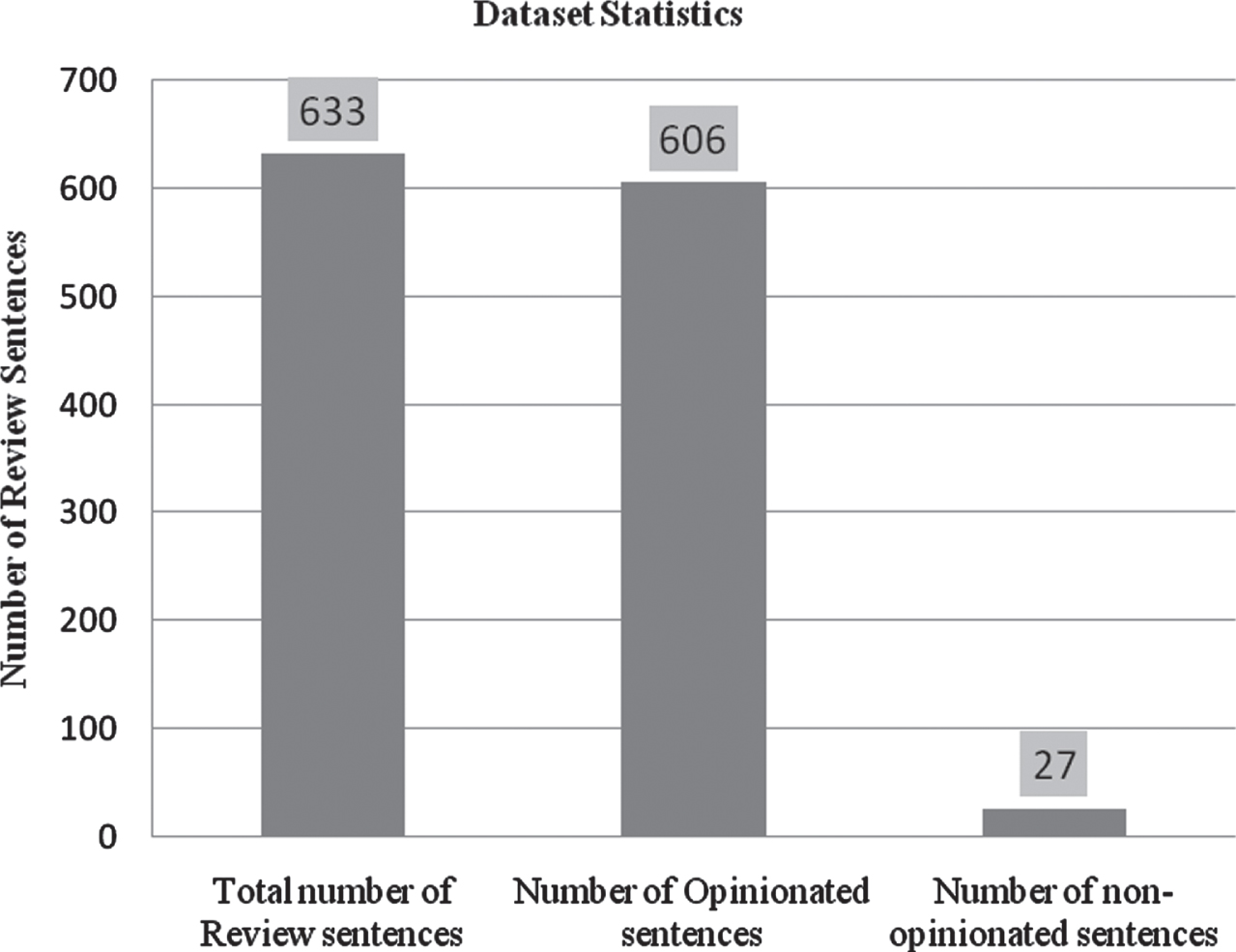
Dataset Statistics.
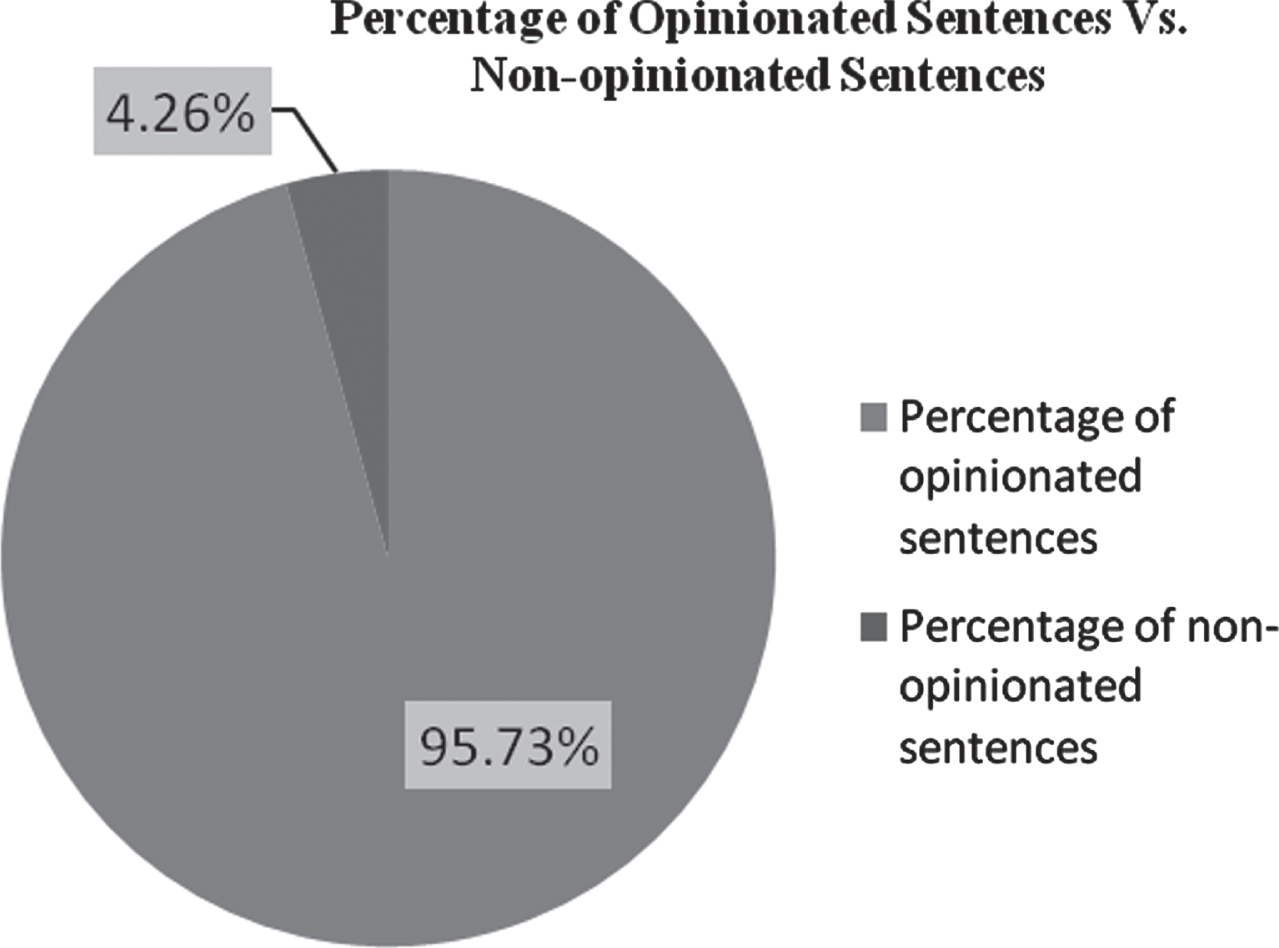
Percentage of Opinionated Vs Non-opinionated sentences.
The non-opinionated sentences were excluded from the experimentation process as they do not contain any sentiment expressed over the aspects. The opinionated sentences were alone included in the experimentation process. Table 9 shows the statistics about aspect-opinion word extraction. Out of the 606 opinionated sentences, 731 pairs of aspect-opinion words were present. The proposed model has identified 88.24 percent of the actual number of pairs, i.e) 645 aspect-opinion word pairs were detected out of 731 pairs which is a reasonably good percentage achieved by the enhanced rule-based model as compared to the baseline model which retrieves 76.47 percent of the actual number of aspect-opinion word pairs. Figures 5 and 6 show the corresponding graphs.
Statistics about Aspect-opinion word Extraction
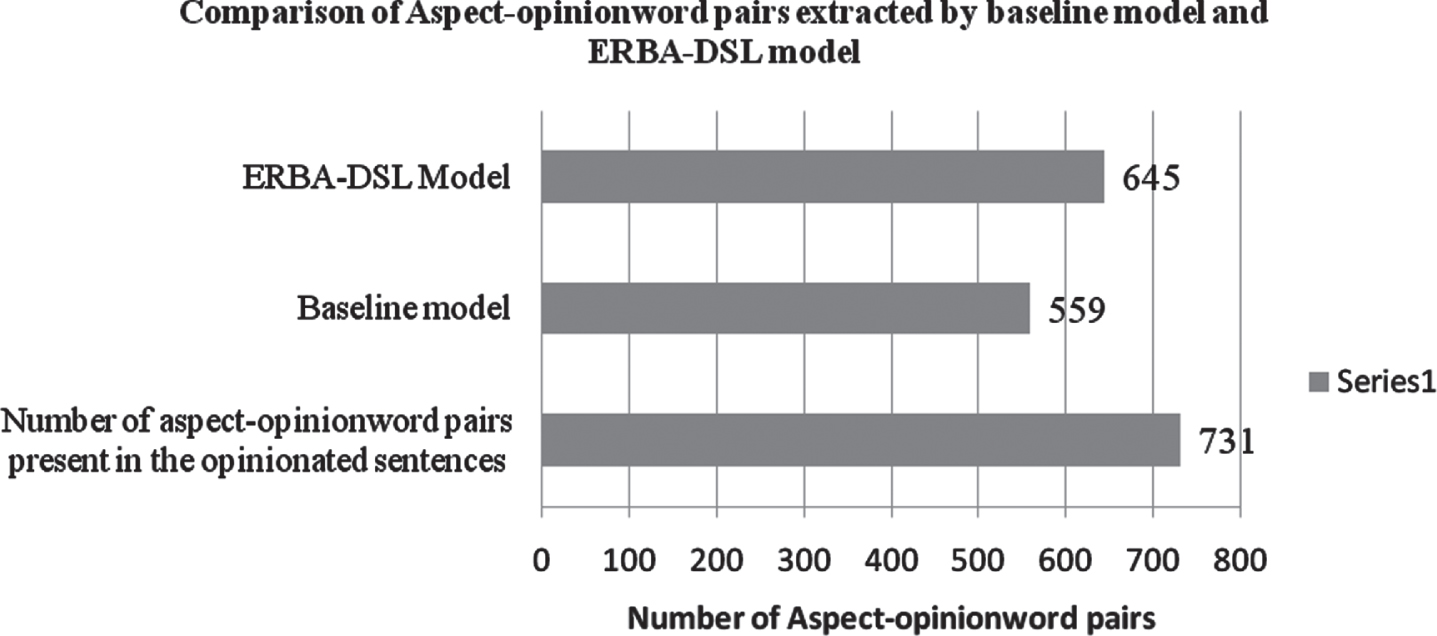
Comparison of Number of Aspect-opinionword pairs extracted by baseline model and ERBA-DSL model.
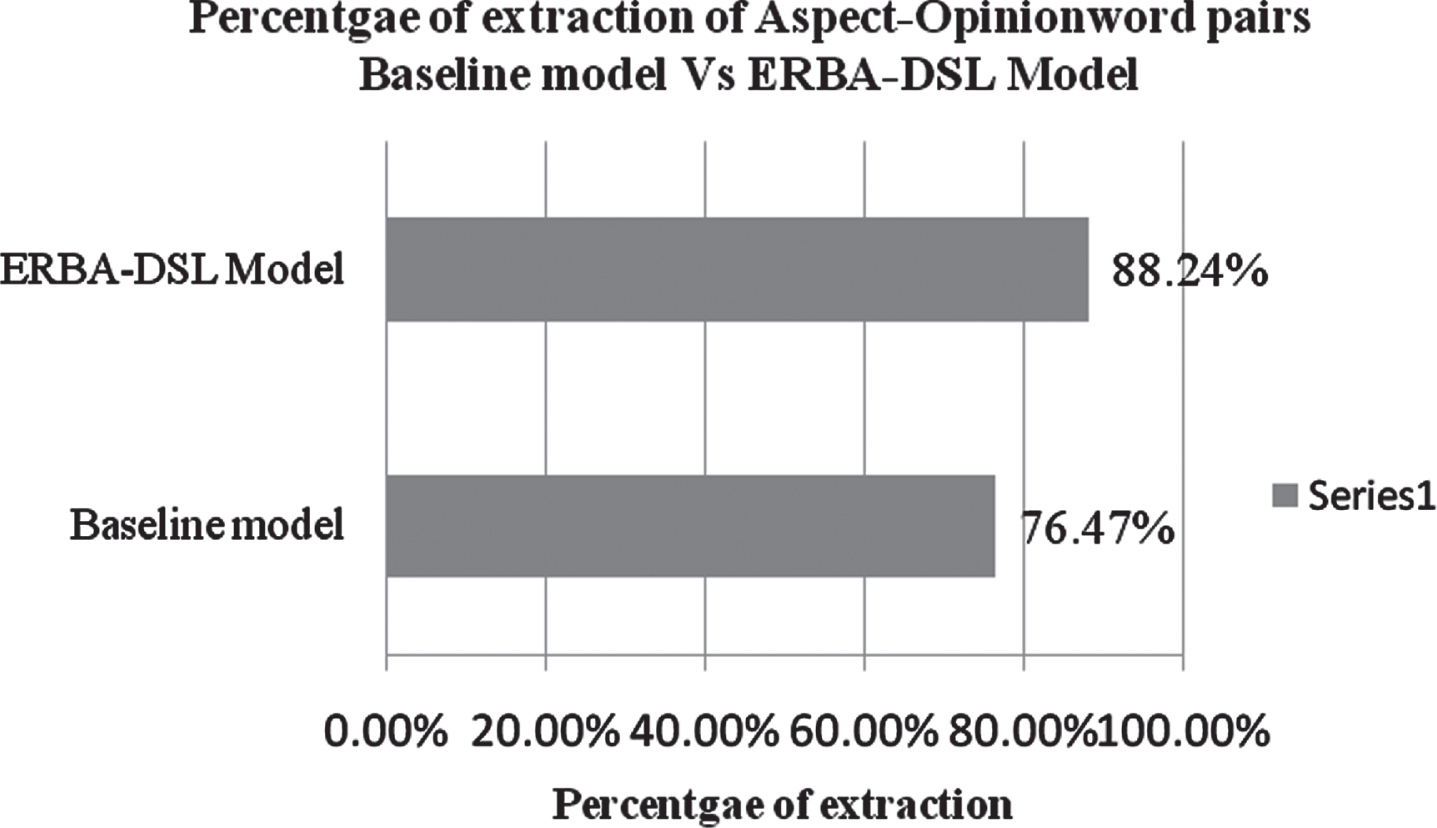
Percentage of extraction of Aspect-Opinionword pairs Baseline model Vs. ERBA-DSL Model.
Among the 606 opinionated sentences, 93.56 percent of opinionated sentences contained explicit aspects and 6.44 percent of sentences expressed opinion over hidden implicit aspects. Table 10 and Fig. 7 represent these data. Even though the percentage in the latter case is comparatively lower, still detection of those hidden aspects makes a significant contribution to overall aspect extraction accuracy. So, analyzing such types of sentences proves worthy. Implicit aspects were identified from multiple previous nouns in 46.15 percent of the opinionated sentences. Nearly, 25.64 percent of the sentences contributed to detecting implicit aspects from a single previous noun. Implicit aspects were detected as the main entity of the domain in about 28.21 percent of the opinionated sentences. Table 11 and Fig. 8 represent the data about IAD.
Distribution of Explicit aspects and implicit aspects in opinionated sentences
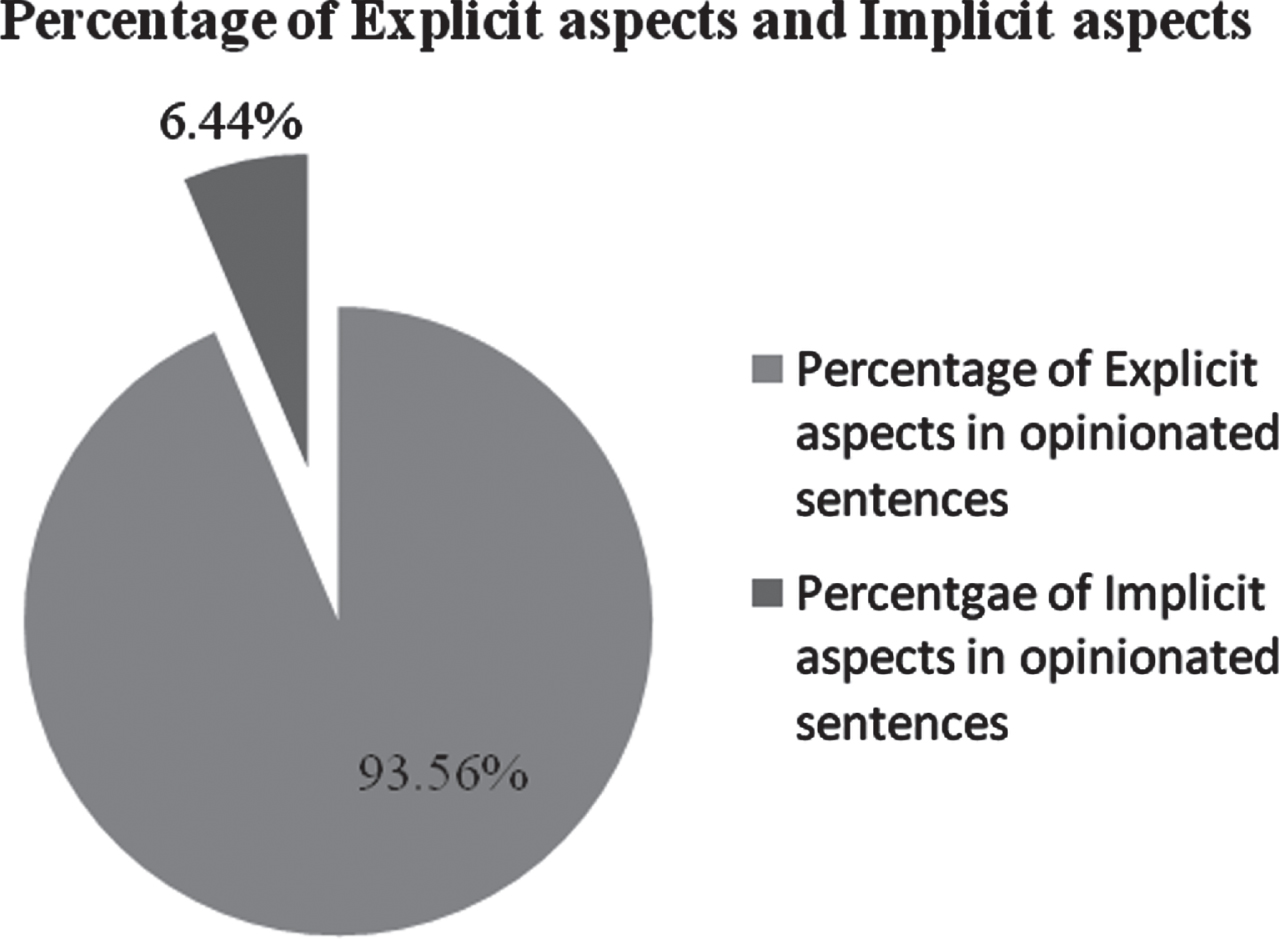
Percentage of Explicit aspects and Implicit aspects distributed over the opinionated sentences.
Statistics on Implicit aspects identified by the main entity, previous noun and multiple previous nouns
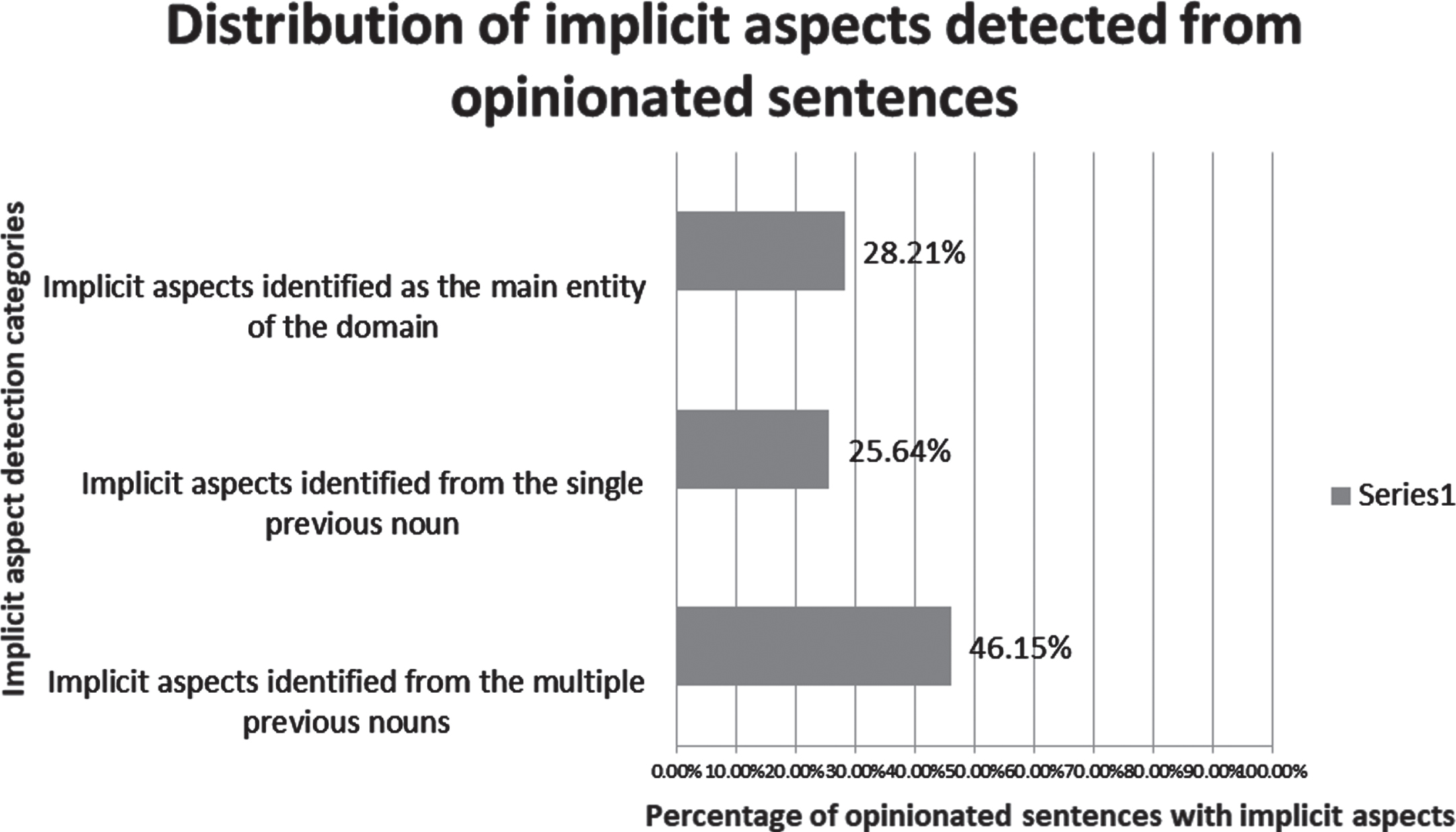
Percentage distribution of implicit aspects detected from opinionated sentences.
To evaluate the performance of the proposed model, the aspect-opinion word pairs extracted by the proposed model were compared against the standard set of aspect-opinion word pairs annotated. The standard set of aspect-opinion word pairs contains the actual aspect-opinion word pairs that are present in opinionated reviews. For evaluation of the model, metrics such as precision, recall, and F1-score are used. Precision(P) is the fraction or percentage of retrieved aspect-opinion word pairs that are relevant. It is denoted by:
Both precision and recall are measures of goodness that are tied to the notion of relevance. F1-score is a measure of the test’s accuracy. Both precision and recall are used in calculating the F1-score. It conveys the balance between precision and recall. Based on these metrics, the baseline model and the ERBA-DSL model were evaluated and the results are shown in Table 12. Figure 9 depicts the comparison of precision and recall achieved by the proposed ERBA-DSL model and the baseline model. Figure 10 compares the F1-score obtained by both models.
Comparison of Precision, Recall and F1-score for the Proposed ERBA-DSL model and Baseline model in the University reviews dataset
Comparison of Precision, Recall and F1-score for the Proposed ERBA-DSL model and Baseline model in the University reviews dataset
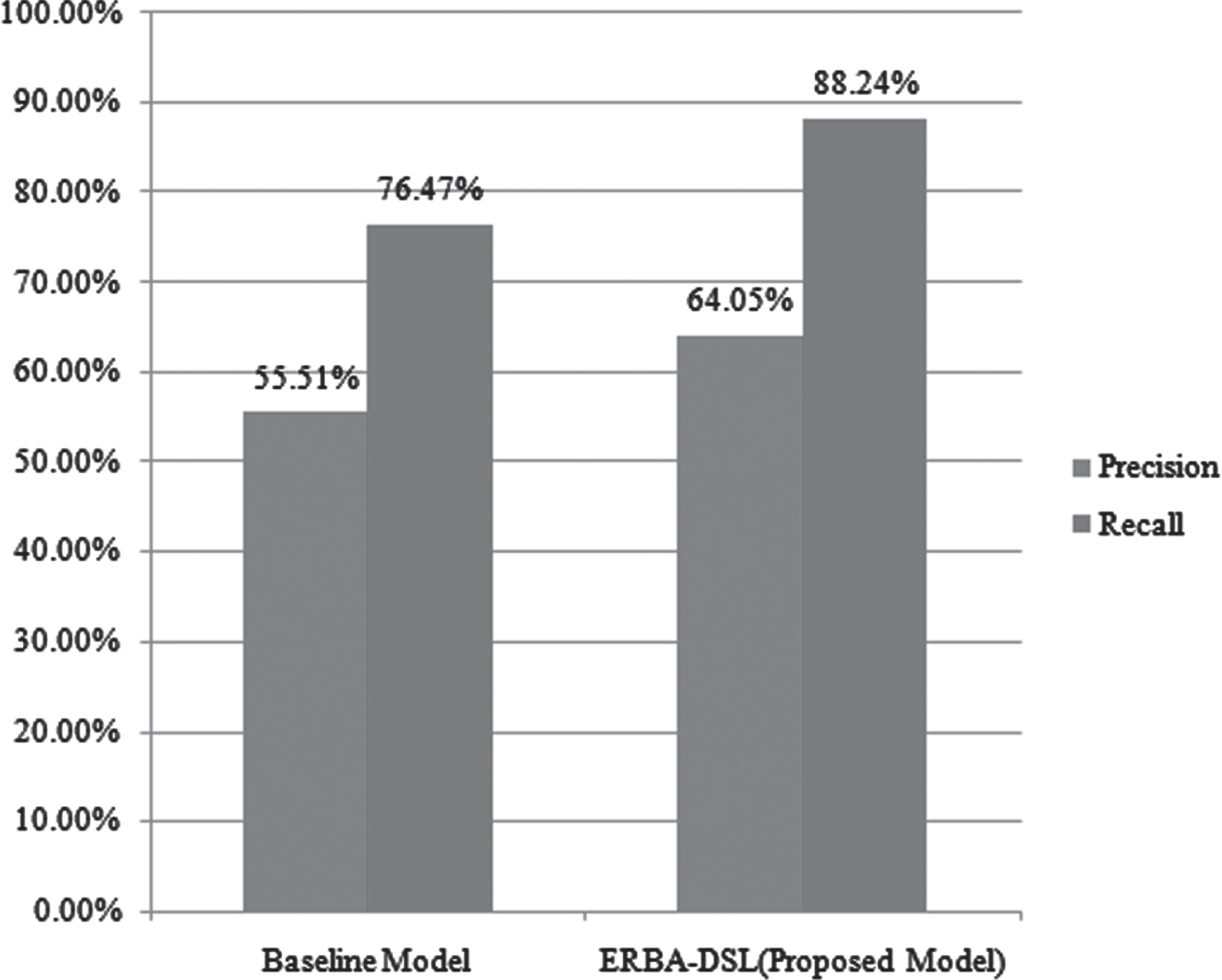
Comparison of Precision, Recall for the Proposed ERBA-DSL model and Baseline model in the University reviews dataset.
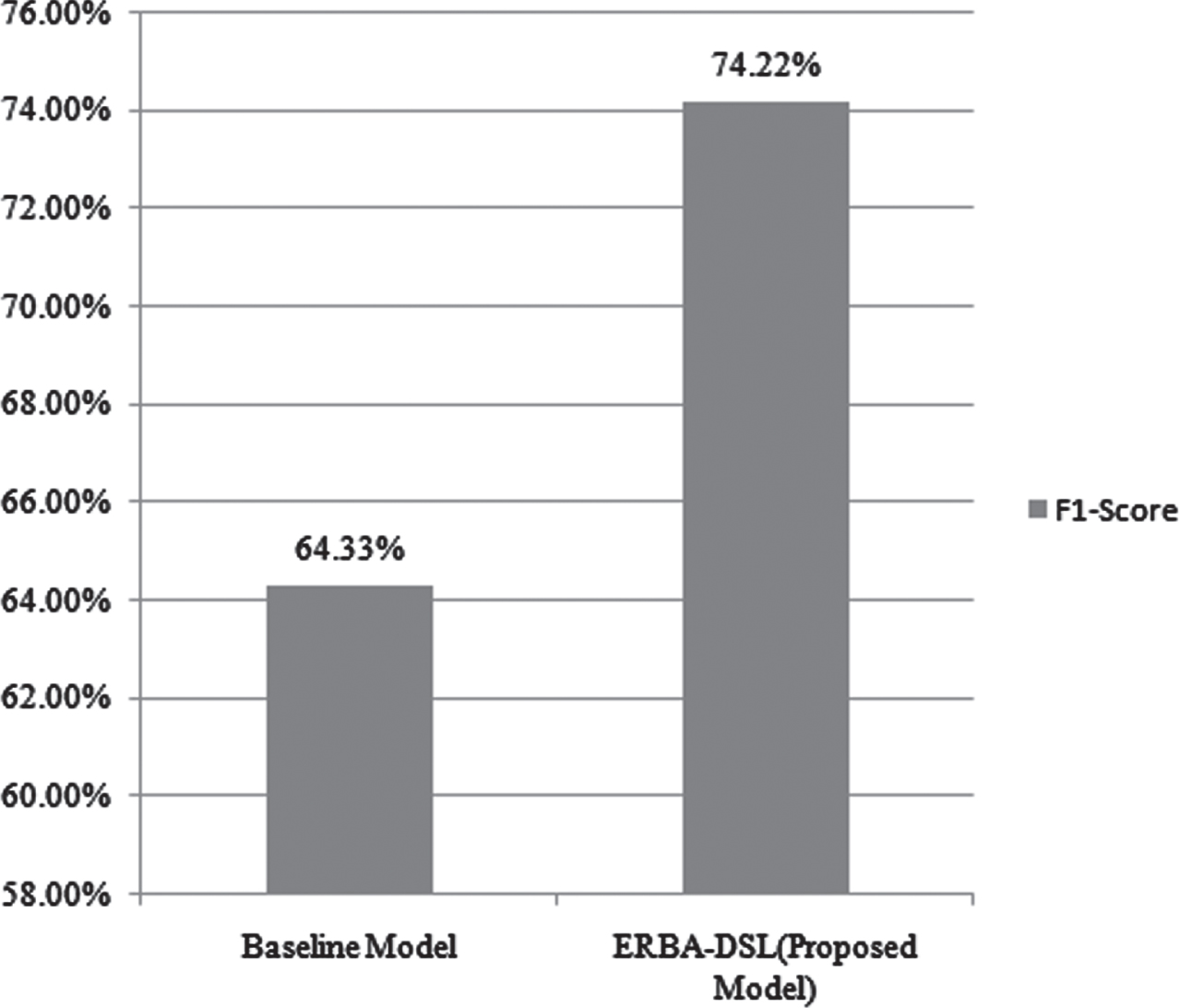
Comparison of F1-score for the Proposed ERBA- DSL model and Baseline model in the University reviews dataset.
The precision of the proposed ERBA-DSL model is 64.05 percent, which shows a significant improvement of 8.54 percent over the baseline model for which the precision is 55.51 percent. Similarly, the recall of the proposed model is 88.24 percent, which again implies an improvement of about 11.77 percent over the recall of the baseline model, which is 76.47 percent only. The F1-score which indicates a balance between precision and recall is 74.22 percent for the proposed model, which is 9.89 percent higher than the F1-score of the baseline model.
The main contribution of the proposed work is the development of an ERBA-DSL model for improving the task of aspect-opinion word extraction. Even though many researchers have performed aspect-sentiment extraction through various methodologies, it is observed that the proposed model is the first work that has developed an enhanced rule-based approach encompassing a robust set of rules and an effective optimum number of patterns each of which covers a reasonably good percentage of review sentences. The proposed work also contributes to new patterns for identifying compound nouns.
The proposed model can deal with new patterns of sentences that tend to occur in the university domain. It deals with complex sentences such as sentences in which multiple opinions are expressed over a single aspect; sentences involving single sentiment expressed over multiple aspects; sentences involving multiple sentiments and multiple aspects. In addition, the proposed model is the first work to utilize nummod dependency, which identifies an opinion word specified in numerical form. This is a novel rule in the sense that usually opinions are expressed in textual form only. But in the proposed model, opinion words in the form of cardinals are detected.
Moreover, the DSL utilized in the proposed work aids in aspect-sentiment extraction, implicit aspect identification, and intensifier scoring. The lexicon includes a list of all aspects that are relevant to the domain. In addition, the lexicon incorporates a DSANCL that is used in the process of detecting implicit aspects. The DSANCL developed as part of the proposed work aids in identifying hidden aspects from the opinionated reviews. For every relevant aspect, the most frequently collocating adjectives are collected and associated with the corresponding aspect. This source has a significant contribution in detecting hidden aspects.
The proposed model is evaluated with the university reviews dataset and the reason for choosing this domain is that it is the least explored domain in previous works. Through an in-depth analysis, it is found that several reviews in this dataset served as a basis for framing special patterns each of which had a good coverage of review sentences.
In the methodology for sentiment scoring, the proposed work brings out a new categorization for intensifiers based on their degree of intensification. The categories of intensifiers in the proposed model are maximizers, boosters, and downtoners. Based on these three categories of intensifiers, the sentiment strength is classified on a nine-point scale.
The enhanced set of rules, when experimented with review sentences, shows good coverage over the opinionated reviews. This fact can be understood by inspecting the precision(64.05 percent) and recall(88.24 percent) values of the proposed model, which shows a good improvement as compared to the baseline model.
On the whole, the proposed work has made three significant contributions, first contribution is the ERBA-DSL model containing an enhanced set of rules and effective patterns for aspect-sentiment extraction, secondly, the DSL containing the adjective-noun collocation list aiding in the extraction of implicit aspects and the third contribution pertains to the intensifier categorization using a nine-point scale for sentiment strength calculation. In future work, the sentiment scoring methodology based on a nine-point scale proposed in this work is to be evaluated. Moreover, the proposed ERBA-DSL model will be experimented in other unexplored domains.
Footnotes
Acknowledgments
We would like to extend our sincere thanks to the authors of the reference papers for their valuable ideas and the recommended methods in the area of sentiment analysis. We also thank the reviewers for their useful comments and suggestions.
Funding statement
The authors received no funding for this study.
Conflict of interest
The authors declare that they have no conflicts of interest to report regarding the present study.