






Abstract
The reduction of constrained mathematical structures leads us to generalize any abstract structures. Using minimum conditions to construct a secure and robust component of the modern encryption algorithm is one crucial problem in multimedia security. With this understanding, we have proposed a new algebraic structure, namely monogenic semigroup, to construct a digital information authentication scheme. Authentication is always completed at the beginning of the application, before any throttling or approval checks are performed, and before any other code is allowed to begin running in the background. Many authentication schemes offer a complex structure for implementation in cryptosystems and applications. The anticipated mechanism uses a simple mathematical structure having the least conditions as compared to other mathematical structures. The suggested scheme provides structures for the authentication of text messages and images.
Introduction
With the progress in science and technology, the means of transmitting information from one place to another place become very easy. The idea of a global village and the internet of things are now evolving due to access to data from any portion of the existing world. But this easiness creates our information open to any kind of misuse or theft from any global end. To protect information from hostile forces, different information security mechanisms were used in literature that including cryptography, watermarking, and steganography. The information confidentiality and hiding techniques are based on chaos theory, optics communication, quantum mechanism, and finite fields [1]. The fundamental purposes of cryptography are information secrecy, authentication, integrity, access control, and nonrepudiation [2]. Chaos theory is utilized to achieve secrecy by adding confusion and diffusion capabilities to any encryption scheme. Chaotic encryption and information hiding techniques are now in fashion to provide the confidentiality, authentication, and integrity of information. The theory of chaos is extensively used in the development of nonlinear components of block cipher namely substitution boxes and hashing algorithms [3]. The nonlinear component is majorly used in the encryption process and hashing is utilized for authentication and integrity of information [4]. To verify a user’s identity, various structures may need various sorts of certifications [5]. The credential is typically in the procedure of a password that is kept confidential and is only known by the system and the user. Typically, a password is used for authentication. The authentication of a user may be accomplished in three ways: via rather the client gets, through something the client is, and through something the client owns. It is possible to separate the authentication method into two stages: genuine authentication and identification. The identification stage provides the security system with the identity of the person who is being protected. The user is provided with this identity in the structure of an ID number. The security system will look through all the theoretical entities that it is aware of to locate the one that the current user is now utilizing, which will take some time. When this is done, the user will be identified as having participated. A user’s assertion does not always mean that it is correct in every instance. It is possible to map one actual user to another abstract user object in the system, which grants the user access and permissions. However, the user must submit verification to the system for the system to verify his or her identity. In the context of authentication, a credential is a verification required by the client through the authentication procedure, and authentication is the act of verifying declared user identification by analyzing user-supplied proof. When message authentication is utilized, it is a small block of bytes that is utilized to identify the message. This block can be used by the recipient to verify that the message has not been tampered with by a third party.
Literature review
In the literature, there exist many schemes for data authentication using different domains. Shi et al. [4] proposed a copyright authentication scheme using a mixture of LT code, Arnold, CRC, Visual Cryptography, Block G-H feature, and timestamp authority. Lin et al. [5] discussed the idea of an image recovery and authentication scheme based on AMBTC-compression and turtle Shell algorithm. Prakasam et al. [6] offered an authentication technique for IoTs by using the 8-bit manipulation principle (HLCAS). Tang et al. [7] suggested a novel authentication scheme for a video surveillance system with high resolution. The idea of medical image authentication using energy entropy and wavelet packet was introduced by Sun et al. [8]. To protect the preservation of vehicular networks, Rawat et al. [9] suggested a novel lightweight authentication process. Santoso et al. [10] proposed a new image authentication scheme by dividing the image into equivalent sizes as the magic square. Swain and swain [11] suggested an effective image recovery and authentication scheme using singular value decomposition (SVD) and block truncation coding (BTC). Bhat and Moon discussed the construction of image encryption and authentication scheme using hyperchaotic systems and DNA encoding in [12]. Many authentication schemes utilize a highly nonlinear S-box. Numerous types of research have been proposed for the construction of robust and high nonlinearity S-box. Khan et al. [13] suggested a novel S-box construction technique using chaotic partial differential equations. Munkhammar [14] studied the impact of chaos in fractional-order logistic equations. Wu and Baleanu [15] discussed discrete chaos in a fractional delayed logistic map. Lawnik [16] proposed a generalized logistic map and its implementation in chaos-based cryptography. Belazi et al. [17] suggested the construction of a robust S-box and implementing it in the design of SPN based cryptosystem. Khan et al. [18] utilized natural randomness in Knight’s underwater tour chain and acoustics for the construction of the S-box for the block cipher. Alkhayyat et al. [19] proposed a novel 4D hyperchaotic system and combining Josephus permutation with chaos produced a highly non-linear substitution box. Razaq et al. [20] proposed a group-theoretic structure for the construction of a robust S-box and implement it in image encryption. Manzoor et al. [21] suggested a secure S-box constructed with the innovative chaotic map. Siddiqui et al. [22] offered the structure of linear recurrences with a constant coefficient for the construction of a secure substitution box. Razaq et al. [23] proposed a group-theoretic structure for the construction of AES-like S-boxes.
Research contribution
Authentication plays an important role in secure data transmission. Therefore, it is important to authenticate the data before the further broadcast of sensitive information. For this purpose, there exist many authentication schemes based on different domains. In our proposed work we have utilized monogenic sequences as the main domain of the scheme combined with the hash function. The offered schemes give excellent results with highly random hashing providing authentication. Our fundamental objective in this context is to devise an original and cutting-edge method for the construction of nonlinear components that is based on a monogenic semigroup. In addition to this, we have offered an authentication system for the information that is based on the monogenic semigroup that we have proposed [24]. To ensure that the authentication procedure is as secure as possible, the offered substitute box is utilized by the offered technique. Because of the relatively low complexity of the authentication structure, it is easy to implement in a variety of cryptosystems and applications.
Paper organization
The remainder of the work is designed as follows. In section 2, we provide basic concepts used in subsequent sections of this article. In section 3, we have proposed an innovative system for the structure of S-boxes based on the fractional logistic map. In section 4, we suggested a new authentication scheme along with small examples. Finally, the conclusion is described in section 5.
Preliminaries
In this segment, we have presented some descriptions, which are essential for the interpretation of the new structure of message and image authentication by using monogenic semigroup.
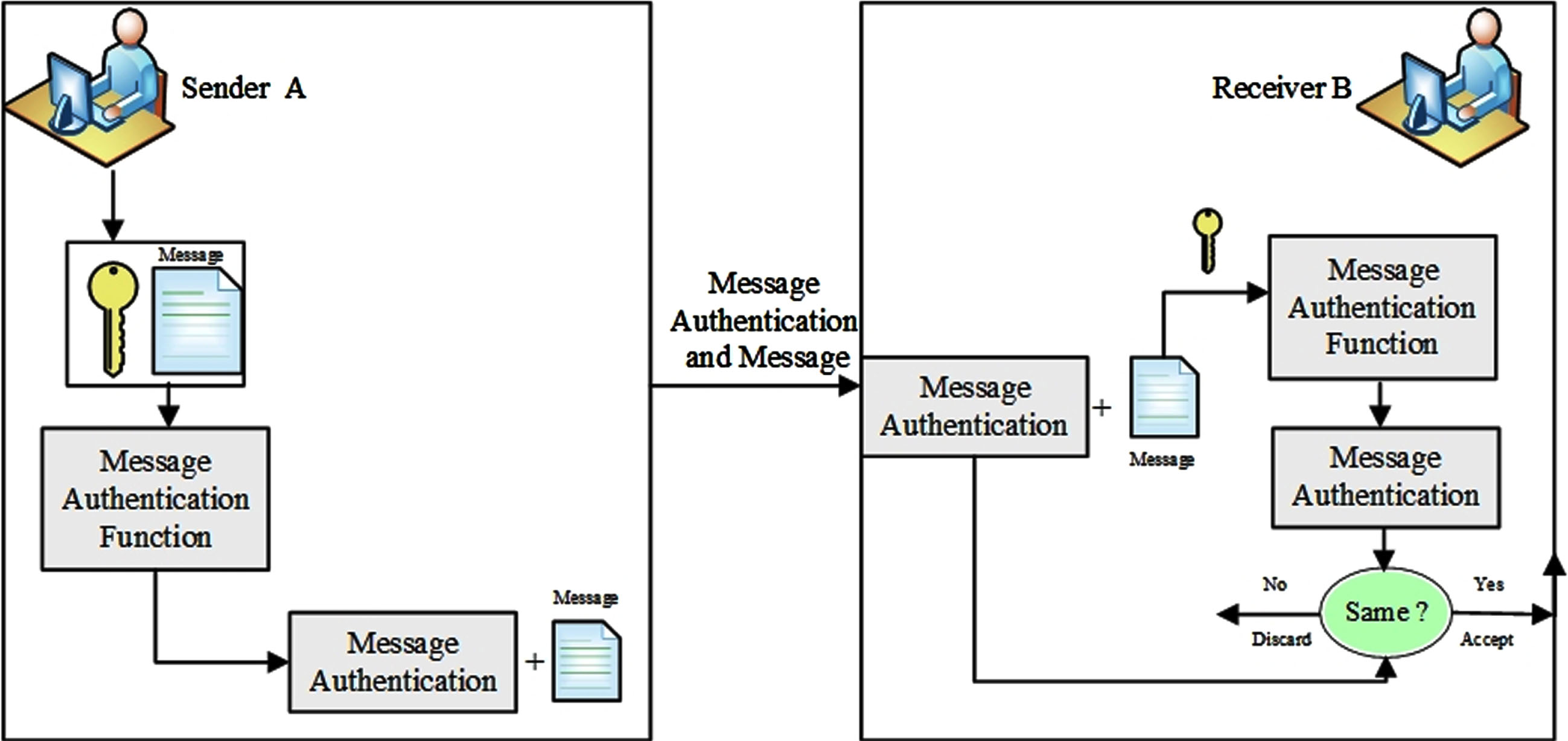
Message authentication created by A and checked by B.
S (k, m): yields a message verification code t that belongs to a set T. V (k, m, t): yields a value false or true depending on the accuracy of the obtained authentication code.
where M denotes all possible messages m set, k denotes all possible keys k set, and T represents all authentication codes t.
The system used to name and depict numbers is known as the numeral system. Counting and measuring are two of the most common uses of numbers, and they may also be used to complete a variety of mathematical computations. In mathematics, there exist a variety of number systems. Table 1 shows the four most frequent number schemes:
Number system with different bases
Number system with different bases
The decimal number approach The binary number approach The octal number approach The hexadecimal number approach
We write (a * b) as (ab).
∩{ U
i
: i ∈ I } must either be an empty group or a subsemigroup of S if {U
i
: i ∈ I } is a non-empty family of subsemigroups of semigroup S. Because S is a semigroup, the family of subsemigroups of S including A is non-empty if A is an arbitrary non-empty subset of S; therefore, the intersection of the family is a subsemigroup of S including A. It’s abbreviated as <A>. It has the following qualities inside the set of S subsemigroups:
A⊆ < A > ; if U is a subsemigroup of S including A, then <A > ⊆ U.
All components of S that may be represented as finite products of factors in A make up the subsemigroup <A>. We can assume A is a generating set of S if <A > = S. The scenario when A is finite is of relevance. We’ll write <A> as <a1, a2, … , a n > if A ={ a1, a2, …, a n }. The scenario where A = { a } , when <a> = { a, a2, a3, … } is very intriguing.
The monogenic subsemigroup of S created by the element a n is referred to as <A>. The order of the sub semigroup <a> is described as the order of a. We call a semigroup S monogenic if it possesses the condition S =< a > for some a in S.
Regard as the monogenic subsemigroup <a> = { a, a2, a3, … } of S created by an as a component of a semigroup S. If the list a, a2, …, does not repeat itself, i.e. if a
m
= a
n
⇒ m = n . Then (< a > , .) is isomorphic to the natural number semigroup (N, +) in terms of addition. For example, we refer to the infinite monogenic semigroup <a> as an infinite monogenic semigroup and the element a has infinite order. If there are any repeats between the exponents of a, then the set is complete.
Now we’ll look at the construction of <a>, provided that a indicates m and a period of r. Equation (1) implies that
All the exponents a, …, a
m
, …, am+r-1 are unique. We can denote s = m + qr + u for all s ⩾ m using the division technique, where 0 ⩽ u ⩽ r - 1 and q ⩾ 0. After that, it observes that
A subsemigroup of <a> is the subset k
a
={ a
m
, …, am+r-1 }. The kernel of <a> is what we call it. In reality, K
a
is a subgroup of <a>, since if am+u, am+v are two components of K
a
, we can get a component am+x in K
a
for which am+x is equal to <a>.
Because K
a
is a commutative function. Indeed, the K
a
group is cyclic. This may be shown by looking at the integers.
Therefore, k (m + g) = k ( mod r) for any k in N and so the exponents (am+g) k of am+g, for k = 1, …, r, exhaust K a . That is, K a is a cyclic group of order r created by the element am+g . If we select z so that 0 ⩽ z ⩽ r - 1 and m + g = 1 ( mod r) , then am+z is idempotent and so is the identity of k a .
a
m
= am+r ; (∀ u, v ∈ N) am+u = am+v iff m+ u = m + v ( mod r) ; <a> = { a, …, am+r-1 } ; K
a
={ a
m
, …, am+r-1 } is a cyclic subgroup of <a > .
The cyclic form of a monogenic semigroup is represented in Fig. 2.
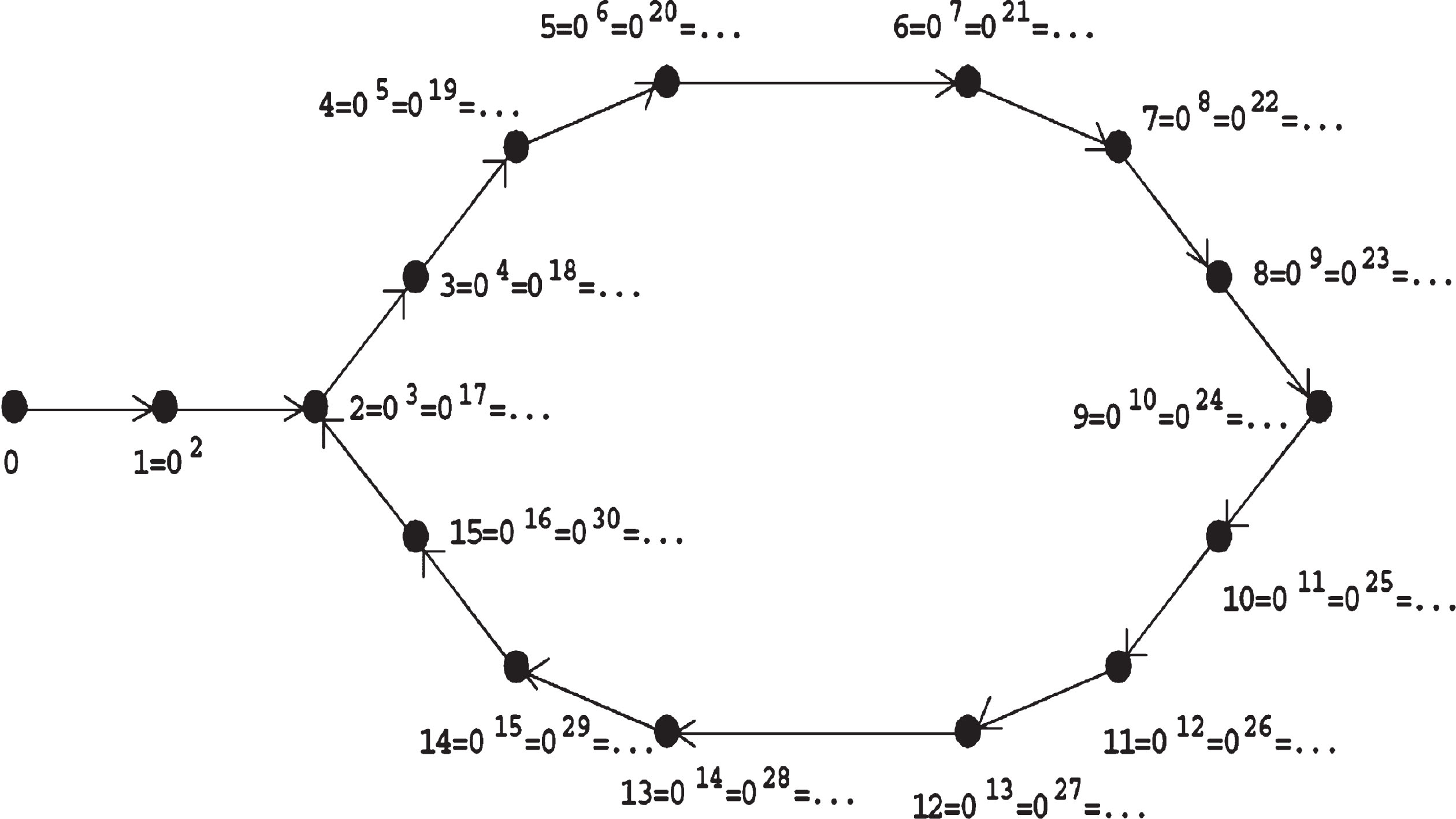
Cyclic form of monogenic semigroup generated by a generator a.
It is easy to see from Table 2 and Fig. 2 shows that (S,.) is a monogenic semigroup generated by 0. Here the index of 0 is 3 and the period is 14. Here also K0 = {2, 3, 4, …, 15} is a cyclic subgroup of the monogenic semigroup generated by 2 = 03 and 13 is the identity of K0 . The hexadecimal form of Table 3 is given as follows:
Cayely’s table for monogenic semigroup over sixteen elements
The hexadecimal equivalent of the monogenic semigroup
Cayely’s table for monogenic semigroup over sixteen elements
Also shown in Fig. 3 below:
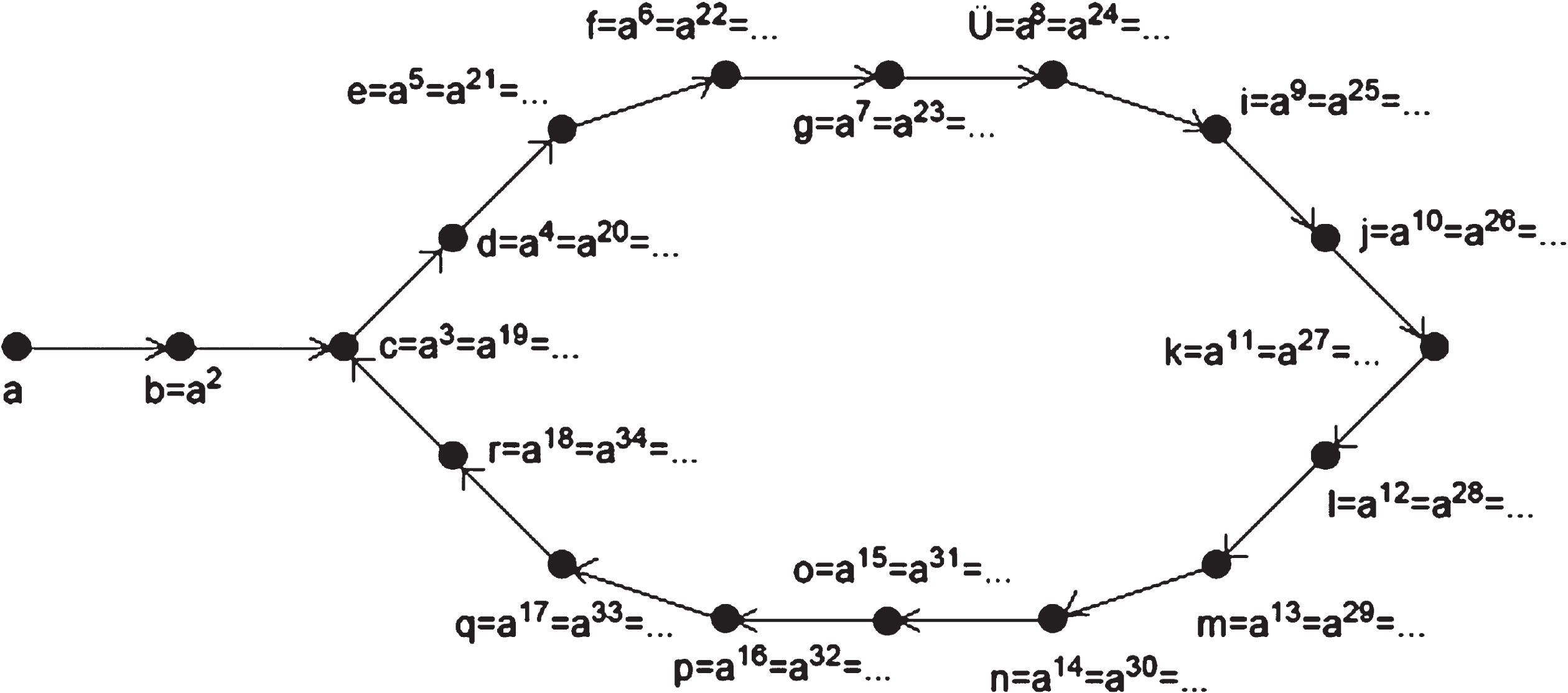
Cyclic form of monogenic semigroup generated by a generator a.
It is easy to see from the table and figure that (S,.) is a monogenic semigroup generated by a. Here the index of a is 3 and the period is 16. Here also K a = {c, d, e, …, r} is a cyclic subgroup of the monogenic semigroup generated by c = a3 and p is the identity of K a .
This segment is generally pointed with the application of monogenic semigroup for message authentication and image authentication.
Authentication of message
The suggested method aims to do authentication of message and image which includes the operation of the suggested non-linear component. This scheme can be used for messages in binary form or messages in simple text form can also be converted into binary form. Let m1, m2, …, m i be the message (binary or non-binary) that is required to be authenticated by the addition of some sort of signature or any other methodology. In this scheme, we define a method for the development of the signature, which is later concatenated with the original message for authentication.
In our purposed method, we divide the message into a finite number of parts (depends upon the given no. of bits of the message) containing an equal number of bits then we divide these parts into subparts of n-bits and write each subpart into the decimal representation.
After splitting up the message into parts we generate a signature by using these chunks through the operation A
i
defined by
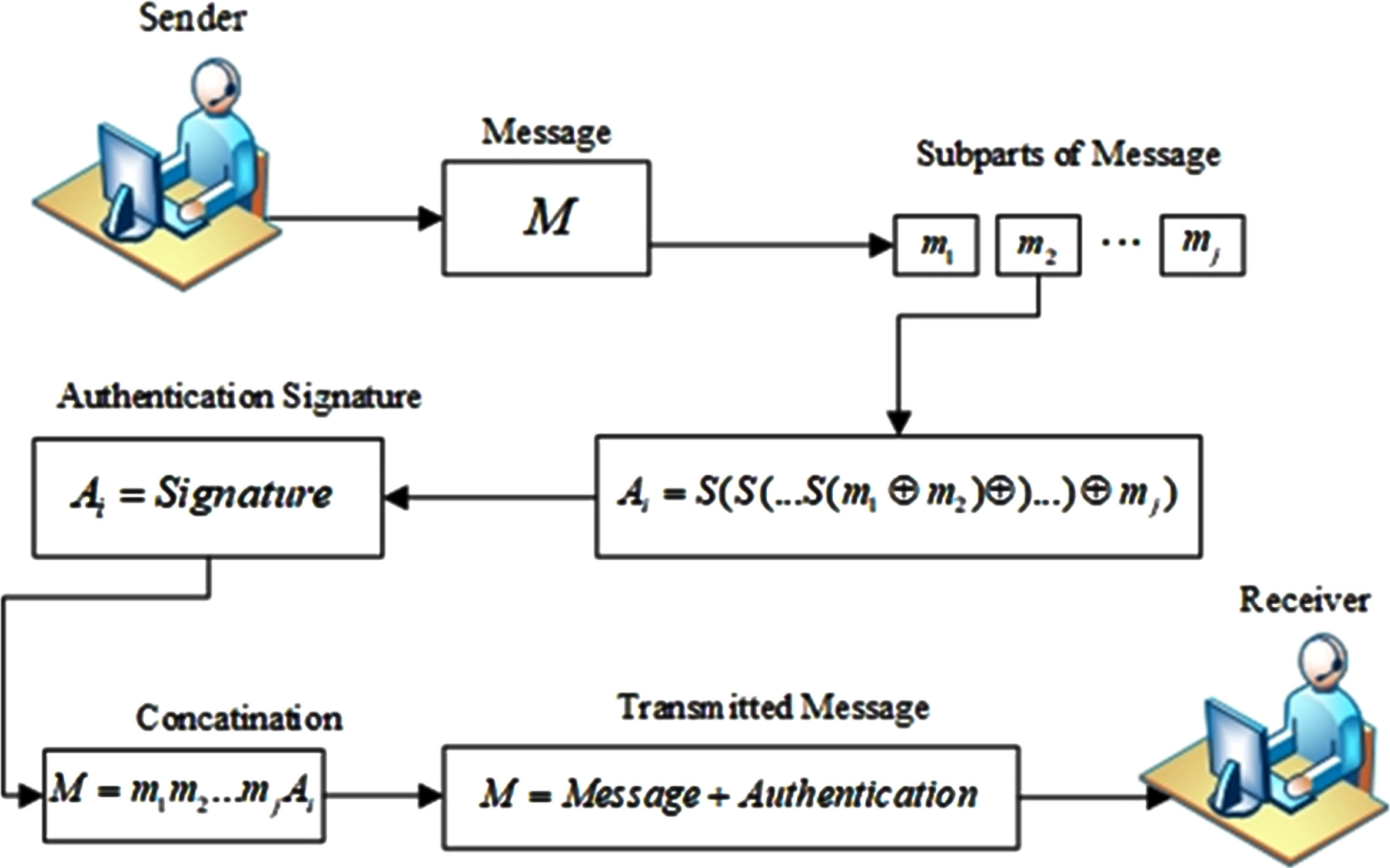
Proposed message authentication scheme.
Now we explain some examples to illustrate the proposed scheme step by step.
After splitting up the message into three parts, we generate a signature by using these chunks through the operation A
i
defined by
By concatenating 4-bits of each A
i
along with the message M we, therefore, transmit the message
Now we divide the message M into four parts each consisting of 4 hexadecimal numbers and write each subpart into the hexadecimal representation as follows:
After splitting up the message into three-part we generate a signature by using these chunks through the operation A
i
defined by
By concatenating these 4 hexadecimal elements of each A
i
along with the message M, we, therefore, transmit the message
which is the required message with authentication.
The anticipated scheme can also be implemented over digital multimedia applications. The simplest case of digital media is an image. We can easily extend the suggested authentication methodology to a digital image with less effort. Fundamentally, a digital image is consisting of pixels in which energy is stored in the form of bright and dark colors represented by binary bits. Furthermore, each pixel of an image are consisting of the most significant bits (MSBs) and least significant bits (LSBs). The LSBs are the neutral bits of pixels of an image whereas MSBs are the disturbing bits of pixels. Adding anything in LSBs does not change the apparent representation of the image whereas replacing a single bit in MSBs distorts the actual contents of an image. Therefore, LSBs are the carrier of information in digital form. The following algorithm simply offers a new authentication technique for the digital image. First, we take an image and convert it into binary form.
After that, we divide this binary form into chunks of 8-bits of equal length. Then we separate LSBs and MSBs from each chunk of 8-bits. By using monogenic semigroup of order 255, we apply the following operation on the elements of MSBs: Further, we hide the bits of A
i
in LSBs. After that, we convert the binary form into an image. The image contains authentication in LSBs of the converted image.
In Fig. 5, we presented a diagram of our intended image authentication method.
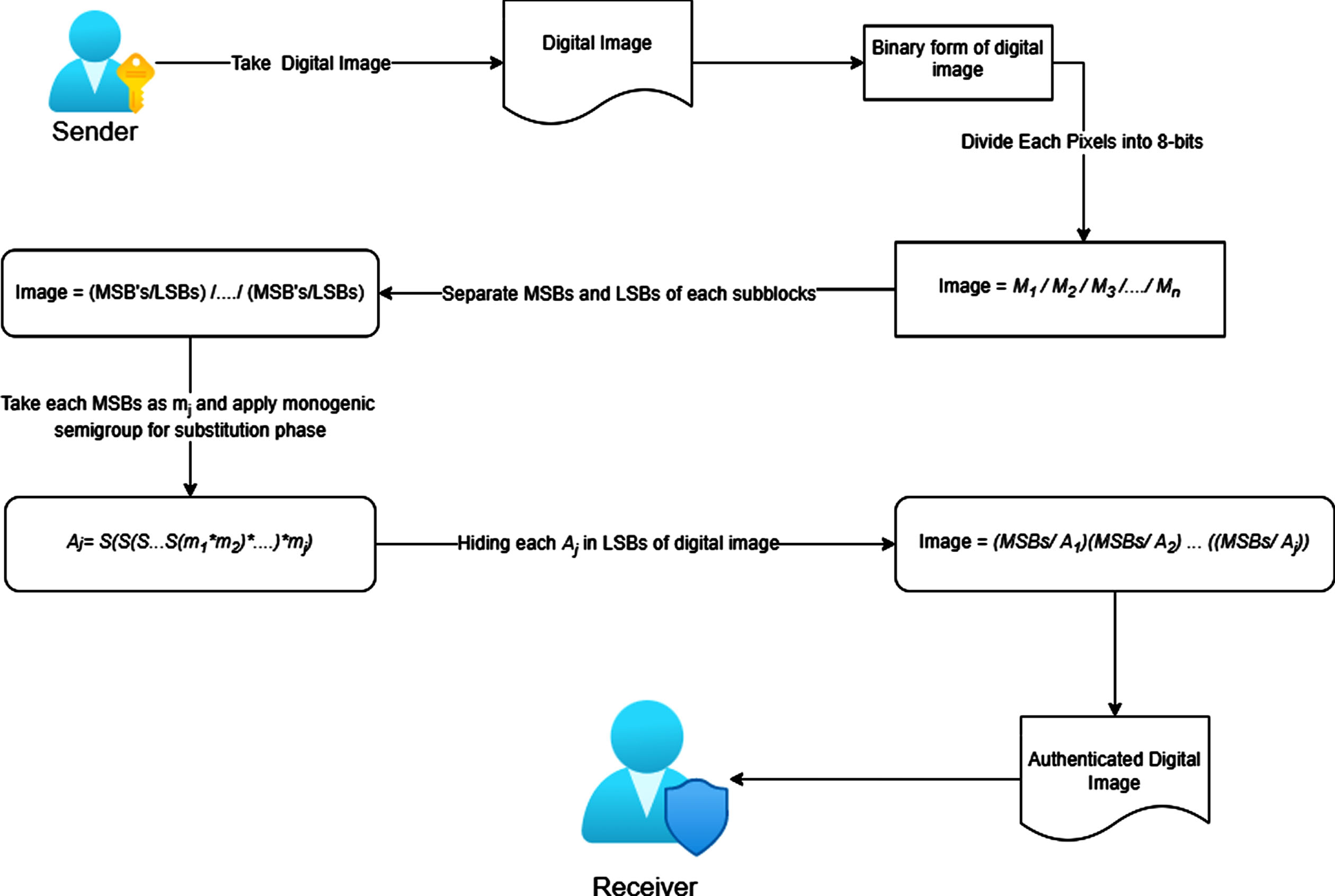
Proposed image authentication scheme.
The purpose of this work is to propose a novel authentication technique based on the monogenic semigroup, and it will apply to both binary bits and hexadecimal types of data sets. The research presented here includes a representation of the prototype model for digital content. According to the results of this research work, the authentication process that makes the application of this technique is both very simple and highly secure to implement. The implementation of our purposed monogenic semigroup-based authentication is uncomplicated, and this extends to both messages and images. The proposed authentication technique has the potential to provide robustness across a variety of cryptosystems and applications while also reducing complexity and maintaining a high level of security. These insights provide a wide variety of new possibilities for use in audio and video authentication. An ongoing incentive for future study is the possibility of one day being able to effect authentication by making use of the mathematical framework with the fewest restrictions.
Conflicts of interest
The authors declare that they have no conflict of interest.
Ethical approval
This article does not contain any studies with human participants or animals performed by any of the authors.
Data availability statement
The authors declare that data supporting the findings of this study are available within the article.
Footnotes
Acknowledgment
This research was funded by Princess Nourah bint Abdulrahman University Researchers Supporting Project Number (PNURSP2022R87), Princess Nourah bint Abdulrahman University, Riyadh, Saudi Arabia.
Funding
This research was funded by Princess Nourah bint Abdulrahman University Researchers Supporting Project Number (PNURSP2022R87), Princess Nourah bint Abdulrahman University, Riyadh, Saudi Arabia.