







Abstract
Neutrosophic Set (NS) allows us to handle uncertainty and indeterminacy of the data. Several researchers have investigated the Transportation Problems (TP) with various forms of input data. This paper emphasizes a dynamic optimal solution framework for TPs in a neutrosophic setting. This paper investigates a Neutrosophic Transportation Problem (NTP) in which supply, demand, and transportation cost are considered as Single-Valued Neutrosophic Trapezoidal Numbers (SVNTrNs). The weighted possibilistic mean value of their truth, indeterminacy, and facility membership function are calculated. Then, NTP is modelled as a parametric Linear Programming Problem (LPP) and solved. Further, the drawbacks of the existing approaches and advantages of the developed method are discussed. Finally, the real-time problem and numerical illustrations are presented and compared to existing solutions. This study helps the Decision-Makers (DMs) in budgeting their transportation expenses through strategic distribution.
Keywords
Nomenclature
Decision-Maker Falsity-Membership Fuzzy Linear Programming Fuzzy Transportation Problem Intuitionistic Fuzzy Set Indeterminacy-Membership Linear Programming Problem Neutrosophic Set Neutrosophic Transportation Problem Possibilistic Mean Transportation Problems Truth-Membership Single-Valued Neutrosophic Number Single-Valued Neutrosophic Set Single-Valued Neutrosophic Trapezoidal Number
Introduction
Firms transport their products from the point of production (origins) to the point of consumption (destinations). Each production point has a finite supply and each destination has a certain need that must be satisfied while transporting the goods. In this regard, transportation models are exploited to calculate the minimum shipping cost t-hat will meet the supply and demand. Hitchcock [12] was introduced the concept of a transportation problem in the form of a LPP and solved it by using the Simplex algorithm. It has received a significant amount of interest in the literature. It has been used in a variety of fields, including inventory management, logistics management, supply chain management, etc. In classical TP supply, demand, and costs are all considered as real or crisp numbers.
Recently, there are many situations with many forms of uncertainty that cannot be handled with traditional mathematical theory. Zadeh [35] introduced the fuzzy set theory, which is described by its membership grades, to handle situations involving imprecise or vague information. Many authors have exploited fuzzy numbers (particularly triangular and trapezoidal fuzzy numbers) to represent inexact intervals, unclear boundaries, and imprecise data sets. A Fuzzy Linear Programming (FLP) model was introduced by Zimmermann [36]. It has been used to address a variety of Fuzzy Transportation Problems (FTP) [18, 24]. For determining the solution of an FTP with fuzzy supply and demand, Chanas et al. [3] proposed an FLP technique, but they considered the cost of the transportation to be real numbers. Dinagar and Palaneivel [3] discussed a solution technique for FTP in which the parameters like demand, supply, and transportation cost are assumed as trapezoidal fuzzy numbers. Kaur and Kumar [14] proposed a new framework for resolving the FTP. The rough set was used by some researchers to deal with the uncertainty of TP. To handle the problem’s ambiguity, Liu [17] proposed the concept of rough variables. One of the best tools for using uncertainty theories in the handling of imperfect information is possibility theory.
However, in many circumstances, the decisions or outputs based on the given data are insufficiently accurate. The notion of an Intuitionistic Fuzzy Set (IFS) was first developed by Atanassov [1], which addresses the problems involving imprecision data because of their membership and non-membership values. As a result, IFS theory has been used to solve a wide range of real-world decision-making issues. To solve TPs, many researchers employed an IFS technique. Other than ambiguity or uncertainty in the current TP model’s restrictions, there is some indeterminacy owing to other causes such as lack of knowledge of the situation, data imperfections, and poor forecasting. The concepts of left and right Possibilistic Mean (PM) values of fuzzy numbers were introduced by Carlsson and Fuller [4]. Fuller and Majlender [10] investigated the footnote of the weighted interval-valued PM value of fuzzy numbers. Wan et al. [32] established the possible mean, variance, and covariance of IFNs. The possibility mean, variance, and covariance of a generalised intuitionistic fuzzy number were proposed by Garg et al. [11]. IFS theory can deal with inadequate data, but not with indeterminate or inconsistent data.
FS and IFS are not applicable for all possible uncertainties in many natural problems. Smarandache [25] proposed Neutrosophic Sets (NSs) as a generalisation of classical sets, FSs, and IFSs to overcome this problem. The Truth-Membership (TM) degree, Indeterminacy-Membership (IM) degree, and Falsity-Membership (FM) degree components of the NS were appropriate to express indeterminacy and inconsistent data. The concept of a Single-Valued Neutrosophic Set (SVNS) has been used to create several real-world decision-making problems. Wang et al. [32] introduced the Single-Valued Neutrosophic Number (SVNN). SVNS is an upgrading generalized version of the FS and IFS. Further, a triplet of membership degrees are used to represents the element into the set. In SVNS, each element is shown by TM, IM, and FM so that their sum lies between 0 and 3. Many researchers gave more attention to SVNNs in the form of triplet structure. Most of the authors are used the ranking method to solve the neutrosophic problems. Few researchers had been worked on various methods such as TPs under neutrosophic environments. For handling the inverse capacitated TPs in a neutrosophic setting. Khalifa et al. [15] proposed the KKM technique. Thamaraiselvi and Santhi [28] developed a new scoring function for solving TP in a neutrosophic environment. Unfortunately, this scoring function does not satisfy the linear property. Singh et al. [26] proposed a modified approach for solving real and NTPs. Dhouib [7] presented a new method based on the Dhouib-TP1 heuristic approach for solving NTP. Singh et al. [27] used a bi-level TP in order to solve the NTP. They modelled a real-time vaccine distribution problem in order to distribute the vaccine from vaccine production companies to the different centres. In this paper, we have proposed a new method for solving NTPs. The proposed method produces dynamic solutions for the DMs interest. Further, we have pointed out the drawbacks of existing methods.
The structuring of this article is abbreviated as follows: Section 2, discusses the basic preliminaries and an overview of SVN numbers, In section 3, we presents the PM and weighted PM of the SVNTrN. The method for solving NTP is explained in section 4. In section 5, discusses the shortcomings of the existing method. The advantages of the proposed method are analysed in the section 6. Numerical examples and comparative studies are given in Section 7. Finally, the conclusion and scope of future work plan affair.
Preliminaries
When a1 > 0 then
If 0⩽a1 ≤ a2 ≤ a3 ≤ a4 ⩽ 1,
When
(α, β, γ)-cut of SVNTrN
α- cut of SVNTrN
β- cut of SVNTrN
γ- cut of SVNTrN
PM of SVNNs
This section discusses finding the PM value of the TM function, IM function, and FM function for the SVNN.
PM of the TM function
Let us,
Left PM of TM function of
Where, poss denotes the possibility, i.e.,
Thus,
Right PM of the TM function of
Where, poss denotes the possibility, i.e.,
Thus,
PM of the TM for
The β- cut of
Left PM of IM function of
Thus
Right PM of the IM function of
Thus
PM of the IM for
The γ- cut of
Left PM of FM function of
Where, poss denotes the possibility, i.e.,
Thus
Right PM of the FM function of
Where, poss denotes the possibility, i.e.,
Thus
PM of the FM for
Let
Where, λɛ [0, 0.5] denotes that the DM is a risk seeker who prefers uncertainty over certainty, i.e. the probabilistic mean of indeterminacy and falsity membership. λ = 0.5.5 indicates that the DM is unbiased (neither risk seeker nor risk-averse investors) about determining the parameters like supply, demand, and transportation cost of NTP λɛ (0.5, 1] denotes that the DM is a risk-averse investor when it comes to determining the parameters of the NTP problem and prefers certainty.
In this section, we develop a new solution procedure for the NTP. We take into account m number of resource sites from which the commodities will be transferred to n number of demand places. Here, we assume that the transportation cost, supply, and demand are a neutrosophic number. Let
General NTP
General NTP
Where,
The NTP is solved by using the weighted possibility mean value approach. The detailed procedure is explained as follows:
Where, i = 1, 2, . . . m, j = 1, 2, . . . , n.
Where, i = 1, 2, . . . m, j = 1, 2, . . . , n.
where i = 1,2,...m, j = 1,2,...,n.
Where, i = 1,2,...m, j = 1,2,...,n.
Where, i = 1,2,...m, j = 1,2,...,n.
Where, i = 1,2,...m, j = 1,2,...,n.
Where, i = 1,2,...m, j = 1,2,...,n.
General weighted possibilistic mean transportation
Subject to
Subject to
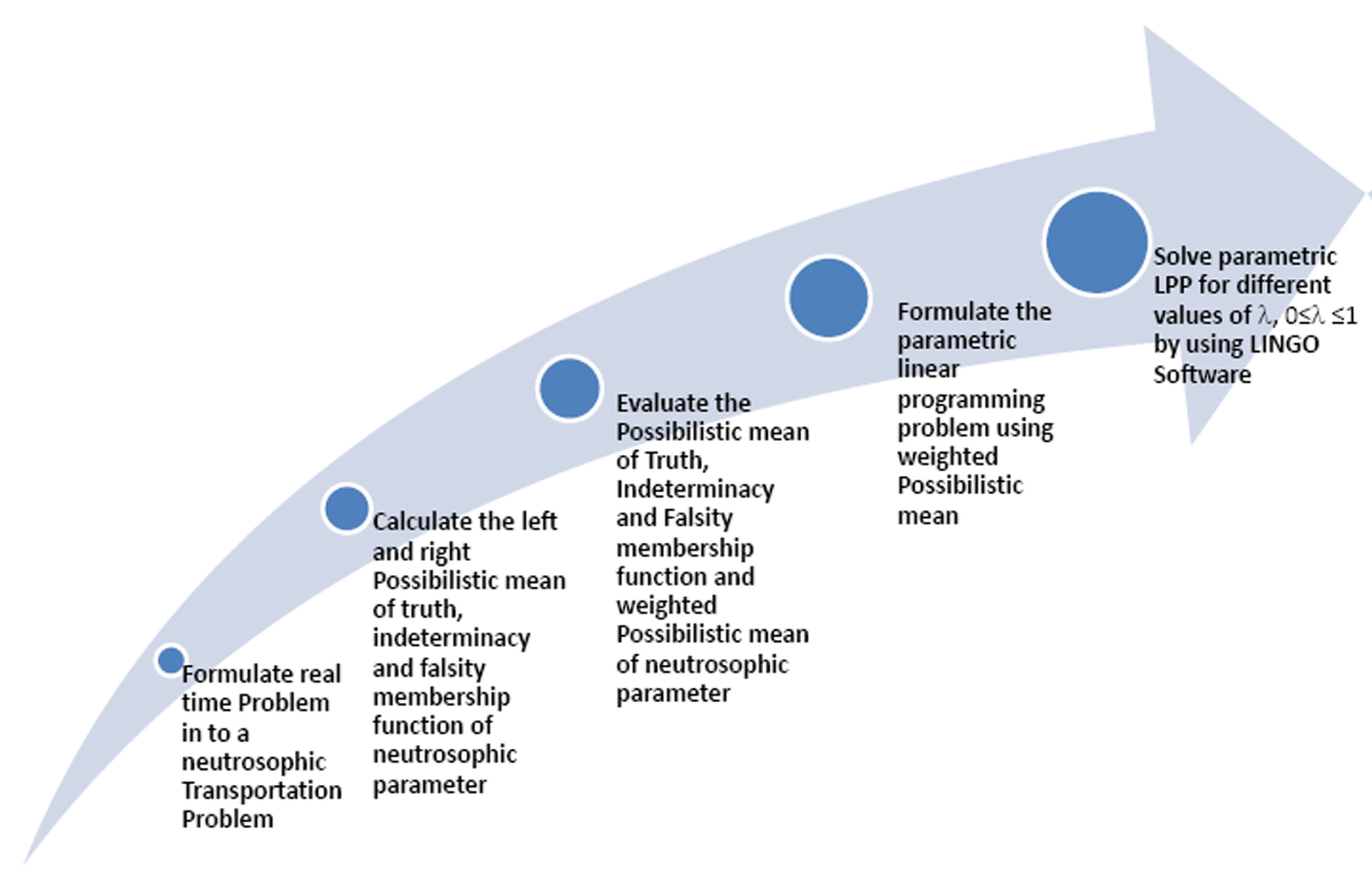
Framework of the proposed method.
This section discusses the incorrect assumptions of the existing methods. Tamaraiselvi and Santhi [28] have used the following ranking function to convert SVNTrN into crisp value. Let Singh et al. [28] used a modified scoring function, in order to adding two SVNTrNs. That is, If
Where,
Which is also not satisfied the assumption
To overcome the above drawbacks, the proposed method NTP is converted as a set of LPPs. After that, the problem can be solved using any one of the linear programming solvers.
Advantages of the proposed method
This section demonstrates the major advantages of the suggested method over existing NTP-solving methods. Since DMs have no specific knowledge regarding the data connected to its various transportation factors, the parameters (supply capacities, unit transportation costs, and so on) of the TP are uncertain values. The DMs perceive more flexibility in their decision-making process when they employ the NS approximation to this feasible zone. As a result, we provide these components in NS form, with the source, demand, and conveyances all being NSs. Neutrosophic numbers are a generalization of fuzzy numbers and intuitionistic fuzzy numbers. Hence, the recommended approach can be exploited for solving FTPs, IFTPs, and NTPs. To overcome the drawbacks of the existing methods, the proposed dynamic approach has given a superior solution in a neutrosophic environment. As a result, the developed method can be used to solve a variety of neutrosophic optimization problems. Since the TP is solved using conventional linear programming algorithms, the suggested method is easier to employ in real-world applications than existing methods for obtaining the neutrosophic optimal solution of NTP. In previous methods, the solution of the NTP is a single value, but the proposed method gives the range of value based on the DMs interest. Hence the proposed method is more flexible to handle uncertain situations.
Numerical illustration
In this section, we solve two real-time transportation problems in a neutrosophic environment using the proposed framework. Further, the obtained dynamic optimum transportation cost compare with existing methods.
Numerical Example 1
Consider the NTP has three sources and four destinations, which is taken form [28]. The neutrosophic supply, demand and transportation cost are given in Table 3.
Transportation table for Example 1
Transportation table for Example 1
Weighted PM value of the neutrosophic transportation cost, supply and demand are calculated by using step 1 to step 9, which is given in the following Table 4.
Weighted possibilistic mean transportation table
For different values of λ, (0 ⩽ λ ⩽ 1) the weighted PM values of the transportation cost, supply and demand are evaluated by using step 10, which is given in Table 5.
Weighted PM values of transportation cost, supply and demand different values of λ
Further, the NTP is converted as a crisp LPP for different values of λ and solved by using LIGO software. The dynamic transportation allotment for different values of λ are given in the Table 6.
Dynamic solution of the NTP for Example 1
From the table, we observe that the optimal transportation cost is 1407 for λ=0, and 78 for λ=1. That is, the optimum cost decreases whenλ is increased.λ=0 indicates that the data have more indeterminacy and falsity degrees and it skips the truth membership degree, which is indicating that the expert likes uncertainty. When the uncertainties are high then the transportation cost is high, which is proven in the table. When, the value ofλ increases, the DMs have decreased the indeterminacy and falsity degrees of the data, and increase the truth membership degree knowledge of the parameters. Hence the transportation cost reduces, which is shown in the Table. Whenλ=1 means the DM has confidence in data, which indicates that the information is truth. So, indeterminacy and falsity degrees of the transportation parameters cost, supply, and demand are ignored. Hence, the transportation cost is minimum, which is shown in the table.
Canned peas are one of the primary products of Sailco Corporation. Three processing plants (in Bellingham, Washington; Eugene, Oregon; and Albert Lea, Minnesota) prepare the peas, which are then trucked to three distributing warehouses in the western United States (Sacramento, California; Salt Lake City, Utah; and Albuquerque, New Mexico). Since transportation expenses are a significant burden, the administration has interested to minimize the transportation cost. Each cannery’s output has been estimated for the succeeding season, and each warehouse has been assigned a specific quantity from the total supply of peas. This data (in truckloads) is provided in Table 7, as well as the shipping cost per truckload for each cannery-warehouse combination given in Table 7. Determine which plan for assigning these shipments to the various cannery-warehouse combinations would minimize the total shipping cost. By using step 1 to step 9, we calculate the weighted PM, which given in the Table 8.
Neutrosophic transportation table for Example 2
Neutrosophic transportation table for Example 2
Weighted possibility mean transportation table
Further, for different values of λ (0 ⩽ λ ⩽ 1), we calculate the weighted possibilistic mean of supply, demand and cost, which is given in the Table 9.
Weighted PM values of cost, supply and demand different values of λ
By using the weighted possibility mean values of cost, supply and demand in Table 9, we formulate the linear programming problems for different values of λ. The linear programming problems are solved by using LINGO software and the solution are depicted in Table 10.
Dynamic solution of NTP 1
In this section, we compare the proposed method within Thamaraiselvi et al. [28], Singh et al. [27], and Dhouib [6] approach. Suppose the numerical example 1 is solved by deterministic supply and demand as given in Table 11. For different values of λ, the weighted values of the transportation cost are evaluated by using step 10. The transportation cost is the same value, which is mentioned in the Table. Further, the NTP is modelled as a crisp LPP for different values of λ with deterministic supply and demand values and solved by using LIGO software. The solutions are given in Table 12.
NTP with crisp supply and demand
NTP with crisp supply and demand
Solution of the comparative example
This problem is solved by Thamaraiselvi et al. [28] approach the transportation cost is 140.118, Singh et al. [27] approach the optimum cost is 275.25, and Dhouib [6] approach optimum transportation cost is 272, whereas the proposed approach, the optimal transportation cost is 837 for λ=0, and 124 for λ=1. From the Table 13, we see that the optimum cost decreases when λ is increased. λ=0 indicates that the data have more indeterminacy and falsity degrees and it skips the truth membership degree, which is indicating that the expert likes uncertainty. When the uncertainties are high then the transportation cost is high, which is proven in the Table 13. When, the value of λ increases, the DMs have decreased the indeterminacy and falsity degrees of the data, and increase the truth membership degree knowledge of the parameters. Hence the transportation cost reduces, which is shown in the Table. When λ=1 means the DM has confidence in data, which indicates that the information is truth only. So, indeterminacy and falsity degrees of the transportation parameters cost, supply, and demand are ignored. Hence, the transportation cost is minimum, which is shown in the table. These dynamic solutions cannot be obtained in the existing approach.
Comparison of proposed method vs existing method
Most of the decision-making problems involve not only instability but also ambiguity, uncertainty, inaccuracies, error, contradiction, undefined, unknown, incompleteness, redundancy data. Since the NS can handle uncertain data, many characteristic decision-making problems can be easily solved. In this paper, we have presented a solution framework for solving NTPs. As a result, for the first time in the field of NTP, the idea of the PM has been introduced. The developed method also analyses the DM’s risk attitude/preference parameter and evaluates how it influences the optimal transportation cost. Finally, a numerical example and real-life example are shown to demonstrate the method’s application and performance. It is observed that applying probabilistic means and experts’ risk attitudes, optimum solutions to the neutrosophic optimization issue can meet the objective function to a greater extent. The study also shows that experts will have adequate knowledge about the various possible solutions ranging from the best alternative solution to the worst alternative solution to make proper decisions based on the condition when evaluating the varying degrees of the feasibility of k in the scenario of vagueness, insufficient, and imprecise parameters. Future developments will cover multi-objective NTP and neutrosophic fractional TP, as well as the implications of duality theory on them.