







Abstract
With the development of complexity in complex equipment, the selection of suppliers referred to several groups. How to select the suppliers for the complex equipment under several groups becomes an important topic. To solve the problem, a two-level consensus reaching process is designed to select the suppliers of the complex equipment in uncertain environments. First, considering the fuzzy environment of selection, the cloud model, which could reflect the fuzziness and randomness, is used to present the uncertain preferences of the decision-makers. Then, considering the negotiation and interaction of two groups, the bi-level consensus reaching process is established to present the master-slave features of complex equipment. Third, to solve the proposed bi-level model, the improved artificial bee colony is proposed, which adopts the gray wolf algorithm’ searching mechanism and levy flying method. The adopted strategies could enhance the searching power of artificial bee colony. Finally, a case study is used to verify the advantages of our study.
Introduction
In supply chain management, the suppliers of complex equipment are the key to its quality, especially the key suppliers. The selection of key suppliers in complex equipment plays an important role in manufacturing. In general, the key supplies mean customers designate suppliers, monopoly suppliers, and strategic suppliers. For example, the aircraft’s engine suppliers are key suppliers because of the monopoly. Considering the differences between the key suppliers and general suppliers, the selection process is quite different. Obviously, the selection methods in previous works are not feasible, and we should propose a novel method to select the key suppliers.
First, the uncertain preferences in previous works are not suitable for selecting the key suppliers. In previous works, kinds of uncertain preferences were proposed to present the decision makers’ preferences. Garcez studied the uncertain features of supplier selection, and the grey number was used to present the decision makers’ preferences [1]. Also, Ma et al. regarded the hesitant fuzzy linguistics as uncertain preferences [2]. Ecer adopted the interval type-2 fuzzy variables as uncertain preferences, and the improved analytical hierarchy process was designed to select suitable suppliers [3]. Also, other kinds of uncertain preferences were studied in previous works [4–6]. However, these mentioned methods may not be feasible for selecting the key suppliers in complex equipment. The key suppliers of complex equipment are quite complicated compared to general products. The parameters of the key suppliers’ products may be fluctuant, although the product’s quality is feasible for the purchaser [7]. Certainly, how to present the fluctuant parameters is meaningful to study. In previous studies, the linguistic variables were used to present the uncertain preferences in complex environments [8], and we also use the linguistic variable to present the uncertain preferences. Meanwhile, considering the fuzziness and randomness of the decision-makers in complex environments, the linguistics variables are converted into cloud models [9].
Second, the multiple group consensus reaching process is proposed to select the supplier. In previous works, based on the preferences, the decision-making methods were always used to select the suppliers. Garcez used the additive-veto model to select the suppliers based on the grey number [1]. Lei proposed the TOPSIS method to select the suppliers [10]. Ho designed via Fuzzy Analytic Hierarchy Process to select the suppliers because of the uncertain environment [11]. However, the selection of complex equipment is different from the general product, especially the key suppliers [12]. Generally, the key suppliers’ product has high personalization. The enterprises should discuss the product’s parameters with the key suppliers. On one hand, enterprises want to change the parameter so that the product could better match their product. On the other hand, the key suppliers want to minimize the value of adjusted parameters. There exist conflicts between the key supplier and enterprises. To deal with the conflict, we design the bi-level optimization model. The first level is the enterprise’s group, and the second level is the group of key suppliers. The final supplier is determined when the two groups both realize the requirement of the consensus reaching process (CRP).
After establishing the bi-level programming model, we design an improved artificial bees colony (ICS) to solve the problem. In the previous works, the basic solvers, like Lingo or Gurobi, were frequently used to solve the CRP model [13–16]. However, the proposed bi-level method in our study is hard to be solved by the general solvers, because the proposed model is not convex. Like previous works, the heuristic algorithms were used to solve the no-convex problem, like artificial bees colony [17], genetic algorithms [18], and meta-heuristic algorithms [19]. The artificial bees colony (ABC) was a novel heuristic algorithm, which has strong searching power. Meanwhile, the basic ABC was useful to solve the continuous problem. Hence, in our study, the ABC is used to solve the CRP model. Also, to better enhance the performance, we design an improved ABC (IABC) to solve the bi-level CRP.
All in all, in our study, the cloud model is used to present the decision-makers uncertain preferences because of the complex equipment’s uncertain features. Then, because the parameters of the supplier’s product should be determined by the group decision, the bi-level CRP is designed to support the multiple groups’ negotiation. Finally, to solve the proposed programming model, IABC is designed. Hence, the content is shown in Fig. 1.
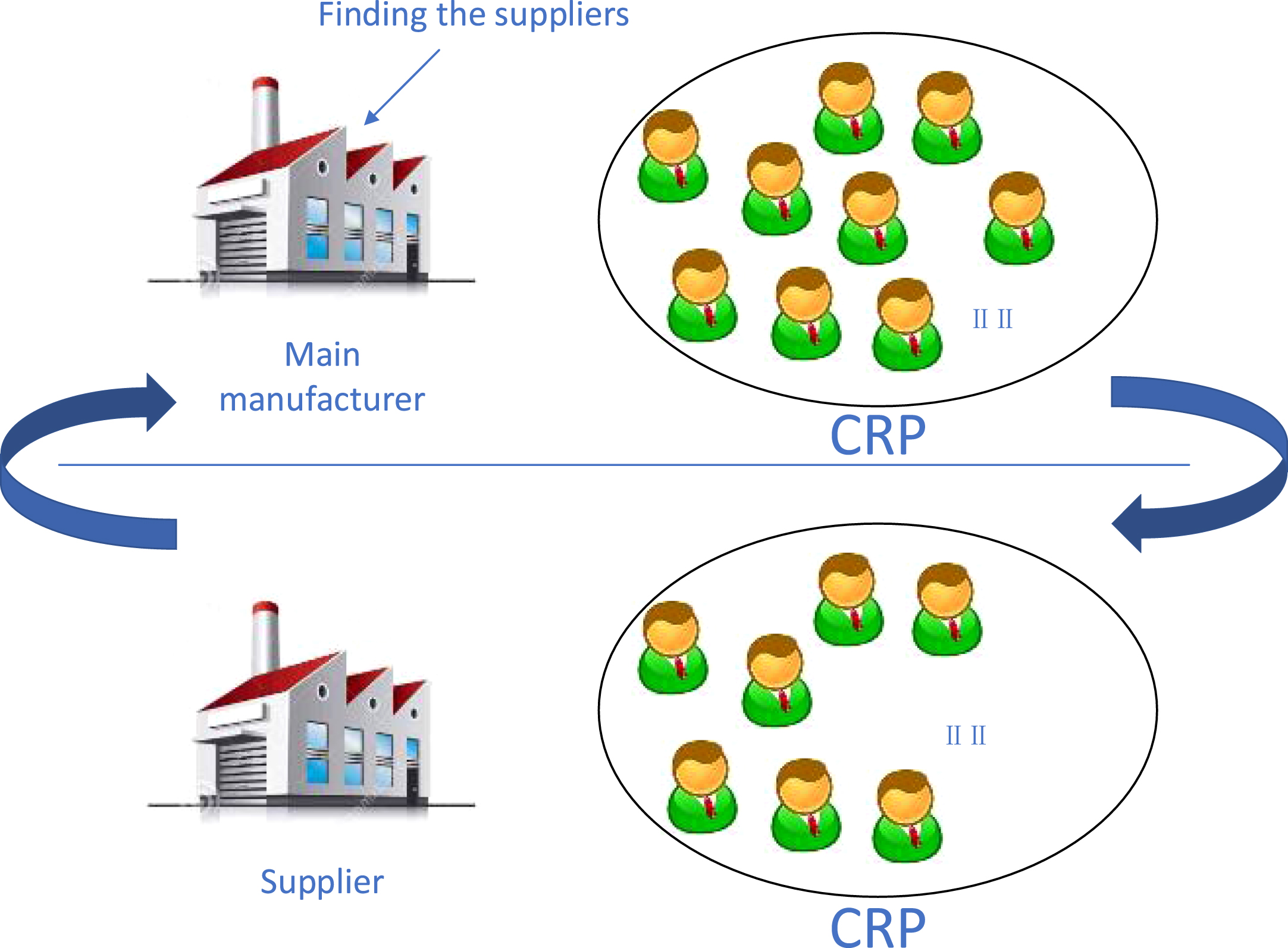
The bi-level CRP model.
The content of our study could be divided into five parts. Section 2 introduces the basic knowledge of the cloud model. Section 3 introduces the bi-level CRP model. Section 4 introduces how to solve the proposed programming model in Section 3. Section 5 uses a case study to illustrate our proposed method, and compare our work with previous studies in this section.
In our study, the cloud model is used to present uncertain preferences. Also, the cloud model could present the randomness and fuzziness of the uncertain data. For the cloud model, there exist three key parameters, including expected value (Ex), entropy (En), and super entropy (He). Generally, the Ex indicates the expected value. En indicates uncertainty and ambiguity of cloud droplet. He indicates the uncertainty of the data.
After introducing the basic parameters of the cloud model, the integrated method of multiple cloud models is introduced. Assuming a series of clouds A i = (Ex i , En i , He i ) (i = 1, 2 . . . n), and the weight of each cloud is set as W = (w1, w2, . . . w n ). The integrated cloud model is defined as Formula (1) [20].
In our study, the similarity proposed by Pei Wang is regarded as satisfaction [21]. To calculate the similarity of two cloud models, distances and similarities are identified. First, given a cloud model, A1 = (Ex1, En1, He1), the estimated cloud score is identified by Monte Carlo simulation, and the estimated score can be obtained as Formula (2).
Fuzzy distance is the second important definition. Given two cloud models A1 = (Ex1, En1, He1) and A2 = (Ex2, En2, He2), the figure is shown in Fig. 2.
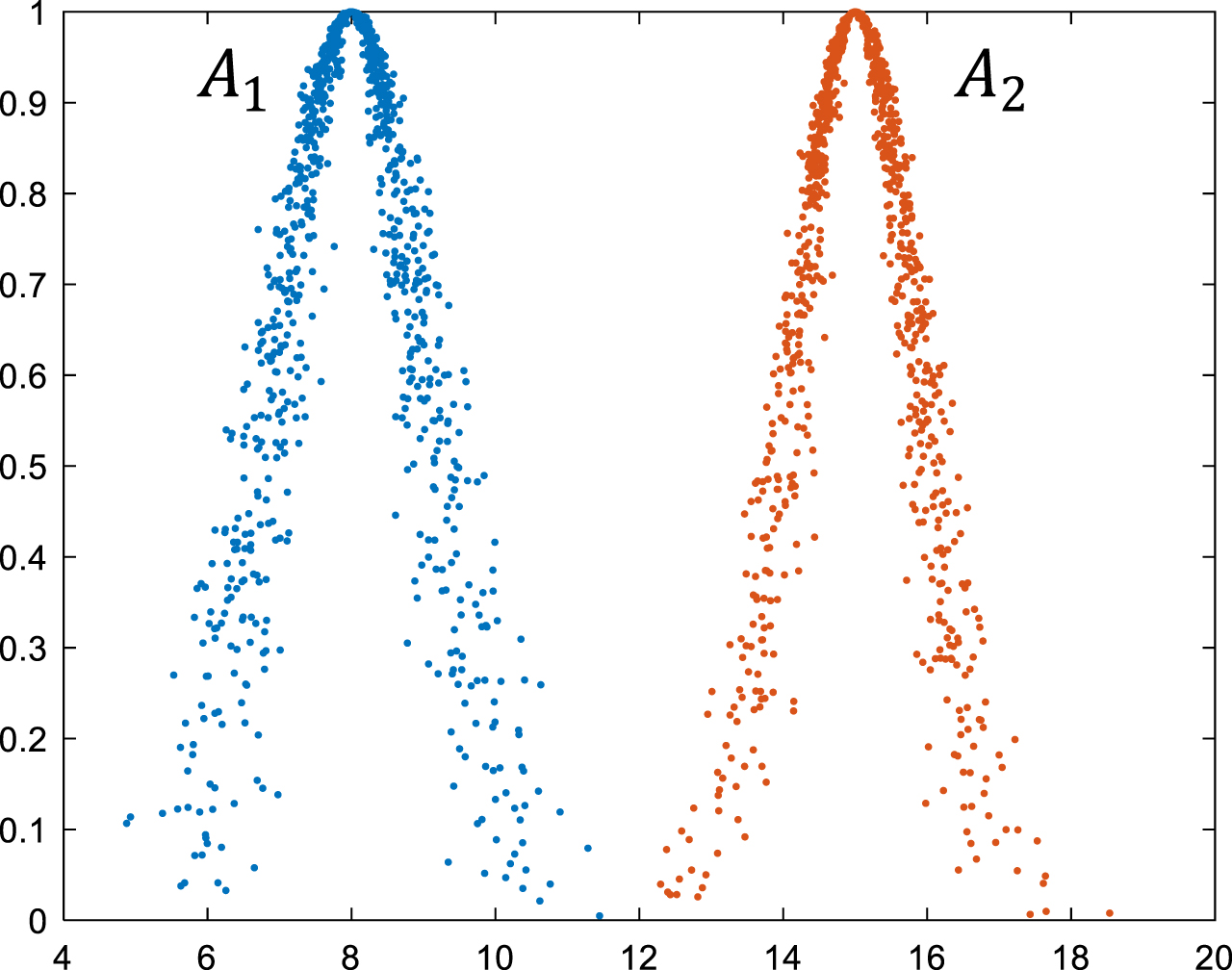
The cloud model of A1 and A2.
The fuzzy distance is defined as the formula (3).
Finally, the similarity between A1 and A2 is obtained by Formula (4).
To select the key suppliers of complex equipment, the bi-level CRP is established considering the two groups’ negotiation. In the first level, the enterprises’ experts discuss the parameter of the suppliers’ products. Then, after obtaining the result of the first level, the suppliers’ experts discuss the parameter of their product. The final parameters are obtained when the two groups both realize the consensus. Hence, according to the features of the two groups, the bi-level programming model was established.
Meanwhile, some notations are defined to illustrate the problem better. Assuming N parameters, the alternative’s parameters are X ={ x1, x2, …, x N }. Enterprises group has Q experts CG ={ Cg1, Cg2, …, Cg Q }, the q - th expert’s i - th parameter is y qi . The supplier group has P experts EG ={ Eg1, Eg2, …, Eg P }, the p - th expert’s i - th parameter is z pi .
The first level: The CRP of enterprises
In the first level, the CRP of enterprises is introduced. For enterprises, the parameters of the supplier’s product are discussed by many experts. The final parameters are determined after all experts realizing the consensus. To realize the consensus, the CRP method is proposed.
Meanwhile, because all experts are from the same enterprise, these experts are connected by the social relationship. The social relationship influences the CRP, which was illustrated in previous works [22–25]. Certainly, the social relationships among the experts are studied in our work.
Generally, the expert’s influence on social relationships is higher, the expert will deeply influence the CRP. To analyze the expert’s influence, the importance degree of the expert should be determined. Like previous works, the centrality degree was used to calculate the importance degree, and the formula is shown as Formula (1).
In formula (1), Cr qu indicate the value of the social relationship between the q - th expert and the u - th expert. CD L (C q ) indicate the centrality degree of the q - th expert.
Next, assuming the social relationship set CR = (r1, r2, … r
γ), the calculation of the q - th expert’s importance degree is shown in Formula (2).
In Formula (2), w
q
After determining the experts’ importance degree, the consensus of each parameter is shown in Formula (3).
Based on Formula (3), the q - th expert’s consensus is shown in Formula (4).
In Formula (4), CI q indicates the q - th expert’s consensus.
To realize the consensus, we aim to maximize all experts’ total consensus. When the total consensus is larger, the experts are more possible to realize the consensus. Generally, the perfect state is that all experts’ consensus value is 1. However, the perfect is hard to be realized. Hence, previous works had proposed the soft consensus, which means the expert’s consensus value is larger than a threshold value (λ). In our study, the soft consensus is also adopted. The constraint is shown in Formula (5).
Based on the soft consensus, the mathematical model is shown in Formula (6).
In the second level, the CRP of the suppliers is introduced. After obtaining the discussed parameters from the first level, the experts from the supplier discuss these parameters. Like the first level, the experts in the supplier group also are connected by the social relationship. Studying the impactor of the social relationship is necessary. Hence, the CRP under the social relationship should be studied.
Similarity, assuming the social relationship between two experts Er, the centrality degree is shown in Formula ().
Then, assuming the social relationship set of the supplier CR = (l1, l2, … l
ζ), the p - th expert’s importance degree is shown in Formula (8).
After determining the experts’ importance degree, the consensus of each parameter is shown in Formula (9).
Based on Formula (9), the q - th expert’s consensus is shown in Formula (10).
In Formula (10), EI p indicates the p - th expert’s consensus.
The constraint is shown in Formula (11).
Based on the soft consensus, the mathematical model is shown in Formula (12).
In our work, the enterprise discussed the product’s parameters and find the suppliers based on the determined parameters. Then, because of the complexity, the supplier did not have the enterprise’s required product, they will revise the related owned product. Sometimes, the parameters from the enterprise are hard to be finished, and the experts from the supplier would like to discuss the parameters so that the product could be produced. For the supplier, the parameters will be discussed again. Hence, when the two groups both realize the consensus for the same parameters, the final parameters are determined.
To reflect the characteristics of master-slave, bi-level programming was used. The formulas are shown as follows:
First level- CRP of the enterprises:
Second level: the CRP of the supplier:
Formula (13) indicates the objective is maximizing the total consensus of the enterprises’ experts. Formula (14) indicates q - th expert’s consensus value. Formula (15) indicates the group’s consensus value. Formula (16) indicates the expert’s preferences based on the parameter. Formula (17) means the importance degree of the expert. Formula (19) indicates the center degree of the expert. Formula (20) indicates the threshold value of the consensus. Formula (21) indicates the range of the index.
Meanwhile, in the second level, the meaning of the formulas is like the corresponding value of the first level, and we do not illustrate the definition of pleonastic.
In section 2, bi-level programming is proposed to determine the final parameters. To find the final parameters, we should design an efficient method to solve the bi-level programming model. In our study, the bi-level programming is hard to be solved by accurate algorithms, because the programming is not convex. Hence, we should use a heuristic algorithm to solve the problem.
The ABC is a kind of heuristic algorithm, which has a simple structure, few control parameters, and strong convergences. Also, the ABC was applied to many areas, like scheduling, matching, and continuous optimization. The good performances of ABC were verified by many scholars, especially the continuous optimization. Our proposed model is also a kind of continuous optimization. Certainly, the ABC is also used in our study. However, the previous ABC still has some disadvantages. First, the original ABC could not solve the bi-level programming. Second, the global search ability of ABC is not strong. Hence, to enhance the performance of the original ABC, we design an improved ABC (IABC) to solve the proposed bi-level model.
For our proposed model, we design the bi-level mechanism for ABC to solve the two-level programing. Second, to enhance the global searching ability, the guiding mechanism of the gray wolf algorithm is used to enhance the global searching ability. Meanwhile, the adaptive method is used to further enhance the searching ability. Then, to enhance the local searching ability, the levy flying mechanism is adopted.
To better illustrate the IABC, like previous works, we introduce the three stages of ABC, including the employed bees, onlooker bee, and scout bee. Then, the bi-level mechanism of the ABC is introduced.
The employed bees
In the original ABC, the stage of employed bees aims to conduct global searching. Generally, the employed bees use the formula (28) to search for new food.
In formula (28), Pop indicates the number of employed bees.
However, the original searching method is weak. In our study, we fully adopt the searching mechanism in the gray wolf algorithm.
First, the three best solutions, named α, β, and γ, are selected from the employed bees. The α bee is the best solution. The β bee is a little worse than the α bee. The γ bee is a little worse than the β bee.
Then, the employed bees are classified into three parts. The α, β, and γ guide the three parts separately. In detail, a number ζ (ζ ∈ [0, 1]) is generated for each bee. When 0 ⩽ ζ < 1/3, the α bee is used to guide the selected bee. When 1/3 ⩽ ζ < 2/3, the β bee is used to guide the selected bee. When 2/3 ⩽ ζ < 1, the γ bee is used to guide the selected bee.
Meanwhile, we design the adaptive method to further enhance the searching ability. At the beginning of the algorithm, the α bee could quickly guide the population to better solutions, so the algorithm should select the α bee as much as possible. At the end of the algorithm, the effectiveness of the first wolf’s guides becomes weak, and the algorithms should search for the effective fragments in β wolf and γ wolf. Hence, we design an adjustive parameter δ to realize the objective.
Assume the max iteration of the algorithm is Max _ iter, the current iteration is η, the adjustive parameter is shown as Formula (29).
After that, the mechanism of selecting a wolf is shown as Formula (30).
The function of the onlooker bee is local searching. In our study, we adopt the levy flying mechanism to enhance the local searching ability. The levy searching ability can realize the search mechanism with alternate long and short steps, which could avoid the local optimal. Hence, the levy searching mechanism is shown in Formula (31).
In Formula (31), L (s, λ) indicates the levying flying mechanism, and ϱ is the parameters. The detail of L (s, λ) is shown in Formula (32).
In this stage, when the solution has not been improved after several times of searching (trial times), the algorithm abandons the solution and generates a new solution.
The bi-level ABC
In our study, because the programming model is a kind of bi-level problem, the bi-level ABC should be designed to solve the proposed problem. First, we illustrate how to solve the problem in the first level based on the IABC, and the IABC is shown in Algorithm 1.
Second, we illustrate how to solve the problem in the second level based on the IABC, and the IABC is shown in Algorithm 2.
Third, after solving the two-level programming, we illustrate how to solve the combination problem. The algorithm is shown in Algorithm 3.
A case study of the aircraft
Aircraft is a kind of complex equipment, which has complex techniques and high requirements of the suppliers. Because of the complexity of aircraft, the main manufacturers are hard to finish the production by themselves. Hence, to complete the production of aircraft, kinds of suppliers are required to cooperate with the main manufacturers. Because the aircraft has high-degree personalized features, the supplies should design the required product for the main manufacturer. However, designing a new product is hard for suppliers. The suppliers will organize the experts to discuss the main manufacturer’s solutions. Also, after discussion, the suppliers will respond to the solutions to the main manufacturers.
For example, the structure, a part of aircraft, plays an important role in manufacturing. An aircraft structural part is an important part of the skeleton and aerodynamic shape of the aircraft body, they come in a variety of complex shapes and different materials. The design and manufacture of aircraft structural parts require full consideration of the dual requirements of strength and weight. The manufacturing process of aircraft structural parts is complicated, and the requirements of the process are high [26]. Because of the complexity, the design of the structure is discussed back and forth between manufacturers and suppliers. In our study, we use the proposed method to determine the final parameters. Generally, there are many related parameters for structure. In our study, five parameters, including internal stress (IS), precision (PR), roughness (RG), reliability (RE), and life (LI), are adopted.
After searching the suitable suppliers in the market, four suppliers are capable to produce the structure. Hence, the main manufacturer discussed with the four suppliers and find the best solution. To better cooperate with each other, the main manufacturer and four suppliers organize their own experts group. The main manufacturer’s group has 6 experts. The four suppliers have 6,5,5, and 4 experts separately. Then, the structure of the main manufacturer and four suppliers are shown in Fig. 3.
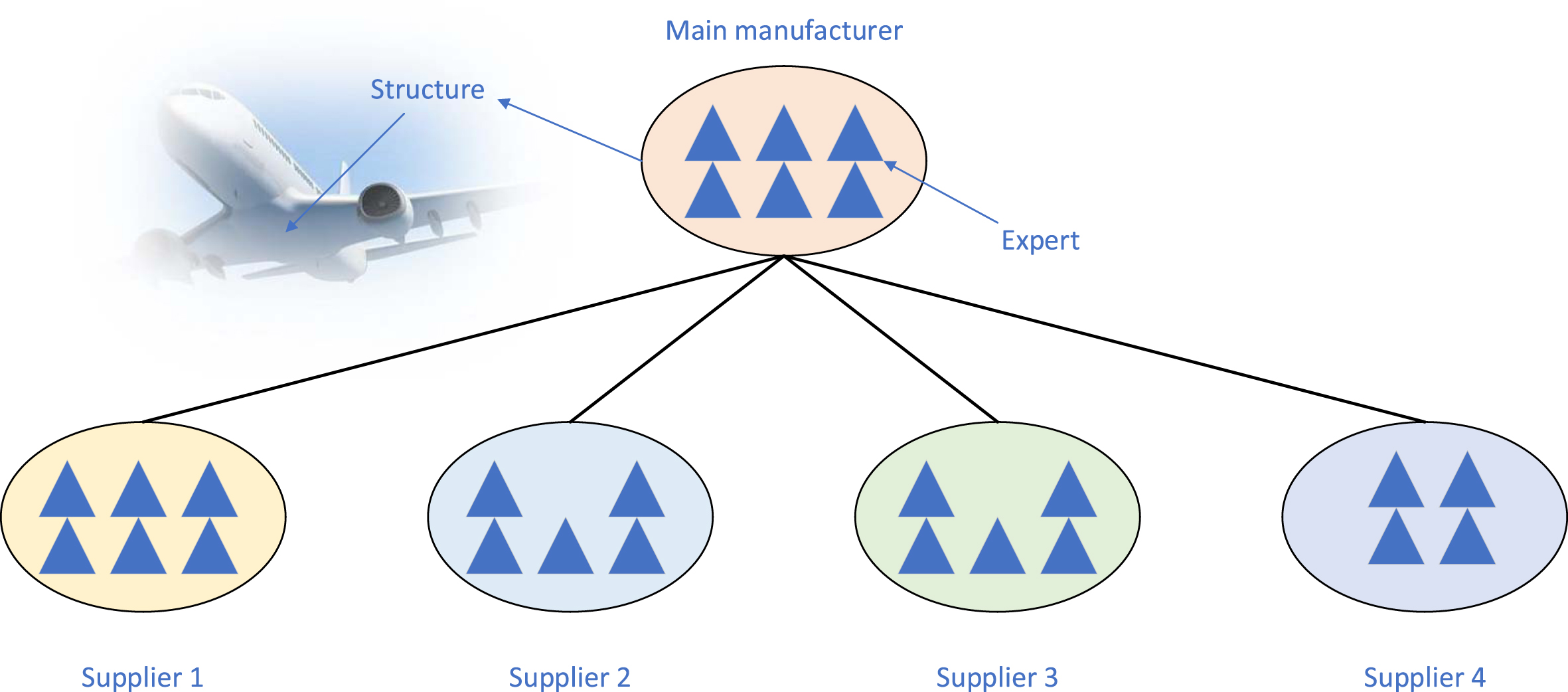
The model of selecting the supplier.
To eliminate the influence of the unit, we should normalize the parameters. Because each parameter has its safety range, we use the range of each parameter to normalize the parameters. For example, assuming the range of RE [0.98, 0.99], the actual value is 0.985, and the normalized value is 0.5.
At the beginning, the main manufacturer proposed the initial scheme {0.29, 0.56, 0.48, 0.62, 0.88} by referring to the historical data. Then, the experts from the main manufacturer assess the initial scheme. Generally, considering the complexity of the product, the linguistic variable, which is frequently used in qualitative assessment, is used. Five kinds of linguistic variables are used, including very bad (VB), bad (BA), general (GE), good (GD), and very good (VG). The experts’ assessment is shown in Table 1.
The assessment of the experts (Main manufacturer)
The assessment of the experts (Main manufacturer)
Meanwhile, to reflect the fuzziness and randomness of the linguistic variables, the variables were converted into the cloud model. In previous works, the converting results had been already illustrated. The references shown the result [27]: VB (0, 1.031, 0.262), BA (3.09, 0.637,0.162), GE (5, 0.393, 0.1), GD (6.91, 0.637, 0.162), and VG (10, 1.031,0.262). Hence, the integrated assessments, which were converted into the cloud model, are shown in Fig. 4.
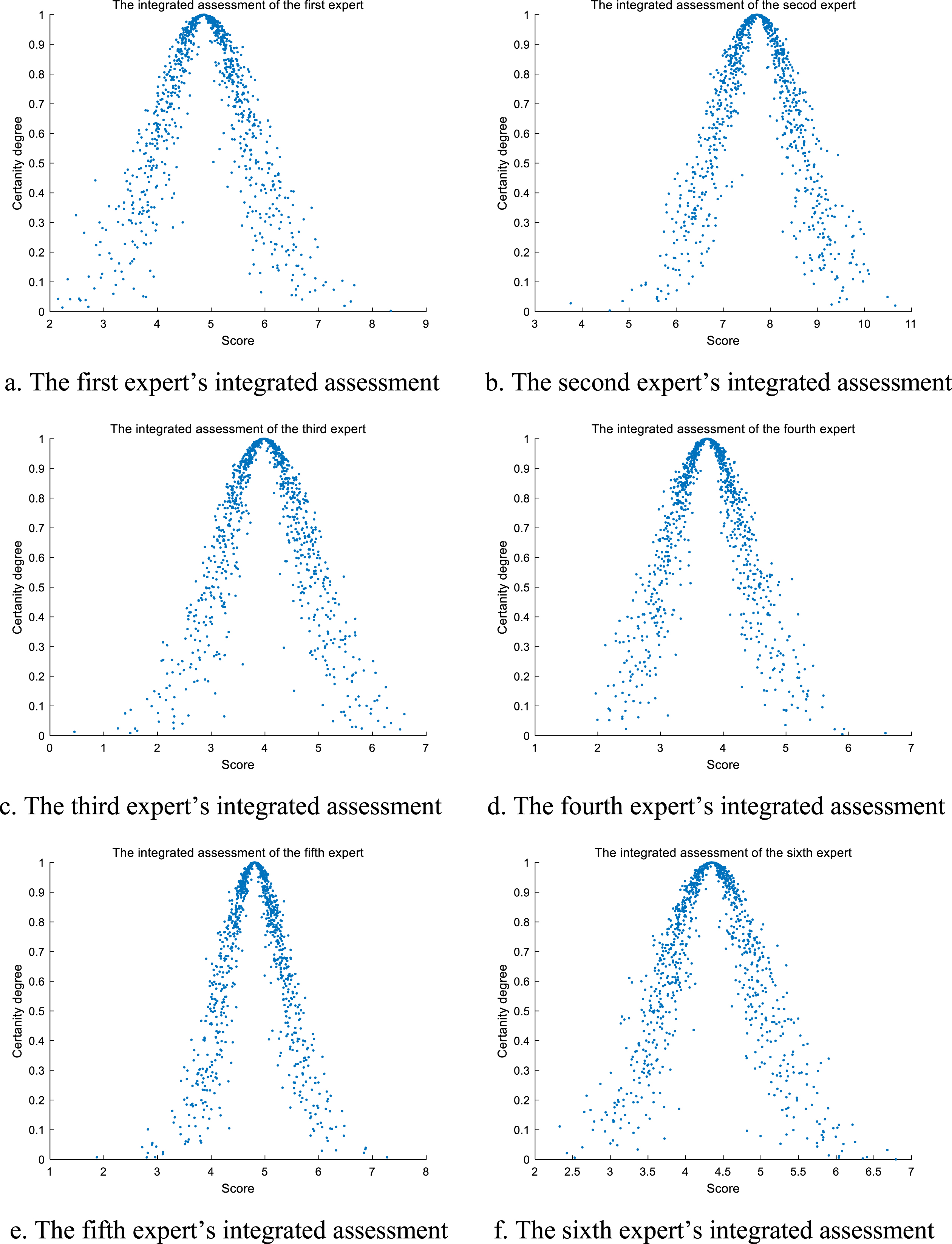
The integrated assessment of the six experts (main manufacturer).
Then, the expert’s assessment of the first supplier is introduced. As the main manufacturer, the linguistic variables are shown in Table 2.
The assessment of the experts (First supplier)
Like the main manufacturer, the integrated assessment is shown in Fig. 5.
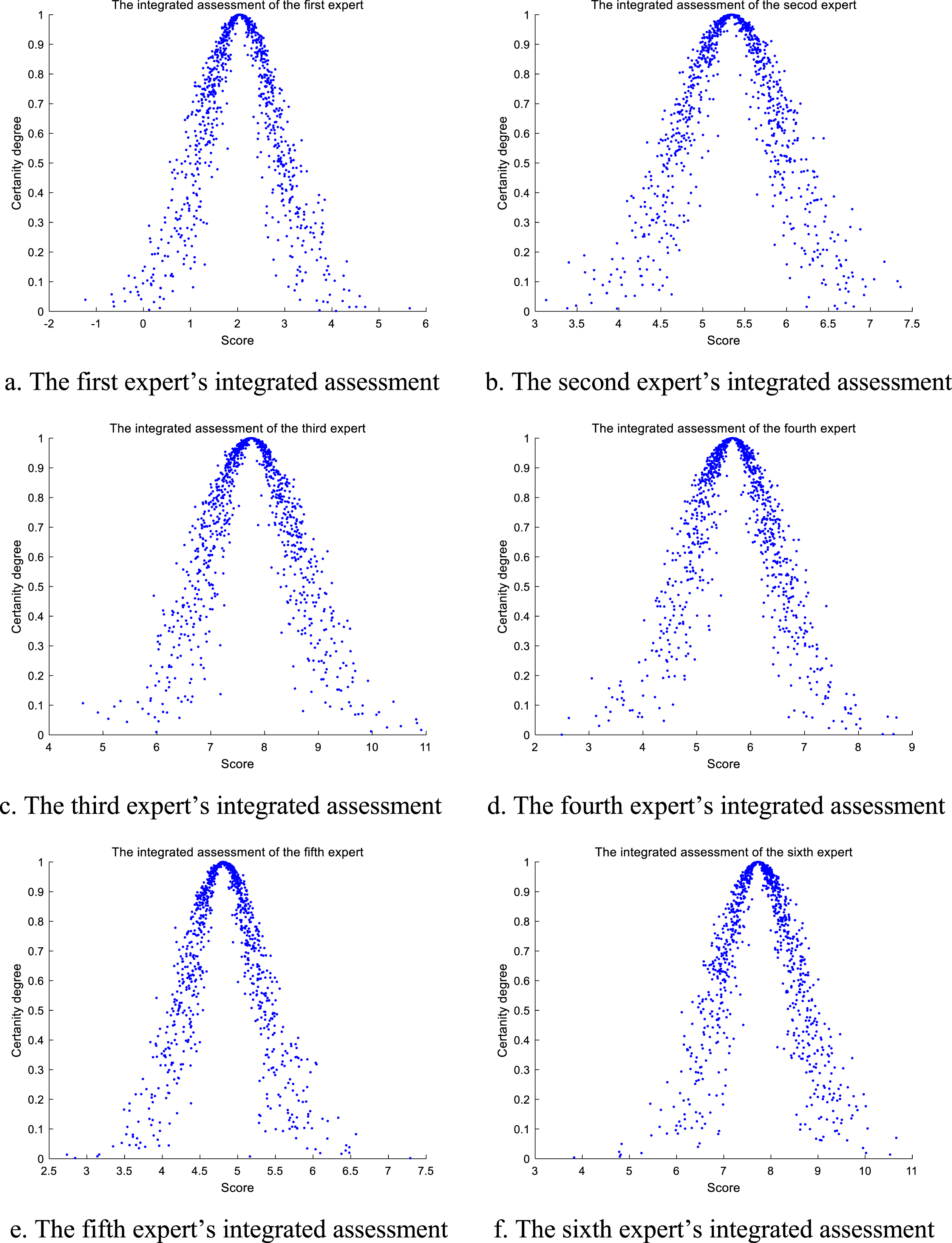
The integrated assessment of the six experts (first supplier).
Next, the experts of the second supplier are introduced. The assessments of experts from the second supplier are shown in Table 3.
The assessment of the experts (First supplier)
Also, the integrated assessments are shown in Fig. 6.
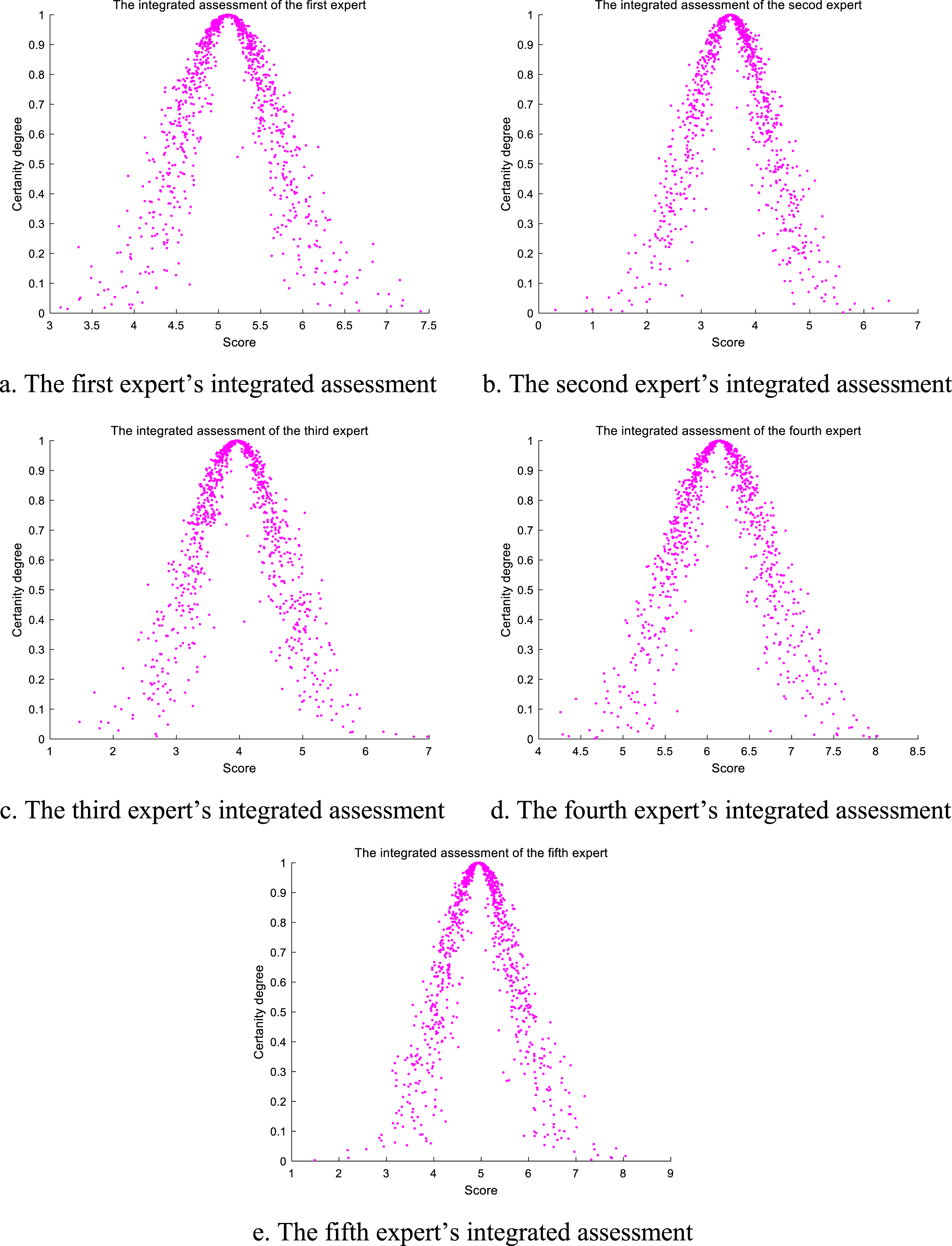
The integrated assessment of the six experts (second supplier).
Because the remained suppliers’ assessments are like the first two suppliers, we did not list these data considering the length of the article.
Based on the related data in Section 5.1, the algorithm in Section 4 is used to solve the problem. As our study has four suppliers, we should run the algorithm four times separately. The running result is shown in Fig. 7.
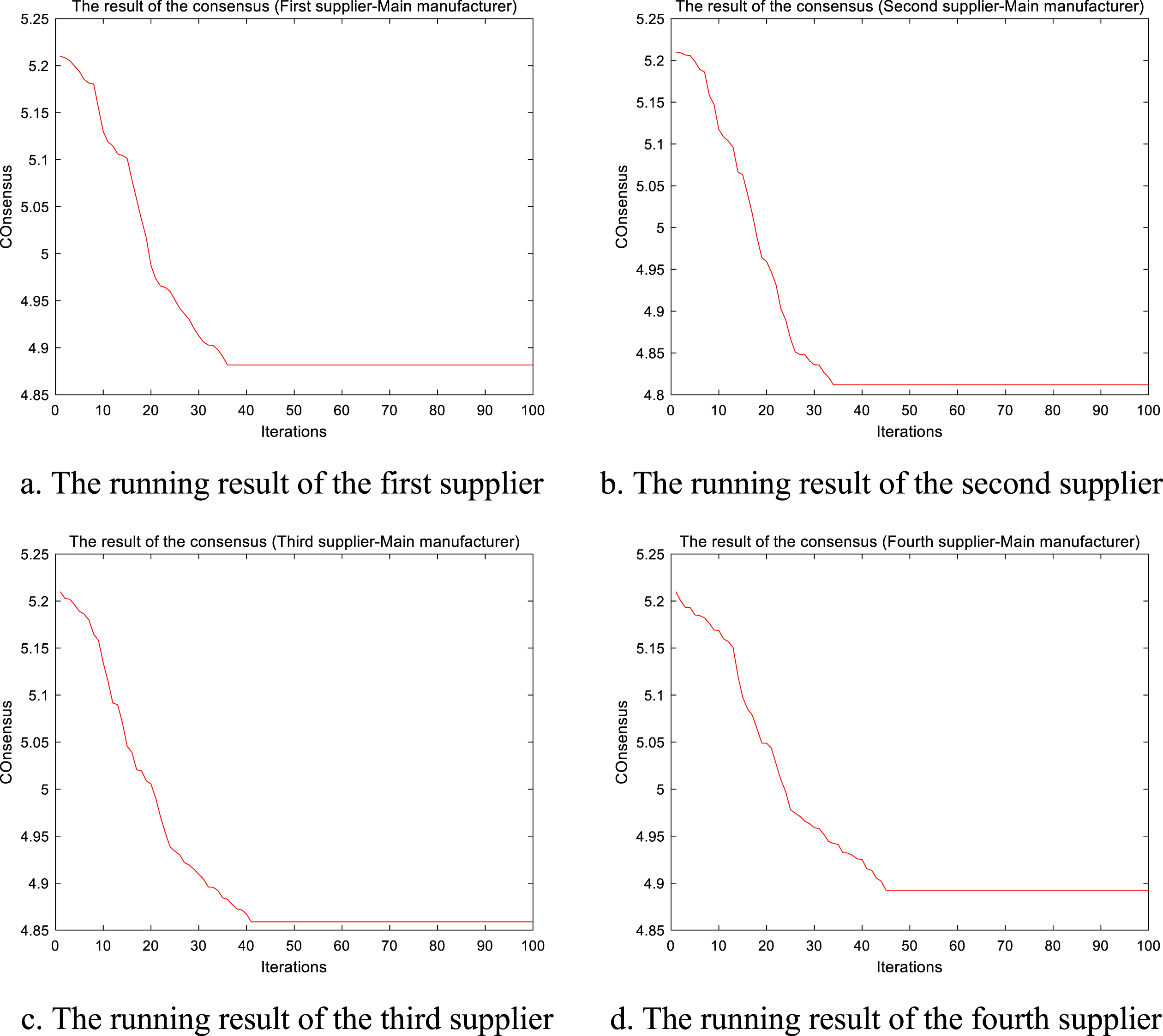
The running results of different suppliers.
According to Fig. 7, the consensus value of the main manufacturer is shown in Table 4.
The consensus value of the main manufacturer under different suppliers
According to Table 4, when the main manufacturer selects the fourth supplier, the consensus value of main manufacturer is the largest. Hence, the fourth supplier is selected.
According to Fig. 6 and Table 4, we could conclude three conclusions: first, the beginning of the four situations is the same in Fig. 6. Because the bi-level model is dominated by the main manufacturer, the optimization is also beginning from the first level. When we optimize the first level, the best solution is the same. Second, the consensus value of the first level is decreased with the rise of the iterations. Because the final solution is the balance between the two levels, the two groups gradually compromise to realize the final consensus. The two groups’ consensus both decreased compared to the beginning solution. Third, the main manufacturer’s final consensus value is different under the four suppliers. Because the different suppliers have their own preferences, the balance is also different for diverse suppliers. When the preferences are like the main manufacturer, the two groups are easy to realize the consensus, and the consensus value is larger. In practice, the main manufacturer is recommended to cooperate with the suppliers, which is easy to realize the consensus.
Comparing IABC with different algorithms
In our study, we design a novel IABC. To verify the advantages of IABC, we compare the algorithm with other similar heuristic algorithms, like the gray wolf algorithm (GWA), genetic algorithm (GA), and cuckoo searching algorithm (CS). Considering the influence of the initial population solution on the algorithm, all algorithms in this paper use the same initial population. Secondly, since the parameters of the algorithm will also affect the performance of the algorithm, this paper selects the method of the Taguchi experiment to determine the parameters of different algorithms. Finally, considering the random search characteristics of the heuristic algorithm, this paper runs all the algorithms 50 times and selects the one with the largest consensus degree of customer experts as the comparison (if the consensus degree is the same, the one with the fastest convergence is selected as the algorithm result). The results of the algorithm comparison are shown in Fig. 8.
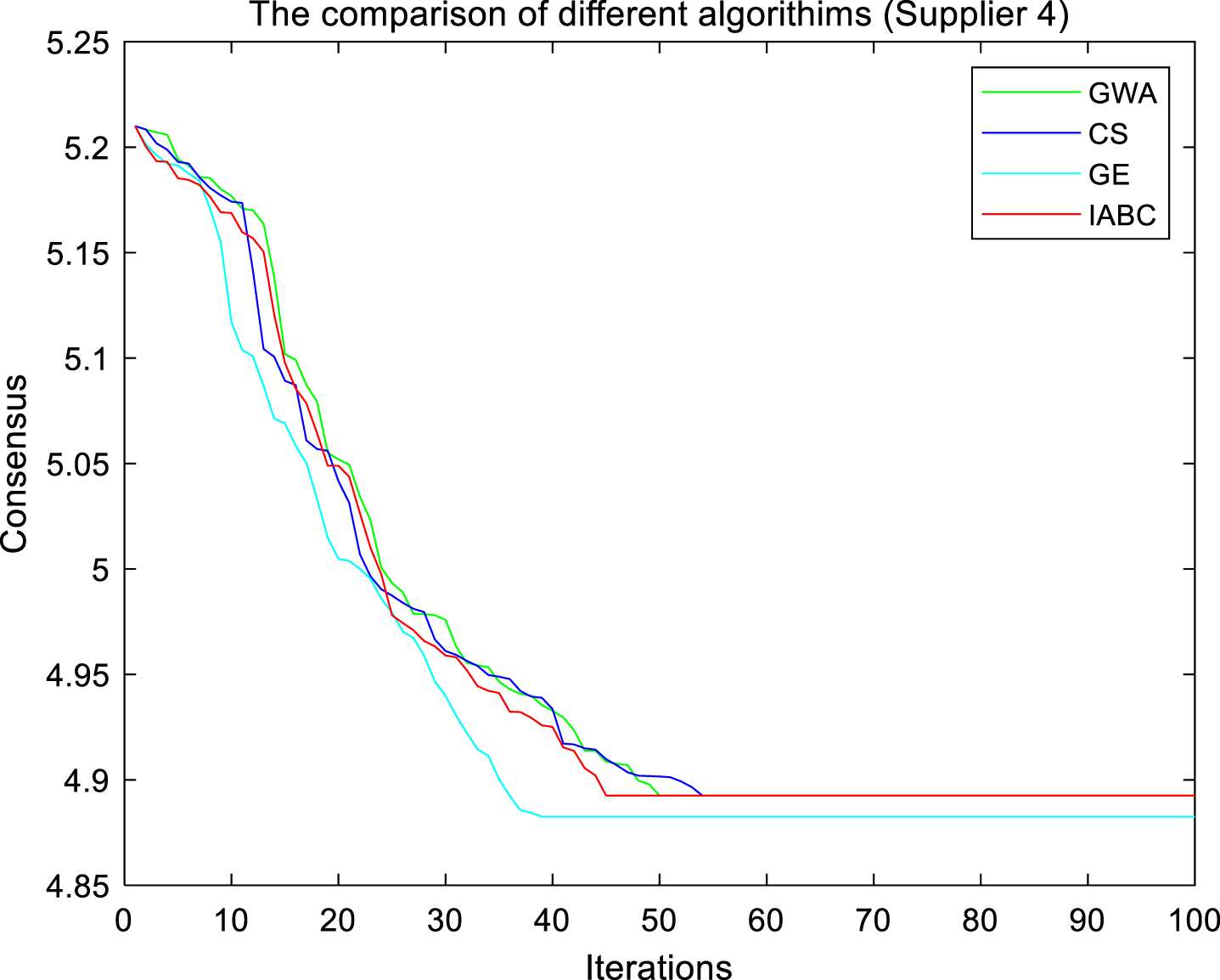
The comparison of different algorithms.
According to Fig. 8, IABC, CS, and GWA found the same results. GE finds the worse solutions which is lower than IABC’s results, although this algorithm finds the solution earlier compared to our work. Certainly, we could refer that our proposed IABC has better performances, like fast convergences and powerful searching ability.
In previous studies, the weighting method is used to solve the CRP of multiple groups. However, the weighting method has several disadvantages. First, lots of impactors influence the weights of the diverse groups. Determining the weight required professional knowledge background. It is hard to select the experts to determine the weight, especially selecting the suppliers for complex equipment. Then, when we used the method of exhaustion to determine the weight, the process is time-consuming.
Next, we compare our method with the method of exhaustion. Like Section 4.2, the data of the fourth supplier is regarded as the experiments. The comparisons are shown in Table 5.
The comparisons of different methods (Supplier 4)
The comparisons of different methods (Supplier 4)
According to Table 5, we could find that the main manufacturer’s consensus value of all experiments is lower than our study. Meanwhile, the method of exhaustion is time-consuming. The five experiments required 321 seconds, but our proposed method only need 217 seconds. Certainly, the bi-level method is better than previous work on our problem.
In our study, the CRP of the bi-level mechanism is proposed for selecting the suppliers. First, considering the fuzziness and randomness of the decision-makers, the cloud model is used to present the uncertain preferences of the experts from the main manufacturer and suppliers. Then, because of the master-slave features of selecting, we establish the bi-level mechanism to select suppliers based on the cloud model. In the first level, because the experts should discuss the product, the CRP is necessary. Hence, the first level establishes the CRP for the main manufacturer’s experts. In the second level, also, the suppliers’ expert needs to discuss the main manufacturers’ product to complete the production. The second level also needs to establish the CRP model. All in all, the bi-level CRP is established. Third, the IABC is designed to solve the bi-level programming problem. Also, kinds of strategies, like the searching mechanism in GWA and the levy flying mechanism, is adopted to enhance the performance of the IABC.
In the future, first, other kinds of uncertain preferences could be studied, which is helpful to enhance the feasibility of our method. Then, we recommend that future scholars study other objectives in the selection, like minimizing the cost. Third, to solve the problem efficiently, novel algorithms should be designed.
Footnotes
Acknowledgments
The work is supported by the National Social Science Foundation (20BGL025).