






Abstract
Breast cancer is the leading cause of cancer-related deaths, and choosing a suitable treatment plan for this disease has proved difficult for oncologists owing to the variety of criteria and alternatives that must be considered during the decision-making process. Since prospective treatment options influence patients’ health-related quality of life in a variety of ways, a methodology that can completely and objectively evaluate alternative treatments has become an essential issue. This paper proposes a novel multi-criteria decision-making (MCDM) methodology by integrating the CRiteria Importance Through Intercriteria Correlation (CRITIC) and the REGIME techniques and handles the problem of breast cancer treatment selection problem. CRITIC enables the determination of objective criterion weights based on the decision matrix, while REGIME ranks the options without the need for lengthy computations or normalization procedures. The suggested methodology is demonstrated in a spherical fuzzy atmosphere, which allows decision experts to independently express their degrees of membership, non-membership, and hesitancy in a broad three-dimensional spherical space. In the numerical example provided, three oncologists evaluate four breast cancer treatment alternatives, namely, surgery, radiotherapy, chemotherapy, and hormone therapy, with respect to five criteria, which are disease or tumor type, stage of disease, patient type, side effects, and financial status of the patient. The tumor type is determined to be the most important assessment criterion, and surgery is selected as the best course of action. The stability and validity of the proposed methodology are verified through sensitivity and comparative studies. The discussions, limitations, and future research avenues are also given within the study.
Introduction
Cancer is a condition in which abnormal cell growth occurs in a specific area of the body and typically originates in one area of the body and spreads to others, affecting the functioning of the host and healthy organs nearby [51]. All over the globe, breast cancer is the kind most likely to be identified, and it is the second biggest cause of deaths connected to cancer [11]. On the other hand, it is proven to be among the most curable, and most of the patients diagnosed with breast cancer are experiencing dramatic life changes as a direct result of advancements in breast cancer treatment, including earlier diagnosis, surgical intervention, radiation therapy, and chemotherapy [9]. However, there are several treatments available, and their selection depends on an assortment of factors, and choosing the best solution for a particular patient has become a major concern for oncologists.
Due to its complexity and significant impacts on patients’ lives, making decisions on healthcare issues can be challenging in many instances [34]. Meanwhile, MCDM methods enable selecting the optimal alternative from a finite number of choices using preset criteria [48], and are widely used to handle a broad variety of healthcare decision-making challenges, including diagnosis, establishment of priorities, evaluation of health care technologies, and selection of treatment alternatives [31]. Treatment selection problems indeed include a variety of potential paths of alternatives and evaluation criteria, and from this aspect, it can be structured as an MCDM type of problem [27].
In addition, uncertainty is a characteristic of the real world and appears in the nature of the majority of MCDM issues as well as the problem of breast cancer treatment selection. The criteria for such a problem might be quite qualitative, and health professionals often assess them using linguistic terminology. Fuzzy set theory may represent the fuzziness in the linguistic evaluations when they are substituted for precise numerical values in the decision matrix. Using fuzzy systems [58], decision experts may convert their linguistic judgments into numerical values and deal with the inherent uncertainties that come with such assessments. In this work, the uncertainty of the data is addressed by using spherical fuzzy sets [4], which were developed based on Pythagorean fuzzy sets [55] and picture fuzzy sets [12]. Spherical fuzzy sets allow users to model uncertainty with three independent parameters, namely membership, non-membership, and hesitancy degrees, and are preferable to many other fuzzy set approaches due to the spherical vast area where fuzziness can be addressed.
The CRITIC [13], on the other hand, is a technique for measuring the similarity between criteria by using the correlation coefficients between the criteria. This technique bases the calculation of attribute weights on a decision matrix. Based on a correlation coefficient between the criteria that is computed from the values in the decision matrix, it assesses how similar the criteria are to one another. It is possible to assess the relative importance of a certain criterion to the others by calculating the standard deviation for that criterion.
In addition, the REGIME [22] method is preferable in certain ways to other MCDM methods since it does not need a normalization step or laborious calculations. This technique uses a matrix known as the REGIME matrix to determine the final ranking of alternatives where pairwise comparisons of alternatives form the foundation of the approach. In order to establish which of the two alternatives is preferable when taking into account all the criteria at once, the scores obtained from pairwise comparisons are multiplied by the weights of the criteria.
Related work
In this section, the literature of the suggested works surrounding spherical fuzzy sets, CRITIC and REGIME methods, and cancer-related MCDM approaches is presented in order to better comprehend the importance of our suggested method and the problem addressed.
Spherical fuzzy sets are one of the most recent extensions of ordinary fuzzy sets and are commonly utilized with different forms of MCDM models to simulate the uncertainty in the nature of problems encountered in various fields e.g. information technology governance maturity level analysis [36], operational efficiency assessment of airports [57], seismic vulnerability evaluation [37], technology selection for process mining [14], disease treatment [42], evaluation of education units during the pandemic process [35], security supplier selection for an industrial control system [24], emergency decision support modeling [6], air quality evaluation [3] and a managerial decision-making problem [5].
Kahraman et al. [29] extended the CRITIC method with spherical fuzzy sets and used it to prioritize supplier selection. Zhang et al. [59, 60] extended Multi-Attributive Border Approximation area Comparison (MABAC) and the Technique for Order of Preference by Similarity to Ideal Solution (TOPSIS) with spherical fuzzy sets and applied them to green supplier residential location selection issues and Sarucan et al. [49] suggested a spherical fuzzy TOPSIS approach and handled a physician selection problem. Using Analytic Hierarchy Process (AHP), Unal and Temur [53] ranked factors that influence sustainable supplier selection and modeled uncertainty through spherical fuzzy sets. Buran and Erçek [8] utilized spherical fuzzy AHP for business model assessment of public transport. On the other hand Hamal and Senvar [20] combined AHP and MULTIplicative form with Multi-Objective Optimization Ratio Analysis (MULTIMOORA) techniques for ranking financial ratios using spherical fuzzy sets, On the other hand, Menekse and Camgoz-Akdag [38] developed a novel framework based on the Elimination and Choice Translating Reality (ELECTRE) method by utilizing the mathematical operations of spherical fuzzy sets.
The assignment of weights in MCDM problems is a crucial step in the decision-making process as a whole. In some decision-making scenarios, the extraction of subjective preferences is either challenging or undesirable. The CRITIC [13] technique derives these weights objectively based on the measurement of contrast intensity and the contradictory nature of assessment criteria. CRITIC has been included in MCDM problems in a variety of fields, and the most prominent ones are as follows: Mishra et al. [39] provided a Fermatean fuzzy hybrid MCDM framework for selecting logistics providers and used CRITIC to determine the attribute weights. Mitrović Simić et al. [40] established an integrated decision-making model for the safety evaluation of roads and determined the importance of the inputs using the CRITIC technique. The authors presented their work in a two-dimensional triangular fuzzy setting. On the other hand, Kamali Saraji et al. [30] examined the obstacles to the adoption of Industry 4.0 using a Fermatean fuzzy based technique and claimed that their approach reduces subjectivity by using the CRITIC method. Yang et al. [56] addressed a manufacturing sector-related issue using an integrated q-Rung orthopair fuzzy MCDM technique, with CRITIC employed to determine the weights of the criterion. Furthermore, Peng et al. [46] assessed an intelligent healthcare management system by constructing a unique fuzzy soft decision-making approach based on a hybrid model in which the CRITIC calculates the weights of the criterion objectively. Naik et al. [43] proposed a crisp-based EDAS model for prequalification evaluation of contractors and calculated the criteria in the problem with the CRITIC approach. Finally, Biswas et al. [7] chose passenger automobiles and used the CRITIC approach to derive the weights of the vehicle selection criteria and the Combined Compromise Solution (CoCoSo) method to rank the vehicles.
The REGIME methodology was created by Hinloopen et al. [23] as an MCDM technique with minimal computing complexity. Using qualitative or quantitative pairwise comparisons to rank alternatives, this method has been utilized by many researchers. Oztaysi et al. [44, 45] introduced Pythagorean and spherical fuzzy REGIME methods and used a waste disposal site selection problem to exemplify their suggested methodologies. Haktanir and Kahraman [19] proposed an integrated CRITIC REGIME technique and adapted the superiority and guide indices, superiority identifier, and REGIME matrices to a picture fuzzy environment with an illustration from a health field. On the other hand, Chen [10] proposed a novel T-spherical fuzzy REGIME approach and evaluated the applicability and strengths of the improved methodology through a practical application in the area of solar plants. Tsigdinos and Vlastos [52] analyzed the most effective alternative road network in a metropolitan area using the crisp-based REGIME approach. Moreover, Esangbedo et al. [16] extended the traditional REGIME method based on grey system theory and assessed human resource information systems.
Based on the performed literature analysis, the following research gaps are identified: The CRITIC REGIME technique has not benefited from the use of spherical fuzzy sets for resolving ambiguity. In the context of MCDM, breast cancer illness has been pretty much ignored. The scientific literature also lacks a fuzzy MCDM-based study for breast cancer planning. Uncertainty about the nature of cancer-related decision-making problems may have a significant effect on the results. However, the bulk of existing research either does not account for uncertainty and depends on precise numbers or uses mostly two-dimensional fuzzy sets. Sensitivity and comparative analyses have not been given much attention in CRITIC-based MCDM research.
Motivation and main contribution
The majority of cancer-related fatalities are caused by breast cancer, and selecting an effective treatment strategy for this illness has proven challenging for oncologists due to the wide range of factors and options that must be taken into account. Since the modern healthcare industry offers a range of possible treatments, it has become crucial to pre-evaluate them in a timely and cost-effective manner in order to send the patient to the optimal approach for further examination. In this respect, the primary motivation of this research is to assist oncologists in their early assessment of breast cancer therapy possibilities. Consequently, the ideal treatment plan is determined, and potential patients are referred to the right investigational route.
The objective of the study is to establish a new MCDM methodology with an application to the breast cancer planning problem. For this purpose, we combine the CRITIC and REGIME techniques in a spherical fuzzy environment to take advantage of their benefits with the intent of determining criterion weights and ranking alternatives. In the first phase, a spherical fuzzy CRITIC approach is used to determine the criterion weights, and the resulting weights are then used in the second phase, where the alternatives are ordered using the spherical fuzzy REGIME method. The aforementioned research gaps will also be revealed within the scope of the study.
The following are the new features i.e. main contributions of this study, which may also be regarded as its novel aspects or advantages: The CRITIC and REGIME methods are integrated in a spherical fuzzy environment. The ideal breast cancer treatment alternative selection problem is handled through a fuzzy MCDM methodology. A practical tool is established for assessing different breast cancer treatment alternatives by taking into account a variety of criteria and the opinions of multiple decision-experts. A set of criteria and treatment options that may serve as a useful tool for specialists in this field are provided. The breast cancer treatment selection problem is handled with an approach that satisfies the requirement for an objective criteria weighting as well as a straightforward and reliable alternative ranking that does not need time-consuming calculations. The suggested methodology does not call for a distinct criterion weight assignment, which might make the outcomes more dependent on the subjective assessments of the decision expert.
The remaining sections of the paper are organized as follows: In Sect. 2, the proposed methodology is described in detail. In Sect. 3, a numerical application, sensitivity and comparative analyses, and a discussion are provided. Finally, Sect. 4 concludes the study.
Methodology
In this section, the proposed methodology is given in the following manner: In Sect. 2.1, the fundamental operators of spherical fuzzy sets are described. In Sect. 2.2, classic CRITIC and REGIME approaches are summarized briefly, and in Sect. 2.3, the flowchart and details of the recommended methodology are provided.
Spherical fuzzy set preliminaries
Spherical fuzzy sets have recently been constructed based on Pythagorean and picture fuzzy sets and have the advantage of three dimensional spherical geometry. The sphere is treated as a volume rather than a solid in spherical fuzzy sets, and membership, non-membership, and hesitancy parameters can be assigned independently in this spherical volume. Fig. 1 shows a geometric representation of spherical fuzzy sets.
Definition, basic operators, aggregation operator, normalized Euclidean distance [33], and defuzzification operator [18] of spherical fuzzy sets are given below:
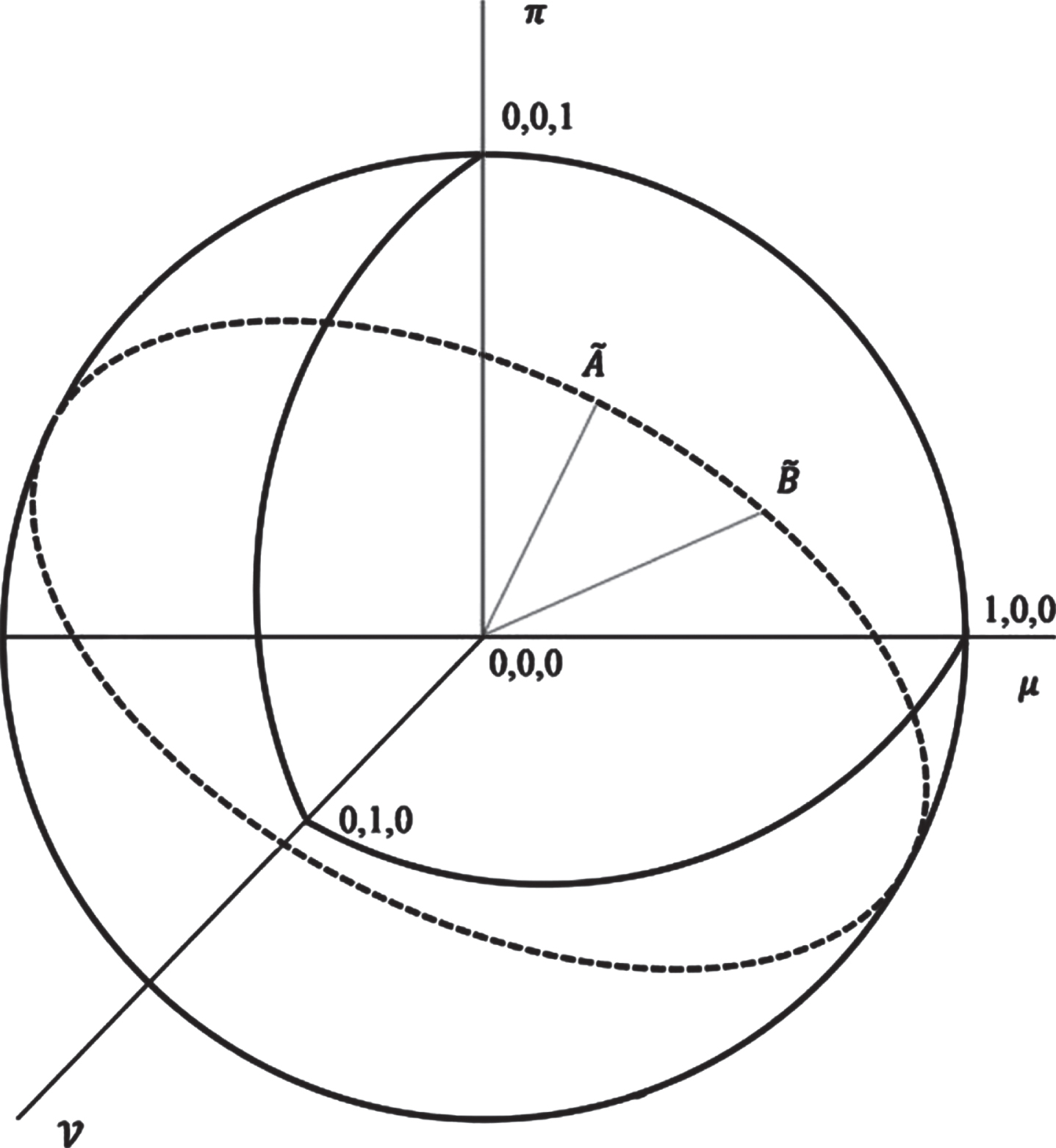
Geometric representation of spherical fuzzy set [17].
where
and the hesitancy
Eq. 2 becomes as below for on the surface of the sphere,
The CRITIC [13] is based on the degree of contrast and conflict that exist within the problem. Correlation analysis is used to identify the differences between several criteria. The major steps of this approach are as follows: (i) The decision experts weigh the options against the criteria and come up with the decision matrix. (ii) The decision matrix is normalized. (iii) The correlation coefficients and standard deviation of the criteria are calculated. (iv) Finally C indices are calculated and criterion weights are obtained accordingly.
The REGIME [22] is an MCDM method that solves the problem with the help of the regime matrix and then ranks the alternatives. In the final ranking, the weight that the decision expert gives to each attribute is important and can change the results. In this method, there is no need to translate qualitative features into quantitative attributes. The major steps are as follows: (i) The decision matrix is constructed based on the evaluation of alternatives with respect to criteria. (ii) The REGIME matrix is constructed based on the comparison of alternatives in a pairwise manner. (iii) In the final step, the guide index is obtained and the criterion weights are calculated.
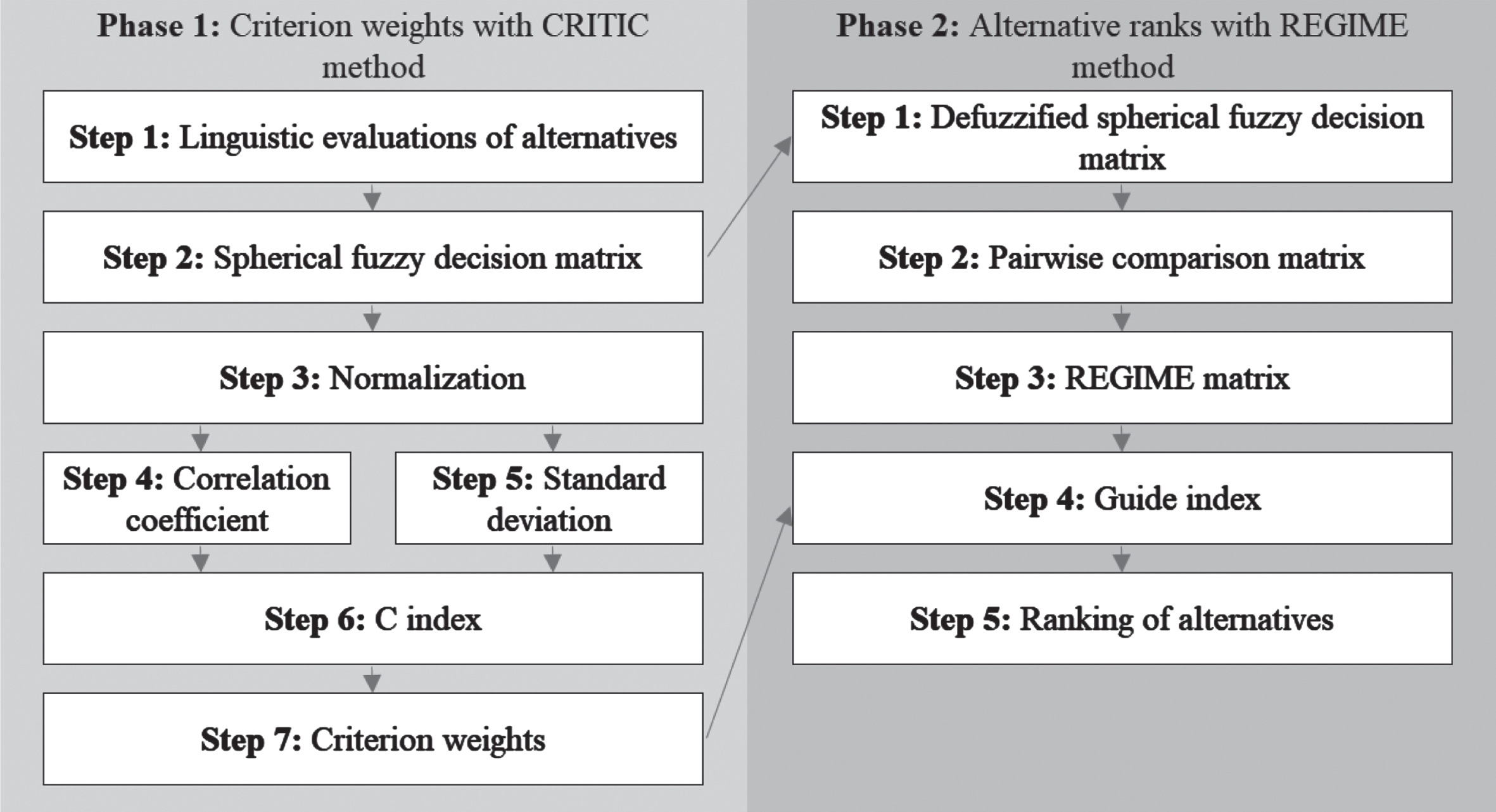
The flowchart of the proposed methodology.
In this subsection, a novel spherical fuzzy CRITIC REGIME methodology is proposed. The flowchart (Fig. 2) and the details of the methodology are presented below.
Step 1. Using the linguistic terms listed in Table 1, decision experts assess the alternatives based on the set of criteria.
Linguistic terms and their corresponding spherical fuzzy numbers [33]
Linguistic terms and their corresponding spherical fuzzy numbers [33]
Step 2. Utilizing the linguistic scale presented in Table 1, the linguistic evaluations of decision experts are translated into spherical fuzzy numbers in matrix form. All matrices are then combined to produce a singular collective matrix called the spherical fuzzy decision matrix
where
Step 3. Normalization of the spherical fuzzy decision matrix
where i = 1, 2, . . . , m ; j = 1, 2, . . . , n; x
ij
is the normalized value of
r+ and r- are found by utilizing the defuzzification operator S that is given in Eq. 9 as follows:
Step 4. Using Eq. 16, the correlation coefficient ρ jk between every pair of attributes is computed.
where
Step 5. The standard deviations σ j of criteria are obtained by utilizing Eq. 18.
Step 6. The C indices of criteria are obtained by utilizing Eq. 19.
Step 7. The criterion weights w j are determined in accordance with Eq. 20.
Step 1.
Step 2. Based on the comparision of defuzzified values obtained in Step 1, construct pairwise comparison matrix.
Step 3. On the basis of pairwise comparisons of the alternatives according to defuzzified values, the REGIME matrix is constructed. The Efl,j value for each C j attribute is determined by comparing the alternatives A f and A l as in Eq. 21.
where (r lj , r fj ) indicates the rank of (A l , A f ) alternative based on the attribute C j
The structure of the REGIME matrix is given in Eq. 22.
Step 4. The Guide index
where w j is the importance weight of jth criterion that is already obtained in Stage 1. Note that, the CRITIC and REGIME approaches converge at this point.
Step 5. Alternatives are ranked according to guide indices E
f
. In essence, the comparison is based on the subtraction
In the application section of our research, the topic of breast cancer treatment strategy selection is addressed. To this end, four breast cancer treatment options, namely surgery A1, radiotherapy A2, chemotherapy A3, and hormone therapy A4, are evaluated based on five criteria, namely disease or tumor type C1, disease stage C2, patient type C3, side effects C4, and the patient’s financial status C5. The decision experts consist of three professional oncologists with the same degree of expertise and, hence, equal weights (1/3). The decision-experts in this illustrative scenario are presented with an assessment paper in the form of a matrix for a specific patient. In this matrix, the patient is evaluated using five given criteria. Each potential treatment alternative is rated through a readily given 9-point scale (Table 1).
This section is organized as follows: In Sect. 3.1, the alternatives and the criteria are described. In Sect. 3.2, step-by-step numerical solution of the problem is presented. Sect. 3.3 provides sensitivity and comparative analyses. In Sect. 3.4 a further discussion is given.
Alternartives and criteria
The alternatives are as follows:
A1 Surgery. Surgery for cancer is an operation or treatment in which a tumor and maybe some surrounding tissue are removed surgically. Surgery for breast cancer may enhance the patient’s oncologic results as well as their quality of life [28].
A2 Radiotherapy. Radiation of a high energy is used in this method to kill out any cancer cells that may be present. Radiotherapy is an essential component of the treatment for breast cancer, and its use has been shown to improve both local control and overall survival rates [50].
A3 Chemotherapy. Conventional chemotherapy is an integral cancer treatment strategy for a variety of cancer types, and the treatment approach aims to destroy cancer cells using toxic medicines [47].
A4 Hormone therapy. Hormone therapy is a kind of cancer treatment that inhibits or completely halts the progression of cancer. It is commonly used in clinical adjuvant situations and in advanced cancers, with remarkable results. In the treatment of breast cancer, hormone therapy is a highly prevalent modality [25].
The criteria are as follows:
C1 Disease or tumor type. The type of cancer is one of the primary determinants of the cancer treatment strategy and scope [1].
C2 Stage of disease: The stage and location of a tumor are both taken into account while determining a treatment regimen [1].
C3 Overall health of the patient. General health, level of fitness, and clinical characteristics of each individual patient are distinct, necessitating the development of an individualized treatment strategy, despite the absence of a universally accepted approach for any stage of breast cancer [54].
C4 Side effect. Physical and psychological distress are two types of side effects that cancer patients may experience during treatment, and both may have a substantial influence on patients’ ability to enjoy life. Potential side effects must be considered while developing a treatment plan [21].
C5 Financial factors. The rising costs of cancer care and treatment may have a significant impact on a person’s quality of life after a cancer diagnosis and treatment. In this way, the patient’s ability to pay will play a role in determining the kind of care that is ultimately administered [41]. Preferences for cancer therapy may also be affected by financial constraints and health insurance status [2].
Numerical solution
Step 1. Four breast cancer treatment alternatives are evaluated with respect to five criteria by three decision experts DE as in Table 2.
Linguistic evaluations of alternatives
Linguistic evaluations of alternatives
Step 2. Linguistic evaluations are converted to their corresponding spherical fuzzy numbers by using Table 1 and then aggregated with Eq. 8. Spherical fuzzy decision matrix
Spherical decision matrix
Steps 3 and 4.
Correlation coefficients of attributes
Steps 5, 6 and 7. Standard deviations, C indices and criterion weights are calculated by utilizing Eqs. 16, 17 and 18 respectively and given in Table 5.
Standard deviation, C index and criterion weights,
Step 1. Deffuzified i.e. crisp form of spherical fuzzy decision matrix is obtained as in Table 6.
Crisp form of spherical fuzzy decision matrix
Step 2. Pairwise comparison of alternatives with respect to criteria are given in Table 7.
Pairwise comparison of alternatives
Step 3. REGIME matrix is constructed as in Table 8.
REGIME Matrix
Step 4. Guide indices are obtained as in Table 9.
Guide index
Step 5. Based on the comparison of guide indices, the ranking of alternatives are obtained as A1 > A3 > A4 > A2. A1 Surgery is selected as the optimal treatment alternative.
Sensitivity analysis measures the efficacy in response to changes in inputs, and it is often used to assess how well an MCDM methodology performs [26]. To conduct the sensitivity analysis 10 distinct criterion weight distribution scenarios are generated as shown in Table 10.
Sets of weights (w1,w2,w3,w4 and w5) for the criteria used in sensitivity analysis
Sets of weights (w1,w2,w3,w4 and w5) for the criteria used in sensitivity analysis
In this table, scenario w1 represents the initial criterion weights, and w2, w3, w4 and w5 are generated by systematically shifting the original scenario w1. In addition, the effects of the increase in each criterion on the results are observed for a more comprehensive sensitivity analysis. In this context, the criterion weights of the intial scenario w1 are increased sequentially. In the scenario w6, for instance, the weight of the first criterion is increased by 0.2. Likewise, in other scenarios w7, w8, w9 and w10, the effect on the result is observed by increasing the criterion weights incrementally.
Table 11 lists the guide indices that are obtained in this manner, and Table 12 lists the alternative rankings that are derived using these indices.
Guide indices for sensitivity analysis
Final ranking of alternatives for sensitivity analysis
Except two scenarios, it can be noticed that A1 always ranks first. In seven out of ten instances, it is evident that A2 ranks last. Similar to this, seven out of the 10 scenarios show that A4 remains unchanged. These findings show that, in general, the ranking of the alternatives in accordance with the modified criteria is steady and not significantly altered. Considering the weights of the various criteria, it is reasonable to claim that the suggested methodology is well-balanced.
For comparative analysis the same problem is solved with the spherical fuzzy TOPSIS [33], WASPAS [32], EDAS [15] and ARAS [37] methods by using the criterion weights obtained from the CRITIC phase of the proposed method. The obtained score values and alternative rankings are presented in Table 13.
Comparative analysis results
The findings of the comparative analysis indicate that the first and second rankings do not change based on the suggested methodology and the outcomes of the other four fuzzy MCDM approaches. For the third and fourth rankings, the proposed methodology produces the same results as the TOPSIS-based approach. In other methods, the third and fourth positions are seen to be switched. Nonetheless, it should be observed that the appraisal score values are pretty similar. In this context, it is reasonable to argue that the suggested approach produces results comparable to those of other state of the art fuzzy MCDM methods.
In contrast to other weighting approaches, CRITIC employs statistical terminology. Utilizing concepts such as correlation coefficient and standard deviation gives criterion weight assginment a statistical viewpoint. On the basis of the decision matrix, it captures all preference data included in the criterion. In other words, the objective weight is determined by measuring the information intrinsic to each evaluative criterion. As a benefit, the CRITIC technique normalizes the decision matrix by using the ideal values of criteria concurrently, and the independence of criteria is not required.
In the REGIME approach, the alternatives for each criterion are compared against one another, and a transition to the REGIME matrix is made by assigning values of 0, -1, or 1 based on their relative superiority. At this point, while arithmetic simplicity is offered, a data loss may be stated since just the information of which alternative is superior based on a pairwise REGIME matrix, but not the information of how superior it is. In contrast, while constructing the REGIME matrix, the exact results obtained from pairwise comparison of alternatives can be substituted for the -1, 0 and 1 values. In this context, the normalized Euclidean distance can be utilized, and the differences between the alternatives can be transmitted directly to the calculation of guide indices, and this may enable us to maintain the problem’s intrinsic information within the framework of the problem.
In the suggested methodology, the alternative treatment strategies for each criterion are evaluated, and a transition to the REGIME matrix is accomplished by assigning discrete values depending on their relative superiority. While arithmetical simplicity is provided at this stage, a data loss may be alleged since only the knowledge of which treatment strategy is better based on a pairwise comparison is conveyed to the REGIME matrix, not the information of how superior it is. Other approaches, on the other hand, calculate the appraisal score of each alternative separately, and we can quickly determine how near or distant one alternative is from another. To clarify this point, see Table 13. Although rankings can be seen in both approaches, the suggested methodology does not display an appraisal score value.
Considering the high incidence of breast cancer cases and developing treatment methods, an MCDM methodology is presented in order to assist medical professionals in deciding which treatment options to pursue. Breast cancer treatment strategies are considered distinct alternatives in this study. However, in some cases, a combination of these alternatives may be used. In essence, the proposed methodology should be assessed as an auxilary tool, and oncologists should make the final decision regarding the cancer patient’s treatment strategy. As a result, oncologists might employ a variety of treatment combinations. The purpose of this paper is to use a pluralistic approach to deal with different criteria, alternatives, and the opinions of more than one expert, to translate the linguistic comments of these experts into a mathematical environment; and to give the user an idea by ranking the alternatives using a generally accepted systematic method without the need for a separate evaluation of the criterion weights.
Conclusion
Treatment options for breast cancer must be carefully considered for the recovery of a patient. However, identifying the method for a specific breast cancer case is a formidable task for healthcare professionals and scientists. This paper provides a novel MCDM methodology for aiding the challenge of picking the best treatment choice for breast cancer.
In this context, the classical CRITIC and REGIME approaches, which have previously been acknowledged in the literature for a variety of problems, are combined with spherical fuzzy sets. The spherical fuzzy sets offer exhaustive modeling of the problem’s uncertainty; the CRITIC allows the user to objectively determine the criteria, and the REGIME ranks the alternatives. The presented methodology is illustrated through a numerical example, and surgery is selected as a treatment method.
As a limitation of the research, we can note that the REGIME approach does not provide the evaluation score values of alternatives in the last step; rather, it provides the index values of pairwise comparisons of alternatives. Therefore, it is required to compare index values individually in order to determine alternative rankings. In future research studies, in addition to the selection of cancer treatment techniques, the proposed methodology can be applied to a variety of other issues. With the CRITIC integrated REGIME approach, other fuzzy sets, including neutrosophic sets, can be utilized. Alternatively, interval-valued spherical fuzzy sets can be employed in this way to boost the fuzziness modeling capability of the methodology, and the resulting findings can be compared to those of the current study.