






Abstract
An L (p1, p2, p3, … , p m )- labeling of a graph G, has the vertices of G assigned with non-negative integers, such that the vertices at distance j should have at least p j as their label difference. If m = 3 and p1 = 3, p2 = 2, p3 = 1, it is called an L (3, 2, 1)-labeling which is widely studied in the literature. In this paper, we define an L (3, 2, 1)-path coloring of G as a labeling g : V (G) → Z+ such that between every pair of vertices there exists at least one path P where in the labeling restricted to this path is an L (3, 2, 1)-labeling. Among the labels assigned to any vertex of G under g, the maximum label is called the span of g. The L (3, 2, 1)-connection number of a graph G, denoted by k3c (G) is defined as the minimum value of span of g taken over all such labelings g. We call graphs with the special property that k3c (G) = |V (G) | as L (3, 2, 1)-path graceful. In this paper, we obtain k3c (G) of graphs that possess a Hamiltonian path and carry forward the discussion to certain classes of graphs which do not possess a Hamiltonian path, which is novel to this paper. Although different kinds of labeling are studied in the literature with different mathematical constraints imposed, the idea of showing the existence of a graph with a given number as its minimum labeling number has rarely been addressed. We show that given any positive integer, there always exists an L (3, 2, 1)-path graceful graph with the given integer as its k3c (G), thus addressing the inverse question. Finally exploiting the fact that there is no gap on the k3c (G) number line, we give an application of path colorings for secure communication on social networking sites. Efforts to deploy graph coloring in task scheduling, interference-free transmission, etc have been dealt by earlier researchers. In this paper, we deploy the L (3, 2, 1)-path coloring technique defined by us for secure communication in social networks, which has not been dealt with so far.
2010 Mathematics Subject Classification: 05C15, 05C40, 05C38
Introduction
The graphs under study in this paper are simple, connected, undirected, and finite. For standard graph theory terminology we refer [1]. The Frequency Assignment Problem (FAP) which evolved during 1980’s was the task of assigning channels (frequency) to radio stations so that interference is either avoided or minimized. The challenging aspect of the problem was to make this assignment utilizing the least possible frequency spectrum. The FAP was modeled as a graph labeling problem by Hale et al., 1980 [2] by denoting the radio stations as the vertices of a graph and edges drawn between two vertices if the corresponding stations are in close proximity and could possibly interfere. Assigning frequencies to stations was visualized as assigning non-negative integers to the vertices. The closer the stations geographically, larger had to be the difference in the labels assigned to them. More formally, an L (p1, p2, p3, … , p m )- labeling of a graph G, where m is a positive integer, assigns non-negative integers to the vertices of G such that vertices at distance j should have at least p j as their label difference. Generally, two levels of interference have been studied in the literature by taking m = 2. In particular if p1 = 2 and p2 = 1, it was called the L (2, 1)-labeling problem or the distance two labeling, extensively studied in the literature [3]. The largest label used in such a labeling was called as the span of the labeling. Minimizing the span of the labeling meant minimal usage of the frequency spectrum of the FAP. The least possible value of span was called the L (2, 1)- number of the graph, denoted by λ (G). Finding λ (G), for a given graph G, is a highly non-trivial task due to the umpteen number of ways a graph can be L (2, 1)- labeled. Developing a mathematical proof to prove the minimality of λ (G) is an equally challenging task.
Inspite of this, the authors in [4], THEOREM 6.2, obtained upper bounds for λ (G) as, λ (G) ≤ Δ2 + 2Δ, where Δ, is the maximum degree in the graph. Restricting themselves to graphs of diameter 2, they also improvised this bound as, λ (G) ≤ Δ2. Determining λ (G) is shown to be NP-complete by relating it to the problem of finding Hamilton paths. In [5], the upper bound for the L (2, 1)- number of sun-free (SF)-chordal graphs is obtained and a polynomial time algorithm to determine λ (T) for a tree T is found. In [6], the authors have imposed the condition that the L (2, 1)-labeling be surjective and worked on cycles and circular arc graphs.
To ensure safe communication, Ruxandra Marinescu-Ghemeci in [7], seek a path between every pair of vertices such that the labeling restricted to that path satisfies L (2, 1)-labeling condition. The author called such a labeling as L (2, 1)-path coloring. The largest label used among all vertices of G, in such a labeling was called as the span of the labeling. The least value of span over all such labelings was called as the L (2, 1)- connection number of graph G, denoted by λ c (G). We present an example to illustrate this.
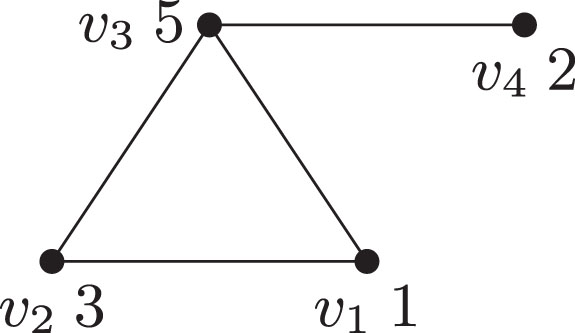
In Fig. 1, as we move along the path v1 - v2 - v3 - v4, say P, we see that the adjacent vertices on the path have been assigned labels that differ by at least 2 and those at distance 2 on the path are assigned labels that differ by at least 1. So this serves an L (2, 1)- path between v1 and v4. Moreover, for every pair of vertices v i , v j in the graph, the sub path of P from v i to v j serves as the L (2, 1)-path between them. The highest label used here is 5, which is the span of the labeling. We now check if it is possible to further reduce the span.
L (2, 1)-path coloring of G.
Consider another labeling of the same graph as shown in Fig. 2.

L (2, 1)-path coloring of G with minimum span.
If we consider the same path P as earlier it fails to be an L (2, 1)-path. This is because v2 and v3 are adjacent but their labels do not differ by a minimum of 2. Instead if we take the path v2 - v1 - v3 - v4 say P′, then the required conditions are met. Moreover, the span is reduced to 4. As earlier, in this case also one single path, i.e., P′ serves the purpose for all pair of vertices. The natural question that arises to an inquisitive mind is that whether the further reduction of span is possible, may be by considering having different L (2, 1)- paths between different pairs of vertices. Unfortunately, the answer to the question is not in the affirmative and the following argument settles the claim.
It is impossible to reduce the span further for this graph, no matter what way we label the vertices. Since the graph has 4 vertices if the span should be reduced to a number less than 4, the label of at least two vertices should be the same. But as per the L (2, 1)-labeling, labels of two vertices may repeat if the L (2, 1)-path between them is a P
n
, where n ≥ 4. But the graph in discussion has only two such paths namely P and P′, both are P4- paths, having two internal vertices. If the end vertices of these paths receive label a, then the internal ones cannot be labeled with a, a + 1 and a - 1, again because of the L (2, 1)-labeling condition. Suppose our range set is {1, 2, 3}. If a = 1, then both the internal vertices should receive 3. If a = 2, then there exists no suitable label for both internal vertices. If a = 3 both internal vertices should receive 1.
In any case we do not obtain a legitimate L (2, 1)- path coloring of G. So the least possible value of span is 4 and hence this is the L (2, 1)-connection number of the graph.
In practical situations interference can occur at levels more than two also. Hence, as an extension of L (2, 1)-labeling, Jean Clipperton et al. [8], introduced the L (3, 2, 1)-labeling by fixing m = 3 in the
Amalgamating the ideas of path coloring introduced by Ruxandra in [7] and the L (3, 2, 1)-labeling in [8] we conceived the idea of L (3, 2, 1)- path coloring of graphs. Here, we seek at least one path between every pair of vertices which is an L (3, 2, 1)-colored path. The formal definition with examples and remarks follow in the next section, i.e.; Section 2, where we also obtain some preliminary results. Our main results on Hamiltonian and non-Hamiltonian graphs, existence theorems and algorithm to path color a graph using the L (3, 2, 1)- condition are presented in Section 3. In Section 4, we apply this concept of path coloring to social networks with an illustration. Finally we conclude the article with some open problems in Section 5.

L (3, 2, 1)-path coloring of G.
In Fig. 3 we show an L (3, 2, 1)-path coloring of a graph G. The path v1 - v2 - v3 - v4, i.e., P serves as an L (3, 2, 1)-path, between v1 and v4. On this path, vertices at distance 1, 2, and 3 differ by at least 3, 2, and 1, respectively. Moreover, for every pair of vertices v i , v j in the graph, the sub path of P from v i to v j serves as the L (3, 2, 1)-path between them. The span of this labeling is 6. In fact, this is the least possible span and hence k3c (G) =6 as explained below:
In an L (3, 2, 1)-path coloring, we are concerned about vertex labels only up to distance 3 from a given vertex. So vertices at distance more than three can have same labels. This means that any L (3, 2, 1)-path between a pair of vertices with same labels is a P n , where n ≥ 5. The given graph has no such path and hence no labels can repeat or g is an injective function. As there are 4 vertices in the graph, k3c (G) ≥4.
Suppose k3c (G) =4, the range set is {1, 2, 3, 4}. In this set, the only pair of labels that differ by at least 3 are 1 and 4. So in any L (3, 2, 1)-path between v1 and v4, the end vertices of only one edge can be assigned with 1 and 4. As v1 and v4, are not adjacent, any L (3, 2, 1)-path between them will have more than one edge. Hence this possibility is ruled out and k3c (G) >4.
Suppose k3c (G) =5. The range set is {1, 2, 3, 4, 5}. As there are only 4 vertices in the graph and g is injective we need exactly 4 labels. So we discard one label from this set. Discarding 5 results in case, just discussed. Discarding a label other than 5, gives 4 different possible range sets namely, {2, 3, 4, 5}, {1, 3, 4, 5}, {1, 2, 4, 5}, {1, 2, 3, 5}. Further, consecutive labels can be assigned to vertices at a distance 3 or more only. Choosing P, i.e., v1 - v2 - v3 - v4 as the L (3, 2, 1)- path between v1 and v4, one pair of consecutive integers may be assigned to v1 and v4. If we decide to make v1 - v3 - v4 as L (3, 2, 1)-path between v1 and v4, even a single pair of consecutive integers cannot be accommodated as labels. The same happens if P′, i. e., v2 - v1 - v3 - v4 is chosen as the L (3, 2, 1)- path between v2 and v4. But each of the range sets listed above has more than one pair of consecutive integers and any assignment would not yield an L (3, 2, 1)-path coloring of G. Hence k3c (G) ≥6. In fact the labeling shown in Fig. 3 proves 6 is sufficient. Therefore, k3c (G) =6. Even for a simple graph, as the one considered above, we can observe that it is a highly non-trivial task to find the L (3, 2, 1)-connection number. As the number of vertices, edges, and paths between vertices increases it becomes all the more tedious to compute this number.
We recall the following two results for ready reference from Jean Clipperton et al., [8] on k (P n ) and k (K1,n). P n , is the path on n vertices and K1,n is the star graph in which one central vertex is adjacent to n pendant vertices. By Remark 2.3 these are also the results for k3c (P n ) and k3c (K1,n) respectively. Throughout the rest of this article we use these results for k3c (P n ) and k3c (K1,n) respectively.
The authors here have obtained the above result by repeating the pattern 3, 6, 1, 4, 7, 2, 5, 8 along the vertices of the path when n ≥ 8.
Here the authors have obtained the result by assigning label 1 to central vertex of the star and 4, 6, 8, …2n + 2 to the pendant vertices.
We now present some preliminary results on k3c (G) for any graph G, in this section and our main results in the next section.
k3c (G) ≥ k3c (P
r
) ≥ k3c (Pdiam(G)+1) ≥4, where r ≥ diam (G) +1. Proof. The last inequality is obvious as any connected graph with at least 2 vertices has diameter at least 1. By Theorem 2.4 and Remark 2.3 the result holds. Let g be an optimal L (3, 2, 1)-path coloring of G. Let y and z be two vertices which are at a distance equal to diam (G). Then any L (3, 2, 1)-path P
r
between y and z has a minimum of diam (G) +1 vertices and contains a sub path isomorphic to Pdiam(G)+1. Hence by Theorem 2.4 and Remark 2.3 we have the second inequality. As P
r
is a sub graph of G, the span of any L (3, 2, 1)- path coloring of the graph G is at least as much as k3c (P
r
). k3c (G) is the minimum value of span, the first inequality holds.□ k3c (G) ≤ k3c (H) +3 (n - p), where H is any induced subgraph of G with p ≤ n vertices. Proof. The equality holds if n = p because H = G. The inequality follows by the definition of L (3, 2, 1) -path coloring. An optimal labeling of H can be extended to G as follows: An increase of 3 starting from the value of k3c (H) is progressively assigned to the vertices of G that are not in H, in any order, then we get an L (3, 2, 1) -path coloring of G with span k3c (H) +3 (n - p). k3c (G) being the least value of span the result holds.□ If the graph G has n bridges incident on the same vertex then k3c (G) ≥2n + 2 Proof. If uu1 and uu2 are adjacent bridges then the only path between u1 and u2 is u1 - u - u2. Hence n bridges incident in the same vertex induce a subgraph H in G, isomorphic to K1,n such that any L (3, 2, 1)-path coloring of G induces a L (3, 2, 1)-path coloring of H. Thus we have k3c (G) ≥ k3c (K1,n) = k (K1,n) =2n + 2. By Remark 2.3 and Theorem 2.5 the result holds.□ k3c (G) ≤ k3c (H) where H is a spanning connected subgraph of the graph G. Proof. H is a spanning connected subgraph of G containing all the vertices of G. So, any L (3, 2, 1)-path coloring of H is also L (3, 2, 1)-path coloring of G. The edges in G that are not in H, create new paths in G and this may result in a smaller span and hence k3c (G) ≤ k3c (H).□ k3c (G) = k3c (H) = k (H), if H is a Hamiltonian path in G. Proof. H is a spanning connected subgraph of G. Hence by the point(4) of the same proposition we have, k3c (G) ≤ k3c (H). Let d
P
(u, v) and d
H
(u, v) denote the distance between the vertices u and v along any path P and along the Hamiltonian path H respectively. Then d
P
(u, v) ≤ d
H
(u, v). Let g be an optimal L (3, 2, 1)- path coloring of G considering P as the L (3, 2, 1)- path between u and v with span k3c
P
(G). Then |g (u) - g (v) |≥4 - d
P
(u, v) ≥4 - d
H
(u, v). So g is also an L (3, 2, 1)- path coloring of G, taking H as the L (3, 2, 1)- path between u and v. So k3c (P
n
) = k3c
H
(G) ≤ k3c
P
(G) where k3c
H
(G) is the least span obtained considering H as the L (3, 2, 1)- path between u and v. Hence the result holds. □
If G contains a Hamiltonian path, the value of k3c (G) does not exceed 8, whatever be the number of vertices in the graph. Repeating the pattern 3, 6, 1, 4, 7, 2, 5, 8 along the Hamiltonian path, we get an L (3, 2, 1)-path coloring of G with minimum span. The natural question that arises is about the k3c (G) of more general graphs, i.e., the ones that do not contain a Hamiltonian path. Are there any such graphs which have the k3c (G) value as less as 8 ? Our next Theorem 3.1 on complete bipartite graphs explores the same and answers this question in the affirmative. Surprisingly, though not all complete bipartite graphs posses a Hamiltonian path, this class of graphs, have their k3c (G) stabilizing at 8. The results on complete bipartite graphs and bistars are presented in the next section. The results on the star graph, which is a special case of complete bipartite graph and that of the bistar lead us to state and prove the existence theorem, which is presented later in the next section. That is given any positive integer a, we prove that there always exists a graph G, such that k3c (G) = a. Lastly, we present an algorithm to L (3, 2, 1)-path color a graph whose k3c (G) = a. The algorithm takes the value of a as input and produces the L (3, 2, 1)-path coloring of the graph whose k3c (G) = a.
The complete bipartite graph Km,n is a special kind of graph whose vertex set is partitioned into two sets V1 and V2 with m and n vertices respectively. Every vertex of V1 is adjacent to every vertex of V2 and no two vertices of the same set are adjacent. If m = 1 then it is the star graph.
Proof.
Let V (Km,n) = {y1, y2, … , y m } ⋃ {z1, z2, … , z n } where 2 ≤ m ≤ n with m + n ≥ 6.
Define the labeling g as follows:
The example of K3,5 is shown in Fig. 4. As k3c (K3,5) =8 = |V (K3,5) | it is L (3, 2, 1)-path graceful. It can be easily seen that between each pair of vertices of Km,n there is an L (3, 2, 1)-path coloring as follows: For every j, 2 ≤ j ≤ m, the path from y1 to y
j
is [y1, z1, y
j
]. For every j, 2 ≤ jtextlessk ≤ m, the path from y
j
to y
k
is [y
j
, z2, y1, z1, y
k
]. For every j, 2 ≤ j ≤ n, the path from z1 to z
j
is [z1, y1, z
j
]. For every j, 2 ≤ jtextlessk ≤ n, the paths from z
j
to z
k
is [z
j
, y1, z1, y2, z
k
]. For every j, k, 1 ≤ j ≤ m, 1 ≤ k ≤ n, the path from y
j
to z
k
is [y
j
, z
k
].□
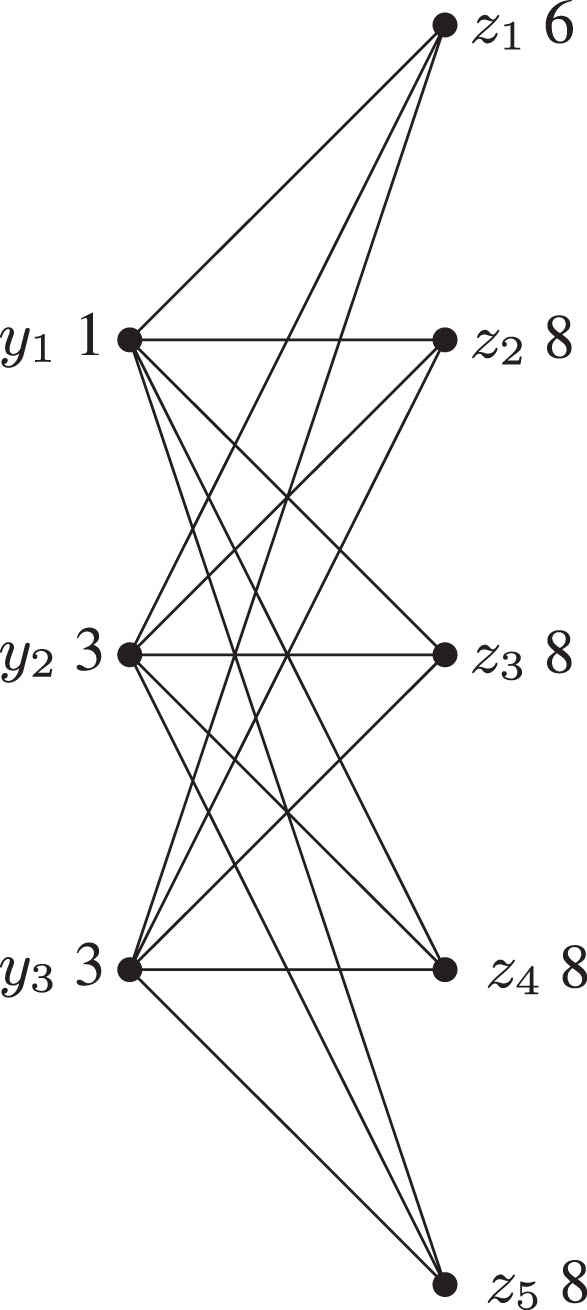
L (3, 2, 1)-path coloring of K3,5.
As a consequence of the Theorem 3.1, we have the following Corollary 3.2:
The bistar Bn,n, is the graph obtained my making the central vertices of two copies of the star graph K1,n adjacent.
Proof. Let the vertex set be V (G) = {u, u1, u2, . . . u n , un+1, v1, v2, . . . v n } where u and u1 are the center vertices of two stars K1,n. The bistar has n + 1 bridges incident on a single vertex u. Hence, k3c (Bn,n) ≥2n + 4. By Proposition 2.6 point 3. Suppose k3c (Bn,n) =2n + 4. From [8], we see that an optimal L (3, 2, 1)- labeling of K1,n+1 assigns 1 to the central vertex and 4, 6, 8 … (2n + 4) to the pendant vertices. The remaining n vertices of the bistar need to be labelled. But the bistar does not contain a P n where n ≥ 5 and hence none of the labels used earlier for K1,n+1 can be reused. Moreover, the labels 2, 3, and 5 cannot be used by the definition L (3, 2, 1)- path coloring. This leaves us with n - 1 labels 7, 9 . …2n + 3 for the remaining n vertices of the bistar, which is insufficient. Therefore, k3c (Bn,n) ≥2n + 5.
We now exhibit an L (3, 2, 1) -path coloring of the bistar with span 2n + 5, which proves the required result. Define the labeling g as follows:
It can be easily seen that between each pair of vertices of Bn,n there is an L (3, 2, 1)-path coloring as follows: For every i, 1 ≤ i ≤ n + 1, the path from u
i
to u is [u
i
, u]. For every i, j, 2 ≤ i ≤ j ≤ n, the path from u
i
to v
j
is [u
i
, u, u1, v
j
]. The path from u
i
to u
j
is [u
i
, u, u
j
] for all i, j, 1 ≤ itextlessj ≤ n + 1. For every i, 1 ≤ i ≤ n, the path from v
i
to u1 is [v
i
, u1]. The path from v
i
to u is [v
i
, u1, u] for all i, 1 ≤ i ≤ n. The path from v
i
to v
j
is [v
i
, u1, v
j
] for all i, j, 1 ≤ itextlessj ≤ n.□
The particular case of B4,4 is shown in the Fig. 5.
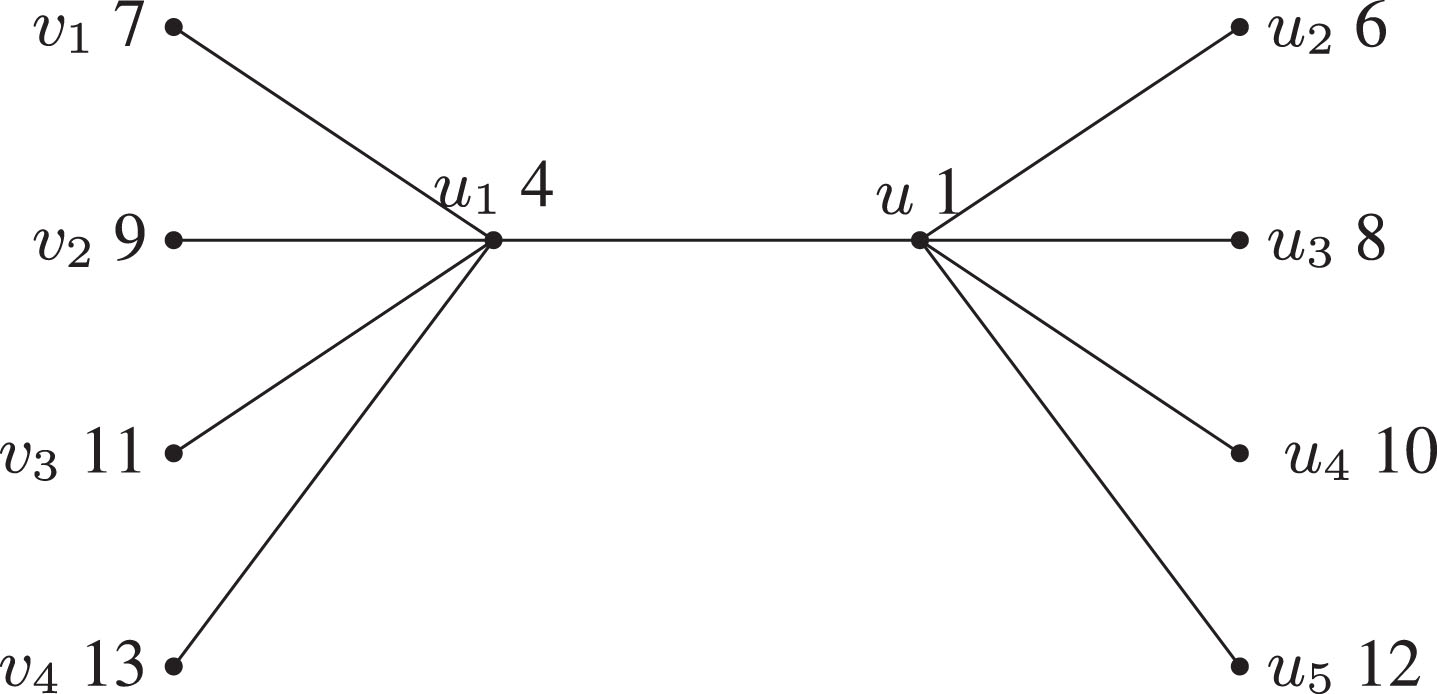
L (3, 2, 1)-path coloring of B4,4.
As a consequence of the above Theorem 3.3, we have the following Corollary 3.4:
It is clear that, given any positive integer except 2, 3 and 5, we always have a graph for which the given number is the k3c (G). For 1 and 7, we have paths P1 and P7 such that k3c (P1) =1 = |V (P1) | and k3c (P7) =7 = |V (P7) |. So P1 and P7 are L (3, 2, 1)-path graceful. For any integer a ≥ 4 and a ≠ 5, 7 we have stars and bistars whose k3c (G) is the given integer. This proves that there is no gap in the k3c (G) number line except at 2, 3, and 5 but these graphs are not L (3, 2, 1)-path graceful. Our next two Theorems 3.5 and 3.6 shows that star and bistars are not the only graphs that can be constructed for a given value of k3c (G) but more complex ones exist and they have the star and bistar as induced subgraphs. Moreover, these graphs have the special property of being L (3, 2, 1)-path graceful. In the next two Theorems 3.5 and 3.6, we prove that for every positive integer a ≥ 8, there always exists a graph of order a which is L (3, 2, 1)-path graceful.
Proof. Let
We exhibit a labeling g below with span a and prove that it is L (3, 2, 1)-path coloring.
It can be easily seen that between each pair of vertices of G there is an L (3, 2, 1)-path coloring as follows: For every i, The path from u to v1 is [u, u1, v3, v1]. The path from u to v2 is [u, u1, v3, v1, v4, v2]. The path from u to v3 is [u, u1, v3]. The path from u to v4 is [u, u1, v3, v1, v4]. For every i, For every i, j, The path from u1 to v1 is [u1, v3, v1]. The path from u1 to v2 is [u1, v3, v1, v4, v2]. The path from u1 to v3 is [u1, v3]. The path from u1 to v4 is [u1, v3, v1, v4]. For every i, For every i, For every i, For every i, For every i, For every i, j, For every i, j,
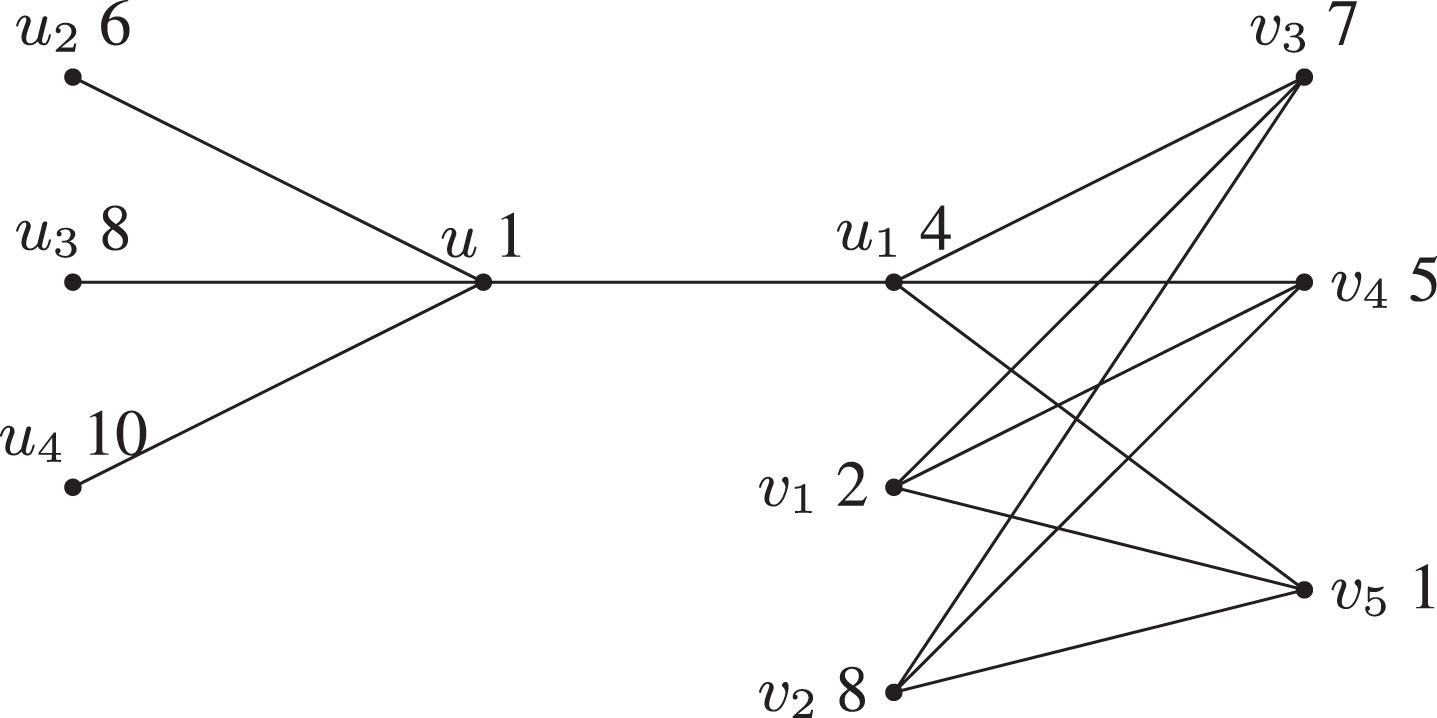
L (3, 2, 1)-path coloring of G with a = 10.
Proof. Consider the bistar with two centers u and v. Let u
i
and v
i
where
We now exhibit a labeling on V (G) with span a, which proves the required result.
Let
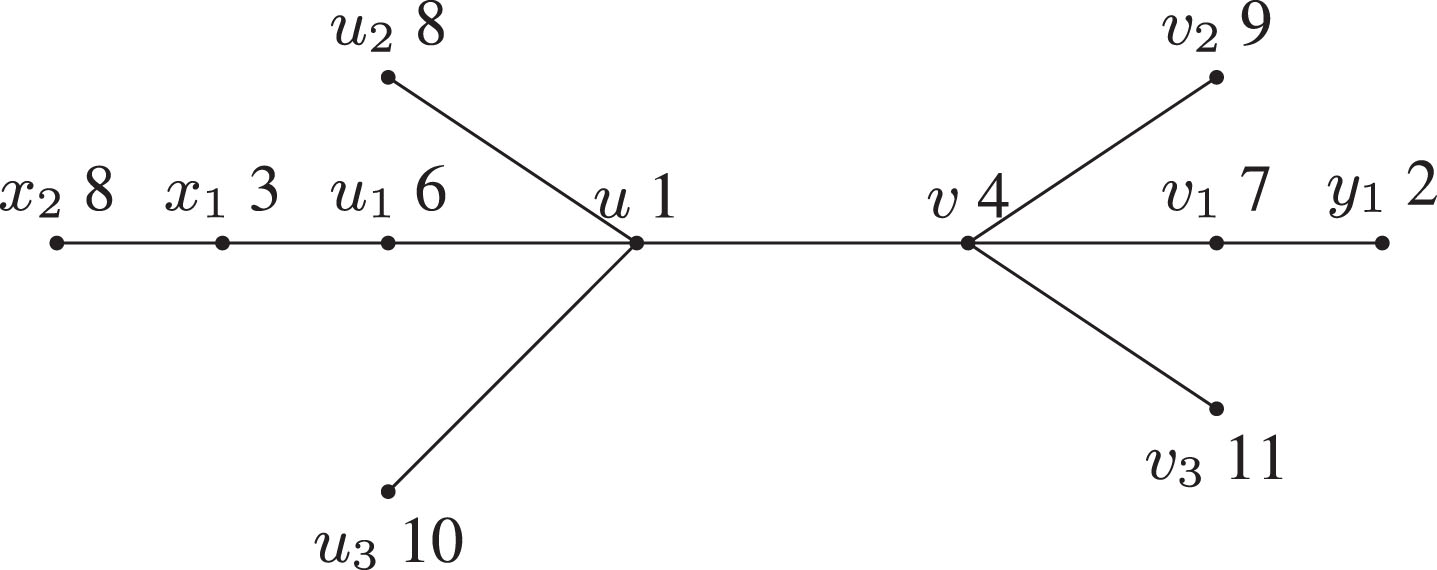
L (3, 2, 1)-path coloring of G with a = 11.
It can be easily seen that between each pair of vertices of G there is an L (3, 2, 1)-path coloring as follows:
The path of length 6, i. e., x2 - x1 - u1 - u - v - v1 - y1 forms an L (3, 2, 1)-path. It’s enough to show that there is an L (3, 2, 1)-path from u
i
and v
i
to all the other vertices of G. For every i, For every i, The path from u
i
to v1 is [u
i
, u, v, v1] for all i, For every i, j, The path from u
i
to y1 is [u
i
, u, v, v1, y1] for all i, The path from v
i
to y1 is [v
i
, v, v1, y1] for all i, For every i, The path from v
i
to u1 is [v
i
, v, u, u1] for all i,
We now present an algorithm to obtain an L (3, 2, 1)-path coloring of a graph G whose k3c (G) = a. The graphs can be first constructed as explained in Theorems 3.5 or 3.6 as the case may be and then the labeling can be done using this algorithm.
If a is even the complexity of the algorithm is obtained as follows:
Statements 3 to 7 being assignment statements are of order 1 each. The statement 9 that involves three operations namely one addition, one multiplication and one assignment statement is executed
If a is odd then the complexity of the algorithm is as follows:
Statements 15 to 19 being assignment statements are of order 1. Statements 21 and 22 involve 3 operations each as explained in the previous case and are executed
In both cases the algorithm is a polynomial in the input a. Since the graph can be constructed for any given integer a and labeled in polynomial time we next present an application of this in social networks for secure communication.
Security issues need to be given prime importance on social networking sites and users are often unaware about how their privacy is compromised [10, 11]. Enhanced security is required when image posts are shared compared to text [12]. Different kind of labeling techniques like the radio mean labeling have been used in securing messages [13]. Encrypted text is sent to receiver as a sequence of edges or vertices of cipher graph. Using the cipher graph, receiver can decrypt the received sequence of numbers to original text message. In [14], the same authors have applied L (3, 2, 1)-path coloring to star graphs K1,n for encryption and decryption. Here we apply the above theory of L (3, 2, 1)-path coloring for secure communication. Suppose there is a group of people who need to communicate with each other securely. Anyone in the group can send a message to any other but the message has to pass through a specific set of people before it reaches the receiver(may be to follow a hierarchy). For example in the Fig. 4 suppose y1 represents the principal of an institution and the remaining y i ’s are faculty working under him. z1 is the director of the institution and z i ’s are heads of various sections like controller of exams, head of student affairs, hostel warden and so on. If the principal wants to send a communication to the faculty he needs to take prior approval from the director and then do so. So the L (3, 2, 1)-path y1 - z1 - y j can be used. Similarly the path y j - z2 - y1 - z1 - y k could be used if y j wants to communicate with y k , a matter related to the portfolio of z2. But this communication has to pass through the concerned head, the principal, and he in turn takes consent of the director and finally the message reaches y k and so on. Unique paths involving a different set of people exists and the most suitable one could be chosen. This would avoid unwanted messages to people who are not concerned with the issue thus saving their time and respecting their privacy. Edge labels could be found as difference in the labels of end vertices and that could be treated as time or cost involved in the communication. Since we are seeking a path coloring with minimum span it could mean a faster or cheaper communication.
Exploiting the idea of existence of a graph for any given integer a ≥ 8, whose k3c (G) = a we propose a method for safe communication. This can be done along a L (3, 2, 1)-path between the sender and the receiver, the vertices along the path represent those set of people through whom the message has to pass through. If there is more than one such path then the sender and the receiver can decide on which path to communicate before the communication begins. The original message is sent by the sender in an encrypted form, using an encryption rule and the next person who receives this message has to decrypt this. He passes on the message to another person applying a different encryption rule and the process continues till it finally reaches the intended recipient. So each time the message goes through a new person, it gets more and more secure.
The following information is made known to the members of the group before the communication begins: An integer a, is made known to all members of the group before communication starts. Based on whether a is even or odd, all the members construct the graph as explained in Theorems 3.5 and 3.6 and label the vertices using the Algorithm 1 in polynomial time. The edge e
ij
incident between two adjacent vertices v
i
and v
j
along an L (3, 2, 1)-path is labeled as g (v
i
) - g (v
j
). Keyword to be used.
THE PROCESS
At first the blank spaces if any in the plain text are removed. Then the plain text is divided into digrams or pairs of letters. If the message consists of an odd number of letters, a rare letter like x is appended at the end of the text. If a letter is repeated in both positions of the digram, break the pair and pair one letter with x and other with the next letter in the plain text. The 6*6 Playfair matrix is constructed with the keyword written in the first row, which is then filled by the remaining characters of English alphabet a - z and numbers 0-9 in order. Then apply the following rules on the digrams obtained in step 1. If both letters of the digram are in the same column then each letter of the digram is replaced by a letter immediately below it. If a letter in the digraph is in the last row, then it is replaced with the letter on first row of the same column. If both letters of the digram are in the same row then each letter of the digram is replaced by a letter immediately to its right. If a letter in the digraph is in the last column, then it is replaced with the letter on first column of the same row. If both letters of the digram belong to different row and column of the Playfair matrix, then consider the submatrix having these two letters on one pair of its diagonally opposite corners. The first letter in the digram is then replaced by the letter which lies in the row of the first letter and column of the second. The second letter in the digram is replaced by the letter which lies in the column of the first letter and row of the second. Let C be the text obtained after the Playfair encryption. Next the 26 english alphabets and the 10 numerals are represented as the vertices of the cycle C36 in the clockwise direction and then a circular permutation of C is obtained as follows: Suppose the text message is to be sent from v
i
to v
j
, along a L (3, 2, 1)-path between them. If v
l
is adjacent to v
i
on the path, then v
i
moves C on C36 in the clockwise direction by a number of steps equal to the label of e
il
if it is positive and in the anticlockwise direction if negative and obtains the corresponding alphanumeric sequence N and sends it to v
l
. If v
l
wants to decrypt the message N, on the same C36 he moves N in the anti clockwise direction by a number of steps equal to the label of e
il
if it is positive and in the clockwise direction if negative and the corresponding playfair text C is obtained. Applying the reverse play fair rules he gets the plain text P sent by the sender v
i
. Next v
l
has to send the message to say v
k
on the L (3, 2, 1) path. He considers the alpha numeric sequence N sent by v
i
. Moves it on C36 in the clock wise direction by a number of steps equal to e
lk
if it is positive and in the anticlockwise direction if negative and obtains a new alpha numeric sequence M. If v
k
wants to decrypt this he finds the sum of edge weights e
il
and e
lk
. If this sum is positive he moves M in the anticlockwise direction on C36 by a number of steps equal to the sum and if negative in the clockwise direction. This leads him to the cipher text C. Applying reverse playfair rules he gets to the original plain text P. This process continues till the message reaches the final recipient v
j
.
ILLUSTRATION:
The following information is made known to all members of the group a = 11 Keyword =“strict”.
The corresponding playfair matrix would be:
The members construct the graph as shown in Fig. 7 and label the vertices and edges using the Algorithm 1. Suppose the plain text is “examination” to be sent from x2 to u. The plain text P is divided into pairs of letters: ex, am, in, at, io, nx. Since the length is odd, x is appended at the end. Applying Playfair rules mentioned in step 2 of encryption process we get the cipher text, C as: huiocmsramow. The edge from x2 to x1 has weight 5. Each alphabet in C is moved on C36 by 5 steps in the clockwise direction. Thus x2 obtains the alpha numeric sequence N as mznthrxwfrt1. Now x1 may decrypt this by moving on C36 5 steps in the anticlockwise direction. He gets the cipher text C, to which he applies the reverse play fair rules and obtains the plain text P. x1 is adjacent to u1 and the weight of the edge between them is -3. If he wishes to pass the message to u1, he moves N on C36 in anticlockwise direction by 3 steps and he obtains the new alphanumeric sequence M as jwkqeoutcoqy. If u1 has to decrypt this he sums up the weights of the first two edges on the L (3, 2, 1)- path. This sum is 5 - 3 =2, which is positive. So on C36 he moves the message M by 2 steps in the anticlockwise direction to get the cipher text C. On using the reverse play fair rules the original plain text can be obtained. Next the message moves from u1 to u. The weight of the edge connecting them is 5. So u1 moves the message M by 5 units in the clockwise direction to get the new message say K as o1pvjtzyhtv3. Next u sums up the edge weight of the three edges on the L (3, 2, 1)-path and gets 5 - 3 +5 = 7. He now moves K on C36 in anticlockwise direction by 7 steps to get the cipher text C. Applying reverse playfair rules to C the plain text P is obtained. As the value of a, the method of constructing the graph and labeling using the L (3, 2, 1) path coloring with minimum span is known only to the members in the group, the communication remains secure. Moreover when there are multiple L (3, 2, 1) paths it becomes difficult for any intruder to hack information. If the number of people in the group, i.e., a is fixed then the graph and its labeling remains fixed. To bring a variation in this one of the members in the group can be made ’Dummy’. This is made known to the members just before the communication starts. Suppose in the above example x1 is made dummy, then an edge of weight 8 - 6 =2 can be assumed from x2 to u1. Accordingly all the edge weights change hence the number of moves on C36 changes. Since the ’Dummy’ tag is attached to a vertex just before communication starts, the graph changes dynamically and so do the L (3, 2, 1)- paths which make hacking difficult for an intruder.
Conclusion and scope for future work
The idea of path coloring discussed in the paper may be extended to higher levels by taking m = 3, 4, …. The authors are working towards generalizing this idea upto m = diam (G) levels. A more generalised version of the above path coloring would be to seek k internally disjoint L (3, 2, 1) paths between all pairs of vertices and obtain the k - L (3, 2, 1) connection number of G. These k paths can add more complexity for an intruder and application of these ideas for secure communication in social networking may be explored.