







Abstract
Group decision-making is that individuals collectively make a choice from a set of alternatives. Then, in complex decision-making problems, the decision-making process is no longer subject to a single individual, but group decision-making. Hence, the decision reliability and credibility of the collective evaluation information become more critical. However, current decision-making methods lack the confidence level and credibility measure of group evaluation information. To ensure the confidence level and credibility measure of small-scale group decision-making problems, the aim of this paper is to propose a Multi-Attribute Group Decision-Making (MAGDM) approach using a hyperbolic sine similarity measure between Confidence Neutrosophic Number Credibility Sets (CNNCSs) in the circumstance of Fuzzy Credibility Multi-Valued Sets (FCMVSs). To achieve this aim, this paper contains the following works. First, we present FCMVS to represent the mixed information of fuzzy sequences and credibility degree sequences with different and/or identical fuzzy values. Second, according to the normal distribution and confidence level of fuzzy values and credibility degrees in FCMVS, FCMVS is transformed into CNNCS to avoid the operational issue between different fuzzy sequence lengths in FCMVSs and to ensure the confidence neutrosophic numbers/confidence intervals of fuzzy values and credibility degrees. Third, a hyperbolic sine similarity measure of CNNCSs is established in the circumstance of FCMVSs. Fourth, a MAGDM approach is developed based on the weighted hyperbolic sine similarity measure in the circumstance of FCMVSs. Fifth, the proposed MAGDM approach is applied to an actual example of the equipment supplier choice problem to illustrate the efficiency and rationality of the proposed MAGDM approach in a FCMVS circumstance. In general, this study reveals new contributions in the representation, transformation method, and similarity measure of small-scale group assessment information, as well as the proposed MAGDM method subject to the normal distribution and confidence levels in small-scale MAGDM scenarios.
Keywords
Introduction
In uncertain and incomplete environments, fuzzy theory [1] and Decision-Making (DM) methods are important research topics and show their obvious merits in the expression and processing of fuzzy information. Therefore, the fuzzy DM techniques have been wildly applied in science and engineering fields. For example, various fuzzy DM methods have been applied to programming problems [2], water supply management [3], financial risk assessment [4], drug selection for coronavirus disease 2019 (COVID-19) [5], frozen shrimp supplier evaluation and selection [6], cyber risk assessment in an IoT-based supply chain [7], task allocation of multi-agent collaborative design of ships [8], and so on.
However, the fuzzy DM methods mentioned above lack the credibility measure of fuzzy evaluation information due to the vagueness and uncertainty of decision-makers’ cognition and judgments in uncertain and vague circumstances. Hence, the fuzzy assessment values must be related to their credibility measures to enhance the credibility degrees of the fuzzy assessment values and the completeness of the evaluation information in the DM process. Therefore, Ye et al. [9, 10] proposed fuzzy credibility sets/elements and fuzzy credibility cubic sets/elements and developed their weighted average and geometric aggregation operators and DM approaches for the optimal choice of slope design schemes. Then, Du and Ye [11] presented Interval-Valued Fuzzy Credibility Sets (IvFCSs) and their cosine and tangent similarity measures and developed the group DM method of the cosine and tangent similarity measures for slope stability assessment in an IvFCS circumstance.
In fuzzy group DM problems, some researchers proposed various hesitant fuzzy DM approaches [12–18]. Then, hesitant fuzzy sets do not contain the same fuzzy values in hesitant fuzzy sequences due to the hesitant characteristics and expression form. Therefore, they cannot represent fuzzy multi-valued information including the same and/or different fuzzy values in the fuzzy DM issue, which may result in the loss of partial information. To overcome this defect, Du and Ye [19] introduced indeterminacy Fuzzy Multi-Valued Sets (FMVSs) with the same and/or different indeterminacy fuzzy values and a group DM approach using the parameterized correlation coefficients of indeterminacy FMVSs, and then Turkarslan et al. [20] introduced a group DM approach using the cosine similarity measure of consistency fuzzy sets in a FMVS setting. However, the fuzzy multi-valued DM approaches [19, 20] cannot also reflect the credibility measure of collective fuzzy evaluation values so as to difficultly ensure the credibility and reliability of evaluation information and decision results. Based on a probabilistic perspective, some researchers presented the DM approaches of probabilistic-based expressions [21–29], including probabilistic linguistic information and probabilistic hesitant fuzzy information. Then, the representations and operations of group assessment information are very critical issues because they can impact on the reliability and rationality of decision results. Although the probabilistic DM approaches can reflect their effectivity and rationality in large-scale group DM problems, the probabilistic DM approaches may result in the distortion/irrationality of decision results in small-scale group DM process due to using distorted/unreasonable probabilistic values. Therefore, the probabilistic DM approaches [21–29] need large-scale collective assessment data to ensure the efficiency and rationality of the decision results in group DM process, which are difficult to apply and realized in the actual DM problems.
In light of the probabilistic characteristics, we need to use some confidence level of (1−α)×100% for a level α and known probabilistic distribution for small-scale sample data to estimate that the (1−α)×100% probability of the sample data will fall within the confidence interval [30]. Since a neutrosophic number [31–33] can easily represent the merits of changeable interval values subject to uncertain ranges, Lv et al. [34] proposed the notions of the neutrosophic number probability and Confidence Neutrosophic Numbers (CNNs) (confidence internals) and developed CNN linear programming methods to solve production planning problems subject to probability distributions and confidence levels of (1−α)×100%.
The aforementioned group DM is that multiple individuals collectively give a choice from a set of alternatives to overcome the decision choice problem of a single individual in a complex decision-making problem. Hence, the reliability and credibility measures of group DM information imply their importance. Although the existing FMVSs [19, 20] are very suitable for the full expression of collective fuzzy evaluation values in Multi-Attribute Group Decision-Making (MAGDM) problems, the fuzzy multi-valued group DM approaches also lack their reliability and credibility measures. Generally, existing fuzzy, hesitant fuzzy, fuzzy multivalued, and probabilistic MAGDM methods do not consider the confidence level, probability contribution, and credibility measure of group evaluation information simultaneously, so that it is difficult to ensure the reliability and credibility of their decision results. To guarantee the confidence level and credibility of MAGDM problems, it is necessary to develop a new representation of small-scale group assessment information, a confidence level-based transformation technique, and a similarity measure to ensure the reliability and credibility of group DM results in a MAGDM circumstance. Motivated by these new requirements, this study aims: (a) to present a Fuzzy Credibility Multi-Valued Set/Element (FCMVS/FCMVE) for the mixed expression of a fuzzy sequence and a credibility degree sequence, (b) to propose a CNN Credibility Set (CNNCS) in view of the method that transforms FCMVS into CNNCS subject to the normal distribution and the confidence levels of 90%, 95% and 99% used usually in actual applications, (c) to establish a Hyperbolic Sine Similarity Measure (HSSM) between two CNNCSs, (d) to propose a MAGDM approach using the weighted HSSM in a FCMVS circumstance, and (e) to apply the proposed MAGDM approach to an actual example of the equipment supplier choice problem to illustrate the efficiency and rationality of the proposed MAGDM approach in a FCMVS circumstance.
In general, this original study reveals the main contributions in the representation, transformation technique, HSSM of group DM information and the MAGDM approach using HSSM subject to the normal distribution and confidence levels of small-scale collective assessment data.
The remainder of this article consists of the following sections. Section 2 proposes the definitions of FCMVS and CNNCS. Section 3 presents HSSM between two CNNCSs based on the hyperbolic sine function and its properties. In Section 4, a MAGDM approach is developed in terms of the proposed weighted HSSM of CNNCSs in a FCMVS circumstance. Section 5 provides an actual example on the choice problem of equipment suppliers and the comparison of the related DM approaches to illustrate the efficiency and rationality of the proposed MAGDM approach in a FCMVS circumstance. Finally, the conclusions and future research directions are remarked in Section 6.
FCMVS and CNNCS
This section proposes the definitions of FCMVS and CNNCS.
For the simplified expression, the j-th element 〈u j , T R (u j ) , C R (u j )〉 in R is denoted as the FCMVE r j =〈 T Rj , C Rj 〉 = 〈 (tj1, tj2, . . . , t js j ) , (cj1, cj2, . . . , c js j ) 〉 with two increasing fuzzy sequences. Especially when s j = 1, the FCMVE r j is reduced to the fuzzy credibility element.
In terms of probability and statistics, a confidence level of (1−α)×100% reflects that the (1−α)×100% probability of a random variable will fall within the confidence interval in a limited sample data situation with certain distribution. According to the confidence interval subject to a confidence level of (1−α)×100%, we propose a transformation technique from FCMVS to CNNCS and give its definition below.
where the fuzzy CNN and the credibility CNN are produced by the following equations:
In CNNs,
Consequently, the fuzzy CNN of Equation (3) and the credibility CNN of Equation (4) depend on a confidence level of (1−α)×100%, which reflects that the (1−α)×100% probability of the fuzzy values will fall within the fuzzy CNN and the (1−α)×100% probability of the credibility degrees will fall within the credibility CNN. For instance, regarding the confidence level of 95%, the 95% probability of the fuzzy values will fall within the fuzzy CNN and the 5% probability of the fuzzy values will be outside the fuzzy CNN, while the 95% probability of the credibility degrees will fall within the credibility CNN and the 5% probability of the credibility degrees will be outside the credibility CNN.
First, using Equations (5)–(8), the average values and standard deviations of the fuzzy sequences and the credibility degree sequences in R1 are given below:
tm11 = 0.76, tm12 = 0.675, tm13 = 0.7, cm11 = 0.82, cm12 = 0.725, and cm13 = 0.65.
dt11 = 0.114, dt12 = 0.0957, dt13 = 0.0816, dc11 = 0.0837, dc12 = 0.05, and dc13 = 0.0577.
Then, using Equations (2)–(4), the fuzzy and credibility CNNs with v α/2= 1.645, 1.960, 2.576 for α =0.1, 0.05, 0.01 are given by the following calculations:
Finally, the CNNCS S α1 for α = 0.1 is obtained below:
S α1 = {< u1, [0.6761, 0.8439], [0.7584, 0.8816]>, < u2, [0.5963, 0.7537], [0.6839, 0.7661]>, < u3, [0.6328, 0.7672], [0.6025, 0.6975]> |I α =[−1.645, 1.645]}.
By a similar calculational process, in view of the confidence levels of 95% and 99% with v α/2 = 1.96, 2.576 for α = 0.05, 0.01, CNNCSs are also obtained below:
S α1={ < u1, [0.6601, 0.8599], [0.7467, 0.8933]>,< u2, [0.5812, 0.7688], [0.676, 0.774]>, < u3, [0.62, 0.78], [0.5934, 0.7066]> |I α = [−1.96, 1.96]} for α = 0.05.
S α1 ={< u1, [0.6286, 0.8914], [0.7236, 0.9164]>,< u2, [0.5517, 0.7983], [0.6606, 0.7894]>, < u3, [0.5948, 0.8052], [0.5756, 0.7244]> |I α = [−2.576, 2.576]} for α = 0.01.
The j-th basic element in S
α1 is simply represented by the CNN Credibility Element (CNNCE)
s1j (I
α) ⊆ s2j (I
α) ⇔ s1j (I
α) = s2j (I
α) ⇔ s1j (I
α) ⊆ s2j (I
α)and s1j (I
α) ⊇ s2j (I
α), i.e.,
This part presents HSSM between two CNNCSs based on the hyperbolic sine function.
G(S1, S2) = G(S2, S1); 0≤G(S1, S2) ≤1; G(S1, S2) = 1 iff S1 = S2; If S1 ⊆ S2 ⊆ S3 for three CNNCSs S1, S2, and S3, then G(S1, S2) ≥ G(S1, S3) and G(S2, S3) ≥ G(S1, S3).
(b) Since there is the Cauchy-Schwarz inequality
(c) If S1 = S2, then s1
j
(I
α)=s2
j
(I
α). Thus, there are
If G(S1, S2) = 1, then the hyperbolic sine value in Equation (9) is equal to 1. Therefore,
(d) If S1 ⊆ S2 ⊆ S3, then s1
j
(I
α) ⊆ s2
j
(I
α) ⊆ s3
j
(I
α) (j = 1, 2, . . . , p),
Corresponding to the cosine similarity measure property (the angular distance relationship), there are C (s1j (I α) , s3j (I α)) ⩽ C (s1j (I α) , s2j (I α)) and C (s1j (I α) , s3j (I α)) ⩽ C (s2j (I α) , s3j (I α)). Therefore, G(S1, S2) ≥ G(S1, S3) and G(S1, S2) ≥ G(S1, S3) also exist since sinh(u) for u ≥ 0 is an increasing function. □
When the weight value of s
kj
(I
α) (k = 1, 2; j = 1, 2, . . . , p) is given by β
j
∈ [0, 1] for
G
w
(S1, S2) = G
w
(S2, S1); 0≤G
w
(S1, S2)≤1; G
w
(S1, S2) = 1 iff S1 = S2; If S1 ⊆ S2 ⊆ S3 for three CNNCSs S1, S2, and S3, then there are G
w
(S1, S2) ≥ G
w
(S1, S3) and G
w
(S2, S3) ≥ G
w
(S1, S3).
In view of the similar proof process of Proposition 1, we can easily verify Proposition 2 (omitted).
In this section, we develop a MAGDM approach in terms of the proposed weighted HSSM of CNNCSs in a FCMVS circumstance.
A MAGDM problem usually contains a set of several alternatives K = {K1, K2, …, K q }. Then, the alternatives must meet the requirement of a set of attributes B = {B1, B2, …, B p }. Taking into account the importance of different attributes, the weight vector of B is assigned by β = (β1, β2, . . . , β p ). In the assessment process, a group of experts/decision makers is invited to give their satisfactory evaluation values of each alternative meeting the requirements of the attributes by FCMVEs.
Regarding this MAGDM problem, the MAGDM approach can be established and described by the following steps.
Generally, the decision flow chart of the proposed MAGDM approach is shown in Fig. 1.
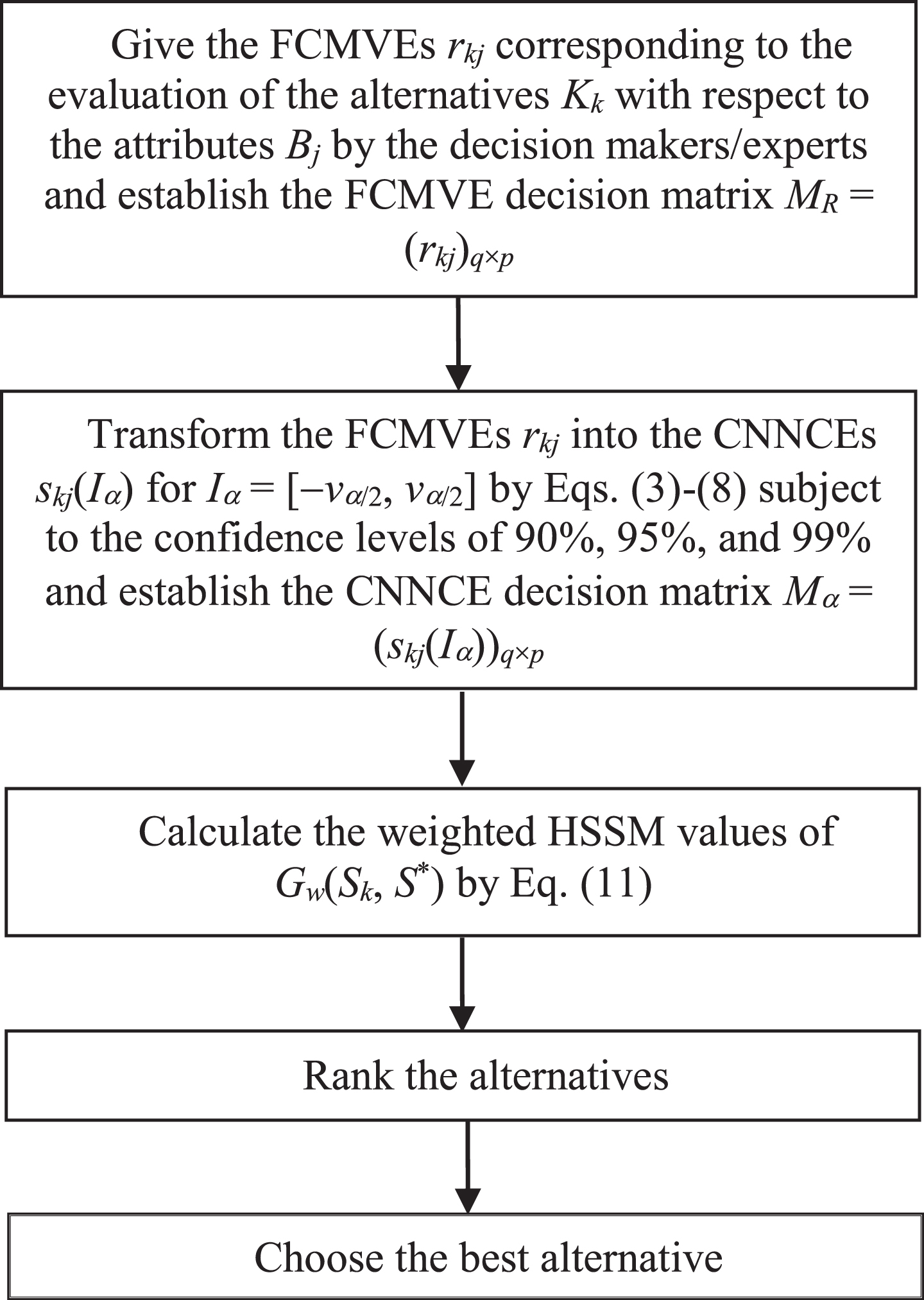
Decision flow chart of the proposed MAGDM approach.
This section provides an actual example on the choice problem of equipment suppliers to illustrate the efficiency and rationality of the proposed MAGDM approach in a FCMVS circumstance.
Actual example
A manufacturing company wants to buy mechanical equipment from equipment suppliers. Then, the technical department preliminarily chooses four equipment suppliers, which are denoted as a set of four alternatives K = {K1, K2, K3, K4}, from potential equipment suppliers. To assess the four equipment suppliers, they must meet the three critical factors/attributes: equipment quality (B1), equipment price (B2), supplier service quality and credibility (B3), and after-sales service response speed (B4). The weight vector of the four attributes is assigned by β = (0.3, 0.25, 0.22, 0.23).
Regarding this MAGDM example, the proposed MAGDM approach can be applied to the actual example and described by the following steps.
Decision matrix of FCMVEs
Decision matrix of FCMVEs
Sorting orders of the four alternatives and the best choice corresponding to different confidence levels
In Table 2, the decision results indicate that different confidence levels of (1−α) ×100% can impact on the sorting order of the four alternatives and then the best one is K2 or K4. It is obvious that the confidence level implies its importance in the DM process. Therefore, the proposed MAGDM approach with various confidence levels reveals the obvious merits of decision flexibility and reliability under the condition of small-scale collective evaluation data.
To compare the proposed DM approach with the existing DM approach using cosine and tangent similarity measures of IvFCSs [11], we assume that CNNCSs with the confidence level of 95% (the most commonly used confidence level) are considered as IvFCSs subject to the specified situation of the decision matrix of CNNCSs in the above example. In this case, we can introduce the following cosine and tangent similarity measures of IvFCSs proposed by Du and Ye [11]:
In the environment of IvFCSs, using Equations (12) and (13), the decision results of the above example are shown in Table 3.
Sorting orders of the four alternatives and the best choice in the environment of IvFCSs
Clearly, the sorting orders in Table 2 and Table 3 reveal some difference between the proposed MAGDM approach and the existing DM approach regarding the confidence level of 95%, then the best alternative K4 is identical. In the CNNCS circumstance, the proposed MAGDM approach can demonstrate its decision flexibility and reliability corresponding to different confidence levels/CNNs with respect to the normal distribution of small-scale collective evaluation data, while the existing DM approach with IvFCSs cannot reflect its decision flexibility and probabilistic credibility/reliability so that it is difficult to ensure its confidence levels of the group assessment values in the DM process. Therefore, the former reflects obvious superiorities over the latter.
Compared with the existing probability MAGDM approaches [21–29], the proposed MAGDM approach can perform group DM issues in the setting of small-scale collective assessment data, while the existing probability MAGDM approaches [21–29] lack some confidence level and credibility measure of the collective assessment data so that they difficultly carry out the DM issue of the actual example with FCMVSs given by the five decision makers, which contain small-scale collective fuzzy assessment values and credibility degrees. However, probability MAGDM approaches are only suitable for large-scale group DM problems, rather than small-scale group DM problems. Therefore, the proposed MAGDM approach shows the obvious superiorities over the existing probability MAGDM approaches [21–29] in small-scale group DM problems.
Generally, the advantages of the proposed MAGDM approach are summarized below. The presented FCMVS is very suitable for the representation of mixed information with multiple fuzzy values and multiple credibility degrees containing identical and/or different fuzzy values in MAGDM problems. The information expression transformed from FCMS to CNNCS can contain both the fuzzy CNN and the credibility CNN to make the fuzzy and credibility arguments more reliable and reasonable from a probabilistic point of view. The presented CNNCSs can conveniently provide their similarity measure operation to avoid the operation problem between different fuzzy/credibility sequence lengths in FCMVEs.
The proposed MAGDM approach using HSSM can make the decision results more credible and reasonable in view of the probabilistic distribution and confidence levels of group assessment values (small-scale collective assessment data) in a FCMVS circumstance.
In this study, first, the presented FCMVS can satisfy the expression issue of mixed information with a fuzzy sequence and a credibility degree sequence. Second, the proposed transformation technique from FCMVS to CNNCS subject to the normal distribution and the confidence levels of small-scale fuzzy evaluation data to avoid the operational problem between different fuzzy sequence lengths in FCMVS and to guarantee the reliability and efficiency of the transformed information. Meanwhile, CNNCS not only reflects the confidence intervals of fuzzy values and credibility degrees, but also strengthens the reliability and rationality of the information representation. Third, the established HSSM of CNNCSs subject to confidence levels can guarantee its measure reliability and rationality in the circumstance of FCMVSs. Fourth, the MAGDM approach developed based on the weighted HSSM can effectively solve MAGDM problems subject to some confidence levels of (1−α)×100% in the circumstance of FCMVSs. Fifth, the developed MAGDM approach can be effectively applied to an actual example of the equipment supplier choice problem, and then it can flexibly perform the choice problem of equipment suppliers corresponding to different confidence levels in the circumstance of FCMVSs. Furthermore, compared with existing related DM approaches, the developed MAGDM approach can ensure the rationality and reliability of the decision results in small-scale group DM problems and reveal its decision flexibility depending on different confidence levels.
However, the MAGDM approach proposed in this study is only suitable for DM issues with the normal distribution of group evaluation data, which shows the limitation of decision applications. Therefore, we need to propose a transformation technique and a MAGDM approach subject to lognormal distribution and confidence levels in a FCMVS circumstance and a group DM approach considering consensus among internal individuals as future research directions.
Data availability
All data generated or analyzed during this study are included in this article.
Conflicts of interest
The authors declare no conflict of interest.