






Abstract
In China, steel structure building has become an important direction of national support and development. As a link in steel structure construction, welding plays a vital role. With the continuous development of domestic steel structures in the direction of “big, special, and new”, manual welding becomes increasingly difficult. The application of robotic technology can effectively reduce the problems of unstable quality and low efficiency caused by manual welding. However, how to evaluate the overall application effect of this technology from the perspective of steel structure construction projects is an urgent problem to be solved at present. Through an in-depth analysis of the technology of building steel structure welding robots, combined with the idea of the capability maturity model and WSR methodology, the evaluation index system of application maturity of building steel structure welding robotic technology is designed. In addition, according to the gray, fuzzy, and difficult-to-quantify characteristics of the evaluation index system, the evaluation model of the application maturity of the building steel structure welding robot technology is established by using the subjective and objective combination weighting method and the gray system theory. In this model, the mixed weighting method of AHP and entropy weight method is used to determine the index weight, and then the multi-level gray theory is used to comprehensively evaluate the maturity of the technology application. Lastly, a project is used as an example to check the science and feasibility of the model.
Introduction
Welding robot refers to the industrial robot engaged in welding. The International Organization for Standardization (ISO) defines an industrial robot as a multi-purpose, repeatable programmable automatic control operator with three or more programmable axes for use in the field of industrial automation. Welding robots originated from the United States Unimation Inc in 1962, which developed the world’s first truly practical industrial robot (robot arm) named “Unimate”. After decades of rapid development, welding robots have been widely used in the automobile industry, aerospace, shipbuilding, mechanical processing industry, electronic and electrical industry, and other related manufacturing industries in industrially developed countries [1]. However, compared with industries with a high utilization rate of welding robots such as automobiles, construction machinery, boilers, and pressure vessels, the application and development of robot welding technology in steel structure buildings is still relatively slow [2]. The welding workload in modern steel structure buildings is massive, and more than 40% of them need welding, so the importance of welding is self-evident [3]. According to statistics, more than 90% of welding work is still done manually, which is even higher in heavy industry [4]. Nowadays, with the shortage of welders, soaring costs, bad welding environment, low efficiency of manual welding, unstable quality and other problems in the field of building steel structure welding, manual welding alone has been unable to meet the basic needs. Therefore, robot automatic welding has become an important approach to solve welding problems.
In recent years, European countries have vigorously promoted the application of fully automatic welding production systems in the steel structure manufacturing and processing industry and used mature software and robotic systems to integrate automatic welding technology to create a “man-machine cooperation” working environment. In Japan, the number of steel structure buildings is the largest among the current various building structures, accounting for about 20% of the total residential building area [5]. As a country with frequent earthquakes, Japan has formulated strict a seismic design code in architectural design, and has adopted high-quality and efficient robot automatic welding and manufacturing methods; up to 2015, the number of installed steel structure welding robots in Japan has exceeded 3000, and the process of applying automatic welding robots in steel structure industry has become mature [6]. In China, welding robots are mostly used in steel structure manufacturing plants. Except for some remarkable projects, welding robots are rarely used in steel structure construction sites; typical examples include the GDC-1 rail type all position welding robot applied to the “Olympic Bird’s nest project” [7], the flexible rail type all position welding robot applied to the Shanghai center building project [8], and the mobile welding robot applied to the Beijing new airport project [9]. According to the survey, at present, the degree of welding automation in the world’s industrial developed countries has reached 80% of the welding technology, while in China, according to the estimation of welding materials consumed by manual welding and automatic welding, the nominal degree of welding automation is 30%, which is a big gap [10].
Recent years in China, the National Development and Reform Commission, the Ministry of Industry and Information Technology and the Ministry of Science and Technology have made plans and guidance for the development of robots, encouraging and supporting the technological innovation and industrial development of robots. Some Chinese local government has also issued relevant policy documents to support the development of robots. The Robot Industry Development Plan (2016–2020) clearly points out that “promote industrial robots to move towards middle and high-end, focusing on the development of arc welding robots [11].” The 2017 edition of the revised “10 New Technologies for the Construction Industry” newly added high-efficiency welding technologies for steel structures, including welding robot technology [12]. The application maturity of building steel structure welding robot technology is to describe the industrialization and application scale of the technology level, process flow, supporting resources, technology life cycle, and other aspects of this scientific and technological achievement. The maturity means that the actual application of this technology must be continuously improved over time, so as to have core competitiveness. Since the introduction of welding robots in China is relatively late, and most of them are non-core technology modifications made by domestic enterprises based on imported equipment, therefore, in addition to many bottlenecks in key technology areas to be broken, the relevant policy environment, management system, product standards, and other aspects need to be further strengthened and improved. Under the joint influence of a series of factors, how to accurately measure and describe the specific application of domestic building steel structure welding robot technology in the project, and measure its overall maturity, for subsequent technical research and improvement, until the mass application and promotion, is of great importance.
At present, in China, the application of welding robot technology for building steel structures mainly focuses on qualitative research, but lacks quantitative evaluation. Therefore, this paper put to use the WSR methodology and the idea of the capability maturity model to establish the maturity evaluation index system, use the combination of the AHP method and entropy weight method to determine the weight of indicators at all levels, and introduce multi-level gray comprehensive evaluation method, in order to more reasonably evaluate the maturity of welding robot technology application in domestic construction projects.
Literature review
Research status of welding robot technology for building steel structure
There are many technologies involved in welding robots for building steel structures, European and American scholars focus on the improvement and optimization of the welding process and the development of the welding robot system. In the welding process, the research on the properties and micro-structure of welded joints is a more concerning aspect abroad. For example, Friction Stir Spot Welding (FSSW) has been proven to be able to connect very advanced high-strength steel and has flexibility in controlling welding heat and welding joint micro-structure, which makes friction stir welding a potential alternative to resistance spot welding [13]. Stanciu, et al. [14] studied the influence of the key parameters of laser welding on the geometric shape and micro-structure of the weld. Another hot keyword in the welding process is laser welding, which is an efficient and precise welding method. This method uses a high-energy-density laser beam as the heat source. Kang, et al. [15] studied the laser welding quality monitoring technology and proposed the quality monitoring method and the robot-based remote laser welding system to solve the problem of limited welding speed and accuracy of traditional laser welding systems; Jasnau, et al. [16] introduced a laser arc hybrid welding process and compared with the laser or arc welding process alone, this hybrid welding process has obvious advantages. With the increasing thickness of steel members, in order to achieve high-quality welding, higher requirements are put forward for the robot system. Tavares, et al. [17] proposed a BIM-based robotic reprogramming and spatial augmented reality collaborative welding system, which has the advantage of not only ensuring maximum flexibility in the beam assembly stage but also improving overall productivity and product quality. For the problem of insufficient automation of H-column structures, Moon, et al. [18] proposed a practical steel beam welding robot system, which was specially designed for the welding of H-column structures.
Chinese scholars mainly focus on automatic welding of high-strength steel and box steel structure. The Code for Welding of Steel Structures (GB50661-2011), implemented on August 1, 2012, is an important turning point for the large-scale adoption of high-strength steel in the field of building steel structures [19]. The appearance of high-strength steel promotes the development of building steel structure welding towards automation. Zhang [20] analyzed the characteristics and difficulties of high-strength steel welding, the demand for welding materials for efficient welding of high-strength steel, and the application and development of automatic welding technology for high-strength steel. Yang [21] believes that the current welding automation technology used in high-strength steel is still in essence the general automatic welding technology to weld high-strength steel, so there are some processes that have not become part of the welding automation, which need further exploration. The advantages of box-shaped steel structures are mainly reflected in their light weight, plasticity, and good toughness, thus promoting the wide application of box-shaped steel structures in the field of bridges and steel buildings. Guo et al. [22] designed a new box-type steel structure all-position welding robot system to solve some problems in the process of box-type steel structure welding construction, mainly including the lack of stability of the joint quality, low degree of welding automation and dangerous work at height, and the welding robot system parameters selection and structural design can adapt to the ring seam all-position welding during the construction of box-type steel structure.
Evaluation method of technology application
There are many of evaluation literatures on technology applications, including application demand evaluation, application suitability evaluation, application risk evaluation, etc. The methods used can be divided into the fuzzy comprehensive evaluation method, the matter element analysis method, and the TOPSIS method. Chu et al. [23] used the factor analysis method and fuzzy comprehensive evaluation method to evaluate the application demand of Internet of Things technology in China’s agricultural informatization; Wang et al. [24] evaluated the suitability of the application of low-pressure pipeline irrigation technology in southern China by building a comprehensive evaluation model combining ahp and fuzzy evaluation method. Hu et al. [25] built a matter-element evaluation model based on COWA-G1 combination weighting to comprehensively evaluate the risk of BIM technology application in EPC projects; Wang [26] evaluated the application risk of municipal traffic engineering BIM technology by building a combination weighted matter-element model of analytic hierarchy process and entropy weight method. Mo et al. [27] used the weighted TOPSIS method to evaluate the comprehensive effectiveness of the HIR (Hot in-place recycling) technology application; Han et al. [28] used the improved entropy weight TOPSIS evaluation model to evaluate the application ability of BIM technology. The above evaluation methods are summarized as shown in Table 1.
Main characteristics of the evaluation method
Main characteristics of the evaluation method
From the basic and single evaluation method to the comprehensive evaluation method under uncertain conditions. Expert rating based on the actual situation of technology application and knowledge structure: the analysis of green building technology promotion [29]. Ranking and evaluation of technological innovation capacity in different regions of China: an equation model integrating innovation input, output, and related factors [30]. Benefit evaluation of the application of new construction technology: the qualitative and quantitative analysis model established by using the analytic hierarchy process [31]. Multilevel, multi-dimensional, and quantifiable TDGS technology applicability evaluation: a three-level comprehensive evaluation method based on the binary comparative analysis method, TOPSIS, linear weighted sum method, and exponential evaluation baseline method [32]. The Green construction bid evaluation under multi-index and uncertain conditions: based on multi-level gray evaluation model [33].
The Capability Maturity Model (CMM) was proposed by the Carnegie-Mellon University Software Engineering Institute (CMU-SEI). Originally researching a maturity framework to help organizations improve their software process, SEI further developed the software process maturity framework into a software capability maturity model based on the publication of a brief description of the process maturity framework and a maturity questionnaire. By analyzing more than 200 maturity-related papers, Wendler [35] points out that applied research on maturity involves more than 20 fields and is conducted mainly from three aspects: first, research on the basic concept of maturity, second, research for the purpose, application, and advantages of maturity evaluation, and third, research on the construction of maturity models. He [36] introduced some basic concepts of the software capability maturity model, and then described the five-level structure and the content of the model, the relationship between different maturity levels, and the behavior characteristics of each maturity level, and pointed out some problems in the model. In terms of engineering projects, there are many pieces of research on maturity evaluation based on CMM theory. For example, Ma et al. [37] put forward the building fire emergency response capability maturity (FE-CMM) evaluation system on the basis of the capability maturity model, and developed a plug-in to evaluate the fire emergency response capability based on the building information model (BIM) platform to effectively realize the intelligent evaluation of the building fire emergency response capability; Park et al. [38] deeply discussed and studied the relevant evaluation of the PMIS communication management capability of construction projects based on CMM theory. Many researchers have constructed corresponding models by referring to the CMM model and project knowledge system. Based on CMM theory, the National Institute of Building Sciences (NIBS) has established an interactive BIM-CMM maturity model, which includes 11 research fields of interest, and defines the weight and maturity level of each field [39]. The American Project Management Institute (PMI) launched the Organization Project Management Maturity Model (OPM3) in 2003 and promoted it as an industry standard [40]. Another example is the knowledge management maturity model, including three management objectives, 68 knowledge management activities, and 19 key process areas [41]. These maturity-related studies have played a role in promoting the development of the industry.
Research status of multi-level grey theory
As a new method, gray system theory takes “small data” and “poor information” uncertainty system with “partly known information and partly unknown information” as the research object, mainly through mining the “partly” known information and extracting valuable information, and then achieve the correct description and effective control of the system operation behavior and its evolution law [42]. The multi-level grey comprehensive evaluation method is a comprehensive integration method based on grey system theory, covering fuzzy mathematics and qualitative to quantitative methods. In the field of architecture, there are many pieces of evaluation kinds of literature established by using the multi-level grey comprehensive evaluation method, whose research directions include risk evaluation [43], green construction evaluation [44], enterprise information evaluation [45], etc. It can be seen from the above literature that this method can have stronger flexibility by combining subjective or objective (combined) weighting methods to solve diversified evaluation problems. This paper uses the multi-level gray comprehensive evaluation method to evaluate the maturity, mainly considering the following points: first, the building steel structure welding robot has not been implemented for a long time in China, and there are few application examples, lacking sufficient data, which belongs to the uncertainty problem; second, the evaluation index system is multi-level and complex, and the indicators are mostly qualitative indicators, which are difficult to quantify; third, the information provided by the evaluator is affected by human factors, which is gray. Because AHP and fuzzy theory are difficult to solve the uncertainty problems such as “small samples” and “poor information”, the general methods also have defects in the use of various gray degree evaluation information [46]. Therefore, for the above evaluation problems, the multi-level gray comprehensive evaluation method is the most appropriate, which can make the evaluation results more objective and reasonable.
In general, the research on the welding robot technology for building steel structures is progressing steadily. In addition, the research on the capability maturity model and technology application evaluation method has also achieved good research results, effectively promoting the organization to achieve the set goals. However, due to the late start of China’s construction steel structure welding robot, the study of its application is mainly from a qualitative, single perspective, but they lack quantitative as well as holistic research. Thus, it is necessary to establish a maturity model that conforms to the current application situation of building steel structure welding robot technology in China, design the corresponding evaluation index system and select appropriate evaluation methods, and then systematically evaluate the application of building steel structure welding robot technology according to the gray nature of the research object.
Methods
Maturity level stage division
The application maturity level of building steel structure welding robot technology is a gradual upgrading process. Based on the basic theory and the idea of the Capability Maturity Model (CMM), and combined with the application characteristics of building steel structure welding robot technology in engineering projects, the maturity is divided into five levels: initial level, starting level, development level, maturity level, and optimization level. Among them, the application maturity of each level is the foundation of the next level, and the continuous improvement of maturity is also the embodiment of the gradual maturity and standardization of the application of welding robot technology for building steel structures.
(1) Initial level
The initial level is characterized by a limited overall application environment. At this stage, the national and local governments have not realized the importance and feasibility of the welding robot technology for building steel structures; the enterprise takes a wait-and-see attitude in the application of this technology. The level of automatic welding technology is low, and the welding forms are mainly manual welding and semi-automatic welding, with low welding quality and efficiency; the construction organization structure and management system of the cooperative welding robot have not been established, and the process management is in a disordered state; it is difficult to coordinate the economic, environmental and social benefits.
(2) Starting level
The starting level is characterized by the improvement of the overall application environment. At this stage, the state and local governments realized the importance and feasibility of welding robot technology for building steel structures, and formulated relevant policies and incentives for the application of welding robot technology; the enterprise formulates a scientific research investment plan. The welding robot system does not have the ability to feedback the external information, so it is difficult to adapt to the changes in the working environment; the enterprise starts to establish the construction organization structure and management system and defines the basic work contents in the process management; the economic, environmental and social benefits are not obvious.
(3) Development level
The development level is characterized by the continuous development of the overall application environment. At this stage, the state and local governments will implement relevant policies and incentives; the enterprise actively invests resources and funds. The welding robot system has a certain sense of the external environment and can adjust the working state according to the changes in the environment; the construction organization structure and management system are gradually taking shape, and the process management tends to be standardized and institutionalized; economic, environmental and social benefits have been improved simultaneously.
(4) Mature level
The characteristic of the mature level is that the overall environment has formed a positive state of all-around development and application of technology. At this stage, the state and local governments began to formulate improvement measures based on the feedback on the effects of relevant policies and measures; the enterprise continuously invests resources and funds. The welding robot system realizes the integration of multiple functions and highly intelligent feedback and self-regulation, and can adapt to the changes of the external environment and coordinate the completion of various tasks; the enterprise integrates the construction organization structure and management system to improve the process management efficiency and execution; the economic, environmental and social benefits are remarkable.
(5) Optimization level
The optimization level is characterized by a sound overall application environment. At this stage, the relevant national and local policies and systems have formed a systematic system; the enterprise optimizes the input of resources and funds. The welding robot technology has realized industrial development with outstanding advantages, achieving high quality, high efficiency, and high adaptability. Meanwhile, it is committed to further development and exploration in the fields of standardized design of steel components, optimization of welding material performance, and improvement of welding process and methods; the enterprise realizes the digital integrated management of welding equipment, welding operators, and welding production process through the network, and its management level is in a virtuous circle of continuous optimization and improvement; economic, environmental and social benefits continued to be optimized.
Thinking of WSR methodology
WSR is the abbreviation of “WuLi - ShiLi –RenLi Methodology”. It is an oriental methodology put forward by Chinese scholars in the 1990 s. WuLi is a Chinese word, which refers to the objective existence that people face in the process of dealing with a system project (or problem), and is the sum of the laws of material movement; similarly, ShiLi refers to the mechanism of intervention when people face the objective existence and laws in the process of dealing with a system project (or problem); in addition, RenLi refers to the relationship and change process between all people involved in the processing of a system project (or problem) [47]. As a systematic way of thinking, when analyzing and researching complex problems, WSR should not only consider the WuLi aspect of the object but also how to better apply the WuLi aspect to the ShiLi aspect. And when making management decisions, we can’t deviate from RenLi, and finally know WuLi, understand ShiLi and communicate RenLi.
Taking the welding robot for building steel structures as the research object, it can be applied maturely and needs to start from the following aspects. First of all, it is necessary to meet WuLi factors such as basic application environment and equipment technology. Secondly, it is also necessary to consider the process management of the application of this technology in the actual project, coordinate and solve possible problems, and strive to maximize the benefits of ShiLi factors. Finally, RenLi factors that attach importance to the role of people and groups in the system. Therefore, the idea of WSR theory is in line with the idea of building the maturity model of building steel structure welding robot technology. In this paper, the preliminary construction of the evaluation index system is carried out from the three levels of WuLi support, ShiLi optimization, and RenLi coordination.
Division of main factors based on WSR level
In order to objectively evaluate the application maturity of building steel structure welding robot technology, based on the above maturity level analysis and WSR methodology, the specific development status of building steel structure welding robot technology is compared with the maturity level characteristics, and the main factors are divided. The objects and contents emphasized by “WuLi” mainly refer to the objective material world, laws, regulations, etc. As for the construction steel structure welding robot, the WuLi support is reflected in environmental factors and technical factors. The objects and contents emphasized by “ShiLi” mainly refer to the organization, system management, and the principles of doing things. Therefore, the ShiLi optimization is reflected in management factors and benefit factors. The objects and contents emphasized by “RenLi” mainly refer to people, groups, and the principles of life. Therefore, the RenLi coordination is reflected in personnel and group factors. The factors included in all levels affect the maturity of the application of the construction steel structure welding robot technology, and the overall application of the construction steel structure welding robot technology is finally reflected by the comprehensive effect.
(1) Environmental factors
Environmental factors are the macro support required by welding robots in the field of steel structures. Policy support, scientific research investment, and future planning are the preconditions for the sustainable development of welding robots. Technical standards and specifications are the basis for the establishment of a construction system. The degree of automation reflects the current technical level of the enterprise.
(2) Technical factors
Technical factors refer to some technologies that must be possessed by building steel structures to realize automatic welding by robots. It is the core of the application of welding robots. The key technologies include: welding sensing technology, welding seam tracking technology, welding programming technology, etc. The standardized design of components is the premise and foundation of the popularization of welding robot technology for building steel structures. Upgrading and optimization of welding materials is an important development direction to ensure the quality of robot welding products. Secondly, quality and efficiency are the fundamental purpose of technology research and development, and are also important criteria for evaluating technology research results. The welding effect in dynamic environment reflects the adaptability of automatic welding technology.
(3) Management factors
The management factor refers to a series of coordination and management of the whole process when applying welding robots for on-site construction, which is some auxiliary work in the whole operation process. Specifically, it includes some management work in the early, middle, and late stages. For example, the preliminary preparations include the formulation of technical operation procedures, the erection of wind shelters, operation platforms, and horizontal safety nets, and the integrated transformation of robots. Management work carried out during operation: management of personnel, safety, and quality. Later related work: equipment maintenance, material stacking management, etc.
(4) Benefit factors
The benefit factors are mainly aimed at the three levels of economy, environment, and society. The economic benefit reflects the beneficial advantages of the robot compared with the employment of welders in terms of purchase cost and production efficiency. Environmental benefit refers to the degree to which the pollution generated by robots can be controlled during operation. Social benefits include improving workers’ working conditions and environment, reducing labor intensity, etc. Whether welding robots can be used maturely requires good coordination between the three.
(5) Personnel and group factors
The meaning of personnel and group factors refers to the basic role played by people when applying robot welding technology, mainly referring to the basic operating ability and cognitive level they should have.
Maturity model structure
According to the level construction and main factor division of WSR theory, combined with the level thought of maturity model (CMM), the established maturity model structure is shown in Fig. 1. The model includes two levels. The first level of model construction is the five levels of maturity, and the second level of model construction is the three levels of “WuLi”, “ShiLi” and “RenLi” of WSR theory.
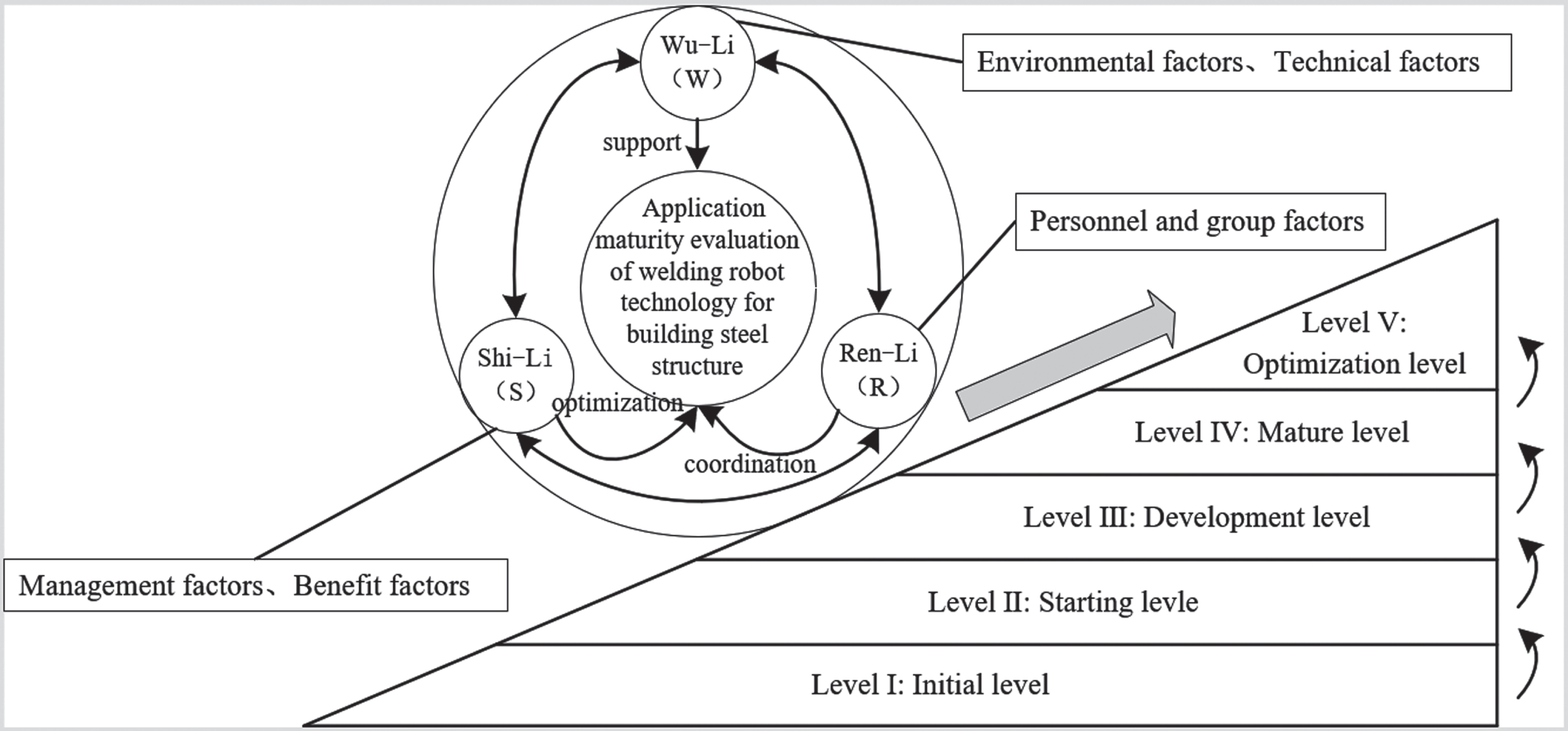
Model structure of application maturity of building steel structure welding robot technology.
The establishment of an evaluation index system of application maturity of welding robot technology for building steel structures needs to start from multi-level and multi-index. First of all, based on the above five main factors involved in the application maturity model structure of the building steel structure welding robot technology, and through reading the relevant documents in the CNKI database, a series of evaluation indicators affecting the technology application are summarized and sorted out, and the evaluation indicators are preliminarily classified to systematize the original complex indicators. Secondly, following the principles of typicality and reasonableness, the indicators initially summarized are screened, the indicators with overlapping relationships are merged, and the indicators with weak correlation are removed. Finally, the expert interview method is used to adjust and optimize the evaluation indicators to make the indicators more scientific and real. The evaluation index system of application maturity of building steel structure welding robot technology constructed by adopting the above steps can be divided into four layers: the overall evaluation objective, 3 first-level indicators, 5 second-level indicators, and 29 third-level indicators, as shown in Table 2.
Evaluation index system of application maturity of welding robot technology for building steel structure
Evaluation index system of application maturity of welding robot technology for building steel structure
Using a combination weighting method to determine index weight
The analytic hierarchy process (AHP) is a multi-criteria decision-making method for quantitative analysis of qualitative problems. Its advantages mainly lie in its simplicity, flexibility, and practicality. This paper uses the AHP method to determine the subjective weight of indicators, and Saaty’s 1–9 scale method is used to compare the importance of each evaluation index, and then a judgment matrix
The subjective weighting method is subjective and easy to be affected by people’s experience and knowledge level. Therefore, in order to reduce the weight deviation caused by subjective weighting, this paper introduces the entropy weight method to determine the objective weight. Suppose there are p evaluation samples and n evaluation indicators, the evaluation matrix
Subjective weight obtained by the AHP method: The first-level indicator weight vector is expressed as T =(t1, t2, t3, ... , t i ), the second-level indicator weight vector is expressed as T i = (ti1, ti2, ti3, ... , t ij ) and the third-level indicator weight vector is expressed as T ij = (tij1, tij2, tij3, ... , t ijk ).
Objective weight obtained by the entropy weight method: The first-level indicator weight vector is expressed as V = (v1, v2, v3, ... , v i ), the second-level indicator weight vector is expressed as V i = (vi1, vi2, vi3, ... , v ij ) and the third-level indicator weight vector is expressed as V ij = (vij1, vij2, vij3, ... , v ijk ).
Given the subjective weight determined by the AHP method and the objective weight determined by the entropy weight method, the combined weight value can be calculated by the following formula (taking the third-level indicator w
ijk
as an example):
Applying multi-level grey theory to evaluate results
(1) Determine the indicator scoring grade and standard
In the application maturity evaluation of building steel structure welding robot technology, the evaluation level is divided into optimization level, maturity level, development level, starting level, and initial level, i.e. I ={ I1, I2, I3, I4, I5 }. Assign 9, 7, 5, 3, and 1 to the five evaluation grades, and assign 8, 6, 4, and 2 between the two adjacent grades to convert qualitative indicators into quantitative indicators, and invite p experts to score the third-level indicators. In order to accurately judge the level of each technology application maturity impact indicator, this paper briefly describes the characteristics of each indicator’s maturity level, providing a reference for maturity assessment. Due to the limited space, some indicators in “environmental factors” are selected as examples for an explanation, as shown in Table 3.
Evaluation criteria for partial indicators of “environmental factors” of application maturity of building steel structure welding robot technology
Evaluation criteria for partial indicators of “environmental factors” of application maturity of building steel structure welding robot technology
(2) Determine the evaluation sample matrix
According to the score d
ijkh
of the h-th expert on the third-level index U
ijk
, the evaluation sample matrix D is as follows:
Where p is the number of experts, and m is the number of third-level evaluation indicators in the matrix.
(3) Determine the evaluation gray class
If the evaluation gray class is recorded as s, then s = (1, 2, 3, 4, 5), the corresponding grey number ⊗ = (9, 7, 5, 3, 1). The whitening weight function
1) The first gray class is optimization level, s = 1, the gray number ⊗1∈ [9, 10], and the whitening weight function is:
2) The second gray class is mature level, s = 2, the gray number ⊗2∈ [7, 10], and the whitening weight function is:
3) The third gray class is development level, s = 3, the gray number ⊗3∈ [5, 10], and the whitening weight function is:
4) The fourth gray class is the starting level, s = 4, the gray number ⊗4∈ [3, 10], and the whitening weight function is:
5) The fifth gray class is initial level, s = 5, the gray number ⊗5∈ [1, 10], and the whitening weight function is:
(4) Grey evaluation weight vector of third-level indicators and grey evaluation weight matrix of second-level indicators
According to the score d
ijkh
of the third-level indicators U
ijk
in the evaluation sample matrix D, it is substituted into the whitening weight function, and the whitening weight function value of the third-level indicators U
ijk
belonging to the l-th evaluation gray class is obtained as
The grey evaluation weight vector of the third-level indicators U
ijk
is:
Construct the grey evaluation weight matrix of the second-level indicators U
ij
:
(5) Grey evaluation weight vector of second-level indicators and grey evaluation weight matrix of first-level indicators
The grey evaluation weight vector of the second-level indicators U
ij
is:
Constructing the grey evaluation weight matrix of the first-level indicators U
i
:
(6) The grey evaluation weight vector of the first-level indicators and the total grey evaluation weight matrix of the comprehensive evaluation target
The grey comprehensive evaluation weight vector of the first-level indicators U
i
is:
Construct the total grey evaluation weight matrix of evaluation objective U:
(7) General evaluation objective: Grey Comprehensive Evaluation
The grey comprehensive evaluation vector of the overall evaluation objective U is:
Comprehensive evaluation value of grey number of general objective U:
Wherein, I = (9, 7, 5, 3, 1), namely the threshold value corresponding to each evaluation gray class. At the same time, the maturity evaluation of indicators at all levels has been achieved, as shown in Table 4.
Evaluation value of maturity of indicators at all levels
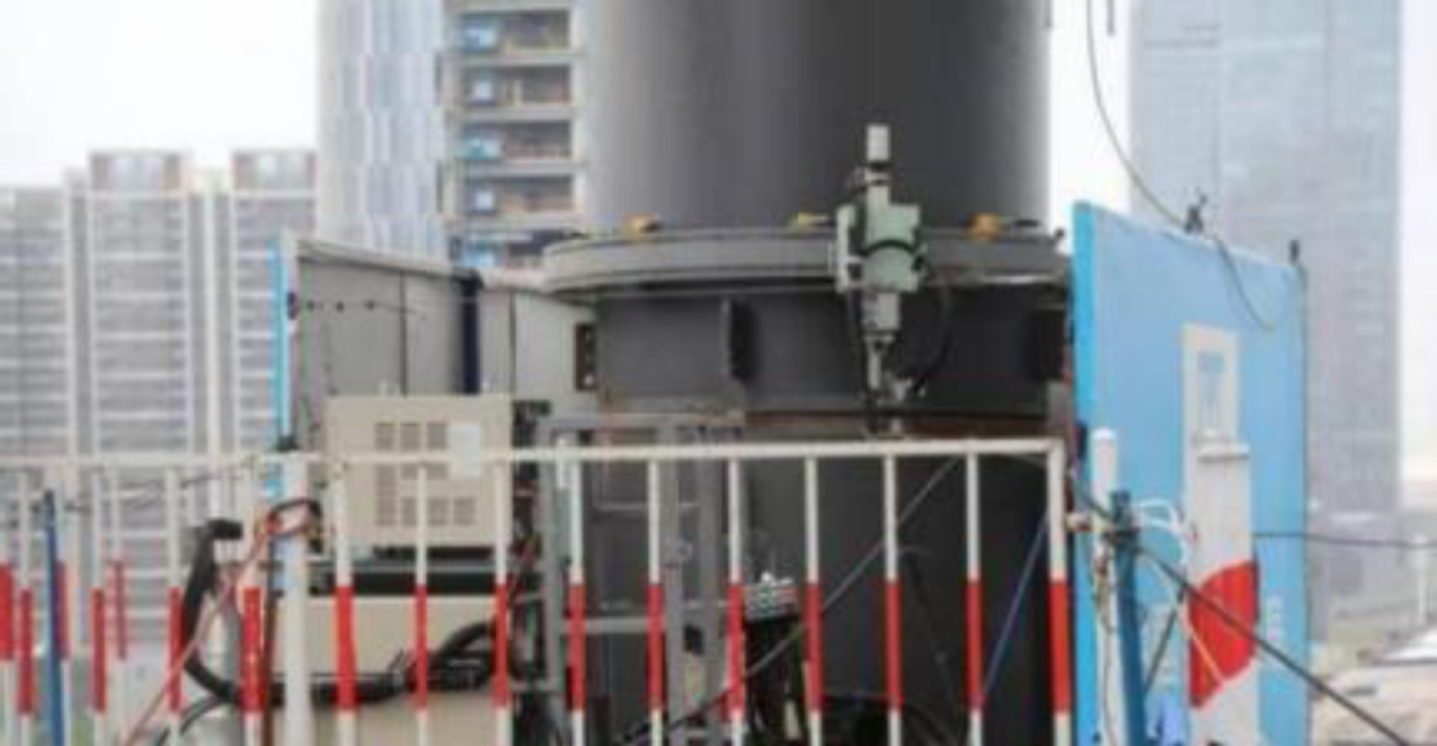
Scene of welding robot operation on the project site.
Project overview
Jinan International Financial Center Lot A1 Phase I (A1-1 # Building) Project is located in the CBD area of Jinan City, Shandong Province, China. The building has 53 floors, with a total construction area of 128680 square meters, and the highest point is 260 meters. Among them, the total building area above the ground is 126267 square meters, and the underground building area is 2213 square meters. The ground includes office and commercial functional areas, and the underground is mainly a parking area. This project applies a permanent magnet track type intelligent girth welding robot independently developed by China Construction Fifth Engineering Bureau. The robot is developed based on the key and difficult points in project welding construction. The track of the permanent magnet track type intelligent girth welding robot adopts the magnetic suction form and can be matched with steel pipe columns of various sizes (500mm–1600 mm in diameter is applicable). Using the maturity evaluation model established above, the application maturity of the building steel structure welding robot technology in this project is comprehensively evaluated, and the corresponding evaluation level is obtained. Based on the analysis results, suggestions for improvement are put forward.
Project maturity evaluation
Calculate the index weight. Ten experts are invited to score the importance of a single indicator in the form of a questionnaire survey. The weight of indicators at all levels can be obtained by using the calculation steps of index weight of the combination weighting method, as shown in Table 5. Construct the evaluation sample matrix. According to the expert’s rating of the third-level indicators U
ijk
in the evaluation index system of the technical application maturity of building steel structure welding robot, the evaluation sample matrix D can be obtained as follows:
(3) Calculate the grey evaluation weight vector r
ijk
of the third-level indicators, construct the grey evaluation weight matrix R
ij
of the second-level indicators, and calculate the evaluation value Q
ijk
.
Evaluation value Q ijk : Q111 =5.783, Q112 =5.793,
Q113 =5.840, Q114 =5.373, Q115 =5.322;
Q121 =5.701, Q122 =5.654, Q123 =5.081,
Q124 =5.390, Q125 =5.306, Q126 =5.480,
Q127 =4.822, Q128 =5.225, Q129 =4.745;
Q211 =5.378, Q212 =5.199, Q213 =4.887,
Q214 =5.678, Q215 =4.863, Q216 =5.216,
Q217 =5.384, Q218 =5.125, Q219 =5.327;
Q221 =5.396, Q222 =5.284, Q223 =4.716;
Q311 =4.551, Q312 =4.657, Q313 =4.622.
(4) Calculate the gray evaluation weight vector b
ij
of the second-level indicators, construct the gray evaluation weight matrix B
i
of the first-level indicators, and calculate the evaluation value Q
ij
.
Evaluation value Q ij : Q11 =5.580, Q12 =5.223, Q21 =5.192, Q22 =5.215, Q31 =4.608.
(5) Calculate the gray evaluation weight vector e
i
of the first-level indicators, construct the total gray evaluation weight matrix E of the comprehensive objective, and calculate the evaluation value Q
i
.
Evaluation value Q i : Q1 =5.411, Q2 =5.197, Q3 =4.608.
(6) Overall objective comprehensive evaluation results. According to the total gray evaluation weight matrix obtained, the gray comprehensive evaluation vector of the total evaluation target is calculated as:
Comprehensive evaluation value of total evaluation objective: Q = ZI T =5.131.
Weights of indicators at all levels
Weights of indicators at all levels
The comprehensive evaluation results show that the overall application maturity of the construction steel structure welding robot technology of the project is at the development level, indicating that the overall application level of the construction steel structure welding robot technology of the project is fine, but it is not mature enough and needs to be further improved. For the three levels of “WuLi - ShiLi - RenLi”, the maturity of the technology application is judged as development level, development level, between starting level and development level.
Among them, environmental factors scored the highest, indicating that the state, local, and enterprise pay attention to the basic environment needed to create the application of welding robot technology. The ranking of scores is followed by technical factors, benefit factors, and management factors, which shows that the enterprise attaches more importance to the relevant technology, process management system, and three aspects of benefits of welding robots. Enterprise improves welding quality, welding efficiency, and environmental adaptability through research on key technologies; through the consideration of three aspects of benefits, to ensure the significant improvement of some benefits; through the establishment of a management system, the work can be effectively connected, thus becoming more standardized. The lowest score of personnel and group factors indicates that the enterprise does not attach importance to the professional ability and related skills training that operators should have, and the basic knowledge of technology is limited.
Suggestions
Since the links are interrelated and cannot be short, there is a need to improve the weak links as well as the shortcomings. The key point to improve the application maturity of the construction steel structure welding robot technology should be the three-level index with low evaluation value. In terms of environmental factors, the enterprise should increase investment in scientific research and improve its automation level. In terms of technical factors, the focus of technical research is mainly on the upgrading and optimization of welding materials and the improvement of the welding process database. In terms of management factors, we will strengthen the integrated transformation of robots and the management of welding operators and other related auxiliary work, so that all work in the process management system can cooperate with each other and improve the overall management efficiency. In terms of benefit factors, we should not blindly pursue the maximization of economic benefits, but also coordinate the environmental and social benefits to achieving synchronous improvement. In terms of personnel and group factors, in addition to the need to popularize the relevant knowledge of steel structure welding robots in the construction units, it is also necessary to pay attention to the professional level of operators and carry out pre-job skills training.
Conclusion
Through the exploratory research on the application maturity evaluation of steel structure welding robot technology, this paper designs an evaluation index system for the application maturity of steel structure welding robot technology, which is suitable for the actual situation and specific characteristics of China’s engineering projects, on the basis of learning from the capability maturity model and WSR methodology. In addition, the evaluation model of application maturity of building steel structure welding robot technology based on combination weight and multi-level gray theory is constructed. Finally, the scientific and feasibility of the model are verified through case analysis, which makes up for some deficiencies in the existing application research of building steel structure welding robot technology, and provides a more scientific method for evaluating the overall application level of building steel structure welding robot technology. The evaluation results obtained in this paper are basically consistent with the actual qualitative conclusions, and the methods adopted have also been verified in many pieces of literature in the field of architecture.
Of course, there are still some problems worthy of in-depth studies, such as how to deepen the evaluation index system and expand the scope of evaluation objects. Although the selection of evaluation indicators is based on the WSR methodology and capability maturity model, combined with a large number of literature evaluation standards and scholars’ research, it is still not comprehensive and authoritative. The application of welding robot technology for building steel structures is a dynamic development process. In the future development process, the evaluation indicator system needs to be synchronously revised and updated according to the actual situation and research progress. In addition, the research object of this paper is mainly the welding robot for domestic building steel structure projects. The evaluation model established is still limited to the evaluation of the technical application maturity of a single project. Because the technical application statuses of different projects are different, how to conduct a comprehensive evaluation of the technical application maturity of a certain region in China is our next work.
Conflicts of interest
The author declares that they have no conflicts of interest.
Footnotes
Acknowledgments
This work has been partially supported by two projects: the research and development project of the ministry of housing and urban-rural development (project number: 2020-K-129); the research project of philosophy and social sciences in Hubei province colleges and universities (project number: 21Y039).