







Abstract
One of the major challenge in Wireless Sensor Networks (WSN’s) deployment is efficient energy consumption. Critical distance, proper routing algorithm and error control coding techniques can be used for energy optimization. As WSN contains a large number of power constrained sensors, the sensed data from the environment should be transmitted in a cooperative way to the base station (BS). The pattern of the clustering structure can extend the sensor network life time, reduce the total consumed energy and regulate the data transmission. Clustering concept combines group of sensors which are located in the same communication range. Some of the routing protocol like, SEED, LEACH, SEP, Z-SEP etc., suffers from idle listening problem, which cannot cope with an environment with sensor nodes. It leads to energy wastage across the network. To manage energy efficiency and traffic heterogeneity issues, a new routing protocol called enhanced energy efficient sleep awake aware intelligent sensor network (EEESAA) is proposed. Here, one sensor in each group will be in active mode whereas other sensors entered in sleep mode. Based on the nodes energy, sleep and awake node pairs will be altered. In the proposed method, one slot is allotted for group of pairs. The proposed approach is evaluated and compared against LEACH, SEP and Z-SEP protocols. Simulation results show that EEESAA protocol performs better than LEACH, SEP, Z-SEP in terms of cluster head selection, throughput, number of alive & dead nodes and network lifetime.
Keywords
Introduction
Recent days, military and civil applications are leveraged by sensor networks. Rapid technological developments have led to miniaturization and small sized battery operated sensors [1, 2]. WSN comprises of large number of sensor nodes. Sensors are used to send the collected data to interested parties by using on board radio. Battery capacity, wireless micro sensor nodes, less power for data transfer, etc., are some of the characteristics of WSN. As each sensor node has finite number of resources, it is necessary to include energy saving strategies to increase the lifespan of WSNs [3, 4]. Literature have numerous research reports for finding efficient routing protocols for WSNs. Neamatollahi. P et al., [5] concludes that a scheme based on clustering is a practical solution for solving energy issues, enhancing scalability and extending the network life time. Orlando Philco Asqui et al., [6] and Ramesh. S et al., [7], proposed a multi hop deterministic energy efficient (MDEE) routing protocol. They have elected the cluster heads through local radio communication.
According to the amount of data transmitted and communication activities [8, 9], the sensor node battery power and node energy is increased [10]. Therefore, an effective data routing method is required among the sensor nodes. Most of the sensor nodes are heterogeneous in their energy and data rate [11]. If they are not properly utilized, it may lead to uneven energy consumption and imbalanced load across the network. Xu. C et al., [12] tries to compare the overhead energy consumed in RR mechanism with (a) Generic dynamic cluster based protocols (b) Re-clustering avoidance protocol (c) Centrally controlled dynamic cluster based protocols. From the comparative analysis it is found that the life time network has been improved by 25% in RR technique. In order to achieve the goal of energy conservation, Guanghui Han et al., [13–15] has proposed a new technique called energy efficient clustering routing protocol based on weighting and parameter optimization (WPO-EECRP). They have considered two factors namely neighbor communication range (R) and weight coefficient (W). The result showed that the network lifetime has been increased by 1.4 times of other methods [16, 17].
Low energy adaptive clustering hierarchy (LEACH) algorithm is the basic and most commonly used routing protocol. It has certain limitation such as cluster head (CH) identification, selection and its count [18–20]. To improve the performance, to reduce the CH node energy and easy communication from CH to base station (BS), a number of new routing protocols have been proposed in the literature [21]. This method uses randomness technique. Hence, most of the researchers are focusing on this algorithm. To boost the capability of LEACH clusters intelligent optimization methods are used. LEACH has two phases like setup and steady phase. First phase forms and selects CH whereas in second phase sensor nodes sense and transmit data from CH to BS.
In the routing algorithm, CH node takes the responsibility of establishing the routing table, cluster organization, data collection, compression and data transmission [22, 23]. So, among the entire network, the energy consumption of a CH node is higher. Muqeet Ahmad et al., [24, 25] has proposed a novel connectivity based LEACH mobile energy efficient and connected (LEACH-MEEC) routing protocol. In their work CH is selected based on the neighboring nodes connectivity and the mobile sensor node energy. It includes data delivery, number of alive nodes (NAN), number of dead nodes (NDN) and packet delivery ratio (PDR) [26]. The results show that the proposed model produces better results than other mobility models.
Even though the clustering algorithms like LEACH, SEED and DEEC [27, 28] etc., have achieved better performance, it faces the following issues
Literature on LEACH, SEP, DEEC etc., is not addressing this issue. We have introduced the concept of pairing algorithm to minimize the energy consumption and to enhance the network lifetime. For that the nodes which are at minimum distance are coupled in pair by BS. Then the paired information is broadcasted to all nodes in the network by BS. According to the proposed method, the nodes switch between “Sleep” and “Awake” mode to save their energy and to avoid over hearing. Switching of sleep and awake can be done without communicating CHs. This paper tries to address clustering problems with algorithms, energy efficient CH formation and routing, extended network life span and selection of inter and intra route communication with respect to relay nodes.
The main contributions are, To introduce the concept of pairing in order to minimize energy consumption, to enhance the network stability period and to increase the network lifetime. To evaluate the performance on the basis of clustering process, network stability period and throughput.
The paper is organized as follows. First section deals with the literature review based on the energy consumption, clustering, routing network stability and network life time. Second section explains the new routing protocol which aims to improve the network life time and energy efficiency. Section 3 presents the simulation outcomes of the proposed work with comparative analysis and section 4 concludes the work.
EEESAA: the proposed protocol
The general block diagram of the proposed enhanced energy efficient sleep awake algorithm (EEESAA) for WSN is shown in Fig. 1. It starts with the network model creation which includes data collection, sensor nodes and preliminary node selection, clustering and transferring data. Routing protocols are selected on the basis of the shortest route it discovers to transmit data packets. If any variations occur in the nominated path, then the proposed protocol has to make a fresh new route. In this work, we propose a new routing protocol for heterogeneous network called enhanced energy efficient sleep awake algorithm (EEESAA). Then the proposed algorithm is simulated using Matlab R2015a and the results obtained are analyzed.
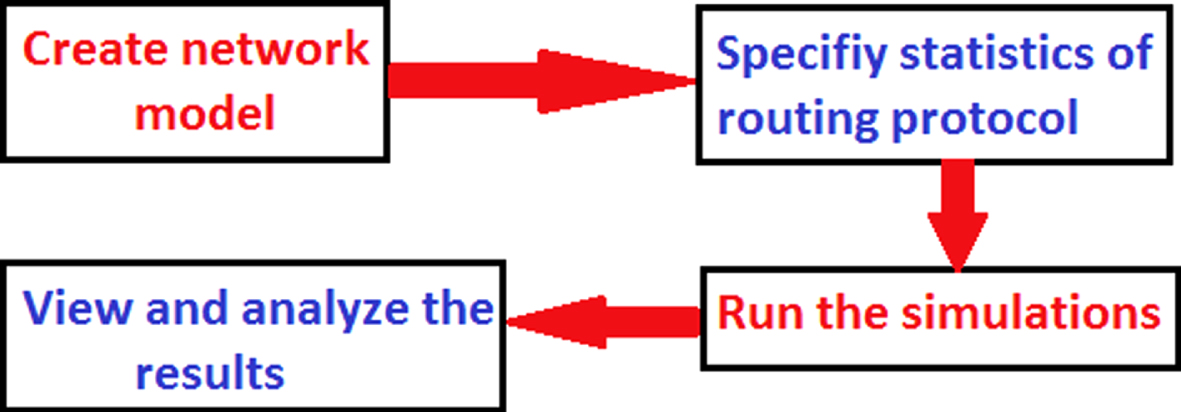
Block diagram of the proposed system.
Figure 2a and 2b shows the architecture and clustering of WSN. It consists of several sensor nodes and centralized location named BS. Initially, all the sensor nodes are positioned to form clusters. Clustering is helpful for uniform communication and to cooperatively pass their data to a primary location called sink. The sink collects data and reports the same to users through the internet.
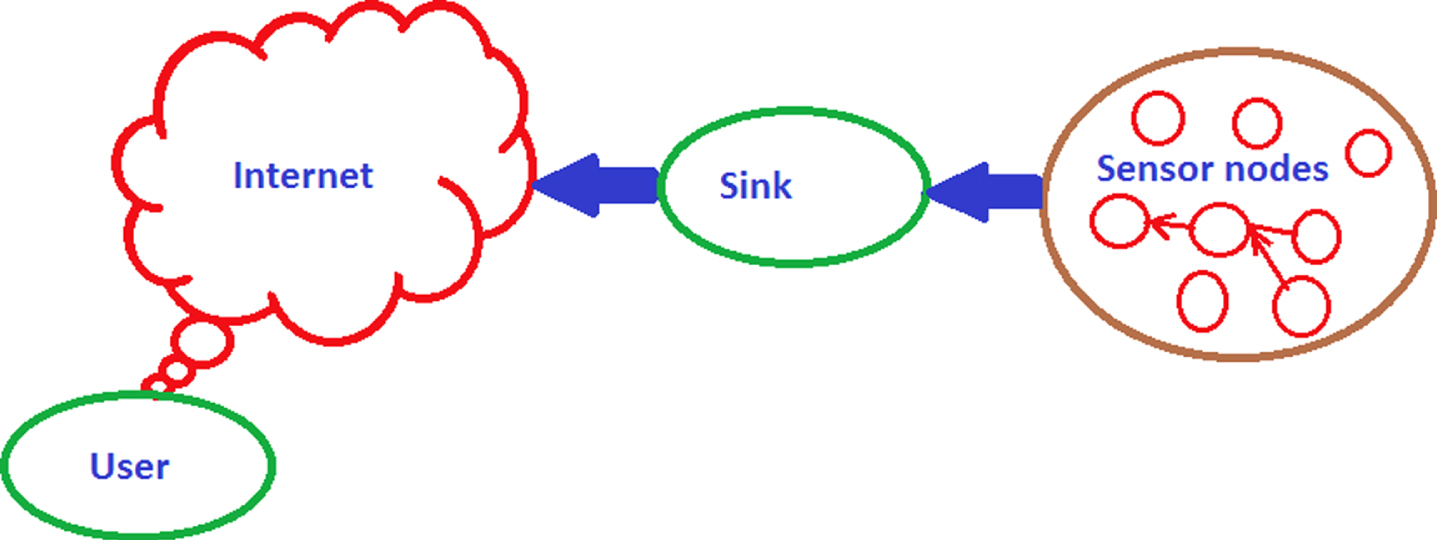
Architecture of WSN.
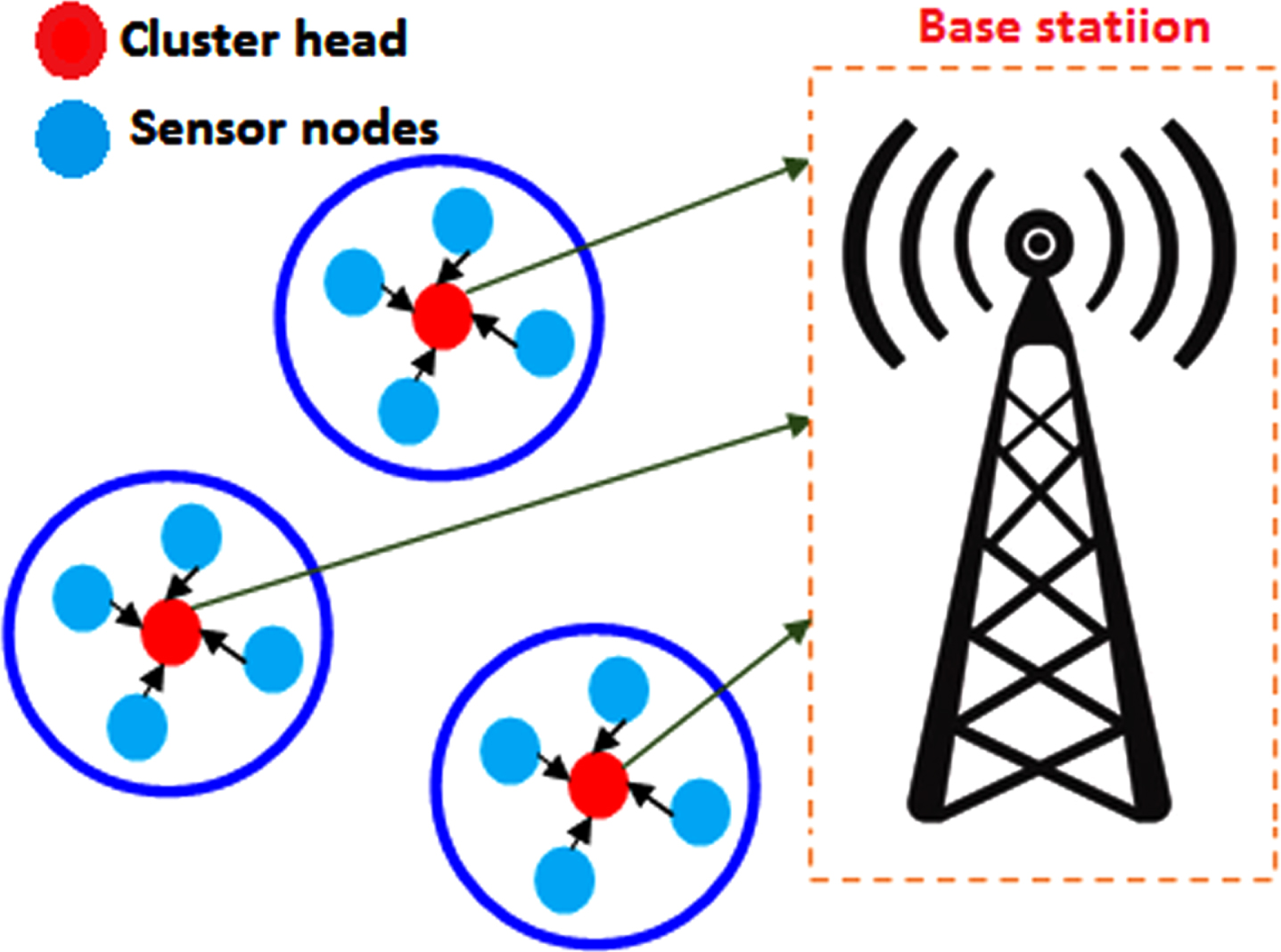
Clustering process of WSN.
In the proposed EEESAA algorithm, sensor nodes transmit their location information to the BS. Then BS calculates the distance between the nodes. The nodes that are located at the minimum distance are coupled by BS. The paired nodes information is sent by BS to all nodes in the network. Here the paired nodes switch between sleep and awake mode. So the power consumption is minimized. Isolated nodes remain in active mode. The proposed algorithm also enhances the CH selection technique. More are detailed in the following sections.
Generally, the data forwarded by the sensor nodes within short distances lead to redundant sensing which results in performance degradation and unnecessary data transmission. In this research work, application based dense sensor nodes are considered to eliminate redundant transmission. So, data’s are sent with different transmission rate according to the data rate. The number of messages reported by high rated data is much greater than low rated data. It leads to uneven energy dissipation. So this work proposes the concept of node pairing. The nodes which are placed in close proximity are paired for sensing and transmitting data. Based on the energy rate criteria, the paired nodes alternate between sleep and awake mode. Pair formation is followed by CH selection. A node with lesser distance from the sink is selected as CH. Once CHs are formed, remaining sensor nodes become a member of the closest CH. Even though the node has no data to transmit, it must be in awake mode during its slot time which leads to waste of energy. This is rectified by allocating slot according to the number of paired and isolated nodes within the cluster.
EEESAA: algorithm
Start the program Initially, all nodes send their location details to BS. Then BS uses coupling algorithm couples/ pairs the nodes with the minimum distance. All nodes aware of their paired partner Paired node will be active if other nodes distance is lesser than its partner. Active mode is also called as awake mode whereas inactive mode is known as sleep mode Nodes may not be paired due to its long distance placement. It is called isolated and awake node Each node generates a random number based on cluster head selection probability The node which has lesser random number than the threshold value is selected as CH and the information is broadcasted to all other nodes All the non-CH nodes and the isolated nodes send join message to the nearest CH Again node pairing is done. Unpaired nodes send data to CH without computing the energy rate If the energy (Ni) of the paired node is greater than the threshold value, then it is said to be awake. Otherwise the node will be in sleep mode. According to the present energy level and threshold value sleep and awake node will be altered. Awake nodes are used to sense the surrounding and send data to CH End the process
EEESAA: system flow chart
The detailed description of the proposed algorithm is shown in Fig. 3.
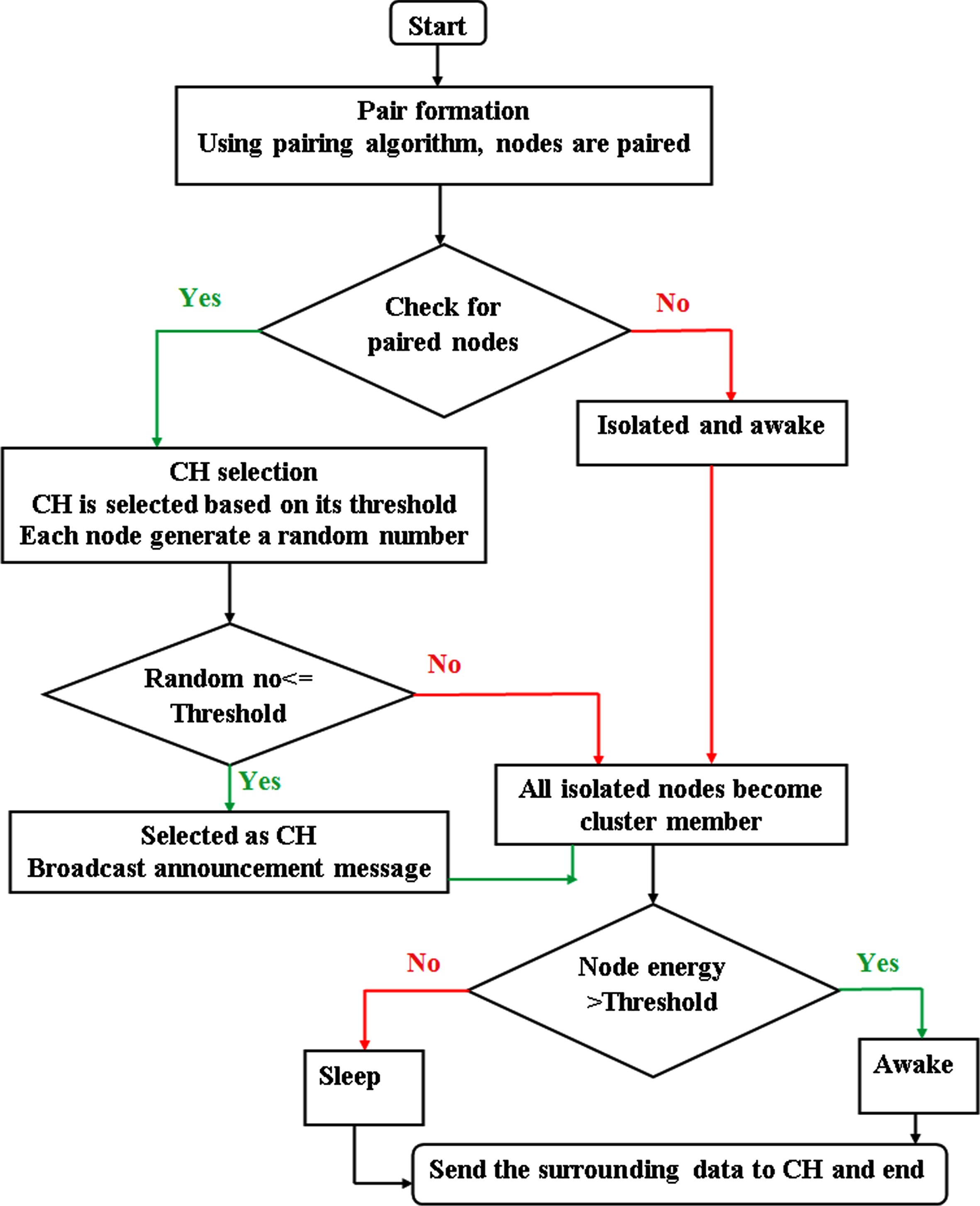
System flow chart.
Figure 3 summarizes the proposed approach.
Literature use node pairing strategy for homogeneous scenario only. However this work uses heterogeneous scenario. Introduction of pairing concept eliminates heavy energy consumption. In the pairing strategy, sensor nodes with the same intra cluster range and the same applications are paired together. The paired nodes can alter the data transmission tasks. This alteration procedure is also called sleep-awake mechanism. It uses centralized approach for pairing. So all the other nodes are aware of the paired nodes. And also nodes send the identity and position information to the BS. The node without having the pair node is noted as isolated node. The following algorithm describes node pair formation.
Selection of CH
Cluster head selection is responsible for data collection, communication gateway between BS and sensor nodes, cluster coordination and data transmission. CH is selected if the generated random number by the node is lesser than the threshold T (i,r).
G(r) - Entitled CH nodes
r - Number of round
The ratio of number of pairs is calculated by,
Where, Nbi (r) - Number of pairs for node i at r round
The node with higher number of pair, low traffic and higher energy has high chance of being selected for CHs. So, the CH selection probability is given by,
ETIE & Eaed – Total initial energy and average energy dissipated
Poptm – Optimum CH node percentage
Koptm – Optimum cluster number
βTH – Traffic heterogeneous parameter
βTHi – Traffic heterogeneous parameter for ith node
Ei (r) – Energy remains in r round
βEHi – Energy heterogeneous value for ith node
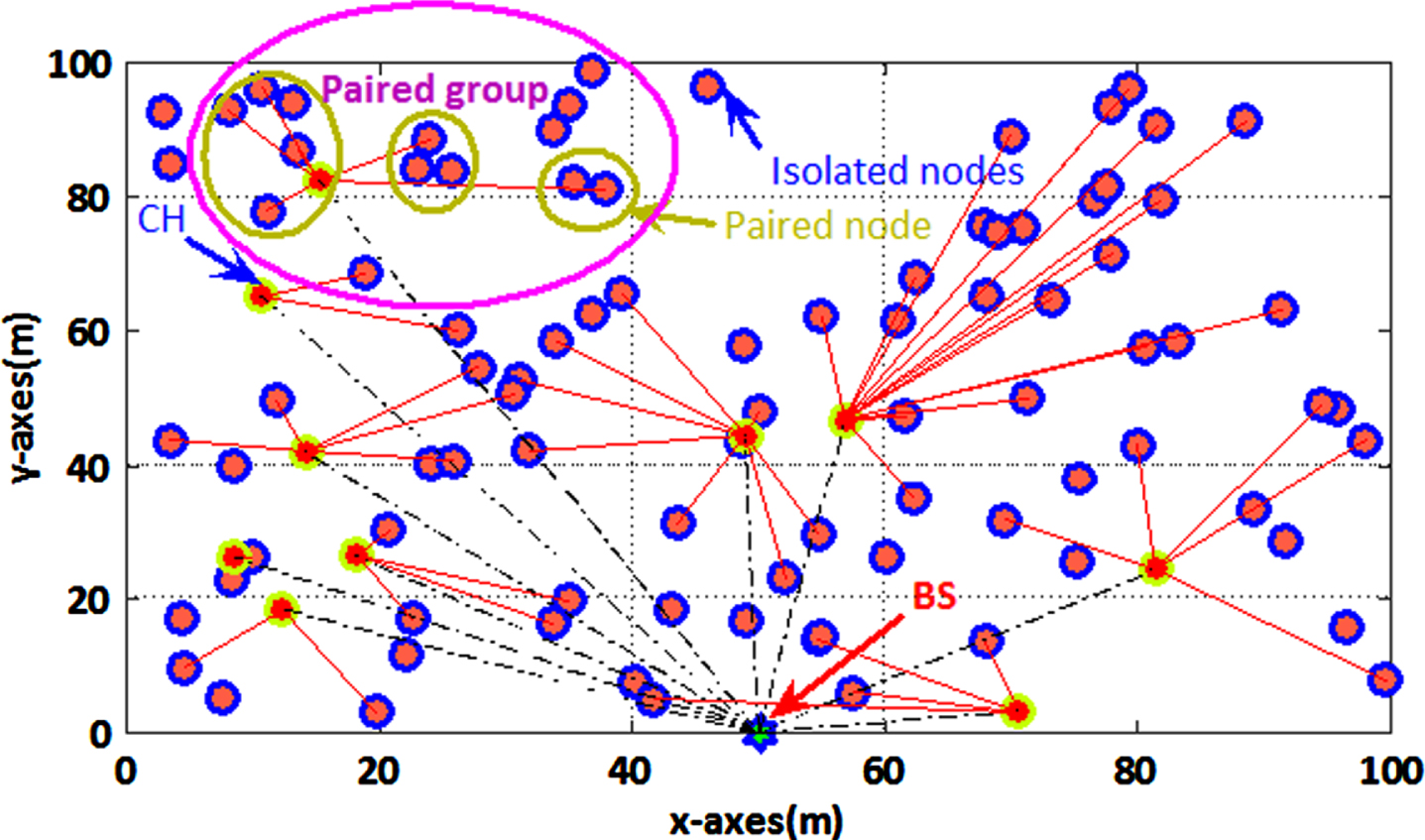
Figure 4 shows the paired node and isolated nodes. As shown in the figure, the nodes within the clusters are called as paired nodes and the cluster where the paired nodes are connected is called paired group. The sensor node which is not connected anywhere is called isolated node.
Pair formation.
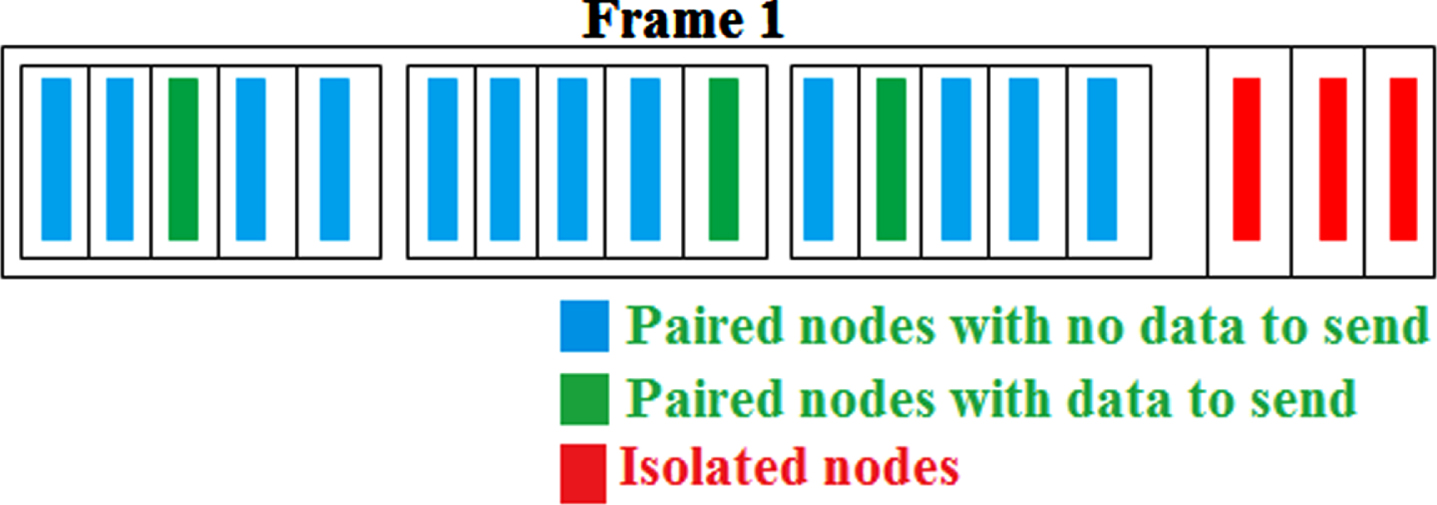
To avoid overlapping of data transmission CH schedules time division multiple access (TDMA). A slot is allocated to each nodes in the paired group. Traditional TDMA method fixes the slot continuously for the data to be conveyed. During the slot time sensor node is awake which leads to energy waste. Here the number of paired groups determine the number of slots in a cluster. The number of allotted slot can be found by using the following formula.
N – Number of nodes
K – Number of clusters
The total time spent/ cluster Tts can be written as,
Where, Tt is the time required to transmit data to CH and the number of allotted slot is Nslot. From Fig. 5, it is clear that each pair group is allocated a slot and each isolated node has a slot.
TDMA schedule architecture.
The following algorithm explains TMDA schedule among the paired group and isolated nodes.
The total energy dissipated by CH during the round is calculated as follows,
EAGR – Aggregate received data,
The nodes which are in awake mode is used to transmit their detected data to CH. Generally nodes in sleep mode are not affected by the transmission phase. By using this technique, a reasonable amount of energy can be saved.
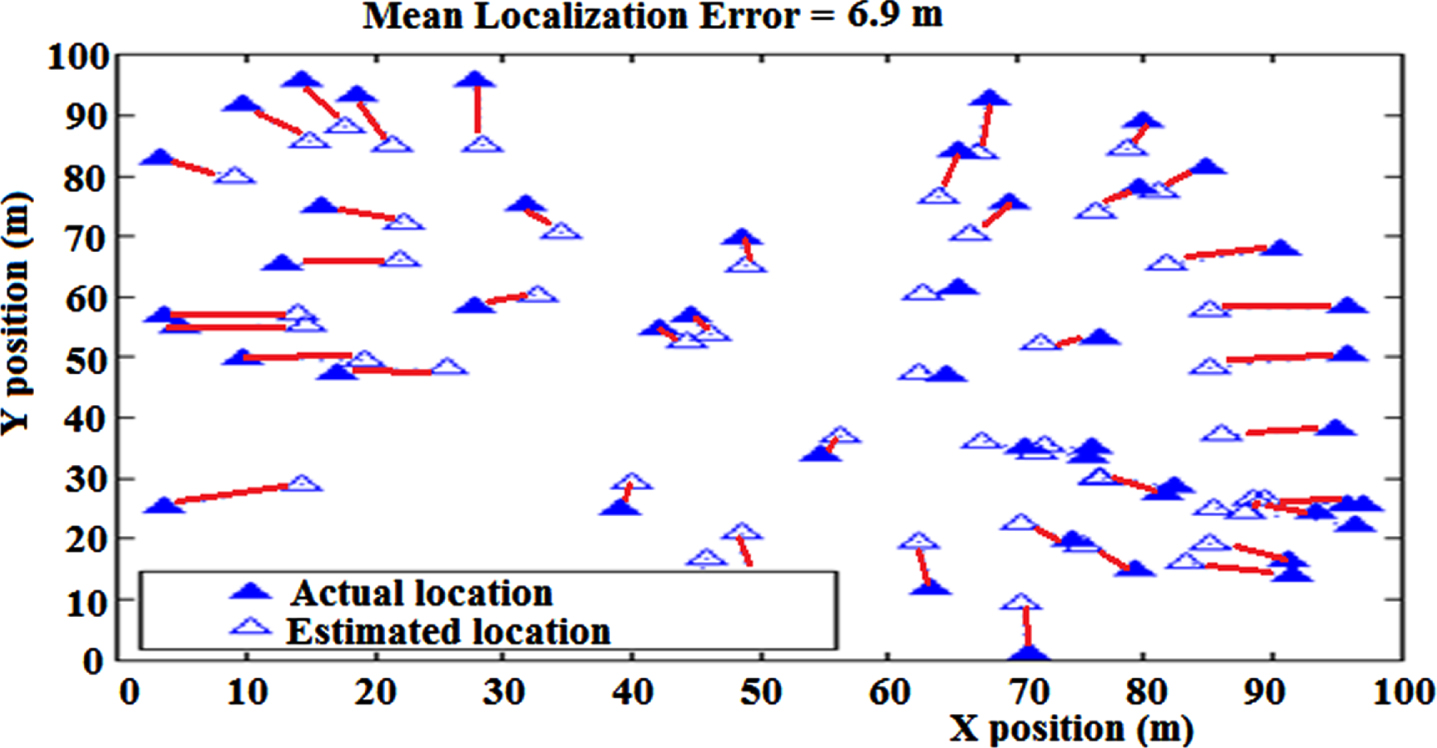
The simulation results are detailed in this section. 100X100 m area with 100 sensor nodes are deployed in this work. BS is positioned at the corner of the region. The proposed approach is simulated using MATLAB R2015a. Here first order radio model is depicted. The network parameters used for the proposed simulation work is given in Table 1. Figure 6 shows the actual and estimated node location.
Simulation parameters
Simulation parameters
Actual and estimated node location.
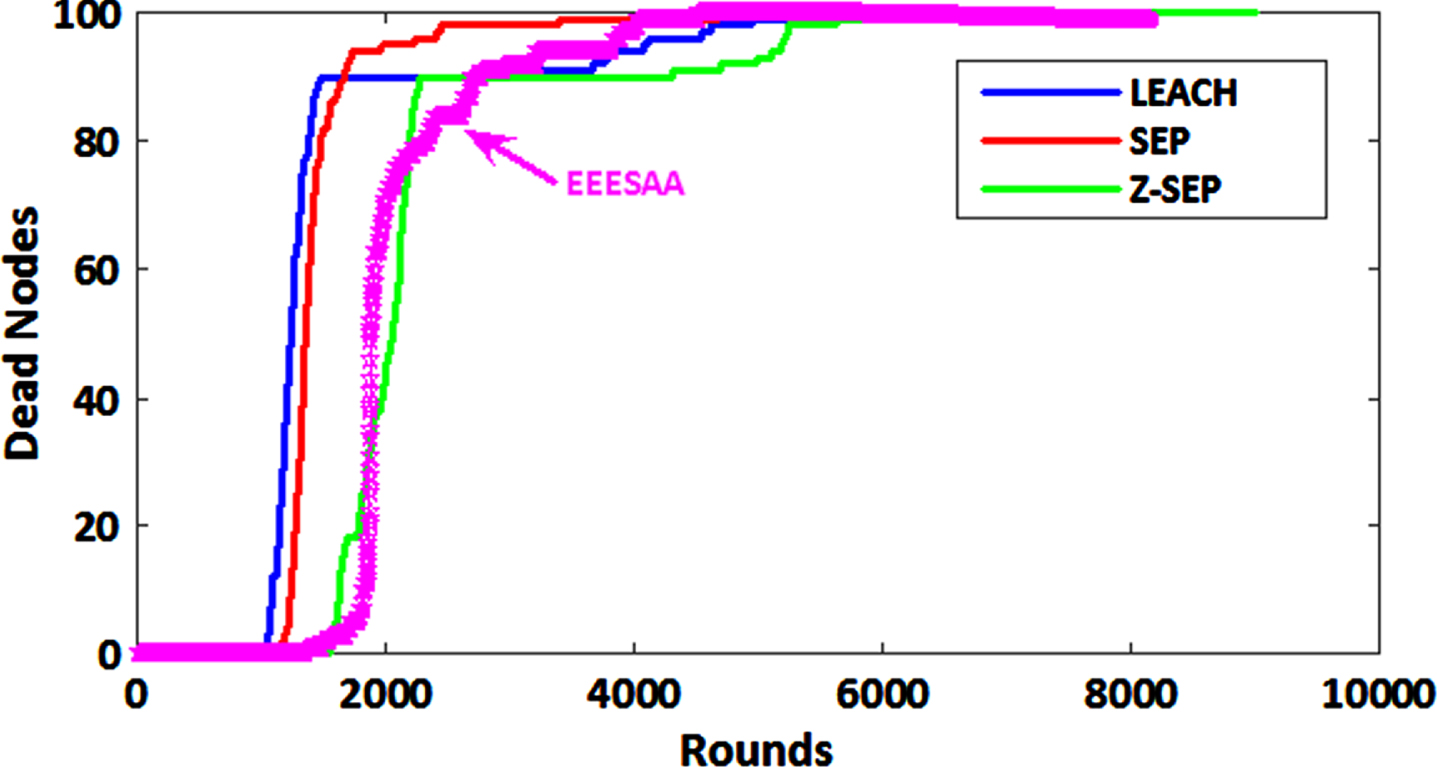
Network lifetime is the exact time when the network is non-functional and the time taken by the network right from the node deployment. In this research work, it is considered as the rounds. One round is calculated as time of the first node dies or certain percentage of nodes die or depletion of the last node in the network. We analyze network lifetime of LEACH, SEP, Z-SEP and our EESAA protocols; hence, the following figures show the numbers of alive and dead nodes
Figure 7 shows the number of dead nodes per round. From the figure it is understood that the first node of EEESAA is died in 1900 round which is smaller than other protocols. So the stability period of the EEESAA is also longer. Figure 8 shows the number of alive nodes. The number of alive nodes are larger than the other protocols.
Number of dead nodes.
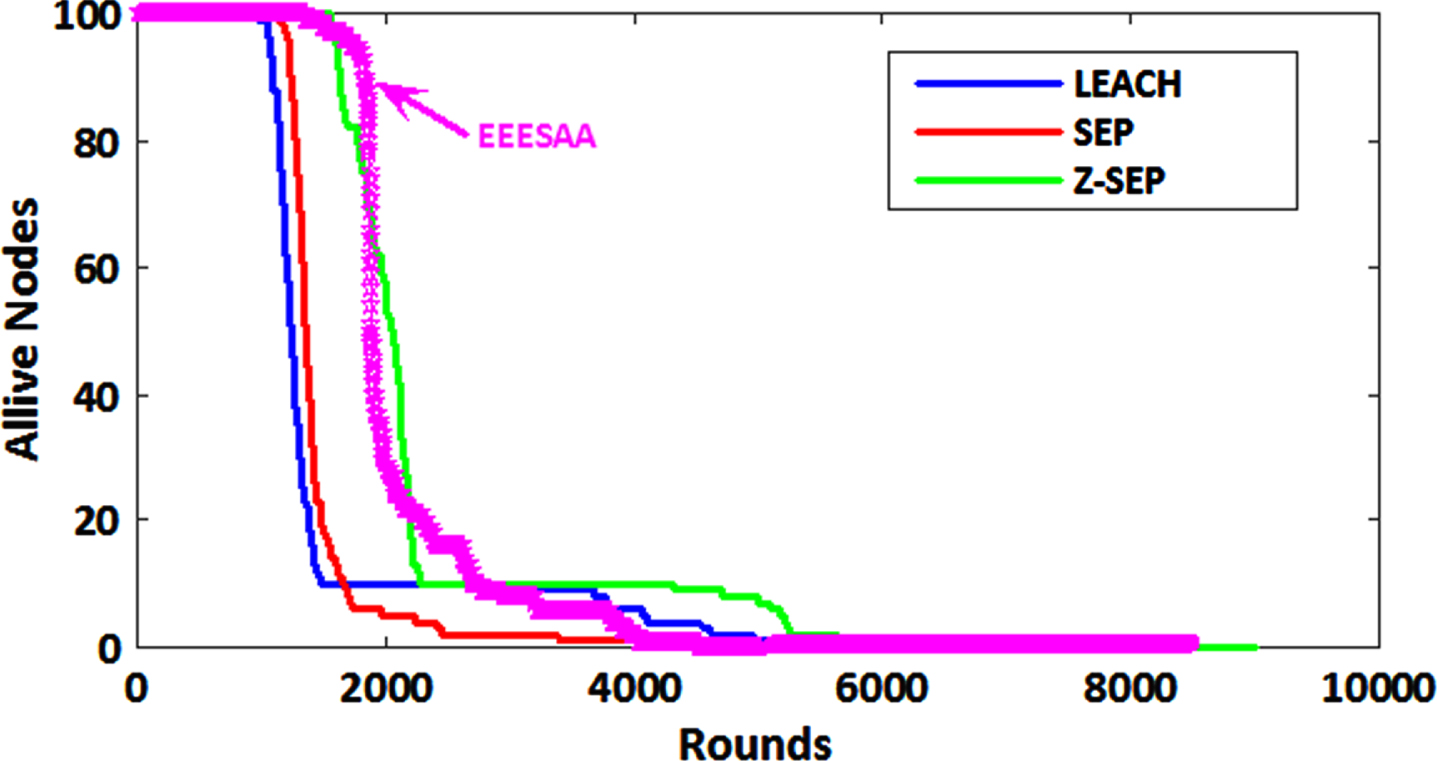
Number of alive nodes.
The total number of CH/round is shown in Fig. 9. It shows that the instability region of EEESAA is started after 4500 round. The first round dead in 2590 rounds in case of proposed EEESAA whereas 2000 rounds in Z-SEP protocol. LEACH and SEP has the first dead nodes in 1800 and 1900 rounds respectively. It means the enhancement percentage in stability period is 26%, 30%, 65% and 69% comparing with EEESAA, Z-SEP, SEP and LEACH respectively.
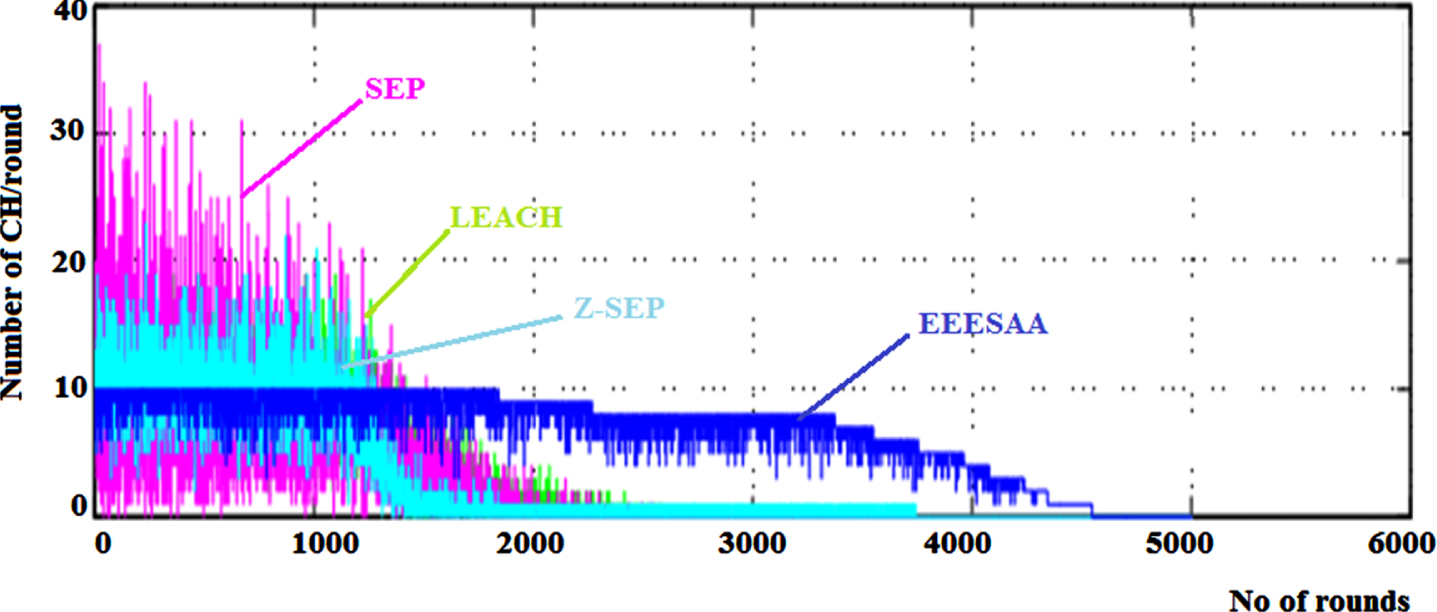
Number of CH.
The network life time has been increased to 58%, 61%, 100% and 120% comparing with EEESAA, Z-SEP, SEP and LEACH respectively. A random number of CHs is selected in each round, however the ESSA protocol has a controlled selection of CHs. Figure 10 shows the residual energy diagram of EEESAA. Residual energy (RE) is the remaining energy which has the ability to make efficient use of network energy.
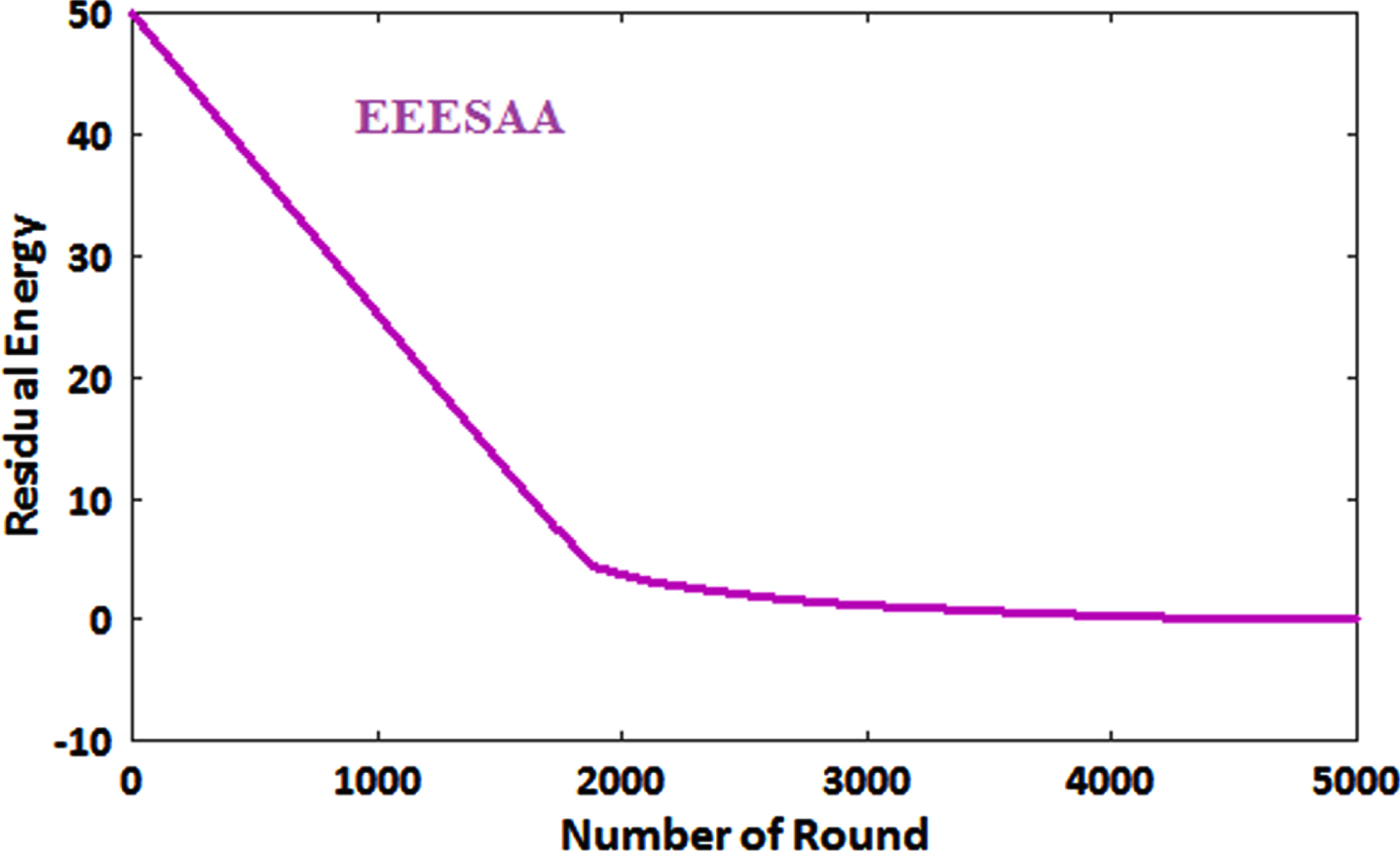
Residual energy.
Throughput is the total number of bits transmitted to the BS in a particular period of time. The Fig. 11 shows the number of packets sent to BS. The proposed EEESAA has better throughput than other algorithms.
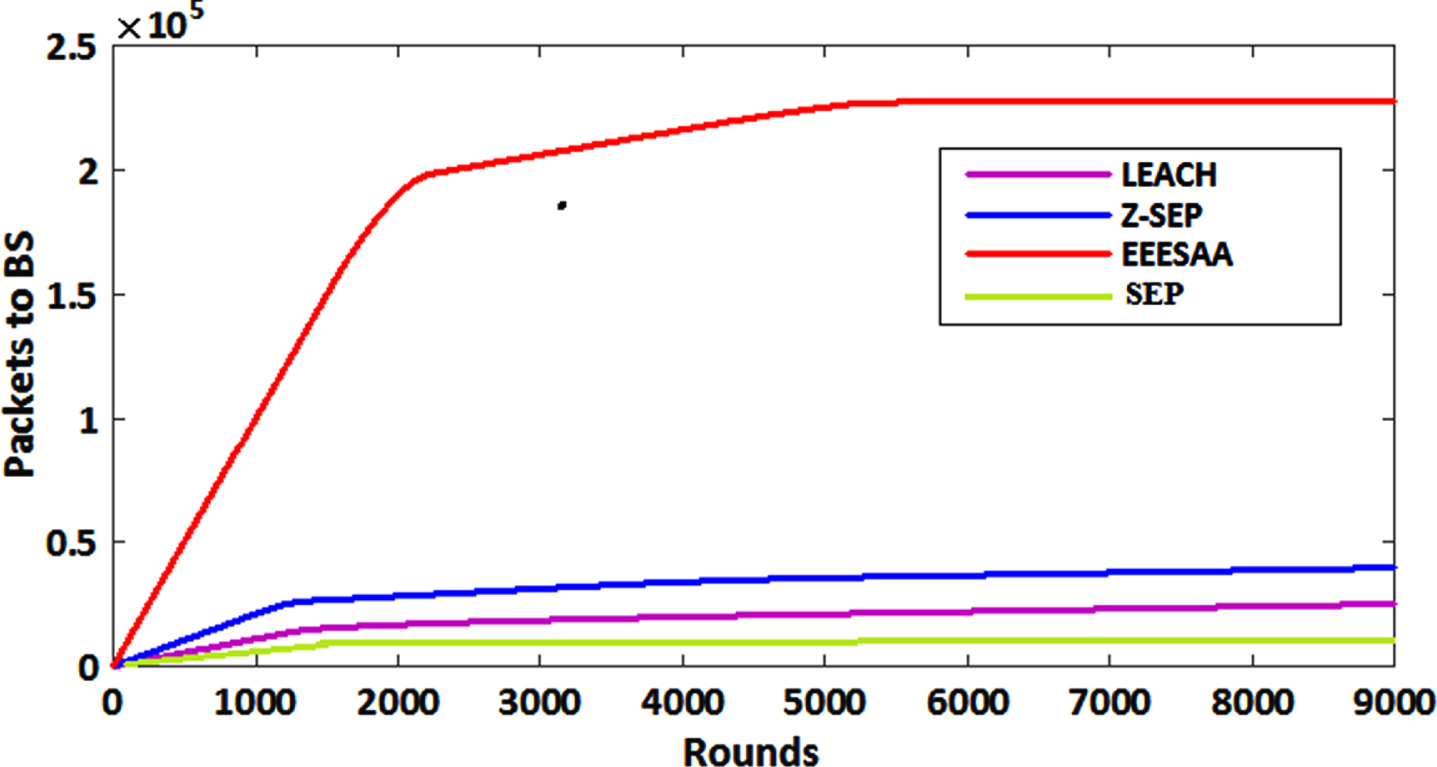
Packets send to BS.
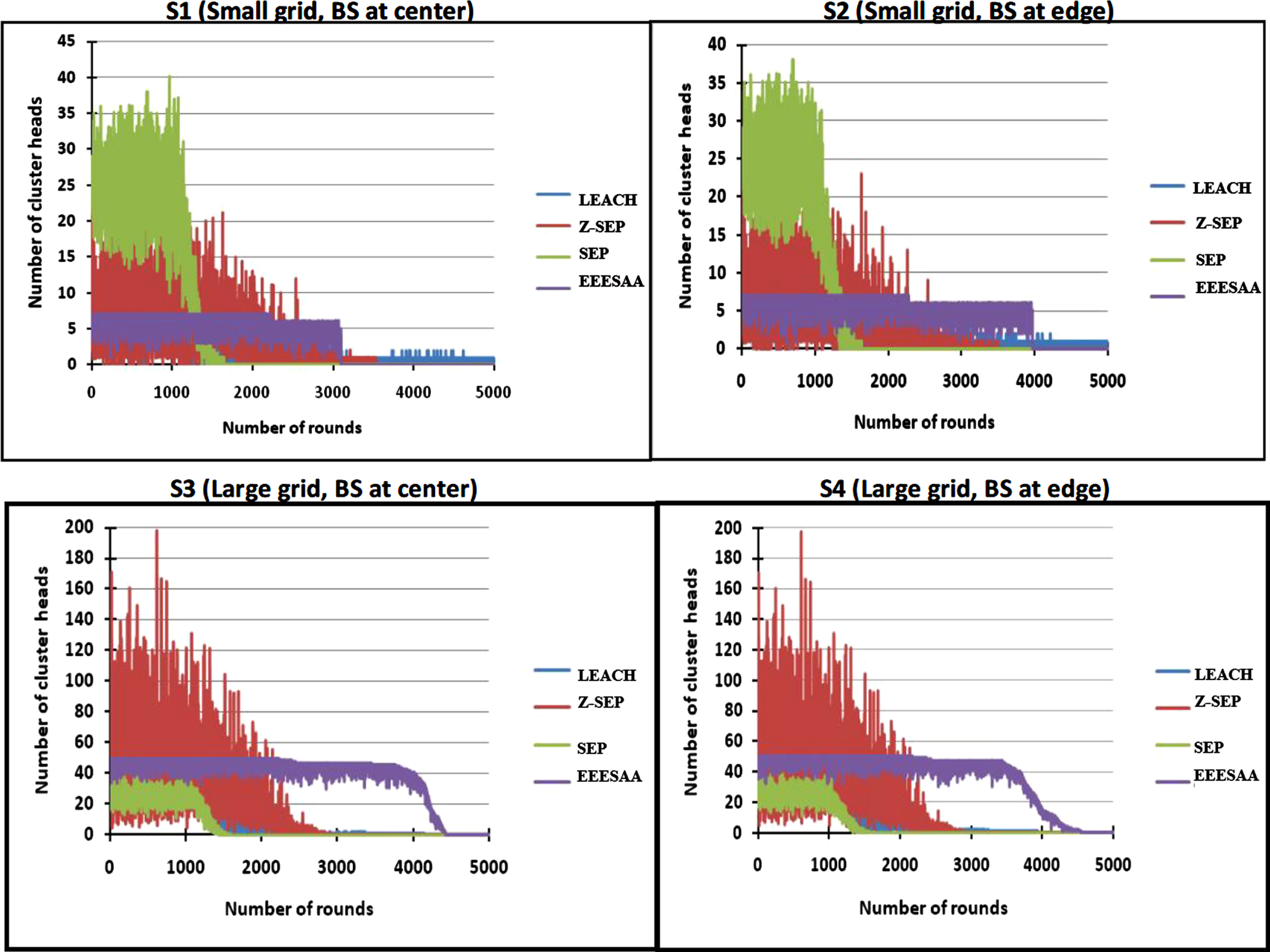
Comparison of four different protocol of cluster head per round.
The efficient CH selection algorithm of the EESAA protocol allows data to be transmitted in a better and consistent way to the BS. Due to the nodes’ sleep-wake strategy, EESAA transmits less data to the BS during the first rounds. However, after 4500 rounds, EESAA has the highest data rate.
In this work, a new energy efficient routing technique for WSNs on EEESAA protocol is proposed. It is based on the pairing concept which swings between active and sleep modes. The main aim of this research was to maximize network lifetime, alive nodes and minimizing the number of dead nodes by using CH selection process, efficient energy consumption model and service reliability. CHs were selected on the basis of residual energy from the previous round. EEESAA algorithm has a good enhancement in power consumption by changing phase between sleep and active. The slots were allocated for the paired nodes even though not all nodes have data to report to CH. This is done to address idle listening problem to minimize energy consumption. Stability period of the network and lifetime has been improved. Simulation results show that there is significant improvement in first node dead, tenth node dead, packets sent to BS, and packets sent to CHs when compared with related work in the same area such as LEACH, SEP, Z-SEP and EEESAA protocols.