






Abstract
Multi-attribute group decision-making (MAGDM) is one of the research hotspots in human cognitive and decision-making theory. However, there are still challenges to the existing MAGDM methods in modeling uncertain linguistics of decision-makers’ (DMs’) cognitive information and objectively obtaining weights. Therefore, this paper aims to develop a new MAGDM method considering incomplete known weight information under spherical uncertain linguistic sets (SULSs) to model uncertain information in MAGDM problems. The method mainly includes the following aspects. Firstly, a new concept, which enables an intuitive evaluation of neutral membership and hesitancy degrees at the linguistic evaluation, has been is first developed for capturing the more uncertain information. Secondly, the cosine similarity measure (CSM) and cross-entropy measure (CEM) are widely used to measure ambiguous information because of their robustness of measurement results. The CSM and CEM are extended to SULSs to calculate the DMs’ and attributes weights quantitively, respectively. Thirdly, in terms of effective integration of fuzzy information to obtain more accurate decision results, the Hamy mean (HM) and dual Hamy mean (DHM) operators are valued due to their consideration of the interrelationships between inputs. Two extension operators, named spherical fuzzy uncertain linguistic weight HM and DHM, are proposed to integrate spherical fuzzy uncertain linguistic information in the third stage. In the experiment, a decision case is presented to illustrate the applicability of the proposed method, and results show the effectiveness, flexibility and advantages of the proposed method are demonstrated by numerical examples and comparative analysis.
Keywords
Introduction
Decision-making in humans can be described as a cognitive process that mainly focuses on the data that is given as input and on the cognitive capabilities of people [1]. Multi-attribute decision-making (MAGDM) is a process of selecting the best alternative from a set of alternatives containing multiple attributes which are evaluated by a group of decision-makers (DMs) based on their cognitive factors [2]. Cognitive factors include DMs’ knowledge, experience, psychological factors, etc. In the actual problem, due to the limitation of DMs’ cognitive structure, effectively expressing ambiguous and uncertain attribute information is the primary key task to making the right decision. The fuzzy set theory [3], expressing ambiguous information through the degree function, is favored by most scholars for its contribution to expressing the uncertainty and ambiguity of information. For example, uncertain information is effectively examined by membership degree (MD) and non-membership degree (NNMD) assigned by intuitionistic fuzzy sets (IFS) [4]. Considering the condition that IFS can’t solve, the Pythagorean fuzzy set (PyFS) is proposed [5] by relaxing the satisfied condition of the IFS. Although IFS and PyFS are applied to many felids [6, 7] some scenarios in our daily life make it difficult to express information by using them. The classic scenario is the one faced by voters when exercising their right to vote. There are four options for voters which are voting supporting, opposing, abstaining and refusing to vote where abstention means that the voters participate in the voting but reject both support and opposition to the candidate. In order to make more contributions to fuzzy theory in the scenarios of MAGDM, Cuong et al. [8] added the neutral membership degree (NMD) based on the IFS and proposed the concept of the picture fuzzy set (PFS). However, the assignment of membership functions of PFS is strictly required to be within a certain range, there is no way to solve such a practical scene where the MD, NNMD and NMD are 0.3, 0.4 and 0.4 respectively. Gündoğdu et al. [9] proposed the spherical fuzzy set (SFS). It expresses the information more precisely by assigning MD (P(x)), NNMD (I(x)), and NMD (N(x)) under the condition of 0≤P2(x)+I2(x)+ N2(x)≤1. In view of the exceptional performance of SFS in dealing with uncertain phenomena and information, it is applied in many fields, such as warehouse site selection [9], project selection [10] and supplier selection [11]. Although SFS has certain advantages in expressing fuzzy information, it is difficult to implement in practical scenarios. Because DMs prefer to express their preference information in qualitative values for the complexity of real-world problems and the ambiguity of human cognition. For example, linguistic values such as “good”, “poor” and “excellent” failed to be discussed by approaches under IFS, PFS, and PyFS.
The linguistic variable (LV) is proposed by Zadeh [12] for expressing attributes of alternatives in such scenarios. To further facilitate the application of linguistic variables in the field of MAGDM, scholars have combined the advantages of quantitative and qualitative evaluation. Generally, the MD of the linguistic variable is one, which limits the expression of uncertain information. To address the above restriction, Xu [13] considered the advantage of an ordered linguistic variables pair to express the linguistic information and proposed the concept of uncertain linguistic numbers (ULNs). Liu and Jin [14] combined the ULS with IFS and developed the intuitionistic uncertain linguistic sets (IULSs). Meanwhile, the Pythagorean fuzzy uncertain linguistic set (PyFULS) [15] is introduced to enhance the ability to model uncertain information. In addition, Wei [16] proposed the picture uncertain linguistic sets (PULSs) by considering the NMD and applied it to select the service outsourcing provider of the communications industry. Nevertheless, the IULSs, PFULSs and PULSs inherit the drawbacks of IFSs, PyFSs and PFSs. Overcoming these defects will be an interesting and meaningful topic in MAGDM problems. However, the aforementioned extension sets are still ineffective in some scenarios. However, the aforementioned extended sets are still ineffective in some scenarios as they inherit the inherent drawbacks of existing fuzzy sets. For example, the IULSs inherits the drawbacks of IFS’s inability to express neutral attitudes and limited usage range.
As two important topics in the fuzzy theory, cross-entropy measures (CEMs) and similarity measures (SMs) of fuzzy sets have been investigated widely by many researchers from different points of view [17]. For example, Borah et al. [1] derived two weighted vector similarity measures to obtain the optimal alternative. On the one hand, there are certain cognitive limitations in people’s minds, such as initial impressions and emotional satisfaction at the time of decision-making, which limit them from giving reasonable evaluation information in MAGDM scenarios. Therefore, calculating DMs’ weights can give a contribution to making the right decision. For instance, Liu et al. [18] determined the weights of DMs by calculating the Jousselme distance under linguistic intuitionistic fuzzy numbers (LIFNs). Similarity measures can help favorably for such calculations. Scholars have made great efforts in this direction. Yang et al. [19] gave the Hausdorff distance measure under q-rung orthopair fuzzy sets (q-ROFSs) to calculate the weights of DMs. However, Ye [20] demonstrated that other similarity measures of IFS have stronger discrimination in pattern recognition and medical diagnosis while the cosine similarity measure (CSM) possesses strong robustness. In addition, the CSM can be applied to the measurement of text similarity compared to other SMs [21]. The CSM, which is defined in vector space, is applied to judge similarity matrices or vectors by identifying the consistency of matrices. Later, Liu et al. [22] proposed the CSM for ILSs and applied it to pattern recognition and medical diagnosis. On the other hand, information about attribute weights is not completely known or completely unknown due to time pressure, lack of knowledge or data, and limitations of DMs’ cognition of the problem domain. How to obtain the optimal weights of such attributes has become a research challenge in the field of MAGDM. Wang et al. [23] constructed the maximum deviation model under q-ROFSs by calculating the distance between attributes to obtain incompletely known weights. The CEM, as an important concept in Shannon’s information theory, is used to measure the variability of two information distributions. Currently, cross-entropy has been successfully applied to cognitive decision problems, and many scholars have proposed various fuzzy sets of cross entropy for measuring the discrepancy of two fuzzy information [24, 25]. Peng et al. [26] developed the cross-entropy of intuitionistic hesitant fuzzy sets (IHFSs) for determining the optimal weight of attributes by constructing the optimization model. Ye [27] constructed the objective function to derive the optimal evaluation for the weight of each alternative based on cross-entropy of interval-valued intuitionistic fuzzy sets (IVIFSs). Similarly, due to the inherent shortcomings of current fuzzy sets, the application of these measures in practical problems is affected. Extending CEM and CSM to more general models to solve MAGDM problems in multiple scenarios will be more valuable.
Another challenge for MAGDM problems is the correct ranking of alternatives. Unlike traditional decision-making methods, such as Technique for the Order of Preference by Similarity to Ideal Solution (TOPSIS) [28], vIsekriterijumska optimizacija i kOmpromisno Resenje (VIKOR) [29], and TODIM (an acronym in Portuguese of interactive and multiple attribute decision-making) [30], aggregation operators (AOs) can fuse the attribute assessment of the alternatives and provide the ranking results [31]. For instance, Liu and Jin [14] investigated the MAGDM approach based on weighted geometric average (WG) and ordered WG (OWG) operators in the intuitionistic uncertain linguistic environment. However, the WG and OWG operators suppose the attributes are independent and ignore the interrelationship between attributes. Recently, Liu and Zhang [32] proposed the intuitionistic uncertain linguistic Bonferroni mean (BM) operators for aggregating intuitionistic uncertain linguistic information. However, the BM aggregates the attribute with the assumption that there is only an interrelationship between any two attributes. The Hamy mean (HM) operator, proposed by Hara [33], can capture a variety of interrelationships among multiple arguments by flexibly adjusting its parameter, and many MAGDM methods on HM have been achieved. For example, Ji et al. [34] proposed HM operators of the probabilistic dual-hesitant Pythagorean fuzzy sets for aggregating probabilistic dual-hesitant Pythagorean fuzzy information. Xing et al. [35] incorporated HM into the q-ROFSs and proposed q-ROFSs Hamy mean operators. Liu et al. [36] developed a MAGDM method based on linguistic intuitionistic fuzzy Hamy mean operators. In practical MAGDM problems, a robust integration operator is favored by decision-makers. Therefore, it is meaningful to extend the HM operator to the MAGDM method that can capture multiple types of information to integrate information.
From the above analysis, it can be seen that SFS can overcome the disadvantage that other fuzzy sets cannot capture the neutral membership objectively and ULSs can fully express qualitative information, but there are still many limitations in solving the MAGDM problem. The limitations and drawbacks of all these techniques are listed as follows. In view that the expression of human cognition in the actual MAGDM scenarios is indispensable from qualitative and quantitative information. SFSs and ULSs have demonstrated a strong ability to express quantitative and qualitative information, respectively. However, it is not considered simultaneously to obtain uncertain information. In the field of cognitive decision-making, DMs’ preference information is often influenced by their cognitive factors such as knowledge, experience, and psychology [1]. Measuring the weights of DMs is a critical step to making the right decision. Based on the more robust measurement result, the CSM has been used in many fields, such as pattern recognition [22], medical diagnosis [37], MAGDM [38], etc. However, in the evaluation of uncertain semantics and spherical fuzzy environments, CSM will fail. Attribute weights are often unknown or incomplete known due to human cognitive limitations and the complexity of the actual cognitive decision problems. Addressing unknown or incomplete known attribute weights in cognitive decision-making has become a hot topic [39]. The CES is widely respected by scholars for its outstanding ability to measure fuzzy information [27, 40]. However, due to the limited application scenarios of fuzzy modeling tools, the practical application of CES is also limited. Providing a more general solution for cognitive decision-making to construct optimization models for cognitive decision-making problems with incomplete or unknown attribute weights is currently needed in research. It is well known that the integration of information is an important influencing factor for proposing correct and rational decision results. The HM and operators can capture a variety of interrelationships among multiple arguments by flexibly adjusting parameter k. How to combine its information integration advantages and propose a more general MAGDM method is currently lacking in research institutes.
Motivation and Contribution
The method proposed is motivated by five attractive branches of the literature, that is, SFSs, ULSs, fuzzy information entropy, cosine similarity measure and fuzzy information integration operators. Their combination results in novel techniques, named SULSs, spherical uncertain linguistic fuzzy cosine similarity measure, spherical uncertain linguistic fuzzy cross entropy and spherical uncertain linguistic fuzzy weight operators, which allow us to perform appropriate evaluations of decision in MAGDM. The main motivations of this paper can be described as follows: In the evaluation of decision information, it is expected to capture more information. In the expression of assessment information, a novel concept, named spherical uncertain linguistic fuzzy set which can capture the subjective and objective information by expressing the satisfaction, abstinence and dissatisfaction nature of human decisions, is proposed. It is necessary to calculate the weight of experts in the decision assessment process because experts are not completely rational. The cosine similarity measure which has shown strong robustness is applied to measure the degree of similarity by identifying the consistency of information. The calculation of incomplete known weights has become a hot topic, and the optimization model based on cross entropy measure can effectively solve the incomplete information perfectly. Integration of fuzzy information is a crucial step in obtaining correct decision results. HM and DHM operators have the ability to flexibly consider the interrelationships between multiple inputs in information integration. Expanding them to the new MAGDM method can enhance information fusion capability.
The main contributions of the proposed method are as follows. Modeling expert evaluation information using SULSs. This is because SULSs not only relax the limitations of experts expressing uncertain and fuzzy evaluation information but also integrate the expression ability of quantitative and qualitative information, making them suitable for more practical analysis scenarios. Deriving the CSM under SULSs for objectively determining DMs’ weights. It can balance the impact of the assessment results caused by the differences in experts’ cognition. Constructing an optimization model by proposing the CEM under SULSs is applied to objectively compute the optimal weights for the incompletely known or completely unknown attributes in practical complex MAGDM problems. Proposing the HM and DHM operators under the spherical uncertain linguistic environment to capture the input of ambiguous and uncertain information for improving the reliability of the cognitive decision results. The operators are applied to integrate the evaluation information for they can capture a variety of interrelationships among multiple arguments by flexibly adjusting its parameter. Applying the proposed method to a case of select suppliers and comparing the proposed method with other existing methods. The applicability, superiority and robustness of the method are verified.
Novelty
This paper introduces a new MAGDM method, in which the proposed SULS uses multiple scenarios to capture uncertain information, which can solve scenarios that existing uncertain information modeling tools cannot capture. Combining the inherent characteristics of integrating multiple experts and attributes in MAGDM problems, CSM and CEM in a spherical uncertain semantic environment are proposed to objectively obtain expert and attribute weights. The proposed method is used simultaneously for MAGDM problems with unknown and incompletely known attribute weights, which are not executable in many existing methods.
The rest of this paper is shown as follows: Section 2 reviews some basic concepts and proposes some new concepts by correcting the operator laws of the SFSs. In Section 3 and Section 4, we propose four SULHM operators and the MAGDM approach based on the proposed operators, respectively. Section 5 conducts a numerical experiment and some comparative analyses to illustrate the validity of the proposed MAGDM approach, and Section 6 summarizes this paper.
Preliminaries
In this section, we shall briefly review the concepts of SFSs [9], ULSs [13] and HM [33]. Meanwhile, the definitions and basic operational rules of SULNs are proposed.
Spherical fuzzy sets and uncertain linguistic sets
where μ A (x), η A (x) and ν A (x) represent the positive membership degree, the neutral membership degree, and the negative membership degree respectively, satisfying the condition that 0≤μ A (x), η A (x), ν A (x)≤1 and 0≤μ A (x)2+η A (x)2+ν A (x)2≤1. The refusal degree of A is expressed as π A (x) = (1-μ A (x)2-η A (x)2-ν A (x)2)(1/2). For convenience, (μ A (x), η A (x), ν A (x)) is called a spherical fuzzy number (SFN), which can be simply denoted by α = (μ, η, ν).
If i > k, then s
i
> s
k
, Negation operator: Neg(s
i
) = s
k
, such that k = l-1-i, Maximum operator: if s
i
≥s
k
, max {s
i
, s
k
} = s
i
, Minimum operators: if s
i
≤s
k
, min {s
i
, s
k
} = s
i
.
In general, l can be set to 5, 7, 9, etc. For example, when l = 7, a set S can be represented as follows:
However, the assessments of attributes cannot be described by a single LV accurately. Xu [13] proposed the concept of the uncertain linguistic number to save all given information.
s1 ⊕ s2 = [sθ1+θ2, sτ1+τ2] , s1 ⊗ s2 = [sθ1×θ2, sτ1×τ2] , λs = [s
λ×θ, s
λ×τ] , s
λ = [s
θ
λ
, s
τ
λ
] .
It is obvious that the SFS only considers DMs’ quantitative information and loses sight of qualitative information and the ULS only expresses DMs’ qualitative information and loses sight of quantitative information. However, DMs usually express their evaluations both quantitatively and qualitatively. Moreover, in actual MAGDM problems, quantitative information and qualitative information should be taken into account to ensure the integrity of information. So the IULSs [14] and PFULSs [15] are developed whereas they inherit the drawback of IFSs and PFSs. To overcome this limitation, we propose the concept of SULS to more roundly express DMs’ information.
Based on the operational rules of SFNs and ULNs, we propose the operational rules of SULNs.
a ⊕ b ∈ Ω a ⊗ b ∈ Ω λa ∈ Ω a
λ ∈ Ω
The proof of
α1 ⊕ α2 = α2 ⊕ α1 α1 ⊗ α2 = α2 ⊗ α1 λ (α1 ⊕ α2) = λα1 ⊕ λα2
λ1
α1 ⊗ λ2
α1 = (λ1 + λ2) α1
((α1)
λ1)
λ2 = (α1)
λ1
λ2
if E (α1) > E (α2), then α1 ≻ α2,
if E (α1) = E (α2), then:
if H (α1) > H (α2), then α1 ≻ α2,
if H (α1) = H (α2), then α1 = α2.
CEM and CSM play crucial roles in the measurement of ambiguous information and are widely used in different fields. Ye and Liu et al. proposed the CSM of the IFSs and IFLSs, respectively [22]. Ye and Li derived the CEM of the IVIFSs and PyFs, respectively [27, 40]. Based on the inspiration from Zhao et al., [43] and Sahin [44], we derive the CEM and CSM of SULNs.
(1) CE* (α1, α2) ⩾ 0,
(2) CE* (α1, α2) = 0, if α1 = α2,
(3) CE* (α1, α2) = CE* (α2, α1).
It can be easily proofed based on
0 ⩽ C
SULS
(A, B) ⩽ 1, C
SULS
(A, B) = C
SULS
(B, A), C
SULS
(A, B) = 1, if and only if sθ
A
(x
i
) = sθ
B
(x
i
), sτ
A
(x
i
) = sτ
B
(x
i
), μ
A
(x
i
) = μ
B
(x
i
), η
A
(x
i
) = η
B
(x
i
), ν
A
(x
i
) = ν
B
(x
i
).
∥The proof of
Hamy mean operator
The HM operator, introduced by Hara et al. [33], is an aggregation operator for nonnegative real numbers, which can capture the interrelationships among the multiple input arguments. The mathematical form is defined as follows:
then HM(k) is the HM operator, where (i1i2, . . . , i
n
) traverses all the k-tuple combination of (1, 2, . . . , n) and
The HM is a function that has Schur convex and monotonic when aggregating numerical information. So a dual form of the HM that satisfies the characteristics of Schur convexity and monotonic is proposed by Wu et al. [45], which is called the DHM.
Based on Equation (7) and Equation (8), some definitions of spherical uncertain linguistic HM (SULHM), spherical uncertain linguistic DHM (SULDHM), spherical uncertain linguistic weighted HM (SULWHM) and spherical uncertain linguistic weighted DHM (SULWDHM) for aggregating SUL information are developed.
The proof of
By adjusting different values of the parameter k, some special cases can be obtained as follows.
From the above two cases, it can be seen that when k = 1 and n, the SULHM operator can be reduced into ordinary arithmetic mean and geometric mean operators, without considering the relationships between internal inputs.
The proof of
and
The proof of
The proof of
The SULHM operator does not consider the importance of the input arguments. Nevertheless, in many real-world problems, the influence of each argument is different in the aggregation process. To take account of the weight of input arguments, the SULWHM operator is developed.
where (i1, i2, . . . , i
k
) traverses all the k-tuple combinations of (1, 2, . . . , n), and
According to the operations of SULNs, the following theorem can be derived.
The proof of
It is easy to prove that the SULWHM has properties of monotonicity and boundedness, but doesn’t have the property of idempotency.
The SULHM and SULWHM operators can obtained the integration results of input arguments by first performing a geometric mean operation on any k inputs and then an arithmetic mean operation. Next, it is necessary to explore the effectiveness of dual HM in information integration by first calculating the arithmetic mean operator and then calculating the geometric mean operator.
According to Equation (7), the definition of the SULDHM based on the rules of SULNs is proposed.
According to
The proof of
Similarly, the following theorem can be acquired according to
The proof of
It is also easy to prove that SULWDHM has properties of monotonicity and boundedness, but doesn’t have the property of idempotency. Similarly, the SULWDHM operator also has properties of idempotency, monotonicity and boundedness.
In this section, a novel approach to MAGDM with spherical uncertain linguistic information by the SULWHM operator or SULWDHM operator is proposed.
Description and decision-making process of MAGDM problem
A typical MAGDM problem can be described as follows. Let X = {X1,X2,X3, . . . ,X
m
} is a collection of alternatives and C = {C1,C2,C3, . . . ,C
n
} is a collection of attributes. The weight vector of attributes is w = {w1,w2,w3, . . . ,w
n
}, satisfying wj ∈ [0, 1],
The method of tackling the MAGDM problem involves three key parts shown in Fig. 1. The weight matrices of DMs and attributed are obtained in the first and second parts and the ranking result is obtained in the third part. The detailed steps of the algorithm are given as follows.
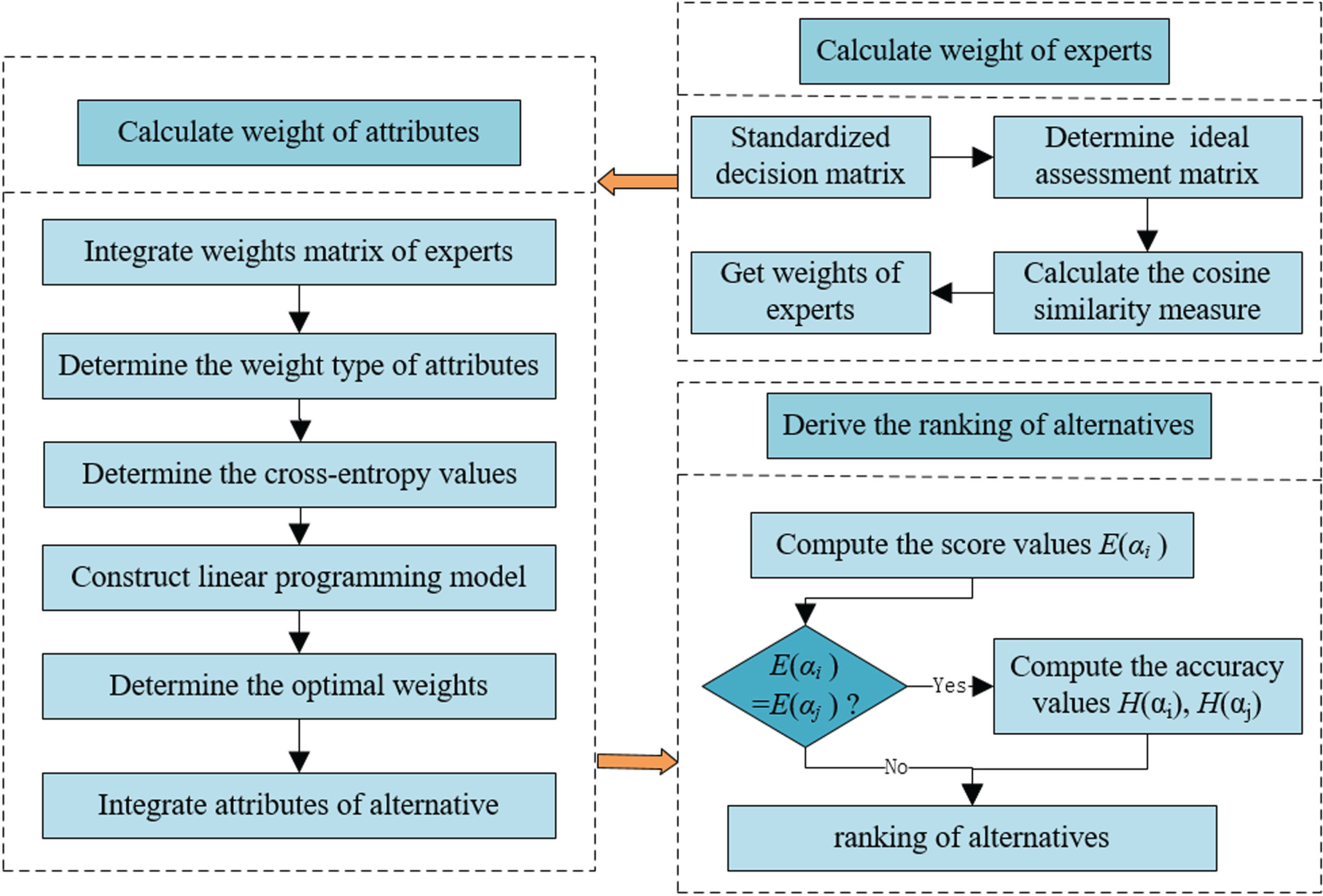
The flow chart of the decision-making process.
In this subsection, the algorithm for MAGDM is given and its detailed steps are shown as follows.
where G1 represents the cost attribute, and G2 represents the benefit attribute.
The weight of attributes can be divided into two types, i.e., incompletely known and completely unknown, which depend on the practice problems.
For the C
j
, the deviation of X
i
to the other alternatives can be defined as follows according to Equation (5):
Then the overall deviation of all alternatives to other alternatives for attribute C
j
is represented as:
Based on the above analysis, we have to choose the weight vector w to maximize the deviation values for all the attributes. That is, we can reasonably construct the following linear programming model:
For other situations, if the information regarding the weights of attributes is completely unknown, we can construct a linear programming model as follows:
By solving model (M-1) or (M-2), the optimal solution w ={ w1, w2, w3, ⋯ w n } can be obtained.
If there are two same score values,
According to their expected values based on the comparison rules from
In this section, a numerical instance is applied to demonstrate the application of the proposed method.
The decision-making matrix R1
The decision-making matrix R1
The decision-making matrix R2
The decision-making matrix R3
The decision-making matrix R4
The ideal evaluation matrix of four DMs (SULWHM operator)
In the following, some detailed steps to solve
The Integration information of all DMs (SULWHM operator)
The Integration information of all DMs (SULWHM operator)
Similarly, some detailed steps to solve
max D(w) = 43.4680w1 + 44.1678w2 + 42.9320w3+ 43.7552w4
X1 = < [s0.19,s0.25],(0.0918,0.9301,0.1800)>,
X2 = < [s0.19,s0.24],(0.1510,0.9377,0.2759)>,
X3 = < [s0.17,s0.24],(0.0864,0.9272,0.2026)>,
X4 = < [s0.19,s0.24],(0.1071,0.9352,0.1728)>.
The results are shown as follows.
E(X1) = 0.2170, E(X2) = 0.2082, E(X3) = 0.2028, E(X4) = 0.2144.
The ranking result is X1 ≻ X4 ≻ X2 ≻ X3 and the best alternative is X1.
The influence of parameter k on the results
To investigate the influence of parameter k, we use the method based on the SULWHM and SULWDHM operators to compute Example 2 under different values of the parameter k. The results are shown in Tables 7 and 8.
As Table 7 and Table 8 show, all expected values are different with utilizing different parameter k, and the ranking orders are changed by adjusting parameter k. It means that the computation of DMs’ overall opinion depends on the parameter k. It can be found that the ranking results are the same in Table 7 and Table 8 when k = 2,3 or 1, which can illustrate the validity of the proposed method. However, in Table 7, there are some differences in ranking results. Exactly, when k equals 4, it produces the ranking result X1 ≻ X2 ≻ X4 ≻ X3, whereas the ranking result is different, i.e., X4 ≻ X1 ≻ X2 ≻ X3 when k = 1 and X1 ≻ X4 ≻ X2 ≻ X3 when k = 2,3. The reason is the interrelationship between attributes can’t take into account when k = 1,4 and the ranking results are not the same as the results obtained by the method when k = 2 and 3 where attributes are interrelated. It illustrates that our method is very flexible in the process of aggregation and can deal with MAGDM problems where the interrelationships exist among attributes by adjusting parameter numbers.
Ranking results based on different parameter k using the SULWHM for Example 2
Ranking results based on different parameter k using the SULWHM for
Ranking results based on different parameter k using the SULWDHM for
Moreover, tables also show the expected values will be changed with the changing of the parameter, which can reflect the more interrelationships among arguments that are taken into account by using the method based on proposed operators and it provides the flexibility of choice for DMs to tackle actual MAGDM problems at the same time. This means that the parameter has good control ability, and different parameters can be considered as the risk preference of DMs. DMs can choose favorable parameters based on prior knowledge and their preferences to adapt to different MAGDM problems.
As mentioned in the overview, we obtained different ranking results by adjusting the parameter k in this section. It can be known that with the change of parameter k, it will cause changes in the decision results in the decision-making problem. Due to the existence of parameter k, this provides DMs with the freedom to adopt different parameters for different practical problems. For a deterministic decision problem, parameter k has and can only has one value, and the value of parameter k is obtained by the DM based on prior knowledge. Therefore, the selection of parameter k may vary for different problems, but in a decision problem, the value of parameter k is determined.
In this subsection, to illustrate the rationality and flexibility of the proposed method, we use some existing MAGDM methods to solve example 2. We assume that the DM weight and attribute weight are λ= [0.24,0.25,0.24,0.27] and w = [0.3,0.2,0.2,0.3], respectively, when using all MAGDM methods. The detailed analyses are given in the following subsections.
(1) Compared with methods based on the BM, HM operators
It is widely known that the PFS satisfies the condition that is 0≤P(x)+I(x)+N(x)≤1, which does not satisfy the range of values given in
Ranking results based on our method and existing methods
Ranking results based on our method and existing methods
(2) Compared with the method based on spherical linguistic fuzzy operator
In this subsection, we use the method based on the SLWA (spherical linguistic weight averaging) [47] operator to solve
Ranking results of the proposed method and Ashraf’s method
It has been observed from Table 10, we know that the ranking result obtained by our method is X1 X1 ≻ X4 ≻ X2 ≻ X3 while the result obtained by the SLWA method is X4 ≻ X1 ≻ X3 ≻ X2. This is because the SLWA method has incorrect operator laws between any two spherical linguistic fuzzy numbers, which can lead to a wrong decision for DMs. Thus, the proposed method is more reasonable than the existing method for solving practical MAGDM problems. The SLWA method also has its limitation where it cannot deal with the situation that considers uncertain linguistic evaluation information. Therefore, the proposed method in this paper is more powerful for dealing with actual MAGDM problems.
(3) Compared with other weight calculated methods
Table 11 lists the attribute acquisition methods adopted by different decision-making methods [16, 47–50], including attribute weight and expert weight, as shown in Table 11. In the evaluation of their cognition and behavior, they are seriously affected by the factors of cognition and experience. Therefore, obtaining the weight of experts based on known expert evaluation variables plays an important role in the decision-making process. However, the methods in [45, 47] and Liu et al. are required to obtain the weight vector of DMs in advance, which has a serious impact on obtaining the correct decision results. In addition, methods in [16, 47] are limited to cognitive decision-making with known attribute weights. However, for cognitive decision-making problems with incomplete or completely unknown attribute weights, the value of these methods will be ignored. It can be seen from Table 11 that methods in [21, 48–50] consider that the attribute weight is not completely known. The methods proposed by Zeng et al. [48] and Liu et al. [50] are applied to obtain the weight vector of attributes by calculating the linguistic q-rung orthopair fuzzy numbers (Lq-ROFNs) and the single-valued neutrosophic sets (SVNSs) entropy measures of a single attribute evaluation variable, respectfully. The above two methods ignored the relationship between different attribute variables. Ullah et al. [49] applied the grey relational analysis method (GAR) method of picture hesitant fuzzy sets (PHFSs) to compute the weight vector of attributes while the two ideal solutions need to be set in the method. The method requires DM to be completely rational in the evaluation process, otherwise, it will seriously affect the final decision-making result with the acquisition of the ideal solutions. Because DM behavior is affected by cognitive factors, it is impossible to require it to be completely rational. In addition, the method proposed by Farrokhizadeh et al. [21] also contributes to the fact that the attribute weight is incomplete known or unknown. However, it not only does not consider the linguistic expression of human evaluation information but also ignores the value of its application in the field of group decision-making.
Compared with weight obtained of decision methods
It can be seen from the above analysis that the above methods have some shortcomings in dealing with cognitive decision-making problems with incomplete known or completely unknown attribute weights. Our proposed method perfectly overcomes these defects by fusing the CEM and CSM of SULSs. Specifically, CEM takes into account the differences between global evaluation variables, obtains more accurate attribute weights, and CSM effectively measures the difference in evaluation information caused by experts’ cognitive factors.
(4) Compared with methods based on other fuzzy sets
To illustrate the advantages of this method, we use the following methods, as shown in Table 11. As can be seen from Table 12, methods based on IULHM (intuitionistic uncertain linguistic Heronian mean) [48] and PULVHM [51] (Pythagorean uncertain linguistic variable Hamy mean operator), which do not contain the neutral membership, can’t deal with the situation that the neutral membership is needed. In addition, based on PULN (picture uncertain linguistic number), SFN and spherical linguistic fuzzy number (SLFN) respectively, PULWA [52], and SLWA [47] methods all have limits for DMs to solve the actual MAGDM problems. Exactly, PULN with the condition 0 ⩽ μ
A
(x) + η
A
(x) + ν
A
(x) ⩽1 can’t deal with the situation where the sum of evaluation information exceeds 1 as in
The difference in condition satisfied compared with existing methods
(5) Compared with methods based on considering different conditions
To better illustrate the advantages and superiorities of our proposed method, we list the main characteristics of some existing methods Archimedean picture fuzzy linguistic weighted arithmetic averaging (A-PFLWAA) [32], IULWA [53], IULHM [48], hesitant fuzzy linguistic weight HM (HFLWHM) [34] and SLWA [47] in Table 13. In our proposed method, we not only consider the influence of the parameter but also consider the uncertain linguistic numbers, which make our method more accurate for solving actual MAGDM problems and provide more flexible choices for DMs. Besides, the HM operator, which not only calculates the interrelationship among any two attributes but also computes the interrelationship among multiple arguments, provides availability for our proposed method. In addition, the above methods can’t solve the MAGDM problems in that the attributes’ weights are incomplete known while the method proposed in this paper can not only solve most scenarios of practical MAGDM problems but also bring bright prospects for solving the problems of attribute weights that are incomplete known.
The difference between some operator methods
From the above analysis, it can be concluded that the advantages of the proposed method can be summarized as follows. (1) It can capture more uncertain information. The proposed new fuzzy set not only considers the acquisition of uncertain semantic information, but also takes into account the expression information of intermediate degree. This has significant advantages compared to current fuzzy sets, as existing fuzzy sets are not always suitable for some special scenarios, as can be clearly seen in Table 12. (2) It can integrate the relationships between multiple inputs during information fusion. (3) It can objectively obtain the optimal weights of experts and attributes. Compared with the subjective method of obtaining weights, the objective method of obtaining weights can better reflect the cognitive differences of experts. In addition, objectively obtaining the optimal weights of attributes can make the MAGDM method more commonly used in practical problems.
Nevertheless, our method still has some drawbacks. We have conducted a detailed analysis of the shortcomings of the method. (1) The proposed method obtains the final result by calculating the score function of the fuzzy set, which leads to a lack of comparability between alternatives. (2) When obtaining attribute weights, the method only considered the limitations of historical information, resulting in incomplete knowledge of the weight results. The method did not consider the opinions of the experts involved in this decision on attribute weights.
This paper proposed a novel MAGDM method for effectively expressing and measuring cognitive decision-making problems with attribute weight that is incomplete known or unknown. Because of the importance that the expression of human cognition is inseparable from qualitative and quantitative information. A new concept of SULSs is proposed under the operator laws of SFS are corrected. To effectively measure the difference in DMs evaluation preference caused by cognition, this paper integrates SULS and CSM to obtain a powerful DMs weight calculation tool. Another important concept, CES of SULS, is proposed to solve the cognitive decision-making problem that the attribute weight is not completely known or completely unknown caused of human cognitive limitations and the complexity of practical problems. To effectively fuse the evaluation information of DMs, HM and DHM of SULS are to effectively fuse information. In addition, we proved the concepts and properties derived in this paper to ensure the robustness of our proposed MAGDM method. Finally, the proposed and other MAGDM methods are applied to solve an actual cognitive decision-making case, and the effectiveness, correctness, and universality of the proposed method are also proved by comparing them.
Although the method proposed in this paper has corresponding advantages, there are still some drawbacks. For example, the proposed method cannot integrate the evaluation information of attributes’ weights. Therefore, the following aspects will be worthy of further research in the future. (1) Integrate expert evaluation information on attribute weights for supervisors. Although the method proposed in this article can solve most MAGDM problems, it is ineffective in some cases when considering expert evaluation of attribute weights. (2) Integrate some comparative decision-making methods. As described in conclusion, the proposed method obtains ranking results by calculating the score function of the integrated information. This approach ignores the comparability between schemes, and it is meaningful to integrate comparative methods such as TOPSIS, VIKOR and others in future research. (3) Develop a strategy to achieve consensus among experts during the evaluation process. As a group decision-making method, experts are influenced by cognitive factors when evaluating information, and there are still differences and controversies between them, which is not conducive to the evaluation of decision attributes. Developing methods for reaching consensus among experts is valuable and necessary.
Funding
This research was supported by the Fundamental Research Funds for the Central Universities (grant number 2023YJS132) and Beijing Natural Science Foundation (grant number L201003).
Declarations
Ethical Approval
This article does not contain any studies with human participants or animals performed by any of the authors.
Conflict of Interest
The authors declare that they have no conflict of interest.
