The construction price is an important parameter when designing neutron guides, but it has so far difficult to take into account during the overall optimiation. We therefore introduce the CoatingWriter add-on for the guide design tool guide_bot under McStas. This add-on allows for optimization of guide coating (m-value), taking both performance and price into account, in addition to the geometry optimization provided by guide_bot. We find that by using CoatingWriter we are able to generate good guides at significantly lower overall price levels than was possible before.
Neutron transporting guides are essential in neutron instrumentation [9], since they can transport the neutron beam away from the source to positions with lower background. Initially, work was done by analytical calculation of the properties of simple guides. The work on complex guide geometries received a boost with the emergence of general-purpose ray-tracing programs, such as RESTRAX, VITESS, and McStas [8,11,15], and new ballistic guide concepts were concieved, such as linearly tapering and elliptical [10,13]. In the design study of the European Spallation Source (ESS), long neutron guides of up to 170 m were found to be essential for many instruments [7,14]. The performance of even very long ballistic guide types were found to be excellent [6], almost approaching the theoretical limit given by the Liouville theorem.
To assist in the design of guide systems, the tool guide_bot was written for McStas [1,5]. This tool uses a combination of phase space arguments [2] and the numerical optimizer iFit[4] to quickly obtain a simulation of a guide system. However, only the guide geometry is optimized, while the quality of the guide supermirrors, the m-value, is not used in the guide_bot optimizations.
CoatingWriter[3] is created as an add-on to guide_bot, and adds another layer of tools to the package. The function of CoatingWriter is to add a distribution function to the m-values of all guide sections and add these parameters to the optimization process. CoatingWriter provides the functionality for optimizing coating parameters by reading the McStas instrument files created by +guide_bot+. All changes are implemented automatically and theoptimization can be run as a normal guide_bot job without any further actions needed. The program can accept options, which limit or change the optimization process. Options are located in an easy-to-read file that is automatically created when running guide_bot. All settings have default values suitable for most guide systems.
CoatingWriter uses iFit to handle the McStas optimizations. Since a flexible coating distributions will add many parameters, a single optimization will often be inadequate. To handle this, several optimization methods are included that will optimize different subspaces of the parameter space. This makes it possible to get a good result, even though the total number of parameters far exceeds what is normally found in guide_bot optimizations.
An important feature in CoatingWriter is the ability to take the guide price into account. For example, the neutron flux divided by the total price is available as a figure-of-merit. The price is estimated from general information from one guide vendor [12]. Although not as accurate as an actual quote, this price estimate is extremely useful to point the optimizer in the direction of lower m-values without compromising the transport properties. Using this feature, the user will have much less need for locking parameters during the optimization. For each mirror in the guide design, the surface areas and m-values are listed as output. This enables a later calculation of a more accurate total price.
CoatingWriter has an option to specify a target price. This allows the optimizer to find the best performing guide within a certain price range. A build-in function allows to loop over different price targets to obtain a list of guide solutions over a specified price range.
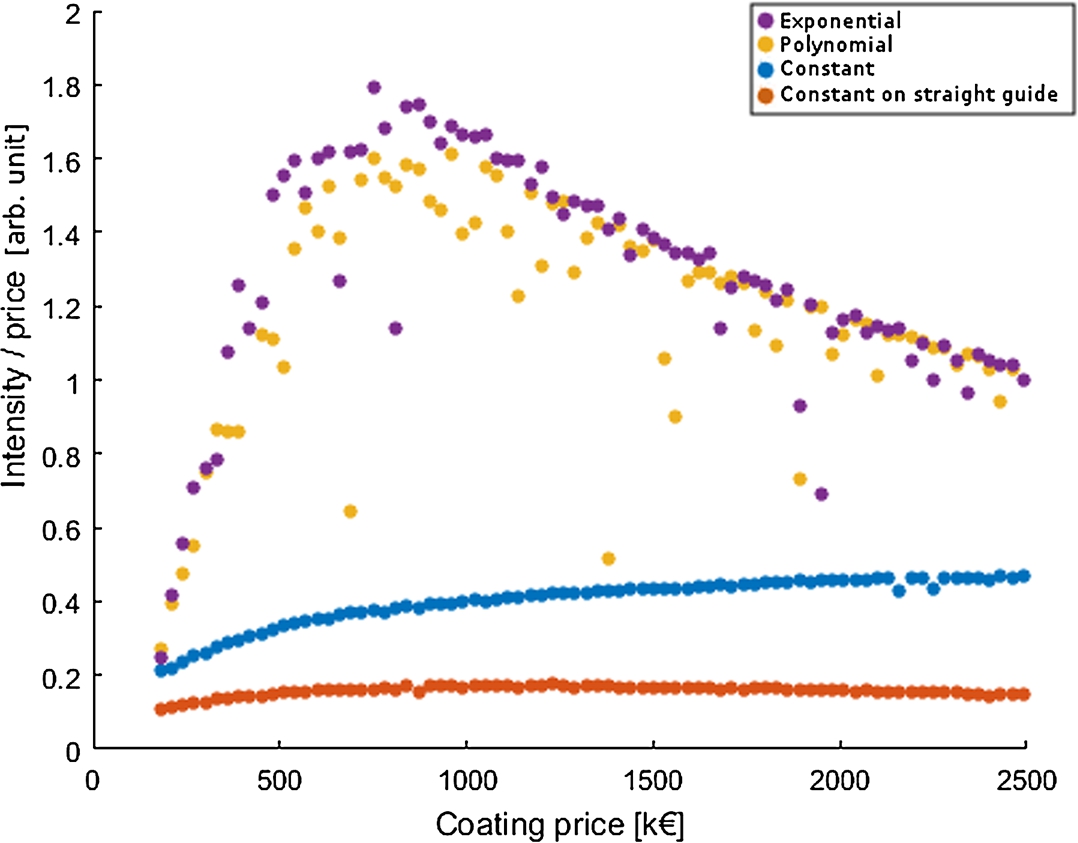
The intensity vs. price curve for neutrons from a moderator in a 167.5 m long elliptical guide, optimized for: [purple] exponential coating distribution function, [yellow] polynomial coating distribution function, [blue] constant m-value. [red] shows results for a straight guide with constant m-value. Each dot represents an individual optimization. Made with an early version of CoatingWriter.
The first results from CoatingWriter showed that adding a coating distribution function gave a significant increase in intensity for the same cost. The result for a 167.5 m long thermal guide is shown in Fig. 1. We used the flux over price as the figure-of-merit. Among a straight guide and a selection of elliptical ones, the performance is best for those elliptical guides where the m-value are higher towards the ends (labels “Exponential” and “Polynomial”). At a price level of around 800 kEuros, the elliptical guides with distributed coating perform almost 5 times as well as the one with constant coating.
We have used Guide_bot in combination with CoatingWriter in the early design process of several guides. The method is currently being used in the development process of the instruments BIFROST, HEIMDAL and MIRACLES for the ESS. For BIFROST, the program saved around 25% of the guide budget (or 500 kEuros). We think that this newly developed tool will have a large use in the design of future neutron instrumentation, leading to significant savings that can be used to improve the instrument in other aspects, or to produce better guide systems for the same price.
E.Farhi, E.Bebab and P.Willendrup, iFit: A new data analysis framework. applications for data reduction and optimization of neutron scattering instrument simulations with McStas, J. Neutr. Res.17 (2014), 5–18.
K.H.Klenø, K.Lieutenant, K.H.Andersen and K.Lefmann, Systematic performance study of common neutron guide geometries, Nucl. Instr. Meth. A696 (2012), 75–84. doi:10.1016/j.nima.2012.08.027.
7.
K.Lefmann, K.H.Klenø, J.O.Birk, B.R.Hansen, S.L.Holm, E.Knudsen, K.Lieutenant, L.von Moos, M.Sales, P.K.Willendrup and K.H.Andersen, Simulation of a suite of generic long-pulse neutron instruments to optimize the time structure of the European spallation source, Rev. Sci. Instr.84 (2013), 055106. doi:10.1063/1.4803167.
8.
K.Lefmann and K.Nielsen, McStas, a general software package for neutron ray-tracing simulations, Neutron News10 (1999), 20–23. doi:10.1080/10448639908233684.
9.
H.Maier-Leibnitz and T.Springer, J. Nucl. Energy17 (1963), 217.
10.
S.Mühlbauer, M.Stadlbauer, P.Böni, C.Schanzer, J.Stahn and U.Filges, Performance of an elliptically tapered neutron guide, Physica B385–386 (2006), 1247–1249. doi:10.1016/j.physb.2006.05.421.