






Abstract
The Target Station at the European Spallation Source (ESS) is designed to convert high power proton beam to high brightness neutron beams, for studying fundamental properties of materials. Upon commissioning of the ‘beam on target’ planned in 2022, the ESS linac will deliver lower energy proton beam than the design value of 2 GeV, for neutron production. The beam energy will then be gradually ramped up, with the sequential commissioning of the downstream part of the superconducting cryomodules. During neutron production, the beam intercepting devices and moderators are exposed to intense flux of primary and secondary particles, suffering from radiation induced structural degradation. The extent of the radiation damage depends on the energy and intensity of the impinging protons. Currently, the lifetime criteria determined for these components are based on the 2 GeV beam energy. To secure availability and reliability of the neutron production during the beam energy ramp-up phase, the radiation damage rates in these components should be reassessed and the lifetime criteria be adjusted. In this paper, we present the lifetime criteria for the beam intercepting devices and moderators for different beam energies, to serve for the planning of the maintenance and replacement schedule during the proton energy ramp-up phase.
Introduction
The European Spallation Source (ESS) which is being built in Lund in Southern Sweden will deliver high brightness neutrons, upon start of the user program in 2023 [9,17]. Once the design scope of the ESS is realised in end 2020s, the spallation neutron production will be driven by 2 GeV proton beam that impinges on the rotating tungsten target. The design value of the time-averaged beam current is 2.5 mA, which makes the beam power 5 MW.
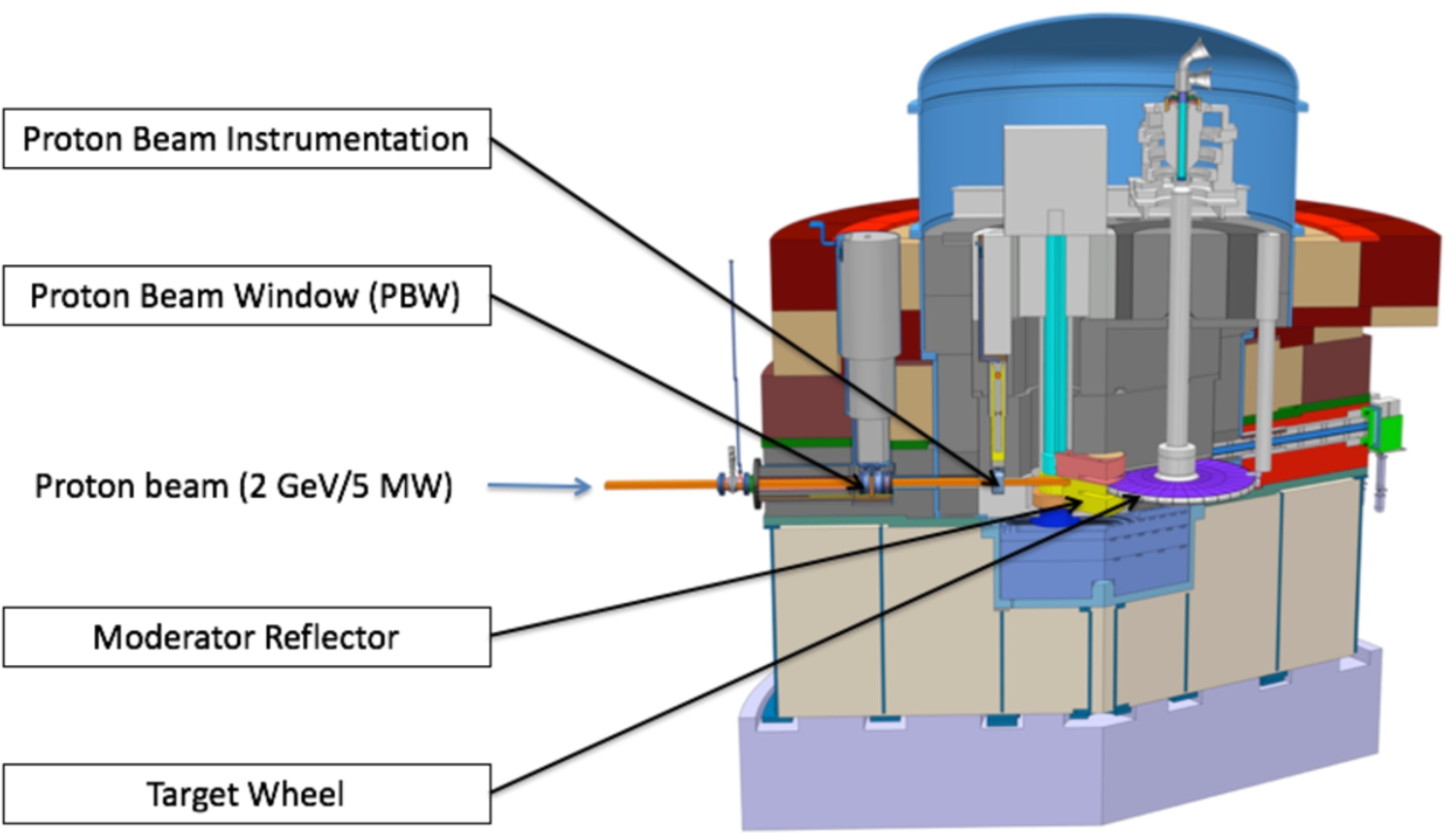
The beam intercepting devices and moderators in the ESS Target Monolith.
During neutron production, the beam intercepting devices are subject to radiation damages caused by primary protons and back-scattered neutrons, while the peripheral components such as moderators are exposed to radiation damages by high flux of neutrons. Figure 1 shows a vertical cut view of the ESS Target Monolith, illustrating the beam intercepting devices and moderators. The beam intercepting devices include the proton beam window (PBW), multi-wire beam profile monitor (MWPM) and the target wheel. The PBW interfaces to accelerator vacuum and serves as the gate for the incoming proton beam to the target environment. The beam then passes the MWPM, where the beam profile is monitored using secondary electron emission. The proton beam then enters the spallation volume to produce spallation neutrons, which consists of a large number of tungsten bricks contained in stainless steel vessel. The part of the target vessel which intercepts the proton beam is called beam entrance window (BEW), which suffers from the highest radiation damage than any other structural parts of the target vessel. The spallation neutrons produced in the target is moderated to cold and thermal neutrons in the moderator-reflector system. Figure 2 illustrates the beam intercepting devices and the upper moderator.
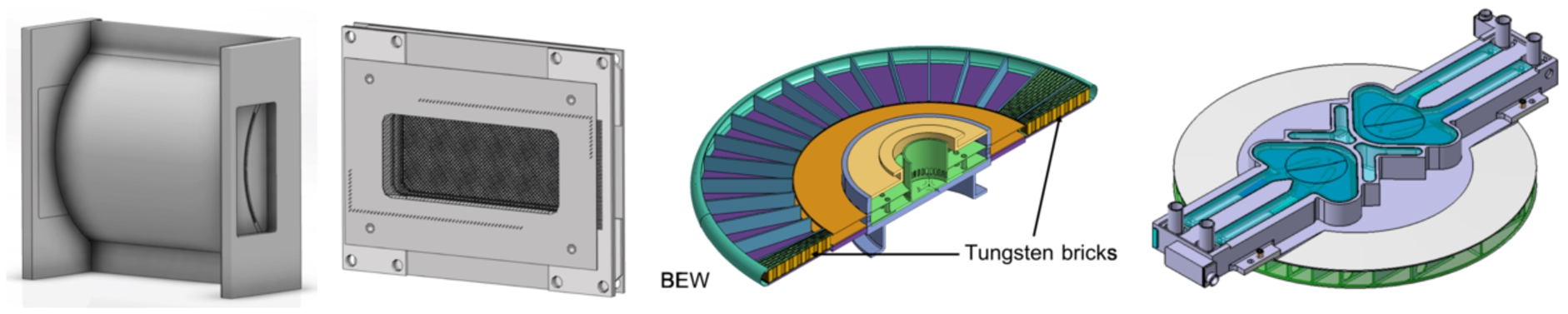
Illustrations of the PBW (top left), the MWPM, the target vessel with BEW and spallation volume, and the upper moderator (from left to right) in the ESS Target Monolith. Picture courtesy by ESS-Bilao and Forschungszentrum Jülich.
Upon commissioning of the ‘beam on target’ planned in 2022, the ESS linac will deliver lower energy proton beam than 2 GeV, for neutron production. The beam energy will then be gradually ramped up, with the sequential commissioning of the downstream part of the superconducting cryomodules. The extent of the radiation damage in the beam intercepting devices and moderators depends on the kinetic energy and intensity of the impinging protons. Therefore, the radiation limited lifetimes of these components should be assessed based on the real-time beam parameters as monitored during the beam energy ramp up phase.
The selected materials and radiation damage limited lifetimes of the functional components in the ESS target environment were reported by Lee [12]. The lifetimes were evaluated based on the 2 GeV proton beam energy on the target, which is the design value of the ESS linac. To secure availability and reliability of the neutron production during the beam energy ramp-up phase, the radiation damage rates in these components should be reassessed and the lifetime criteria be adjusted. In this paper, we present the lifetime criteria for the beam intercepting devices and moderators for different beam energies, to serve for the planning of the maintenance and replacement schedule during the proton energy ramp-up phase.
Figure 3 shows the schematics of the ESS linac from the ion source to the spallation target. The first neutron production at ESS is planned in 2022, with the commissioning of the linac part up to the medium-β cryomodules and the upstream part of the high-β cryomodules. After the “beam on target,” the downstream part of the 21 high-β cryomodules will be commissioned sequentially during long shutdown periods, and the beam energy will be sequentially ramped up towards 2 GeV.

The schematics of the ESS linac from the ion source to the spallation target.
For the study of radiation damage rates and lifetime estimates of the beam intercepting devices and moderators during the beam energy ramp up phase, five beam energies were chosen as shown in Table 1. Each beam energy corresponds to the commissioning of the first to “nth” cryomodules, with “n” arbitrarily chosen.
Beam energies chosen for the study of radiation damage rates and lifetime estimates during the beam energy ramp up phase
The down stream part of the high-energy beam transport (HEBT) rasters the beam to spread the beam to a quasi-rectangular profile before it crosses the proton-beam window. The beam rastering reduces the peak beam intensity on the beam intercepting devices, relaxing thermo-mechanical loads and slowing the progress of radiation damage in these components. The rastered beam configuration presented in Ref. [13] is used for the study, for different beam energies. Table 2 summarises the nominal beam raster parameters on the beam entrance window.
Nominal beam raster parameters on the beam entrance window (BEW)
System overview
The beam intercepting devices that will suffer from radiation damage are the proton beam window (PBW), the multi-wire beam profile monitor (MWPM), the beam entrance window (BEW) and the spallation material. The radiation damage caused by secondary neutrons limits the lifetime of the moderator as well. Table 3 lists the components subject to radiation damage in the target environment, the materials of which these components are made, and the types of the radiation damage that limit the lifetimes of these devices. In the list, the spallation material, tungsten, is not included. Though the radiation damage in the tungsten bricks are high, it is considered as passive components which do not carry structural function. The radiation damage mechanism of tungsten has other operational importances than the lifetime aspects, which are investigated separately.
List of the components subject to radiation damage in the target environment
List of the components subject to radiation damage in the target environment
Al6061-T6 is chosen for the proton beam window material, due to its low scattering cross-sections to incoming high energy protons [19], proven radiation resistance in reactor environments [6] and good mechanical strength. Under intense high energy proton beam irradiation, the lifetime of aluminium alloy is mainly determined by the helium production rate [4,10]. There are scarcity of data of proton dose dependent helium embrittlement effects in Al6061-T6 available. In determining the lifetime of the PBW at ESS, the data from the post irradiation examination of the BEW of the SINQ Target-9 at PSI were taken as the guiding reference [1]. The BEW of the SINQ target-9 is made of Al5754, and it received the maximum fluence of
For the calculation of the helium production rate in the PBW at ESS, the particle transport code FLUKA [2,8] was used. The calculated values of the helium production rate in aluminium slightly differs depending on the particle transport codes used. Therefore, the reference helium production value 2447 appm in the SINQ target, which was calculated by the MCNPX code, cannot be directly adopted for the PBW at ESS. Since the neutron contribution to the helium production in the SINQ target is much less than that of the protons, a benchmark study with the FLUKA code was made to calculate the helium production in an aluminium alloy window impinged by 570 MeV protons with the fluence of
A number of FLUKA simulations have been made to calculate the helium production rates in the PBW at ESS, for different beam energies ranging from 571 MeV to 2 GeV. The maximum beam current density of the rastered beam on the PBW is
Estimated lifetime of the PBW which is set by maximum helium production of 2400 appm. The statistical error in the calculated helium production rate data is less than 2%
Estimated lifetime of the PBW which is set by maximum helium production of 2400 appm. The statistical error in the calculated helium production rate data is less than 2%
Arrays of 100 μm thick strings made of SiC will be used for the MWPM. The beam profile monitor made of SiC strings has been serving for the TS-2 at ISIS since its beam commissioning in 2008. The total accumulated proton beam charge on the harp is more than 1.5 Ah to date. For the 800 MeV beam with the RMS beam size of 1.2 cm at the TS-2 of the ISIS, the maximum displacement damage calculated by FLUKA is 3 dpa in the SiC wires [12]. The displacement damage of 3 dpa sets the guiding reference for the lifetime of the SiC wires of the MWPM at ESS.
Estimated lifetime of the MWPM which is set by maximum displacement damage of 3 dpa. The statistical error in the calculated dpa rate data is less than 2%
Estimated lifetime of the MWPM which is set by maximum displacement damage of 3 dpa. The statistical error in the calculated dpa rate data is less than 2%
A number of FLUKA simulations have been performed to calculate the displacement damage rates in the SiC strings at ESS, for different beam energies ranging from 571 MeV to 2 GeV. The physical model which the FLUKA uses to calculate the displacement damage is presented in Ref. [7]. Table 5 summarises the estimated lifetime of the MWPM which is set by the maximum displacement damage of 3 dpa. The calculated displacement damage rate in SiC is not dependent on the beam energy. This indicates that the lifetime of the SiC wires of the MWPM is correlated with the integrated beam current.
Solution annealed 316L type stainless steel is selected as the target vessel material, due to its proven lifetime under high power proton irradiation environments. The beam entrance window (BEW) is a part of the vessel which intercepts the impinging proton beam. The BEW suffers from the highest radiation damage than any other structural parts of the target vessel and the radiation damage rate in there determines the lifetime of the target wheel. The operational experiences and the post irradiation examination of the SNS target vessel show that the 316L steel can withstand the displacement damage of 7 dpa [15]. Furthermore, some of the recent SNS targets are known to have been operated for the radiation damages exceeding 9 dpa. Considering that there are uncertainties among the dpa values calculated by different Monte Carlo codes, we conservatively take the displacement damage of 7 dpa as the guiding reference criteria for the lifetime of the BEW at ESS.
A number of FLUKA simulations have been performed to calculate the displacement damage rates in the BEW at ESS, for different beam energies ranging from 571 MeV to 2 GeV. The maximum beam current density of the rastered beam on the BEW is
Estimated lifetime of the BEW which is set by maximum displacement damage of 7 dpa. The statistical error in the calculated dpa rate data is less than 1%
Estimated lifetime of the BEW which is set by maximum displacement damage of 7 dpa. The statistical error in the calculated dpa rate data is less than 1%
The moderating materials, which are liquid hydrogen and water, are contained in the moderator vessel. Aluminium alloy Al6061-T651 is selected for the main building material for the moderator vessel, which has a low neutron scattering cross-section, qualified mechanical properties for pressure vessel applications with a high market availability. The Al6061-T6 alloys have been extensively used at many operating high flux thermal and cold neutron sources with a well classified dose limited lifetime criteria.
The moderators receive a high flux of neutrons from meV to GeV energy range. The lifetime of the moderator vessel is set by two sub-criteria, maximum displacement damage and thermal neutron fluence. Differently from the proton beam irradiation case, the helium embrittlement does not pose a major lifetime challenge, due to lower helium production cross section of aluminium to sub-10 MeV neutrons, which constitutes most part of the neutron flux in the moderator region.
In the spallation target environments, the SNS MARK-I moderators are known to have received the highest displacement dose. The maximum displacement damage rate in the SNS moderator system was calculated to be about
On the other hand, the French nuclear code RCC-MRx [18] defines the negligible radiation damage limit with the thermal neutron fluence of
A number of FLUKA simulations have been performed to calculate the maximum displacement damage rates and thermal neutron flux in the moderator vessel at ESS, for different beam energies ranging from 571 MeV to 2 GeV. Tables 7 and 8 summarise the estimated lifetime of the moderator vessel which is set by maximum displacement damage of 20 dpa and by maximum thermal neutron fluence of
Estimated lifetime of the moderator vessel which is set by maximum displacement damage of 20 dpa. The statistical error in the calculated dpa rate data is less than 1%
Estimated lifetime of the moderator vessel which is set by maximum displacement damage of 20 dpa. The statistical error in the calculated dpa rate data is less than 1%
Estimated lifetime of the moderator vessel which is set by maximum thermal neutron fluence of
For given proton beam energy, the lifetime limited by maximum displacement damage provides more conservative criteria. Therefore, the lifetime of the moderator vessel at ESS is determined by the criteria presented in Table 7. Note that the lifetime expressed in integrated beam power is not dependent on the beam energy. This is related to the fact that the neutron yield from the tungsten target is almost linearly proportional to the beam energy [5]. In this respect, the lifetime of the moderator vessel is better correlated with the integrated beam power.
The proton induced heat deposition per unit beam current in the beam intercepting devices depends on the beam energy. Figure 4 shows the maximum heat deposition per unit beam current in the PBW, BEW and tungsten bricks during beam energy ramp up. The values are normalised to those at 2 GeV. Note that the heat deposition per unit beam current in the PBW is 16% higher at 571 MeV beam energy compared to that at 2 GeV. This indicates that the total heat deposition in the PBW is higher for the 1.4 MW beam with 571 MeV proton energy than the 5.0 MW beam with 2 GeV, at the full beam current of 2.5 mA. During the beam energy ramp up phase, one should pay attention that lower beam power does not necessarily mean lower thermo-mechanical load in the beam intercepting devices. Contrary to the case of PBW, the maximum heat deposition per unit current in the BEW does not change much with increasing beam energy, while that in the tungsten volume increases with increasing proton energy. The reason is that higher proportion of the energy deposition in these components are due to the back scattered neutrons from the massive spallation volume, with increasing beam energies.
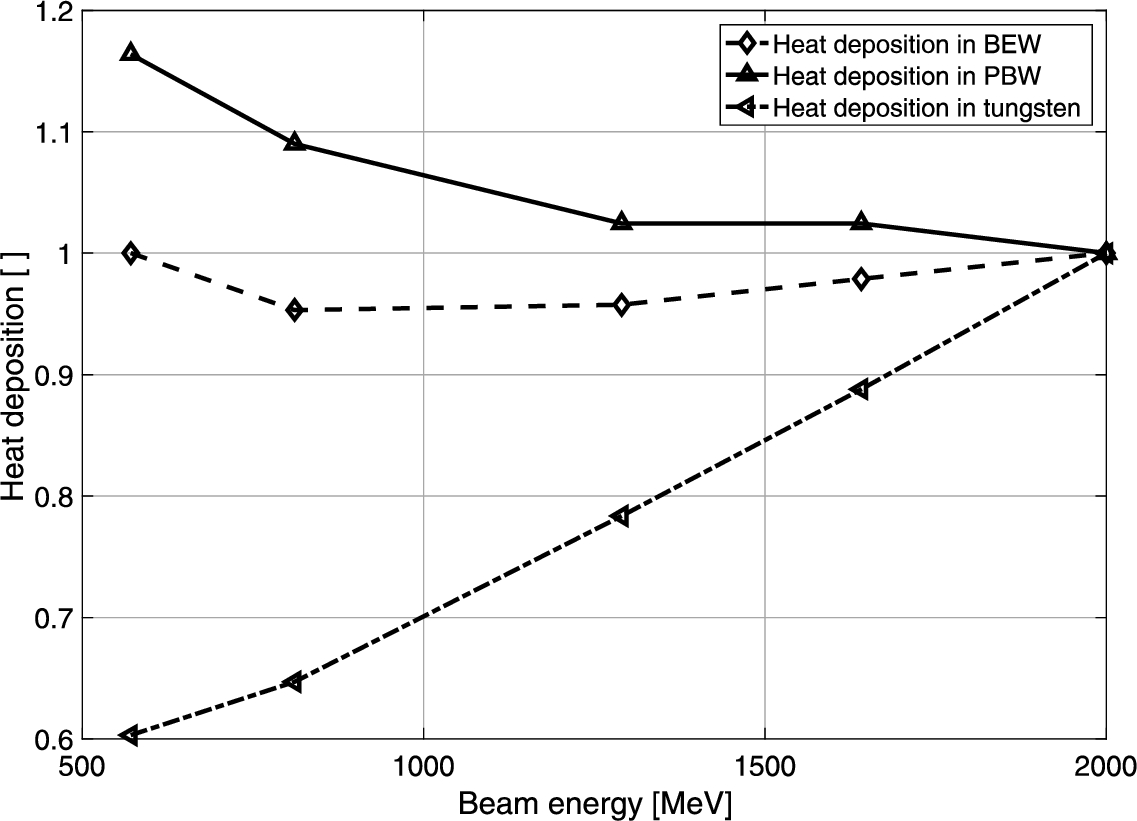
Maximum heat deposition per unit beam current in the PBW, BEW and tungsten bricks during beam energy ramp up, normalised to that at 2 GeV.
As the protons travel through the PBW, it interacts with the PBW material and the beam diverges. Figure 5 shows the calculated polar angle distributions of the momentum vectors of the incoming and outgoing protons at the PBW, with respect to the beam direction, for chosen beam energies. For reference, a polar angle divergence of 1.0 mrad implies 3.5 mm transverse beam offset on the target. From the figure, one notices that more protons are diverted by the PBW at lower beam energies. At the commissioning of the beam with lower beam energy, about 10% of the incoming protons are estimated to be lost downstream the PBW before it reaches the spallation target. With the progress of the proton beam energy ramp up, the fraction of proton loss will decrease.
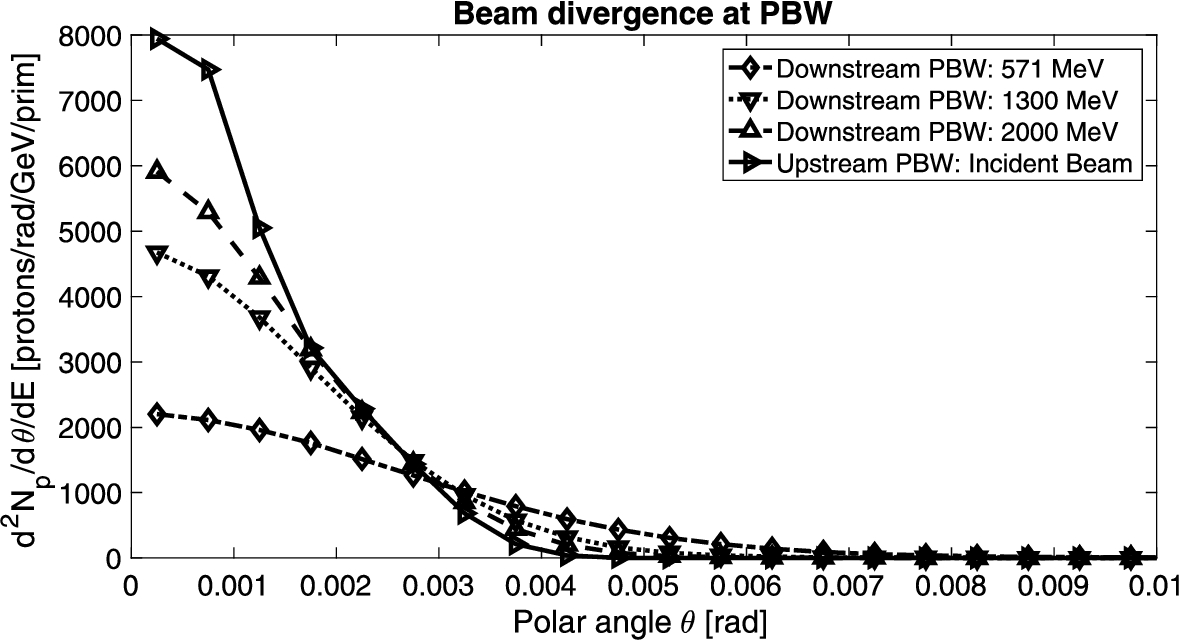
The polar angle distribution of proton momentum upstream and downstream of the PBW for selected beam energies.
The presented lifetime criteria are largely based on the operational experiences of equivalent systems at leading high power spallation sources. A fair amount of conservatism has been taken in making the lifetime estimates, because of the reasons in the following. There are scarcity of radiation damage data at a high proton fluence level comparable to that of ESS, which makes it difficult to obtain a large enough statistical sample size. The operational conditions of the benchmarked systems are not identical to those at ESS. For example, the operational temperature of the helium cooled target vessel at ESS is higher than those mostly cooled by water at other facilities. It is known that the irradiation temperature affects the radiation damage mechanism of the material. With the commissioning of the facility in 2022, continuous efforts will be made to relax the conservatism taken in this work by studying the physics of beam-matter interaction at the beam intercepting devices in the ESS target environment.
From the radiation damage induced lifetime viewpoint, the PBW is of a concern. Considering that the annual “beam on target” time at steady state operation is planned to be 5400 hours, the lifetime of the PBW as summarised in Table 4 is shorter than a year. This means that the ESS linac operation should be interrupted once between the annually planned long shutdown time for the replacement of the PBW, adding operational complexity and costs. A post irradiation examination (PIE) program is launched in collaboration with PSI, to investigate candidate materials for the PBW which could potentially allow the lifetime longer than the 5400 hours under the nominal beam conditions at ESS. From the PIE program, the realistic proton radiation damage limit of the PBW material, Al6061-T6, will be investigated. In addition, alloy 718 and Ti-6Al-4V will be investigated, which are the commonly used PBW materials at leading high power proton machines.
During the beam energy ramp up, the beam parameters should be compiled to assess the lifetime consumption rate of the functional systems in target environment. The presented lifetimes are based on nominal rastered beam profile summarised in Table 2. The information about actual beam energy, beam current, beam profile and peak current density should be monitored by beam diagnostic devices, and these data should be fed back to assess the lifetime relevant radiation damage rates in the beam intercepting devices. Among other beam parameters, most critical information determining the lifetimes of the beam intercepting devices is the peak beam current density. For given beam energy, the radiation damage rates presented in Tables 4, 5 and 6, should be adjusted by a multiplication factor, which is the fraction of actual beam current density to nominal beam current density.
Conclusions
The lifetime criteria for the beam intercepting devices and moderators during the beam energy ramp up phase at ESS are presented. The lifetimes of these components mainly depend on the proton energy and maximum beam current density. While the lifetimes of the PBW, MWPM and BEW are more correlated to the integrated beam current, that of the moderator is more correlated to the beam energy. The lifetime criteria presented in this paper serve as a basic input for making the initial operational planning of the ESS, particularly for scheduling the hardware procurements and replacements.