






Abstract
BACKGROUND:
Patient safety culture (PSC) as a main component of the organizational culture plays a key role in providing safe, effective and economic cares and services in healthcare organizations. PSC provides a way to assist hospitals in order to improve patient safety and prevent medical errors.
OBJECTIVE:
The present study aimed to measure PSC and healthcare professionals’ attitude towards voluntary reporting of adverse events in two hospitals in Iran and to develop a hybrid intelligent approach for modeling PSC grades.
METHODS:
The Hospital Survey on Patient Safety Culture (HSOPSC) questionnaire and a two-part questionnaire were used for examining the PSC and healthcare professionals’ attitude towards voluntary reporting of adverse events, respectively. Principal component analysis (PCA) was applied to extract of the main components in the HSOPSC questionnaire and to construct 12 dimensions of patient safety culture. The overall grade of patient safety culture was modeled using adaptive neuro-fuzzy inference systems (ANFIS) as a classification problem.
RESULTS:
Almost half of the participants have experienced a medical error and adverse events. The PSC grade was acceptable from the point of view of 55.5% and 50% of participants in hospital No.1 and hospital No.2, respectively. The overall accuracy of ANFIS in modeling overall grades of patient safety culture in both study hospitals was 0.84. Of those individuals gave an acceptable grade on patient safety culture in both study hospitals, more than 50% believed that all medical errors and near misses should be reported.
CONCLUSIONS:
The ANFIS algorithm was proposed for modeling and predicting of PSC for healthcare organizations. The results confirm the capability of the proposed model to predict patient safety grades in healthcare settings.
Introduction
According to the Advisory Committee on the Safety of Nuclear Installations (1993), the safety culture of an organization is, “the product of individual and group values, attitudes, perceptions, competencies, and patterns of behavior that determine the commitment to, and the style and proficiency of, an organization’s health and safety management” [1]. Safety culture as a main component of the organizational culture has an influence on staff attitudes and behavior with regard to the organization’s ongoing health and safety performance [2]. Safety culture is an important issue in the healthcare industry because it has considerable influence on healthcare professionals and patients’ safety [3]. Patient safety is defined as the prevention of potentially harmful medical errors (of commission or omission) [4]. Patient safety culture (PSC) refers to the healthcare employees’ values, beliefs, attitudes, and behaviors towards safe practices in healthcare organizations [5]. Creating a culture of patient safety by healthcare organizations can enhance the quality and safety in the healthcare settings [6].
Adverse events were defined as unintended injuries caused by healthcare management rather than the disease process [7]. Adverse events include a wide range of in deliberately events such as adverse drug event, procedure-related complications, infection, and medication errors [8, 9]. Approximately 2.9% to 16.6% of patients experience at least one adverse event in acute care hospitals. However, up to 50% of the events were preventable [10]. The Institute of Medicine (IOM) released the report To Err Is Human in 1999 which emphasize the importance of development of the medical event-reporting system and creating a center for patient safety to share information and suggest possible solutions to safety issues. IOM also recommended that voluntary reporting effort may encourage participation [11, 12]. Factors which adversely influence critical incident reporting in healthcare professionals include time constraints, fear of punishment, and a lack of perceivable benefits of engaging. Voluntary reporting of the medical events may also impose personal liability [13].
The IOM reports indicated that clinical preventable adverse events in the United States were more than 1 million and the outcomes of 44,000 to 98,000 of these adverse events were death in each year [11]. Two third of adverse events occur in surgical units containing general surgery, orthopedic surgery, obstetrics, gynecology, and other surgery units. The rates of adverse events associated with medical units containing internal medicine unit, cardiology, pediatrics, gastroenterology, and medical oncology are higher than family practice ward, emergency medicine, and radiology [14]. Investigation of Kabirzadeh et al. (2011) [15] showed 39.6% of participants, who are working in hospitals, had experienced medical errors. Most managers believe that reporting medical errors and adverse events is essential for improving patient safety and approximately 85% of the subjects disagreed with the punishment policy due to medication errors.
One of the most important issues in modeling the data related to patient safety culture is to extract the values of components in the HSOPSC questionnaire. Principal component analysis (PCA) [16] as a popular feature extraction (FE) method in data mining is used for extracting important dimensions from a multivariate data set. PCA is used to describe the inter-relations among a set of variables. The method makes it possible to combine a set of observed variables into a small set of “artificial” variables and reduce the number of variables and rank decision-making units (DMUs) [17, 18].
After extracting fundamental component of PSC, these components can also be used in modeling overall grade on PSC. This is a classification problem. Artificial intelligent (AI) techniques such as artificial neural networks (ANN) and fuzzy logic (FL) can be useful in real classification applications [19]. In recent years, several attempts have been made to use AI methods in the classification problems in health and safety activities [20]. Adaptive neural-fuzzy inference system (ANFIS) methodology is a Sugeno fuzzy model that uses a framework in order to facilitate learning and adaptation. Such the framework makes the ANFIS modeling more systematic and less reliant on expert knowledge [21].
Although there are a large number of published studies describing the psychometric properties of the hospital survey on PSC questionnaire and measuring it using HSOPSC [22–27], there has been a little discussion about the use of statistical and intelligent methods to extract the dimensions of the PSC and modeling patient safety grades. The aims of this paper were to measure PSC and healthcare professionals’ attitude towards voluntary reporting of adverse events in two hospitals in the northeast of Iran and develop a hybrid intelligent model based on a combination of PCA and ANFIS to model overall grade for PSC.
Methods
Study participants
This cross-sectional study was conducted at two hospitals in Northeast of Iran. All employees of two hospitals including healthcare staff (physicians, nurses, midwives, paramedics, anesthetic staff, and operating room personnel), para-clinical staff (laboratory personnel, radiologists, and medical records personnel), and hospital pharmacy personnel were enrolled in the present study. Inclusion criteria contained at least one year of work experience, willing to participate, working in the hospitals, and having at least an associate’s degree and the exclusion criteria were having an incomplete questionnaire (response rate of <50%), unwilling to continue the study, and working in other occupations rather than mentioned jobs. According to the inclusion criteria, the initial sample consisted of 400 healthcare professionals of whom 89 (such as specialist doctors) did not complete the questionnaire or were unwilling to participate in the study. Finally, the study was done with 311 healthcare staffs. The objectives of the study were clearly explained for the participants and all participants read and signed an informed consent form.
Data collection tools
Many instruments have been developed for the purpose of measuring safety culture in hospitals. The HSOPSC, which was developed by the Agency for Healthcare Research and Quality (AHRQ) in 2004, is used to collect data on PSC [6, 28]. HSOPSC is composed of 42 items (questions) indicative of 12 dimensions [22]. The validity and reliability of the questionnaire were studied by many researchers in different language versions such as English-language version by Smits et al. (2008) [6], Turkish version by Bodur and Filiz (2010) [22], Farsi (Persian) version by Moghri et al. (2012) [29] and by Chen Li (2010) in Taiwan [30]. The values of the fitness function and goodness-of-fit index for the Persian version of HSOPSC were 14.25 and 0.96, respectively. The internal consistency (Cronbach alpha) of the items ranged from 0.57 to 0.8 [29].
Demographic and job data including age, gender, education level, work experience, working unit, work hours, and direct contact with patients were obtained through the questionnaire. Table 1 illustrates the coding and description of the job and demographic variables in the present study.
Description of variables
Description of variables
The questionnaire has 42 questions for measuring 12 dimensions related to PSC (including 1) communication openness, 2) feedback and communication about error, 3) frequency of event reporting, 4) hospital handoffs and transitions, 5) hospital management support for patient safety, 6) non-punitive response to error, 7) organizational learning – continuous improvement, 8) overall perceptions of patient safety, 9) staffing, 10) supervisor/manager expectations/actions promoting patient safety, 11) teamwork across hospital units, 12) teamwork within units). Each dimension contains 3 or 4 questions. Subjects answered the questions presented in a 5-point Likert scale (totally agree– totally disagree). In addition, there were two questions related to an overall grade on patient safety in the hospitals and the number of events reported in the past 12 months.
Healthcare professional’s attitude towards adverse events voluntary reporting systems was assessed by a two-part questionnaire developed by Kabirzadeh et al. (2011) [15]. The first part of the questionnaire consisted of 5 questions about the involvement of healthcare professionals in medical errors based on their past experiences such as “are all medical errors already reported?” and “did you ever report your own errors?”. These questions had 3 answers including yes, no, and do not know. The second part of the questionnaire consisted of 18 questions in which employees’ attitudes were assessed through questions addressing the healthcare professional’s attitude towards adverse events voluntary reporting systems. The response was presented on a 5-point scale. The validity of the questionnaire was assessed using expert judgment and to evaluate the questionnaire reliability, the internal consistency and test-retest reliability methods were used by Kabirzadeh et al. (2011) [15]. The Cronbach alpha value of the questionnaire was 0.796 [15].
In the present work, we proposed a hybrid intelligent model to model patient safety culture. The proposed model was developed in two steps:
Step 1: Using PCA to extract the values of the components of the HSOPSC questionnaire and to construct 12 dimensions (D1 to D12) of PSC.
Step 2: Using ANFIS classifier for modeling PSC by data extracted from PCA analysis as input variables.
The details of the proposed model are presented in the following sections.
PCA technique
The PCA approach relies on the eigenvalues of the covariance or correlation matrix of features and the application of the singular value decomposition (SVD). Assume that X is the set of N features related to a dimension (for example there are three features for communication openness dimension (D1):1- Staff will freely speak up if they see something that may negatively affect patient care, 2- Staff feel free to question the decisions or actions of those with more authority, and 3- Staff are afraid to ask questions when something does not seem right). Let R be the N × N correlation matrix of the N features in data and w = (w
1, w
2, … w
N
)
t
be the eigenvector corresponding to its largest eigenvalue of R. The main factor of PCA for N features was used as the extracted dimension of related features and was obtained by following linear combination:
Fuzzy rule based systems have been successfully used in a wide range of real problems from different areas [31–33]. The fuzzy rule based systems can be classified into two types including the linguistic (Mamdani-type) [34] and the Takagi– Sugeno– Kang (TSK) [35].
Adaptive Neuro-Fuzzy Inference Systems (ANFIS) [36] are TSK models put in the framework of adaptive systems to facilitate learning and adaptation. To present the ANFIS architecture, let us consider two-fuzzy rules based on a first order Sugeno model:
A possible ANFIS architecture to implement these two rules is depicted in Fig. 1. Note that a circle indicates a fixed node whereas a square indicates an adaptive node (the parameters change during training). In the following presentation, O Li denotes the output of node i in a layer L.
Layer 1: All the nodes in this layer are adaptive nodes, i is the degree of the membership of the input to the fuzzy membership function (MF) represented by the node:
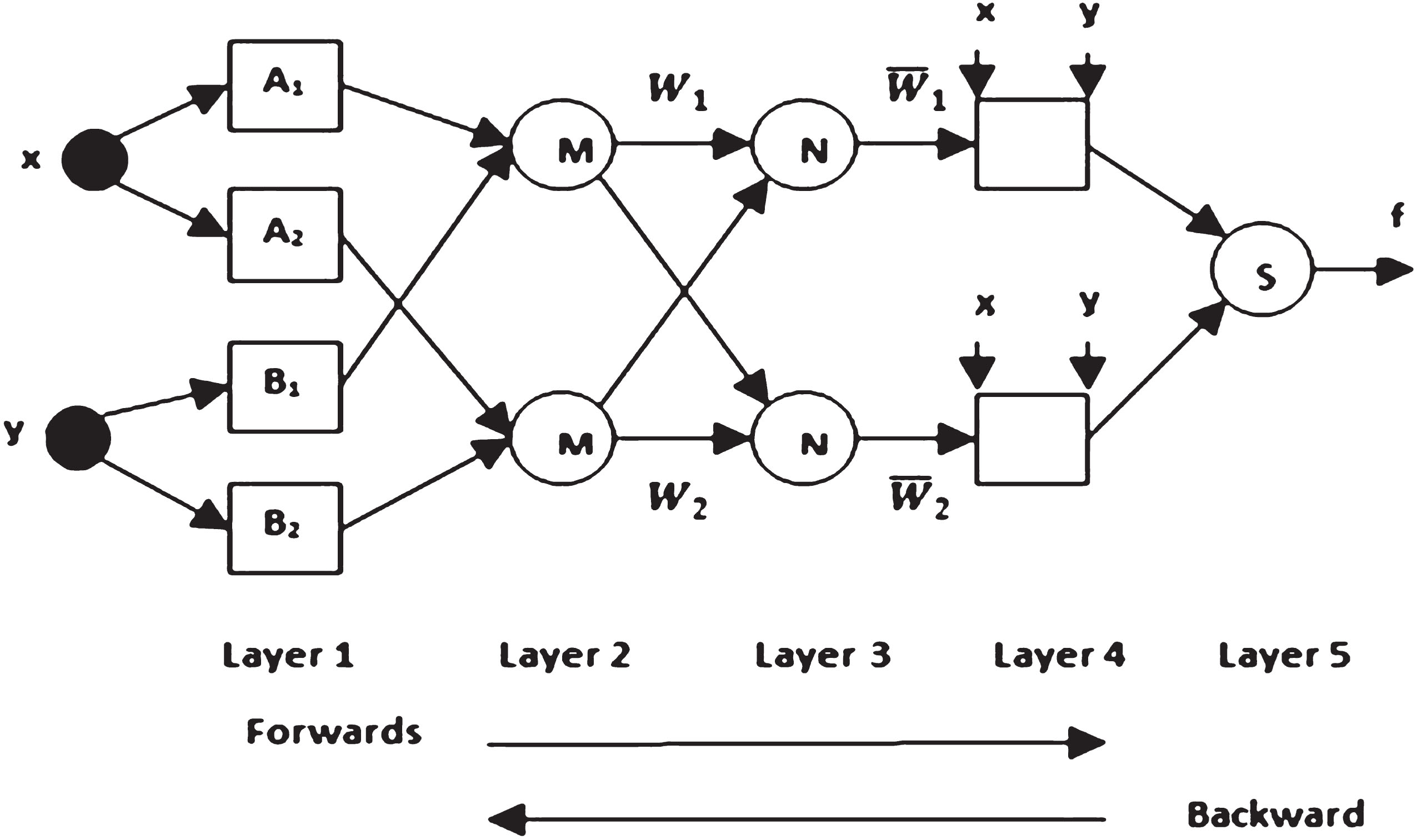
The ANFIS architecture.
A
i
and B
i
can be any appropriate fuzzy sets in parameter form. For example, if bell MF is used then:
Where a i , b i and c i are the parameters for the MF.
Layer 2: The nodes in this layer are fixed (not adaptive). These are labeled M to indicate that they play the role of a simple multiplier. The outputs of these nodes are given by:
The output of each node in this layer represents the firing strength of the rule.
Layer 3: Nodes in this layer are also fixed nodes. These are labeled N to indicate that these perform a normalization of the firing strength from the previous layer. The output of each node in this layer is given by:
Layer 4: All the nodes in this layer are adaptive nodes. The output of each node is simply the product of the normalized firing strength and a first order polynomial:
Where p i , q i , and r i are design parameters (consequent parameter) since they deal with the then-part of the fuzzy rule.
Layer 5: This layer has only one node labeled S to indicate that performs the function of a simple summer. The output of this single node is given by:
The ANFIS architecture is not unique [37]. Some layers can be combined and still produce the same output. In this ANFIS architecture, there are two adaptive layers (1, 4). Layer 1 has three modifiable parameters (a i , b i , and c i ) pertaining to the input MFs. These parameters are called premise parameters. Layer 4 has also three modifiable parameters (p i , q i , and r i ) pertaining to the first order polynomial. These parameters are called consequent parameters [38].
The first set of analyses extract the main components of the HSOPSC questionnaire using PCA and extract principal components of PSC. Table 2 provides the results of PCA for some questions of HSOPSC questionnaire in two study hospitals. The larger values indicate the higher effects of the component. PCA eigenvalues on the data set are presented in Table 3.
The results of PCA for some components of the questionnaire in two study hospitals
The results of PCA for some components of the questionnaire in two study hospitals
Eigenvalues of the PCA for different dimensions
Note: D1: communication openness, D2: feedback and communication about error, D3: frequency of event reporting, D4: hospital handoffs and transitions, D5: hospital management support for patient safety, D6: non-punitive response to error, D7: organizational learning – continuous improvement, D8: overall perceptions of patient safety, D9: staffing, D10: supervisor/manager expectations/actions promoting patient safety, D11: teamwork across hospital units, D12: teamwork within units.
Table 3 shows that the dimensions have sufficient information from their related components (questions). For example, the main extracted component of PCA for dimension D3 has eigenvalue 1.24, and the proportion of explained variance by this component is
The results of principal components in working units of hospitals indicated that the values of dimensions were higher in some hospital units than other units of studied hospitals. The scores of some dimensions such as hospital handoffs and transitions (D4) and non-punitive response to error (D6) in the internal medicine unit of hospital No.1 were higher than those obtained for other units such as surgery unit and operating room of hospital No.1. In the pediatric unit of hospital No. 2, hospital handoffs and transitions (D4) dimension was among the highest-scoring PSC dimension. For hospital No. 1, the high dimension score was related to communication openness (D1) in the women’s unit. The highest dimension score was related to hospital handoffs and transitions (D4) in the surgery unit of hospital No. 2.
The overall grade of PSC was modeled using ANFIS. This is a classification problem with classes including class 1“poor grade” and class 2 “acceptable grade” of PSC. The values of 12 dimensions extracted using PCA were used as input data for modeling PSC and training process was done using training data obtained by random selection of 90 percentages of all instances. The architecture of the ANFIS model was constructed and related parameters were tuned. In order to obtain the best architecture (i.e. best parameter values) yielding a minimum error, different values of parameters have been examined and the suitable values for the number of clusters were obtained. The membership functions for input variables were Gaussian. Figure 2 shows the presented ANFIS structure.
The number of ANFIS rules for rule base of each hospital was 6. To analyze of the accuracy of the ANFIS model, the confusion matrix was used. The confusion matrix of the ANFIS model for testing data (10 percentages of all instances) in hospital No. 1 and No. 2 are shown in Table 4.
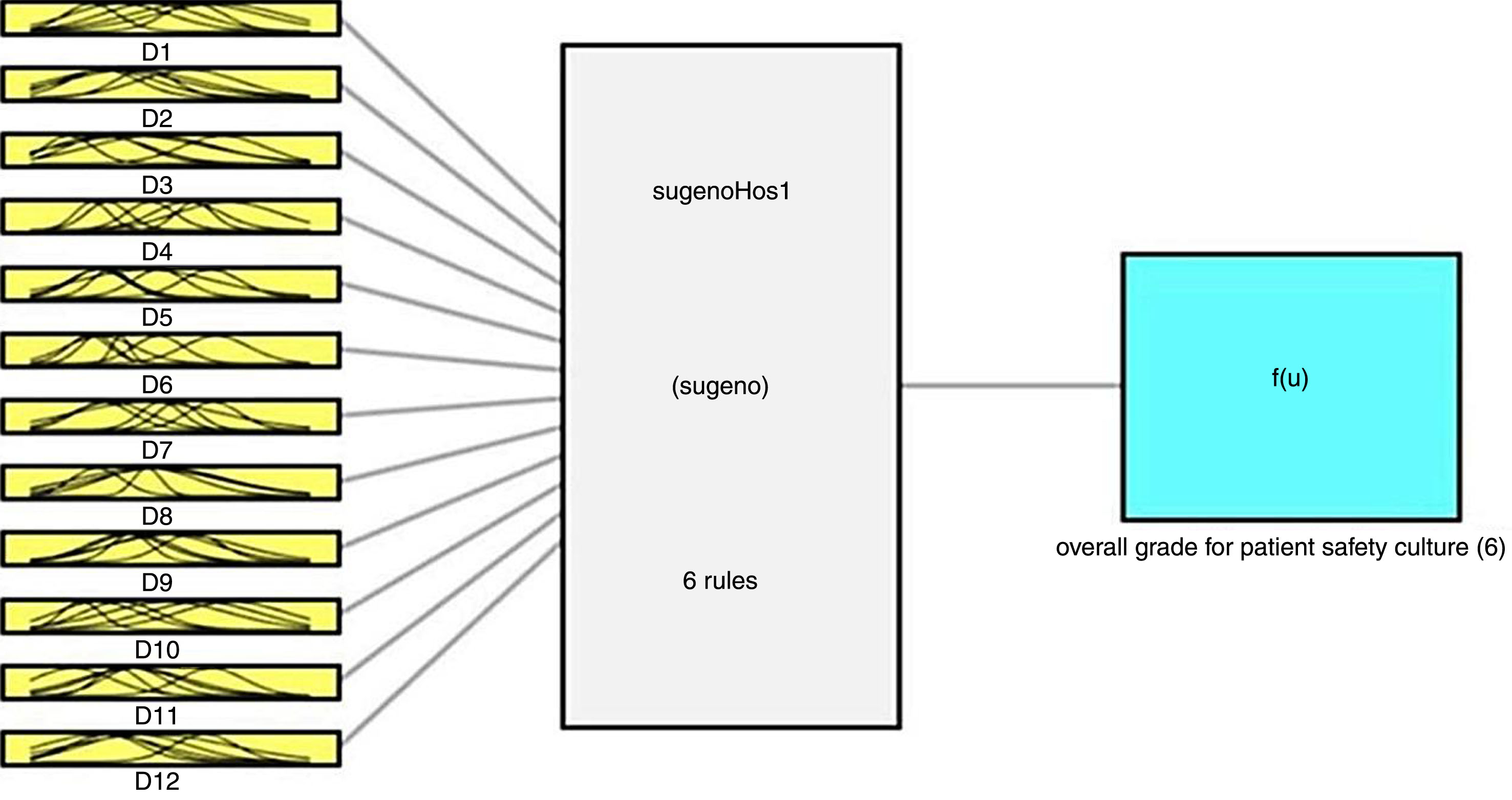
ANFIS structure for modeling overall grades of patient safety culture.
Confusion matrix of ANFIS for testing data in the hospitals
According to the above statement, using the proposed ANFIS model as an intelligent modeling of overall grades of PSC can accurately simulate and predict PSC.
Healthcare professionals’ attitudes towards voluntary reporting of adverse events were assessed using a two-part questionnaire. The results indicated that 46.5%, in hospital No.1, and 34.6%, in hospital No.2, of healthcare professionals who gave an acceptable grade on PSC, voluntarily reported their own medical errors. Table 5 represents the involvement of health professionals in medical errors. Frequency and percentage of responses to some attitudes questions are shown in Table 6.
Health professionals’ experiences in medical errors
Frequency and percentage data reflecting healthcare professionals’ attitudes towards voluntary reporting of adverse events
Note: TA: Totally agree; A: Agree; NI: No idea; D; Disagree; TD; Totally disagree.
The present study aimed to measure PSC and healthcare professionals’ attitude towards voluntary reporting of adverse events in two hospitals in Iran and to develop a hybrid intelligent approach for modeling PSC grades. The findings show that 50.9% of healthcare professionals in hospital No.1 and 51.2% of healthcare professionals in hospital No.2 have experienced a medical error in the last 12 months before the study. The results of assessing PSC by another study in the northeastern part of Iran indicated that 47% of health-care workers had reported a medical error in the last 12 months before entering the study [23]. Assessment of PSC in 223 health professionals in Saudi hospitals revealed that 43% of healthcare professionals had no reported adverse events over the past 12 months [39]. Comparing the results, it can be seen that, the error rates of the healthcare in our studied hospitals were higher than that reported in hospitals in northeastern Iran, but lower than that reported in Saudi hospitals. These differences are due to the differences in organizational culture, in population characteristics, and in safety variables between the hospitals.
Investigating the values of the principal components in the working units of both study hospitals revealed that the high dimension scoring was related to hospital handoffs and transitions (D4) in the surgery unit of hospital No. 2. Assessment of PSC in different units of a hospital in Isfahan (a province of Iran) showed that the average percentage of positive responses for hospital handoffs and transitions in the surgery unit of the hospital was 41% [40]. Characteristics of unit-level patient safety culture in hospitals in Japan indicated that patient safety culture varies in different units of the hospitals and high scores of patient safety culture were reported in obstetrics and gynecology unit and perinatal unit and low scores were reported for long-term care unit, rehabilitation unit, and administration unit [41].
Among healthcare professionals, 55.5% of participants in hospital No.1 and 50% of subjects in hospital No.2 gave their hospital an acceptable patient safety grade. Assessment of PSC at 6 teaching hospitals in Tehran province of Iran demonstrated that 60% of healthcare professionals gave their hospital an acceptable patient safety grade, 15% of them gave a very good grade, 7% of subjects gave excellent grade, and 4% of them gave their hospital a poor patient safety grade [42]. ANFIS was applied to classify and predict the overall grade on patient safety culture. Moreover, 12 dimensions extracted using PCA data were considered as input data and overall grade on patient safety culture was considered as the output variable. For an analysis of the accuracy of the ANFIS model, the confusion matrix was used. The overall accuracy of ANFIS in modeling overall grades of patient safety culture in two studied hospitals was 0.84. Also, the accuracy of predicted grade 1 for patient safety culture using ANFIS in hospital No. 1 and hospital No.2 was 0.87. Therefore, ANFIS is capable of forecasting the overall grade on patient safety culture in both study hospitals.
Assessing the attitudes regarding voluntary reporting of adverse events indicated that among those (86 participants) who gave an acceptable grade on patient safety culture in hospital No.1, 60.5% agreed with the statement that all medical errors and near misses should be reported. In hospital No.2, 52.6% of the subjects who gave a poor grade on PSC agreed with the statement “error reporting can probably improve patient safety”. The findings of Kabirzadeh et al. (2011) [15] showed that 59% of hospital managers, chief nurses, supervisors, and head-nurses thought that medical-error reporting can probably improve patient safety, 39.9% of them totally agreed with the statement “all medical errors and near misses should be reported”, and approximately 43% disagreed with the statement “current policies of our hospital in relation to errors are desirable”. This study has found that 27.9% of healthcare professionals in hospital No.1 and 17.9% of participants in hospital No.2 who gave an acceptable grade on PSC disagreed with the statement “current policies of our hospital in relation to errors are desirable”. The prevalence of adverse events in healthcare was found to be high and it appears that more attention should be paid to prevent adverse events in medicine.
The results of this study demonstrate that the development of PSC in hospitals should be the special priority for hospital managers and adopting a non-punitive policy to error and increasing staff knowledge by training strategies can potentially improve voluntary reporting of medical errors and adverse events in hospitals. In addition, fuzzy rule based systems can be used in applications and a wide range of real problems from different areas such as patient safety. Fuzzy systems provide a framework for modeling and organizing patient safety data.
There are some limitations that should be considered. Firstly, due to lack of cooperation of physicians, number of participants among nurses and the other professions such as physicians varied considerably. Secondly, the results maybe become more reliable and practicable for other similar settings if more hospitals are involved in the study. A further study in order to assess PSC in large and more hospitals and high participation of physicians and other professionals is strongly recommended.
Conclusions
The aims of the present study were to measure patient safety culture and healthcare professionals’ attitude towards voluntary reporting of adverse events and develop a hybrid intelligent model based on a combination of PCA and ANFIS approach to model overall grade for PSC. The findings of this investigation revealed that approximately half of the healthcare professionals in both study hospitals gave their hospitals an acceptable patient safety grade. Further, improvements in PSC in both study hospitals are needed. Of those individuals gave an acceptable grade on PSC in both study hospitals, about more than half believed that all medical errors and near misses should be reported. The results demonstrated that the ANFIS model is a suitable method to predict respondents’ patient safety grades.
Conflict of interest
The authors have declared no conflict of interest.