






Abstract
BACKGROUND:
Adverse events in hospitals may jeopardize the safety of patients. Failure in professional autonomy, organizational learning or in the contact between these two factors may explain the occurrence of injurious incidents in hospitals.
OBJECTIVE:
To study reasons for failure in contact between professional autonomy and organizational learning in resilient management of specialized health care through document analysis.
METHODS:
A total of 20 reports from the Norwegian Board of Health Supervision were evaluated by a retrospective in-depth document analysis. In the analysis of adverse events, we applied the Braut model to identify function or failure of 1. Professional autonomy, 2. Organizational learning and 3. Contact between professional autonomy and organizational learning.
RESULTS:
Multivariable regression analysis showed that failure in organizational learning was the only explanatory variable for failure in contact between doctors and nurses autonomy and organizational learning. Failure in organizational learning had the strongest effect on failure in contact between doctors and nurse’s autonomy and organizational learning (B = 1.69; 95% CI = 0.45 to 2.92). Failure in professional autonomy showed no significant effect on this contact.
CONCLUSIONS:
Failure in organizational learning is associated with failure in contact between professional autonomy and organizational learning. Failure in professional autonomy did not influence this contact.
Keywords
Background
Unsafe medical care in health institutions is still of major concern as adverse events occur in 10% of all admissions in modern hospitals [1,2] and can be compared with diseases such as malaria and tuberculosis [3]. Furthermore, an association between patient injuries and substandard medical management has been observed [4]. Investigations of failures in health care have underscored the negative role of poor management and lack of organizational scrutiny of safety [5,6]. Lack of an overall integrated organizational regulatory approach has also been observed, with a substantial overlap between functions and activities [7]. Thus, the importance of leadership in resilient organizations is less than well highlighted [8].
On the micro level, the term ‘safety in hospitals’ can be defined as the ability to avoid accidents and injuries to the patients as a result of adverse events [9,10]. Evaluation of health care safety may be judged along three main lines. Firstly, ‘professional autonomy’ describes the approach of the actors who actually make decisions about the treatment and management of patients. The obligations and right to self-determination of physicians and nurses have been strong throughout history, while patient safety has become more and more established at management level through legislation and regulations [11]. Providing benefit (beneficence), or at least delimiting the damage to make it disproportionately smaller in relation to the benefit of the treatment (non-maleficence), are two requirements that physicians and nurses must meet [12]. Secondly, a more systemic focus is addressed in the organizational management of hospitals [13]. This approach is one of the characteristics of a resilient institution or management [14]. A resilient organizational and safety culture is clearly central to uncovering and reporting undesirable incidents to management or the supervisory authorities [15]. Management is responsible for ensuring that laws and guidelines are utilized correctly and optimally and reach the right decision level. A resilient institution is challenged when aiming to learn from unexpected negative events and using this knowledge to improve the quality of practice in local hospitals [16]. Activities that provide health care services should be organized so that the health personnel are able to follow their statutory obligations. Thirdly, the relationship between ‘professional autonomy’ and ‘organizational learning’ opens up for a new dimension; the contact between the two entities, i.e., ‘contact between professional autonomy and organizational learning’. An established contact between professional autonomy and organizational learning describes a resilient health service on community level [17,18]. Hospitals must be organized so that health personnel can adhere to laws and guidelines to provide safe health care. The responsibility for facilitating and ensuring safe health care is placed on top management. It is no longer just the professionals’ responsibility [16,17].
On the macro level, the government choose to counteract the above-mentioned undesirable events through legislation and improvement of the quality of health care services [17,19]. During the period 1980–2000, the Norwegian government developed laws and regulations [20], where safety and organizational responsibility within the health service were emphasized [16,21]. A regulatory framework for safe professional practice in health care was introduced with emphasis on the role of management and leadership [22]. Previously, safety measures were considered a professional obligation for practitioners [23]. Today, patient safety and safety improvements are part of the management’s responsibility [24–26]. In addition, there are national regulations for professional practice [16,27]. Importantly, the Norwegian Directorate of Health presents a national action plan for patient safety and quality improvement (2019–2023) as an overall plan to systematically reduce patient injuries and improve resilience and patient safety [28].
In 2012, the Norwegian Board of Health Supervision (NBHS) established a notification scheme with the following objective: “The purpose of the notification system for the most serious incidents is to identify unjustifiable conditions more quickly so that the conditions are rectified and contribute to better patient safety.” The two most common criteria that trigger the obligation to notify NHBS are: 1. Death of a patient and 2. Very serious injury to a patient or user because of the provision of health and care services [29]. All notifications should be published anonymously and are available to the public on the NHBS’s website. The purpose of these public reports is to stimulate the management systems to learn from these undesirable events in order to change the local organizational culture [17,30]. Each report from the NBHS contains and evaluates one case on both the professional and the systemic management aspects of the adverse event [31]. The relationship between the professional and systemic level are also reported [3]. Finally, an evaluation of the above-mentioned three main factors; the professional level, the organizational level and the contact level over several cases may better illustrate the reality as a whole than information from a single report only.
There is a need for new knowledge and better theories and models for understanding the causal chains behind adverse events in health care [32]. Not least we need a better understanding of the intersection between individual and systems related factors contributing to failure, and how this can be approached in evaluations and investigations.
In the present paper, the Braut model (Fig. 1) is used for empirical purposes [16]. The model triangulates ‘professional autonomy’, ‘organizational learning’ and ‘contact between these two entities’. The underlying hypothesis of the Braut model is that if there is a ‘failure in the contact between professional autonomy and the organizational learning’, it can lead to undesirable serious incidents in the hospitals [16]. Thus, the purpose of the present paper is to analyze consecutive reports from the NBHS using the Braut model [16] and to study how they interpret the role of the professional, the organizational and the contact between the professional and organizational level when adverse events involving the patients occur in hospitals.

Overview of the Braut model. Basically, it triangulates the ‘proper operation of the health trust’ (grey), ‘professional autonomy’ (yellow) and ‘organizational management/learning’ (blue). In the present paper the relationship between ‘professional autonomy’ and ‘organizational management/learning’ is in focus and denoted ‘contact’ between these two variables (green), i.e., ‘contact between professional autonomy and organizational management/learning’.
The main objective of this work is to study reasons for failure in contact between professional autonomy and organizational learning in resilient management of specialized health care, through document analysis. Specifically, the study seeks to (1) assess the use of the Braut model in analyzing the reports from the NBHS and (2) identify factors that can contribute to explaining failure in the contact between professional autonomy and organizational learning [16].
Professional autonomy encompasses the ability for every individual, qualified practitioner to make own decisions in clinical situations concerning single patients. Organizational learning concerns the structures and processes established through leadership and management for supporting the practitioners and ensure that clinical practice in general in the specific clinical unit is according to prudent standards and medical evidence.
Methods
Research design
We performed a retrospective in-depth analytical document study and applied the Braut model empirically on 20 consecutive reports from the NBHS. A short abstract of each case is presented in Table 1. All reports have the following structure: a descriptive part where the case is described based on information from journal records, interviews or other sources. and an analytical part containing assessments and conclusions from the NHBS.
Review of the 20 cases from the Norwegian Board of Health Supervision
Review of the 20 cases from the Norwegian Board of Health Supervision
For the sake of readability, in this paper failure in the contact between professional autonomy and organizational learning will be referred to as failure in contact. After initial definitions, all items derived from the Braut model are used without inverted commas to increase readability.
The 20 reports from the NBHS included in the study were obtained from the archives of the NHBS’s website and constituted consecutive reports from the 2018 collection (Table 1). They were studied by in-depth reading and scored according to the Braut model. The formation of 18 scoring variables is shown in Table 2. All reports were read by two researchers (AS and HS). During the in-depth reading we allocated each theme to one of the 18 variables. During the scoring, we used coloured line markers to outline which variable belonged to which part of the text (descriptive, analytic or total). When there was a discrepancy in scoring, a third researcher (GSB) was consulted to reach consensus.
Overview of the 18 variables used to score the 20 reports from the Norwegian Board of Health Supervision. The letters A to R correspond with the numbering of the figures in Fig. 3
Overview of the 18 variables used to score the 20 reports from the Norwegian Board of Health Supervision. The letters A to R correspond with the numbering of the figures in Fig. 3
SPSS version 25 for Mac was used. All notifications on the 18 variables in Table 2 in the 20 reports were calculated and sum scores provided. First, we made a descriptive analysis of the 18 sum scores. Second, a bivariate correlation between the key variables was performed [33]. Then, a simple linear regression analysis was carried out followed by a multivariable linear regression analysis [34]. The level of significance was set to P < 0.05.
Results
Descriptive analysis
The distribution of a properly functioning hospitals, professional autonomy and organizational learning is shown in Fig. 2. Furthermore, the descriptive analysis of all the 18 variables derived from the Braut model of the in-depth reading analysis are presented in Fig. 3 A to R. Both types of distribution, median and mean values are included in the analysis. Interestingly, many of the analytical analyses show a zero count, which leads to a skewed distribution for several of the variables.
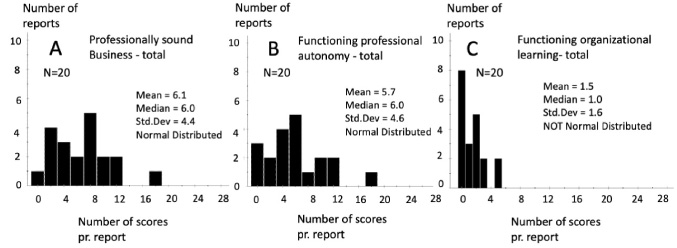
Distributions of the scorings of the basic characteristics of the Braut Model; ‘proper operation of the health trust’ (A), ‘professional autonomy’ (B) and ‘organizational management/learning’ (C).
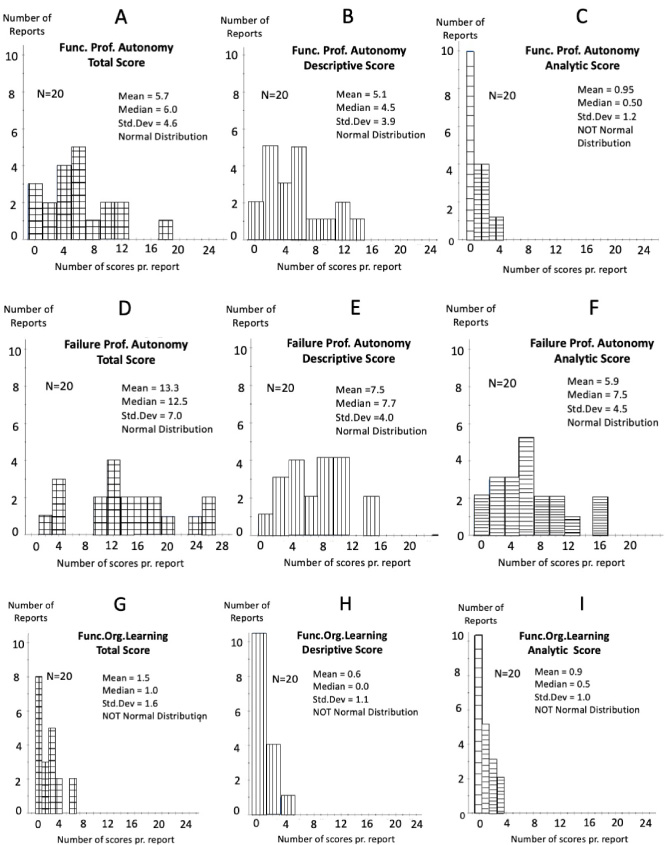
Distribution of the 18 variables (A to I) from the Braut model. For all basic variables, total score, descriptive score and analytic score are presented.
The correlation between proper operation of the hospitals and professional autonomy was very good (r = 0.979; R 2 0.958; p < 0.0001). However, the correlation between proper operation of the hospitals and organizational management and learning was poor. (r = 0.004; p = 0.985) (Fig. 4).
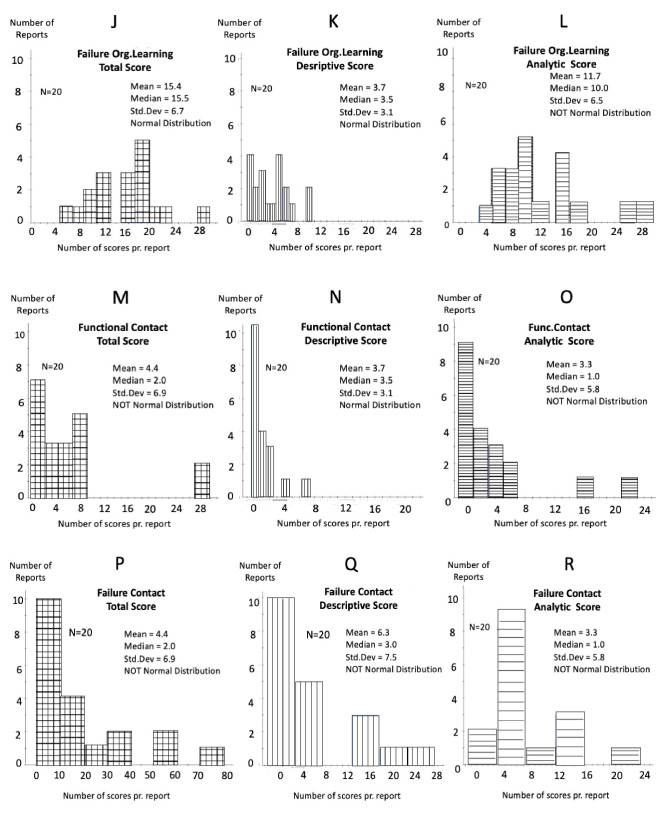
Distribution of the 18 variables (J to R) from the Braut model. For all basic variables, total score, descriptive score and analytic score are presented.
The bivariate correlation between the 18 study variables showed a trend towards that failure in contact was correlated with failure in organizational learning (Table 3). The strongest correlation was between failure in contact – descriptive and failure in organizational learning – analytical with a r = 0.602; p = 0.005 (Table 3, line 12).
Bivariate correlations of the variables
∗Spearman’s rho.
Table 4 shows the results from the simple linear analysis when failure in contact – total was the dependent variable. Here, failure in organizational learning total and failure in organizational learning – analytical had a Beta value of 1.44 (95% CI 0.19 to 2.70) and 1.69 (95% CI 0.45 to 2.92) respectively (Table 4, lines 4 and 6). When failure in contact – analytical was selected as the dependent variable failure on organizational learning -analytical was the only significant independent variable (B = 0.97; CI95% 0.11 to 1.83) (Table 5, line 6).
Simple linear regression analysis 1
Simple linear regression analysis 1
Simple linear regression analysis 2
In the multivariable linear analysis, we observed that failure in organizational learning was the only explanatory variable for failure in contact. Furthermore, failure in organizational learning - analytical had the strongest effect with B = 1.69 (95% CI 0.45 to 2.92) (Table 6, Model 1). Model 1 uses failure in contact – total as the dependent variable, while Model 2 uses failure in contact - analytical as dependent variable.
The independent variable was the same (failure in organizational learning - analytical) in both Model 1 and 2. The reason for presenting two separate models is a considerate overlap between the two dependent variables with an extensive interference with each other when they are in the same model. It was therefore sensible to split the analysis into two models (Table 6).
Multivariable linear regression analysis
Multivariable linear regression analysis
Model 1 uses failure in contact – total as the dependent variable, while Model 2 uses failure in contact - analytical as the dependent variable. The independent variable was the same (failure in organizational learning - analytical) in both Models 1 and 2. The reason for presenting two models is a considerate overlap between the two dependent variables interfering heavily with each other when they are in the same model.
To the best of our knowledge, this is the first time that reports from the NBHS have been used on an empirical basis in quantitative analyses. When applying the Braut model, we observed that failure in organizational learning was the only factor that explained failure in contact between professional autonomy and organizational learning.
In our opinion, the audit reports contain three important elements that make them relevant to all hospitals in Norway [35]. First, the reports have a thorough review of each of the 20 cases from the point of view of the health personnel. Second, the NBHS analyzes the role of the management and the organization in depth and becomes an unbiased voice in meeting the top management. Third, the 20 cases represent a broad variety of medical fields [3]. As such, we believe that the NBHS reports cover several medical questions and situations. Thus, these reports are probably representative of and relevant for all involved parties in providing appropriate health care to patients at all hospitals in Norway [36].
One important question is whether it is relevant to use the Braut model empirically in the present context [16]. When the NBHS assesses whether health care is justifiable, it considers whether the professional autonomy leads to adequate assessments and actions in the correct order in the specific situation [16]. The NHBS also assesses whether the hospital has arrangements enabling health personnel to provide proper health care (= organizational learning) [37]. This means that health care can be considered justifiable even if the outcome is tragic with disabling injury or death [38]. Thus, the reports deal with the two entities found in the Braut model. Therefore, this model seems suitable for analysis of the issues raised in the audit reports. Furthermore, we found that there was strong correlation between proper operation of hospitals and professional autonomy, while there was no significant relationship between proper operation of hospitals and organizational learning. This is in accordance with our basic understanding of the Braut model [16]. It also helped to strengthen the internal validity of the Braut model for the analysis of our reports.
In the multivariable modelling, we observed two interesting findings. First, failure in professional autonomy had no influence on failure in contact. This could mean that even if the doctors’ and nurses’ best judgment in complicated situations later turns out to be wrong, it does not necessarily place any obstacles in the way of contact with the organization and management. Doctors and nurses often feel responsible and comply with guidelines from management [39,40]. Secondly, failure in organizational learning was the only variable explaining the failure in contact in the final multiple variable modelling. This finding might have three explanations: Firstly, it seems that the systemic/organizational part appears to be more important than the professional part when ensuring that health workers comply with routines and organizational regulations [41]. This is in line with recent studies where stronger leadership commitment and acknowledgement of quality and safety as integral to the operational culture of healthcare organizations are questioned [40,42]. In addition, it may appear that the assessments of the NBHS have a systemic focus on adverse events [30], as failure in management tasks could lead to uncertainty and poor communication down the ranks [43]. Thus, it might affect many health workers and their relationships with patients [44]. Secondly, the NBHS’s analytical part was the significant explanatory variable. This suggests that the NBHS postpones the criticism of management until the analytical part of the report [45]. It is also a logical way to distribute the points in the report, by starting ‘professionally’ and finishing ‘organizationally’. Furthermore, the NBHS probably has a special focus on management matters [30]. This is because management deficiencies might have consequences for several departments in a hospital. Therefore, much could be gained from correcting failure in organizational learning [46] as it might affect large parts of the organization [47,48]. A third factor is that the NBHS might be somewhat biased towards management. This may have led to the fact that particularly failure in organizational learning had a strong correlation in our analyses.
Implications
Our observations have highlighted the systemic level (organizational learning) to optimize the contact between the professional and organizational parts with a B = 1.69. Consequently, if the hospitals invest in organizational learning they will gain 1.69 times more outcome for each unit they put into improving the conditions for this entity. Such outcome may be less money spend, less unfavorable events or more attentions to check lists for various procedures.
Limitations
This study has several limitations. First, it can be argued that auditing 20 reports from the NBHS is too few for a quantitative analysis. However, these 20 reports constitute a complete year (2018) of consecutively published reports from on-site inspections by the NHBS. In addition, the scoring model led to 392 scores (median 112) on the various variables in the 20 reports, which represent a good basis quantitative analysis.
Another possible limitation is lack of validation of the applied scoring form in comparison with guidelines for validating a questionnaire [49]. We may therefore have had a lower construct validity than a standard questionnaire validation. This was probably compensated by the fact that the scoring form was quite simple (only three main variables) and that two researchers went through all the reports and came to a consensus. When in doubt, a third researcher was involved.
The NHBS tendency to critically assess the management’s role in the reports may have introduced a bias and thus a type 1 error [50]. Furthermore, the low number of scores on some variables can lead to a type 2 error, but several variables had sufficient scores so that type 2 errors are probably not present in this study [50]. The external validity is acceptable as we used 20 consecutive current reports representing several medical fields. However, the external validity could probably be improved by adding more reports and thus covered a broader field of medical specialties.
Future research
In the future, one may have to look at interaction and the safety perspective in a new way, as in the Safety-II approach. This new paradigm has evolved over the last 5 years [51]. The classic safety thinking that involves analyzing what went wrong is called Safety-I thinking [44]. From a modern security perspective, this is turned upside down, where one asks: What went well? - and why? Such thinking is called the Safety-II approach [52]. The five core points of the Safety-II approach are: (1) Definition of safety, which is the ability to create a fortunate outcome, (2) Handling safety, (3) The focus on human recourses, (4) Accident investigation and (5) Risk assessments focused on analysing why things are going well, so that one can understand what happens when adverse events and errors occur [52]. According to Turner, such an approach will be complementary to the classic Safety-I universe [44]. To increase resilience in both the Safety I and II contexts, the importance of learning from systematic training and simulation is emphasized [53].
The Braut model is likely to be well suited to address Safety-II thinking in the future [54]. We can probably consider functional contact between the professional leg and the system leg in the same way as the present study has analysed failure in contact in accordance with Safety-I thinking. It will be exciting to conduct this analysis in the light of the Safety-II approach.
Kim and Mauborgne tell managers that ``people care about the decisions you make, but they care even more about the process you used along the way" [55]. They recommend adhering to three principles of a fair process: expectation clarity, explanation and engagement. This invites appropriate structural management while taking into account the right to self-determination. Then you want to breathe new life into the patient safety culture in the hospitals by working towards a functioning contact between the profession and the organization. Thus, the principles from the Braut model could be important for hospital managers in the future.
Conclusion
Empirical use of the Braut model in the analysis of the 20 audit reports from the NBHS identifies failure in organizational learning as the explanatory variable for failure in contact in the hospitals. Furthermore, a change in organizational learning of one unit will improve the contact by a factor of 1.69.
We would like to emphasize that doctors and nurses must not be deprived of their professional right to autonomy, as this entity does not have any significant effect on contact between professional autonomy and organizational learning. Doctors and nurses should instead be given a sound framework so that they can work safely. Furthermore, the organizational learning and management underpins the professional understanding. Therefore, it is important to maintain professional soundness as a profession-based and cultural phenomenon, while at the same time building up and strengthening organizational support. These endeavors will be a small step for the institutions, but a giant leap for improving resilience in Norwegian hospitals.
Footnotes
Acknowledgements
The authors thank Prof. Jan Terje Kvaløy, University of Stavanger for the statistical support.
Conflict of interest
None of the authors have any conflict of interest to report.
Informed consent
Not applicable.