







Abstract
Despite the importance of multi-attribute group decision making (MAGDM) problem in the field of optimal design, it is still a huge challenge to propose a solution due to its uncertainty and fuzziness. The spherical fuzzy sets (SFSs) can express vague and complicated information of MAGDM problem more widely. The Evaluation based on Distance from Average Solution (EDAS) method, as a highly practical decision-making method, has received extensive attention from researchers for solving MAGDM problem. In this paper, a spherical fuzzy EDAS (SF-EDAS) method is proposed to solve the MAGDM problem. Moreover, the entropy method is also introduced to determine objective weights, resulting in a more proper weight information. In addition, a practical example is settled by SF-EDAS method, which proves the excellent efficiency in applications of MAGDM problem. The SF-EDAS method provides an effective method for solving MAGDM problems under SFSs, and EDAS also provides a reference for further promotion of other decision-making environments.
Keywords
Introduction
Zadeh [1] reported a concept of fuzzy set to improve the accuracy of decision problem in daily life. Further, Atanassov [2] put forward intuitionistic fuzzy sets (IFSs) and it allows us to process uncertain information more expressively [3, 4, 5]. Zhao et al. [6] defined the Intuitionistic fuzzy MABAC method based on cumulative prospect theory. Zhang et al. [7] built the Grey relational analysis method based on cumulative prospect theory for intuitionistic fuzzy MAGDM. Xiao et al. [8] built the Taxonomy method for MAGDM based on interval-valued intuitionistic fuzzy with entropy. Mou et al. [9] studied MAGDM method in IFSs. Yager [10] introduced that the Pythagorean fuzzy set is a novel extension of the IFSs. Furthermore, in order to express more possibilities when we face the intricate problems, Cuong [11] came up with the concept of picture fuzzy sets (PFSs) based on the as-mentioned above works. It also attracts the research interest of the majority of scholars. Son [12] applied image ranging technology and investigated its applications in fuzzy clustering of images. Zhou et al. [13] studied some operators of geometric sets and fuzzy mathematics based on PFSs. Jiang et al [14] investigated a CPT-EDAS method for picture fuzzy MAGDM. Jiang et al. [15] defined the picture fuzzy MABAC method based on the prospect theory. Jiang et al. [16] defined the CPT-TODIM method for picture fuzzy MAGDM.
The spherical fuzzy sets (SFSs) are derived from PFSs. Abdullah et al. [17] proposed a spherical fuzzy weighting and ordered weighted aggregation operator for MAGDM. Gundogdu et al. [18] proposed a CODAS method under SFSs. Gundogdu et al. [19] defined the TOPSIS method using emerging interval-valued SFSs. Abdullah et al. [20] introduced a spherical T-norm and spherical fuzzy T-Conorms. Gundogdu et al. [21] extended a traditional WASPAS method to SFSs, which was applied in the selection problem of industrial robots. Hussain et al. [22] defined a TOPSIS method for MAGDM problems in SFSs. Zhu et al. [23] put forward a t-SFWGMSM operator with an effective window, and it can deal with many MAGDM problems. Kumam et al. [24] systematacially investigated the spherical fuzzy distance, similarity measurements and their applications. Chakrabortty et al. [25] combined the hierarchical analysis method of SFSs with TOPSIS. Mahmood [26] used the SFSs to solve the problem of medical diagnosis. Gundogdu et al. [27] applied the analytic hierarchy process (AHP) of SFSs to renewable energy. However, despite the critical and key role in daily life, MAGDM problems under SFSs is still not solved effectively and accurately, thus it remind us to introduce EDAS method to solve group decision making problems under SFSs Zhang et al. [28] built the SF-GRA method based on cumulative prospect theory for MAGDM. Zhang et al. [29] built the CPT-MABAC method for spherical fuzzy MAGDM.
Ghorabaee et al. [30] reported the EDAS method for the first time, which selected the optimal solution by calculating the distance between each solution and the optimal value, showing a high practical value in the case of attribute contradiction. However, it is only used to solve decision problems in real number field. Recently, more and more scholars have extended the EDAS method to solve MAGDM problems in other environments. For example, Huang et al. [31] defined the enhancement EDAS method based on Prospect Theory. Ren et al. [32] used the EDAS to solve the MAGDM problem in four-fuzzy environments. Feng et al. [33] extended the application of EDAS in the hesitant and fuzzy scenes. Behzad et al. [34] analyzed and compared the sequence inversion between EDAS and TOPSIS. Peng et al. [35] designed the neutrosophic software MAGDM algorithm based on EDAS and defined the similarity measurement. Karasan et al. [36] used the Neutrosophic EDAS for decision problems. He et al. [37] defined pythagorean 2-tuple linguistic EDAS method. Li et al. [38] proposed the linguistic Neutrosophic EDAS method. Karasan and Kahraman [39] designed an interval value EDAS method. It can be seen that many scholars have introduced EDAS method in the context of IFS and Pythagorean to provide a way of making decisions, but the SFSs is an extension of the IFSs and the Pythagorean fuzzy sets Wei et al. [40] built the EDAS method for probabilistic linguisticMAGDM. Lei et al. [41] defined the PDHL-EDAS method for MAGDM. Su et al. [42] defined the Probabilistic uncertain linguistic EDAS method based on prospect theory. Unfortunately, we do not find any work of the EDAS method based on Entropy method with SFSs in the existing literature.
As an extension of other fuzzy sets, spherical fuzzy sets can better express the uncertainty of decision information Therefore, it is necessary to solve MAGDM problem under SFSs, yet few reports have effectively solved this kind of problem. In this study, EDAS method is used to solve MAGDM problem in spherical fuzzy environment, resulting in a more reasonable and accurate decision. In addition, in order to make the research results of this paper have a strong objectivity, entropy method is applied to calculate the properties of objective weight. The main innovations and contributions of this study are briefly summarized as follows: (1) The SFSs is used to indicate assessment information of decision makers more comprehensively; (2) The EDAS method is extended in the spherical fuzzy environment for settling MAGDM problems; (3) Using a company’s facility and equipment procurement as an example, the EDAS method is utilized to solve MAGDM issue in fuzzy environment to make optimal decision; (4) The as-proposed method provides some new perspectives for the extension of EDAS in other information environments.
Preliminaries
This part reviews the basic concept and operators for SFSs, the entropy method and the traditional EDAS method.
Spherical fuzzy sets
Where
Where
And when compare the sizes by the Score function, if the Score function is the same, then comparing them by Accuracy functions:
(i)
Entropy weight method is a method to determine the weight, which can deeply reflect the ability to distinguish indicators, making the weight assignment more objective, theoretical basis, high credibility, compared with the analytic hierarchy process (AHP) and other subjective methods has a certain accuracy; In addition, the algorithm of entropy weight method is relatively simple. The calculating steps of Entropy method [48] is listed as follows.
Step 1. Obtain the decision matrix from DMs as follows:
where
Step 2. Use Eq. (16) to make the decision matrix normalized:
Step 3. Calculate the degree of entropy with Eq. (17):
Step 4. Figure out the initial deviation of entropy depending on Eq. (18):
Step 5. Get the attribute weights according to Eq. (19):
The EDAS method [30] is an important decision-making method, which is very applicable in the case of contradictory attributes. It is to determine the best solution by calculating the distance between attributes and attribute all alternatives best solution. This method is compensatory, which converts qualitative decision into quantitative attribute, so as to obtain the optimal decision-making result.
Step 1. Create decision matrix by DMs as below:
where
Step 2. Calculate the average solution for each attribute using the following formula:
Step 3. From the results of the second step, the average positive definite distance (PDA) and the average negative definite distance (NDA) can be obtained by the following formula.
For the benefit indicator:
For the cost indicator:
Step 4. Compute the value of the weighted PDA and weighted NDA with the aid of Eqs (25)–(26):
Step 5. The weighted normalized value of PDA and NDA based on Eqs (27)–(28):
Step 6. Use the following formula to calculate the evaluation score of each scheme and sort all schemes.
Let
The procedure of the SF-EDAS method.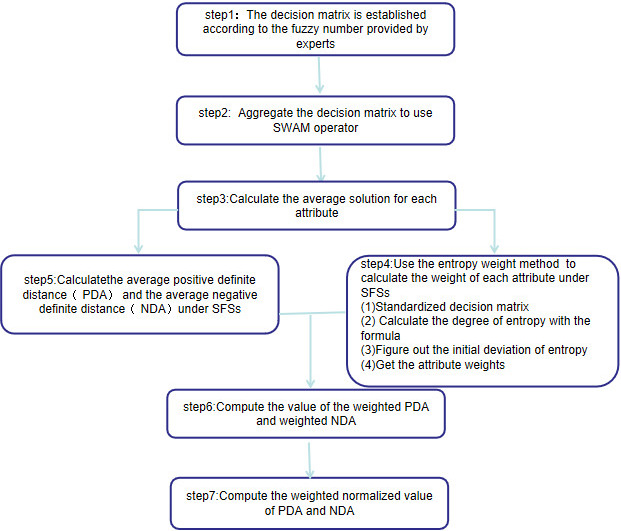
Step 1. Establish corresponding assesses information from DMs.
Using SWAM operator obtains the aggregate group decision matrix, as shown below:
Step 2. Based on Eq. (2) and Eq. (30) to get the average solution
Step 3. Compute PDA and NDA with the following formula:
For the benefit attribute:
For the cost attribute:
Step 4. Utilize Eq. (14) to get the score values of group decision matrix, and the objective weights (
Step 5. The value of the weighted PDA and weighted NDA is calculated by Eqs (35)–(36):
Step 6. Normalized PDA and NDA by Eqs (37)–(38):
Step 7. Calculate the evaluation score of each scheme by Eq. (39) and rank all schemes based on the value of
Numerical methods SF-EDAS examples
A company needs to purchase a batch of new machinery and equipment from the following four companies
Step 1. A fuzzy evaluation matrix is given:
represents the evaluation of the
The results of
The results of
The results of
The objective weights of attributes
Step 2. All the cost-type indicators in Tables 1–3 were converted into efficiency indicators, as shown in
The transformation from cost index to benefit index in spherical fuzzy set is as follows:
For example,
Step 3. Aggregate evaluation matrix of each expert to obtain group decision matrix by using the SWAM operator and weight of expert, as below.
In
According to the above calculation results,
Step 4. The average solution is obtained from Eq. (2) and Eq. (18), and
Step 5. Equation (31) and (32) can be used to PDA and NDA, which are shown in Tables 1–2 respectively.
Step 6. According to Eqs (7)–(10), the objective weight can be calculated, as shown in Table 3.
The weighted
Normalize the weight
Step 7. The value of the weighted
Step 8. Equations (37) and (38) were used to normalize the weighted PDA and the weighted NDA respectively (see Table 5). Take
Step 9. Finally, Eq. (39) is used to figure out the evaluation scores, as shown in the Table 6.
According to the above example demonstration and the final result of
The evaluation scroes
In the previous part, we studied the SF-EDAS method as a new approach to solve MAGDM, and demonstrated it with an example In numerous studies, we found that some scholars also extended other methods about SFSs, such as the proven SF-VIKOR method [49] and SF-TOPSIS method [50]. To verify the correctness of the extended EDAS, we compared the proposed method with the SF-VIKOR and SF-TOPSIS method.
Compared with SF-VIKOR
Next, The SF-VIKOR [49] was utilized to test the proposed method. Based on the data of Tables 1–3 and objective attribute weight, a brief calculation process and results are shown below.
The PIS and NIS
The PIS and NIS
The distance between PIS and each attribute
The
Step 1. The decision matrix is aggregated using the SWAM operator.
Step 2. Get the Positive ideal solution PIS and Negative ideal solution NIS, as shown in Table 7.
Step 3. Get the distance between PIS and each attribute, as shown in Table 8.
Step 4. Calculate the weighted distance
Step 5. Obtain the
Step 6. Then get
The
The
The
Step 7. Compute
According to the calculation process, and the final conclusion from Table 12, we can clearly get the index sorting
In the following, we will take the case in the article as an example to use SF-TOPSIS method [50] to certify the proposed SF-EDAS method. Based on the Table 4 and attribute weights, the calculation steps and the optimal scheme results are displayed as follow:
Step 1. The SWAM operator is used to aggregate the weighted spherical fuzzy decision matrix.
Step 2. Calculate the score values of the weighted group matrix as shown in Table 13.
The score values of the weighted group matrix
The score values of the weighted group matrix
Step 3. Obtain NIS and PIS (see Table 14).
The NIS and PIS
Step 4. Calculate the distance between each scheme and the SF-NIS and the SF-PIS (see Table 15).
The distance between each scheme and the SF-NIS and the SF-PIS
Step 5. Compute the closeness ratio for each alternative (see Table 16).
The closeness ratio
The comparison analysis
Finally, we can get the finally ranking
In this paper, we use SF-VIKOR [49] and SF-TOPSIS method [50] to verify the effectiveness of SF-EDAS We found that the optimal solution of SF-EDAS with SF-VIKOR and SF-TOPSIS method is consistent, it is confirmed that the SF-EDAS method in this article is effective. In addition, by the steps above we can see that calculating program of the SF-EDAS method is simpler and clearer, so SF-EDAS method has a more efficient and rapid method when making optimal decisions in SFSs. Meanwhile, the SF-EDAS method greatly reduces the cumbersome steps when we make decisions and improves the decision-making efficiency of complex environment.
In Table 17 above, we have showed out the final ranking results of the conclusions calculated by SF-EDAS method and the SF-VIKOR and SF-TOPSIS method, so that we can see the final ranking of the three methods more intuitively and clearly.
As can be seen from Table 17, the optimal decision scheme in the above methods is
Conclusion
In this paper, based on SFSs and the traditional EDAS method, we present the SF-EDAS method for MAGDM problem. Firstly, we briefly introduce basic knowledge of SFSs and the corresponding calculation steps of the EDAS method. In order to make the final decision more objective and reasonable, entropy method is introduced to calculate the weights of attribute in SFSs. Then the EDAS method is applied to spherical fuzzy environment, and a new method to make the optimal decision in the fuzzy environment is obtained by combining them effectively, and the concrete calculation steps and formulas are given. Then, we take an example to carry out practical application to make readers understand this method more clearly. Finally, we used the existing proven SF-VIKOR method and SF-TOPSIS method for comparison and obtained the consistent results of the optimal scheme. Similarly, this method can also be applied to service evaluation, personnel selection and other decision-making problems. How to extend other decisionmaking methods to spherical fuzzy environment, so as to make spherical fuzzy decisionmaking theory more perfect, is a problem that can be further studied in the future Based on the limitations of EDAS and the existing environment that scholars have studied, we believe that in the future, the other weight information method are consider in MAGDM [51, 52, 53, 54, 55] and the EDAS method will be more widely used and will attract more readers’ interest as research objects in other settings [56, 57, 58, 59, 60, 61, 62].