







Abstract
The storage stability of catalase is very low under practical reaction conditions. Therefore, this study is aimed to evaluate the storage stability of catalase from camel liver by treated it with polyethylene glycol (PEG), glycerol, bovine serum albumin (BSA) and glucose against different storage conditions. The effect of some additives as stabilizers on the storage stability of camel liver catalase at 4°C and 30°C after 30 and 90 days was studied. The enzyme with additives at 5%concentration was more stable at 4 and 30°C for 90 days of incubation than native enzyme. The activity of catalase was more thermal stable in presence of 5%additive. The activity of enzyme with 5%BSA and glucose was retained 60%of its activity at 60°C. At pH 11 the catalase with glucose retained 30%of its activity. The native enzyme lost 80%of its activity in presence of 5 mM β-mercaptoethanol, where the enzyme with additive retained 30–46%of its activity. At 8 M urea, the native enzyme and enzyme with 5%of all additives retained 28%and 61–77%of its activity, respectively. The catalase with additives retained 50–90%of its activity in presence of different dyes. The results appeared that the catalase with additives may be used for elimination of excess of hydrogen peroxide after bleaching of textile.
Introduction
Catalase is used in different applications such as medicinal, food industrial, elimination of excess of hydrogen peroxide after bleaching of textile [1–5]. The storage stability of catalase is very low under practical reaction conditions [6–8]. Catalase is a tetrameric enzyme consisting of four subunits [9]. The storage stability of soluble multimeric enzymes is very poor compared with monomeric enzymes [10]. The inactivation of monomeric enzymes occurred by changes in their tertiary structure [11], where the dissociation of the enzyme subunits caused the inactivation of multimeric enzymes [12]. Using soluble enzyme in different applications is very limited because it easily denatured by changes of the environmental conditions such as temperature, pressure, pH and ionic strength [13]. The resistance of the enzyme activity against high temperatures, pHs and denaturing compounds is very important for industrial application of the enzymes [14, 15]. This work focused on the study of the storage stability of catalase from camel liver as homotetrameric enzyme by treated it with different additives (polyethylene glycol, glycerol, bovine serum albumin and glucose) against different environmental conditions.
Materials and methods
Camel liver catalase
The purified camel liver catalase was obtained from Prof. Omar A. Al-Bar [16].
Measurement of catalase activity
Catalase activity was detected by the method of Bergmeyer [17]. The reaction mixture (1.0 ml) includes: 0.025 M H2O2, 0.075 M sodium phosphate buffer, pH 7.0 and one unit of catalase at room temperature. One unit of enzyme activity was defined as the amount of the enzyme that causes a change of 0.1 in absorbance per min under standard assay conditions.
Effect of additives on storage stability of catalase
Different concentration of polyetheleneglygol (PEG), bovine serum albumin (BSA), glucose and glycerol (1, 2 and 5%v/v) as stabilizers was added to camel liver catalase. The enzyme activity was measured in native enzyme and enzyme with additive at 4°C and 30°C after 30 and 90 days.
Thermal stability of catalase
The native enzyme and enzyme with additive were incubated at different temperature (10–60°C) for 24 h. The substrate was added, and the enzyme activity was measured according to the standard assay conditions.
pH stability of catalase
The native enzyme and enzyme with additive were incubated at different pH’s (6.5–11) (pH 6.5–9 (0.075M) Tris-HCl: pH 9.5–11 (0.075M) carbonate/bicarbonate buffer) for 24 h. The substrate was added, and the enzyme activity was measured according to the standard assay conditions.
Effect of compounds on catalase
The β-mercaptoethanol (2 and 5 mM), urea (2 and 4 M), and 5%of bromophenol blue, methyl green, methylene blue and methyl orange were incubated with the native enzyme and enzyme with additive for 3 h. The substrate was added, and the enzyme activity was measured according to the standard assay conditions.
Results
The effect of some additives as stabilizers on the storage stability of camel liver catalase at 4°C and 30°C after 30 and 90 days was studied (Table 1). Different concentrations of PEG, glycerol, BSA and glucose were used as stabilizers. After 30 days of incubation, the activity of native catalase was retained 62%and 40%at 4 and 30°C, respectively. The activity of native catalase after 90 days of incubation at 4 and 30°C lost 72 and 92.8%of its activity, respectively. On contrast, the activity of catalase with different additive concentrations retained 17–105%of its activity.
The effect of additives on storage stability of camel liver catalase
The effect of additives on storage stability of camel liver catalase
PEG: Polyetheleneglycol. BSA: Bovine serum albumin.
The effect of storage conditions was carried out for camel liver catalase in presence of additives at 5%, which considered the best concentration for storage stability of the enzyme. The thermal stability of enzyme was carried out at different temperatures for 24 h incubation (Fig. 1). The activities of native catalase and catalase with 5%additive were stable up to 30 and 40°C, respectively. The activity of native catalase was rapidly decreased to reach 5%of its activity at 60°C. The activity of enzyme with 5%BSA and glucose was retained 60%of its activity at 60°C.
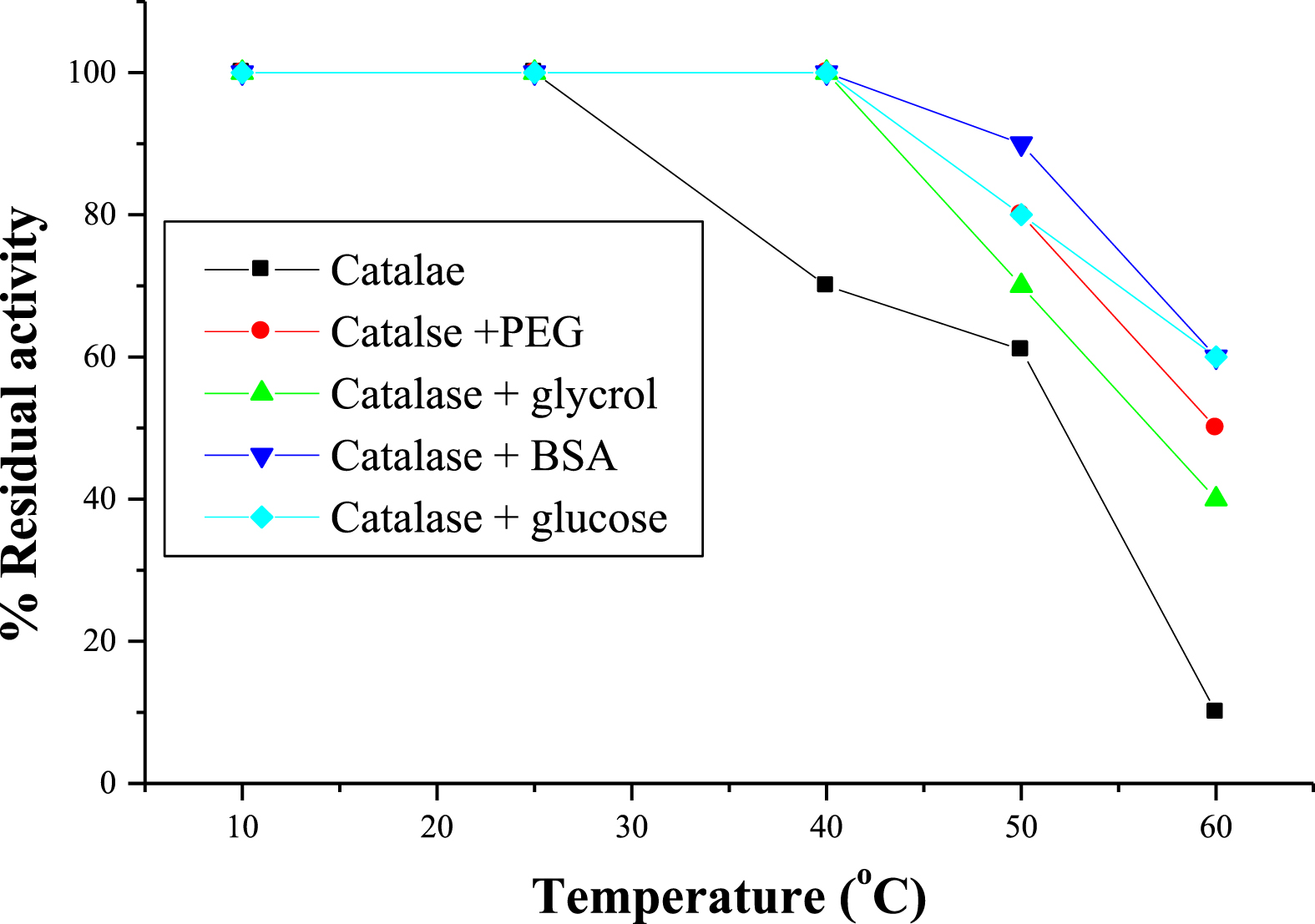
Thermal stability of camel liver catalase in presence of (5%v/v) organic additives.
The pH stability of camel liver catalase was carried out at different pH’s and incubation for 24 h (Fig. 2). The activity of native catalase and catalase with 5%PEG and glycerol was stable up to pH 7.0, where catalase with 5%BSA and glucose was stable up to pH 7.5. The pH stability of native catalase was rapidly decreased with increase of pH and the activity was complete lost at pH 11. The catalase with all additives was also decreased with increase of pH, where at pH 11 the catalase with glucose retained 30%of its activity.
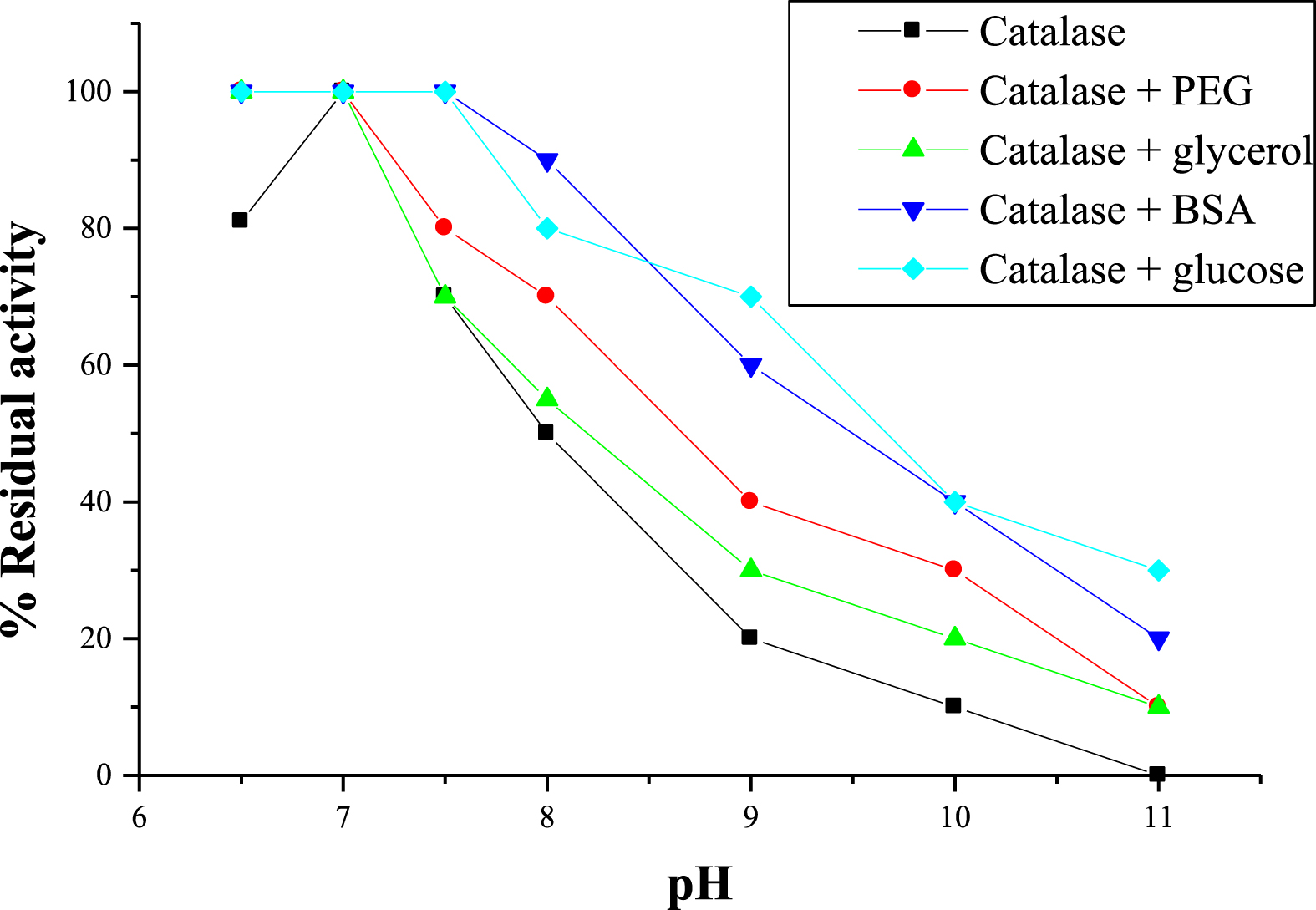
pH stability of camel liver catalase in presence of (5%v/v) organic additives.
The effect of β-mercaptoethanol as reducing agent on camel liver catalase was studied (Table 2). At 2 mM β-mercaptoethanol, the native enzyme and the enzyme with 5%additives increased 110%and 137–160%of its activity, respectively. The native enzyme lost 80%of its activity in presence of 5 mM β-mercaptoethanol, where the enzyme with additive retained 30–46%of its activity.
The effect of β-mercaptoethanol on the activity of camel liver catalase with 5%additives
The effect of urea concentration on the activity of catalase was studied (Table 3). The native catalase was retained 38%and 28%of its activity in presence of 4 M and 8 M urea, respectively. At 4 M urea, the catalase with 5%of all additives retained the most of its activity (87–98%). The partial retention of catalase activity with 5%additive (61–77%) was detected at 8 M urea.
The effect of 4 and 8 M urea on the activity of camel liver catalase with 5%additives
The effect of dyes on camel liver catalase activity was studied (Table 4). The native catalase was lost about 80%of its activity in presence of 5%bromophenol blue, methyl green, methylene blue and methyl orange. The catalase with additives retained 50–90%of its activity in presence of different dyes. The results appeared that BSA is the most additive protected the enzyme activity from inhibition by methylene blue.
The effect of 5%dyes on the activity of camel liver catalase with 5%additives
Although the catalase used in different applications, the storage stability of native catalase is very low. In the present study, camel liver catalase in presence of PEG, glycerol, BSA and glucose at 5%concentration was more stable at 4 and 30°C for 90 days of incubation than the native enzyme. However, the storage stability of catalase from Bacillus Sp was studied in presence of different additives [18]. The glycerol and glutaraldehyde showed the best performance for long-term storage at 30°C. The environment conditions such as temperature and pH are very important of enzyme applications. The activity of camel liver catalase was more thermal stable in presence of 5%additive compared with native catalase. Bacillus Sp catalase with glucose retained 40%of its activity at 60°C [18]. The thermal stability was determined for chicken erythrocytes catalase. The enzyme was thermal stable at 10–30°C and the activity decreased with increasing temperature and the complete loss of activity was detected at 80°C. The thermal stability of crude enzyme preparation was very low. At 4°C, a complete loss of crude enzyme activity was detected after 96 h of storage. A loss of 52%of partially purified enzyme was detected at the 4°C after 7-day of storage. For highly purified enzyme, 10%activity loss was detected after 4-month storage at 4°C [19].
The pH influenced on the charge of any enzyme and its activity. The activity of camel liver catalase was more pH stable in presence of 5%additive compared with native catalase. At pH 11.0, the glycerol retained 30%of its activity compared to the native catalase [18]. Chicken erythrocytes catalase was stable at pH 7.0 and the enzyme lost 45 and 64%of its activity at pH 4.0 and 10.0 [19].
The mammalian catalase consists of four identical subunits binding by S–S bond. The increase of β-mercaptoethanol (SH) may be breaking this bond. Samejima et al. reported that the thiol reagents bind to the heme group existed in catalase, where the conformational structure of enzyme was altered [20]. At high concentration of β-mercaptoethanol (20 mM), complete loss of chicken erythrocytes catalase activity was detected [19]. Therefore, the effect of β-mercaptoethanol as reducing agent on camel liver catalase was studied. At 5 mM β-mercaptoethanol, the enzyme with additive retained 30–46%of its activity compared with 80%loss of activity for native enzyme.
Generally, urea is considered unfolding agent for protein. Therefore, the effect of urea on the activity of camel liver catalase was studied. In presence of additives, the enzyme retained 61–77%of its activity at 8 M urea compared with native enzyme, which retained 28%. For chicken erythrocytes catalase, the incubation of 4 M urea for 20, 30 and 60 min lead to loss of 48%, 64%and 88%of its activity, respectively [19]. At 8 M urea, the catalase from human erythrocyte lost 97%of its activity [21]. A complete loss of beef liver catalase activity was treated with 8 M urea [22].
The commercial catalase used for the elimination of excess of hydrogen peroxide from cotton fabrics improved the dyeing behavior and the color yield with a reactive dye [23]. Chakraborty and Jaruhar reported that alkaline catalase was capable of developing dye bath potential on cotton compared with sodium sulphide as reducing system [24]. Therefore, the effect of dyes on camel liver catalase activity in presence of additives was studied. The results showed that the enzyme with additives retained 50-90%of its activity in presence of different dyes compared with native enzyme.
Conclusions
The study showed that the PEG, glycerol, BSA and glucose improved the storage stability of camel liver catalase at 4 and 30°C after 30 and 90 days. The additives protected the enzymes from storage conditions including pH, temperature, effect of urea and β-mercaptoethanol. These additives also stabilized the enzyme in presence of dyes including bromophenol blue, methyl green, methylene blue and methyl orange. The results appeared that the catalase with additives may be used for elimination of excess of hydrogen peroxide after bleaching of textile and saving the water elution and energy.
Footnotes
Acknowledgment
This project was funded by the Deanship of Scientific Research (DSR) at King Abdulaziz University, Jeddah, under grant No. (G- 238- 130- 38). The author, therefore, acknowledge with thanks DSR for technical and financial support.