







Abstract
Synthesis of cobalt aluminate was achieved by using the peel extracts of Citrus family species. The peel extracts of lemon, orange and mandarin were used as capping agent in experimental step. These peels were extracted through varied solvents including water, ethanol and methanol. In this regard, the efficacies of the peel type and the extraction liquid were surveyed in the study, using a co-precipitation technique in the synthesis of CoAl2O4 spinel. Samples compared in different parameters were subjected to a range of analyses consisting of colorimetry, X-Ray Diffraction, Scanning Electron Microscope and thermal examinations. The minimum b* value was reached as –14.23 in the sample with a capping agent provided by the orange peel extract, extraction liquid of which is water. The results denoted successful crystal structure scores and single-phase CoAl2O4 formation as well as the occurrence of a double-phase configuration. The highest XRD score of 83 was obtained for CoAl2O4. Considering SEM results, the lowest and highest particle size distributions were found between 100–150 nm and 350–800 nm, respectively. In the research, cobalt aluminate synthesis was carried out by means of modifying agents prepared with the peels of Citrus family species using different solvents.
Introduction
As being advanced ceramic material, spinel compounds are commonly found in the form of AB2O4. The significance of spinel compounds is tended to wide applications because of their optical and chemical properties. These compounds exhibit resistance to light, high temperature and water. In the form of spinel, cobalt aluminates can be employed in hydrogenation of carbon monoxide, methane reforming, colouration of glazes and ceramic materials, humidity sensors, photodegradation of Congo red and catalysts of combustion reactions of NOx/O [1–7].
The spinel form of cobalt aluminate (CoAl2O4) is well-known with its blue colour and its formation can be identified by analysing its chromatic parameters. According to the Co/Al ratio in compound the colour of compounds turns to green from black and the colour change is completed with the blue powder formation [8]. Reaction conditions are also effective on the characteristics of obtained product. CoAl2O4 can be traditionally produced by using solid-state methods. However, the use of solid-state methods requires high temperature and long reaction times. To overcome these drawbacks, hydrothermal methods have been studied in recent years. With this purpose, various liquid-state methods and the combinations of liquid-solid state methods are developed such as co-precipitation, hydrothermal, emulsion, sol-gel, polyol, combustion and Pechini [3–7, 9–17].
To strengthen the characteristic of obtained samples, some novelties have been experimented such as clay addition, microwave, ultrasound and capping agent addition [11–13, 17]. Inside of these novelties, capping agents can be defined as the notable additives that are commonly added to solution to control the particle shape and size. The reaction between the surfaces of capping agent and metal particle is related with the electrical attraction among the steric properties of surfaces, chemical properties of ligand and composition [18]. In hydrothermal conditions, particles formation includes two processes: nucleation and growth. Generally, the capping agent takes role in both processes. A draft for the required nucleus formation is prepared with the capping agent addition. The length of surfactant and other chemical properties are also effective on the critical nucleus formation. By this way, particle shape and size can be controlled. In the growth step of particle, the process can be proceeded by diffusion from cluster to particle surface and bonding of ion-solid particles [19].
Capping agents are generally classified according to the donor atom, and peel extracts such as other bio-compounds are assumed as green ligands [20]. Peel extracts are commonly used as additives to modify the compounds, especially in nanoparticle synthesis. In this study, it is aimed to prepare cobalt aluminates by using the peel extracts of different Citrus family species. These species can be found abundantly in nature and they have ability of reduction of metal ions due to their rich source of bio-components such as ascorbic acid, phenolic acid, phenolic esters and flavonoid. However, cobalt aluminate synthesis by using fruit peel extract has not been studied before. Effects of peel type and extraction solvent were examined. Prepared samples were characterized by using the techniques of chromatic analysis, X-Ray diffraction (XRD), scanning electron microscope (SEM) and thermal analyses.
Materials and methods
Materials
Cobalt (II) chloride hexahydrate (CoCl2·6H2O) was the cobalt source and purchased from Sigma-Aldrich, with a minimum purity of 98.0%. Aluminum chloride hexahydrate (AlCl3·6H2O) was the aluminum source and provided from Merck Chemicals, with a minimum purity of 97.0%. Sodium hydroxide (NaOH) was obtained from Merck Chemicals and used for pH adjustment. The solvents of ethanol and methanol were bought from ISOLAB, with a minimum purity of 98%.
Citrus family fruits of orange, lemon and mandarin were supplied from the regions of Antalya, Mersin and Adana in Turkey, respectively. The fruit peels were extracted by using the solvents of ethanol, methanol and water at room temperature for 1 hour. The obtained orange-yellow solutions were kept at +4°C.
Synthesis procedure
For the synthesis procedure, traditional co-precipitation method was determined. The effect of citrus peels on the synthesis were experimented by using the peels of orange, lemon and mandarin in the extraction solvents of ethanol, methanol and water. The cobalt and aluminum source were dissolved in distilled water and stirred at Co/Al mole ratio of 1/2 for 30 mins. The pH of mixture was adjusted to 13 by using 3 M NaOH solution and 1 ml of citrus peel extract was added. The mixtures were filtered, dried and ground. The pink-purple particles were calcined in high temperature furnace, at 1200°C for 3 h. The parameters of the experimental procedure are presented in Table 1.
Experimental procedure for spinel synthesis
Experimental procedure for spinel synthesis
The prepared powders were employed to chromatic analyses by using the PCE CSM 1 model colorimeter. The crystal structure of samples was identified by using a PANalytical Xpert Pro X-Ray Diffractometer at the operating conditions of 45 kV, 40 mA and in the 2θ range of 10 –90°. For the morphological analyses, scanning electron microscope (SEM) of Hitachi was used at 15 kV and magnification value of 60 kX. Thermogravimetric data was obtained by a Perkin Elmer Diamond at nitrogen atmosphere in the temperature range of 30–1000°C.
Results and discussion
Chromatic analyses results
The probable reaction equations are explained in Equations 1 and 2. According to the equations, the complexes of cobalt –aluminium would form in hydrothermal conditions at first stage. In here, pink-purple particles are seen with the effects of pH adjustment and capping agent addition (Eq. 1). The insoluble Co-Al complexes are separated by filtration and spinel form of cobalt aluminate is formed by calcination (Equation 2).
The conversion of Co-Al complexes to spinel form of cobalt aluminate begins with the formation of black particles of cobalt oxide. The black appearance turns to green with the increasing amount of aluminium in structure. When the conversion to spinel is completed, bright blue particles are observed [8, 21].
Chromatic analyses result of the samples was given in Table 2. In chromatic analyses, L* constant is related with the brightness of sample and varied between 0 and 100. The constants of a* and b* can be either positive or negative. The lower values of a* and b* leads to green and blue colour in sample, respectively. In all samples, lower values of L* signified the dark colours of sample that can be explained with the by-product of cobalt oxide. In according to the b* values, the lower b* value was observed in the use of orange peel extract than other citrus peel extracts. The bluest sample was G-3 that indicated the suitability of orange peel extract in water. The obtained result was consistent with another study in which fruit extract-capped cobalt aluminate spinel was produced by Mindru et al. [22].
Chromatic analyses result of the samples
In XRD results, the samples were identified as the mixture of Cobalt aluminate spinel (CoAl2O4) and Cobalt oxide (Co3O4). The main phase was analysed as Cobalt aluminate spinel (CoAl2O4) between these phases. When the synthesized samples were compared among themselves, the G-3 coded sample stood out owing to its single-phase crystal structure and remarkable XRD score. In addition, the XRD score, which represents a measure of resemblance to an excellent crystalline structure, was achieved at the highest level in the sample coded G-3 (Table 3).
Identified phases and XRD scores of samples
Identified phases and XRD scores of samples
In Fig. 1, the characteristic peaks (h k l [dspacing]) of G-3 were observed at the 2θ of 31.29° (2 2 0 [2.85 Å]), 36.85° (3 1 1 [2.43 Å]), 44.81° (4 0 0 [2.02 Å]), 55.60° (4 2 2 [1.65 Å]), 59.29° (5 1 1 [1.55 Å]), and 65.13° (4 4 0 [1.43 Å]). These peak locations were in good agreement with the study of Sakr [23].
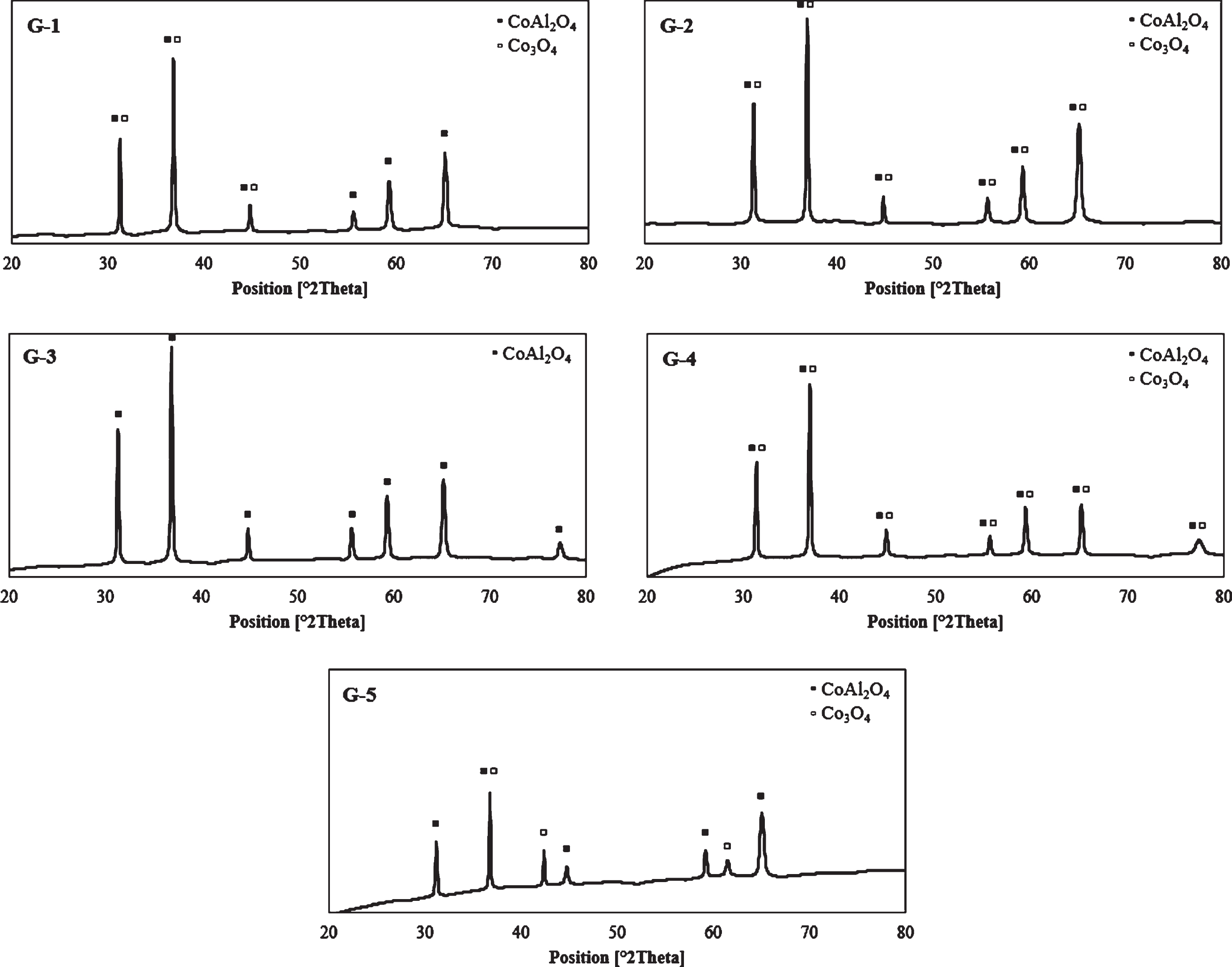
XRD patterns of the synthesized cobalt aluminates.
SEM morphologies of the obtained compounds were represented in Fig. 2. It can be viewed that the morphologies of the samples generally were in an angular and circular structures. It was observed that the G-1 sample with the orange peel extract was not uniform in terms of particle size and shape ranging from 100 to 200 nm. In the surface morphology of the G-2 sample, which was produced with the addition of orange peel extracted by dissolving in methanol, an increment in particle size and dense aggregation occurred. In the evaluation of the surface morphology of the G-3 coded sample containing orange peel extract, the solvent of which is water, a homogeneous particle framework and size varying from 150–200 nm were obtained. From the examinations, it can be specified that a satisfactory result was reached in the sample in which water was used as a solvent in the orange peel extraction process. The sample designated G-4 with the lemon peel extract capping agent is similar to the specimen coded G-2 in terms of particle size, and there is also non-uniformity owing to aggregated particles in the structure. On the other hand, the sample with the highest particle size is the G-5 sample, which is the specimen with mandarin extract added. In addition to this, significant irregularity in the particle size distribution, ranging from 350–800 nm, and multi-angular particle morphology in the structure were encountered. The SEM analyses results indicated that the use of peel extracts can be beneficial to modify the morphology of produced compounds.
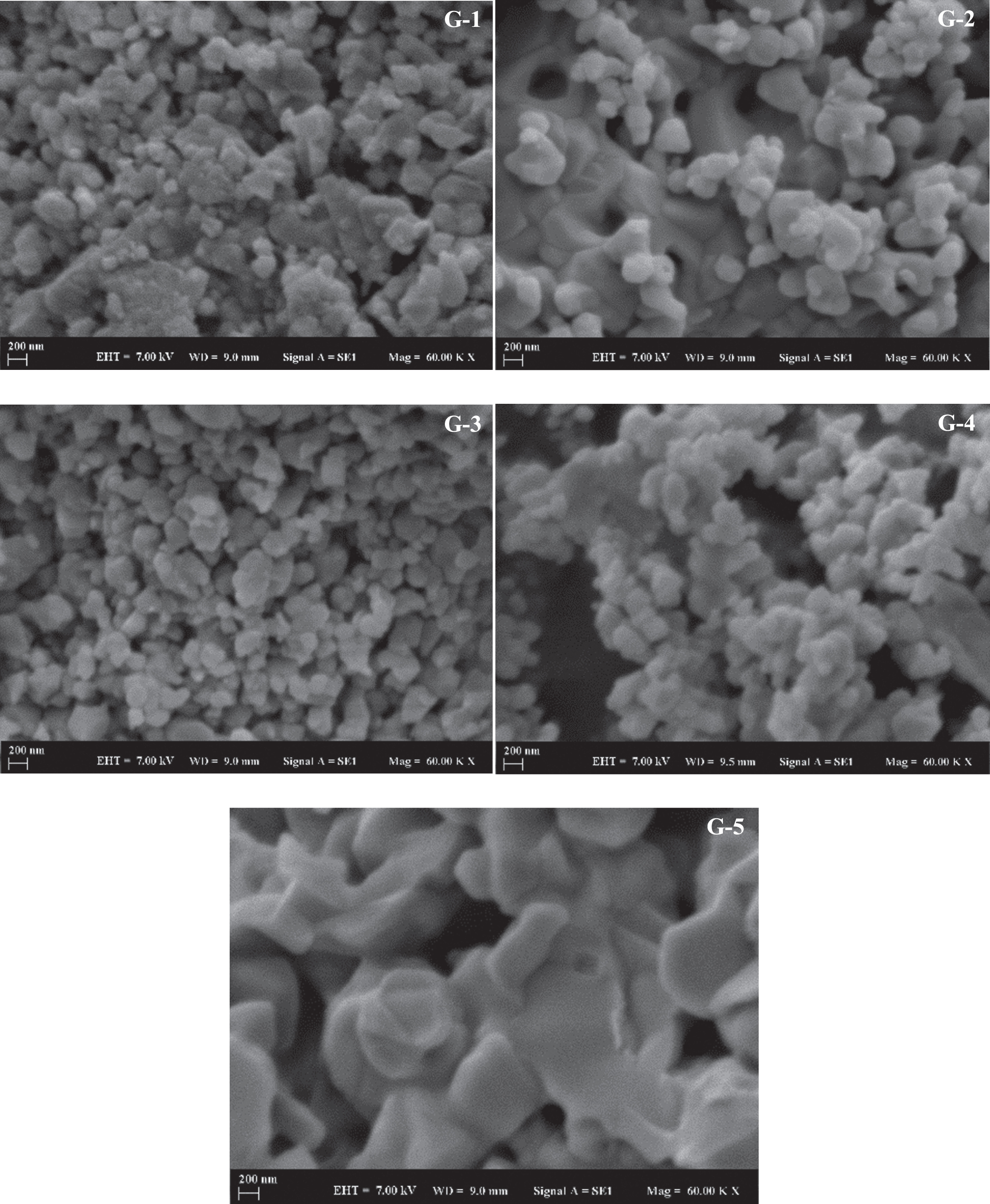
The surface morphologies of synthesized cobalt aluminates.
The thermal analysis curves of the optimum sample are presented in Fig. 3. With respect to the Thermogravimetric (TG) / Differential Thermogravimetric (DTG) curves. The total mass loss was 12.22% during the thermal treatment period. The subsequent peaks, which can be seen till 230°C, may be interpreted by the degradation phenomena of the peel extract of the citrus family in the structure. When considered together with an endothermic peak formed at a temperature close to 300°C in the DTG curve and obtained from the DTA curve, it can be attributed that this event is related to the melting and/or the decomposition of Al(OH)3 [24]. A peak, which can be seen around 900°C and ascribed to the endothermic reduction of Co3O4 remaining in the structure to CoO, was not encountered as a result of the thermal analysis in the optimum sample [25]. When the DTA curve is examined, the exothermic peak viewed around 404°C was commentated as the transformation phenomena of cobalt aluminate complexes into spinel structure [26].
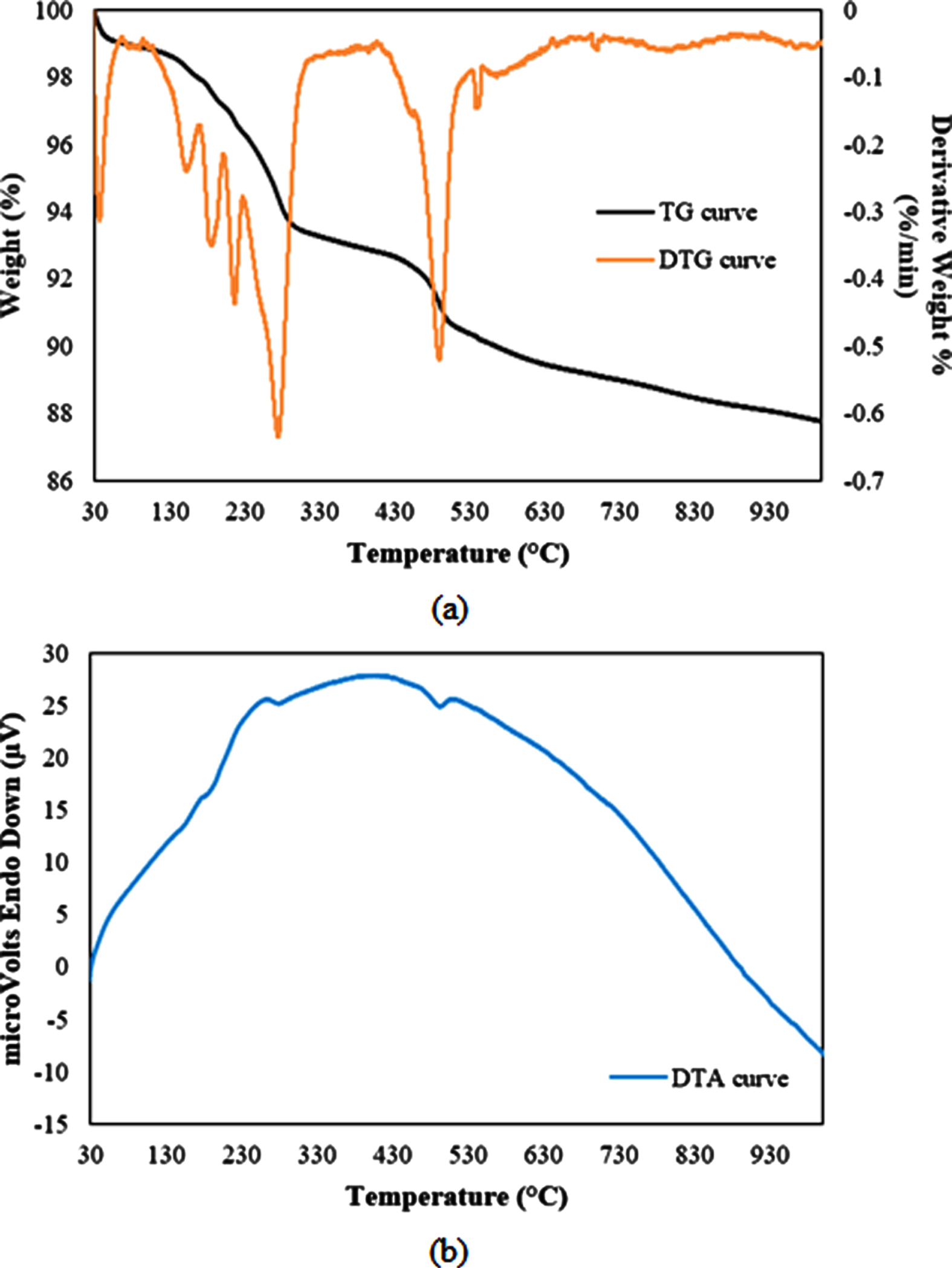
Thermal analysis curves of the optimum sample coded G-3: (a) TG and DTG curves, (b) DTA curve.
In the fabrication of spinel structures, the contribution of capping agents plays a significant role both in the modification of the structure and in obtaining the nano-sized particles uniformly. In this study, peel extracts attained from Citrus family species were evaluated as a capping agent contribution to the cobalt aluminate spinel structure. The effects of both extracts obtained from diverse kinds of peels and solvent liquid were investigated by performing a series of evaluations including chromatic analysis, XRD, SEM and thermal analysis. In the chromatic analysis, which was the first examination to reveal the formation of the spinel structure, the lowest b* value was reached in the sample where the liquid acquired from the extraction of orange peel in water was utilized as a modifying agent. Furthermore, the XRD analyses results showing up double-phase formation in some samples also demonstrate that high XRD scores and single crystalline CoAl2O4 structure can be achieved. While the SEM results exhibited the formation of particles at nanoscale and conformational modifications in the addition of different capping agents, the thermal analysis results allowed the thermal alterations in the optimum sample to be examined along with the formation of the spinel configuration. In compare with the samples, orange peel extract was determined as suitable to obtain higher crystallinity, single phase formation, smaller particle size distribution and bluest colour.
Declarations
Funding
This work was not supported.
Conflict of interest
Not applicable.
Availability of data and material
Made substantial contributions to the conception or design of the work; or the acquisition, analysis, or interpretation of data.
Code availability
Not applicable.
Authors contributions
FTSD and EMG carried out the experiments and wrote the manuscript, EMD supervised the work and edited the manuscript.
Ethics approval
Not applicable.
Consent to participate
Not applicable.
Consent for publication
Not applicable.