






Abstract
BACKGROUND:
Ramadan fasting involves refraining from food and liquids from the sunrise till sunset for one month yearly; affecting the sleep pattern and duration, physical activity, and meal number and composition leading to biochemical and physiological changes in the body. Irisin, adiponectin, and leptin induce multiple metabolic effects.
OBJECTIVE:
The aim of this study is to examine the effect of the Ramadan fasting on serum levels of irisin, adiponectin, and leptin.
MATERIALS AND METHODS:
A total of sixty healthy students (43 females and 17 males) were recruited, 20.9 years mean age, who were fasting for Ramadan were included in this study. Anthropometry, blood samples and physical activity were determined. Lipid profiles were determined using an enzymatic colorimetric method, and serum levels of irisin, adiponectin, and leptin were measured using Enzyme-linked Immunosorbent Assay. All measurements were measured before Ramadan and in the fourth week of Ramadan.
RESULTS:
Subjects experienced a significant increase in LDL was determined during Ramadan vs before Ramadan (142.8 vs. 158.1 mg/dl p = 0.03) along with a significant reduction in leptin, adiponectin and irisin concentration during Ramadan compared to before Ramadan (11.6 vs. 8.6; p = 0.000; 4.42 vs. 3.58; p = 0.022; 33.6 vs. 16.3; p = 0.003). A significant positive correlation was found between physical activity and irisin concentration before Ramadan (r = 0.338, p = 0.022).
CONCLUSIONS:
Ramadan fasting has significant effects on irisin, adiponectin, and leptin levels. Their levels were significantly reduced during Ramadan while LDL level was increased. Irisin level has a significant correlation with the physical activity of the participants.
Introduction
Ramadan fasting is a religious practice involving abstention from food and liquids between the hours of sunrise and sunset and lasts between 29-30 days. Duration of Ramadan fasting hours varies between countries and seasons, with an average length of 10–19 hours [1–3].
Many changes occur during Ramadan fasting influence sleep pattern and duration, physical activity, and meal number and composition leading to biochemical and physiological changes in the body. A large number of studies were conducted to show the effect of Ramadan fasting on various parameters in healthy people. In most of the studies, it was found that Ramadan fasting leads to changes in the metabolic status including blood glucose, lipid profile, hematological parameters, hormones, physical activity and body weight. [2, 4–16]. Fasting may influence habitual physical activity particularly in longer fasting days. Previous studies have reported that Ramadan fasting was associated with reduced physical activity and sleeping time [3, 17]. Irisin is a novel exercise-mediated myokine that has been suggested to mediate the advantages of exercise [18]. It is proposed that irisin induces browning of subcutaneous adipocytes and thermogenesis by increased the levels of uncoupling protein 1 (UCP1) [18, 19].
A limited number of studies discussed the effect of Ramadan fasting on some hormones that regulate energy and body weight homeostasis. Irisin, adiponectin, and leptin are assumed to induce multiple metabolic effects including glucose homeostasis and fatty acid oxidization by playing an important role in the suppression of the metabolic disruptions that may lead to type 2 diabetes, obesity, and metabolic syndrome [19–27]. Although some research has been carried out on the relationship between Ramadan fasting and either adiponectin or leptin or both [2, 28–30]. This is the first study that examine the effect of Ramadan fasting on serum irisin levels. These hormones have an effect on metabolic status including blood glucose, lipid profile, hormones, physical activity and body weight, which led us to hypothesize that Ramadan fasting has an inversely effects on these hormones level. Therefore, the present study aimed to investigate the serum concentration of circulated irisin, leptin and adiponectin levels before and during Ramadan month and its relationship with physical activity.
Subjects and methods
The study was conducted between May to June 2018, sixty students (43 females and 17 males) were recruited from The Hashemite University, the age group was 19 –24 years (mean age 20.9), who volunteered, did not have significant past medical history, and who were fasting Ramadan were included in this study. The study protocol was explained to these students in detail and informed consent was obtained. The students were regularly motivated to continue with the study however during the course of the study, fifteen students dropped out due to personal reasons. The study protocol was approved by the institutional ethical review board of The Hashemite University/ permission number 5/1/2017/2018, date of release 21/11/2017.
The study protocol consisted of two phases – phase one or pre-Ramadan phase and phase two; in the fourth week of Ramadan.
The exclusion criteria included subjects known to have thyroid gland problems, chronic diseases such as diabetes, pregnancy, subjects with BMI≥30 kg/ht (m)2, and subjects who did not agree to participate in the current study
Weight, height and waist circumference were measured in the two phases, Body weight was measured, to the nearest 0.1 kg, using electronic weighing scales (Seca 770; SECA, Hamburg, Germany), with subjects wearing light clothing and no shoes. Height was recorded, to the nearest 0.5 cm, with subjects standing erect, head in the Frankfurt plane and without shoes. Waist circumference was measured midway between the lower rib margin and the iliac crest with a plastic tape to the nearest 1 mm. The body mass index (BMI) was calculated using the standard formula: weight (kg)/height (m)2.
Activity diary for typical day was filled in the two phases. The activity diary was a modification of the method originally described by previous study [31]. Subjects chose the number that best described the type of exercise they did every 15 minutes on a record sheet, which was divided into 96 periods (1,440 minutes). Subjects were given a detailed explanation and demonstration of the activity diary before the beginning of the study. The physical activity diaries were analyzed using WinDiets for Windows computer program (Robert Gordon, University, Aberdeen, UK). In this program, age, weight, and gender of the subject were specified. The physical activity level (PAL) was calculated.
Measurement of blood biomarkers
Biochemical and immunological analysis took place in the Research Laboratory for the department of medical laboratories at The Hashemite University. Venous blood samples (5 ml total) after 10 min resting supine were collected in plain tubes and used to obtain serum from all study subjects, samples were centrifuged directly at 3500 xg for 5 minutes and the resulting serum samples were stored at –80°C until used. Serum total cholesterol (TC) and high-density lipoprotein–cholesterol (HDL-C) were measured by an enzymatic colorimetric method using cholesterol oxidase perioxidase, and the chromogen 4-aminophenazone/phenol [32]. Serum triacylglycerols (TAGs) levels were determined by an enzymatic colorimetric method using lipoprotein lipase glycerokinase, glycerphosphate oxidase, and the chromogen 4-aminophenazone/N-ethyl-N (3-sulphopropyl)-nramisidine [33]. Low-density lipoprotein – cholesterol (LDL–C) was calculated using Friedwald et al. equation [34].
Serum irisin levels were measured using an enzyme-linked immunosorbent assay method (ELISA) (Human irisin ELISA, Phoenix Pharmaceuticals, Inc, Burlingame, USA) according to the manufacturer’s directions. The levels of Serum adiponectin and leptin were measured using human adiponectin Elisa and human leptin kits (R&D Systems, Inc, Minneapolis, USA) according to the manufacturer’s directions. The absorbance of samples was measured immediately using a spectrophotometer at 450 nm and the standard curve was constructed to determine the concentration of samples by using the kit standard curve.
Statistical analysis
Analyses were carried out using SPSS software version (IBM SPSS Statistics for Windows, Version 21.0. Armonk, NY: IBM Corp). Continuous variables were described using mean and standard error of mean (SEM). Paired samples t test was used to compare the variables before and during Ramadan. The Pearson’s correlation coefficient was used to evaluate the strength of association between two variables. P value of <0.05 was considered a cut-off value for significance.
Results
A total of 60 participants enrolled in this study, (72% were females and 28% were males). The age group was 19 – 24 years (mean age 20.9). There were no significant changes in the mean body weight, BMI, and waist circumference. A possible trend of statistical significance reduction of PAL during Ramadan (p = 0.09) as shown in Table 1. A significant increase was noticed in LDL concentration (142.8 vs. 158.1 mg/dl p = 0.03), also, an approaching borderline statistical significance increase in serum cholesterol (p = 0.07) as shown in Table 2. Table 3 showed a significant reduction in leptin, adiponectin and irisin. The results of the correlational analysis were presented in Fig. 1. From the data in Fig. 1 A, it is apparent that a positive correlation between irisin level and physical activity before Ramadan while showed a negative correlation during Ramadan. Figure 1, B & C showed a non-significant negative correlation between either leptin or adiponectin before or during Ramadan as can be seen.
Anthropometric parameters and physical activity before and during Ramadan (mean±SEM)
Anthropometric parameters and physical activity before and during Ramadan (mean±SEM)
Lipid profile before and during Ramadan (Mean±SEM)
Leptin, adiponectin and irisin levels before and during Ramadan (Mean±SEM)
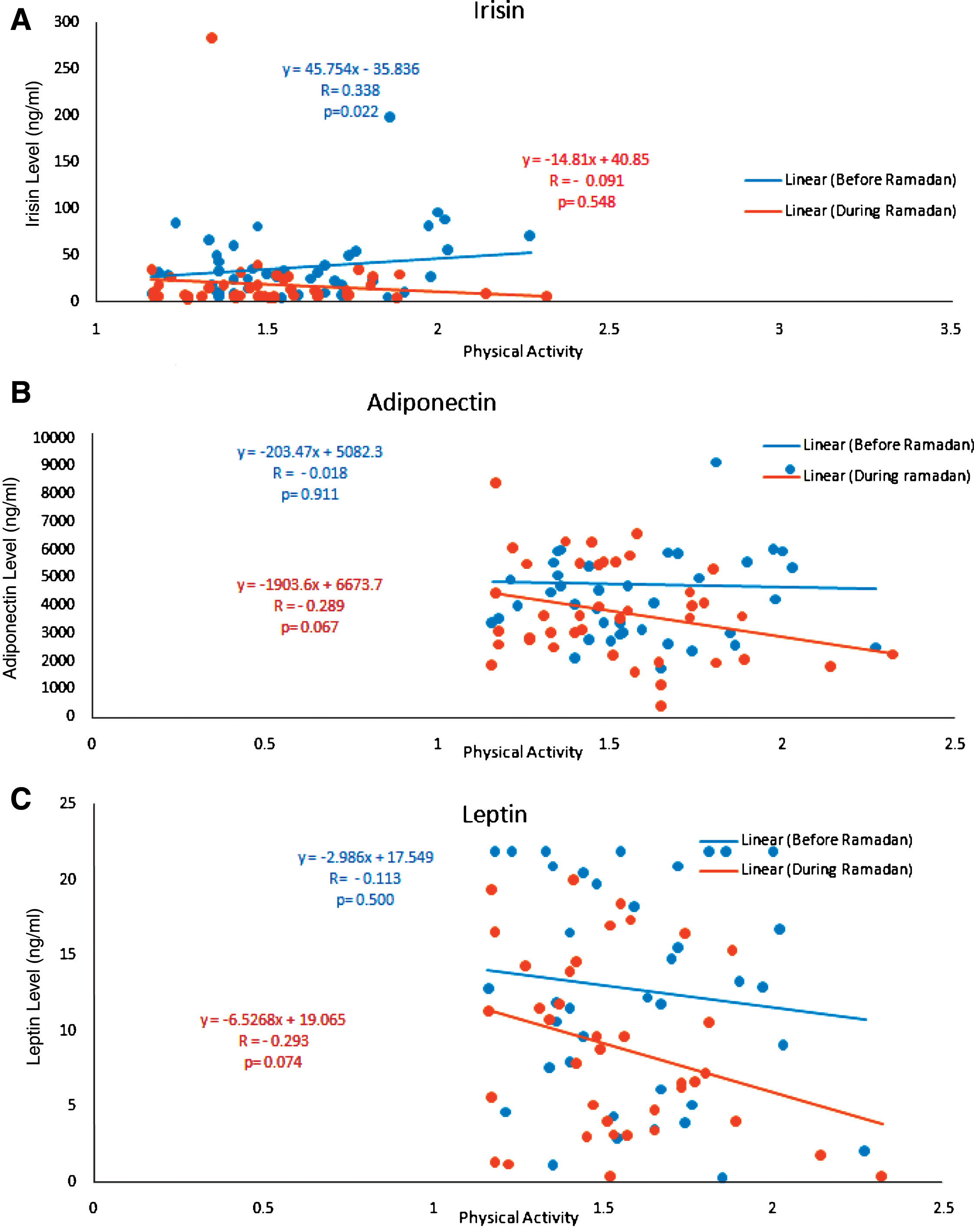
Pearson correlation coefficient (r) and p-value (p) between hormone levels and physical activity. (A) A scatter plot of irisin levels and physical activity (B) A scatter plot of adiponectin levels and physical activity, (C) A scatter plot of leptin levels and physical activity.
Many changes occur during Ramadan fasting influence sleep pattern and duration, physical activity, and meal number and composition. Changes in blood lipids seem to be variable and depend probably on the quality and quantity of food consumption and the degree of weight loss. To the best of our knowledge, the present study will be the first study that investigates the association between physical activity and serum levels of the irisin, leptin, and adiponectin before and during Ramadan fasting. The results showed a notable but not significant decrease in participant’s physical activity (PA) during Ramadan when compared before Ramadan (P = 0.09). This reduction in PA is habitual PA in Ramadan, the results of this study was consistent with Al Hourani and Atoum results [3]. The subjects of the current study were classified as sedentary or light lifestyle according to [35] in relation to intensity of habitual physical activity. The reduction in PA may be attributed to the tight study schedule as they are university students and shorter daytime for physical activity.
In many studies, it is found that Ramadan fasting leads to significant reduction in weight [2, 4] and changes in body composition, the results of the current study showed a non-significant weight reduction, the differences in results may be due to variances in physical activity and the type and amount of food consumed.
Many studies have been published on the effect of Ramadan fasting on serum lipids among healthy individuals, with inconsistent or even conflicting findings. The discrepancy might be attributed to the amount and type of food intake, physical activity, ethnic, and genetic background of the studied populations. In the current study, an approaching borderline statistical significance increase in serum cholesterol during Ramadan fasting compared to before Ramadan (P = 0.07), which was consistent with what was reported by Ismail and his co-workers in 2014 [36]. LDL concentration showed a significant increase during Ramadan, some studies reported a significant increase of LDL cholesterol during Ramadan [37, 38], the results were consistent with the current study. It seems that the effect of Ramadan fasting on serum lipid levels may be closely related to the dietary habits and other life style changes, alteration of food habits might explain the significant increase in LDL. In Jordan, sweets and desserts are an essential components of Ramadan’s ceremonial. Different types of fat usually used in preparation of these desserts such as butter and some of these desserts need to be fried. Grundy [39] reported that diet have saturated fatty acids increased plasma LDL cholesterol.
Recently, it was revealed that circulating irisin is augmented in a transient manner by an acute frenzy of exercise, its concentration correlates with the intensity of exercise [40]. However, our result for the first time shows a significant reduction in irisin level during Ramadan which might be a result of reduction habitual PA during Ramadan. Controversially, Biniaminov et al., 2018 [41] showed that Irisin serum concentrations were not related to measures of physical activity and physical fitness in healthy humans under resting conditions. This might support our result that Ramadan has an effect of irisin level. Our result is also showed a significant positive correlation irisin level a PA before Ramadan but not during Ramadan. Our result also showed that R is negative in adiponectin and leptin during and before Ramadan, but with Irisin, was positive correlation before Ramadan while during Ramadan was negative (inverse relationship).
The effect of Ramadan fasting on adiponectin levels was contradictory; it was increased significantly during the fourth week of Ramadan as Feizollahzadeh et al. reported [28], while its level was decreased significantly along with significant loss in weight during Ramadan [2]. Our result is inconsistent with Feizollahzadeh et al. [28] and consistent with Gnanou et al. [2]; it showed a significant dropped in adiponectin levels during the fourth week of Ramadan compared to the week before Ramadan with no significant loss of weight, BMI, or waist circumference. The results of this study showed that there was no correlation between PA and adiponectin before or during Ramadan; this might be due to the effect of fasting in Ramadan month.
Leptin levels during Ramadan was conflicted; some studies showed a decrease in leptin level due to Ramadan fasting in pregnant women [30] while significant increase in leptin levels was reported during Ramadan. Our result showed a significant reduction in leptin levels during the Ramadan compared to before Ramadan phase. We also showed a no correlation between the PA and the leptin levels before or after Ramadan; this also might be due to small number of samples or the fasting of Ramadan has this impact.
In conclusion; Ramadan fasting has a significant effect on decreasing the irisin, adiponectin, and leptin levels along with increased in LDL level. We feel that people during Ramadan has to change their nutrition and physical activity habits that might led to this reduction in those metabolic affecting hormones. Further studies are needed to illustrate the mechanism of fall in irisin, adiponectin, and leptin levels in the healthy adult subjects.
Strength and limitations
Strength of the study was assessing irisin levels before and during Ramadan for the first time, however, smaller sample size is a limitation of the study.
Conflict of interest
The authors have no conflict of interest to report
Ethics
The study protocol was approved by the institutional ethical review board of The Hashemite University. The protocol number of permission is: 5/0/2017/2018. The date of its release is: 21/11/2017.
Footnotes
Acknowledgments
The researchers would like to gratefully acknowledge Mrs. Efat Negresh who served as research assistant for this study and our undergraduate students in Faculty of Applied Health Sciences at the Hashemite University who participated in this study. This Study was funded by the Hashemite University, Grant number 111/2018.