







Abstract
Synbiotic supplementation can improve metabolic disorders. The aim of this study was to assess the impact of synbiotic supplementation on the levels of asprosin, lipid profile, glucose, and insulin resistance in pregnant rats fed a high-fat diet (HFD).
Rats were divided into three groups: control group (fed base chow), HFD group, and HFD + synbiotic group. Levels of blood glucose, total cholesterol, triglyceride (TG), low-density lipoprotein (LDL), high-density lipoprotein (HDL), insulin, and asprosin levels were measured.
Birth weight of offspring in the HFD + synbiotic group was significantly lower than in the HFD group. Similarly, serum asprosin, insulin, insulin resistance, TG and total cholesterol levels in the HFD + symbiotic group were significantly lower than in the HFD group. Asprosin levels had a significant and positive correlation between food intake in the first ten days of the experiment and gestation period, fasting blood sugar (FBS), TG, and homeostatic model assessment (HOMA) index. Moreover, asprosin levels had a significant and negative correlation with HDL and insulin levels.
Results showed, synbiotic supplementation has beneficial effects on obese animals and improves weight gain during pregnancy, pup birth weight, FBS, insulin resistance and lipid profile. These advantages of synbiotic supplementation could be mediated by reducing serum asprosin levels.
Background
Nowadays, people in many countries undergo considerable changes in their dietary patterns. Most notably, foods rich in vitamins and minerals such as fruits, vegetables, and whole grains have been replaced by others rich in saturated fat, sugar, and salt [2]. This change in dietary pattern will significantly increase the incidence of obesity and related diseases such as insulin resistance, Type 2 diabetes mellitus (T2DM), and cardiovascular diseases (CVD) [3, 4]. Prevalence of obesity is escalating in females, especially pregnant women [5]. Several studies have shown that, during pregnancy, obese women have a high risk of such complications as hypertension, gestational diabetes mellitus (GDM), and preeclampsia [6]. Furthermore, animal studies have demonstrated that a high-fat diet (HFD) during pregnancy can substantially increase FBS, insulin resistance, and blood pressure [7, 8].
Obesity is defined as the accumulation of adipose tissue in some parts of the body that affects fat in controlling body weight and energy balance by secreting a large group of hormones, especially adipokines such as leptin, resistin, and asprosin [9–11]. Adipokines produced from the fat tissue play an important role in regulating insulin sensitivity, glucose metabolism, lipid metabolism, and energy stability [12, 13]. Adipokines mediate vital crosstalk between adipose tissue and other metabolic tissues, including the brain, muscle, pancreas, and liver [14]. Local and systemic improvements in adipokines secretion can greatly help mitigate obesity and metabolic disorders [15].
Asprosin is a recently identified protein hormone which is produced by white adipose tissue. Increasing the levels of cyclic adenosine monophosphate (cAMP), this hormone activates the signaling pathway of the protein kinase A (PKA) and, subsequently, stimulates glucose secretion from the liver [16]. The peak of asprosin secretion occurs during fasting and reduces by feeding [11]. Plasma asprosin levels rise in humans and mice under pathophysiological conditions such as insulin resistance or obesity. Studies have shown that asprosin level increases in patients with T2DM and is associated with fasting blood glucose and TG levels. On the other hand, decreasing levels of asprosin can improve insulin sensitivity and lower appetite as well as body weight in mice [16–18]. Meanwhile, limited studies have been conducted on the role of asprosin in the pathophysiology of obesity and metabolic disorders [11]. Based on the results of different studies, asprosin is involved in glucogenic function and serves as a centrally-acting orexigenic hormone. It also has the potential to be a therapeutic target for metabolic disorders like obesity and diabetes [19].
Although drug therapy is effective in treating obesity and related diseases, it should be noted that using certain medications can lead to severe side effects. Therefore, it seems that modifying the dietary pattern is a suitable and low-risk alternative in this regard [20]. The role of human gut microbiota in dietary absorption and metabolic conditions has been investigated. There is evidence proposing that gut microbiota can significantly affect physiological and pathological processes in human [21–23]. The composition and stability of the gut microbiota is determined by nutrition or other factors such as synbiotics, antibiotics, drugs, and diseases [24]. Prebiotic products are defined as indigestible foods that, by altering the composition and metabolism of the gut microbiota, exert beneficial effects on the host body [25]. Probiotics (especially Bifidobacterium and Lactobacillus) are living microorganisms that, when given sufficiently, can have positive effects such as lowering cholesterol levels, increasing vitamins and minerals, and preventing cancer from spreading [26, 27]. Evidence suggests that the modulation of gut microbiota by synbiotics (prebiotics and probiotics) can reduce obesity and insulin resistance in mice [28–30]. Also, Tunapong et al. reported that consuming HFD in rats caused obesity and insulin resistance. Receiving prebiotics, probiotics, and synbiotics helps lower insulin resistance in mice by improving insulin sensitivity and lipid profiles [31]. Although several studies have examined the effect of prebiotics or probiotics on reducing obesity and its complications, no study, to our best knowledge, has so far addressed the combined impact of these two substances in controlling and preventing obesity by affecting asprosin levels. Therefore, this study was designed aiming at exploring the effect of synbiotics on the levels of asprosin, lipid profile, glucose, and insulin resistance in pregnant rats fed with HFD.
Materials and methods
Animals
The present study was carried out on 30 adult female Wistar rats (body weight 200±20 g). All rats were under controlled conditions: temperature (21±2°C), and lighting (light-dark (12 h-12 h) cycle) with free access to food and water ad libitum. The animals were adapted to these conditions for two weeks before the study. The experimental protocols were approved by the Ethics Committee at the Research Council of Zahedan University of Medical Sciences (ZAUMS) (Ethical code: IR.ZAUMS.REC.1397.377).
Experimental design
After being adjusted to the condition, all rats except the control group were fed a high-fat diet (HFD) for 10 days [32]. The base chow (3.05kcal/g digestible energy) contained 64.4%carbohydrate (starch 54.4%and sucrose 10%), 23.1%protein (casein), 4.8%fat (soybean oil), 0.3%vitamins, and 7.7%minerals (Behparvar Company, Tehran, Iran). In order to provide an HFD, 20%sheep tail fat, 1%cholesterol, and 15%sucrose [33] were added to the usual pellet diet [32]. This mixture in the form of paste was shaped as rat pellet diet and was dried in the proximity of air [32]. At the end of the 10th day, all rats were weighed and each one male rat with two female rats were placed in a single cage in order to induce pregnancy [34]. To confirm mating, the smear was prepared from the vagina and after observing the sperm, the female rats were separated from the cage and, thus, their first day of gestation began [35]. Pregnant rats were randomly divided into 3 ten-member groups: control, HFD, and HFD + synbiotic (in each group n = 10). The control group received the regular diet; the HFD group received HFD alone; and the HFD + synbiotic group, in addition to taking HFD, was gavaged with a synbiotic solution, which contained L. rhamnosus and L. coagulans at a concentration of 108 CFU/ml and FOS 10%[32]. Synbiotics were dissolved in the 1 cc normal saline and administered in a daily gavage from the first day to the delivery date [32]. At the end of each week, all rats were weighed. Immediately after birth, neonatal weights were measured and recorded by a digital scale. Dams were then isolated in cages and, after 12 hours of fasting, anesthetized by ketamine hydrochloride (90 mg/kg) and xylazine (10 mg/kg). Heart blood samples were taken and serum separation was performed to measure the biochemical parameters. Eventually, blood glucose, total cholesterol, TG, HDL, insulin, and asprosin levels were measured by commercial kits.
Chemical substances
Synbiotic supplement was purchased from Pardis Roshd Mehregan Company, Shiraz, Iran. Blood glucose, total cholesterol, HDL, and TG kits were prepared from Pars Azmoon, Tehran, Iran. LDL was calculated according to the Friedewald formula [36].The insulin and asprosin assay kits were purchased from Shanghai Crystal Day Biotech Co. (E1703Ra Rat Asprosin) and measured by ELISA method.
The minimum detectable concentrations of blood glucose kit was 5 mg/dl (intra-assay: CV value < 1.19 %, inter assay: CV value < 1.74 %).
The minimum detectable concentrations of total cholesterol kit was 5 mg/dl (intra-assay: CV value < 1.62 %, inter assay: CV value < 1.22 %).
The minimum detectable concentrations of HDL kit was 1 mg/dl (intra-assay: CV value < 0.82 %, inter assay: CV value < 1.8 %).
The minimum detectable concentrations of TG kit was 5 mg/dl (intra-assay: CV value < 1.53 %, inter assay: CV value < 1.6 %).
The minimum detectable concentrations of Insulin kit was 0.1 mIU/L (intra-assay: CV value < 10 %, inter assay: CV value < 12 %).
The minimum detectable concentrations of Asprosin ELISA kit was 0.05 ng/ml (intra-assay: CV value < 10%, inter assay: CV value < 12%). Insulin resistance was also calculated by HOMA-IR formula [37].
Statistical analysis
Statistical analysis was performed in Graph Pad Prism 7.0 software using one-way ANOVA followed by the Bonferroni post hoc test. Pearson correlation coefficient was also used to analyze the correlation between variables. P < 0.05 was considered statistically significant.
Results
Rats weight
As shown in Fig. 1, the weight of animals in the three groups was not significantly different at the beginning of the study. On the 10th day, however, the weight of animals in the HFD group was significantly higher than in the control group (P < 0.01). At the end of the first week of gestation too, the mean weight of the HFD group was significantly higher than the control group (P < 0.01).
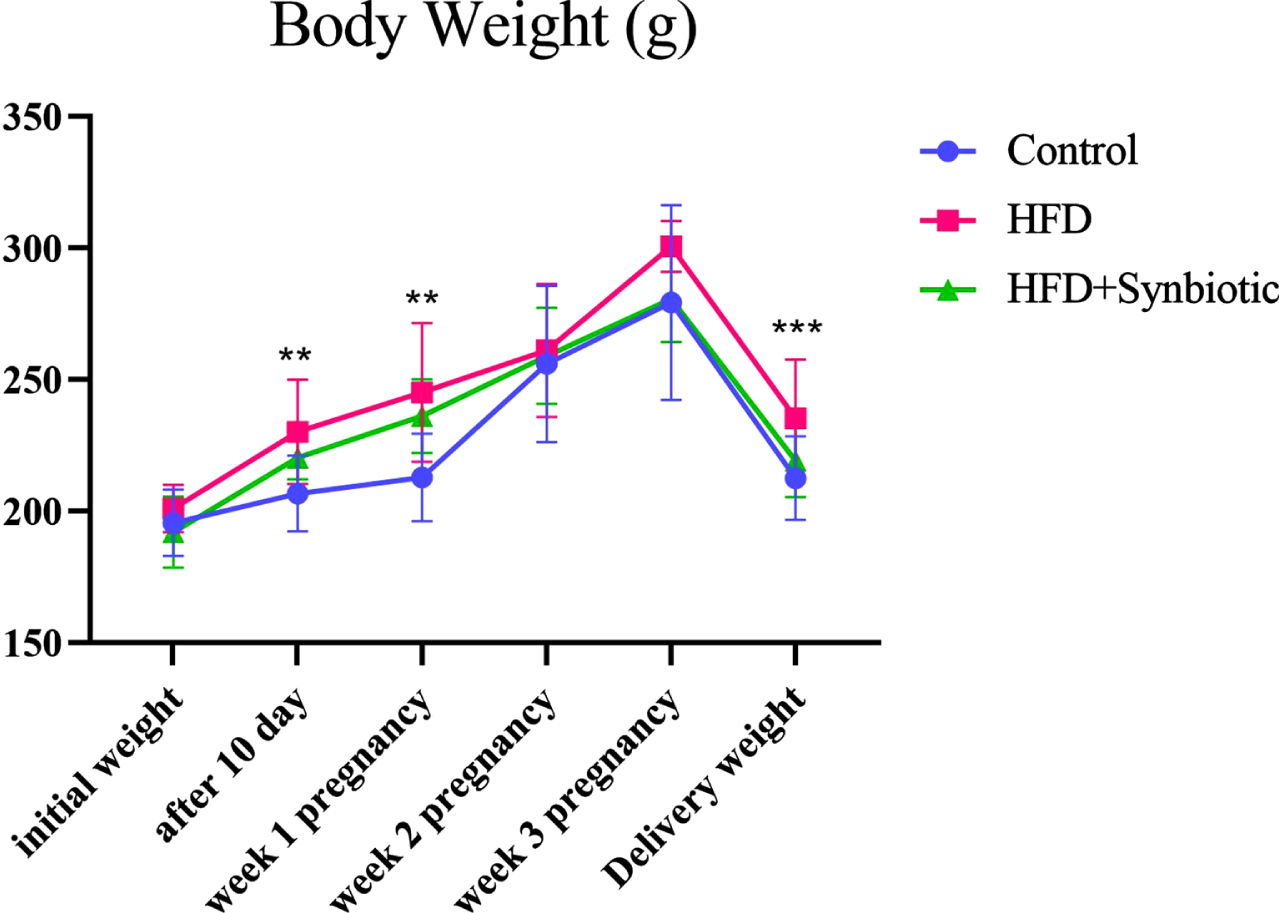
Changes in the weight of rats in different groups at baseline, on the 10th day of the experiment, in the first, second, and third weeks of gestation, and after delivery (**P < 0.01 Control vs. HFD group, ***P < 0.001 Control vs. HFD group (mean±SD)).
Although the weight of the HFD group was higher than the control and HFD + synbiotic groups in the second and third weeks of gestation, this difference was not significant (P > 0.05). Nevertheless, one day after delivery, the mean weight of the HFD group was significantly higher than the control group (P < 0.001).
As shown in Table 1, food intake on the 10th day of the study was significantly higher in the HFD group than the control and HFD + synbiotic groups (P < 0.001). Food intake during the gestation period was significantly lower in the control group than the HFD and HFD + synbiotic groups (P < 0.001).
Mean of food intake and birth weight of offspring in the study groups at different stages
Mean of food intake and birth weight of offspring in the study groups at different stages
(***P < 0.001 vs. HFD group; #P < 0.05, # # #P < 0.001 vs. HFD group; $ P < 0.05 vs. HFD + synbiotic group (n = 30, mean±SD)).
The birth weight of offspring in the HFD + synbiotic group was significantly lower than the control and HFD groups (P < 0.01).
According to Table 2, although serum FBS levels in the HFD group were higher than those of control and HFD + synbiotic groups, this difference was not significant (P > 0.05). Serum insulin levels and HOMA Index were significantly higher in the HFD group than in the control and HFD + synbiotic groups. Synbiotic administration significantly reduced serum insulin levels and HOMA index (P < 0.001, P < 0.01).
Blood analysis of the three study groups
Blood analysis of the three study groups
(*P < 0.05, **P < 0.01, ***P < 0.001 vs. HFD group; #P < 0.05, # #P < 0.05 vs. HFD group).
Similarly, serum cholesterol and TG levels were significantly higher in the HFD group than in the control (P < 0.001) and HFD + synbiotic groups (P < 0.01). However, the mean serum HDL levels in the HFD group were significantly lower than in the control and HFD + synbiotic groups (P < 0.001).
As shown in Fig. 2, the concentration of asprosin in the HFD group was significantly higher than in the control group, yet asprosin level in the HFD + synbiotic group was significantly lower than in the HFD group (P < 0.001).
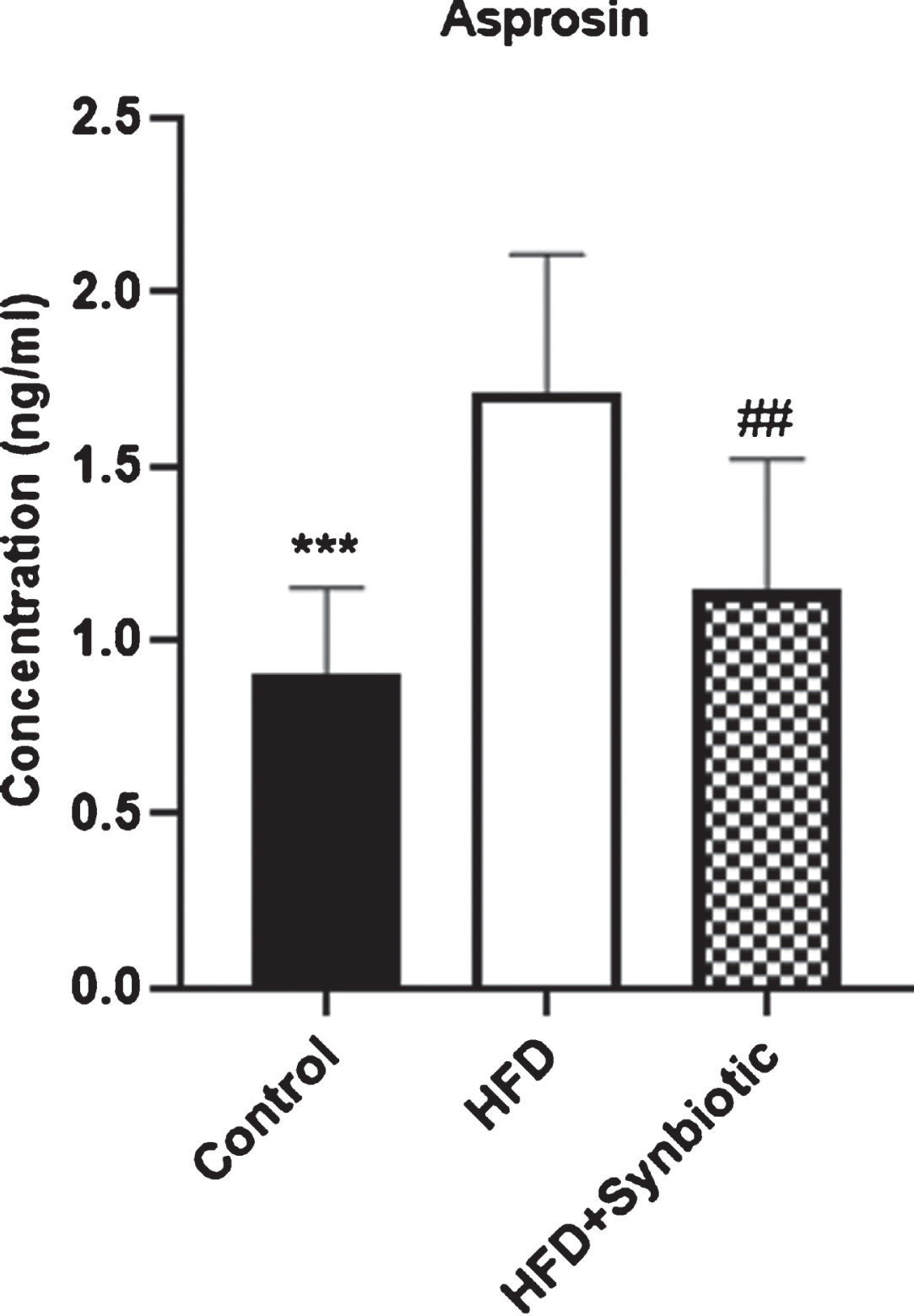
Effect of synbiotics on serum levels of asprosin in the study groups (***p < 0.001 vs. HFD group; # #p < 0.01 vs. HFD group).
The results in Table 3 show the correlation between asprosin and other variables. Pearson test showed that food intake in the first ten days and during the gestation period had a significant and positive correlation with asprosin, FBS, TG, and HOMA Index. Also, asprosin had a significant and negative correlation with both HDL and insulin.
Pearson correlation coefficient of variables associated with circulating asprosin concentration
Pearson correlation coefficient of variables associated with circulating asprosin concentration
The aim of the present study was to investigate the effect of synbiotic supplementation on the serum levels of asprosin, blood glucose, lipid profile, and insulin resistance in obese pregnant rats. The results exhibited that the use of synbiotics in the HFD group during pregnancy, compared to the group only receiving HFD, could lower the serum levels of asprosin. In addition, synbiotic supplementation reduced food intake during pregnancy, insulin concentration, insulin resistance, blood lipids, and the birth weight of puppies in HFD + symbiotic group compared to the HFD group.
There was a positive association between asprosin concentration and the amount of food intake during pregnancy, fasting blood glucose, insulin resistance, and TG levels. Also, asprosin concentration was found to be negatively associated with both insulin and HDL levels. Asprosin is a hormone that is secreted from adipose tissue and stimulates the secretion of glucose from the liver [16].
Some adipokines, such as leptin are involved in the regulation of food intake and weight gain [1]. In human, with increasing adipose tissue mass, the concentration of leptin in the circulating blood also increases [1]. Under physiological conditions, leptin reduces food intake and body weight through its effect on the hypothalamus and appetite [1]. In addition, leptin regulates glucose metabolism directly through its receptors in the liver and thereby regulates food intake and weight gain [1].
In our study, by lowering asprosin release from adipose tissue, synbiotic supplementation could have reduced glucose release from the liver and, consequently, decreased insulin secretion, insulin resistance, fasting blood sugar, and food intake in obese pregnant rats.
It has been reported that asprosin increases appetite and body weight. Asprosin crosses the blood-brain barrier and, via stimulating orexigenic AgRP+ neurons, raises appetite and body weight [19].
Regarding the suggestion that increased food intake increases serum FBS, TG level, and insulin resistance [38, 39], synbiotic supplementation in our study could have led to a decrease in FBS, TG level, and insulin resistance by lowering asprosin secretion from adipose tissues. In support of our results, several studies have confirmed a positive association between asprosin concentrations and FBS and TG levels [18, 41]. A high level of asprosin is also associated with insulin resistance. Our findings revealed that asprosin levels in the HFD + synbiotic group were significantly lower than in the HFD group. The exact mechanism of the effect of synbiotics on adipokine levels is unknown, but a number of studies have proposed that this impact may be due to changes in microbiota balance [42, 43].
In line with the report by Mofidi et al., the results of the present study demonstrated that synbiotics improved insulin resistance in the synbiotic group compared to the HFD group [44]. It was also observed that insulin resistance was significantly higher in the HFD group than in the HFD + synbiotic and control groups, indicating the effect of HFD on insulin levels and insulin resistance. Synbiotics can reverse insulin resistance through mechanisms such as changing intestinal flora, increasing fecal PH, and decreasing endotoxin concentrations [45]. Consistent with the study by Rabie et al., it was found that synbiotic supplementation reduced fasting blood glucose levels in the HFD group [46]. In the present study, the consumption of synbiotics improved lipid profile of animals in the HFD group. Thus, cholesterol and TG were lower and HDL was higher in the HFD + synbiotic group compared to the HFD group. The results reported by Kooshki et al. reinforce these findings [47]. Synbiotics can improve lipid profile through several possible mechanisms, including lipolysis of triglycerides and removal of cholesterol from the intestine by binding it to prebiotics [48–50].
It seems that the reduction of asprosin level can enhance blood glucose levels and insulin resistance by decreasing the release of glucose from the liver [51]. Our results showed that serum levels of asprosin had a positive correlation with triglyceride and a negative correlation with HDL. It has been shown that asprosin levels have a significant correlation with lipid profile in patients with type 2 diabetes (T2DM) [51].
Duerrschmid et al. (2017) concluded that asprosin level of obese mice is pathologically higher than normal mice. They showed that the removal of serum asprosin by a monoclonal antibody could lead to a reduction in appetite and body weight [39]. It has been suggested that asprosin affects appetite regulation center of the brain, which in turn is an orexigenic hormone playing an important role in obesity and diabetes [19]. Our results revealed that the serum level of asprosin had a positive and significant correlation with daily intake in the first 10 days of the experiment and during pregnancy.
The results of the present study revealed that daily intake was lower in the HFD + synbiotic group than the HFD group. In line with our findings, Roseline et al. showed that while synbiotic supplementation does not affect blood glucose, it has beneficial effects on TG and HDL-cholesterol levels [52].
According to the results of the present study, the birth weight of pups in the HFD + synbiotic group was significantly lower than that of the HFD group. Human and animal studies have illustrated that HFD and high-energy diets during pregnancy are linked to the increased birth weight as well as fetal and neonatal developmental problems [53]. The precise mechanism of the effect of synbiotics on birth weight, metabolic disorders, and pups’ growth problems is still unclear. However, several studies confirm that synbiotics have a positive impact on birth weight through mechanisms such as changes in lipid metabolism and its conversion to short chain fatty acids [54–56]. Zhou et al. suggested that offspring microbiota develop prior to birth and during pregnancy. Since maternal obesity can lead to microbial colonization, it may also increase the prevalence of metabolic diseases in the offspring [56].
Conclusion
Based on the results of the present study, synbiotic supplementation has beneficial effects on obese animals that improve weight gain during pregnancy, pup birth weight, FBS, TG, cholesterol, HDL and insulin resistance. Some of these advantages could be mediated by reducing serum asprosin levels.
Footnotes
Acknowledgments
This article is derived from MSc thesis of Mr. Mehrdad Naghizadeh (code no. 9126).
The authors express their gratitude to the Deputy for Research and Information Technology of Zahedan University of Medical Sciences for their financial (code number: 9126) and operational support. Thanks also go to Pardis Mehregan Company (Shiraz, Iran) for providing synbiotic supplements.
Funding
The authors report no funding.
Conflict of interests
The authors report no conflict of interests related to this study.