







Abstract
BACKGROUND:
Stroke survivors show “foot drop”, dragging their toes on the ground in the swing phase of gait. Ineffective ankle dorsiflexion may result in an abnormal gait pattern.
OBJECTIVE:
The purpose of this study was to investigate the effect of ankle Thera-Band® use on gait patterns in stroke survivors.
METHODS:
Gait data were collected in eight subjects who had had strokes using gait analysis system, both with and without the Thera-Band®. The following dependent variables of gait parameters were analyzed: velocity, cadence, step length, stride length, single support time, and double support time.
RESULTS:
There were significant improvements in gait velocity, cadence, stride length, and double support time in those who used the Thera-Band® compared to those who did not (p < 0.05). However, there were no significant differences in step length or single support time (p > 0.05).
CONCLUSIONS:
The results show that ankle Thera-Band® use may have a positive effect in improving gait parameters by increasing the ankle stability in stroke survivors with foot drop. Its usefulness in the rehabilitation of foot drop in stroke survivors needs to be further investigated.
Keywords
Introduction
Stroke is regarded as a major cause of serious problems with motor, sensory, and cognitive functions (Tong et al., 2006). The disturbance in motor function can cause muscle weakness, spasticity, and a decrease in the ability to maintain balance, as well as abnormal gait patterns (Rodriquez et al., 1996; Sharp & Brouwer, 1997). Approximately 20% of stroke survivors, show “foot drop”, dragging their toes on the ground in the swing phase of gait. This is secondary to spasticity or contracture of plantar-flexor muscles, as well as limitations in the range of motion of the ankle (Burridge et al., 1997). Consequently, the affected limb has a lower velocity in the total gait phase, and a shorter stance phase to length in the swing phase, than the less affected limb (Mauritz, 2002).
Gait is characterized by the individual’s walking rhythm, velocity, cadence, step length, and stride length (Gunasekaran et al., 2016). For normal gait, appropriate concentric-eccentric contraction should occur at the muscle of the ankle joint (Lomaglio & Eng, 2005). However, stroke survivors show weakness of the ankle joint muscle which limits their ability to maintain normal gait (Mills et al., 2013). The tibialis anterior, extensor digitorum longus/brevis, extensor hallucis longus, gastrocnemius, soleus, posterior tibilalis, peroneus longus, and peroneus brevis muscles are all activated during walking (Winter, 1989). Activation of the tibialis anterior muscle in particular enables enough dorsiflexion to prevent the toes from dragging on the ground during the swinging phase (Winter, 1989). It also contributes to movement of the center of gravity, postural control, and balance during the stance phase (McIntosh et al., 2006; Liu et al., 2006).
In order to regain a normal gait pattern, stroke survivors are advised to use ambulatory assistive devices (e.g. ankle foot orthosis, cane, and walker), or to apply either taping or the Thera-Band® to the muscles required for gait (Peurala et al., 2005). The ankle foot orthosis, a commonly used ambulatory assistive device, provides stability to the ankle joint and reduces foot drop during the swing phase, and also increases improves the ground-toe spacing. While this is the strength of the device, its disadvantage is that it prevents dorsiflexor muscles from being activated because it fixes the ankle joint (Perry & Davids, 1992). The low cost and portable Thera-Band, on the other hand, minimizes the plantar-flexion and inversion of the ankle joint during the swing phase (Hughes et al., 1999), and assists the activation of dorsiflexor muscles. Therefore, it improves the ground-toe spacing (Geboers et al., 2002; Veneri, 2004). Previous study have evaluated the range of motion, muscle activation changes, balance, and gait of stroke survivors by using the Thera-Band® (Patil et al., 2011). However, only a few studies applied it solely to the foot and ankle.
This study, consequently, aims to evaluate the effects of application of the Thera-Band® to the ankle joint on the gait pattern in stroke survivors.
Methods
Participants
This study targeted patients diagnosed with hemiplegia, a type of stroke. The study subjects were recruited through the bulletin board of H Hospital. The study subjects were those who: (1) were diagnosed with hemiplegia more than six months prior, (2) did not have a problem with communication, (3) were able to walk** more than 10 m with or without the use of assistive devices, (4) did not have issues associated with the musculoskeletal, cardiovascular, or respiratory systems that might affect gait, and (5) had not had orthopedic surgery to the lower extremities. Ten subjects met the criteria, but two were excluded*** from the study because they were unable to achieve independent gait over 10 m. Consequently, eight participants were entered into the study. All study subjects voluntarily agreed to participate after fully understanding the objectives and procedures used in the study. The study was approved by the Research Ethics Committee of Kyungnam University and conducted accordingly.
Procedures
This was a cross-sectional study. The basic information (i.e., age, gender, height, weight, diagnosis, duration of illness, and foot length) of the final study subjects was collected through simple interviews. Afterwards, the subjects were asked to walk normally on GAITRite (GAITRite Electronic Walkway, CIR system Inc., New Jersey, USA) without wearing the Thera-Band® on three successive occasions. Subjects were allowed to use an assistive device if needed for walking, and two research assistants were close at hand in case the subject should fall. Each subject rested for five minutes after the test, and the same research assistant then applied the Thera-Band® to that subject. The subject walked on GAITRite three times while wearing the Thera-Band®. Another research assistant collected data through GAITRite. The collected data were used to compare the gait status without wearing the Thera-Band® and, thereafter, with its use.
The Thera-Band® was applied as shown in Fig. 1. The green Thera-Band®, commonly used for the rehabilitation of patients with nervous system injuries, was used to assist dorsiflexion, and the blue Thera-Band® was also applied to retrain the muscles of plantar-flexion and inversion. For each stroke survivor subject, the green Thera-Band® was crossed and tied on the knee around the medial and lateral condyles of the femur* in order to assist dorsiflexion of the more affected side. The Thera-Band® was tied around the tibial and fibular heads and then crossed in front of the tibia. Following this, the crossed Thera-Band® was pulled from the medial part to the lateral part, and a knot was tied. In addition, in order to limit the plantar-flexion and inversion, the blue Thera-Band® was wrapped around the metatarsal bones, including the toes, over the green Thera-Band®. At this time, the blue Thera-Band® was pulled tighter on the lateral than the medial parts of the foot and then crossed over the top of the foot. The blue and green TheraBand were tied together to make a knot (Fig. 1).
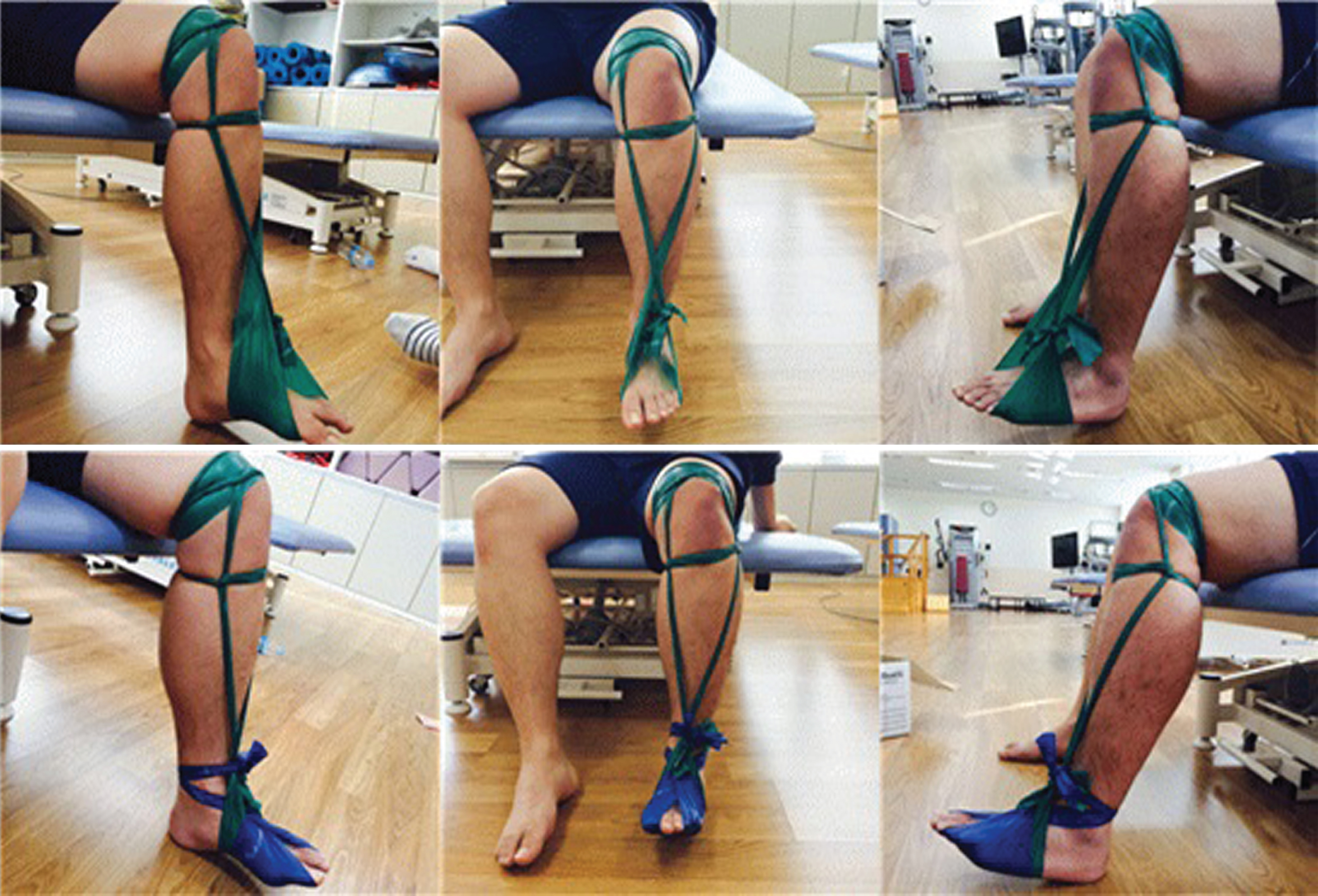
The application of the Thera-Band®.
The spatio-temporal gait parameters of the subjects were measured using GAITRite. The GAITRite is an electronic walking mat (length = approximately 4 m and width = 0.89 m) with 1 cm-diameter sensors installed at 1.27-cm intervals*. The spatio-temporal gait parameters are automatically transferred to the computer via the installed load sensors at a sampling rate of 80 Hz when the foot is in contact with the mat (Webster et al., 2005). The spatio-temporal gait parameters include velocity, cadence, step length, stride length, single support time, and double support time. The test-retest of GAITRite has a very high reliability with an intra-class correlation coefficient (ICC) of 0.91 (Van Uden, & Besser, 2004).
Statistical analysis
All statistical analyses were performed using SPSS version 18.0 (IBM Corporation, Armonk, NY, USA). The normality of data was verified using the Kolmogorov-Smirnov test. The difference between the gait with the Thera-Band® and without it was compared using the paired t-test. Statistical significance was determined as p < 0.05, unless otherwise stated.
Results
The mean age, height, weight, duration of illness, and foot length of the study subjects were 55 years, 171.13 cm, 68 kg, 4.63 years, and 261.88 mm, respectively. Of the 8 subjects, 5 were diagnosed with cerebral hemorrhage and the other 3 subjects were diagnosed with cerebral infarction (Table 1).
General characteristics of subjects
General characteristics of subjects
The velocity, cadence, stride length, and double support time were significantly different before and after wearing of the Thera-Band® (p < 0.05). The velocity significantly increased from 23.70 to 33.10 m/s (difference = 9.40 m/s), while the cadence significantly increased from 59.90 to 72.27 steps/min (difference = 12.37 steps/min). The stride length significantly increased from 49.23 to 55.88 cm (difference = 6.65 cm) in the affected limb, and from 49.04 to 55.32 cm (difference = 6.28 cm) in the less affected limb. The double support time significantly decreased from 1.24 to 0.84 s (difference 0.40 s) in the affected limb, and from 1.22 to 0.86 s (difference = 0.36 s) in the less affected limb. On the other hand, the step length increased after wearing the Thera-Band®, but it was not significantly different in either the affected or less affected limbs (p > 0.05). The single support time did not change in the affected limb and was not significantly decreased in the less affected limb (p > 0.05) (Table 2).
Comparison of changes in gait parameters between two conditions
Values are presented as mean(SD). *p < 0.05, significant differences between condition without Thera-Band® and with Thera-Band® on gait parameters.
This study evaluated the effects of Thera-Band® applied to the ankle joint on the gait pattern of stroke survivors. The results of this study showed that the velocity, cadence, and stride length of both affected and less affected limbs improved significantly after wearing the Thera-Band®.
Hwang et al. (2013) conducted a study with 15 stroke survivors. They fixed the front side of the tibia, the back of the knee joint, the middle of the thigh, and the back and sides of the hip with plastic rings, and applied the green Thera-Band® to the ankle, knee and hip joints. They reported a significant difference in the velocity, step length and stride length of the less affected limb. Veneri (2012) applied the green Thera-Band® to the front of the ankle and the back of the knee in a figure-of-eight shape in order to assist knee flexion and dorsiflexion of stroke survivors. They then underwent gait training on a treadmill with three sets of ten-minute walks for a period of ten weeks. Velocity, strengthening of the ankle eversor, gait distance, and stride length were all significantly improved. The results of this study also showed that the application of the Thera-Band® to the ankle joint significantly improved the velocity, cadence, and stride lengths of both the affected and the less affected limbs, and also improved the double support time. Previous studies have shown that assistive devices used to assist dorsiflexion provided stability to the ankle joint and induced a normal gait pattern in the swing phase of the gait (Patil & Rao, 2011; Geboers et al., 2002; Veneri, 2004). The application of the ankle foot orthosis to assist dorsiflexion increased the velocity of gait, cadence, and balance (Doğğan et al., 2011; Ferreora et al., 2013). Other studies also revealed that the step length and stride length of the affected limb increased significantly during gait (Burdett et al., 1988; Mojica et al., 1988). Moreover, Pohl & Mehrholz (2006) reported that the double support time of both the affected and less affected limbs decreased significantly. We thought that the reason for the increase in velocity, cadence, stride length, and double support time in this study was that the Thera-Band, used to assist dorsiflexion, moved the ankle of the affected limb to the neutral position. This helped the forward movement of the legs in the swing phase of gait and improved balance by increasing the stability in the stance phase.
However, this study did not show a significant difference between the step length of the affected limb or the less affected limb. Mills et al. (2013) argued that the precondition for normal gait was the performance capability of appropriate hip, ankle, and step strategy of the body. The majority of stroke survivors are limited to barely putting one foot forward while walking, as they generally have a gait pattern of circumduction of the affected limb, pelvic elevation, and hyperabduction (Zissimopoulos et al., 2015). This study could not confirm the changes in step length of either the affected or the less affected limbs. Moreover, there was no significant change in the single support time. It was speculated that this might be because this study applied the Thera-Band® to the ankle joint only, focusing on foot drop, which is a characteristic of stroke survivors, while a previous study applied the Thera-Band® to the ankle, knee, and hip joints to maintain the normal gait pattern in stroke survivors (Hwang et al., 2013).
Stroke survivors have a reduced walking velocity, asymmetric stance time, and stride length (Park et al., 2015). The results of this study showed that the Thera-Band® applied to the ankle joint of stroke survivors to fix the ankle joint in a neutral position, significantly improved the velocity, cadence, and stride length of the affected and less affected limbs, as well as the double support time. It did not, however, change the step length of the affected or less affected limbs, or the single support time significantly. The Thera-Band® used in this study is relatively easy to purchase and use. Therefore, it can easily and conveniently be used in the clinic to improve the gait pattern of stroke survivors. There were, however, some limitations to the study. First, there were a small number of subjects, making it difficult to generalize the results. Second, a Thera-Band® with identical strength was used in all subjects. The required strength of the Thera-Band® may differ, since the degree of spasticity varies among stroke survivors. Moreover, (as mentioned above) the Thera-Band® was applied only to the ankle joint. These may be reasons why it could not solve the problems associated with gait in patients with hemiplegia. Future studies should evaluate the gait after applying different strengths of Thera-Band® according to the spasticity of stroke survivors, as well as assess the method of application of the Thera-Band® to other parts of the body in a way which is easy and convenient.
Conflict of interest
None to report.