






Abstract
BACKGROUND:
Social communication is a persistent area of need after pediatric traumatic brain injury; however, it continues to be misunderstood, under-recognized, and under-treated. Clinicians must have a working understanding of current evidence and practice recommendations to support practice.
OBJECTIVES:
1) To analyze recent evidence in social communication published in the last ten years, which is specific to pediatric TBI and 2) To translate these findings for clinicians.
METHODS:
A systematic literature review was conducted. Ninety-five articles met criteria for full analysis. For analysis, articles were grouped according five themes: 1) Theoretical/Review; 2) Etiology/Characteristics; 3) Recovery/Outcome; 4) Assessment; or 5) Intervention. Article findings were then extracted, translated, and summarized.
RESULTS:
The majority of articles focused on describing characteristics of social communication deficits after pediatric TBI, documenting recovery, and identifying factors that contribute to outcome. Research on the relationship of development, age at injury, injury severity, and environmental factors with social communication outcomes requires additional attention. Research in assessment and treatment is critically sparse.
CONCLUSION:
The results of this review highlight both the progress that has been made in understanding the phenomena of social communication deficits in pediatric TBI and the critical need for basic and translational research in assessment and intervention.
Introduction
Social communication is “a domain of social functioning that specifically refers to a child’s ability to draw meaning from complex language” (pg. 176; Anderson, Beauchamp, Rosema, & Soo, 2014). Social communication allows individuals to communicate for social purposes, follow conversational rules, and understand ambiguous or implicit meaning. It is a component of the larger multifaceted construct of social outcome, which includes quality of peer relationships, amount of contact with peer-groups, and quality of peer group interactions (Table 1) (e.g., Anderson et al., 2014; Anderson et al., 2013). Additionally, social communication also relies on other higher-order cognitive processes (Table 1) (McDonald, 2013). Given the complex nature of social communication, and by extension social outcome, social communication itself is at clear risk for impairment for individuals that sustain neurologic injury or damage (Babikian, Merkley, & Savage, 2015; Kok, Post, & Tucha, 2014), including children with traumatic brain injury (TBI).
Constructs related to social communication
Constructs related to social communication
*See McDonald, S., Togher, L., & Code, C. (Eds). (2014). Social and communication disorders following traumatic brain injury 2nd edition. East Sussex, UK. Psychology Press.
Social communication has been documented as a persistent area of need for children after TBI; however, it continues to be misunderstood, under-recognized, and under-treated (Slomine, 2009; Rivera et al., 2012; McDonald & Flanagan, 2017). For children with TBI, deficits in social communication can be identified at the micro-structure (e.g., Tlustos et al., 2011) and macro-structure levels (e.g., Babikian et al., 2015) though it is understood to be most evident in high-demand contexts (Ewing-Cobbs et al., 2012) that rely on the integration of non-verbal, linguistic, and extra-linguistic information as well as meta-pragmatic skills (e.g., awareness of the context of the conversation, awareness of conversational options) (Beauchamp & Anderson, 2012). Because of the intricacy of social communication, coupled with mechanism of injury, the impact of TBI on developmental processes, and increasing developmental and environmental expectations, deficits may not be readily apparent at the time of injury but rather have latent presentation (e.g., Gamino, Chapman, & Cook, 2009), creating a challenge for clinicians to ensure that children with TBI are identified and monitored over the long-term.
Social communication is an essential component in the academic and social world of children and adolescents with difficulties in this area being linked with a variety of negative outcomes including difficulties in school, academic failure, poor peer relationships, and delinquent behavior (e.g., as reviewed by Haarbauer-Krupa et al., 2017). The transition from hospital to school is thought to be a critical period, and the success of school transition has been linked to social competence (e.g., integrating multiple cognitive and social processes to meet social demand) and to overall outcome in children with TBI (DeMatteo, Stazyk, Giglia, & Mahoney, 2015).
Given the complexity of social communication, the role it plays in longer-term outcomes, and the importance of school transition for children with TBI, it is critical that providers have a working understanding of current research evidence and practice recommendations to advocate, plan, and execute services as children with TBI re-enter the academic setting. Therefore, the overall aim of this project was to review the current evidence in social communication and its associated components (as identified in Table 1) in the children with TBI for clinicians that are on the front lines of service provision.
To identify and summarize the available literature in the area of social communication and associated constructs, for children with TBI in the last 10 years To translate for clinicians review findings in the areas of theory, etiology/characteristics, recovery/outcome, assessment and intervention of social communication deficits, and associated constructs, for children with TBI and to specify points of application for school transition To highlight areas that need attention in research and clinical practice regarding social communication, and associated constructs, for children with TBI
Methods
Data sources
A systematic literature search was conducted using the following databases: Google Scholar, PubMed, PsychInfo, and SocIndex. Ancestry hand searches of table of contents were also completed and searches continued until duplication was reached.
Search terms
Search terms included; “traumatic brain injury”, “traumatic brain injury and children”, “traumatic brain injury and social communication” and “traumatic brain injury and children and social communication”. Search terms were used independently, combined, and meshed.
Study selection
Search results were reviewed in the following order: a) title; b) abstract; and c) full article review. Two independent reviewers, both graduate students in speech-language pathology, conducted the title and abstract reviews. Any discrepancy regarding inclusion/exclusion was discussed and resolved by the first author. Once articles passed the first two review steps, the first author conducted the final full article reviews. Study criteria to move to full article review were as follows:
Inclusion criteria: 1) At least 50% of the participants were children or adolescents ages 18 years or younger; 2) Direct measurement or discussion of social communication, or an associated construct (e.g., social behavior, social cognition, social competence, social integration, emotion recognition, theory of mind); and 3) Manuscripts published between 2006-April 2017.
Exclusion criteria: 1) Less than 50% of the sample included pediatric participants 18 years of age or younger; 2) no measurement/discussion of social communication or an associated construct; and/or 3) Manuscripts published before 2006 (Fig. 1).
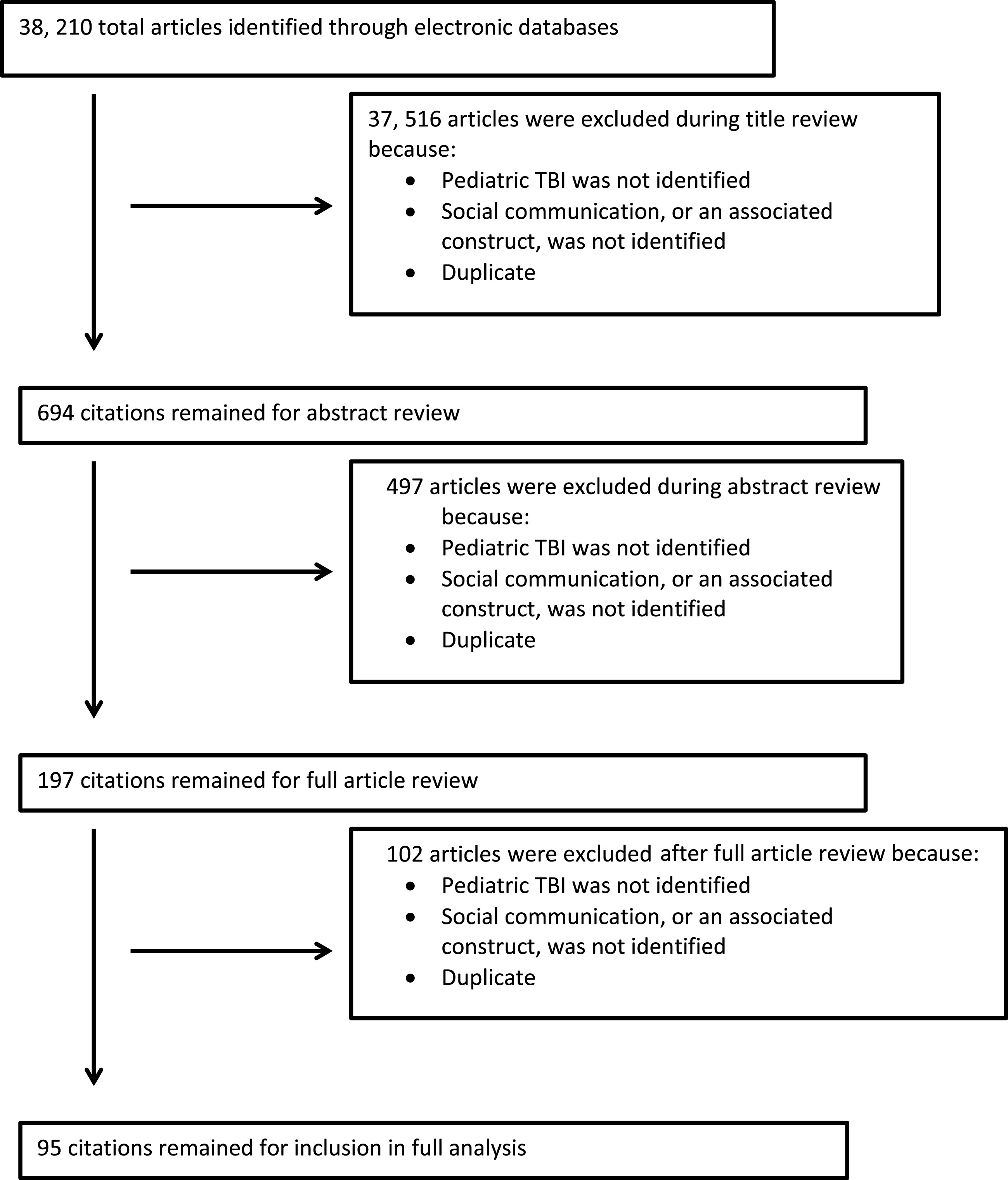
Flow chart for article extraction. Search Terms: (traumatic brain injury), (traumatic brain injury) AND (children), (traumatic brain injury) AND (social communication).
Articles that were included in the final step of the review process were classified as 1) Theoretical/Review; 2) Etiology/Characteristics; 3) Recovery/Outcome; 4) Assessment; or 5) Intervention. Main findings were then extracted and compiled in table format. Formal quality assessment procedures were not completed.
Results
Literature reviews/Theoretical positions of social communication deficits in children with TBI
12/95 articles were literature or systematic reviews or papers concerning theory/s of social communication in children with TBI. Consistently, literature review/theoretical position papers described the complex and multi-component nature of social competence, including social communication (e.g., Kok et al., 2014). Additionally, the likely impact of the paired processes of development and injury mechanism were noted several times as well as recognition of the need for a theoretical model to guide research and clinical decision-making. For example, Beauchamp and Anderson (2010) proposed the Socio-Cognitive Integration of Abilities Model (SOCIAL), a biospychosocial model that combines biologic/neurologic components, cognitive skills needed for social function, and the internal and external factors that impact behavioral manifestation of deficits in social competence. A model, such as the SOCIAL, is necessary for robust and valid innovation in research and clinical practice of social communication in children with TBI.
Etiology/Characteristics of social cognition/social communication deficits in children with TBI
50/95 articles focused on the description of characteristics of social cognition/social communication deficits in children with TBI. Characteristics of social communication deficits and deficits in associated constructs in children with TBI included: turn-taking, topic maintenance, topic appropriateness, discourse organization, emotion recognition, comprehension of abstract language including irony, deception, and sarcasm, social problem solving, perspective-taking, and theory of mind, and understanding of extra-linguistic/non-verbal cues (e.g., Dennis et al., 2016; Ryan et al., 2016).
The relationship between social communication, social competence, higher-order cognitive function, and the chronic presentation of impairment was noted throughout the review. For example, global executive function was shown to be impaired for children even 24 months post-injury and shown to have critical developmental windows. Development and maturation of neuroanatomical substrates, and their associated behaviors including social cognition/communication (Ewing-Cobb et al., 2012; Krasny-Pacini, et al., 2017) can demonstrate varied outcomes based on age at injury. This relationship is not linear, as an injury that occurs during specific periods of rapid growth and development can result in more severe impairment than would be otherwise expected. Additionally, long-term outcome studies that included adult survivors of pediatric TBI demonstrated persistent difficulties in higher-order language, social participation, and social relationships (e.g., Anderson et al., 2009).
It was also noted that improvement in social communication behaviors could demonstrate limited generalization to real-world settings and this difficulty with generalization could result in behavioral challenges. For example, Königs et al. (2016) described the presentation of externalizing behavior when children with TBI encountered difficulty in generalizing to novel situations. Limitations in generalization could potentially contribute to breakdowns in social communication, as social situations are dynamic and influenced by multiple variables in the environment.
In addition to differences in social communication performance noted across studies that compared children with TBI and control group participants, responses to a variety of social communication tasks also indicated developmentally immature, yet similar, responses compared to uninjured peers (e.g., Hanten et al., 2008; Moran et al., 2015; Muscara et al., 2008). For example, pre-school children with TBI were noted to rely on gestures similar to younger, uninjured peers during play and playfulness was documented to be immature (Mortensen et al., 2006). The use of immature social interactions could partially explain the well-documented difficulties in establishing and maintain friendships for children with TBI and potentially provide an additional explanation for difficulties with generalization.
In the area of friendship, it has been documented that children with TBI experience difficulty both with maintaining friendships and with creating new friendships (Gauvin-Lepage, & Lefebvre, 2010; Prigatano et al., 2007). For example, children with TBI experienced neglect and avoidance by peers (Heverly-Fitt et al., 2014) that impacted psychosocial outcome. However, while there were documented negative impacts on friendship for children with TBI a protective mechanism was identified. Heverly-Fit et al. (2014) reported that for children with TBI having at least one high-quality best friend moderated the impact of peer victimization and also had a positive impact on overall outcome compared to children with TBI that did not have a close friend.
Recovery of function/Outcome in social cognition/social communication deficits in children with TBI
24/95 articles focused on recovery of function or outcome in social cognition/social communication deficits for children with TBI. Uniformly, recovery of social communicative function was impaired in children with TBI (e.g., Levin et al., 2009), a dose-response relationship was identified between severity of social communication impairment and injury severity (e.g., Dennis et al., 2013), and social communication impairments were documented up to ten years post-injury. Studies that longitudinally followed social communication recovery documented a decrease or plateau in function when compared to cohort-matched peers. These findings were present across age groups and severity levels with persistent, or worsening deficits, noted from mild TBI in early childhood (e.g., LaLonde, et al., 2016; Ewing-Cobbs et al., 2012, 2013) through to adults with a history of TBI sustained in childhood (e.g, Muscara, Catroppa, & Anderson, 2008). These findings lend support to the idea of latent presentation of impairment in social cognition; also know as cognitive stall (Gamino et al., 2009) or neuropsychological lag that may be explained by disruption of social communication development post-injury. Additionally, these findings provide data to refute the idea that younger age of injury results in better recovery and reduced deficits over time.
The multi-faceted nature of social constructs in children with TBI was confirmed. Research included in the review revealed connections in the relationship between social communication, behavior, language, executive function, memory, and neuroanatomical differences (e.g., corpus collosum, cortical thickness in the frontal poles, and dorsolateral prefrontal cortex) (e.g., Ewing-Cobbs et al., 2012; Levan et al., 2016; Muscara, Catroppa, & Anderson, 2008).
Assessment of social communication in children with TBI
5/95 articles focused on assessment of social communication for children with TBI. Given that so few articles directly considered assessment methods and tools, this area would clearly benefit from additional research. A small number of assessment measures were specifically explored in children with TBI that emerged through this review including the Developmental Assessment of Social Competence (DASC) (Muscara et al., 2010), the La-Trobe Communication Questionnaire for use with adolescents (Douglas, 2010), the Pragmatic Protocol for use with children and adolescents (Prutting & Kirschner, 1987), and The Awareness of Social Inference Test (TASIT; McDonald et al., 2002) for use with adolescents. Each of these assessment measures demonstrated the ability to identify some aspect of social communication impairment for children with TBI, although no single assessment battery provided a comprehensive assessment of all possible social communication components.
While not directly discussed in the articles classified under assessment for this review, the larger review revealed a trend that measures of functional social outcome seemed to demonstrate deficits more consistently than cognitive measures of social communication. This pattern was also apparent in the exploration of mediation of social communication deficits via other higher-order cognitive functions (e.g., Levan et al., 2015).
To supplement assessment measures that were directly studied for use in children with TBI that were included in this review, assessment measures that were used across articles are listed in Table 2. This list can be used as a reference for assessment options for practicing clinicians. The list also contains the National Institutes of Health (NIH) Patient-Reported Outcomes Measurement Information System (PROMIS) and the Quality of Life in Neurologic Disorders (Neuro-QoL) measures that are free for use, can be used with children, and contain a variety of outcome measures of social competence. While these measures have yet to appear widely in the literature, the consistent use of common outcomes measures have great potential for moving forward rehabilitation science and clinical practice for this population.
Assessment Measures
Assessment Measures
4/95 articles focused on treatment of social cognition communication for children with TBI. This is clearly an area that requires additional attention. For the few articles in this category, protocols centered on social problem solving and parent/family training to improve social competence (e.g., Tlustos et al., 2016; Wade et al., 2006). These interventions resulted in improvement specifically for adolescents with moderate or moderate-severe TBI, with parents reporting more improvement than the adolescents with TBI themselves. In an expert opinion paper based on theoretical supports, Ylvisaker and Feeney (2007) identified several components of social communication intervention for children adolescents with TBI including: 1) knowledgeable, understanding, and competent communication partners; 2) selection of highly specific and personally important skills for context-sensitive training; 3) extensive practice of social behaviors in actual situations; 4) situational coaching that includes antecedent behavioral support; 5) situational training focused on social perception and the ability to interpret the behavior of others; 6) situational training specifically designed to improve self-monitoring; 7) application of the Goal-Obstacle-Plan-Do-Review format to social interaction with the understanding that social success is the focus; and 8) counseling specifically focused on developing a sense of self that includes positive social interaction. Because the Ylvisaker and Feeney framework is based on expert opinion, it is important to note that not all of the components have yet to be fully validated through research in the pediatric TBI population and could provide a foundation for creating clinically-based research studies.
Discussion
The results of this systematic review of social communication in children with TBI revealed the following trends: the majority of literature published in the area over the last ten years has focused on identifying the characteristics of social communication deficits after pediatric TBI, documenting the recovery of social communication abilities, identifying factors that contribute to successful versus less successful outcome, and identifying a does-response relationship for injury severity and severity of social communication impairments. Research centered on the interaction of development, age at injury, injury severity, and environmental factors is scant and requires additional attention. Also, research in assessment and treatment of social communication deficits after childhood TBI remains critically sparse, contributing to an ongoing challenge for clinicians providing services to this population.
Even though a linear dose-response relationship was repeatedly identified between injury severity and impairment in social communication (or its associated constructs), even children with mild injuries demonstrated changes in social outcome, depending on the social construct being measured. For example, infants and toddlers with mild TBI were noted to have changes in social-emotional abilities both in the acute and chronic phases with deficits noted in joint attention, parent-child interactions, and the use of gesture in conversation (e.g., Ewing-Cobbs et al., 2013; Lalonde et al., 2016; Kaldoja & Kolk, 2012, 2015; and Kok et al., 2014). Preschoolers that had experienced a mild TBI demonstrated deficits on Theory of Mind tasks (Bellrose et al., 2015). The findings of impairment in social competence, and its associated components, for even young children with mild injuries can serve as reminder to service providers that severity of injury alone is not a sufficient predictor of impairment and that all children with a history of TBI are at risk for social communication impairment.
Age at injury as a proxy for developmental stage was identified as an important factor for social competence after TBI in childhood (e.g., Babikian et al., 2015). For example, social language was shown to be sensitive to the effects of a TBI sustained during the pre-school years (Crowe et al., 2014) and Atay et al. (2015) identified the “dual disadvantage” of poor language competence and reduced ability to integrate and act on social cues in children with TBI. Investigation into TBI sustained during adolescence revealed difficulties with the constructs associated with social communication and the ability to interact with peers. Collectively, these findings highlight the complexity of social communication with impairments manifesting in a variety of ways related to age and/or developmental stage.
Results of this review highlight the scarcity of evidence-based assessment measures of social communication for children with TBI, especially in consideration of the broad age range covered and the communication development that occurs during childhood and adolescence. While a limited range of instruments were directly studied, it was noted that the type of measure used to identify social communication deficits was an important variable. That is not all measures are sensitive enough to pick up changes post TBI and the inability to demonstrate impairment on an assessment is a true barrier to access to service. The recent availability of the measures via the NIH toolbox, PROMIS and NEURO-QoL will help contribute to evidence-based practice and practice-based evidence, but more attention is needed in the area of assessment and social communication.
The complexity of social communication creates challenges in treatment research and clinical service provision for social communication deficits following childhood TBI. Given that social communication deficits encompass language, cognitive, emotion, and executive function skills, and that social communication outcome is influenced by a host of injury and non-injury related variables (e.g., Wade, Zhang, Yeates, Stancin, & Taylor, 2016), there are clearly many avenues that could be explored in treatment research. Because this major gap is obvious in the literature, the critical impact of social communication for long-term positive outcome for children with TBI is clear, and persistent difficulties with social communication that are amplified with return to school have been noted, research and clinical innovation is critical.
To help create a framework for making research and/or treatment choices, the International Classification of Functioning Disability and Health (ICF) categories of body/structure function, activity/participation, environment and personal factors (see full ICF description at http://www.who.int/classifications/icf/en/), the practice-portal information provided by the American-Speech-Language Hearing Association in the area of pediatric TBI (ASHA, n.d.), and treatment techniques discussed by Ylvisaker and Feeney (2007) can be combined to create research protocols as well an individualized clinical treatment plans.
In the absence of robust research evidence for intervention in social communication for children with TBI, components of adult social communication intervention could be used as a template and modified for the pediatric population (Sim et al., 2013). Examples include role-playing, video-feedback, self-monitoring/meta-cognitive skills training, discourse/conversation-based training, emotion recognition, and the use of contextual-participation level goals that are established in partnership with the child with TBI, family members, and school faculty (Togher et al., 2014). Additionally, research in social communication interventions for other populations such as Autism Spectrum Disorders could be informative for treatment approaches in childhood TBI. Techniques used in ASD treatment include such as role-playing, scripting, video-feedback, and involvement of family and teachers have been shown to be important in social communication treatment and echoes the approaches used in adult TBI intervention.
To continue to move the rehabilitation science and clinical service provision forward for children with TBI, all stakeholders (e.g., researchers, clinicians, allied health providers, teachers, families, and survivors) must contribute a variety of forms of data – quantitative and qualitative- to create effective, powerful, and meaning interventions. For clinicians, creating evidence is part of daily clinical service provision and is supported and encouraged through the concept of practice-based evidence (Ebbels, 2017). Practice-based evidence is a procedure for gathering good-quality data from routine clinical practice (Marginson et al., 2000) and could potentially decrease clinical translation time. Mechanisms of support, both formal and informal, that would support the dissemination of data generated by direct service providers and clinicians are vital to ensuring that findings are available for use by a wide audience.
Implications for school transition
For providers, the results of this systematic review provide a foundation from which to advocate, plan, and work with students that have a TBI. Often times, children return to school without the benefit of a systematic and coordinated transition (e.g., Enis et al., 2013; Todis & Glang, 2008) and do not have the benefit of special education support (e.g., Glang et al., 2008). As this review demonstrated, social outcome is multifactorial, including social, language, and cognitive factors, as well as contextual and environmental factors (e.g., Ciccia & Threats, 2015; Wade et al., 2016). The availability, accessibility, and appropriateness of school supports are considered modifiable factors, creating an avenue for the provider to deliver service to children with TBI.
While there is limited research on the assessment of social communication in the pediatric TBI population, the measures included in this paper can serve as a foundation. Using the SOCIAL model (Anderson & Beauchamp, 2014), the ICF, and ASHA practice-portal resources (ASHA, 2016) clinicians can make best-possible evidence-based practice decision. Because of the complexity of social communication, a combination of standardized measures and behavioral reports/ratings are important to create of complete picture of social deficits and influencing factors. Because assessment options are meager, this area is ripe for clinical-research and innovation.
It is critical to keep in mind that children with TBI need to be monitored and re-assessed regularly for the occurrence of latent presentation of social communication deficits as the child progresses through their academic career. While each individual clinician would need to determine a monitoring mechanism that works best for their institution and caseload demands, the long-term management of children with TBI is important to overall outcome and the school clinician is the professional with which these children are likely to have the most contact.
In the area of treatment, school clinicians have a distinct advantage in that they have an opportunity to provide services within the child’s functional environment, which has been documented to be an important component of rehabilitation for individuals with executive function deficits (Togher et al., 2014). With access to the child at a variety of points in the school day, the school-based clinician is able to reinforce positive behavior, monitor carryover of social communication skills developed in one-on-one or small group settings, and identify opportunities for environmental modifications that would further support the social success of children with TBI.
In addition to providing services within the school framework, the impact of other environmental and contextual factors that support successful outcome were identified including family factors and friendship. While speech-language pathologists do not directly deal with family relationships, the school-based clinician can work to provide family education and training related to deficits in social communication. Additionally, he/she can provide education and training to teacher/classroom in support of the social communication needs of children with TBI. Given that the review identified the importance of friendships for this population, with the presence of at least one close friendship being identified as a protective mechanism, the school-based clinician is again in a fortunate position to address this issue. For example, peer mentoring facilitated by the school clinician could serve a dual purpose as a role model for age-expected social communication and a potential avenue for creating a new friendship. The school clinician could also help the child with TBI determine which of their pre-injury friends would be the best candidate for ongoing friendship and work with the child to improve skills that would be specific to that friendship (e.g., topic-specific conversational practice).
Limitations
As is frequently the case in research with clinical populations, the participant numbers across the studies were relatively low, making generalization to the larger population of children with TBI difficult. Additionally, the studies in each category spanned wide age-ranges, making it difficult to identify the separate impacts of injury and rehabilitation versus ongoing development (habilitation) post injury. Furthermore, it is a possible that despite conducting a broad and comprehensive search that reached the point of duplication, potential matching articles cold have missed.
Many of the articles that met criteria for inclusion for full analysis were conducted by the same research teams and/or completed multiple analyses with the same dataset, creating a threat to validity (e.g., Wade et al., 2006, 2016; Ryan et al., 2014, 2015, 2016). While the work of these researchers has been essential and critical role to advancing rehabilitation science for children with TBI, the number of individuals collecting data and disseminating this work needs to expand to gain a more comprehensive picture of social communication deficits. Additional threats to validity and reliability were noted, as the strength of the research designs varied greatly including expert opinion/theory, prospective recruitment with a variety control group criteria ranging from matched orthopedic injury control groups to age-similar peers without history of trauma or special education and randomized group assignment without blinding. In terms of the characteristics of the control group, inclusion of a group of peers with age-appropriate social communication abilities (Root et al., 2016) may prove to be a more appropriate comparison rather than traditional control groups.
Future directions
Many unanswered question remain in the area of social communication after TBI in childhood. Because pediatric rehabilitation approaches must be embedded in a developmental framework, age at injury and developmental competence at the time of injury is important to explore. There are clearly many available avenues of research exploration in assessment and treatment of social communication deficits in childhood TBI including the exploration of how recovery continuum are impacted by moderating variables and the potential latent presentation of social communication difficulties.
Practicing clinicians are in a position to make critical contributions to rehabilitation science by sharing the results of the interventions conducted in daily practice. Because clinicians are the individuals who work with these children, and must provide an intervention regardless of the state of the science, data regarding clinical treatment outcomes is critically important.
Conclusion
Recognition of social communication impairments after childhood TBI, and research to document this phenomenon, has gained momentum over the last ten years. Given the complex nature of social communication, the focus of research has been on documenting deficits and establishing a relationship between injury, development, and environment. These findings have been critical to moving forward in the area of social communication; however, clinical translation to robust assessment methods and evidence-based interventions are an essential next step. Clinicians in all practice environments are in a unique position to contribute through the process of practice-based evidence, as they are already providing front-line social communication assessment and intervention services. Furthermore, providers in the school environment are in a unique position to contribute to expanding research and practice, as they have access to children with TBI over the long-term as all involved work toward successful within school transitions, and ultimately the transition to adulthood.
Conflict of interest
There are no financial or non-financial conflicts with the content of this manuscript for any author.
Footnotes
Acknowledgments
Thank you to Roberta DePompei and Ann Glang for putting together this important special issue of NeuroRehabilitation. They are amazing advocates for children with TBI and their families. I hope that this special issue highlights the needs of children with TBI and their families, and encourages us all as we continue to work toward providing opportunities for optimal outcome.