






Abstract
BACKGROUND:
Persons with stroke (PwS) demonstrate impaired reactive balance control placing them at increased risk of falls. Yet, tests used in clinical practice to assess this risk usually rely on proactive balance control.
OBJECTIVE:
To investigate differences in proactive balance in PwS with varying reactive balance capacity.
METHODS:
Reactive balance control was assessed in 48 first-event subacute PwS by measuring multiple-step threshold and fall threshold in response to unannounced surface perturbations. They were classified as low-, medium- high- threshold fallers and non-fallers in accordance with the perturbation magnitude at which they were unable to maintain balance (fall threshold). Proactive balance control and gait performance were tested using the Berg Balance test, 10-meter walk test, 6-minute walk test and the Activities-specific Balance Confidence Scale (ABC).
RESULTS:
PwS who demonstrated poor reactive balance capacity were also more impaired in their proactive balance and gait. Proactive balance and gait performance were significantly different between the 4 groups while ABC was not. The associations between reactive and proactive measures of balance were moderate (r = 0.53–0.67).
CONCLUSIONS:
The moderate correlations between reactive and proactive balance control suggest the recruitment of different neural mechanisms for these two operations, highlighting the importance of assessing and treating reactive balance in clinics.
Introduction
Stroke is a major cause of mortality and a major disabling factor for survivors (Feigin et al., 2003). Falling is a common occurrence after a stroke resulting from poor balance control (Batchelor et al., 2012; Mansfield et al., 2013; Winstein et al., 2016). Both reactive and proactive balance responses are impaired in stroke survivors, thus leading to an increase in the risk of falls, to reduced willingness to walk outside home, to reduced involvement in activities of daily living and to reduced participation (Inness et al., 2014; Mansfield et al., 2013; Simpson et al., 2011; Winstein et al., 2016). Studies have shown that about 50% of stroke survivors experience a fall in the first 6 months after being discharged to their homes (Simpson et al., 2011; Winstein et al., 2016). Hip fracture rates in stroke survivors are up to 4 times higher than in the general population, possibly because of the increased rate of osteoporosis in the hemiparetic side and the tendency to fall sideway towards the affected side (Batchelor et al., 2012).
One of the main reasons for the high rate of falls among stroke survivors is ineffective execution of reactive step to expand the base of support in conditions of unexpected loss of balance (Mansfield et al., 2013). This is a key factor that determines whether a fall occurs (Inness et al., 2014; Schinkel-Ivy et al., 2018). We recently reported on the impairment in reactive balance control in stroke survivors and its assessment by measuring patients’ motor responses to unexpected surface translations (Handelzalts et al., 2019a). Impaired balance control was revealed in a salient manner when stroke survivors had to rely on their paretic leg to bear weight, or to initiate a step (Handelzalts et al., 2019a; Mansfield et al., 2012). Certain characteristics of reactive balance control in stroke survivors, such as multiple-stepping (Handelzalts et al., 2019a; Hilliard et al., 2008; Inness et al., 2014), delayed step onset, shorter step length and inadequate foot clearance are known to be critical factors leading to increased risk of falls (Hilliard et al., 2008; Mansfield et al., 2013; Salot et al., 2015). Mansfield et al. (2013) have found a clear association between stroke patients’ risk of fall during anterior perturbations and lack of step responses, or execution of a step response with inadequate foot clearance, or with delayed initiation following a sudden perturbation. De Kam et al. (2017) have shown that automatic postural responses are delayed and executed in smaller amplitude in chronic stroke patients. Recently, it was found that when balance is lost unexpectedly, multiple-step threshold and fall threshold are significantly lower in stroke survivors compared with age-matched healthy controls (Handelzalts et al., 2019a). Previously it was found that voluntary stepping is significantly slower in chronic stroke survivors (Melzer et al., 2009, 2010). Thus, the increased risk of falls in stroke survivors is contributed both by slowness of proactive voluntary stepping and by delayed and ineffective reactive balance control.
Many clinical measures of balance focus on assessment of voluntary, proactive balance control, which is fundamentally different from the balance control mechanism required in reactive stepping (Inness et al., 2014). In a cross-sectional study, Sibley et al. (2011) surveyed 1,000 physiotherapists to document which balance assessments they used most often in their clinical practice. Results showed that reactive balance control was assessed less frequently than other aspects of balance (Sibley et al., 2011). Thus, it is necessary to find out whether assessments of balance control in the proactive and reactive modes correlate one with each other, and whether impaired balance recovery abilities are adequately assessed using standard tests of proactive control.
In clinical practice patients’ ability to maintain equilibrium and safe, balance and gait is usually evaluated by tests such as the Berg Balance Scale, 10-meter walk test (10 mWT) and 6-minute walk test (6 mWT), i.e., tests that measure proactive balance control, gait speed and endurance, respectively. These tests are easy to use, do not require expensive equipment and are usually quick to administer. However, these tests have limitations, especially as they involve movement executed mainly in a top-down anticipatory manner, whereas falls often occur following unexpected environmental perturbations, due to failed or delayed execution of movements in a bottom-up responsive mode.
In the current study we aimed to investigate whether clinical measures of proactive balance (i.e., BBS, 10 mWT, 6 mWT and ABC) could differentiate between stroke-survivors with varying reactive balance abilities (i.e. low-, medium- high-threshold fallers and non-fallers). We also aimed to investigate the association between reactive- and proactive-balance control abilities in stroke survivors. We hypothesized that stroke survivors who fell at lower perturbation magnitude/low fall threshold (i.e., impaired reactive balance control) would demonstrate lower proactive balance abilities compared with stroke survivors who fell at higher perturbation magnitude or did not fall at all. However, given the inherent differences between the two modes of motor control we hypothesized that the correlation between the two would not be high.
Methods
Participants
In a cross-sectional explorative research study, 48 first-event stroke patients participated in the study (Table 1). Patients were recruited for the study during their 2–3 weeks stay at the Loewenstein Rehabilitation Hospital (LRH), Ra’anana, Israel, in the subacute period after stroke onset. The data was collected between October 2015 and February 2018. In order to be recruited patients had to be able to stand unsupported for at least 2 minutes and to walk independently or under supervision with or without a walking aid. Participants with neurological disorders in addition to stroke, significant musculoskeletal conditions (e.g., severe arthritis, joint replacement surgery), or significant visual impairment were excluded. The study was approved by the Institutional Review Board at the LRH (#LOE-14-0021) and all patients signed a written informed consent.
Characteristics of stroke survivors in each reactive-balance capacity category, mean±SD for continuous variable or rate % for dichotomic variable. It should be noted that there were no statistical significant differences for all comparisons (P < 0.05)
Characteristics of stroke survivors in each reactive-balance capacity category, mean±SD for continuous variable or rate % for dichotomic variable. It should be noted that there were no statistical significant differences for all comparisons (P < 0.05)
Participants stood on a computerized treadmill system with a horizontal movable surface (Balance Tutor, MediTouch, Israel), wearing their own sport shoes and foot orthosis and wearing a safety harness that prevented falls but did not restrict arm/leg movements. They were instructed to react naturally to prevent themselves from falling in response to random unannounced forward, backward, rightward and leftward surface translations with time interval of about 30 seconds between perturbations. Surface translations were increased systematically in six magnitudes from low magnitude (#1) to high magnitude (#6) for a total of 24 perturbation trials (characteristics of perturbation magnitudes are described in Supplementary Table 1 and in Handelzalts et al., 2019a, 2019b). In this study perturbation direction refers to the direction of the platform translation.
In the present study fall threshold and multiple-step threshold served to determine patients’ capacity for reactive balance control. Fall threshold was defined as the magnitude of surface translation where the subject was unambiguously supported by the harness system and multiple-step threshold was defined as the magnitude of lateral surface translation where the subject performed more than single-step to recover from balance loss (Batcir et al., 2018; Crenshaw et al., 2014; Handelzalts et al., 2019a). Multiple-step threshold and fall threshold have been shown to demonstrate high test-retest reliability and inter-tester reliability in older adults and in stroke survivors (Batcir et al., 2018; Crenshaw et al., 2014; Handelzalts et al., 2019b). Thirty-six of the 48 participants fell into the harness system during the tests: 14 low-threshold fallers (platform translation magnitude 1–2), 13 medium-threshold fallers (platform translation magnitude 3–4), 9 high-threshold fallers (platform translation magnitude 5–6). Twelve patients were classified as non-fallers, thus completing the classification of patients in accordance with their reactive balance capacity into 4 categories. Prior to the assessment of reactive balance control, participants underwent an assessment of proactive balance using the Berg Balance Scale (BBS) (Berg et al., 1995; Blum & Korner-Bitensky, 2008), gait endurance using the 6-minute walk test (6 mWT) (Flansbjer et al., 2005; Wolf et al., 1999), and gait speed using the 10-meter walk test (10 mWT) (Eng et al., 2004; Flansbjer et al., 2005). These tests were chosen because they specifically assess proactive balance control. Finally, the activities-specific balance confidence (ABC) scale was assessed (Botner et al., 2005; Powell & Myers, 1995).
A 2-camera motion capture system with a sampling rate of 60Hz was used to record step recovery kinematics (Ariel Dynamics Inc., CA, USA). Cameras, placement of markers and data recording and analysis (i.e., step initiation time, step duration, and step length) were described in much detail previously (Handelzalts et al., 2019a). Kinematic analysis of reactive steps was performed only at platform magnitude 3, since the majority of study participants performed reactive steps at this magnitude of perturbation, whereas in perturbation magnitudes higher than magnitude 3, most participants were not able to recover balance loss (i.e., fell into the harness system). Thus, not all participants were analyzed (see Table 4). The spatiotemporal events of the first recovery step extracted from the collected data were analyzed by customized semi-automated program written in C# (Microsoft, 2000) specifically for this study protocol (Handelzalts et al., 2019a). Step initiation was calculated as the time in milliseconds (msec) from surface translation to foot off the ground. Step duration was calculated as the time in msec from unexpected surface translation to foot contact with the ground. Step length was calculated as the Euclidean distance in cm that the ankle marker displaced from step initiation to foot contact with the ground completing the step. A separate analysis was conducted for the reactive step responses with the paretic leg and the non-paretic leg. In the current study we analyzed lateral recovery step, because in anterior-posterior perturbations, stroke survivors tend to perform recovery step with the non-paretic leg. In lateral perturbations however, almost 50% of the first recovery step was performed with the paretic leg (i.e., the crossover step in response to surface translations toward the paretic side).
Statistical analysis
SPSS version 24.0 (IBM Corp., USA) was used for statistical analysis. Normality of the data was evaluated using the Shapiro-Wilk test. Patient characteristics and the clinical measures of proactive balance and gait were compared between 4 groups of patients classified by their own fall threshold (i.e., low, medium, high fall threshold and non-fallers; see Methods). One-way ANOVA was used to reveal the differences between the 4 groups (i.e., low-threshold fallers vs. medium-threshold fallers vs. high-threshold fallers vs. non-fallers) with respect to age, weight, height, reactive stepping kinematics, and the ABC scale. The Kruskal-Wallis test was used to reveal differences between the 4 groups with respect to BBS, 6 mWT, 10 mWT and lateral multiple-step threshold in perturbations towards the paretic- and non-paretic-sides. Chi-square test for independence was used to test differences in gender, use of orthosis and assistive device. The origin of significant differences was assessed by post hoc analyses (LSD). Significance was set at p < 0.05.
Pearson correlation coefficient or Spearman’s rho coefficient (in case of non-normal distribution) were used to examine the correlations between multiple-step threshold and fall threshold (measures of reactive balance control) and the clinical measures of balance and gait (BBS, 6mWT, 10mWT, ABC). Correlation strength was estimated as absent-to-low (r = 0.00–0.25), low (r = 0.26–0.49), moderate (0.50–0.69), high (0.70–0.89), very high (0.90–1.00) (Domholdt, 2005).
Results
Patients’ age, gender, stroke type, stroke side, time after stroke onset, and use of assistive device/orthosis did not differ significantly in the four categories (Table 1).
Proactive balance and gait function in the four reactive-balance capacity categories
Table 2 shows that proactive balance (BBS), gait speed (10 mWT), and gait endurance (6 mWT) were different in patients classified in the four categories of reactive balance control on the basis of their fall threshold. Proactive balance and gait were worse in patients of the low fall threshold group compared with patients of the higher fall threshold groups and of the non-fallers group. Yet, the effect of group (above 4 categories) on balance confidence (ABC) was not significant.
Proactive balance and gait in each reactive-balance capacity category (mean±SD) and confidence interval limits (CI)
Proactive balance and gait in each reactive-balance capacity category (mean±SD) and confidence interval limits (CI)
Abbreviations: BBS, Berg Balance Scale; 6-mWT, 6 minute walk test; 10-mWT, 10 meter walk test; ABC, Activities-specific Balance Confidence Scale; m, meters; m/s, meter per seconds.
The capacity for reactive balance control, as judged by the fall threshold, was associated with the multiple-step threshold. Both in platform translations toward the paretic side and in platform translations toward the non-paretic side, multiple-step thresholds were significantly different in patients with different fall thresholds (Table 3). Post hoc analysis with pairwise comparison revealed a significant difference between the low fall threshold group and the non-fallers in the multiple-step threshold in perturbations towards the paretic side. In perturbations toward the non-paretic side (i.e., loading the paretic side) the low fall threshold group showed significantly lower multiple-step threshold compared to other groups (Table 3).
Multiple-step threshold in each fall threshold category median (mean±SD) and the confidence interval limits (CI)
Multiple-step threshold in each fall threshold category median (mean±SD) and the confidence interval limits (CI)
Data presented as median (mean±SD) values and confidence interval limits (CI). Abbreviation: MST, multiple-step threshold.
Kinematic analysis of the first lateral reactive step was done in patients who reached perturbation magnitude 3 (i.e., excluding those who fell into the harness system at perturbation magnitudes 1 and 2; see Methods section). Table 4 shows that medium- and high-threshold fallers didn’t differ from non-fallers in their first reactive stepping kinematics (step- initiation, duration and length), during both, the first step involved the paretic leg and when the first step involved non-paretic leg.
First recovery step kinematics* by fall threshold category –(A) paretic leg, (B) non-paretic leg
First recovery step kinematics* by fall threshold category –(A) paretic leg, (B) non-paretic leg
*Kinematic data were retrieved from patients’ performance in platform translation magnitude 3, therefore patients who fell into the harness system at lower platform translation intensity are not represented in this analysis. Mean±SD values. Abbreviations: m/s, meter per seconds; cm, centimeters.
Figure 1 shows a moderate correlation between fall threshold and BBS (r = 0.667, p < 0.001), 10 mWT (r = 0.531, p = 0.002), 6 mWT (r = 0.547, p < 0.001) and low correlation with the ABC score (r = 0.352, p = 0.028).
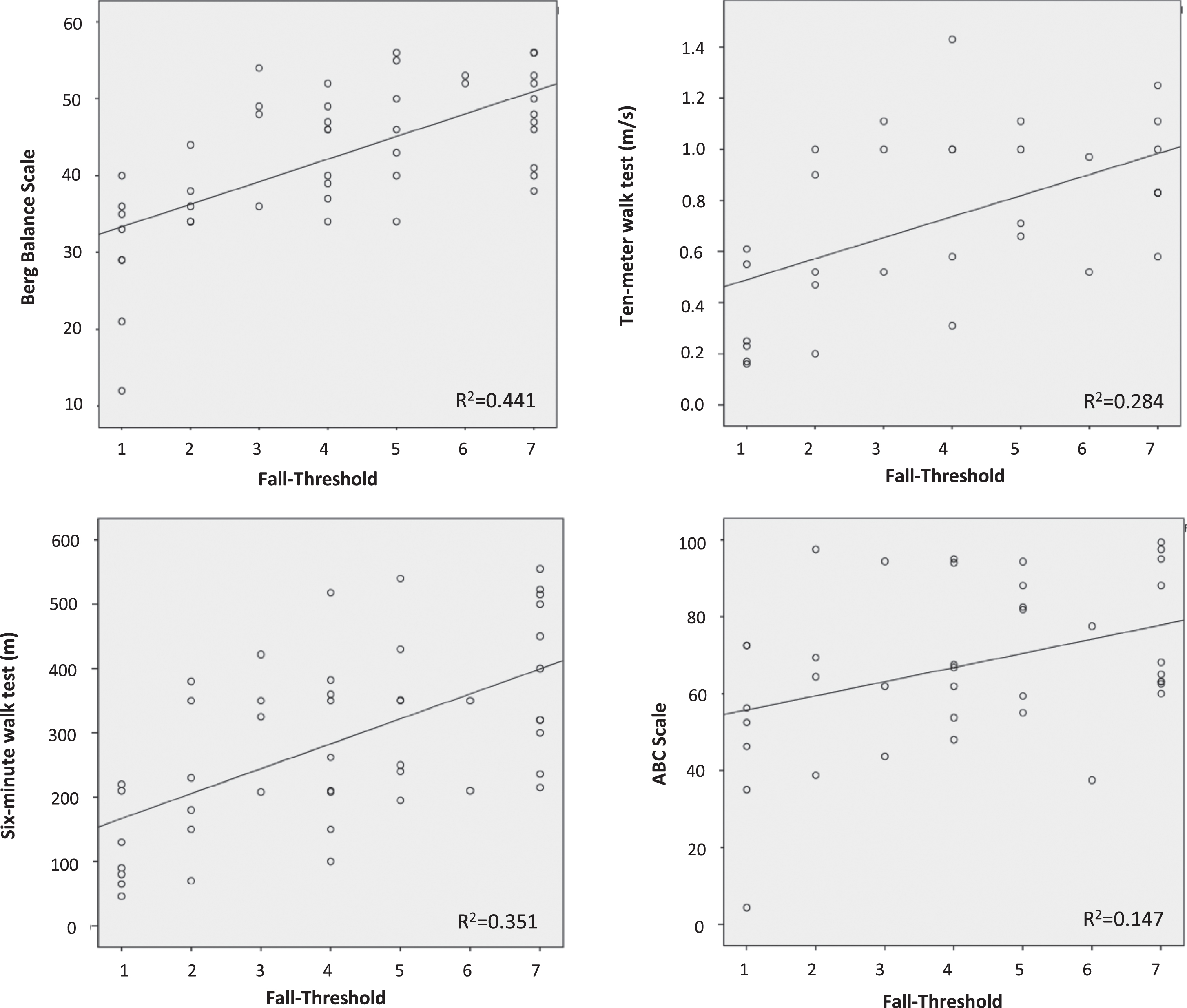
Correlations between fall threshold and Berg Balance Scale (upper left); 10-meter walk test (upper right); 6-minute walk test (lower left); Activities-specific Balance Confidence Scale (lower right). Note: Perturbation magnitudes 1–6 in the x-axis denote fall threshold and perturbation magnitude 7 denotes non-fallers.
A low correlation yet significant was found between the multiple-step threshold in surface perturbation toward the paretic side and 6 mWT (r = 0.354, p = 0.04), and BBS (r = 0.444, p = 0.001). The multiple-step threshold did not significantly correlate with the 10 mWT and the ABC (r = 0.169 and r = 0.225, respectively). There were no significant correlations between multiple-step threshold in perturbation toward the non-paretic side (i.e., loading the paretic side) and the BBS (r = 0.301, p < 0.075), 10 mWT (r = 0.244, p = 0.250), 6 mWT (r = 0.123, p < 0.483) and ABC score (r = 0.483, p = 0.817).
In the current study we explored the associations between reactive and proactive mechanisms for balance control in stroke survivors. Not surprisingly, stroke-survivors with low reactive balance abilities (i.e., low fall threshold) also showed lower levels of proactive balance control (as reflected in the BBS), low gait quality, as reflected in gait speed and low gait endurance (using the 10 mWT and the 6 mWT, respectively). Analysis of first-recovery step kinematics (step-initiation, step-duration and step-length) disclosed no significant differences between stroke survivors classified as medium- or high-threshold fallers and non-fallers. This was true both for stepping with the non-paretic and for stepping with the paretic lower limb. In direct testing of the correlation between reactive balance (i.e., fall threshold) and performance-based scores in the above clinical tests of proactive balance (BBS) and gait (10 mWT, 6 mWT), a moderate correlation was found.
Interestingly, a low correlation was found between the objective capacity for reactive balance control (i.e., fall threshold) and patients’ subjective fear from falls during daily activities (i.e., the ABC scale). This weak correlation suggests that stroke survivors in the subacute period (on average, 48 days after first-event subacute stroke at the time of testing) are still unable to accurately assess their objective ability to recover from an unexpected loss of balance. At this stage all the stroke patients in the current cohort were involved in intensive in-patient rehabilitation, probably with insufficient exposure yet to the demands for reactive balance control imposed by regular life conditions outside the rehabilitation hospital (unpaved roads, narrow passages, different kinds of obstacles on roads, etc.). A realistic image of their recovery capacity in the newly created state of hemiparesis did not yet have enough time to form. Shmid et al. (2012) found that post-stroke activity and participation correlate with balance self-efficacy (assessed by the ABC). The stroke-survivors in Shmid’s study were in the chronic stage and had already gathered more experience with their balance reactions in real-life situations compared to the patients in the current research (Shmid et al., 2012). Later, Shmid et al. (2015) found that chronic stroke-survivors with fear of falling had lower balance abilities as measured by the BBS than did those without fear of falling. This suggests that failed appreciation of true capacity in the early subacute period after stroke does not imply an underlying long-standing form of anosognosia and is likely to resolve towards a more realistic assessment of fall risk, as the necessary experience is gained.
The finding of only moderate correlation between reactive balance (as reflected in fall threshold) and tests commonly used in clinical practice to evaluate balance (e.g., the BBS) is important. The BBS measures patients’ ability to maintain balance in a proactive mode. The presentation of task demands at the testing session (before actual movement starts) enables the activation of a controlled set of motor acts aimed to counterbalance the anticipated displacement of the center of mass. This of course is not the case when one abruptly and unexpectedly hits a bump or slip in the road. With no anticipation of the event and its impact on the body, one has to rely on the immediate execution of a protective motor response, which is recruited automatically and is generally adapted to address the challenge with much less precision compared to the proactive mode of balance control. Thus, the clinical measures of proactive balance and gait do not fully capture the status of reactive balance function in stroke-survivors. Our results are in line with a previous study demonstrating that most of ambulatory stroke patients discharged from inpatient rehabilitation were unable to successfully use reactive stepping following forward balance perturbations despite having attained a high level of functional mobility (Inness et al., 2014). We extended previous protocol by measuring reactive balance capacity in response to increasing perturbation magnitudes and in response to multiple perturbation directions, thus reducing predictability. Therefore, on the basis of the current findings which show the partial agreement between measures of proactive and reactive balance control, we suggest that the practice of using performance tests such as the BBS to assess balance in patients with stroke is augmented by adding tests that address reactive balance control in a specific manner. This can be done as part of patients’ balance rehabilitation program. It should be noted that the correlation between fall threshold and the BBS was higher than its correlation with the gait measures (10 mWT and 6 mWT). As with any measure of proactive balance control, the BBS must also be partially related to demands for reactive control, given the interplay between feed-forward and feed-back operations in almost any voluntary execution of movement. When we divided the stroke-survivors to those who scored higher and lower than 45 in the BBS (25 and 23, respectively) we found that 13 of the high-score patients fell into the harness system during our assessment protocol.
The gait performance measures we used (10 mWT and 6 mWT) had a weaker association with patients’ capacity for reactive balance control (i.e, fall threshold) compared to the BBS. This fact suggests that the mechanisms underlying the capacity of stroke-survivors to regain effective ambulation is only moderately related to the mechanisms underlying their capacity to control balance in a reactive manner. Surprisingly, the kinematic analysis of the first reactive stepping could not discriminate between patients who exhibited different levels of reactive balance control as reflected by the fall threshold. This finding shows that the first reactive stepping is just one part of the set of motor acts comprising reactive balance control and that it is automatic in nature.
This study has several limitations. Cross-sectional studies using fall experiments in the laboratory provide a weaker empirical evidence compared to cohort studies that monitor real-life falls prospectively. The results were most probably affected by uncontrolled confounders, e.g., patients’ premorbid interpersonal variance in reactive balance and motor capacity. The data came from a fairly small sample, volunteers that recruited on the basis of a relatively high level of post-stroke motor functioning, thus preventing generalization of the findings to the entire population of stroke survivors. Future studies should involve a larger sample size, a more controlled design (e.g., random recruitment strategy), less restrictive inclusion criteria and prospective fall monitoring. There are protocols for the clinical assessment of balance that are likely to show better association to fall threshold, e.g., POMA (performance oriented mobility assessment (Tinetti, 1986) and MiniBEST (Franchignoni et al., 2010). In the POMA, a sternal push is provided following a warning signal. In the MiniBEST test, patients lean backwards or forwards against examiner resistance, who then releases the resistance and evaluates the success of this expected, unidirectional stepping response. Truly, these tests do not measure equilibrium recovery to an unexpected ground perturbation, in an unexpected direction and timing. However, further study should explore whether these testing protocols have an advantage in the assessment of fall risk relative to traditional proactive balance tests, like the BBS, and whether they show a stronger correlation with the measures used to test reactive balance in the current study.
Conclusions
The current study in a cohort of relatively high functioning stroke survivors contributes to our understanding of the correspondence between proactive balance and gait and the status of reactive balance control, as can be judged by the fall threshold during unexpected perturbation. The low-medium associations between reactive and proactive balance measures points to the importance of including tests that specifically address reactive balance within a comprehensive assessment of fall risk as well as treating balance reactive abilities in stroke survivors.
Conflict of interest
Authors GG, SH, MKF, and NS –nothing to declare. Author IM owns a patent on some of the technology used in the Balance Tutor system and receives a part of the standard royalty distribution for the Balance Tutor system.
Footnotes
Appendix
Perturbation characteristics of the assessment protocol
| Perturbation intensity | Forward/Backward surface translation | Lateral surface translation | ||||
| Displacement (cm) | Velocity (cm/sec) | Acceleration (cm/sec2) | Displacement (cm) | Velocity (cm/sec) | Acceleration (cm/sec2) | |
| 1 | 10.44 | 17.62 | 126.89 | 5.68 | 20.17 | 73.27 |
| 2 | 14.17 | 24.93 | 150.34 | 8.03 | 27.75 | 97.41 |
| 3 | 17.89 | 32.24 | 173.79 | 10.37 | 35.34 | 121.55 |
| 4 | 21.62 | 39.55 | 197.24 | 12.72 | 42.93 | 145.68 |
| 5 | 25.34 | 46.86 | 220.69 | 15.06 | 50.51 | 169.82 |
| 6 | 29.06 | 54.17 | 244.13 | 17.41 | 58.10 | 193.96 |
Presented are peak values. The system controller receives the required motion parameters from the PC program, which are the target position, maximal velocity, acceleration and deceleration. The controller has an internal motion profile generator that generates a trapezoidal velocity profile. Abbreviations: cm, centimetre; cm/sec, centimetre per second; cm/sec2, centimetre per second square.
Acknowledgments
This study was partially supported by a grant from the Ben-Gurion University, by the Helmsley Charitable Trust through the Agricultural, Biological and Cognitive Robotics Initiative of Ben-Gurion University of the Negev, by a trust from the Loewenstein Rehabilitation Hospital for the doctoral program (SH) and by Raphael Rozin prize for excellent study in rehabilitation.