






Abstract
BACKGROUND:
Traumatic brain injury has multiple impacts on gait including decreased speed and increased gait variability. Rhythmic auditory stimulation (RAS) gait training uses the rhythm and timing structure of music to train and ultimately improve slow and variable walking patterns.
OBJECTIVE:
To describe the feasibility of RAS gait training in community-dwelling adults with traumatic brain injury (TBI). A secondary objective is to report changes in spatiotemporal gait parameters and clinical measures of balance and walking endurance.
METHODS:
Two individuals with a TBI participated in nine sessions of gait training with RAS over a 3-week period. At baseline, post-training and 3-week follow-up, spatiotemporal parameters of walking were analyzed at preferred pace, maximum pace and dual-task walking conditions. Secondary outcomes included the Community Balance and Mobility Scale and the 6-Minute Walk Test. Feasibility was assessed using reports of physical fatigue, adverse event reporting, and perceived satisfaction.
RESULTS:
Both participants completed all 9 planned intervention sessions. The sessions were well tolerated with no adverse events. Participant 1 and 2 exhibited different responses to the intervention in line with the therapeutic goals set with the therapist. Participant 1 exhibited improved speed and decreased gait variability. Participant 2 exhibited reduced gait speed but less fatigue during the 6MWT.
CONCLUSIONS:
RAS was found to be a safe and feasible gait intervention with the potential to improve some aspects of gait impairments related to gait speed, gait variability, dynamic balance and walking endurance. Further investigation including a pilot randomized controlled trial is warranted.
Introduction
Impairments in gait are common following traumatic brain injury (TBI), and a reduction in walking ability can significantly affect an individual’s ability to integrate with their community, ultimately reducing their quality of life (Inness et al., 2011; Walker & Pickett, 2007; Williams & Willmott, 2012). After brain injury, common spatiotemporal deviations in gait include a reduced walking speed, stride length, cadence, and dual-task ability along with increased step length asymmetry and step-to-step variability (McCulloch, 2007; McFadyen et al., 2009; Niechwiej-Szwedo et al., 2007; Ochi et al., 1999; Wade et al., 1997). These issues can arise as a result of reduced muscle strength, instability, coordination issues, or cognitive impairments (Basford et al., 2003; Cantin et al., 2007; Williams et al., 2010; Williams et al., 2013). Kinetic and kinematic deviations often accompany spatiotemporal abnormalities (Williams et al., 2009, 2010; Williams et al., 2013). Individuals with TBI appear to generate less ankle joint power at push off than neurotypical individuals, ultimately compensating for this by increasing hip power generation (Williams et al., 2010). Gait impairments can remain long after injury and some research into specific gait interventions exists (Bland et al., 2011; Hillier et al., 1997). However, there is little information on the effectiveness of an inexpensive and user-friendly gait intervention used in stroke and Parkinson’s Disease: Rhythmic Auditory Stimulation (RAS) (Ghai et al., 2018; Suh et al., 2014). RAS uses the rhythm and timing structure of music to train and ultimately improve slow and variable walking patterns. RAS training relies on neural circuitry in motor regions of the brain to become synchronized to the rhythm and timing of auditory neural patterns generated by external sources such as a metronome, ultimately optimizing both spatial and temporal aspects of the gait cycle (Thaut & Abiru, 2010).
Only a few studies have explored the effectiveness of RAS for gait training in adults with TBI (Hurt et al., 1998; Wilfong, 2009). In a study with 5 community-dwelling people with TBI, a 5-week home RAS gait training program resulted in significantly improved speed, cadence and stride length of preferred pace gait, with mean increases of 50%, 15% and 29% respectively (Hurt et al., 1998). This home RAS program also resulted in mean 12% improvement in swing time symmetry but this was not significant (Hurt et al., 1998). Similar results were achieved with a 3-week RAS training program for 7 adults with TBI living in a long-term inpatient rehabilitation facility. This program resulted in increased speed (13%), cadence (6.6%) and stride length (11%) (Wilfong, 2009).
These findings show the promise of RAS as a TBI gait intervention. It is not known whether incorporating RAS into a comprehensive gait training program that includes walking under challenging conditions (e.g. negotiating obstacles, stairs and compliant surfaces) with a therapist would have a greater effect. Furthermore, recent findings suggest that RAS training can improve dual-task function and gait variability, two areas of concern for individuals with TBI that have been previously undocumented in TBI and RAS gait training studies (Ghai et al., 2018; McCulloch et al., 2010; Niechwiej-Szwedo et al., 2007). The present case series is a preliminary step exploring the feasibility of a comprehensive RAS gait training program for community-dwelling adults with TBI conducted in-person with a therapist. A secondary aim is to explore the effects of RAS on other areas of post-TBI gait dysfunction, specifically gait variability and dual task walking performance. Information gathered in this feasibility study will inform the design of an RCT comparing RAS and conventional gait training in community-dwelling adults with TBI.
Methods
Participants
The case series included two participants with a TBI who completed conventional rehabilitation and were living in the community with ongoing gait impairments. This study was reviewed and approved by the Health Sciences Research Ethics Board at the University of Toronto (Reference #34903). Participants were eligible to participate if they met the following inclusion criteria: 1) diagnosis of TBI; 2) able to walk at least 10 meters unassisted; 3) self-reported ongoing challenges with gait as a result of the TBI; 4) no concurrent neurological or orthopedic conditions affecting gait, and 5) no uncorrected hearing loss. Researchers obtained written informed consent from each participant.
Study protocol
Participants were initially screened for hearing impairments with an audiometer and for capacity to consent determined by a Montreal Cognitive Assessment Score threshold of ≥22 (Karlawish et al., 2013). Participants underwent baseline testing of the primary and secondary outcomes. Then participants received 30-minute sessions of RAG gait training three times per week for three weeks. Within one week of the last training session, all outcome measures were assessed and then again at 4 weeks follow-up. All assessments and training sessions took place in a rehabilitation research laboratory and all outcome assessments were completed by a researcher blinded to the intervention.
Clinical examination and intervention
RAS gait training was provided in-person by a certified neurological music therapist following the principles outlined in The Handbook of Neurologic Music Therapy six-step RAS intervention (Thaut & Hoemberg, 2014). The participant’s gait function was assessed clinically on the first day and specific goals for the RAS intervention were set in collaboration with the participant. The intervention was tailored to the participant’s goals but all interventions had the following structure. Thirty minute sessions were broken down into 10 minutes of pre-gait exercises, 10 minutes of task-specific training (i.e. walking), 5 minutes of advanced gait exercises tailored to the participants functional level and needs (e.g., different surface walking, stairs, stepping over objects), and 5 minutes of activities open to therapist’s discretion and aligned participant’s functional level and goals. The sessions were structures such that the participant spent at least 70–80% of the therapy time walking. Music recordings set to predetermined frequencies were provided with the presence of metronome beats.
Outcome measures
Participants completed a questionnaire that collected demographic information including age, sex, etiology of TBI and time since injury.
Primary outcome measure
The primary outcome of interest was feasibility. Feasibility measures of interest included: acceptability, adherence, tolerance, and limited efficacy (Bowen et al., 2009). Participant acceptance was measured using a satisfaction questionnaire. Adherence was characterized by attendance calculated as percentage of 9 sessions completed by the participant. Tolerance was characterized by fatigue measured with the Borg Rating of Perceived Exertion (RPE) Scale at the beginning and end of each training session (Borg, 1970).
Secondary outcome measures
Secondary outcomes of interest were clinical measures of gait and balance and spatiotemporal gait parameters. These were assessed before and after the 3-week RAS program and at 3-week follow-up. Clinical measures administered included the Community Balance and Mobility Scale (CB&M) (Howe et al., 2006; Inness et al., 2011) and 6-Minute Walk Test (6MWT) (Enright, 2003; Mossberg & Fortini, 2012).
Spatiotemporal parameters of overground gait were recorded with a pressure-sensitive mat (Zeno Walkway, Protokinetics, Havertown, PA, USA), under three walking conditions: 1) preferred paced, 2) maximum paced, and 3) dual-task (DT) walking. The DT was serial subtractions as it has previously been used to assess DT performance following an RAS gait intervention (de Bruin et al., 2010). Participants were given a three-digit number at the start of a walking trial and told to subtract by 7. Participants were instructed to give equal priority to the walking and serial subtraction task.
During each walking condition, participants wal-ked across the mat until 18 footfall events were collected to ensure the reliability (Wong et al., 2014). Spatiotemporal parameters were automatically calculated by the manufacturer software (PKMAS). The selection of parameters for analysis was informed by previous work on RAS for people with TBI and other areas of gait not yet explored. These included: speed (cm/s), cadence (steps/min), step length, step time variability, step length variability, and stride width variability. All measures of variability were reported as a coefficient of variation (% CV). The dual-task effect (DTE) was calculated using Equation 1 with gait speed because it is sensitive to dual task effects (Al-Yahya et al., 2011).
Data analysis
Feasibility measures were summarized with descriptive statistics. Spatiotemporal gait parameters of interest were plotted as a time series. Percentage change in spatiotemporal parameters was calculated for the period between pre- and post-intervention measurements and post-intervention and follow-up measurements using Equations 2 and 3 respectively. Change in clinical measures of gait and balance were compared to minimal detectable change (MDC) values which are 8 for the CB&M (Injury) and ≥45 m for the 6MWT (Van Loo et al., 2004).
Results
The baseline characteristics and demographics of Participants 1 and 2 can be found in Table 1.
Demographic information of the participants
Demographic information of the participants
P1 = Participant 1, P2 = Participant 2, MoCA = Montreal Cognitive Assessment Tool (≥26 neurotypical), MVA = Motor Vehicle Accident, CB&M Scale = Community Balance and Mobility Scale, 6MWT = 6-Minute Walk Test.
Participant 1
Participant 1 walked with a 3-point gait pattern and a single-point cane, had low endurance and difficulty with dual-task walking. The therapeutic goals set for the RAS intervention were to increase endurance and to safely ambulate with a 2-point gait pattern with an assistive device as needed for more challenging community ambulation. The planned RAS intervention was tailored to this participant by practicing advanced gait tasks without his assistive device and functional dual-task walking exercises (e.g. walking while manipulating objects in his hand).
Participant 2
Participant 2 presented with a fast, impulsive, ataxic gait pattern. The primary therapeutic goals were to improve balance and safety during ambulation. The planned RAS intervention was tailored to this participant by focusing on slowing down his cadence, increasing step length and improving his posture in order to increase safety during ambulation. The planned intervention was also tailored to focus on the transfer of safe mobility to his daily life tasks particularly those requiring dual tasking and advanced adaptive gait.
Primary outcome measure (feasibility)
Both participants completed all nine sessions of gait training with rhythmic auditory stimulation within the three-week time-frame (±3 days). The average time between baseline and post-intervention assessments was 30 days and from post-intervention to follow-up was 23 days. Both participants completed the training and either agreed or strongly agreed that RAS improved gait, balance, strength, endurance, coordination, and mood. Both participants also agreed that they would continue participating in the intervention if it were possible and felt the time was well spent participating in the intervention. Participant 1 reported RPE scores representative of light exertion after the first four RAS sessions; however, by the fifth RAS session, Participant 1 noted the training to be very light (Mean RPE: 9.6). Participant 2 reported RPE values ranging from light to very high (11–17) (Mean RPE: 13.8). No adverse events were reported.
Secondary outcome measures (spatiotemporal gait parameters and clinical measures)
The spatiotemporal parameters of preferred and maximum paced gait measured at pre-, post- intervention and at follow-up are summarized in Fig. 1 and 2 respectively. The percentage change from pre- to post- intervention and from post- intervention to follow up is summarized in Table 2. Figure 3 illustrates the dual task effect on preferred gait speed at each measurement time point. The clinical measures (CB&M, 6MWT) at each time point are summarized in Fig. 4.
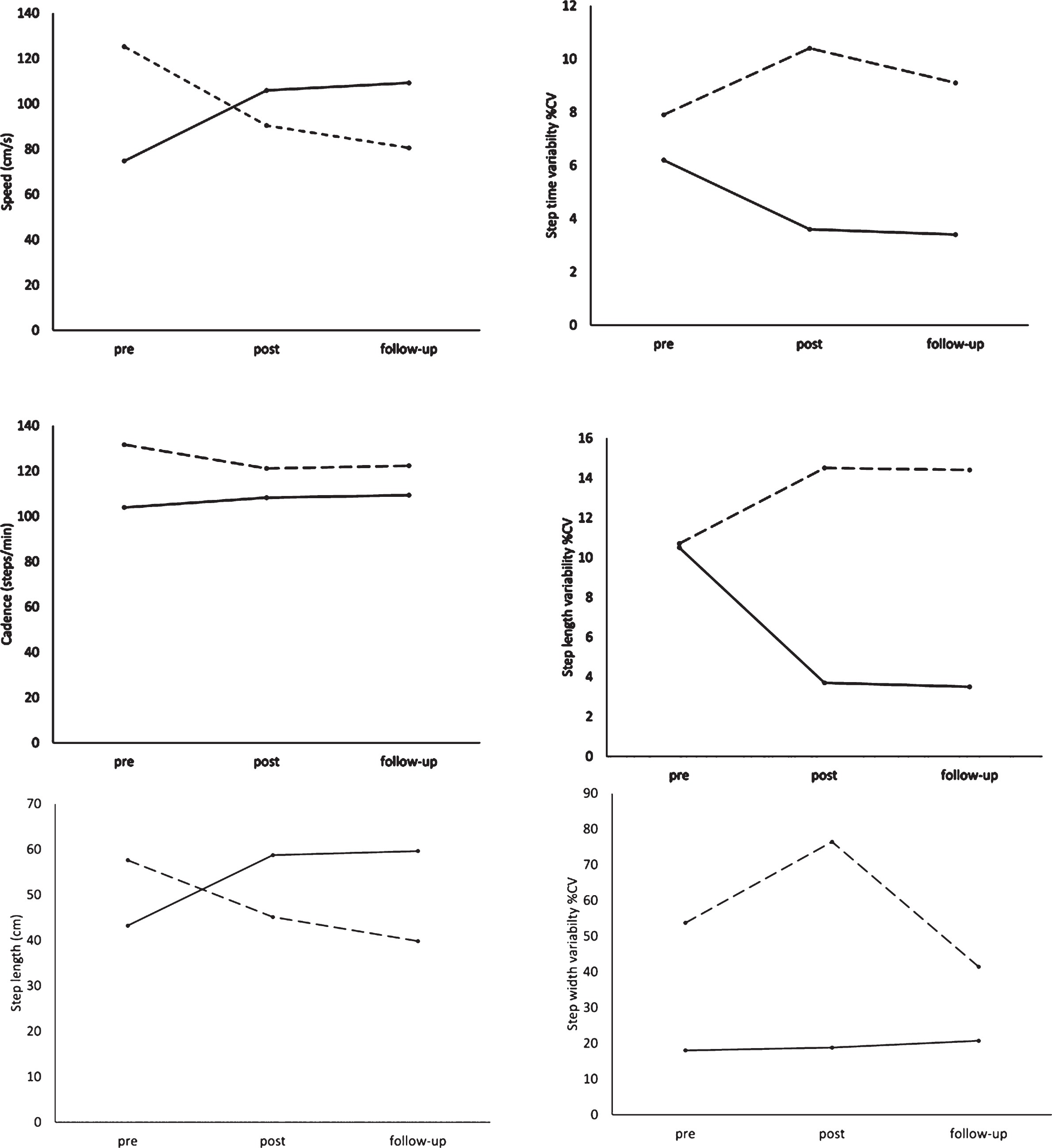
Spatiotemporal preferred pace gait parameters. Spatiotemporal parameters of preferred pace gait for Participant 1 (solid line) and 2 (dashed line) measured pre- and post- 3 week RAS intervention and at 4 weeks follow-up.
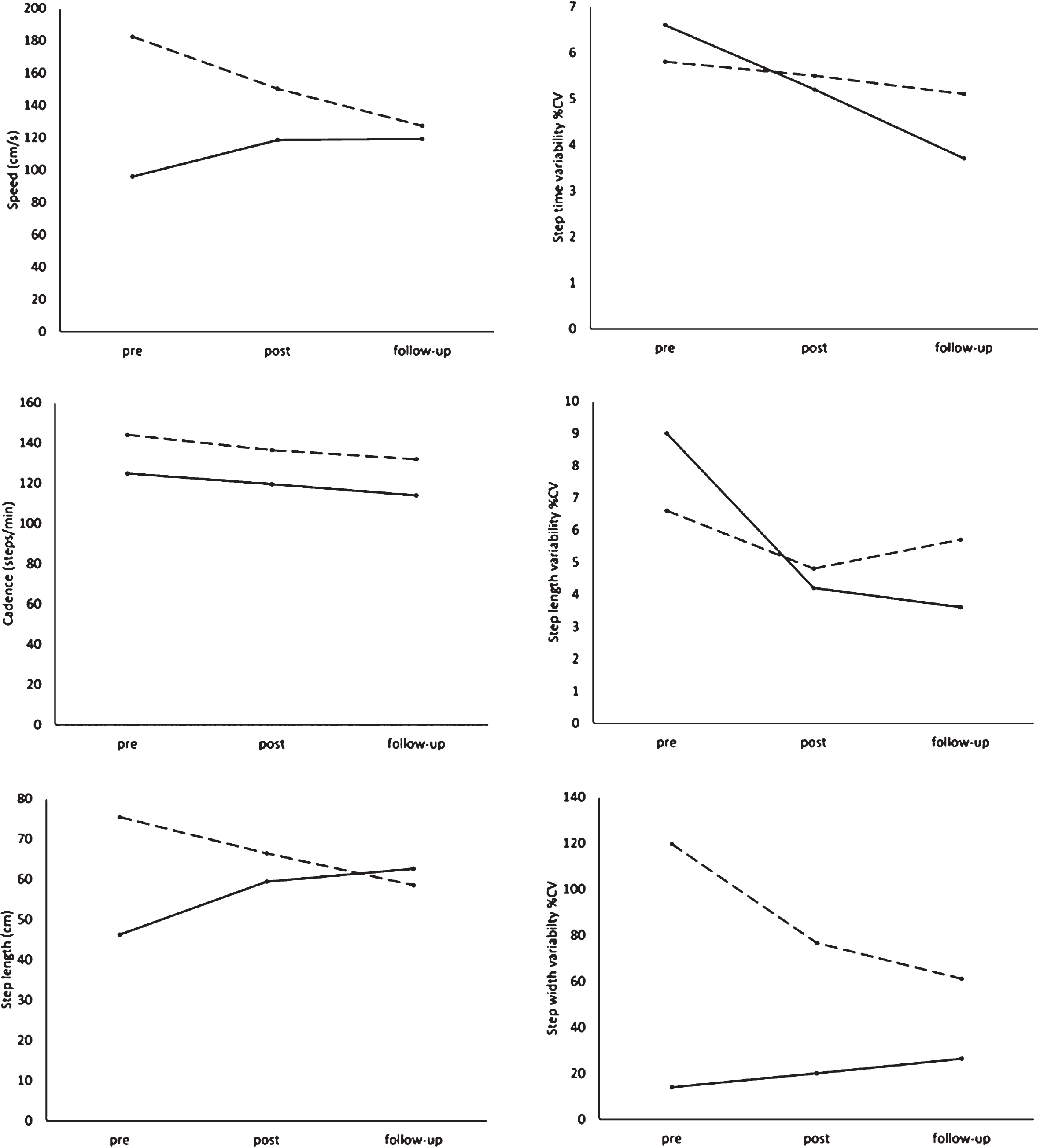
Spatiotemporal maximum pace gait parameters. Spatiotemporal parameters of maximum pace gait for Participant 1 (solid line) and 2 (dashed line) measured pre- and post- 3 week RAS intervention and at 4 weeks follow-up.
Percentage change in spatiotemporal gait parameters
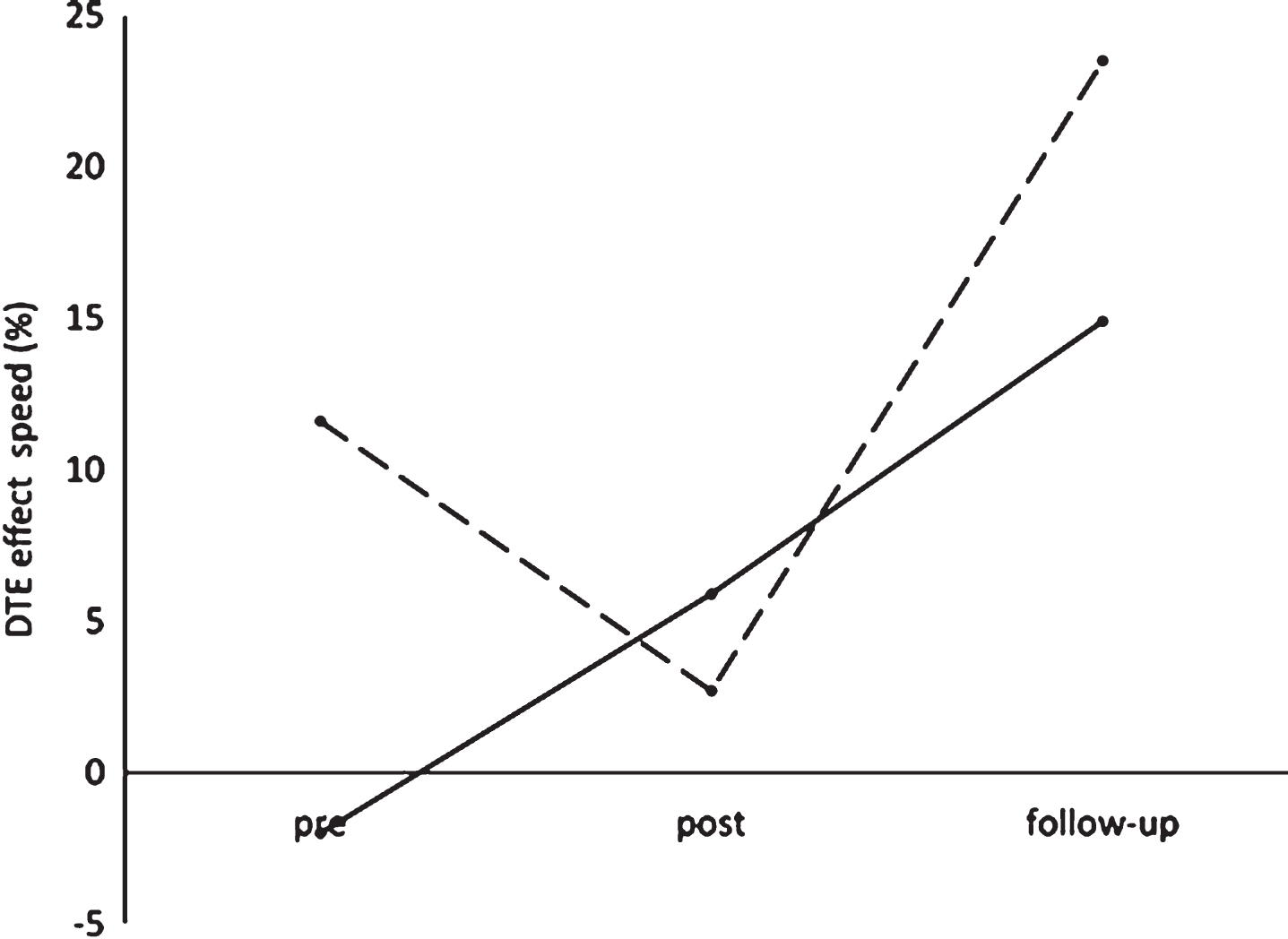
Dual task effect (DTE). The DTE of a cognitive task on speed performed while walking compared to preferred pace gait without a cognitive task. DTE is displayed for Participant 1 and 2 measured pre- and post- 3 week RAS intervention and at 4 weeks follow-up.
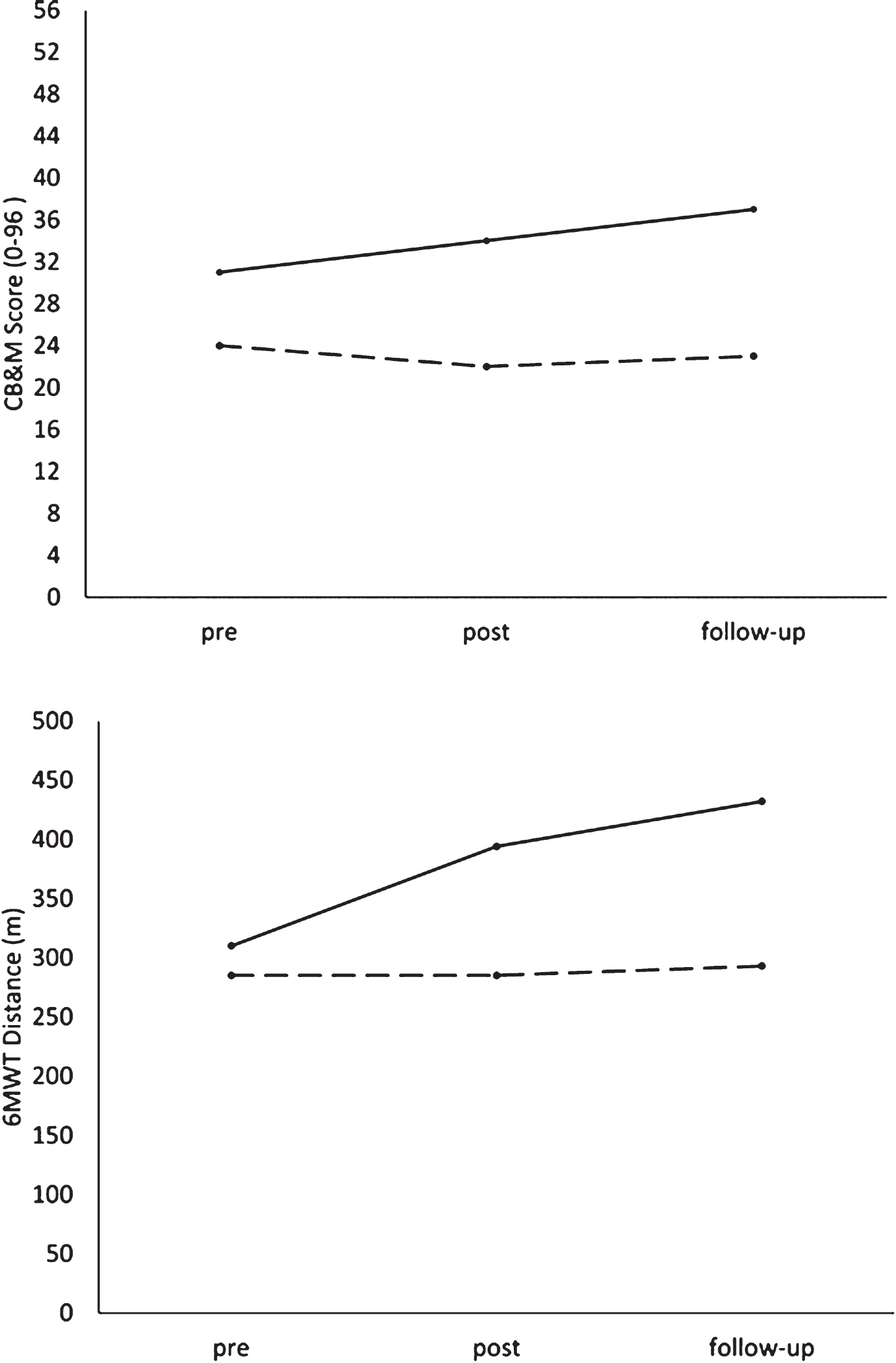
Clinical gait and balance measures. Score for the (a) community balance and mobility scale (CB&M) and distance walked in the (b) six minute walk test (6MWT) for Participant 1 and 2 measured pre- and post- 3 week RAS intervention and at 4 weeks follow-up.
CB&M scores increased from pre- to post-int-ervention by 3 points and increased another 3 points from post-intervention to follow up. The total change of 6 points did not exceed the suggested MDC of 8 points. The distance walked during the 6MWT increased from pre- to post-intervention by 84 m and increased again from post-intervention to follow-up by 38 m. The total change of 122 m exceeds the MDC of 45 m.
Participant 2
CB&M scores decreased by 2 points from pre- to post-intervention and increased by 1 point from post-intervention to follow up. The total change of 1 point does not exceed the MDC. The distance walked during the 6MWT did not change from pre-intervention to post-intervention but it should be noted that the participant took a 60 sec rest during the pre-intervention test but did not take any rests during the post-intervention test. The distance walked during the 6MWT increased by 22 m from post-intervention to follow-up but this did not exceed the MDC.
Discussion
We examined the feasibility of RAS as a gait intervention in two community-dwelling adults with TBI. The findings from this case report provide evidence that a comprehensive RAS gait intervention was feasible, safe and had an impact on many aspects of the participants’ gait patterns.
In the present study, we assessed forward progression, variability, and dual-task performance of gait. Spatiotemporal measures have been commonly used in RAS gait training in ABI research, but have been primarily restricted to speed, cadence and stride/step length (Hurt et al., 1998; Kim et al., 2016; Wilfong, 2009). The addition of step time and step length variability, and dual-task measures to this study provides a comprehensive assessment of the effects of RAS. These added spatiotemporal measures align with RAS studies conducted in older adults, stroke patients and individuals with Parkinson’s disease (de Bruin et al., 2010; del Olmo & Cudeiro, 2005; Hausdorff et al., 1998). Other gait outcome measures to consider in the future are kinematic features of gait. For example, a 3-week RAS intervention for adolescents with ABI resulted in changes in hip and knee range of motion in favor of the RAS intervention compared to conventional rehabilitation (Kim et al., 2016). In the future, characterizing kinematic/kinetic changes after RAS can provide a mechanistic explanation, for the resulting changes in spatiotemporal parameters.
The delivery of the present RAS intervention aligns closely with intervention used with adolescents with ABI by Kim and colleagues (Kim et al., 2016). The presence of a therapist for each training session, a clinic-based setting, and the frequency of training (4 weeks× 30 minutes×3/week) (Kim et al., 2016) were similar between both studies. Our study is the first RAS intervention in TBI individuals to incorporate high-level mobility tasks during training such as walking on uneven surfaces, stair climbing and obstacle avoidance (∼5 minutes per gait training session).
Due to the diffuse nature of TBI, the associated gait-related impairments are widely varied which can lead to different responses to specific gait interventions (Williams et al., 2015). For example, both Wilfong (Wilfong, 2009) and Hurt and co-authors (Hurt et al., 1998) reported individual variability in response to RAS training in adults with TBI. In the present study, the two study participants demonstrated different responses to the RAS intervention consistent with the individualized therapeutic goals set out by the neurologic music therapist. Participant 1 displayed a consistent pattern of improvement in spatiotemporal gait parameters following RAS. A familiar increase in walking speed, cadence and stride length was observed (Hurt et al., 1998; Kim et al., 2016; Wilfong, 2009). Improvement in measures of forward progression (i.e., speed, cadence, step length) is expected given this participant trained with RAS frequencies above their baseline cadence. In contrast, Participant 2 had a high cadence and reduced step length at baseline. For a limited community ambulator who used a scooter for mobility, this pattern was clearly unsustainable and risky (Fritz & Lusardi, 2009). Over the course of the intervention, Participant 2 demonstrated reduced speed of preferred pace walking and a slight reduction in cadence to make the gait pattern in line with the therapeutic goal to make walking less risky. Significant reductions in cadence have been achieved with RAS training regimes that occurred more than five times per week and lasted 30 minutes in duration (Ghai et al., 2018). Although Participant 2 displayed a small reduction in step frequency, with more intensive RAS training, a greater reduction in cadence may have been observed, ultimately creating a more efficient and stable gait pattern ready for a greater degree of safe community ambulation.
Participant 1 did not increase fast-paced velocity to the same degree as preferred-paced velocity following the RAS intervention. For Participant 2, RAS appeared to reduce maximum walking velocity but caused a greater reduction in preferred velocity by comparison. Ultimately, RAS appeared to have a greater effect on preferred velocity over the course of the intervention for both participants, aligning with previous findings (Hurt et al., 1998).
A commonly reported symptom in post-TBI gait is instability, reflected in greater spatial and temporal step-to-step variability compared to neurotypical adults (Niechwiej-Szwedo et al., 2007). Spatial variability of individuals with TBI has been found to be greater than neurotypical values during preferred and fast walking conditions while temporal variability was found to be greater than neurotypical values at fast walking conditions only (Niechwiej-Szwedo et al., 2007). In the present study, Participant 1 exhibited decreased step time and step length variability as their speed increased with RAS (and retained at follow-up) indicating improved dynamic control of gait and consistency of the stepping pattern (Sekiya et al., 1997). RAS has improved stride time variability in people with Parkinson’s disease but this was not maintained at a one-month follow-up (Dalla Bella et al., 2017). In contrast, Participant 2 exhibited increased temporal and spatial variability during preferred walking and decreased variability during fast walking following RAS. The increase in preferred paced variability is likely a byproduct of slower walking speed (Sekiya et al., 1997). It is also possible that this increased variability is a marker of gradual motor learning (Horst et al., 2017). A meta-analysis revealed temporal and spatial variability increased during initial entrainment with an auditory cue in older adults (Ghai et al., 2017). The finding was attributed to the “dynamic system theory” whereby elevated levels of variability encourage a system to organize and refine into a stable and optimal finished product (Stergiou & L.M., 2011).
Finally, DTE appeared responsive to RAS training. Theoretically, as Participant 1 improved single-task gait stability, walking should become more autonomous, alleviating more cognitive resources to be allocated to the cognitive task during dual task walking (Yogev-Seligmann et al., 2008). However, at pre- and post-intervention assessments, Participant 1 increased speed during dual-task walking compared to single-task walking. This pattern has been previously described in Parkinson’s Disease as a risky adaptation contrasting the neurotypical “posture first” adaptation. In this risk-accepting dual-task strategy, the retention of gait speed is given greater emphasis than stability with the introduction of a secondary task while walking (Shumway-Cook et al., 1997).
Participant 1 exhibited an improvement in CB&M. Combined with the improvement in gait variability this suggests that RAS can improve dynamic balance and mobility activities associated with community integration (Inness et al., 2011). Walking endurance also improved with RAS. At baseline, Participant 1 had a 6MWT distance less than individuals at admission to a rehabilitation center (Mossberg & Fortini, 2012). After RAS, Participant 1 demonstrated improved walking endurance (in line with his therapeutic goals) that continued at follow-up and exceeded the published MDC (Van Loo et al., 2004). Participant 2 did not change walking distance after the RAS intervention; however, he did not experience the same level of fatigue during the 6MWT and he was able to complete the test without a rest. There was also a slight improvement in distance walked at follow up. Together these results suggest RAS can improve walking endurance post-TBI.
A limitation of this case report and common to all case studies is the limited generalizability of the larger TBI population. However, the main objective of this study was to evaluate the feasibility of an in-person RAS intervention for people with TBI that incorporated higher level gait activities, which was demonstrated.
Conclusion
In conclusion, this case report demonstrates the feasibility of RAS to address many components of TBI-related gait impairments. In a large-scale RCT, these spatiotemporal outcomes and clinical measures should be used to compare RAS with conventional gait training.
Conflict of interest
None to report.