






Abstract
BACKGROUND:
The use of robotic technologies in pediatric rehabilitation has seen a large increase, but with a lack of a comprehensive framework about their effectiveness.
OBJECTIVE:
An Italian Consensus Conference has been promoted to develop recommendations on these technologies: definitions and classification criteria of devices, indications and limits of their use in neurological diseases, theoretical models, ethical and legal implications. In this paper, we present the results for the pediatric age.
METHODS:
A systematic search on Cochrane Library, PEDro and PubMed was performed. Papers published up to March 1st, 2020, in English, were included and analyzed using the methodology of the Centre for Evidence-Based Medicine in Oxford, AMSTAR2 and PEDro scales for systematic reviews and RCT, respectively.
RESULTS:
Some positives aspects emerged in the area of gait: an increased number of children reaching the stance, an improvement in walking distance, speed and endurance. Critical aspects include the heterogeneity of the studied cases, measurements and training protocols.
CONCLUSION:
Many studies demonstrate the benefits of robotic training in developmental age. However, it is necessary to increase the number of trials to achieve greater homogeneity between protocols and to confirm the effectiveness of pediatric robotic rehabilitation.
Introduction
Rehabilitation is a complex process aimed at promoting the best possible participation and quality of life for child and his family. Through direct and indirect actions, it focuses on the individual in all his dimensions, physical, mental, emotional, communicative and relational (holistic approach; Vuillerot, et al., 2020), and it involves the child’s family, social and environmental context (ecological approach; Chevignard, et al., 2012). It is achieved through the formulation of the rehabilitation plan and of the various treatment programs for three areas: re-education, care and education (Castelli, et al., 2016). Re-education is a responsibility of health workers: its aim is to promote the development and improvement of adaptive functions. Education is a responsibility that lies with the family, with health workers, and with teachers and educators. Care is a responsibility of health workers and social workers and it must be aimed at promoting the wellbeing of the child and his family (Castelli, et al., 2016). The functional profile can be organized according to the taxonomy of the International Classification of Functions (ICF) (World Health Organization, 2007; Martinuzzi, et al., 2013; Giovannetti, et al., 2013; Da Fonseca Filho, et al., 2020), codifying the data according to the following categories: body functions: meaning the physiological functions of the body’s systems (including psychological functions); body structures: meaning the anatomical parts of the body such as organs, limbs and their components; activities: meaning an individual’s execution of tasks or actions; participation: meaning involvement in a life situation; environmental factors: meaning attitudes and the physical and social environment in which people conduct their lives. In the last 50 years, various rehabilitation treatments have been employed in order to favour children’s functional recovery, as well as to improve quality of life and autonomy. A multidisciplinary approach is decisive. The different therapeutic approaches available are: acceptance and commitment therapy, action observations, casting, constraint-induced movement therapy, environmental enrichment, fitness training, goal-directed training, home programs, literacy interventions, mobility training, oral sensorimotor, oral sensorimotor plus electrical stimulation, pressure care, stepping stones triple P, strength training, task- specific training, treadmill training, partial body weight support treadmill training, and weight-bearing (Novak, et al., 2020). The use of robotic technologies is constantly increasing in rehabilitation, mostly in neurological disability. International Federation of Robotic expects a further increase of robot’s use in rehabilitation (World Robotics, 2018). Robotic devices allow controlling different field of force (viscous, elastic and gravitational) and personalization of treatment. They also provide sensory-motor feedback that adapts in real-time to the patient’s actual performance and allow a more efficient motor control. Neural plasticity is the brain capacity to modify functional organization as result of experience; it allows recovery of function after damage to the nervous system. Many studies strongly suggest that neurons possess the ability to alter their structure and function in response of a variety of internal and external stimulations, including behavioural training. Neuroscience research provides indications on the most effective strategies for activating neuronal plasticity (Ismail, et al., 2017; Johnston, 2009). Neural plasticity requires not only the acquisition of a skill but also the continued performance of that skill over time. An effective rehabilitation intervention has to be motivating, intense, repetitive and with a sensorial feedback for self-correction (Novak, et al., 2020; Kleim, & Jones, 2008; Novak, et al., 2013). These are specific features of robotic devices, which constitute a new opportunity for rehabilitation intervention. Robot-based devices are useful to promote improvements in sensorimotor and cognitive process. They produce a controlled and repeatable therapy experience and allow quantitative evaluations of kinematics and kinetics to estimate the patient’s progress. On the contrary, the clinical scales only allow qualitative evaluations and may be affected by a bias due to the subjectivity of the examiner (Liebermann, et al., 2006). Despite the increase in use of robotic technologies, it lacks an overall and shared framework of reference. The general purpose of this review is to develop recommendations of use of these technologies in the disabling conditions of neurological origin in developmental age. To achieve this aim it is necessary to define classification criteria of the devices and understand their clinical indications. Finally, the use of robots in pediatric rehabilitation asks us to consider also the organizational contexts, regulatory aspects, their possible ethical and legal implications.
Materials and methods
A working group was set up by the Italian Society of Physical and Rehabilitative Medicine (SIMFER) and Italian Society of Neurological Rehabilitation (SIRN), composed of a group of experts in paediatric rehabilitation and their collaborators. Working group made a selection and valuation of literature; three thematic areas have been identified: Walking rehabilitation devices (RAGT/Lokomat); Upper Limb rehabilitation devices (upper limb); and Lower limb rehabilitation devices (lower limb/exoskeleton). Working group components have been divided into three subgroups; subdivision was carried out according to the specific professional skills and individual requests; each group dealt with a single specific thematic area.
The working group had to answer the following questions:
Question 1:
Is there scientific evidence on the effects of rehabilitation assisted by robotic or electromechanical devices on walking disorders and upper and lower limb recovery in people with neurological disabilities in developmental age? It was also necessary to define: Types of devices used and in which pathologies or categories of patients Treatment protocols (duration, number of sessions, frequency, etc.) Other associated treatments Treatment outcomes or goals
Question 2:
What are the levels of evidence on the effects of use of robotic or electromechanical devices on rehabilitating of walking disorders and on the recovery of the upper and lower limbs in people with neurological disabilities in developmental age?
To answer the questions a systematic literature review was performed, starting from the analysis of the pathologies of greatest clinical interest related to robotic rehabilitation. No time limits were defined. Papers published up to March 1st, 2020 were included. Only English language papers were considered. Only clinical trials, reviews and international guidelines were considered.
Cochrane Library, PEDro and PubMed were questioned. The following keywords were used: robot, robot rehabilitation, exoskeleton, RAGT (Robot-Assisted Gait Training, Lokomat), robot upper limb, robot lower limb. At the end of the search, 6881 papers were selected (709 from Cochrane Library; 74 from PEDro; 6098 from PubMed). 6821 records were considered non-inherent and were excluded: records excluded were duplicates, papers including participants older than 18 years old, papers about robotic surgery or game activity; papers not using English language. Papers that were not consistent with the objectives of the consensus conference in terms of etiology or goals were also excluded: records in which patients were affected by autism spectrum disorder or not neurological disease, trials that reported non-functional goals or only social aspects, papers with type of intervention not of interest in this context (virtual reality, only treadmill, prototypes presentation, methodological, pharmacological, neurophysiological studies). The screening and eligibility process is summarizied in Fig. 1.
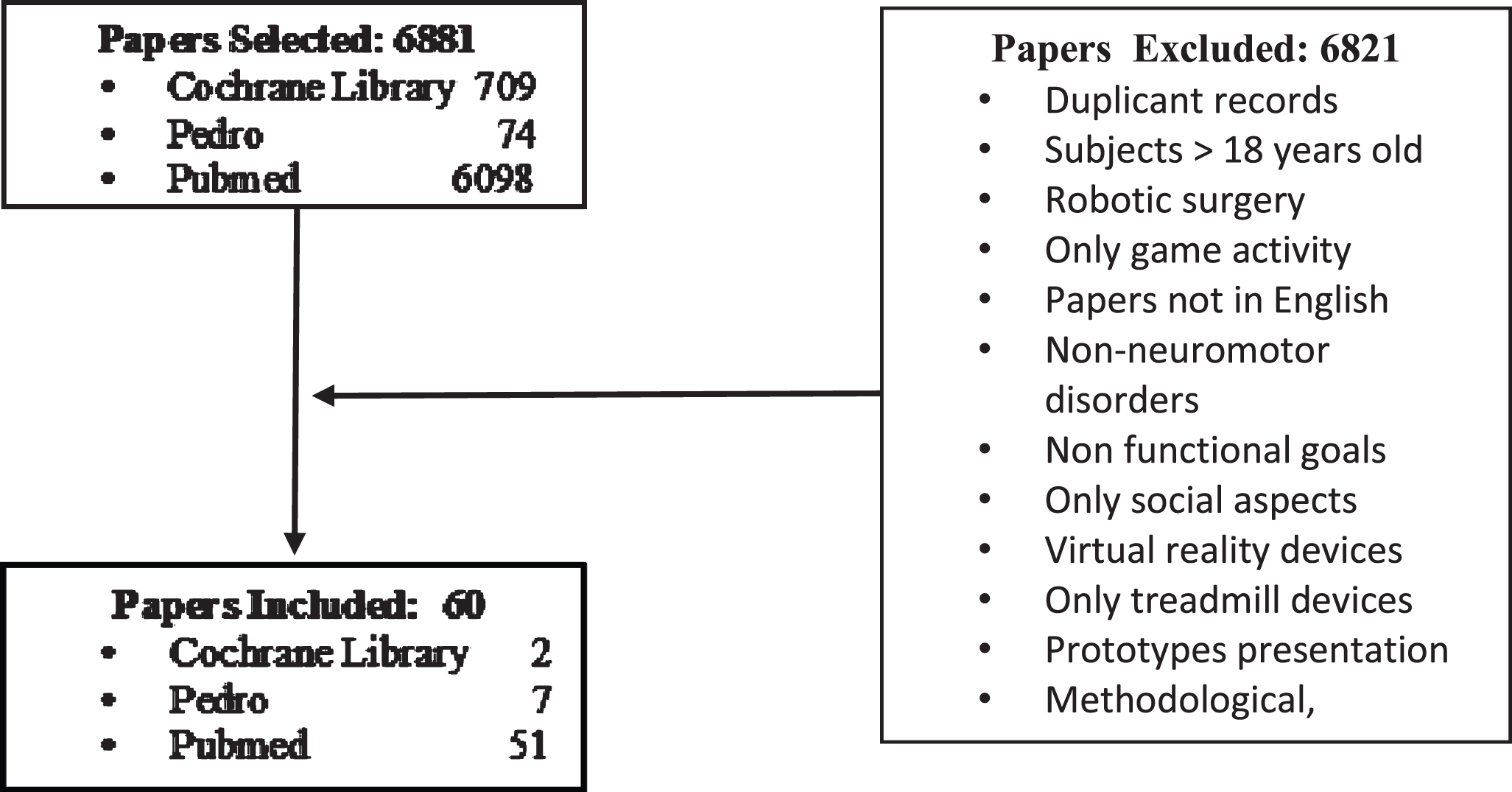
Literature screening and eligibility process.
At the end of screening and eligibility process, we have identified 60 studies (2 from Cochrane Library; 7 from PEDro; 51 from PubMed). International guidelines were not identified.
The articles were analyzed according to the strength of their scientific evidence, using the methodology of the Centre for Evidence-Based Medicine in Oxford (Oxford Centre for Evidence-Based Medicine, 2011; See Table 1 for details).
Levels of strength of scientific evidence, Oxford Centre for Evidence-Based Medicine
* = Level may be decreased based on the quality of the study, its imprecision, the inconsistency between the studies, or the modest “effect size” (low clinical relevance of the results); level can be increased if there is an important “effect size”. ** = Systematic review is superior to a single study.
In Table 2 the studies are subdivided according to the three database and the strength of their scientific evidence.
Selected articles subdivided for database and strength of their scientific evidence
Methodological quality assessment was based on AMSTAR2 and PEDro score: AMSTAR2 was used for systematic reviews; PEDro score for randomized controlled trials.
AMSTAR2 score consists of 16 items; the final qualitative judgment is divided in high, moderate, low, very low; it is determined by the presence or absence of anomalies in critical domine of the scale.
PEDro scale forecast a score from 1 to 10 (excluding the score for external validity).
60 papers were entered into an Excel database; it reported identifying information, study design, aim, results, and level of evidence. Working group components could consult papers and database through a shared folder in Google Drive. Two independent operators for each working group analyzed the literature to find relevant studies; they attributed a shared evaluation of external and internal validity and the univocal description of methods and results. Coordinators of the working group integrated member’s contributions in a single document. This document was divided into the three main thematic areas with a final part of overall consideration. Finally, it was again submitted to the working group components for accurate discussion and review with definition of final document.
Upper limb: Robotic devices used for upper limb paediatric rehabilitation
16 studies were selected. Two of the sixteen studies included were reviews: Chen, 2016 and Fasoli, 2012; three studies were RCT: Gilliaux, 2015; Ladenheim, 2013; El-Shamy, 2018; one was an observational study: Biffi 2018; eight were case-control and case-series studies: Beretta, 2018; Fasoli, 2008; Masia, 2011; Bishop, 2017; Peri, 2016; Weightman, 2011; Frascarelli, 2009; Casellato, 2012; 2 were descriptive studies/expert opinion: Pathak, 2012, Tong, 2015. One review concerned 67 participants out of 9 studies (Chen, et al., 2016) and the other 46 participants out of 3 studies (Fasoli, et al., 2012). The RCT casuistry varies from 16 to 31 patients (median 30). 43 people from 5 to 18 years were included in the observational study (Biffi, et al., 2018); they were divided in 21 Cerebral Palsy (CP) and 22 Acquired Brain Injury (ABI). 100 patients with mixed aetiology were included in the seven case-control and case-series studies: 18 patients affected by ABI hemiplegia in Beretta 2018, 12 patients affected by unspecified hemiplagia in Bishop 2017 and 12 in Fasoli, 2008, 14 patients affected by CP in Peri, 2016; 18 patients affected by CP in Weightman, 2011; 11 patients affected by dystonia in Casellato, 2012; 7 patients affected by CP in Masia, 2011 and 12 patients affected by CP in Frascarelli, 2009. The age ranges from 4 to 18 years; Pathak, 2012 does not report clinical cases and Tong, 2015 reports one clinical case. The following devices are reported in the various studies: REAPlan Robot (Gillaux, et al., 2015), Mit Manus (Ladenheim, et al., 2013), Armeo (Beretta, et al., 2018; El-Shamy, 2018; Biffi, et al., 2018; Bishop, et al., 2017; Peri, et al., 2016), InMotion2 (Fasoli, et al., 2008; Masia, et al., 2011; Frascarelli, et al., 2009); ReHaptic Handle (Tong, et al., 2015); Planar Space Assistive Movement Device-PSAMD e Restricted Planar Space Assistive Movement Device- RPSAMD (Weightman, et al., 2011); Phantom Omni (“sense able”) (Casellato, et al., 2012). Treatment sessions lasted from 20 to 60 minutes; patients were treated, from 2 to 5 times a week, for a total duration from 2 to 8 weeks. Traditional treatment was associated to robotic treatment in 3 studies (Gillaux, et al., 2015, Beretta, et al., 2018, Bishop, et al., 2017); CIMT was associated in only one study (Beretta, et al., 2018).
The following outcome measures were used:
•Body functions and structures (kinematics of the upper limb, Box and Block test, Quality of Upper Extremity Skills test, Modified Ashworth Scale, Fugl-Meyer Assessment of Motor Function)
•Activities (Abilhand-Kids, Pediatric Evaluation of Disability Inventory, Quality of Upper Extremities Skills Test-QUEST, Gross Motor Function Measure-GMFM, Manual Ability Classification System-MACS, Melbourne Assessment of Unilateral Upper Limb Function, Assisting Hand Assessment- AHA, Jebsen-Taylor Test of Hand Function, Canadian Occupational Performance Measure-COPM)
•Participations (Life Habits)
The analysis of the reviews by AMSTAR2 score showed “moderate” quality to Chen, 2016 e “critically low” quality to Fasoli, 2012. The analysis of the RCTs by PEDro score showed: a score of 8/11 for Gilliaux, 2015; a score of 7/11 for Ladenheim, 2013; a score of 8/11 for El-Shamy, 2018.
Lower limb/exoskeleton: Robotic devices used for lower limb and walking rehabilitation in paediatric populations
15 studies, that verified the effectiveness of the robotic devices, were selected. Two studies were RCTs (Chen, 2016 and Wu,, et al., 2017); one study was a cohort study (Sukal-Moulton,, et al., 2014); 10 were case-control studies and case-series (Michmizos,, et al., 2017; Sarhan,, et al., 2014, Wu,, et al., 2011; Chen,, et al., 2018; Bulea,, et al., 2018; Lerner,, et al., 2017a, 2017b, 2019; Samadi,, et al., 2016, Rossi,, et al., 2013); 2 were descriptive studies /expert opinion (Park, 2017, Michmizos, et al., 2015).
One RCT analyzed 41 patients with ABI, from 2 to 18 years old (Chen, 2016), and the other 28 patients with CP, from 5 to 12 years old (Wu, et al., 2017). The cohort study analysed 28 patients with CP (Sukal-Moulton, et al., 2014). 10 case-series with a total number of 85 patients, from 4 to 18 years old, with mixed aetiology (CP, ABI) 23 patients CP in Sarhan, 2014, 12 patients in Wu, et al., 2011, 7 patients in Bulea, 2018, 7, 4 and 5 patients respectively in Lerner, 2017, 2017, 2019, 3 patients in Samadi, 2016, 8 patients in Rossi, 2013, 6 patients in Michmizos, 2017 and 10 ABI patients in Chen, 2018. The following devices are reported in the various studies: robotic device and prototype exoskeletons (Chen, et al.,2018, Wu, et al., 2017, Lerner 2017, 2017, 2019, Bulea, et al., 2018; Samadi, et al., 2016, Rossi, et al., 2013); MIT’spedi-Anklebot (Michmizos, 2015, 2017; Bulea, et al., 2018); Driven gait orthosis-DGO (Sarhan, et al., 2014); IntelliStretch robotic device (Sukal-Moulton, et al., 2014).
Treatment sessions lasted from 20 to 75 minutes; patients were treated from 2 to 5 times for week; total number of sessions were from 6 to 18, with overall duration from 2 to 6 weeks. The treatment protocols had significantly different goals: ankle training (Michmizos, et al., 2015, 2017, Wu, et al., 2011, Sukal-Moulton, et al., 2014, Chen, et al., 2018); hip and pelvis training (Park, et al., 2017), walking training (Wu, et al., 2017, Sarhan, et al., 2014); comparison between home and laboratory robotic treatment (Chen, et al., 2016); validation of robotic instruments for foot or ankle (Lerner, et al., 2019); validation of robotic instruments for crouch knee (Rossi, et al., 2013, Lerner, et al., 2017, Samadi, et al., 2016); training effectiveness assessment tools (Bulea, et al., 2018). Chen, 2016, Wu, et al., 2011 and Sukal-Moulton, 2014 combined the robotic treatment with a traditional treatment. The following outcome measures were used: Body structures and functions: ankle active and passive ROM, MAS, Box and Block test, Fugl-Meyer Lower Extremity (FMLE), instrumental gait analysis Activities measures: 6 or 10 minute walk test (6MWT), Timed Up and Go test (TUG), walking speed on the ground, Pediatric Balance Scale, Selective Motor Control Assessment of the Lower Extremity (SCALE), Gross Motor Function Measure-66 (GMFM-66), Bruininks-Oseretsky Test of Motor Proficiency Subtest 2 for balance Participation measures: nobody used
No guidelines, meta-analysis or review were found by the analyses of literature; the analysis of RCTs with the PEDro scale shows a score 7/11 (Chen, 2016) and 8/11 (Wu, et al., 2011).
29 studies were selected. Two of the 29 studies included were reviews (Lefmann, et al., 2017, Carvalho, et al., 2017); seven studies were RCTs (Druzbicki, et al., 2010, Smania, et al., 2011, Druzbicki, et al., 2013, Hiderley, et al., 2016, Wright, et al., 2017, Wallard, et al., 2018, Kawasaky, et al., 2020); 7 of 29 are cohort studies (Brutsch, et al., 2011; Sarhan, et al., 2014; Wallard, et al., 2017; Ricklin, et al., 2018; Beretta, et al., 2018; Yazici, et al., 2019; Beretta, et al., 2020); 12 are control case and case-series studies (Molteni, et al., 2015; Phelan, et al., 2015; Beretta, et al., 2015; Aurich-Schuler, et al., 2017; Borggraefe, et al., 2010; Chernia, et al., 2019; Aurich-Schuler, et al., 2013; Peri, et al., 2017; Borggraefe, et al., 2010; Hedel, et al., 2016; Schmartz, et al., 2011; Lindsay, et al., 2018); 1 paper was expert opinion (Aurich-Schuler, et al., 2015). Reviews concerned 486 participants out of 17 studies (Lefmann, et al., 2017) and 217 participants out of 10 studies (Carvalho, et al., 2017). Literature analyses highlighted that robotic devices are principally used in children affected by CP according to GMFCS score, from level I to IV. Carvalho’s review (Carvalho, et al., 2017) included exclusivity children affected by CP and Lefmann’s review (Lefmann, et al., 2017) showed that 14 of 17 studies were carried out on CP affected children. The number of patients enrolled in RCTs varies from 18 to 52 patients for a total of 209 children. All RCTs describes CP affected patients with an operating level from II to IV of the Gross Motor Function Classification System. Druzbicki, 2010 involved 18 patients, Smania, 2011 involved 18 patients, Druzbicki, 2013 involved 18 patients, Hiderley, 2016 involved 40 patients, Wright, 2017 involved 32 patients, Wallard, 2018 involved 30 patients and Kawasaky, 2020 10 patients. Five of 7 RCTs used Lokomat: one (Smania, et al., 2011) used Gait Training 1; the other (Kawasaky, et al., 2020) used Honda walking assist device. Patients subjected to usual care treatment represented control group in all studies. Cohort studies included 316 patients, with a variability from 10 to 182 patients for trials; case-control and case-series studies enrolled 284 patients. The expert opinion study (Aurich-Schuler, et al., 2015) did not report a clinical case history but it provided indication on the use of the Lokomat system for rehabilitation of CP affected children according to their functional level. In most of the works the Lokomat system is used on a treadmill with robotic assistance at the hip and knee level; Gait Training 1 is used only in one study (Smania, et al., 2011); Honda walking assist is used in one study (Kawasaky, et al., 2020). In the studies, heterogeneity in the choice of treatment is notice; their duration varies from 30 to 60 minutes. Sessions varies from 2 to 5 in a week and they are repeated for 2– 6 weeks, up to a maximum of 10 weeks (Sarhan, et al., 2014).
Two studies (Druzbicki, et al., 2010, Smania, et al., 2011) associateed robotic treatment and conventional treatment; conventional treatment is characterized by a heterogeneity of interventions in both trials. Outcomes evaluated were: 10MWT for walking speed (Smania, 2011), 6MWT for resistance/distance travelled (Wright, et al., 2017, Smania, et al., 2011); balance with stabilometry (Druzbicki, et al., 2010); degree of functional autonomy (Smania, et al., 2011), Canadian Occupational Performance Measure (Wright, et al., 2017); stride length, speed, double support time, kinematics with gait analysis (Smania, et al., 2011, Druzbicki, et al., 2013); Gross Motor Function Measure-66 and 88 Dimension D and E for gross motor skills (Wallard, et al., 2018, Wright, et al., 2017); Goal Attainment Scale (Wright, et al., 2017); Modified Ashworth Scale and Range Of Motion (Kawasaky, et al., 2020). No guidelines or meta-analysis were found by the analyses of literature; the analysis of the reviews by AMSTAR2 score showed “moderate” quality to Lefmann, 2017 and “critically low” quality to Carvalho, 2017. The analysis of the RCTs by PEDro score showed: Wright, 2017 10/11, Hiderley, 2016 9/11, Smania, 2011 10/11, Druzbicki, 2013 9/11, Druzbicki, 2010 9/11, Wallard, 2018 9/11, Kawasaky, 2020 10/11.
Discussion
Upper limb: Robotic device used to upper limb paediatric rehabilitation
By the literature analysis, robotic device used for upper limb paediatric rehabilitation seems to giving promising results; an excessive number of sessions do not seems necessary in one trial (2 times/week for 8 weeks, Fasoli, 2012); other studies, instead, propose greater intensity of sessions: 5 times/week for 8 weeks (Gilliaux, et al., 2015) or 5 times/week for 4 weeks (Biffi, et al., 2018). Robotic device allows potential feedback (sensorimotor, motor learning); it can be customized and increase the effects on the motor task and motor learning by the subject.
Some limitations have been identified in many other studies: No long-term effects analysis (only in Beretta, et al., 2018 and Fasoli, et al., 2008, even if performed one month after the last therapy). A longer time check would be useful (6 months), also supported by neuroradiological or neurophysiological data. Furthermore, it could be useful to hypothesize at what distance in time to propose a possible second cycle of robotic therapy. Limited number of samples (ranging from one only patient, treated with ReHaptic Handle, for Tong, 2015 until 31 patients described by Ladenheim, 2013) and too variable age. It would be useful to plan multicentre studies to increase the sample size and try to standardize the age of the samples. In addition, case-control studies need to be implemented; this would increase the evidence of progress achieved in subjects undergoing robotic therapy. The demand for adequate cognitive and behavioural competence is another limitation; behavioural compliance has to allow performing tasks and maintaining a good level of attention for 45–60 minutes. So, an IQ within the normal limits or only slightly deficient must be established as a criterion for inclusion in clinical trials. AHA score (Assisting Hand Assessment) is a validated and standardized evaluation tool for children over 18 months with congenital hemiplegia or brachial plexus injury; Karolinska Institute di Stoccolma created it. It is a scale widely used in the internationally research field and it is considered outcome measure in numerous experimental clinical trials; it evaluate effectiveness of on the functional improvement of the upper limb in children with congenital hemiplegia. This scale has considerable utility in clinical rehabilitation field because it allows identifying the aspects in which children have greater difficulties in integrating the hemiplegic hand in the bimanual activities of daily life. However, only one study analysed (Bishop, et al., 2017) used AHA score as outcome measure. The use of this score should be increased on next studies, although operators who have completed the specific course can only administer the scale. Evaluate the increase of ability in the Activities of Daily Living (ADL) with specific scales (AMPS or A-ONE score for example) would be interesting; also in this case the limit is represented by the need for trained personnel to administer the scores; these scores evaluate not only manual or bimanual activity but the organization of the subject’s overall performance. This would allow clinicians to understand whether robot-assisted rehabilitation therapy is able to modify not only motor skills but also process skills, obtaining greater practical effects from rehabilitation exercise. However, a great heterogeneity of the evaluation scales used is confirmed; it made the results of the various works hard to compare. Only Ladenheim, 2013 divides the sample in congenital or acquired paresis; most of the studies included patients with different aetiologies. Only three studies (Gilliaux, et al., 2015, El-Shamy, et al., 2018, Biffi, et al., 2018) specify a level between I and III of the MACS score as inclusion criteria; this criteria should be considered when recruiting subject for future studies, due to different affordance features of the different robot devices used in trials (InMotion2, Armeo Spring, REAPlan, NJIT-RAVR, ReHaptic Handle, Amadeo Hand Robot System). No study assesses the organizational impact of the treatment or highlights the cost-benefit ratio. Furthermore, the machine-operator-patient interaction is never considered. Often in the studies it is not specified whether and which rehabilitation treatments are carried out during the trial with robotic therapy. Where investigated (Ladenheim, et al., 2013) the best motor performance obtained post robotic training was not associated with an improvement in the “participation and activity” domain according to ICF (modify tasks with exercises that replicate some activities experienced by the child on a daily basis). Often these domains and/or the quality of life are measured with interviews or questionnaires addressed to parents or therapists (Vineland 2, PEDI - PEDICat). In future studies it could be hypothesized the use of scales that provide for direct administration to the subject (Olivieri, et al., 2016). The size of the ICF “participation” domain is too little represented. Assessment of visual function is an aspect that could be implemented in future works.The patient is always required to visual check, via video or monitor, the action performed with the assistance of the robot. Because visual problems are often present in CP patients, they should be further specified and analyzed. Despite this, visible characteristics in the subjects are not mentioned in many studies. Only Ladenheim, 2013 describes a generic vision screening, probably limited to the ocular and/or perceptual component only. Instead, Shamekh, 2018 defines a preliminary “normal or corrected vision” meaning only the possible use of glasses for refractive defects. Visuocognitive deficits should instead be sought in children aged 5-6 years onwards before starting robot treatment; visual and cognitive difficulties have in fact possible and well-known repercussions at the level of motor performance. The possibility of introducing a pre-evaluation of the oculomotor component by means of simple instrumental paradigms with eye tracker should be considered.
The analysis of the selected studies does not allow obtaining universally applicable results for the rehabilitation of the lower limb in child with robotic device. Spastic CP (hemiplegic, diplegic) affects patients enrolled in most of the studies (13 studies with the largest sample size). Post head injury patients were enrolled in only two studies and 2 studies enrolled patients with unspecified neurological disorder. Positive results were mostly derived from an experimental setting; few cases resulted from a clinical cohort; and only one case (Chen, 2016) derived from a home setting.
All studies are united by the following purpose: Use of control strategies that, according to the patient’s performance, can provide assistance and resistance in real-time (active or assisted active exercises in the knee and ankle joint) and adaptation to progressive recovery, without the need for intervention by the therapist Specific treatment protocol for each patient and adapted to his/her motor learning Potential supplement and enhancement of conventional rehabilitation protocols, with savings for health systems in terms of economic resources and timing Home use of robotic systems with active involvement of the caregiver Possibility of combining therapies with virtual reality systems with the dual purpose of providing the patient with a specific task to be carried out, as well as greater interactive and motivational involvement.
Outcomes show improving trend in the various studies. Biomechanical parameters (AROM, PROM, Tardieu, POWER, stiffness parameters, MCV), clinic parameters (GMFCS, 6MWT, MAS, SCALE, PBS, TUG), space-time, kinetic, kinematic and electromyography parameters (if subjected gait analysis) were considered. Results of these studies are fundamental for continuing research, but less transportable in clinical routine.
The following critical points were noted: Sample size generally too small (sample mean 13.05) Sample too varied by age and GMFCS level (most studies compare without distinction level I, II and III, without emerging a critical evaluation according to the different abilities) Inclusion criteria are not specified in many cases; exclusion criteria as visual impairment, respiratory impairment, taking medications, surgical interventions, invasive therapies (botulinum toxin) are not specified, however they may distort the results Too few trials specified if cognitive level is adequate for understanding the tasks; in none of the studies considered this aspect was evaluated in a standardized way In most studies developmental age-matched control group misses Randomization misses in most studies Robotic devices and exoskeletons of different studies are not comparable; they can be saleable prototypes or experimental design systems and show different features. No studies compares robotic systems with each other It is not specified whether assessments are carry out by different operators, especially if operator depend Security measures are not mentioned; therapist intervenes or supervises in most cases (especially for the application of assistance and resistance mechanisms for which a bias could be highlighted in the collection of assistance data) Most protocols include training characterized by passive stretching sessions, followed by active and/or assisted active exercises in which the training times are very different (from 3 to 10 weeks, from 2 to 3 session/weeks, from 30 to 75 minutes duration of session); no evidence on treatment attendance or on ideal protocol to use emerge In very few studies, clinical, biomechanical and movement analysis data are collected at the same time. In the absence of integration between the aforementioned parameters, the evidence that emerged cannot be translated into functional terms Improvements are noticed only at the end of the treatment in all studies considered; evaluation tools mostly considered from ICF are “body structures” and “function modifications”, less “functioning". Follow-up evaluations are recorded in a short period (mostly after 6 weeks) and there is no evidence of long-term effects. A questionnaire that evaluates interaction between machine, operator and patients is not used; patients’ comfort and effects on quality of life is not analysed. This is a very important aspect: the impact that wearing and using an exoskeleton can have on a child is an aspect to be explored. Cost-benefit ratio are not mentioned; trials experimental regime is probably the cause.
Robotic therapy through Lokomat in paediatric patient’s studies are promising but insufficient. Treatment with Lokomat is the robotic field in which publications are more numerous (29 papers) given the greater diffusion of this tool nationally and internationally for several years.
It is important to point out that reduce the effort of therapist and offer greater support to walking is a secondary goal. Instead, improve the outline step is the principal goal in affected children. To achieve greater compliance and motivation is another goal in children.
A restriction on use of robotic device is the size of patients; consequently they can start the treatment when the walking has been reach; Lefmann, 2017 indicates an average age of treatment of 9 years 9 months; Carvalho, 2017 reports a wide range of treatment from 4 to 22 years.
Lefmann, 2017 analyze 17 trials and highlights weakness of literature regarding robotic rehabilitation: he concludes that there are few and inconstancies evidence on robotic device use to walking assistance to children; he believe that high-level trials with more population selection are necessary. Carvalho’s review (Carvalho, et al., 2017) with meta-analysis showed positive effects on walking speed, resistance and Gross Motor Dimension D and E. The authors suggest that an equal or higher 30 minutes weekly frequency is correlated with better results. The authors suggest that weekly frequency equal to or greater than 4 times/week correlates with improvement in walking speed, endurance and stride length. A longer duration of treatment equal to or greater than 30 minutes is also related to better results.
Examination of the literature in particular highlights: Many trials demonstrate the benefits of this system in terms of effectiveness, compared to other treatments or control groups. Distance travelled, walking speed, endurance and balance benefit more from robotic treatment (Druzbicki, et al., 2010, Smania, et al., 2011, Wallard, et al., 2018). Conversely in Wright, 2017 and Druzbicki, 2013’s trials the benefits are minimal or absent. Most papers are cohort studies; there are too few RCTs. Evidence of efficacy over time is lacking because only few works provide the follow-up evaluation (Borggraefe, et al., 2010, Yazici, et al., 2019, Smania, et al., 2011). Excessive sample heterogeneity: age (4–22 years), GMFCS level (I-IV), diagnosis (both congenital and acquired neurological pathologies). Extreme variability of protocols, both for frequency (from 2 to 5 time a weeks) and for duration (from 2 to 10 weeks). In some articles, patients carry out both traditional and robotic therapy; in other works only robotic treatment. Aurich-Schuler, 2013 analyze machine-operator-patients interaction: robotic device with therapist interaction seems to be the condition with greater muscle activation. Some trials highlights the importance of operator who interfaced with the child; the operator is important to monitor child’s activity and encourage or guide him in the activity. Brutsch, 2011 talks about biofeedback as human-machine-interaction measurement; this valuation is only mechanics and does not consider humans factors. Phelan, 2015 partially analysed patient-machine interaction with semi structured interviews and collected data on expectations and experiences with Lokomat. The articles is mainly relative to child’s prospective. Trials’ results point out that children were not always enthusiastic about the interaction with Lokomat; sometimes the feeling was anxiety.
The outcome scales show greater homogeneity between studies: 6MWT, 10MWT and GMFM, particularly Dimension D and E, are the most used scores. Few trials included WeeFIM and subjective evaluations, through video recording with robot. Only Wallard, 2018 and Druzbicki, 2010 evaluated balance. Few works used gait analyses; it could give greater strength to the results obtained: A small number of papers defined objectives by specific scale. Side effects are rarely reported (Borggraefe, et al., 2010). Not all papers specify robotic equipment setting parameters (percentage of relief and driving force); if specified, they are not always homogenous. If robotic treatment is compared with traditional treatment, not all papers specify exercises protocol; in most cases, there is no clarification on the possible suspension or continuation of home rehabilitation treatment outside the training protocol. Few studies analyzed cognitive level; if analyzed it is not used in overall data analysis. No trials analyzed cost-benefit ratio. No trials analysed organizational impact; this is a great gap for a very used in literature and clinic technology.
The rehabilitation approach with robotic devices constitutes a recent therapeutic opportunity for the treatment of motor disorders in children with neurological disabilities.
The effectiveness of robotic devices in the rehabilitation process of these patients was evaluated by analyzing the scientific literature, 60 relevant articles have been selected. The analysis was divided into three distinct areas: upper limb (16 articles), lower limb / exoskeletons (15 studies), Lokomat / walking (29 articles). The literature examined did not allow to identify guidelines for any of the three areas.
Some positive aspects on robotic use in children rehabilitation emerge from literature analysis; other are critical and common to the three areas of application considered.
One of the positive aspects is the playful approach of children to robotic training; it motivates and encourages them to improve their performance. Furthemore, robot devices allow repetitive and with a sensorial feedback for self-correction work; these features are known to stimulate neuroplasticity. The absence of reported side effects is another positive aspect.
Among the critical issues that emerged in the three areas of investigation are the lack of class 1 or 2 studies, the reduced number of patients involved and their heterogeneity of pathologies, the variability of the measuring instruments and of robot-assisted training protocols, the reduced consideration of human-machine-therapist interaction aspects, the scarcity of studies that evaluate the cost / benefit ratio. Furthermore, the organizational impact of robotic devices on rehabilitation services is not properly evaluated.
Results appear particularly promising in upper limb rehabilitation; by literature analyses an excessive number of sessions doesn’t seem necessary. An improvement in fluidity and speed of reaching movements is reported. A more careful evaluation of visuo-perceptive and cognitive skills is needed for a more personalized use of robotic devices; a good cognitive level and an acceptable level of development of visual perception skills are in fact necessary for a correct use of the robot device.
It is difficult to draw universally applicable conclusions for paediatric rehabilitation of lower limb or exoskeleton from literature analyses. Outcomes show improvement of biomechanics, clinical, spatio-temporal, kinetics, kinematics and electromyography parameters in patients who performed gait analysis. An increase of number of child who reaches standing station, an improvement in walking distance travelled, in walking speed, in endurance is reported in trials that use robotic devices for walking rehabilitation. Robotic device, as Lokomat, are used most in CP affected children. Robotic therapy with Lokomat appears promising, but with insufficient evidence. There is a heterogeneity in the duration of the treatment and in the number of weekly sessions. In some studies, robotic treatment is associated with conventional rehabilitation. Many works demonstrate the benefits of robotic training in terms of distance travelled, walking speed, endurance and balance.
It is necessary to increase the number of trials, RCT particularly. To increase the number of participants it would be useful to set up multicentre trials. It is necessary to achieve greater homogeneity between treatment protocols to confirm the positive effects of the use of robotic devices in children rehabilitation. Finally, it would be useful to define the number of sessions required, their frequency and repeatability over time.
Conflict of interest
The authors report no conflicts of interest. The authors alone are responsible for the content and writing of the paper.