







Abstract
This paper conducts a staged study for the management system of building materials in the construction process through the use of wireless radio frequency identification (RFID) technology. By excavating and summarizing the problems with the existing building materials management, the functional requirements of building materials monitoring and management were proposed and closed-loop information flow was implemented to facilitate management and monitoring. The method of combining technology and theory was used to design an optimization plan for material monitoring and management and to implement the on-site deployment of equipment for its implementation. Besides, it discusses the implementation scope of the proposed system, studies its applicability in construction projects and building materials, and recommends the proper process for system implementation. The technology adoption model is established by the method of influence factor analysis. The results show that the use intention of users which affects users greatly is the external environment and the strategic direction of the enterprise, and reasonable suggestions are put forward according to the results.
Introduction
In terms of cost control in the construction project, the management of building materials is of great significance. At the roundtable meeting convened by the business circle in 1982, the Construction Industry Cost Effectiveness (CICE) of the United States stated clearly in its research report that the construction industry is in an obviously laggard state by comparison with the manufacturing industry. It is mainly reflected in the building materials management (Sardroud, 2012; Qu et al., 2012; Razavi and Haas, 2011). At present, most construction companies use traditional manual management methods to inventory and manage the site building materials. In general, in the construction project, the design cost accounts for only about 10%–15% of the total cost, while the proportion of the cost for building materials exceeds 50% (Tzeng et al., 2008; Aldrigo et al., 2017; Lu et al., 2011). The manual management mode and the semi-automated operation mode are relatively inefficient in operation and are prone to a large number of human errors. With the development of computer network technology, people began to seek ways to effectively manage the building materials through intelligent technology (Yang et al., 2009; Salmerón et al., 2014; Yang et al., 2011). Intelligent building materials management system can automatically collect and monitor data of building materials, and effectively solve the current management problems of building materials.
Automatic data collection technology is widely applied at all stages of the whole building materials management, including use of building materials, tracking the materials distribution, identification and control of construction materials etc.; with the aid of sensor equipment, the system can achieve automatic identification of building materials (Mejjaouli and Babiceanu, 2015; Hsiao et al., 2016). RFID makes information collection through the communication of radio waves, as a non-contact information collecting technology (Chen et al., 2016; Abad et al., 2009; Huang Et al., 2008). Early RFID technology was mainly used in the military field. During the Second World War, the Royal Air Force used RFID technology to identify the enemy and the aircraft. In the late 1980s, with the rapid development of the computer market, RFID technology began to be applied in the field of life. With relatively low requirements for the working environment, and the advantages of large information carrying capacity, fast identification speed, strong anti-interference ability, high portability, and accessibility, RFID technology is therefore applicable to various fields of industrial production and daily life (Nilsson et al., 2007; Bolic et al., 2015; Hsu and Yuan, 2011). Currently, RFID technology is commonly used in automatic toll recognition systems on highways and automatic car remote control door lock systems etc. (Popov et al., 2010; Kumar et al., 2014). RFID technology consists of the computer system, antennas, readers, and electronic tags.
This paper develops a set of RFID-based building materials management system model, and then completes equipment deployment and the design of each module’s process steps. This system model can realize automatic monitoring, positioning and tracking of building materials, thereby improving the progress and production efficiency of construction projects.
RFID-based management system design and implementation of building material
Overall design of building materials management system
(1) Information flow model for building materials management
Before carrying out the design of the building materials automation management system, a detailed analysis of the overall building materials management should be firstly conducted, and then the open loop construction information flow be optimized and adjusted, so as to form a closed-loop information flow and improve the supervision of managers (Cha et al., 2012). Figure 1 is a schematic diagram of information flow model for automated management of building materials
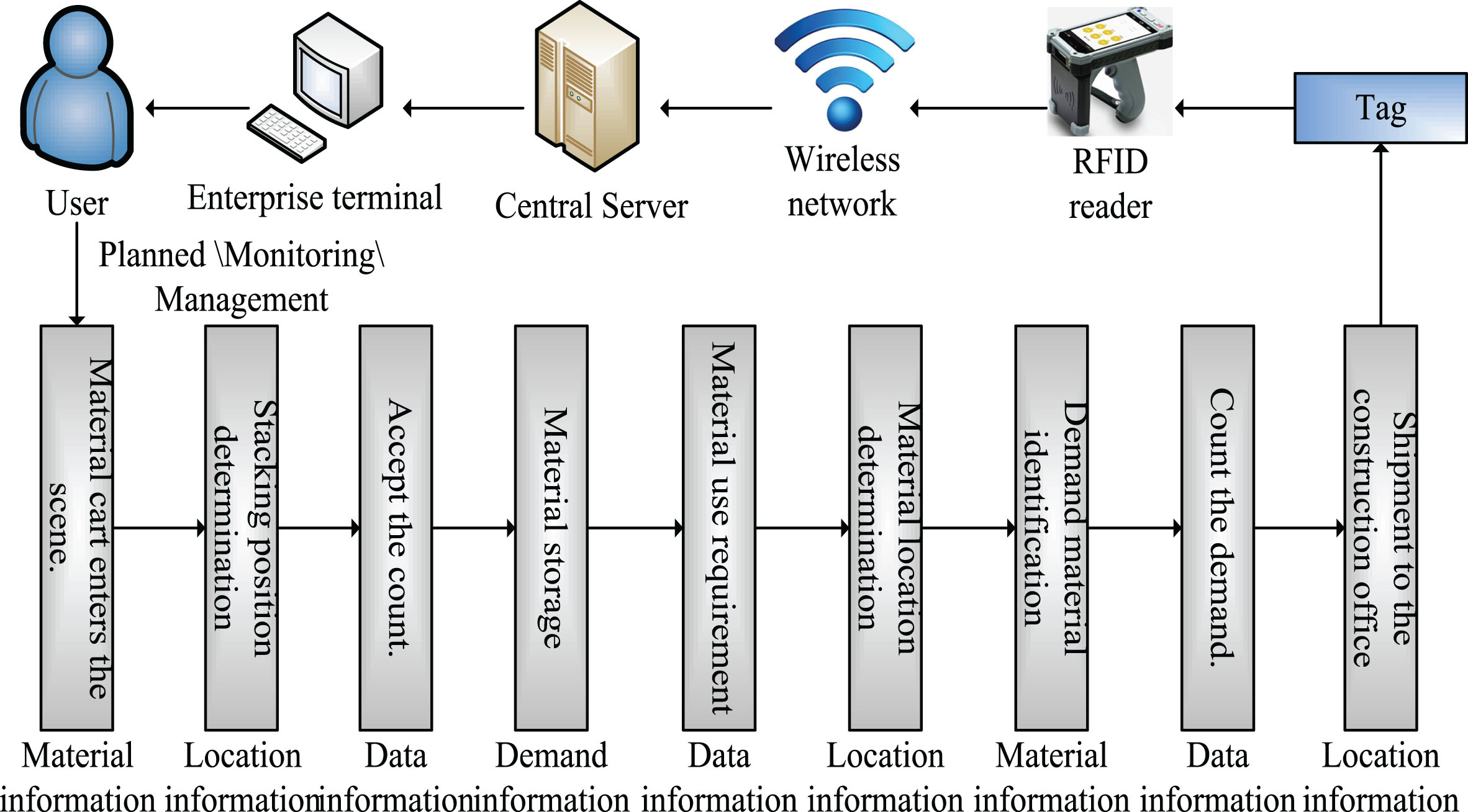
Information flow model for building materials monitoring and management.
Figure 1 shows that in the automatic management process of building materials, the relevant information must first be collected, including the information (varieties, categories, models) of the building materials, the geographical location information of the building materials stacked and constructed, the quantity of building materials, and the information on the specific quantity of building materials required during the construction process, etc. The data collection and pre-processing are realized through hardware devices such as receivers, GPS units and electronic tags, while the data transmission is achieved through a wireless network, for the wireless network can ensure the stability, accuracy and reliability of information transmission. The front-end collected data is transmitted to the central server, and then the system completes the decoding and reading of the building material information stored in the RFID electronic tag through the central server, and edits, modifies, and stores the decoded content. Finally, the processed data is returned to the enterprise’s building materials data information management system for management and reference by construction managers, so the construction managers can supervise and adjust construction plans in a timely manner based on relevant data on building materials in the project construction plan. As a result, a more complete closed-loop information flow management is formed. Also, related research has showed that the closed-loop system has greater advantages in monitoring and management than open-loop system.
(2) Overall architecture of building materials management
Based on demand analysis and relevant data collection, the information flow model for automated management of building materials was created, and the overall architecture system was designed. The system can be divided into five basic layers, namely hardware layer, service layer, user layer, data layer and application layer. Figure 2 shows the overall architecture of the system.
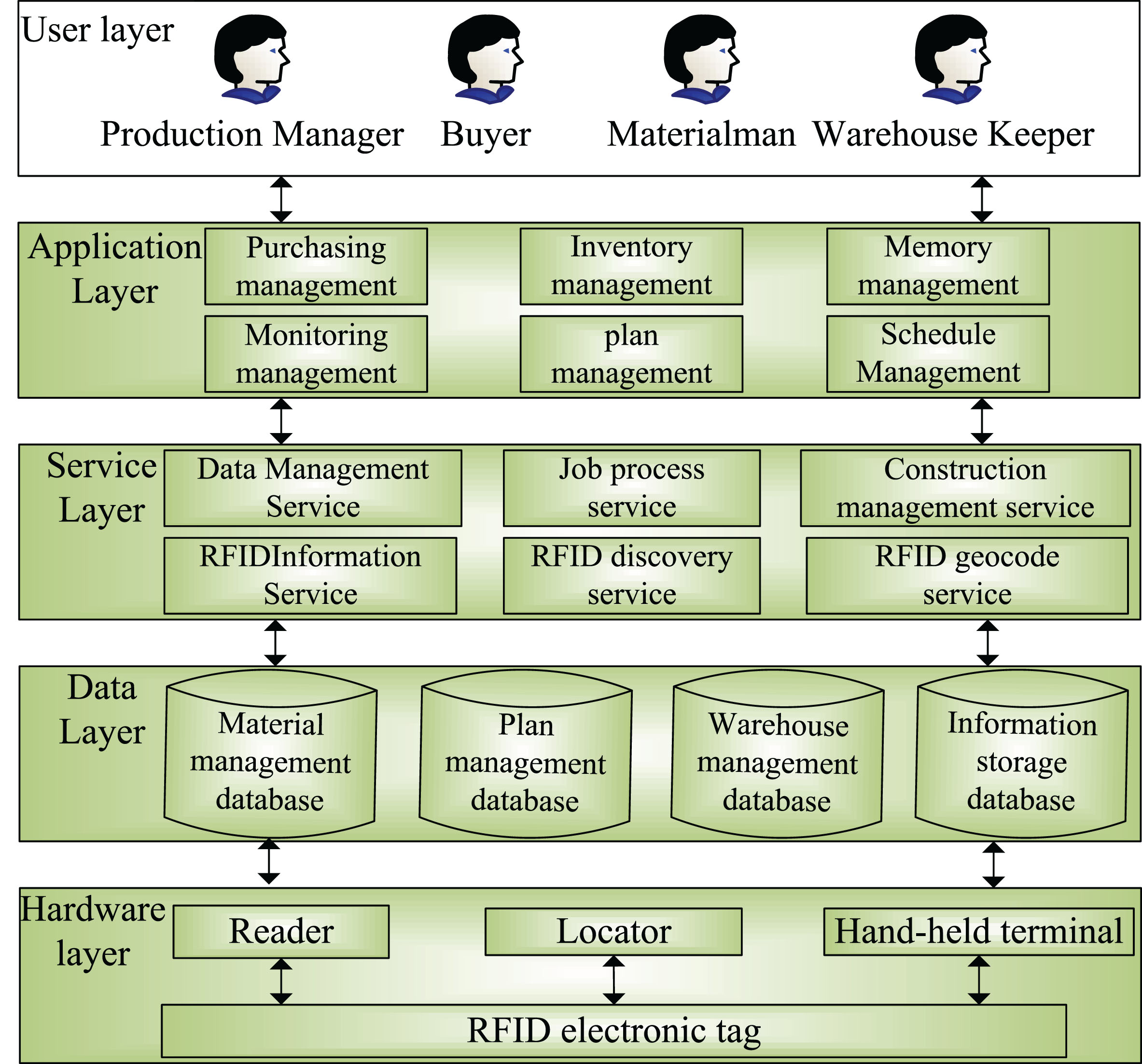
Overall architecture for building materials monitoring and management.
The hardware layer is mainly composed of physical devices such as RFID tags, handheld smart terminals, antennas, and RFID readers. The data layer mainly consists of information, building materials management, project planning, and warehouse information databases, where data can be added, modified, retrieved, and stored. The service layer mainly provides support for the operation of the application layer to ensure the reliable system operation. In the application layer, various application software is stored, which can perform different specific operations for building materials monitoring and management, besides, the managers can achieve different management goals through the software provided by the application layer, perform collaborative work, and improve the overall efficiency of building materials management.
(1) Scheme and deployment of building materials at receiving stage
The traditional receive process of building materials generally consists of seven steps: building materials vehicles enter the construction site; check the specific information of building materials; select the appropriate construction materials; make the unloading and stacking of building materials at the designated locations; count and inventory the quantity of building materials; confirm receives of building materials; conduct the manual entry of building materials information. Through RFID technology, the traditional building material receiving can be optimized into four steps: the construction materials vehicles enter the construction site; select the appropriate location for stacking the construction material; complete the unloading and stacking of building materials at designated locations; confirming the receives of building materials.
In the receive process of building materials, related hardware facilities need to be deployed on site. The hardware facilities include information system hardware devices and intelligent physical device, and then the intelligent physical device can be further subdivided into RFID tags, wireless routers, and RFID handheld devices. Terminals, etc., The deployment of wireless networks is achieved through wireless routers. Figure 3 depicts a schematic diagram of an optimized building material receiving process and field equipment deployment plan.
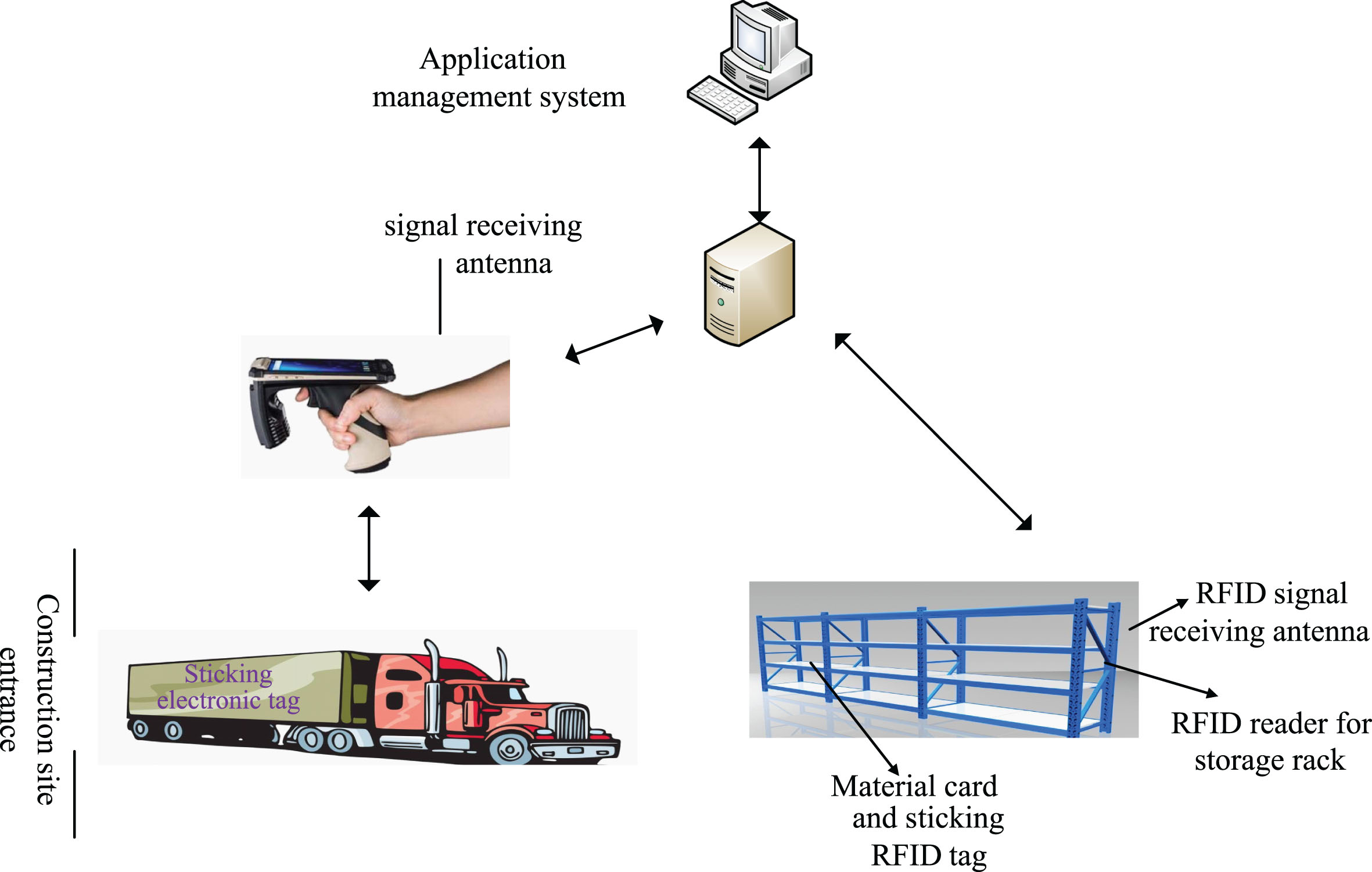
Realization and deployment of building materials on receive process.
After the building material vehicle enters the construction site, the worker first uses the RFID handheld device to scan the electronic tags in the building materials vehicle and obtains the building materials information. Then the read building material information is transmitted to the back-office system and compared with the relevant information provided by the procurement system (category of building materials and the quantity of building materials required); if the result is correct, the entry time information will be recorded, and the admission information and the material storage location information shown in the construction drawing be returned to the handheld terminal. Besides, the RFID reader/writer is installed near the building material rack and building material stacking position and can be used to complete the automatic counting of building materials quantity when unloading the building materials. Finally, after the building material is unloaded, the reader-writer sends the collected data to the back-office system for comparing with the data provided by the procurement system; if the comparison results are consistent, the system confirms the receipt of building materials and sends the confirmation results to the handheld terminal, otherwise, a warning message will be returned.
(2) Scheme and deployment of building material at storage stage
The RFID antenna receiver and RFID reader are mounted on the racks of building materials. In the storage process, when the electronic tag is physically separated from the communication range of the RFID antenna receiver, the antenna receiver automatically transmits the data to the background analysis system for analysis and then sends the result to the building materials management application located in the terminal so that the managers can use the management software to keep abreast of the residual building materials and further achieve the effective management of building materials.
In the design process of information system architecture, more attention should be paid to the early warning problem with the residual amount of building materials. Figure 4 shows the schematic diagram of the early warning for residual amount of the building material.
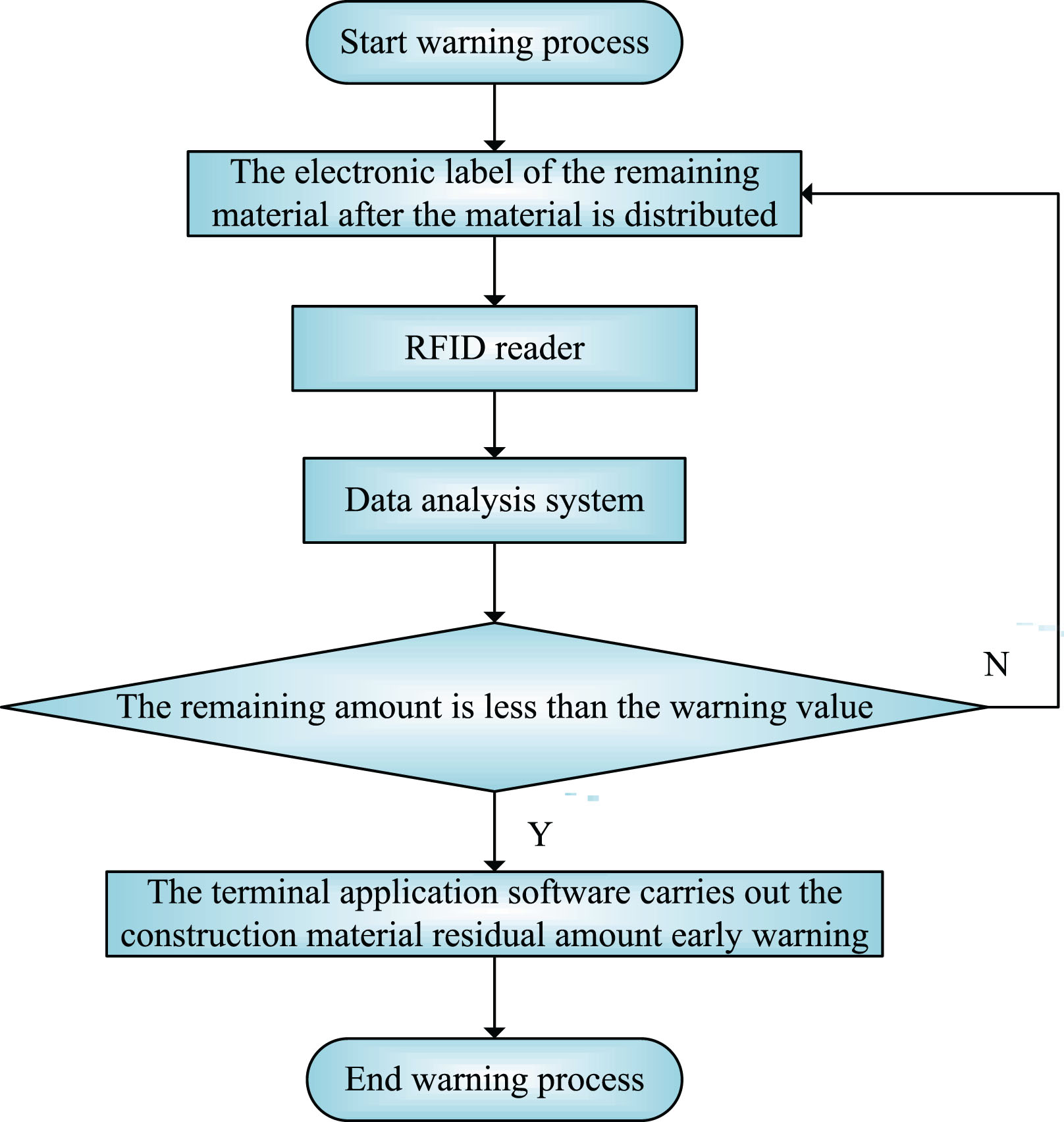
The early warning process for the residual amount of building materials.
After the inventory and distribution of each building material is completed, the RFID reader reads the electronic tags of the residual building materials and records the values; the residual building materials data are transmitted to the backstage analysis system through the wireless network, and the backstage analysis system compares it with the system’s built-in warning value. If the comparison results show that the current residual amount of building materials is lower than the pre-set warning value, the system sends a warning message to the terminal device and the terminal device issues an alarm. If it is greater than the pre-set value, the system makes initialization and re-start the cycle until the next distribution and inventory of building materials is finished. In this way, a complete logic loop is formed from the beginning of inspection to the early warning prompt.
(3) Scheme and deployment of building materials at usage stage
In the usage process of building materials, the related hardware facilities need to be deployed on site. Hardware facility includes information system hardware device and intelligent physical device, where the intelligent physical device can be subdivided into RFID tags, wireless routers, and RFID handheld terminals, etc., and the deployment of wireless networks is implemented through wireless routers. The electronic tags related to building material information are affixed to the building material card, including the following basic information: name, model, and weight of the building material etc. In addition, the electronic tags of some special building materials also contain the information indicators such as the compressive index, structure diagram, etc.
RFID equipment is installed on trolleys, cranes, and electric three-wheeled dump trucks. It can be used to complete inventory and loading of building materials at the same time. RFID on loading device and the RFID reader at the stacking location of building materials work together to inventory the loading building materials. The fixed RFID can also effectively identify building materials that have left from the stacking location. The loading terminal and the fixed terminal’s RFID simultaneously transmit the building material information to the backstage analysis system for processing. Then the back-end analysis system uses a logical algorithm to compare the loading quantity with the order quantity, and the comparison result is fed back to the user’s terminal. This terminal can be either a handheld smart terminal or a PC software terminal.
The first paragraph of the third chapter is modified as: In the last chapter, the design and implementation of RFID-based building material management scheme is completed. It is necessary to further study the users’ adoption degree of the scheme to verify the effectiveness of the scheme. Firstly, the hypothesis of the relationship between the influence factors and the users’ intention of use is put forward, the questionnaire is designed, the user information is collected, and the data is provided to support the model construction. The accuracy of the hypothesis is verified by the correlation algorithm, which lays a theoretical foundation for the popularization and application of the technical scheme.
Acceptance model construction of RFID-based building materials management system
In the design, the author mainly considered the impact of three external variables: external environment, corporate strategy and technology development. The three variables of user’s perceived usefulness, perceived ease of use (PEOU), and usage intension remain unchanged. All of these variables can have a great influence on the final usage decision of the clients.
Therefore, the author designed three dimensions variables in this scheme, including the antecedent variable, intermediate variable, and outcome variable. Enterprise strategy planning, external macro factors and RFID technology levels all belong to typical antecedent variables; the perceived usefulness and PEOC are the intermediate variables; only the user’s usage intention belongs to the outcome variable. Figure 6 shows a schematic diagram of the acceptance model for the RFID-based building materials management system.
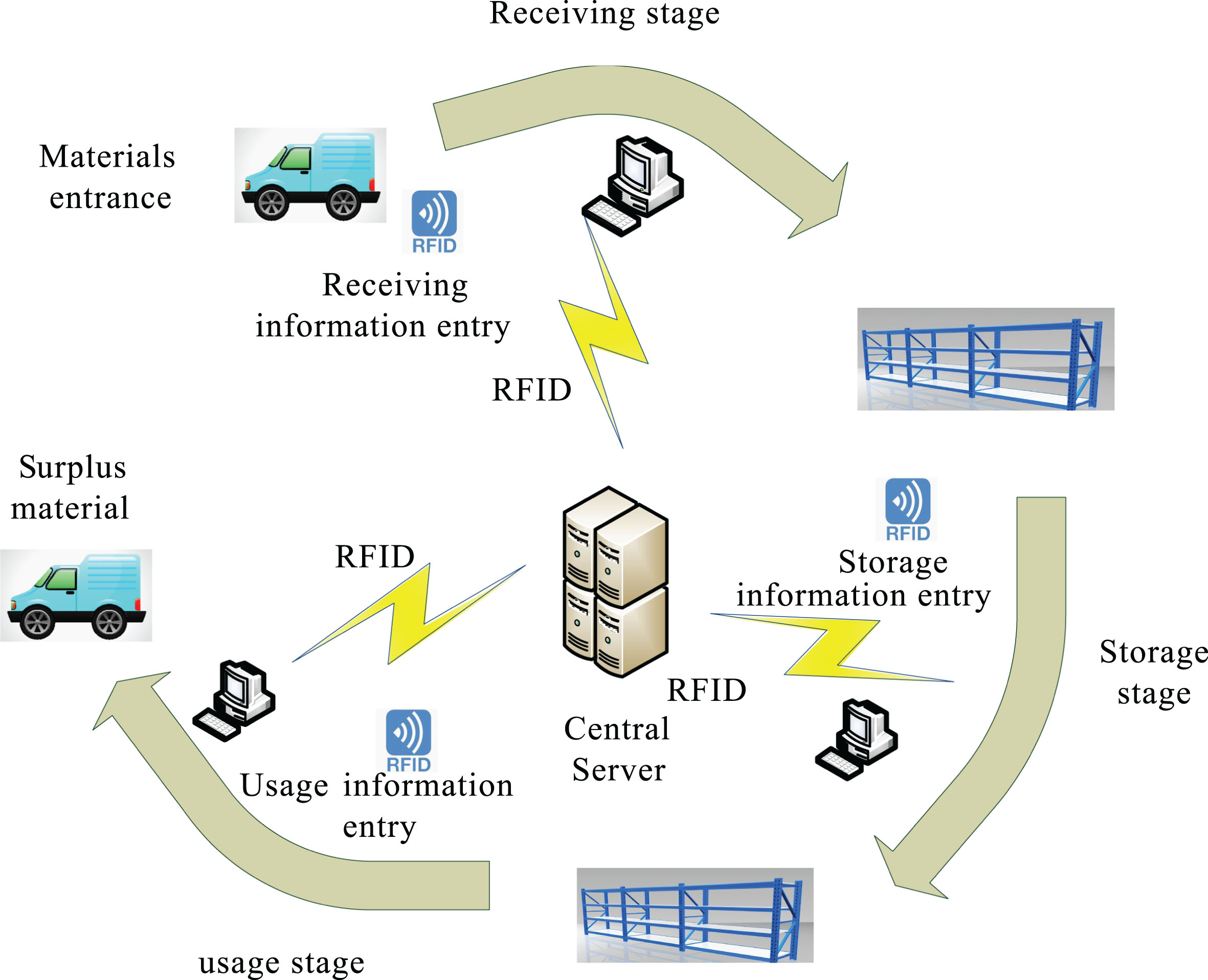
Comprehensive deployment of the building materials management system in the process of receiving, storage and usage.
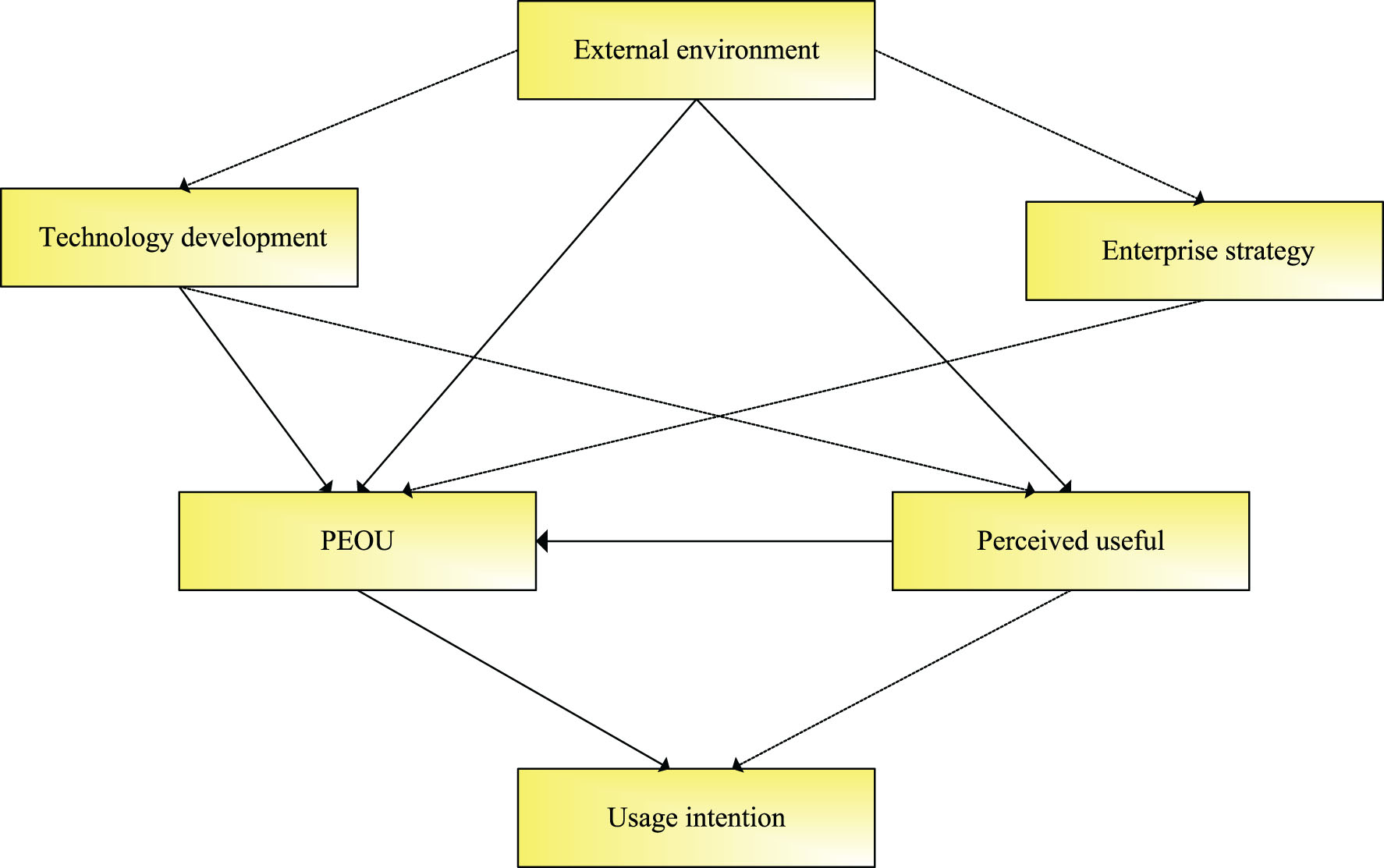
The adoption of building material management system based on RFID.
The questionnaire survey was made by distributing lots of questionnaires to the on-site construction materials management personnel in the construction industry. Through their answers, the basic data for the research was obtained so as to judge the different influencing factors on the implementation of RFID-based building materials management system, and further make the related amendments and adjustments for the technical scheme based on the judgment results.
Besides, the SPSS software and Amos software were applied to analyse the management of engineering building materials during the research process, where the path analysis is mainly realized through Amos software. Amos was developed by software engineer James L. Arbuckle as a simulation software that can effectively process the structural equation model by covariance structure analysis. The use of Amos can realize the visualization of the path. The establishment of the model does not require complicated program code. Only by dragging the mouse to mark the relationship between different variables, the user can obtain the desired model relationship. SPSS is a powerful data analysis software, used to analyse the credibility of the data collected from questionnaire survey, and test the fitting degree of the technical model by integrating with Amos software, thus confirming the path analysis and the feasibility of previous hypothesis.
Using the path analysis function of Amos software, the corrected path graph of the standardized coefficients in the technology acceptance model was obtained. Figure 7 depicts the path graph of the standardized coefficient.
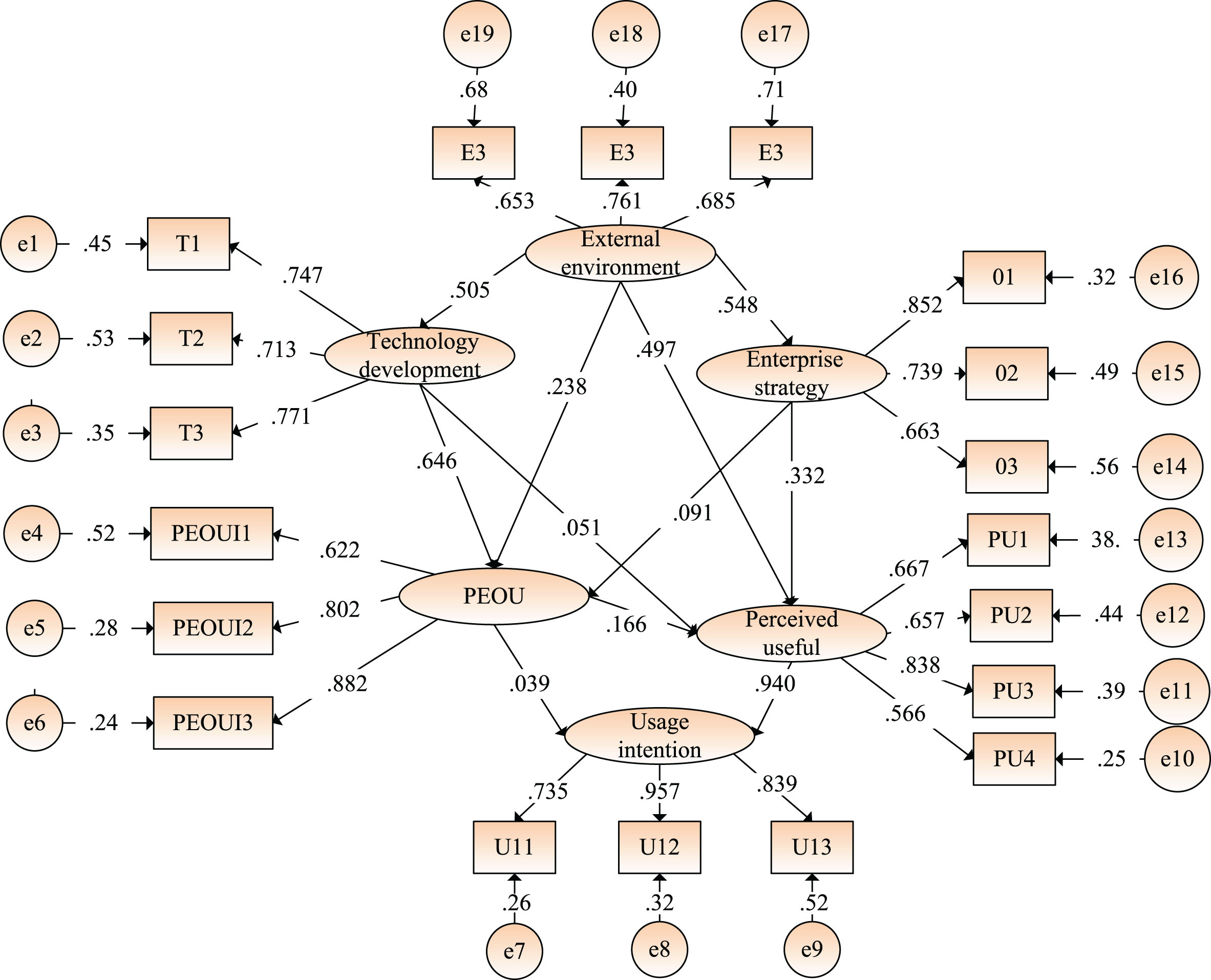
Path graph of model standardized coefficient.
Based on the analysis results of Amos software, various influencing factors in the previous hypothesis were analysed to determine their non-standardized regression coefficient and P value. The calculated data was shown in Tab. 1.
In Table 1, *** is P value <0.001, **P value <0.01, and *P value <0.05. Among the 11 hypotheses proposed above, there were four variable relationships with P greater than 0.05, which were 0.857, 0.326, 0.760, and 0.689 respectively, indicating insignificant impact between the related hypotheses, so these four hypotheses are not valid. Based on P-values shown in the table, it can be seen that when the user perceived useful, the user’s usage intension for the technical scheme is stronger; the effect of perceived ease of use on the user’s intention to use is not significant. In addition, the enterprise strategic direction, external environmental factors etc. will also have a certain impact on the user’s usage intention.
The regression coefficient among influence factors
Through the technology acceptance model, the previous hypotheses were verified and analysed; based on the analysis results, the following suggestions are made for the specific application of this technical scheme:
Enterprises should put more emphasis on information management and increase the proportion of information management in their daily management.
Continuous attention should be paid to the competitors and various related policies in the macro environment.
The cooperation with other companies should be strengthened in the management of building materials. During the use of RFID-based building materials management system, the economic cost should also be taken into consideration.
Conclusion
The RFID-based building materials management system was established; the overall design of the building materials management system was conducted, including the receiving, storage, and usage of building materials, simplifying the traditional management process of building materials.
The building materials management system based on RFID technology includes the process design, the deployment of technical facilities, and monitoring the status and quantity of building materials etc. It provides new ideas for improving the efficiency of building materials management and further ensuring construction progress.
The research on the technology acceptance model of the RFID-based building materials management system shows that the users’ usage intension is mainly influenced by the external environment and the enterprise strategic direction.