







Abstract
The objective of the work is to derive analytical solutions based on the Riemann–Hilbert (R–H) approach for semipermeable strip saturated two unequal collinear cracks in arbitrary polarized piezoelectric media. We particularly consider the influence of far field electromechanical loadings, poling direction and different crack-face boundary conditions. The problem is mathematically formulated into a set of non-homogeneous R–H problems in terms of complex potential functions (related to field components) using complex variable and extended Stroh formalism approach. After solving these equations, explicit solutions are obtained for the involved unknown complex potential functions and hence, the stress and electric displacement components at any point within the domain. Furthermore, after employing standard limiting conditions, explicit expressions for some conventional fracture parameters such as saturated zone lengths (in terms of nonlinear equations), local stress intensity factors and crack opening displacement are obtained. Numerical studies are presented for the PZT-4H material to analyze the effects of prescribed electromechanical loadings, inter-cracks distance, crack-face conditions and poling direction on the defined fracture parameters.
Keywords
Introduction
Since the invention of piezoelectric and inverse piezoelectric effect in 1880 by the Curie brothers, extensive studies have been performed in fracture mechanics of these materials. Parton [19] initiated crack at the interface of a piezoelectric material subjected to a far-field uniform tension. Deeg [8] implemented the Green’s function and dislocation method to study a more general defect mechanics of piezoelectric material. Sosa and Pak [25] performed three dimensional eigenfunction analysis for a semi-infinite crack embedded on a piezoelectric material using William’s eigen function approach. Pak [16] studied mode-III case of piezoelectric fracture problem under out-of-plane deformation and in-plane electrical loads. Sosa [24] applied complex potential and Leikhnitskii’s approach to study fracture mechanics analysis of center crack in an infinite two-dimensional piezoelectric medium under different cases of applied loadings. Suo et al. [26] analyzed the crack present either in piezoelectrics or at the interfaces between piezoelectrics and other materials such as metal electrodes or polymer matrices using extended Stroh formalism. Tobin and Pak [28] performed the Vicker’s indentation tests in poled piezoelectric material with a high electric field. It was found that its apparent fracture toughness may be decreased or increased, depending on the direction of the applied electric field. Hao and Shen [13] analytically proposed a new electric boundary condition in which electric permeability of air in a crack gap was considered. Park and Sun [18] obtained the closed form solution for all three modes of fracture for an infinite piezoelectric medium containing a center crack subjected to a combined mechanical and electrical loading using Fourier integral transforms. Wang and Singh [30] applied the Vickers indentation technique to study crack propagation in a PZT material under simultaneous mechanical loading and applied electric fields. It was demonstrated experimentally that electric fields can inhibit or enhance crack propagation in piezoelectric materials. Wang and Mai [29] studied a cracked piezoelectric material strip using Fourier integral transform subjected to uniform tensions and uniform electrical loads simultaneously, at the far ends.
To study the fracture mechanics problems, Dugdale [9] proposed a simplified elasto-plastic yielding model and obtained a relation between the extent of plastic yielding and external applied load. The elastic-plastic crack mechanics and non-linear crack mechanics problems studied by Japanese researchers and engineers can be found in Yokobori [31]. Based on Dugdale’s model [9], Gao et al. [12] proposed a strip saturation model for a finite crack perpendicular or parallel to poling axis of an infinite poled piezoelectric ceramics. In this model an electrical polarization was reaching a saturation limit along a line segment in front of the crack. The concepts of local energy release rate and global energy release rate had been defined and discussed. The local energy release rate gave predictions which seemed to be in broad agreement with experimental observations. Further, it was observed to be independent of strength and size of the electrical yielding. Ru [20] presented the generalized solution in terms of normal electrical displacement distribution along the saturated strip and studied the effects of polarization saturation condition on near tip field and stress intensity factors. More details of the polarization saturation (PS) model and dielectric break down (DB) model in piezoelectric ceramics could be found in Zhang and Gao [34] and Fan et al. [10]. Later on Fan et al. [11] extended this model to semipermeable crack-face boundary conditions. Further, Singh et al. [23] modified this model in piezoelectric media by considering the polynomial varying saturation condition subjected to semipermeable crack-face conditions and arbitrary poling direction.
Considering the importance of fracture mechanics study of multiple cracks and multiple collinear cracks problems [4,6,7,14,27,32,33] in designs and structures, Bhargava and Jangid [1–3,5] extended the PS model to multiple collinear cracks problems in piezoelectric media. Bhargava and Jangid [1] proposed a 2-D strip-electro-mechanical yielding model for a transversely isotropic piezoelectric media considering two equal collinear straight cracks. Based on Stroh formalism and complex variable technique, they obtained the explicit solutions for the fracture parameters subject to the cases; saturation zone is bigger than developed yield zone and vice versa. Bhargava and Jangid [2,3] presented the mathematical solutions for two equal collinear cracks problems in piezoelectric media considering polarization saturation model and for a particular case when developed saturation zones at the interior tips of the cracks get coalesced. Bhargava and Jangid [5] also extended their study to strip-coalesced interior zone model for two unequal collinear cracks weakening piezoelectric media. For the study both the cracks were considered on the right half of the plane.
Recently Singh et al. [21,22] extended the study of the PS model to modified PS models in piezoelectric media and presented the studies for two equal collinear cracks and two equal collinear cracks with coalesced zones problems using complex variable and non-homogeneous Riemann–Hilbert (R–H) approach.
Above all, one of the important collinear cracks problems in piezoelectric media that is (i.e.) the mathematical solution for strip saturated two unequal collinear cracks in piezoelectric media is still not attempted by any researcher. This might be due to difficulty in finding the solution of non-homogeneous R–H equations and the singular integrals formed from these equations. Hence, to fill this gap, authors presented the mathematical solution for this problem subjected to arbitrary poling direction and semipermeable crack-face conditions using complex variable and R–H approach. To obtain the solution for developed simultaneous non-homogeneous R–H equations, the approach as followed by Theocaris [27] is employed. Explicit forms of expressions have been obtained for saturated zone lengths (in the form of two non-linear equations), local stress intensity factors (LSIFs) and crack opening displacement (COD). In the last section, numerical studies are presented with respect to the variation in electrical loadings, crack-face conditions (in particular comparison between impermeable and semipermeable boundary conditions), polarization angle and inter-cracks distance.
Fundamental equations and crack-face boundary conditions
The fundamental equations such as constitutive, gradient and equilibrium equations in linear piezoelectric media are briefly presented [2,3,10,17,18,21,23,26,28,35].
(i) For stress in absence of body forces:
In piezoelectric media, there are primarily three crack-face boundary conditions which are defined on the basis of electric displacement at the crack surfaces. These are known as impermeable, semipermeable and permeable crack-face conditions. Similar to stress free crack-face conditions in elasto-plastic materials, the impermeable crack-face conditions are defined in piezoelectric media. Mathematically, these conditions are expressed as:
Most of the available literature on fracture in piezoelectric media are based on impermeable crack-face boundary conditions.
Further, considering the permittivity of air as a medium inside the crack-surfaces, Hao and Shen [13] proposed the semipermeable crack-face conditions which are defined as follows:
This assumption was made based on the fact that the electric displacement developed at the surfaces of the crack (because of considering air as a medium) significantly affects the near tip solution due to the presence of stress and electric displacement singularity at the crack-tip. Because air is considered as a medium inside the crack-surface, these conditions are also known as the realistic crack-face boundary conditions. Hence, the most recent research works in fracture in piezoelectric media are based on semipermeable crack-face conditions.
Moreover, assuming the value of permittivity constant very large than air, the semipermeable crack-face conditions reduced into permeable crack-face conditions implying that the medium inside the crack surfaces permits all the electric lines of forces to pass through the crack surfaces which is not true and so cannot be considered as realistic crack-face boundary conditions.
Hence, in this paper authors mainly considered impermeable and semipermeable crack-face conditions for their studies.
An infinite transversely isotropic piezoelectric domain under plane strain conditions and having arbitrary polarization direction is considered. It is taken along the XoY plane with poling direction makes an angle 𝛼 with respect to (w.r.t.) positive y-axis. The domain has two unequal collinear cracks placed symmetrically about the origin and occupies the intervals [−d1, −c1] and [a1, b1] along x-axis. The study is under the influence of applied remote uniform tensile
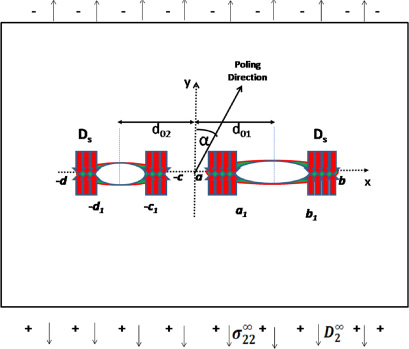
Schematic representation of the problem.
The physical boundary conditions of the problem can be mathematically written as: 𝜎22 = 0, D2 = 0 on |y|→∞.
Following Stroh formalism in 2-D piezoelectric media, the generalized displacement vector u is defined as:
Further, M = (m1, m2, m3, m4) is related to P = (p1, p2, p3, p4) as
Using the boundary condition (i) in Eq. (12), we have
Now considering,
The solution of Eq. (25) together with single valuedness condition of the mechanical displacement components is
Now, Eq. (24) can be rewritten as:
The explicit expressions are derived in this section for saturation zone length, LSIFs and COD.
Saturation zone length
The field components along y-axis are determined using Eqs (12), (14) and (24) as
Therefore, by enforcing the finiteness condition at the extended crack tips x = −d, −c, a and b, the following nonlinear equations can be obtained as:
The field components at any point (−∞ < x < −d1, − c1 < x < a1 & b1 < x < ∞) on x-axis of the domain are given by:
Hence, LSIFs, K
I
(−d1), K
I
(−c1), K
I
(a1) and K
I
(b1) are determined at the actual crack-tips x = −d1, −c1, a1 and x = b1 as
For both the cracks, the relative COD at any point of the crack face i.e. Δu2 is obtained after substituting the value of Ω
k
(x) from Eq. (26) to Eq. (20) and then integrating. It is defined as:
This section presents the numerical studies for two unequal collinear cracks based on the explicit expressions of fracture parameters obtained in Section 5. A problem of two unequal collinear cracks of length equals to c01 and c02 where c01 = |b1 − a1| =3 m, c02 = |d1 − c1| =2 m are considered in an infinite PZT-4 domain. The domain is studied under the far-field electro-mechanical loadings equal to
The material constants of piezoelectric PZT-4H used for the analysis
The material constants of piezoelectric PZT-4H used for the analysis
Before presenting the numerical studies, the R–H approach-based solutions derived in Sections 4 and 5 are validated here by considering a particular case of the problem i.e. considering two collinear cracks of equal lengths. Results of normalized saturation zone lengths (outer and inner) are obtained under this particular case and compared with the results of Singh et al. [21]. Excellent agreement has been observed between these results for both impermeable and semipermeable crack-face conditions and shown in Fig. 2.
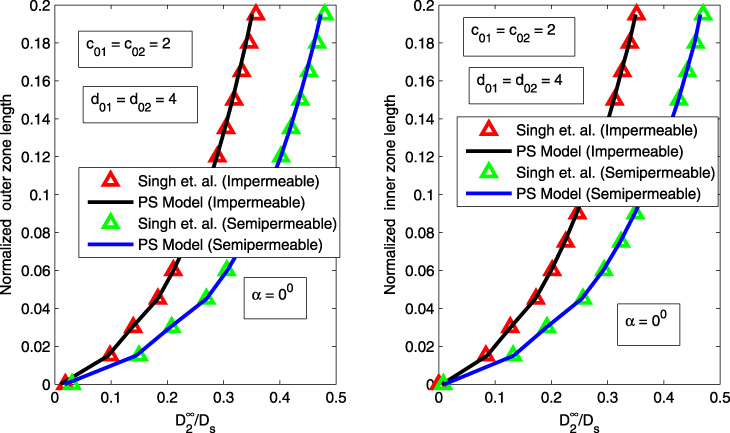
Validation of complex variable solutions for two unequal collinear cracks based on the PS model with the results of Singh et al. [21].
Variations in normalized zone lengths (for both the cracks) w.r.t increase in electrical loadings are shown in Fig. 3. These graphs are plotted for both impermeable and semipermeable cracks under polarization angle equals to zero. Here, the normalized zone lengths are calculated by dividing the zone lengths (outer or inner) by c02. The following effects have been observed on the normalized saturated zone lengths under the influence of electrical loadings and rack-face conditions:
All the normalized saturation zone lengths increase with increase in electrical loadings. For both the cracks, inner zone lengths have higher values than outer zone lengths and this effect increases with increase in electrical loadings. Normalized saturated zone lengths (whether inner or outer) obtained for a bigger crack has higher values than a smaller crack lying collinearly in its domain. The above said behaviors (i) to (iii) can be found under both the impermeable and semipermeable crack face conditions. However, the values of normalized saturated zone lengths (for both the cracks) obtained under semipermeable conditions are less than impermeable crack-face conditions.
Further, the variations of electrical loading have also been observed on the LSIFs at inner and outer tips of both the cracks and plotted in Fig. 4. Results of normalized LSIFs
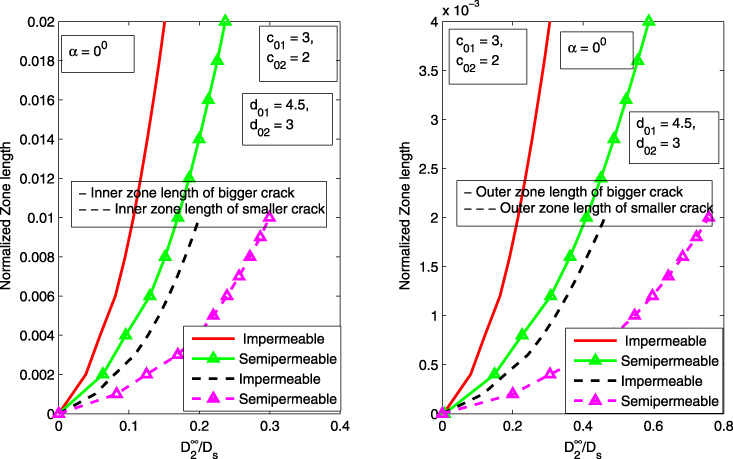
Variations of normalized saturated zone lengths (inner and outer) versus
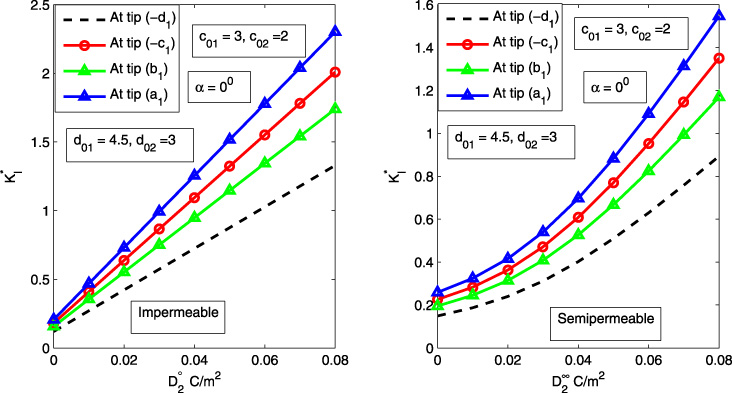
Variations in
In case of saturated zone lengths, the effects of poling direction have been observed only under semipermeable crack-face conditions so the variations in normalized saturated lengths (inner and outer) have been plotted w.r.t increase in polarization angle in Fig. 5. It has been observed that for all the cases (inner/outer and bigger/smaller crack) saturated zone lengths decrease with increasing polarization angle from 0 to 90° and for higher polarization angle no significant effect of electrical loading has been observed on saturation zone length. This might be due to the reason that in that case poling direction is approaching along the crack-axis. The effects of crack lengths on inner and outer saturation zone lengths can also be observed from Fig. 5 as inner and outer normalized saturated zone lengths obtained for larger crack have higher values than smaller crack and also inner zone lengths have significantly higher values than outer zone lengths. Similar behaviors have also been observed in the LSIFs w.r.t. increase in polarization angle for both the crack face conditions and shown in Fig. 6.
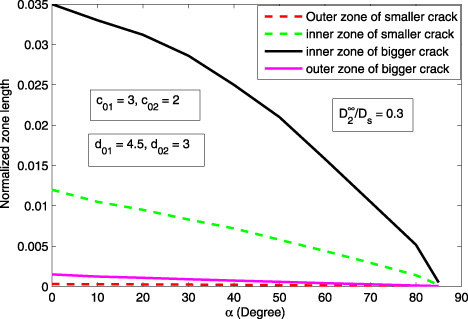
Variations in normalized saturated zone lengths (inner and outer) with increasing polarization angle for both unequal collinear cracks and subjected to semipermeable crack-face conditions.
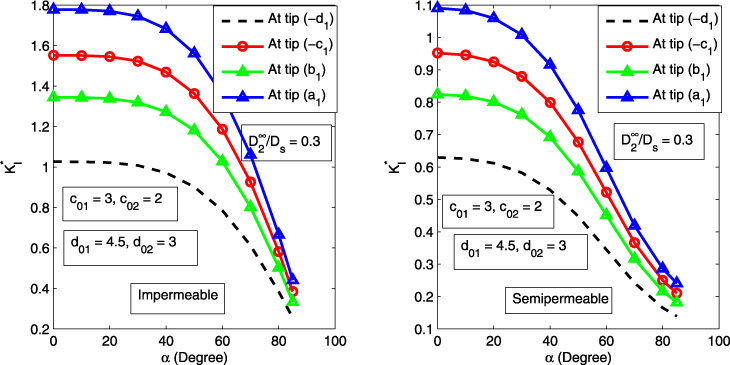
Variations in
Figures 7 and 8 show another important analysis of two collinear cracks problem i.e. the impact of inter-cracks distance on the saturated zone lengths and LSIFs respectively. From these figures, it has been observed that both these fracture parameters decrease with increase in normalized inter-cracks distance
Moreover, to observe the effects of interaction of cracks on LSIF, the ratios of LSIFs at inner tip of the second crack
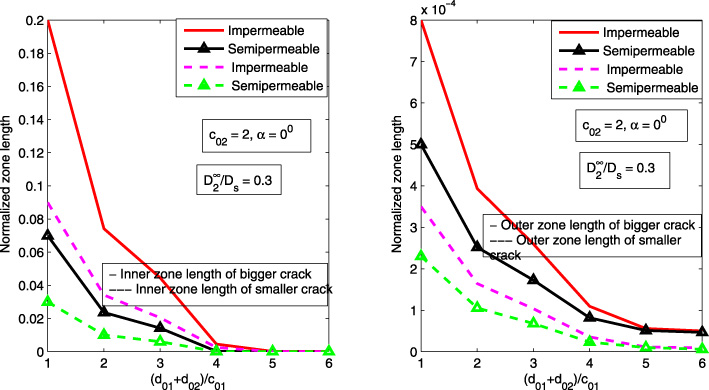
Variations in normalized saturated zone lengths(inner and outer) versus normalized inter-cracks distance
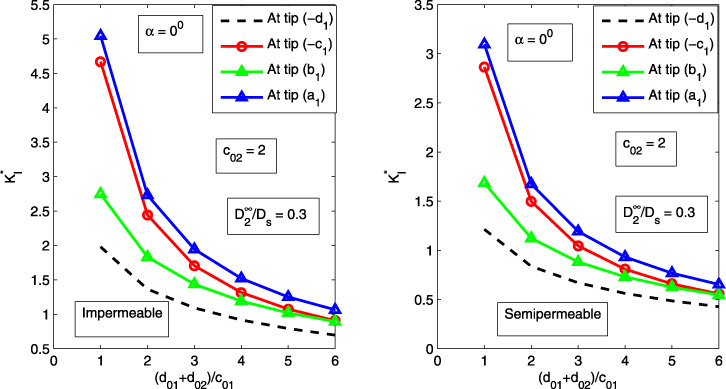
Variations in
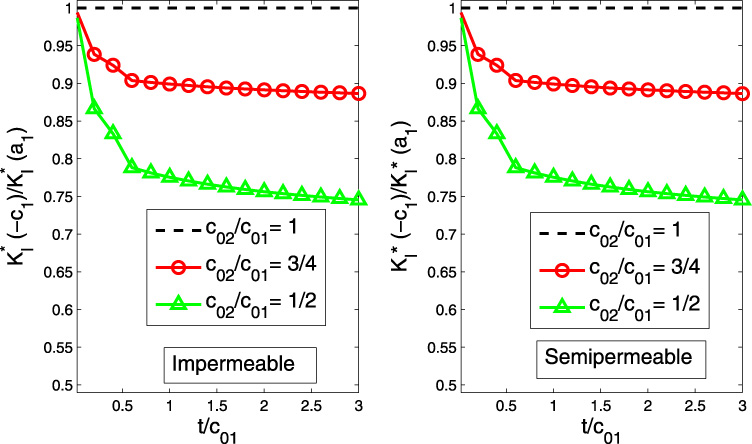
Variations in normalized LSIF
In this paper, we presented the mathematical solutions in terms of complex variable solutions and the numerical studies for two unequal collinear cracks based on the polarization saturation model in piezoelectric materials. Some major conclusions drawn from this investigation can be summarized as follows:
The solutions of non-homogeneous R–H problems and the singular integrals formed from these problems have been addressed. Explicit expressions for some standard fracture parameters such as saturated zone lengths (in terms of non-linear equations), COD and LSIFs are obtained for two unequal collinear cracks problem under arbitrary polarization and semipermeable crack-face conditions. The saturated zone lengths and LSIFs increase with increase in applied electric displacement loading. The saturated zone lengths and LSIFs decrease significantly with increasing polarization angle. Effects of crack length, inter-cracks distance and crack-face conditions have been observed significantly on saturated zone lengths and LSIFs.
Footnotes
Appendix
The expressions defined in Eq. (29) are as follows: