






Abstract
The northwest African country of Mauritania is a vast, desert territory, which was historically been dominated by pastoral nomads. Since independence in 1960, the country has witnessed a dramatic sedentarization of its nomadic population, as well as settlements in and movements to urban centers. This vast sedentarization movement coupled with internal and interregional migration has resulted in the growth of Mauritania’s urban population from less than 10 percent of the total population in 1965 to nearly 90 percent in 2013. Factors that have caused this rapid urbanization, include the droughts that spanned the late 1960s through to the early 1980s, and the turbulent transformation of Mauritania’s political economy. The aim of this study is to determine and examine internal migration flows to analyze the relationship between long-term rainfall changes and dynamic spatial demographic shifts in terms of movements toward urban centers. In this regard, we propose an assessment approach that integrates official statistics from the decennial census and rainfall data, with available socioeconomic variables, to characterize interregional migration flows. Our result confirms that rates of interregional migration remain elevated and are expected to increase. In 2013, 702,575 individuals were documented as having participated in interregional migration, comprising 17.5 percent of the total population. In comparison, there were 477,814 individuals, which migrated inter-regionally in 2000, and 208,039 in 1988. These results demonstrate distinct interactions between climate variability and interregional migration in Mauritania throughout the past four decades.
Introduction
The climate is a dominant regulator of natural ecosystems, given its influence on the growth, abundance, survival, and distribution of species. Globally, ecological impacts of climate change have been evidenced by changes in species abundance and/or extinction, community species composition, fragmentation of habitat, as well as shifts in the structure and function of habitat [29]. Recently, there has been an increase in the global and local focus on climate change. This is due in part to climate changes effect in augmenting the intensity and frequency of natural, slow and sudden onset disasters and their socio-political, economic and ecological impacts on the movement and migration of human populations [36].
Therefore, it has become critical that a deeper understanding of the complex factors that cause human migration, and its associated patterns, is developed in order to most effectively respond to climate change and the increasing environmental degradation. The potential impacts of climate change and increased climate variability on human migration are expected to increase, particularly in the world’s poorest countries. These impacts will most often be the result of an increased frequency and severity of extreme environmental events such as cyclones, hurricanes, tsunamis, drought, floods, and sea level rise, which all greatly increase the prevalence of migration [46].
Since the 1970s, many African countries have experienced multiple climate shocks and conflicts, which have led to the destruction of physical capital, as well as displacement of human capital [47]. In the 19th century, the climate of the Sahel region in western Africa was dominated by acute dry periods, which often spanned multiple decades. This dry period was succeeded by [14] a humid period from the 1930s to the 1960s. The most severe known droughts in the entire Sahel during the 20

Annual Standardized Precipitation Index (SPI) pattern at Seilibaby station in the Guidimagha region in the south from 1933 to 2013.
As depicted in Fig. 1, rainfall during the defined periods was consistently below the 20
These drought impacts destabilized rural livelihoods by accelerating land degradation, loss of livestock, urbanization, and, in many communities, prompted land resource and water access conflicts between farmers and herders [11, 35] . In the past 20 years, rainfall for the entire Sahel region has recovered to the approximate century-long mean [22]. However, numerous sub-regions within the Sahel continue to experience significant droughts.
Notably, the drought cycle is part of the natural climatic variability in the Sahel Region [48]. It has frequently been associated with the internal and international movements of Mauritania’s population for centuries. However, regardless of the isolated nature of these severe drought periods, all recorded observations have linked climatic fluctuations and environmental changes with unprecedented interregional migration. The extreme aridness that Mauritania experienced at the end of the sixties is considered a distinct phenomenon for the country’s rural population. This drought was previously unprecedented due to its duration and related impact on agriculture production, water resources, and vegetation productivity.
Formerly a nomadic country, Mauritania’s independence in 1960 witnessed the rapid sedentarization across the entire nomadic population. Specifically, the nomad population decreased from 75% of the total population in 1965 to 12% in 1988, 6% in 2000, and just 1.9% in 2013 [44]. This abrupt and unprecedented sedentarization can be linked to several factors, including the devastating droughts in the 1970s and 1980s, as well as the turbulent transformation of Mauritania’s political economy. The abandonment of nomadism and the adoption of sedentary livelihoods have led to profound changes not only in communal structures and institutions, but also in modes of production and consumption [44]. The droughts are the prominent underlying cause of this mass sedentarization as they caused the rapid deterioration of the rural economy, which resulted in the development of nomadic settlements and mass rural-urban migration. As these trends continue, the nomadic population will soon become statistically insignificant in the overall Mauritanian population. Consequently, the urban population of Mauritania has grown from less than 10% of the population in 1965 to nearly 90% of the total population in 2013 [44].
Migration has been identified as a key demographic response to environmental changes. The economic theory of labor migration supports the notion that rural households employ migration as strategy to mitigate risks to income [6] resulting from unforeseen climatic events. Furthermore, migration provides a strategy to free oneself from unfreedoms of economic, political and social development, and to augment and diversify the actual freedoms a person can possess [27]. In addition, climate variability related migration occurs more frequently within a country’s internal borders, because of associated migration costs of crossing international boundaries, including legal barriers [9, 32]. There have been a number of studies conducted that investigate the links between rainfall variation and internal migration, specifically, the direct effect of droughts on migration [40]. However, the findings on the impact of climate variability on internal migration are mixed [10].
A strand of the literature reports climate variability to bear significant influence on internal migration as households may adopt mitigation strategies against risks from future climate events or trends. Historical, qualitative, and anecdotal accounts indicate that migration and population mobility have been a common response to drought, as falling agricultural and animal production forces households and individuals to seek new opportunities elsewhere [25, 34]. There is considerable evidence to support the aforementioned finding. For example, rainfall variability and land degradation, at both the origin and destination, increased inter-provincial migration in Burkina Faso [23]. In Tanzania, rainfall reduction intensified internal migration [3] and in sub-Saharan Africa, rainfall and temperature anomalies saw internal and international migration rates sofar [33]. In addition, Canada experienced periods of extended droughts, reducing the quality of farming soil and causing increased internal migration rates [38].
In contrast, an alternative migration theory does not find a clear correlation between climate variability and both internal and external migration. Indeed, significant obstacles can prevent households to opt for migration as a livelihood strategy [12, 13]. Multiple studies have highlighted how groups and individuals do not migrate despite times of environmental or livelihood stress due to a lack of educational opportunities in potential receiving areas [20], strong attachments to land [3], age, number of dependents in the household [41], poor levels of market integration between sending and receiving areas [20], legislative impediments [7], physical barriers to movement or a lack of capital [21].
There are multiple literature findings that do not support the notion that climate variability is a significant driver of migration. For instance, a robust effect of rainfall was not noticed on migration patterns in a Pakistani village [42]. Correspondingly, rainfall was identified as the least important predictor of internal migration in rural Ecuador [19]. In Ghana, rainfall was not a major cause of migration for individuals in agricultural communities despite a majority perception that rainfall was the most pressing stressor, given the communities dependence on agriculture [2]. Furthermore, in India, Dallmann and Millock [15] did not find a statistically significant effect of the magnitude and duration of drought episodes or periods of excess precipitation to be a push factor on inter-state migration.
Hence, there is a lack of conclusive literature about the impact of climate variability on migration. Despite this gap in the literature, it is suspected that there is a correlation between climate variability and migration flows in Mauritania. Mauritania is comprised of a large farming and livestock-breeding population and the climate’s impact on farming and livestock production cannot be overlooked as a motivating factor for migration. Therefore, it is suspected that populations frequently migrate to evade the socio-economic and environmental risks caused by climate variability. Given agriculture’s significance in Mauritania’s culture and economy, this study hypothesizes that climate influenced previous migration flows, and may cause future migration. This paper contributes to the limited existing literature by analyzing the effects of climatic variation and drought intensity on migration in Mauritania.
The aim of this 40-year study is to dissect the complex relationship between demography, key economic, socio-cultural, and political factors, and drought frequency, climatic change, and climate variability. We analyze Mauritania’s interregional migration trends, with a particular focus on the regional migration balance, regional efficiency, out-migration, and retention indices throughout these four decades. Furthermore, we examine the pattern and magnitude of migration flows across the Mauritania’s 13 regions and compare the migrant flows entering each region over specific periods. In the next section, we describe the data used for the study, followed by a presentation of the methods and analytical approach in Section 3. The results are presented in Section 4, followed by conclusions in the final section.
Data
Data was used from four of Mauritania’s most recent population and housing censuses conducted in 1977, 1988, 2000, and 2013 by the National Statistical Office. These four censuses are the largest statistical operation in the country and include data on every individual residing in Mauritania. The comparative study of these four censuses permits the estimation of the migrant population and the characterization of internal migration flows during the last four decades. They further provide comprehensive information on the socio-economic and environmental sectors of the country. More information on the different population and housing censuses used in this study can be found at the National Statistical Office website. (
Key socioeconomic variables were selected from the four censuses based on their appropriateness for the study, capacity to explain the underlying factors causing the interregional migration, and their presence in each of the four censuses. The below variables were observed for the entire period of the study.
This study hypothesized a strong relationship between migration and unemployment rates, as areas with low unemployment rates tend to attract more migrants than areas with high unemployment. Subnational unemployment rates were available in the four censuses and a significant correlation was detected between unemployment rates and an individual’s probability to migrate [45]. Within the context of this study, it is assumed that unemployment reflects economic conditions and is therefore used as a proxy for other missing economic variables.
Education is an established indicator of wellbeing and socioeconomic development. Therefore, this study used it as a proxy for other social services indicators. Mauritania’s national education enrollment index has been steadily increasing. However, some regions, those of historical, political, economic, or geographical importance, have experienced considerable infrastructure improvements when compared to other regions of less strategic importance. These improvements have had clear impacts on access to quality basic services, especially within the education domain. The regions of less strategic importance, such as Guidimagha in the south, continue to suffer from low enrollment levels. Almost three out of every ten children in this region do not attend school [44].
High population density has both positive and negative correlations with population migration. Frequently, population density is dependent upon the magnitude of a demand-driven system of migration versus supply-driven natural growth [31]. Negative impacts of migration include increased pressure on scarce resources, such as water resources and agricultural land. Comparatively, high population density is often associated with higher productivity levels in economic activities, through agglomeration economies [17]. Based on the analyzed censuses, there have been significant density changes in three major regions, Nouakchott, Guidimagha, and Gorgol. These observed changes can be attributed to nationally instituted population growth and national administrative reforms. Specifically, population density in the Nouakchott region doubled during the 1990s and then grew by more than 500% during the first decade of the 2000s. Guidimagha, in the south, experienced growth rates of 5 and 9% in the 1990s and 2000s, and the Gorgol region had population density growth rates of 4 and 7%, respectively [44].
The characterization of changes in inter-annual variability of rainfall over the past 40 years was completed by using two high-resolution gridded rainfall datasets. The first dataset covers the period of January 1960–December 1980 with a pixel size of 0.5-gridded degree These monthly gridded time series were acquired from the Système d’Informations Environnementales sur les Ressources en Eau et leur Modélisation (SIEREM) group website (
Methodology
This study utilized an assessment approach to integrate demographic, socioeconomic, and rainfall time series data from 1960 to 2013 the characterize internal migration in Mauritania. The key outcomes of this approach were to assess the size and direction of internal population movements. This framework consists of three steps with the first step utilizing population and housing census data to characterize migration dynamics. The second step determined the directional change in the inter-annual rainfall and rainfall variability across the regions using three climate variables: (1) inter-annual directional changes of rainfall, (2) standardized precipitation index (SPI), and (3) inter-annual rainfall variation. The third step explored the temporal interaction between population dynamics and the main socioeconomic, demographic, socio-cultural, political and climatic factors at the same regional levels.
Migration dynamics
Focusing on the principal aim of the study, to determine and examine internal migration flows, key indicators on internal migration were extracted for Mauritania’s 13 regions from the four census reports. The key indicators included total migration, net migration, the index of effectiveness, the out-migration rate and the retention index. Combined, these indicators enabled the study of the temporal dynamics of migration flows, as well as the regional mobility degree:
Regional total migration is the sum of the number of people who move into an administrative unit (immigrants) and the number of people who move out (emigrants) of the same administrative unit (region). The lifetime migration or regional total migration used in this study refers to any individual whose place of residence, in a given reference period, is different from his/her place of birth. Regional net migration is the difference between the number of people moving into an administrative unit (region) and the number of people moving out of the same administrative unit. The regional outmigration index is the ratio of the emigrant population of a given administrative unit relative to that unit’s total native population. The index is expressed as a percentage. It is a complementary index to the retention index (100% – retention index). The regional efficiency index is the ratio between net migration and total migration. The range of the index is from zero, when immigrant and emigrant are equal in number, to one, when migration is entirely one-way.
Inter-annual changes in rainfall
To characterize rainfall changes before and during the population and housing censuses, the rainfall time series was divided into five-time segments: 1960–1977(before the first census), 1972–1977, 1977–1988, 1988–2000, and 2000–2013. For each period, three different variables were generated at regional levels.
Inter-annual directional changes of rainfall (slope)
A trend analysis was conducted over the rainfall time series for each period: 1960–1977, 1972–1977, 1977–1988, 1988–2000, and 2000–2013, to capture the directional changes in the annual rainfall for each region. We used an ordinary least-squares (OLS) linear regression model to detect the changes in inter-annual rainfall. This statistical technique is widely used for evaluating rainfall trends [30, 53, 24]. Equation (1) was used for the trend analysis:
Where a is the slope,
Standardized precipitation index (SPI) has been widely used to monitor precipitation conditions on a variety of time scales [37, 50]. Therefore, it is a sound indicator for the characterization of both short-term and long-term drought events. To study drought conditions for each region, we compute the annual SPI from 1960 to 2013 as follows:
Where
The inter-annual coefficient of variation (CoV
Human interregional migration in response to climate events
To estimate the impact of rainfall variability and change on the interregional migration in Mauritania, we applied Dallman and Millock’s [15] methodology to analyze the impact of climate variability on internal migration in India. However, our study makes one distinct departure in that we consider the regional retention index of region at period p, R
The regional retention index as an indicator of migration dynamics is strictly comprised between 0 and 100%, without censuring. Therefore, it is assumed to be linearly determined by a set of variables related to climate or changes in environmental factors, as well as changes in socio-economic conditions Eq. (3). This study accounted for this by controlling for other socioeconomic factors along with key climate variables that may have an impact on regional migration flows. Formally, the reduced form to estimate it is expressed as follows:
In this equation,
For the model estimation we considered both the fixed effects and random effects models and then used the Hausman Test to select the ideal specifications. The random effects specification relied on the assumption that there are no omitted variables – or the omitted variables are uncorrelated with the explanatory variables. The fixed effects model allows to control for omitted time invariant variable biases that are correlated with the variables in the model. Examples of such omitted variables include originating from a mining region or capital. The findings discussion relied on the fixed-effects model results as it is the most appropriate specification based on the Hausman Test (see below).
Interregional migration flow of the period 1972–1977. Most regions registered a negative net migration, particularly those in the south and southeast
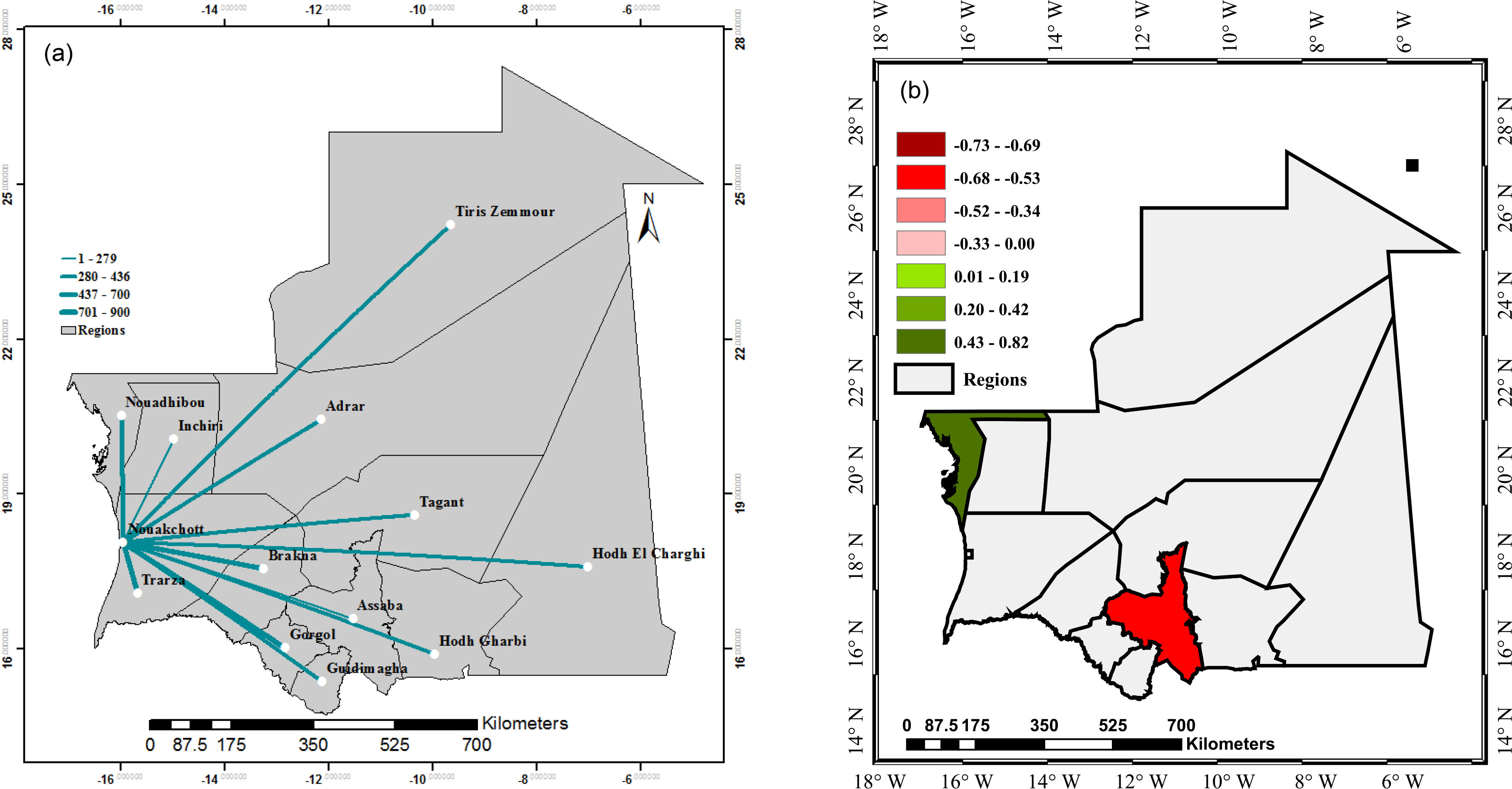
(left) Migration flows between Nouakchott and the rest of the regions during the period of 1972–1977. (right) Regional efficiency index for the same period. Only Nouakchott, Nouadhibou, Tiris-Zemour, and Guidimagha regions showed a positive efficiency index.
Interregional migration patterns
Table 1 illustrates the number of immigrants, emigrants, net migration, and efficiency index, out-migration index, and retention index for the periods 1972–1977 for the 13 regions in Mauritania. During this period, total internal migration represented 26.5% of the country’s total population. Results show that Nouakchott, the capital city of Mauritania, was the main destination for migrants during this time, with a high in-migration rate (59.6%) followed by Nouadhibou, the economic capital city, with an in-migration rate of 8.75%. Only the regions of Nouakchott, Nouadhibou, Tiris-Zemour (mining regions) in the north, and Guidimagha in the south, along the Senegal River, had a positive net migration, with an efficiency index of 0.82, 0.59, 0.42, and 0.13, respectively (Fig. 2a and b). We use the efficiency index at regional levels to map the migration for each period over the different regions. Many of the interregional migration flows were observed towards Nouakchott and the northern regions. This period is the most remarkable in terms of rainfall variability and change (Fig. 3). There was significant displacement from rural regions in the South of the country toward urban centers in the North and West, where the mining industries of Tiris-Zemour and Nouadhibou are located. Results show that four out of five interregional migrants moved toward the country’s economic centers, Tiris-Zemour, Nouadhibou and Nouakchott during this period.
Interregional migration of the period of 1977–1988. Most regions registered a negative net migration, particularly those in the south and southeast
Interregional migration of the period of 1977–1988. Most regions registered a negative net migration, particularly those in the south and southeast
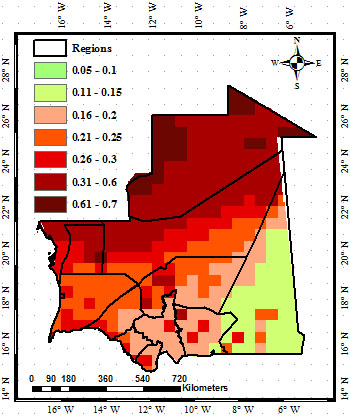
Coefficient of variation of rainfall from 1972–1977.
Climate conditions during this period were characterized by drier years in the late 1970s and from 1983–1984. During these periods, the annual rainfall declined dramatically and the country experienced high spatio-temporal variation (Fig. 1). The total internal migration between 1977 and 1988 reached 309,737 internal migrants, or 22.5% of the country’s total population. The distribution of migrants over the regions shows significant disparities. For instance, the economic centers in the country – Nouakchott, Nouadhibou, and Tiris Zemour – remained the largest migrant destinations, with high in-migration rates of 63.5%, 11.05, and 4.46%, respectively (see Table 2). The regions of Nouakchott and Nouadhibou received more than seven out of ten migrants. Results show that the main regions of origin during this period were Inchiri, Adrar, Tagant, Trarza, Brakna and Assaba. They also indicate that only four regions – Nouakchott, Nouadhibou, Tiris Zemour, and Guidimagha – had positive migratory balances, with differentiated degrees of attraction (Fig. 4).
Interregional migration of the period of 1988–2000. Most regions registered a negative net migration, particularly those in the south and southeast
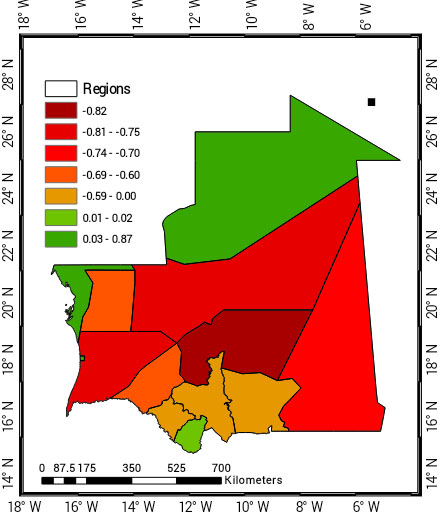
Regional efficiency index for the period of 1977–1978. Only Nouakchott, Nouadhibou, Tiris-Zemour showed a positive efficiency index due to economic opportunities as well as Guidimagha in the South, due to ecological conditions.
Overall flow of internal migration for the period 1988–2000 accounted for approximately 129,000 migrants. Table 3 illustrates the internal migration for the period of 1988–2000. The region of Nouakchott alone accounted for 44.4% of the national flow, and Nouadhibou received about 13.1% of migrations between 1988 and 2000. The northern regions of Inchiri, Adrar and Tiris Zemour received less than 7% of the interregional flow. The regions of Inchiri (0.6%), Adrar (4.3%) and Tiris Zemour (1.7%) were the least favored destinations for migrants during this period. Trarza in the West, Brakna, Guidimagha, and Gorgol received around 20% of emigrants, while the southeastern regions of Assaba, Tagant, Hodh El Charghi, and Gharbi received about 19% of the interregional flow.
The results confirm that only two regions, Nouadhibou and Nouakchott, registered a net positive balance, and to a lesser extent Adrar, experiencing a low positive balance
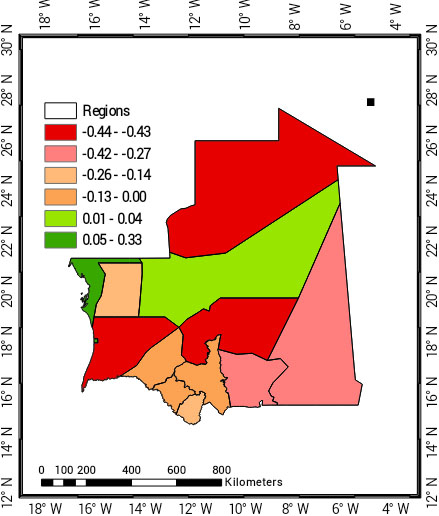
The regional efficiency index at regional levels of the period of 1988–2000. Adrar, Nouakchott, and Nouadhibou regions registered a positive migration balance compared to the remaining regions.
The census data collected in the three most recent censuses provides the base numbers of decennial internal migration flows. From 1988 to 2013 the internal migration flows more than doubled to 129.7%. This accounts for an increase of 208,039 migrants in 1988 to 477,814 in 2000. Despite an overall increase, migration rates slowed between 2000 and 2013, with only 702,575 individuals reporting migratory movements. Therefore, the total migration for 2000–2013 represented 17.5% of the total population.
Interregional migration situation during the period of 2000–2013
However, these results obscure significant disparities at the subnational level. Inchiri region experienced the highest emigration with an outmigration index of 53.9%. This signifies that more than one out of every two Inchiri natives was recorded as residing outside of the region in 2013. Adrar region ranked second, with an outmigration index of 43%, followed by Trarza (31.5%), Tagant (31.1%) and Tiris Zemour (30%).
Guidimagha, Nouakchott, and Hodh El Charghi showed lower emigration with outmigration indices of 7.6%, 8.6%, and 10.6%, respectively. These changes are explained by various factors, including the expansion of agro-pastoral activities in Guidimagha and Hodh El Charghi, as well as the available job opportunities and improved living conditions in Nouakchott, capital city.

Regional efficiency index at regional levels of the period 2000–2013.
Data for the regional net migration and efficiency index revealed an overall positive balance (excess migration balance) with a low efficiency index of approximately 0.1. However, the observed regional results reveal significant disparities (Fig. 6). Only four regions had positive migratory balances with differentiated degrees of attraction (see Table 4). Results depict that Tagant and Adrar regions constitute the two most affected regions, with respective efficiencies of
All thirteen regions in Mauritania recorded a significant increase in their urbanization rate during the drought years between 1977 and 1988, resulting from intraregional and interregional migration (Office National de la Statistique 1988). Urban growth, however, was more pronounced in the regions of Nouakchott, Nouadhibou, and Tiris-Zemour regions. The population of Nouakchott, for example, tripled to about 400,000 from 1977 to 1988 and rose a further 2.5 times to reach nearly 1 million in 2013. This represents growth rates of 10% between 1977 and 1988 and 5.5% between 2000 and 2013 (Office National de la Statistique, 2015). The rapid urban growth, with strong regional disparities, (from 15.4% in Hodh Gharbi to 95.5% in Nouadhibou in 2013) placed significant pressure on available infrastructure and services. This rapid growth caused multiple socio-economic and environmental problems, including the deterioration of housing conditions in large urban centers.
Considering the internal migration dynamics and changes in response to rainfall variability and change over the last four decades, Table 5 displays the results of the econometric estimations of the fixed effects and random effects models. We employed the regional retention index as the outcome variable because it reflects regional resilience, or a region’s capacity to deter its population from outmigration. The Hausman-Test value of 22.74, and its associated p-value of 0.004, negate the hypothesis that individual-level effects are adequately modeled by a random-effects model. Therefore, the fixed-effects model is the most appropriate specification.
Model results showing the different variables included in the regression analysis to explain the interregional migration during the last four decades (Robust standard errors in parentheses:
0.01,
0.05,
0.1)
Model results showing the different variables included in the regression analysis to explain the interregional migration during the last four decades (Robust standard errors in parentheses:
Econometric results of fixed effect models with climate variables included one by one. Robust standard errors in parentheses (
Model estimates with drought severity indicator. Robust standard errors in parentheses (
Critically, the fixed effects model estimation provides significant results for this study’s consideration. Notably, the model indicates that climate events, specifically rainfall variability and change over the last four decades, have strong correlations with internal migration in Mauritania. Primarily, the standardized precipitation index variable, which studies drought impacts on interregional migration, is positive and significant at 10%. This result indicates that an increase in rainfall levels appears to increase the regional retention capacity. Second, we find the interannual rainfall variation negatively correlated with the regional retention indices at a significance level of 5%. Specifically, increased rainfall variation at regional levels coincided with increased internal migration outflows. Similarly, calculation of the interannual directional change in rainfall (slope) negatively correlated with the regional retention index. This result signifies that a prolonged negative trend in rainfall decreases a region’s capacity to retain their populations. Correspondingly, several studies demonstrate that a decline in rainfall levels in Sub-Saharan countries has increased rural to urban migration [7, 16]. This signifies that changes in Mauritania’s rainfall patterns have likely contributed to observed high interregional migration and will likely persist in the future.
Regarding socioeconomic variables, it is found that the primary school enrollment ratio is significant and negative at 1%. This means that the increase in the regional primary school enrollment ratio over time has reduced retention capacity and contributed positively to net internal migration outflows. The negative relationship between the primary school enrollment ratio and the regional retention index can be explained by (1) the lack of access to livelihood opportunities and upper secondary education, which may motivate people to move to other regions to ensure continued education for their children; and (2) by the fact that educated individuals typically possess more skills that permit them to seek employment elsewhere, thus leading them to emigrate [27].
In contrast, the unemployment rate is found to have a significant and positive impact on the regional retention index, at the significance level of 1%. Essentially, regions with lower employment rates tend to resist the migratory impacts of changes in climate. Accordingly, the employment variable is a more appropriate proxy for prevailing economic conditions than the primary enrollment indicator.
Another critical migratory factor is the 1989–1991 Senegal-Mauritania conflict. The conflict increased the retention capacity in the concerned southern regions in Mauritania to 5%. Evidently, the 1989–1991 border conflict shocked the inhabitants of the southern regions, spurring the movement of inhabitants towards the neighboring countries to the south: Senegal and Mali. This mass migration rendered thousands of hectares of agricultural land without owners. This phenomenon eventually triggered a new generation of settlers in the Senegal River Valley.
To explicitly model the regional fixed effects, the analysis was expanded to estimate a Least Square Dummy Variable (LSDV) version of the model. This version produced estimates similar to the fixed effects model. As shown in Table 6, the estimated parameters for the LSDV model variables are identical to those of the fixed effects model. However, the standard errors differ slightly. With the Adrar region as a reference, it appears that Nouakchott, Guidimagha and Nouadhibou are the regions with sizeable specific effects that have critical roles in retention capacity.
Furthermore, the fixed effect model is estimated by individually adding climate variables. The results are displayed in Table 7. The overall R-squared of the model zero (0) indicates that our available socioeconomic variables are relevant; therefore, our previous assumption holds. The robustness of climate effects are confirmed, as the coefficient signs remain unchanged despite slight changes in the magnitudes of the climate variable coefficients. Finally, relying on overall R-squared, the model with the full set of climate variables appears optimal.
Ultimately, to verify the robustness of the calculated impacts of drought, the model estimated the full set of climate variables by replacing the proportion of drought years with an indicator of drought intensity. Furthermore, the index of drought intensity was calculated for each of the five periods. The weighted average of the mean values of the Standardized Precipitation Index were classified as mild drought, moderate drought, severe drought, and extreme drought in each period. The weights are for proportions of varying drought degrees during the total experienced drought within each period. The results are displayed in Table 7. However, this new variable appears insignificant.
In this paper, we analyzed Mauritania’s internal migration dynamics and trends in response to rainfall variability and change over the last 40 years using descriptive and econometric approaches. We used several measures to evaluate internal migration from 1972 to 2013. These measures included immigration, emigration, net migration, efficiency, outmigration, and retention indices, at regional levels for four different periods - 1972–1977, 1977–1988, 1988–2000, and 2000–2013. We produced further analyses on the regional migration balance to understand regional migration direction and flow during each period. Furthermore, we used regional efficiency, outmigration, and retention indices to capture the degree of regional migration attraction.
The study confirms that internal migration rates have continued to increase over the past four decades. Notably, in 2013, total internal migration reached 702,575 individuals, comprising 17.5% of the total population compared with 477,814 (17.63% of total population) in 2000 and 208,039 individuals (10.8% of total population) in 1988. The sustained trend in total migration is partially the result of three factors, the persistent difficult living conditions, constrained national economic activities, and continuous impacts of climate variability and change. Sub-nationally, it was found that the southern and southeastern regions experienced the highest rates of emigration due to impacts of climate and environmental change. The study shows that the regions of Nouakchott, Nouadhibou, and Tiris Zemour experienced negligible emigration due to various factors, including the development of mining activities in Tiris Zemour and fishing activities in Nouadhibou. Additionally, favorable living conditions and increased economic opportunities were reported in Nouakchott.
In conclusion, our results, particularly the econometric findings, suggest that severe and persistent climate variability and change have contributed to sustained increases in Mauritania’s internal migration over the last four decades, especially for rural-urban migration. From 1977–1988, all thirteen regions recorded significantly increased urbanization rates. This increased period of intraregional and interregional migration is during distinctly severe droughts. This rapid urban growth has placed significant pressure on available infrastructure and services, causing multiple socio-economic and environmental issues, including housing conditions concerns in large urban centers. The climate dynamics are poised to continue to cause unfavorable socio-economic and environmental conditions for Mauritania’s rural inhabitants, only exacerbating current migration trends and patterns.