







Abstract
A smart electrocardiogram (ECG) garment system was designed for continuous, non-invasive and comfortable ECG monitoring, which mainly consists of four components: Conductive textile electrode, garment, flexible printed circuit board (FPCB)-based ECG processing module and android application program. Conductive textile electrode and FPCB-based ECG processing module (6.8 g, 55 mm
Keywords
The designed smart ECG garment system. (a) System architecture, (b) and (c) structure and exterior of the conductive textile electrode, (d) FPCB-based ECG processing module under bent state and (e) this module with standard snap fasteners.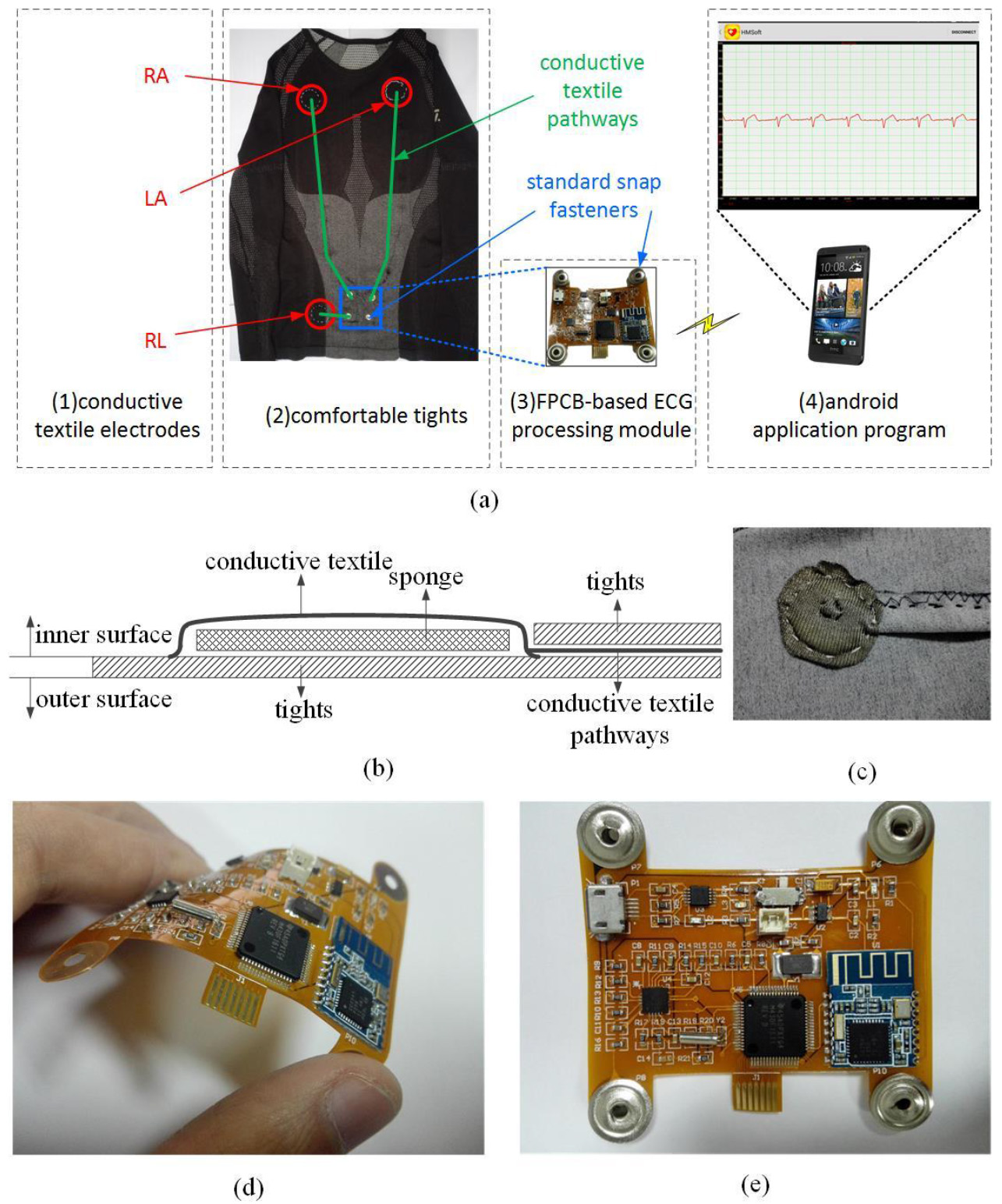
Intermittent cardiovascular diseases urge a long-term and convenient ECG monitoring system in daily life. As a novel approach to monitor the cardiovascular conditions of patients, body sensor network (BSN)-based wearable ECG can prevent the potential risk, and help patients on improving their life quality [1]. Currently, a noticeable effort is focused on developing technologies to extend the capabilities of wearable ECG systems [2, 3, 4]. A T-shirt integrated with two rectangle conductive textile electrodes was designed for ECG measurement in subjects’ supine position as reported in [3]. Although the electrodes could provide comfortable measurement, this system was only tested in stationary environment, which restricts its daily application. ‘Sensing shirt’ using conventional Ag/AgCl electrodes to obtain high-quality ECG signals was reported in [4]. However, the Ag/AgCl electrodes cannot meet the requirement of long-term wearable monitoring. In short, there are still many aspects need to be further explored to meet the requirements for BSN-based wearable ECG monitoring scenario. Particularly, a wearable, comfort, flexibility, smart ECG garment system is highly required.
In this study, we addressed this requirement and designed a smart ECG garment system, with two new aspects of conductive textile electrodes and flexible printed circuit board (FPCB)-based ECG processing module. Experiments were also designed to determine the optimal parameters for the textile electrode design, and to verify the effectiveness of the proposed system.
Methodology
System description
Figure 1 shows the architecture of the proposed smart ECG garment system, which consists of four components: (1) three conductive textile electrodes for sensing, (2) a garment as the carrier of the electrodes for signal pathways, (3) a FPCB-based ECG processing module for signal processing, and (4) an android program for storage, display and analysis.
Skin-electrode impedance test on conductive textile electrode. (a) Method principle for measuring the skin-electrode impedance, (b) locations of the electrodes, (c) curves of the skin-electrode impedance when using the electrodes with different sizes and (d) ECG signals measured from the conductive textile electrodes with different sponge thickness.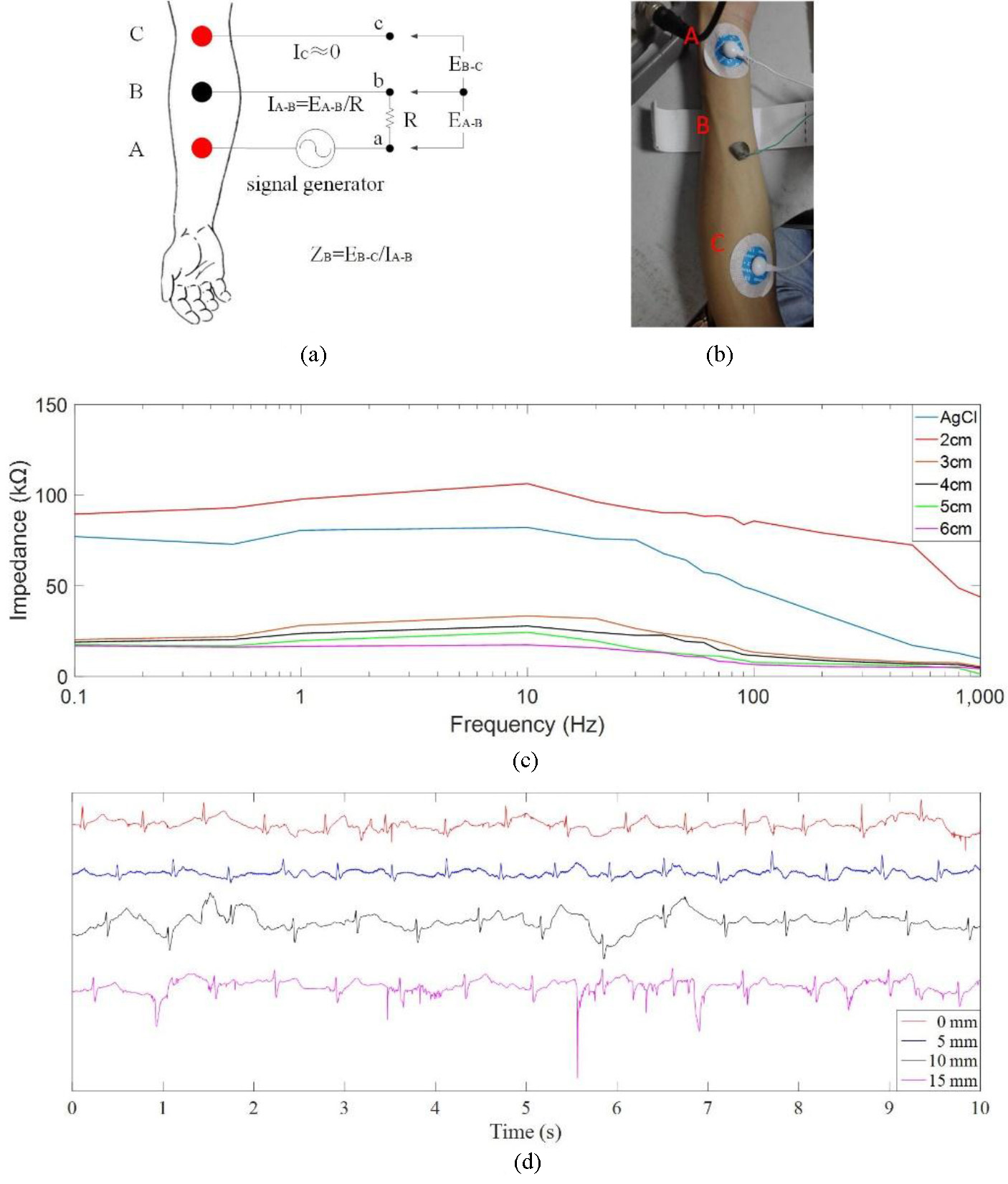
To meet the comfort requirement, conductive textile was used to fabricate the ECG electrode. The electrode was designed as circle in shape referring to the traditional Ag/AgCl electrodes and convex structure by sponge as filler to ensure the well contact between electrodes and curved surface of the body (see Figs 1(b) and (c)).
Smart garment
See Fig. 1(a), the right arm (RA) and left arm (LA) electrodes were located between the chest and clavicles, departure as a 10 cm, to ensure a sufficient potential difference. The right leg (RL) electrode was knitted on the abdomen. Standard snap fasteners were equipped to make it easy for the user to plug and play.
FPCB-based ECG processing module
FPCB technology [5] was chosen as the manufacture method for processing module. The module includes a single-lead ECG monitor chip AD8232 (frequency band
Android application program
The main functions of the Android application program were: Communicating with the FPCB-based ECG processing module, extracting the ECG data, real-time displaying the ECG waveform and storing the ECG data. The development of android application was based on the multithreading mechanism, as the data extraction was performed in a child thread, while the data displaying and storing was conducted in the main thread by Android drawing tool library (AChartEngine) and methods of File class respectively.
Experiments and results
Test on conductive textile electrode
Experimental principle
Considering the signal amplitude in low frequency will sharply drop while the size of the electrode minimizes to less than 1 cm
Effect of electrode size on skin-electrode impedance
Figure 2(c) shows the results of the skin-electrode impedance measurement when using the conductive textile electrodes with different sizes, as well as with the result comparison from the standard Ag/AgCl electrode. From Fig. 2(c), it can be seen that the change trends of the skin-electrode impedance were similar for the conductive textile electrodes and the standard Ag/AgCl electrode as the frequency changed from 0.1 to 1 kHz. The skin-electrode impedance had a slight increase during the range of 0.1 to 10 Hz, and then it decreased sharply after 10 Hz.
The skin-electrode impedance from the conductive textile electrode with 2 cm diameter was larger than that from the Ag/AgCl electrode whereas the conductive textile electrodes with other sizes had lower skin-electrode impedance values. It is because the effective contact area between the conductive textile electrode with 2 cm diameter and the skin is less than that of the Ag/AgCl electrode, and vice versa. Meanwhile, in the ECG bandwidth (0.1 to 100 Hz), the skin-electrode impedance of the conductive textile electrodes with a diameter larger than 2 cm varied from 10 to 30 k
The results of tests on conductive textile electrode confirmed that the conductive textile electrodes with a 40 mm diameter, and 5 mm thickness sponge perform better in the long-term ECG monitoring application.
ECG measurements under four physical situations: (a) standing, (b) sitting, (c) lying in supine position, (d) walking at 5 km/h and (e) recorded ECG signals under the four physical situations.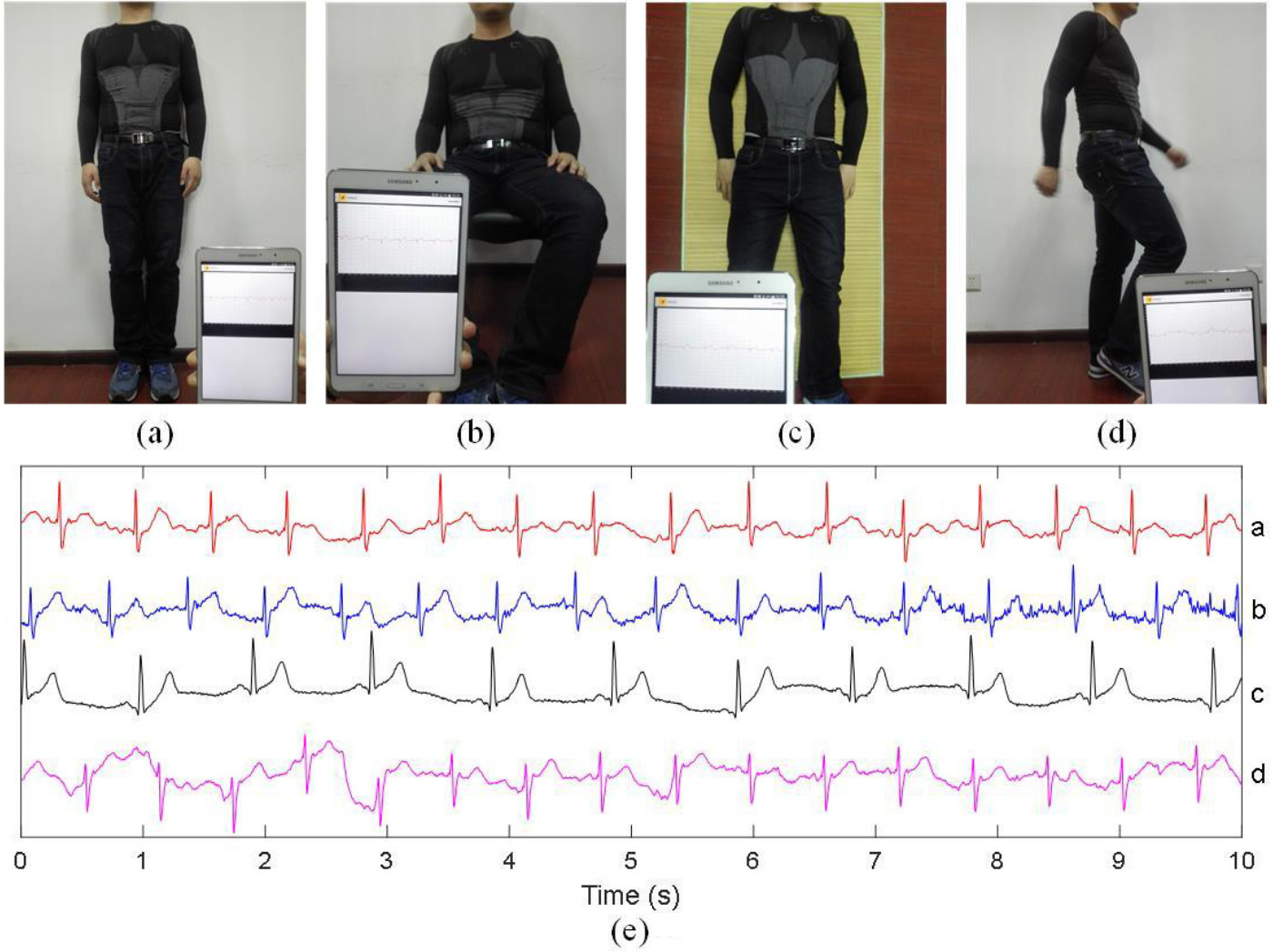
To identify the relationship between the filled sponge thickness and the signal quality, textile electrodes with 0, 5, 10, and 15 mm sponges were chosen in the experiments. And the test subject was walking at 5 km/h.
Figure 2(d) shows the measured ECG signals at the setting of four types of the sponge thickness filled in the electrodes. Movement artifacts existed in each detected ECG signals. However, ECG signal had best signal quality when using 5 mm sponge. In addition, the P wave, QRS complexes and T wave were still well recognizable with the 5 mm sponge. It was clear that the movement artifacts were significant when using 10 mm and 15 mm sponges. The reason is that these sponges were too thick, resulting in an arc-shaped contact between the electrodes and the skin. To obtain ECGs with good signal quality, the conductive textile electrode with 5 mm sponge was chosen in this study.
Test on the whole system
As shown in Figs 3(a)
Discussion and conclusion
A smart ECG garment system was proposed in this study, with two key contributions: The conductive textile electrodes and the FPCB-based ECG processing module.
Considering the sufficient contact between the skin and the electrode, the conductive textile electrode with a 40 mm diameter was adopted. The diameter effect on the skin-electrode impedance was similar to the newly reported carbon nanotube/polydimethylsiloxane composite-based dry ECG electrode [2]. However, the textile electrodes in this study were easier to use, and were comparable with the Ag/AgCl electrodes. Moreover, a thickness of 5 mm sponge was chosen for the electrodes, which was confirmed to be less sensitive to movement artifacts and noises than other choices (0, 10 or 15 mm thickness). The convex structure and the tensile property provided a better contact between the electrodes and skin during daily activities.
The introduction of FPCB technology for ECG processing module advanced the flexibility of the whole system, and diversified the style, shape, and mechanical structure of the processing module, which provided the new possible applications in sports, ergonomics, and monitoring operators with curved surface. Unlike those systems with obstructive DAQU [4, 9], the FPCB-based ECG processing module was lightweight and user-friendly, indicating the system was non-invasive and comfortable.
In summary, this study showed that the designed smart ECG garment system with the integration of these two key components, enables the possibility of recording ECG signals in daily life. The testing results verified its superiority in continuous, non-invasive, comfortable and ambulatory ECG monitoring application.
Conflict of interest
The authors declare no conflict of interest.
Footnotes
Acknowledgments
The project was partly supported by the National Natural Science Foundation of China (Grant Number: 61571113 and Grant Number: 61601124), the National Major Scientific Equipment R&D Project (Grant Number: ZDYZ2010-2) the Natural Science Foundation of Jiangsu Province of China (Grant Number: BK20160697) and Research project of Fujian University of technology (Grant Number: GY-Z160058).