







Abstract
BACKGROUND:
Macrophages commonly exist in two distinct subsets in different microenvironments: classically activated macrophages (M1) and alternatively activated macrophages (M2). The imbalance of M1-M2 macrophage polarization is often related to various diseases or inflammatory states.
OBJECTIVE:
The purpose of this study was to determine whether there is an imbalance in the expression of M1 and M2 macrophage-related cytokines in severe chronic periodontitis.
METHODS:
A total of 30 clinical specimens, including severe chronic periodontitis tissues (
RESULTS:
The mRNA and protein expression levels of M1 macrophage-related cytokines (iNOS and STAT1) and M2 macrophage-related cytokines (Arg-1 and STAT6) were significantly increased in severe chronic periodontitis patients. In addition, the ratios of iNOS/Arg-1 and STAT1/STAT6 in the severe chronic periodontitis group were also significantly increased (
CONCLUSION:
The imbalance of M1/M2 macrophages exists in the pathogenesis of severe chronic periodontitis, and has a tendency towards M1 polarization. Therefore, maintaining the immune balance of M1/M2 macrophages may be a novel therapeutic alternative for the management of severe chronic periodontitis.
Introduction
Periodontitis is one of the most common health problems in the world. It is an inflammatory disease involving gums, cementum, periodontal ligament and alveolar bone. There is growing evidence of the association between periodontitis and systemic diseases, including cardiovascular disease, diabetes mellitus and insulin resistance, colorectal cancer, Alzheimer’s disease, respiratory infections and so on [1]. The occurrence and development of periodontitis are related to a variety of etiology and risk factors such as local microflora and host immune response [2]. Cytokines play an extremely important role in the development of periodontitis, which are also key regulators of dynamic balance and inflammatory processes. They are involved in the first wave of responses to pathogens and stimuli at the barrier site which recruit lymphocytes and helper T cell populations and translocate them into the tissues [3].
Macrophages exhibit a variety of functions in the host, including phagocytosis of foreign substances, innate immune response, antigen presentation of T cells, and secretion of inflammatory and anti-inflammatory mediators. They also assist in tissue stabilization by clearing necrotic and apoptotic cells. According to their phenotypes and cytokine secretion, macrophages can be divided into two polarized types: classically activated macrophages (M1) and alternatively activated macrophages (M2) [4]. M1 macrophages arise as a result of classical activation by stimulating TLR receptors through appropriate ligands such as bacterial lipopolysaccharide (LPS) and some cytokines (INF-
The immune imbalance of M1/M2 macrophages is one of the important markers for the pathogenesis of many inflammatory diseases, such as infection, obesity and cancer [11]. Therefore, we hypothesize that the imbalance of M1/M2 macrophage-related cytokines exists in severe chronic periodontitis, and participates in the inflammation progression and periodontal breakdown. In the present study, we analyzed the immune balance between M1 and M2 macrophages by evaluating the mRNA and protein expression levels of M1 and M2 macrophage-related cytokines in patients with severe chronic periodontitis.
Materials and methods
Sample collection and processing
The present study recruited patients visiting the Department of Oral and Maxillofacial Surgery, Second Affiliated Hospital, Jinzhou Medical University, China. All subjects were divided into the following two groups: severe chronic periodontitis group and healthy control group. The periodontal tissues of patients with severe periodontitis were detected with bleeding on probing, periodontal pocket depth
The exclusion criteria were as follows: (i) patients had received periodontal therapy during the 6 preceding months; (ii) patients with systemic diseases; and (iii) those who had had antibiotic treatment in the past six months. This study was approved by the Ethics Committee of the Second Affiliated Hospital, Jinzhou Medical University, China. All participants signed an informed consent form.
RNA extraction and reverse transcription polymerase chain reaction (RT-PCR)
Total RNA was extracted from periodontal tissues using the TRIzol (Ambion, Austin, USA) reagent according to the manufacturer’s instructions. The quality and quantity of RNA were measured using a spectrophotometer. The absorbance was measured at 260 nm and 280 nm, and the optical density (OD) ratio at 260/280 nm ranged between 2.0 and 2.2. The RNA samples were frozen in
Primer sequences used for real-time RT-PCR.
Western blot analysis
Periodontal tissues were lysed in radioimmunoprecipitation assay (RIPA) lysis buffer containing a protease inhibitor cocktail, and the obtained lysates were incubated on ice for 30 minutes. After total protein quantification with bicinchoninic acid (BCA) assay (Dingguo Prosperous, Beijing, China), sodium dodecyl sulphate – polyacrylamide electrophoresis (SDS-PAGE) was performed using 10% polyacrylamide gels (20
Statistical analysis
Statistical analyses were performed with SPSS software version 22.0. All data were expressed as mean
Results
Real time-PCR analysis
The mRNA expression levels of M1 macrophage-related cytokines (STAT1 and iNOS) and M2 macrophage-related cytokines (STAT6 and Arg-1) were compared between the healthy control and severe chronic periodontitis groups. The mRNA expression levels of M1 macrophage-related cytokines (STAT1 and iNOS), and M2 macrophage-related cytokines (STAT6 and Arg-1) in severe chronic periodontitis group were significantly increased compared to those in healthy control group (
The mRNA expression of M1 and M2 macrophage-related cytokines (
)
The mRNA expression of M1 and M2 macrophage-related cytokines (
Note: ** compared with the control group, the difference was statistically significant,
Electropherogram of the mRNA expression levels in severe chronic periodontitis.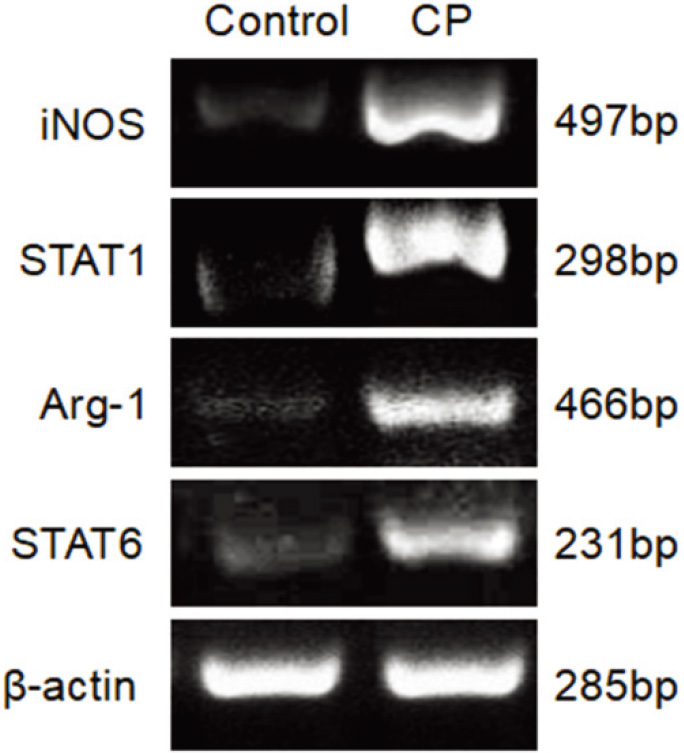
The protein expression levels of M1 and M2 macrophage-related cytokines were compared between the two groups. The protein expression levels of iNOS, Arg-1, STAT1 and STAT6 in severe chronic periodontitis group were significantly increased compared to those in healthy control group (
The protein expression levels of M1 and M2 macrophage-related cytokines (
)
The protein expression levels of M1 and M2 macrophage-related cytokines (
Note: ** compared with the healthy control group, the difference was statistically significant,
Electropherogram of the protein expression levels in severe chronic periodontitis.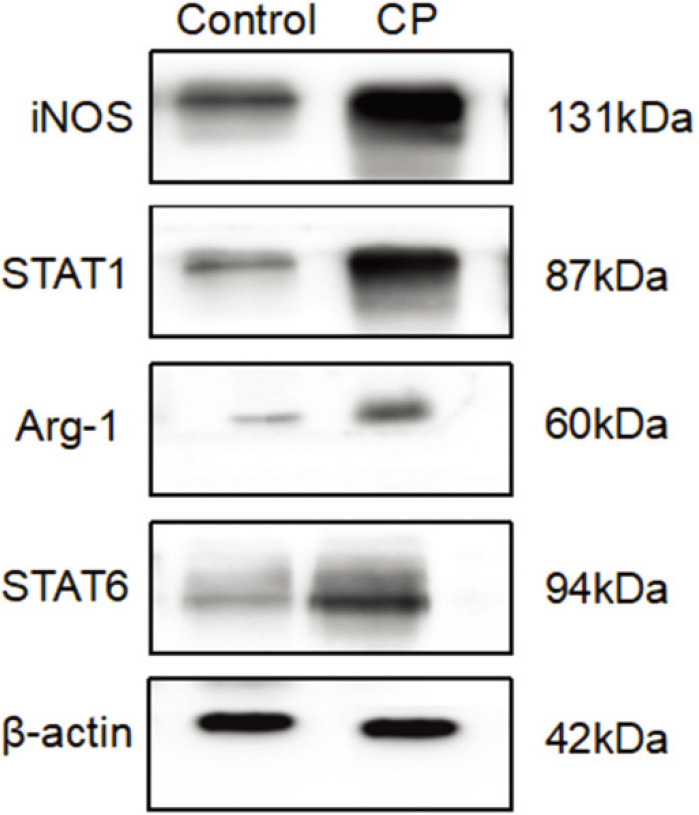
Periodontitis is a disease associated with the host immune response caused by Gram-negative bacteria, which affects much of the world’s population. The interaction between bacteria and their hosts can trigger the immune mechanism leading to periodontal tissue damage [13]. Severe chronic periodontitis is the main cause of tooth loss in adults. The local production of inflammatory mediators and the accumulation of these mediators are one of the mechanisms responsible for bone loss [14]. In the present study, RT-PCR and Western blot methods were used to detect the mRNA and protein expression of M1 macrophageassociated cytokines (iNOS and STAT1) and M2 macrophageassociated cytokines (Arg-1 and STAT6) in healthy control and severe chronic periodontitis groups. It was found that the M1 and M2 phenotypes are enhanced in periodontitis, as revealed by the increased expression of iNOS, STAT1 Arg-1 and STAT6 in the periodontium and the enhanced ratios of iNOS/Arg-1 to STAT1/STAT6 These results indicate that the imbalance of M1/M2 is closely related to the pathogenesis of periodontitis.
Macrophages are important members of innate immunity, which play an extremely important role in the occurrence and development of body defense against pathogenic microbial infection, tumor, allergic diseases, metabolic diseases, tissue damage repair and so on. Under the influence of microenvironment, especially different types of cytokines, macrophages can be polarized into M1/M2 macrophages [15]. It has been found that periodontitis is related to the enhancement of M1 and M2 macrophage phenotypes, in which the phenotypic transition from M2 to M1 may be an important mechanism for mediating periodontal tissue injury, including alveolar bone loss. It is suggested that M1 polarization may be the key mechanism to promote the development of periodontal inflammation [16]. Previous studies analyzed the M1/M2related cytokines in soft tissue biopsies from patients with periodontitis using the immunohistochemistry, qRT-PCR, and/or ELISA methods [17, 18]. However, the examined factors in these studies were single aspect without the involvement of mRNA and protein levels. It is known that the cytokines may be subjected to certain factors during the process from mRNA transcription to protein translation [19]. In this study, RT-PCR and Western blot analyses were used to analyze the mRNA and protein expression levels of M1 markers (iNOS and STAT1) and M2 markers (Arg1 and STAT6), respectively. The mRNA levels of these genes were relatively consistent with their protein expression levels, supporting the imbalance of M1/M2 macrophages in severe chronic periodontitis.
Therefore, it is very important to identify the molecular mechanisms related to the dynamic changes in macrophage polarization and to understand their interactions in order to predict the progression of periodontal disease and design new macrophage-mediated therapeutic strategies [20]. STAT protein also plays an important role in maintaining the dynamic balance of the immune system [21]. The binding of IFN-
In this study, the expression of M2 macrophageassociated cytokines (Arg-1 and STAT6) in severe chronic periodontitis was higher than that in healthy control group. M2 macrophages are characterized by their ability to inhibit the cytotoxicity and inflammatory function of M1 macrophages, as well as angiogenesis, anti-inflammation, tissue repair and remodeling and fibrosis [26]. The subjects of this study are patients with severe chronic periodontitis, which shows that there is periodontal tissue repair in the middle and late stage of periodontitis, but there are still symptoms of tooth loosening and periodontal abscess. The reason may be that the anti-inflammatory cytokines secreted by M2 macrophages are not enough to compete with the pro-inflammatory cytokines secreted by M1 macrophages.
The dominant activation of NF-
In the control of chronic pathological processes mediated by macrophages, the purpose of current treatment is to inhibit the biological activity of cytokines and metabolites produced by macrophages [29]. Azithromycin can down-regulate the expression of NF-
Conclusion
Periodontal inflammation is associated with an enhancement of both M1 and M2 macrophage phenotypes, in which an imbalance in the expression of M1 and M2 macrophagerelated cytokines might be a critical mechanism in mediating periodontal tissue damage. Hence, targeting the imbalance of macrophage populations may offer a promising therapeutic option for severe chronic periodontitis.
Footnotes
Acknowledgments
This work was supported by the National Natural Science Foundation of China (Grant no. 81600870).
Conflict of interest
The authors declare that they have no conflict of interest.